Showing posts with label Farragut. Show all posts

Sunday, October 5, 2014

Farragut 'Touched by Fire'

by Bill Doughty
Admiral David G. Farragut (art by Antonio Verceluz)

Strong Confederate forts. Batteries of guns. Torpedo mines. The iron-clad "ram" CSS Tennessee. All these and more faced the Union Navy led by Adm. David Glasgow Farragut in Mobile Bay in August 1864, 150 years ago this past summer.

The intrepid hero of New Orleans/Mississippi sailed his wooden ships within range of the forts, as described by Farragut contemporary First Lieutenant John Coddington Kinney:
"The central figure was the grand old admiral, his plans all completed, affable with all, evidently not thinking of failure s among the possibilities of the morrow, and filling every one with his enthusiasm. He was sixty-three years old, of medium height, stoutly built, with a finely proportioned head and smoothly shaven face, with an expression combining overflowing kindliness with iron will and invincible determination, and with eyes that in repose were full of sweetness and light, but, in emergency, could flash fire and fury."
Kinney's is one of dozens of first person accounts and memoirs originally published in 1881 by "The Century" magazine and now part of a terrific compilation from 2011, "Hearts Touched By Fire: The Best of Battles and Leaders of the Civil War," edited by Harold Holzer. The book is divided into five parts, each for a year from 1881 through 1885.

In the introduction to "1864," historian Joan Waugh sets the stage:
"Two Federal naval victories in 1864 mitigated the disappointment of the seemingly endless ground campaigns. On June 19 the war sloop USS Kearsarge defeated the famed Rebel raider CSS Alabama off the coast of France in the Battle of Cherbourg. Writing for Battles and Leaders, the Union ship's surgeon, John M. Browne, recounted the war of wits ..."The second Union naval success carried an even greater lift for Northers at a critical time. On August 5, Admiral David G. Farragut seized control of Mobile Bay in Alabama, bringing an end to Confederate shipbuilding in that city and disabling the port's ability to offer a friendly harbor for Southern ships avoiding the Union blockade ... Farragut's triumph closed the last remaining major Confederate port on the Gulf of Mexico and boosted Lincoln's prospects for a fall victory."
Navy Reads contributor Craig Symonds does a masterful introduction for "1861" helping foreshadow the "horrible slaughter and wholesale destruction that would follow" the early months of the war.


The story of how the first compilation came to be published by "The Century" in 1881 involves some intriguing negotiation with President U.S. Grant after the Civil War. The editors ensured we get an accurate portrayal told in real and vibrant prose, not just dry war plans and reports. Illustrations from the time – paintings and etchings from both the Union and Confederacy perspective – are included.

In "Farragut at Mobile Bay" Kinney describes the fire and smoke of battle where "every minute seemed a second." Admiral Farragut climbed the rigging to get better command and control. He damned the torpedoes, faced and ordered broadsides and took his wooden ships into close battle with the enemy. We can almost hear and feel the wooden Hulls scraping and crashing against the iron-clad Tennessee that had been "strengthened by an artificial prow."

Kinney writes of a brief lull in the action:
"The thunder of heavy artillery now ceased. The crews of the various vessels had begun to efface the marks of the terrible contest by washing the decks and clearing up the splinters. The cooks were preparing breakfast, the surgeons were busily engaged in making amputations and binding arteries, and under canvas, on the port side of each vessel, lay the ghastly line of dead waiting the sailor's burial. As if by mutual understanding, officers who were relieved from immediate duty gathered in the ward-rooms to ascertain who of their mates were missing, and the reaction from such a season of tense nerves and excitement was just setting in when the hurried call to quarters came and the word passed around, 'the ram is coming.'"
Kinney takes us back into the intense fighting as Farragut and his fleet focused on what was thought to be the strongest vessel afloat, "virtually invulnerable." 

"The Tennessee now became the target for the whole fleet, all the vessels of which were making toward her, pounding her with shot, and trying to run her down," he writes. Lashed to the rigging, Farragut directed the battle as his sailors and marines continued the attack, with side-by-side bombardments and fearless full-speed attacks and cannon barrages leading to the enemy's surrender and a Union victory.

"Hearts Touched by Fire" is a fascinating you-are-there set of memories from the soldiers, sailors, leaders and citizens affected by that pivotal war that ended slavery and kept the states united.

(See the Navy Reads post about the Adm. Farragut, the U.S. Navy's first Hispanic admiral, from 2011, "Damn the Torpedoes." Hispanic heritage is celebrated in the United States from Sept. 15 to Oct. 15. The Navy Birthday is Oct. 13, 1775.)

Saturday, September 20, 2014

Thomas Jefferson Calls for Submarines

by Bill Doughty
The third president of the United States was the first to expand into the American West, combat religious fundamentalism and terrorists abroad, and think about the future of naval warfare: using submarines and surface ships to provide defense of the States and forward-deploying forces for maritime security. He foresaw peace through global commerce between nations – globalization.

In "Thomas Jefferson: The Art of Power" Jon Meacham explores the complicated way Jefferson combined pure reason with muddy politics as Governor of Virginia, congressman, Secretary of State, President, diplomat in France, and as statesman and philosopher, always trying to achieve "the Founders' dream of a nation beyond partisanship."
Battle of Tripoli Harbor, Aug. 3, 1804
Facing bitter opposition, Jefferson called for naval power against a Muslim caliphate in the Barbary states (Morocco, Algiers, Tunis and Tripoli). Barbary pirates had harassed and kidnapped merchants and captured an American ship. Rather than paying ransom, Jefferson, in a letter to James Monroe, suggested a reasoned approach with hard consequences.

Jefferson wrote, "Would it not be better to offer them an equal treaty? If they refuse, why not go to war with them? ... We ought to begin a naval power, if we mean to carry on our own commerce. Can we begin it on a more honorable occasion or with a weaker foe?"
According to Meacham:
"On Saturday, August 1, 1801, Andrew Sterett of the Enterprize (Enterprise), who was serving under [Commodore Richard] Dale, defeated the Tripolitan vessel Tripoli near Malta. 'Too long ... have those barbarians been suffered to trample on the sacred faith of treaties, on the rights and laws of human nature,' Jefferson told Sterett. 'You have shown your countrymen that that enemy cannot meet bravery and skill united.'"
Meacham judges Jefferson as "more of a chess player than a traditional warrior."

"The Art of Power" is carefully researched and backed up with good source material on both sides of the Atlantic, including unpublished papers. Unfortunately there's not much more discussion about Jefferson's complicated views about developing a Navy. Meacham piques our interest in other writings by Jefferson. 
In a letter published in a collection by the Library of America, "Writings: Autobiography, Notes on the State of Virginia, Public and Private Papers, Addresses, Letters," and written in 1807, President Jefferson communicates his views about naval strategy with Robert Fulton, inventor of the steam engine. Jefferson discusses use and limitations of torpedoes (mines), which would be used extensively a few years later in the War of 1812, and half a century later in the Civil War by Cmdre. David Farragut in the Battle of New Orleans.

In his letter to Fulton, Jefferson calls for more commitment to developing and employing submarines. And he floats the idea of creating a corps of submariners.
"I consider your torpedoes as very valuable means of defence of harbors, & have no doubt that we should adopt them to a considerable degree. Not that I go the whole length (as I believe you do) of considering them as solely to be relied on ... But I have ever looked to the submarine boat as most to be depended on for attaching them [torpedoes], & tho' I see no mention of it in your letter, or your publications, I am in hopes it is not abandoned as impracticable. I should wish to see a corps of young men trained to this service. It would belong to the engineers if at land, but being nautical, I suppose we must have a corps of naval engineers, to practise & use them. I do not know whether we have authority to put any part of our existing naval establishment in a course of training, but it shall be the subject of a consultation with the Secretary of the Navy. Genl Dearborne has informed you of the urgency of our want of you at N Orleans for the locks there. I salute you with great respect & esteem."
Jefferson's views of the Navy seem to have evolved over time. Earlier writings in the 1780s questioned the need for a naval force to compete with European powers. (Eventually, though, especially in response to the Barbary threats, Jefferson understood the need for a strong means to back up peaceful intentions.)

In Query XXII of his "Notes on the State of Virginia" written in 1781-1782, Jefferson offers predictions that have been realized centuries later after wars against Britain, Japan and Germany – cooperative interaction with other nations:
"It should be our endeavour to cultivate the peace and friendship of every nation, even of that which has injured us most, when we shall have carried our point against her. Our interest will be to throw open the doors of commerce, and to knock off all its shackles, giving perfect freedom to all persons for the vent of whatever they may chuse to bring into our ports, and asking the same in theirs."
Jefferson's own words, found in separate collections, help expand revelations in Meacham's biography, which in words and impressive artwork shows many of the key people in Jefferson's life.
Jon Meacham
Meacham's work is personalizing. It focuses on many of Jefferson's relationships, including  with John Adams, Aaron Burr, George Washington, Alexander Hamilton, Sarah "Sally" Hemings, Thomas Paine and Patsy Jefferson Randolph. Meacham writes about Jefferson's friendships, loves and rivalries. Unlike other Founders, Thomas Jefferson did not succumb to bitterness. He took on a recalcitrant Congress and achieved his strategic goals.

The dustcover of Meacham's book proclaims:
"The father of the ideal of individual liberty, of the Louisiana Purchase, of the Lewis and Clark expedition, and the settling of the West, Jefferson recognized that the genius of humanity – and the genius of the new nation – lay in the possibility of progress, of discovering the undiscovered and seeking the unknown. From the Declaration of Independence to elegant dinners in Paris; from politics in Philadelphia and New York to the capital on the Potomac; from his complicated life at Monticello, his breathtaking house and plantation in Virginia, to the creation of the University of Virginia, Jefferson was central to the age."
Jefferson's passion and courage gave us the Declaration of Independence, Constitution and Bill of Rights. Some could say Jefferson's foresight and commitment to progressive development gave us the birth of maritime strategy. And one could even say his expansion of the American West – eventually through Colorado to Washington State – led directly to this weekend's NFL rematch between Peyton Manning of Denver and Russell Wilson of Seattle.

Saturday, December 29, 2012

War on the Waters – How the Navy Saved the Nation

by Bill Doughty

When the USS Monitor was lost in a storm Dec. 31, 1862, exactly 150 years ago, the future of the nation hung in the balance.

In his insightful new book, “War on the Waters,” James M. McPherson shows how Union naval leaders, technology and strategies combined to overcome setbacks and losses to the Confederacy – and eventually win the war.

Civil War SECNAV Gideon Welles
“To say that the Union navy won the Civil War would state the case much too strongly.  But it is accurate to say that the war could not have been won without the contributions of the navy,” concludes McPherson.

The Pulitzer Prize winning author writes about the wisdom of Secretary of the Navy Gideon Welles, the courage of Rear Adm. David Glasgow Farragut and the power of working jointly.  General Ulysses S. Grant worked hand-in-hand with Rear Adm. David D. Porter, the son and namesake of the War of 1812 hero.

Rear Adm. David D. Porter
We also meet Cmdr. John Rodgers (another son and namesake of a War of 1812 Captain) and Cmdr. George H. Preble (grandson of one of the Navy’s greatest leaders, Capt. Edward Preble).  The ties to the War of 1812 – in people, foreign alliances and brown-water naval tactics – are enlightening.

President Lincoln ordered the Army to provide its fleet of vessels to the Navy but promoted the idea of one-two punches by the Navy and Army from river ports to river forts. McPherson describes the fearless leadership of 19-year-old ship driver Colonel Charles Rivers Ellet.

Quoting letters, diary entries, first-person reports and dispatches, the author presents a broad history of naval warfare on both sides of the Civil War.  He describes “asymmetrical war on the waters” in blockades and blockade running, riverbank guerrilla warfare, subterfuge at sea, and night attacks, and he follows the development of ironclad ships, submersible vessels and mines (torpedoes).

Civil War gunship USS Commodore Perry.
The Civil War saw the watershed shift from wooden ships of previous centuries that would lead to the development of battleships by the end of the century.  Innovation would continue.  Less than 50 years after end of the Civil War the era of naval aviation would begin.

Well-worn strategies of blockading commerce and targeting blockade runners would be expanded into the next century.  A naval embargo against Imperial Japan in 1941 led to the beginning of the War in the Pacific.

Against the Confederacy in the 1860s, blockades were important in preventing the exporting of cotton and importing of salt.  The role of salt in the southern economy and the targeting of salt production in the south by the Union Navy are fascinating side notes showing the importance of a healthy economy to a strong military.

McPherson describes the overall sociological effect of naval strategies on people in the north and south, too.

“Modern historical scholarship has shown how the Union army became a powerful force in the liberation of slaves, and how the 180,000 liberated black Union soldiers (most of them liberated slaves) in turn helped the Union army win the war.  Less well known is the role of the Navy in freeing slaves and the vital contribution of black sailors to the navy’s campaigns.  In 1861-1862 the Navy penetrated earlier and more deeply than the army into tidewater regions of the South Atlantic coast and into the valleys of the lower Mississippi River and its tributaries...”

“War on the Waters: The Union & Confederate Navies, 1861-1865” starts as a dry treatise but picks up steam.  With nearly two dozen photos and illustrations and 19 easy-to-read maps, this book is filled with information, details and insights.  It deserves a place on every military historian’s book shelf.

McPherson proves his conclusion: The Navy played a key role in winning the Civil War and saving the United States – a mere 150 years ago.

Photos courtesy of National Archives and Naval History and Heritage Command.

Sunday, January 15, 2012

Warfighting First - Schneller’s ‘Top Ten’

(In 2012 I am pleased to present a series of guest posts offering “top ten” choices of books and authors for our Navy Reads audience.  In the months ahead we’ll have “top ten” recommendations from noted thinkers.  The recommendations in this post -- books on American naval history -- are from historian Robert J. Schneller Jr., Ph.D., historian with the U.S. Naval Historical Center and author of Farragut: America’s First Admiral, which Navy Reads reviewed last September.  Schneller’s suggestions align with the first tenet in the CNO’s Sailing Directions:  Warfighting First. -- Bill Doughty)
by Dr. Bob Schneller
This list reflects my own personal interests as well as the books I think everyone connected with the naval services should read. Most of the books focus on war, for that always has been and always will be the Navy and Marine Corps's primary reason for existence. As you will soon notice, I like stories about the past told by those who were there; hence my list is heavily laden with memoirs and biographies. It is also rife with recently published books, because the focus on the individual's experience in war is a relatively recent historiographic phenomenon. Narrowing the list to ten proved impossible for me, hence the fourteen titles, listed in chronological order of subject. Enjoy!
Despite the amount of historical literature that has come out since The Naval War of 1812 appeared in print a century ago, Roosevelt's book remains arguably the most accurate, impartial, and intrepid account yet written. A particularly timely book this is, too, with the bicentennial commemoration kicking off this year.
The historical literature on the Civil War is so vast that I would have great difficulty in choosing only ten from that conflict alone. Renowned Civil War scholar Holzer and his sidekick Mulligan have presented us with a collection of essays from fellow experts William C. Davis, who provides an overview of the battle; Craig Symonds, who recounts the construction of the ironclads; and Howard Fuller, who examines the battle from the British perspective, as well as the renowned historian of technology David Mindell, who tells us what life was like aboard the ironclads. There's also a nifty essay on the battle's historiography. The slugfest at Hampton Roads was neither the most significant nor costly naval battle of the War of Rebellion by a longshot, but it remains the most written about, most famous, and most symbolic.
For the big one, World War II, I have to list more than one title, as the war included history's most titanic clashes at sea. This book, although dated -- for example, information about codebreaking remained classified when Morison wrote up the battle of Midway -- remains the best introduction to the war at sea. Morison, a Harvard grad, two-time Pulitzer Prize winner, and buddy of President Franklin D. Roosevelt, gained unparalleled access to records, interviewees, and staff assistance to produce a 15-volume history of the war (of which this is a condensation), as well as a commission as a rear admiral in the Naval Reserve and permission to take part in operations. Morison was a gifted writer, too.
Frank's brilliantly researched and well written book seems to be exactly what it claims to be. Subsequent scholarship has overturned some of his findings, but I remain convinced that Guadalcanal was the Pacific War's most important campaign. It was also, by necessity, a joint campaign.
Pacific War expert Wukovits gives us a deeply personal window on the life of a Marine Corps aviation icon. The author lays bare Gregory Boyington's chequered life as a boozer, brawler, and iconoclast. All this the Marine Corps forgave Boyington, because he excelled at two things -- shooting down enemy aircraft and commanding men in battle. During the months he flew in the Solomons, his "Black Sheep" squadron ruled the skies. This book strips away the myths behind the man, yielding an unbiased, unflinching, but sympathetic portrait of a true war hero, with "warts and all," to borrow a phrase from Samuel Eliot Morison.
Here we have an autobiography straight from the deck plates, written by an enlisted destroyerman who served in the Pacific throughout World War II. Officers who read this book might want to avoid becoming martinets, for stewards might urinate in their coffee, as happened with one of Jernigan's unpopular officers. Enlisted men will learn what it was like to experience combat against the weather and the enemy inside a small ship, the vital importance of teamwork and bonding with shipmates and the value of "leading up" good officers.
The 1st Marine Division fights in Okinawa.
Photo by SSgt. Walter F. Kleine, Okinawa, 1945. 
William T. Sherman said "war is all hell" and Sledge leads us right into the inferno. Written from the grunt's perspective, Sledge's memoir exposes the horror, brutality and ugliness of war more fully than any other book I've read. A gently raised teenager, Sledge witnessed the way war strips away the thin veneer of civilization and results in unthinkable acts by beloved comrades. His patriotism never wavers, but neither does the grittiness of his story. Anyone who has the power to declare war or to command people in battle, as well as those who will experience battle, must read this book. If I had to narrow my list to one, this would be it.
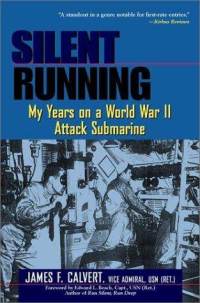
This is my favorite book on the Silent Service during the war because it provides a view from the deck plates, or in this case, from inside the pressure hull. Silent Running opens with the renowned submariner Ned Beach's renowned screed against early war U.S. torpedoes, and then Calvert recounts his nine war patrols in the Pacific against the Japanese. World War II certainly included more renowned and controversial submariners than Calvert, but his understated style and clarity of expression landed his book on my list.
Winner of many prestigious awards, Dower argues that the Pacific War was essentially a race war between the Americans and Japanese, with each race believing itself superior to the other. On both sides the results included poor estimates of the enemy's capabilities, other military miscalculations, and a much higher level of brutality than Americans faced in Northwest Europe. War Without Mercy yields vital insights into what can happen when two different cultures clash; when each side uses a different rulebook for warfare.

Daws, Gavan. Prisoners of the Japanese: POWs of World War II in the Pacific. William Morrow, 1994.


Daws dwells on one particular product of the Pacific War culture clash -- the brutal Japanese treatment of POWs. The book is, in many ways, a collection of horror stories, including the fact that Japanese "physicians" performed vivisection -- dissection of a living being without anesthetic -- vivisection, on members of downed B-29 aircrews. I still shudder to think of it. The warning implicit in Prisoners of the Japanese, like that in War Without Mercy, is that different cultures have different rules of warfare than we do and will not behave as we do in fighting wars.
Naval officers and enlisted men and women do lots more than fight, including, among other things, conducting humanitarian operations, performing rescues at sea, and exploring space. With exclusive access to private papers and interviews with his subject's family and closest friends, Thompson examines the life of one of the first men to fly off aircraft carriers, one of the world's most fearless test pilots, and one of the Navy's iciest, brashest, cockiest and most competitive officers, beating out John Glenn for the first Mercury spaceflight and then later, as a crew member of Apollo 14, whacking a golf ball on the moon. I recommend this one because the Navy still needs test pilots, and Thompson is a brilliant writer.
In this book Reardon, one of America's finest military historians, recounts the history of Medium Attack Squadron 75 from multiple perspectives (the cockpit, the bomb handler, the wives left behind), and sets it within multiple layers of context. The Journal of Military History described it as "a model unit history." So here we have a group biography.
Honestly, I'm not including this to stroke my ego, but I consider this book, along with its predecessor, Breaking the Color Barrier, to be my masterpieces. Using a deep dive into the documentary records along with scores of interviews with largely black midshipmen, I've examined how the Naval Academy was transformed from a racist institution into one that genuinely ranks diversity among its fundamental tenets. The documentary research lays out the Naval Academy's racial policies, how they changed over time, and why. The interviews provide the impact these policies had on the experiences of black midshipmen, told through their own words. The third part of the book includes information on integration of women into the Academy, because many of those women are black. Naval officers and enlisted men and women should read Blue & Gold and Black because it explains the price minority and female shipmates will have to pay as long as parents teach prejudice to their children.
During his 22-year career as a CIA Intelligence Officer, Scheuer served as chief of the Bin Laden Issue Section from 1996 to 1999 and as special advisor to the chief of the bin Laden unit from September 2001 to November 2004. He began this book in 1999 as an unclassified manual for counterterrorism officers. Initially, Potomac Books listed the author as "Anonymous," but with the publication of his follow-on book, Imperial Hubris, his name came to light. As for Through Our Enemies' Eyes, "The crux of my argument," declares Scheuer, "is simply that America is in a war with militant Islamists that it cannot avoid; one that it cannot talk or appease its way out of; one in which our irreconcilable Islamist foes will have to be killed, an act which unavoidably will lead to innocent deaths; and one that is motivated in large measure by the impact of U.S. foreign policies in the Islamic world, one of which is unqualified U.S. support for Israel." It is a harrowing argument, but one that must be understood by all who are serving in the global war on terrorism, the current war, the war we are now in, or whatever we're calling it now.
(A big thanks to Dr. Schneller for sharing his thoughts and recommendations... Look for more thinkers’ suggestions in the weeks and months ahead. -- BD)