Showing posts with label Churchill. Show all posts

Saturday, October 8, 2022

Zelensky the Artist

Review by Bill Doughty––

There are some obvious signs this book was rushed into print to meet the moment in trying to answer key questions. Would Zelensky be able to stay alive to lead his brave country in the fight against Putin’s invasion? Would Ukraine be overrun? Could Russia be stopped?


Rushed as it is, nonetheless this book is an important tool to examine how Zelensky became “Churchill in a T-shirt.” Also, it encapsulates history, context, and personalities to provide context for Putin’s invasion and war against Ukraine.


The book is “Zelensky: The Unlikely Ukranian Hero Who Defied Putin and United the World” by Andrew L. Urban and Chris McLeod, with a foreword by Rebekah Koffler (Regency Publishing, 2022). Urban and McLeod look into the Ukranian President Zelensky’s early life, rise to the presidency, and use of his art as a communicator and performer to become an inspirational leader.

U.S. military readers would benefit from the book’s concise presentation of the history of Ukraine and the demise of the USSR, presented in timelines, statistics, and data.


Readers can appreciate the inclusion of some extras in this book that make it more than just a biography or compilation of statistics and news reports. The authors include historical timelines about Ukraine and the “demise” of the Soviet Union. They present a short chapter on the alliances of Europe, including NATO, the Warsaw Pact, European Union, the Baltic States, and the Commonwealth of Independent States.


Urban and McLeod examine NATO and other strategic alliances and show clearly how Putin and Russia have violated the rule of law, spelled out in the Budapest Memorandum, which calls for nations “to respect the independence and sovereignty and the existing borders of Ukraine.”


Using more statistics, the authors examine the disparity between Russian and Ukrainian forces. They show how and perhaps why the Russians paint the “Z” symbol on their tanks and trucks. They explain the make-up of the Wagner Group, a Russian mercenary paramilitary group, named for the German composer as a nod to one of its organizer’s “passion for the Third Reich.”


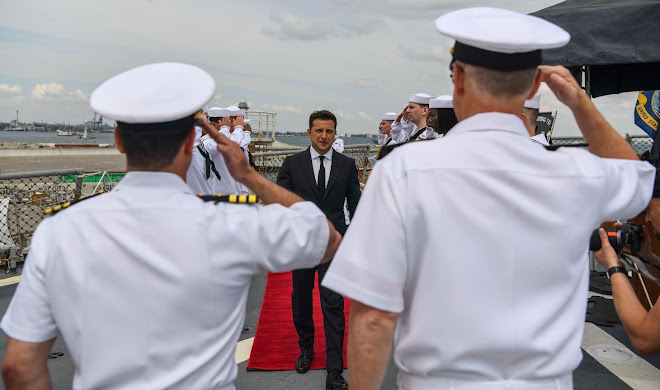
President Zelensky aboard USS Ross (DDG-71)
The authors shoot down Putin’s excuses for his invasion of Ukraine, especially the pretext of the need to attack Nazi forces in control of Russia’s neighbor. We are reminded several times in this book that Zelensky is of Jewish heritage. His great grandfather and other family members were murdered in World War II in the Holocaust.

Readers are told of some uncomfortable ties between Putin’s aggression in Ukraine and some Americans of influence; some who have spoken out against U.S. support and involvement include (now former) Representative Madison Cawthorn, Senate Candidate J.D. Vance, and Fox TV anchor Tucker Carlson. 


Urban and McLeod report how in 2020 former Navy SEAL Erik Prince, founder of the Blackwater paramilitary group, “sought to provide military services to the Wagner Group in its operations in Libya and Mozambique.” (Prince is the brother of President Trump’s former U.S. Secretary of Education Betsy DeVos.) In one of the book’s timelines we are reminded of Trump’s call with Zelensky three years ago this month in which he tried to leveraged military support to Ukraine in an attempt to get political dirt on his opponent, leading to Trump’s first impeachment by the U.S. House of Representatives.


Such indirect support to Putin’s regime and against Ukraine is counterbalanced by the heavy direct support by Western Allies, especially by President Biden and the United States Congress, in providing weapons and ammunition to Zelensky and Ukraine. As of this book’s publication, the United States had provided $1.38 billion in military aid. But, according to Secretary of State Tony Blinken, as of Oct. 4, 2022 the United States has provided $17.5 billion in U.S. military assistance to Ukraine.


This relatively small book is a snapshot from the opening months of the war. Who knows how history will unfold in the weeks and months to come? What seems clear now is Putin is backed into a corner, and the shadow of nuclear escalation and even Armageddon seems bigger and darker. But, Ukraine is showing much of the world that freedom-loving democracy is worth fighting for.


A map in the opening pages purports to show contested areas in eastern Ukraine overrun by Russia; of course, any map older than a week would be inaccurate. 


With no index, no notes, and plenty of repetition and lack of coherence, this book was obviously rushed into print. Still, the good content outweighs the shortcomings.


The book concludes with a transcription of Zelensky’s inspiring address to the U.S. Congress on March 16, 2022, for which he received standing ovations.

His art as a communicator and motivating leader, reminiscent of Churchill, shines through.


In his remarks, Zelensky spoke passionately about need to protect the people in his country who want to live free and under the rule of law. “Americans,” he said, “in your great history, you have patriots that would allow you to understand Ukranians, understand us now when we need you right now. Remember Pearl Harbor…”


Top photo: Ukraine President Volodymyr Zelensky is welcomed aboard USS Ross (DDG-71) by Vice Adm. Gene Black, commander, U.S. Sixth Fleet, and Ross commanding officer Cmdr. John D. John in Odessa, Ukraine, during Exercise Sea Breeze 2021, July 4, 2021. Exercise Sea Breeze is a multinational maritime exercise cohosted by U.S. Sixth Fleet and the Ukrainian Navy in the Black Sea since 1997. Sea Breeze 2021 is designed to enhance interoperability of participating nations and strengthen maritime security and peace within the region. (MC2 Trey Fowler)

Thursday, September 24, 2020

‘Lend Me Your Ears’ Not Fears

Prime Minister Winston Churchill shakes hands with President F. D. Roosevelt after conferring aboard USS Augusta (CA-31), off Newfoundland, Aug. 9, 1941.


By Bill Doughty––


Last February in an interview with journalist Bob Woodward, author of “Rage,” President Donald Trump said he knew the COVID-19 virus was a serious threat, but “I wanted to always play it down; I still like playing it down.” To justify minimizing the COVID-19 pandemic threat to the public, Trump claimed that Churchill and FDR also downplayed threats so as not to panic their citizens.

Trump’s claims led me to read what Prime Minister Winston Churchill of Great Britain and U.S. President Franklin D. Roosevelt actually said. Their greatest speeches are found in William Safire’s “Lend Me Your Ears: Great Speeches in History” (W.W. Norton; 1992).


Safire showcases Churchill’s address to Parliament of May 13, 1940. Hitler and Nazism presented an existential threat to the people of Great Britain. Churchill warned of “a monstrous tyranny never supposed in the dark and lamentable catalogue of human crime.”


Safire reflects on Churchill’s truth-telling “to pound home the period of stress and sacrifice ahead.” Churchill said: “I have nothing to offer but blood, toil, tears, and sweat. We have before us an ordeal of the most grievous kind. We have before us many, many months of struggle and suffering.”


Heroic evacuation from Dunkirk at the end of May and first week of June, 1940.

Churchill called for “united strength.” That is exactly what he got later that month with the heroic evacuation of 340,000 British soldiers from Dunkirk retreating across the English Channel, thanks to hundreds of military and civilian ships and boats.


Safire shows how Churchill spoke the truth about the retreat; Churchill called it a “colossal military disaster.” But Safire notes how the venerated leader balanced truth-telling “with an expression of confidence that the New World –– that is, the United States –– supported by surviving British seapower, would ‘step forth to the rescue and the liberation of the old.’”


Churchill did not play the threat down. He inspired citizens to steel themselves and “never surrender.”


Sir Winston Churchill visits USS Randolph (CVA-15) Oct. 26, 1958. (NHHC) 
Using strong imagery such as a Nazi “invasion,” “originality of malice,” “aggression,” “malignancy,” and “brutal and treacherous maneuver,” Churchill gave what may be the most inspiring speech in Western history:

“We shall prove ourselves once again able to defend our island home, ride out the storms of war, outlive the menace of tyranny, if necessary, for years, if necessary, alone. At any rate, that is what we are going to try to do. that is the resolve of His Majesty's Government, every man of them. that is the will of Parliament and the nation. The British Empire and the French Republic, linked together in their cause and their need, will defend to the death their native soils, aiding each other like good comrades to the utmost of their strength, even though a large tract of Europe and many old and famous States have fallen or may fall into the grip of the Gestapo and all the odious apparatus of Nazi rule. We shall not flag nor fail. We shall go on to the end. We shall fight in France and on the seas and oceans; we shall fight with growing confidence and growing strength in the air. We shall defend our island whatever the cost may be; we shall fight on beaches, landing grounds, in fields, in streets and on the hills. We shall never surrender and even if, which I do not for the moment believe, this island or a large part of it were subjugated and starving, then our empire beyond the seas, armed and guarded by the British Fleet, will carry on the struggle…”

By contrast, Trump told Americans COVID was a “hoax,” that it would “disappear,” and "This is a flu; this is like a flu,” even after telling Bob Woodward he knew it was different and “deadly.” At the same time, Trump spreads panic about a “rigged election,” attacks on “suburban housewives,” a free press as "enemies of the people," and god-hating, gun-confiscating Democrats, among other falsehoods.


Safire’s nearly 1,200 page collection includes Churchill’s warning of an autocratic “iron curtain” descending on Europe. Churchill told the truth to the public, both British and American, about Cold War threats of “war and tyranny” and “poverty and privation.”

At President Truman’s invitation, Churchill gave a memorable speech at Westminster College in Fulton, Missouri, March 5, 1946, calling for “sinews of peace” and power of a free democracy. His call for “free unfettered elections” rings loud and clear in 2020.

“All this means that the people of any country have the right, and should have the power by constitutional action, by free unfettered elections, with secret ballot, to choose or change the character or form of government under which they dwell; that freedom of speech and thought should reign; that courts of justice, independent of the executive, unbiased by any party, should administer laws which have received the broad assent of large majorities or are consecrated by time and custom.”

Prior to the Cold War and WWII, the United States and the rest of the world faced another existential threat: the Great Depression. President Franklin D. Roosevelt told Americans the truth in his first inaugural address, calling himself, in effect, a wartime president: “I assume unhesitatingly the leadership of this great army of our people dedicated to a disciplined attack upon our common problems,” FDR said.


Roosevelt told the truth about telling the truth:

“This is preeminently the time to speak the truth, the whole truth, frankly and boldly. Nor need we shrink from honestly facing conditions in our country today. This great nation will endure as it has endured, will revive and will prosper. So, first of all, let me assert my firm belief that the only thing we have to fear is fear itself—nameless, unreasoning, unjustified terror which paralyzes needed efforts to convert retreat into advance. In every dark hour of our national life a leadership of frankness and vigor has met with that understanding and support of the people themselves which is essential to victory.”

In that fearless (and fear-less) speech nearly 87 years ago Roosevelt acknowledged the causes of the depression, including unbridled greed of “self-seekers.” He asked Americans to embrace American values of selflessness over selfishness.

“Happiness lies not in the mere possession of money; it lies in the joy of achievement, in the thrill of creative effort. The joy and moral stimulation of work no longer must be forgotten in the mad chase of evanescent profits. These dark days will be worth all they cost us if they teach us that our true destiny is not to be ministered unto but to minister to ourselves and to our fellow men. Recognition of the falsity of material wealth as the standard of success goes hand in hand with the abandonment of the false belief that public office and high political position are to be valued only by the standards of pride of place and personal profit; and there must be an end to a conduct in banking and in business which too often has given to a sacred trust the likeness of callous and selfish wrongdoing.”

According to Safire, FDR’s “general promise to do something –– to stop the drift and reverse direction –– coupled with the steel in the speech of the imposition of ‘discipline’ into the chaos, and the vigor of the voice heard on radio, had an electric effect on popular opinion. The bold tone and buoyant delivery encouraged people parched for hope.”

It is clear both Churchill and FDR were not afraid of panicking their populace. They placed the health and safety of people above elections, immediate profits, and stock markets. They were great unifying leaders in a time of need who spoke honestly and with integrity. They did not downplay threats. They offered hope in the face of fear.

(President George W. Bush honors William Safire with the 2006 President Medal of Freedom Friday, Dec. 15, 2006, at the White House. Bush said the former White House speech writer and newspaperman is "a voice of independence and principle, and American journalism is better for the contributions of William Safire." White House photo by Shealah Craighead)

Friday, September 20, 2019

Air Force Drones On

Review by Bill Doughty

Air Force Lt. Col. T. Mark McCurley does his best to downplay the Navy's support, development and use of unmanned aircraft – remotely piloted aircraft – in his personal wartime memoir "Hunter Killer: Inside America's Unmanned Air War" (Dutton, 2015). 


Still, it's worth a read, especially as McCurley, writing with Kevin Maurer, recounts the hunting and killing of terrorists, especially the targeting of Anwar al-Awlaki, the American of Yemeni descent who inspired three high-profile terrorist acts: Army Maj. Nidal Malik Hasan's shooting and killing of 13 people, Umar Farouk Abdulmautallab's failed "underwear bombing" attack aboard an airliner heading for Detroit, and the Boston Marathon bombers.

McCurley describes tracking terrorist leader Abu Musad al Zaaqawi for 480 hours only to fail the mission when an operator accidentally hit a space bar. McCurley shows how UAVs were used in Operation Steel Curtain and the Second Battle of Fallujah, assisting Marines. And, he describes – without ever mentioning the name of the mission – his involvement in the Navy SEALs' Operation Red Wings.

He takes credit for the Air Force zeroing in on the location of the SEAL team who had been ambushed in mountains of Kunar Province, Afghanistan, believing he heard a transmission from Marcus Luttrell (author of "Lone Survivor").
"We took pride in knowing we were the only aircraft able to make it to the area that day. The Predator's unique qualities were an asset in such a dangerous location. The Air Force would never put a human pilot in harm's way in those weather conditions given the threat from the Taliban, and even hough we lost two predators, my aircraft provided the first pictures of the crash site and possibly confirmed Luttrell's position through his radio transmission. Without that information, it would have taken a lot longer to launch the rescue operation."
McCurley does not mention the hero of Operation Red Wings by name: U.S. Navy SEAL Lt. Michael Murphy. He does reveal the personal frustration and remorse of not being able to provide more support.

Several times in "Hunter Killer" McCurley spotlights differences between Air Force RPA and Navy Top Gun, even denigrating volleyball-playing stereotypes. The remote pilots' community comes across as disunited, disconnected but not disaffected by the lethality of some of their missions.

MQ-1 Predator (Senior Master Sgt. Stanley Thompson)
Those pilots see the "proximity of death" when their drones are used to bring lethality in high-definition. "No other pilots got to see the target like we did," he writes.
"Fighter pilots also rarely saw the whole engagement. They just got the call and put bombs on target. The closest they got to the fight was strafing runs and the occasional flash from the bomb or missile as it passed their windscreen. Their proximity to death and violence stirred their blood, but the images in their targeting pods were tiny and fuzzy compared to our high-def pods, keeping them remote to the effects on the ground. Our targeting pods not only showed us everything, but also lingered over the carnage, searing the images into our brains. Our experience was far different from that of the fighters."
The sights, sounds, smells and scorching heat of the Navy-operated Camp Lemmonier in Djibouti make it a desolate hell-hole, where McCurley says he got little support, especially from operations officer "Worm," "a lieutenant commander who acted like an admiral."

Yet he gives grudging credit to another naval officer, "Cruiser," as well as to then-chairman of the Joint Chiefs of Staff, Adm. Mike Mullen. Both were instrumental in getting parts and weapons for UAs that made it possible for the Air Force to carry out its mission.

An MQ-9 Reaper flies a training mission Oct. 18, 2017, at Creech Air Force Base, Nev. MQ-9 and MQ-1 Predator aircrews helped liberate Raqqah, Syria, from the Islamic State of Iraq and Syria’s control in early October. (U.S. Air Force photo/Senior Airman Christian Clausen)
This book is worth a read for anyone interested in an Air Force first-hand perspective on the development and history of remotely piloted aircraft such as the MQ-1 Predator and MQ-9 Reaper – unmanned air systems and aircraft (thou-shalt-not-call-them-"drones," but that's what they're called). Discipline, professionalism and following established rules of engagement are critical to the ethical use of remote warfare, especially as artificial intelligence is developed and implemented.

This book does not have an index, notes or glossary. It does have a good dedication: "to honor the small cadre of aviators, the operators, who fought and continue to fight a war deep in the shadows."

An MQ-9 Reaper sits on the flight line at Holloman Air Force Base, N.M., Oct. 13, 2015.  (U.S. Air Force photo by Airman 1st Class Emily A. Kenney)

McCurley points out – both at the beginning and end of his book – how Gen. Hap Arnold predicted the rise of drones.

On V-J Day, 1945, Gen. Henry H. “Hap” Arnold, U.S. Army Air Forces commander, said, “We have just won a war with a lot of heroes flying around in planes. The next war may be fought by airplanes with no men in them at all ... It will be different from anything the world has ever seen.”

Of course Winston Churchill made the same prediction in 1925 after WWI, and Leonardo da Vinci actually designed a drone in 1485. The history of UA, while benefitting from the Air Force's perspective including in "Hunter Killer," deserves a wider and deeper presentation.

Friday, July 13, 2018

Conversation III: CNO, Drones & Beer w/ Mahan

Interview by Bill Doughty

Professor John Jackson, creator of the Navy Professional Reading Program
He's the originator of the Navy's Professional Reading Program (NPRP, or CNO PRP), and this is our third interview. In this "conversation with the creator III" Naval War College Professor John Jackson, an expert in robotics and unmanned systems, provides insights into how the CNO's reading program, now 12 years old, has evolved over the years. Our interview begins with how the NPRP was personally reinvigorated by Chief of Naval Operations Adm. John Richardson. Like Navy Reads, Jackson aims to support reading and critical thinking.

Q. What was CNO ADM Richardson's contribution to the latest incarnation of the NPRP?

Adm. Richardson has been very “hands-on” in shaping his Professional Reading Program. In fact, we met with him prior to his assumption of the CNO job so we could get a head-start in ensuring that his program met his expectations. He has personally selected the books on the various lists and sub-lists, and has updated them about every six-months. He is a “true-believer” in the value of reading as a primary tool to improve the professionalism of our force. 

Adm. John Richardson, Chief of Naval Operations
Q. The Canon seems to be a foundation – and a good starting point – for Navy readers.

The Canon represents books with which every Sailor should be familiar. It was very difficult to limit the number of books in this category since Navy professionals work in such a wide variety of jobs and specialties. Choices were made that cut across all communities and provided a baseline valuable to everyone in Navy blue and gold.  

Q. The NPRP has evolved since it started under CNO Adm. Mike Mullen. What are some of the biggest changes you've seen in how it's organized and presented?

Our original list in 2006 was categorized by “skills” such as leadership and critical thinking, and was further divided into collections based on experience/rank. The “junior enlisted” collection focused on issues young Sailors would contend with, and the “senior leaders” collection focused more command and large organization issues. We have now evolved into a reading program that is “rank agnostic” and allows everyone to read any book they desire.   

MASN Trevor Miller browses the LiveSafe app on a smartphone. (MC2 Ricks)
Q. Speaking of changes, how has the audience changed? What are some of the ongoing challenges of reaching the digital generations who seem to be tied to their smart phones?

Because of the issues you raise, the CNO-PRP is now based on e-books and digital content. We no longer distribute hard-copy books. As an old guy who likes paper, I tend to read more in hard-copy, but the younger crowd of “digital natives” prefers to read on Kindles, Nooks, or other readers… or to squint and read them on their phones. We don’t care, as long as they are READING!

Fleet Adm. Nimitz and Gen. Eisenhower loved reading about history.
Q. Does reading develop better leadership skills?

I can think of no better way to improve a person’s leadership skills than to read about successful leaders from today and yesterday. It is often said that no one can live long enough to make all the mistakes, but rather should learn from others' experiences whenever possible. It has been said that “not all readers are leaders, but all leaders are readers”!

Q. How can reading and writing help develop better trained and ready Sailors?

Reading and writing demand concentration, much more so than watching a movie or a television program. Your brain must be fully engaged in translating the letters into words and the words into ideas. You can’t be a passive reader.  There are thousands of books on nearly every subject, so Sailors who want to be better at the profession should seek out the biographies and autobiographies of people who have succeeded on the paths they are beginning to walk.

Q. What are the best books right now in your specialty, the study of Unmanned Vehicle Systems?

P.W. Singer’s “Wired For War” is a bit dated, but is still a great source for understanding how we arrived at the place we are in the development and use of Unmanned Systems. “Killing Without Heart” by M. Shane Riza raises many thoughtful questions about what it means to fight a “robot war.” 

And there is a new book being published by the U.S. Naval Institute called “One Nation, Under Drones.” I am the editor, and 10 highly qualified chapter authors write at length about the world of “drones” as it exists today and how it will probably develop in the future. OK, so I plugged my own book! It will be out in December, and I know what everyone on MY Christmas list is getting!

Professor Sally Paine, USNWC
Q. Who are some good women writers you'd recommend?

Naval War College professor Sally Paine has written a number of top-quality books about Asian affairs and other subjects. "The Wars for Asia 1911–1949" (by S. C. M. Paine) is an award winner book that is highly regarded for its use of original source material in the native languages of the originators. 

Q. In May 2017 Navy Reads published a list of 50 books (for 50 years) about the Vietnam War. What are a few of your favorite titles about Vietnam?

Jim Webb’s novel “Fields of Fire” which describes in painful and searing details how U.S. marines faced the challenges of ground combat in the jungles of South East Asia, and “Two Souls Indivisible” by James S. Hirsch that tells the story of the friendship that saved two POWs in Vietnam. My close personal friend CDR Porter Halyburton, USN (ret), lectures annually at the Naval War College and shares the lessons he learned from his seven-and-a-half year ordeal in the prisons of North Vietnam. His inspiring recollections are full of faith, friendship and forgiveness.   

Q. If you could have lunch or a beer with any four or five historians (living or dead) who would be at the table? Why?

I have been blessed to be able to interact with a number of incredible historians, and have shared a meal or a drink with: 

1. David McCullough for his ability to capture the essences of historical events by mining the intimate details of the simple men and women involved. 

2. Craig Symonds, the author of 12 books and the editor of another 9, taught history at the U.S. Naval Academy for three decades and has been on the faculty of the Naval War College. His books (mostly on maritime subjects) are all considered classics. His book “The U.S. Navy: A Concise History” is THE source for understanding how our Navy grew into the incredible fighting force it is today. 

3. George Baer, whose book “100 Years of Seapower” is a classic in every sense. He helped shape thousands of young military officers during his long tenure at the Naval War College. 

…. And in addition to the remarkable men above, I would make special room for Winston Churchill and Alfred Thayer Mahan.   

Q. Adm. Richardson encourages writing as well as reading. For my money, Zinsser's "On Writing Well," is indispensable (a recommendation from Adm. Richardson and Rear Adm. (ret) John Kirby). What's your advice for writers? What should be in their toolbox?

The best way to become a good writer is to write as frequently as possible. You must exercise your “writer’s brain” and seek out other authors/writers and ask them to critique your work. You must have tough skin, since the comments could be harsh. But accept the criticism with the good intention with which it is provided…. write another draft….. “rinse and repeat.” 

Q. What do you see on the horizon? What's ahead for the Navy's Professional Reading Program?

The CNO-PRP will continue to provide digital access to books that matter. We will do all that we can to promote a reading culture within our Navy and help every Sailor become more effective as they labor in support of our great Navy and our treasured nation. I salute “Navy Reads” for doing a superb job of fanning the flames of learning through reading!

Professor John Jackson (right), program manager for the CNO-PRP, discusses reading with U.S. Navy Cmdr. Daniel Dolan and Rear Adm. Walter E. Carter Jr. (center), president of the Naval War College, in Newport, R.I., in Dec. 10, 2013. (Photo by MCC James E. Foehl)

Sunday, July 8, 2018

Destroyers for Democracy / SCOTUS Legacy

Review by Bill Doughty


U.S. and British sailors examine destroyers prior to transfer in 1940.
It's hard to imagine the depths of fear and fascism washing over the world in the wake of the Great Depression and approach of war in the 1930s, a fear that intensified in 1941 when Imperial Japan attacked Pearl Harbor and Hitler declared war on the United States.

America had sided with Great Britain, with President Franklin D. Roosevelt providing 50 World War I navy destroyers to fight German submarines in exchange for the use of military bases on British territories in the Caribbean and western Atlantic.

The man who made that deal happen, despite entering a "sea of troubles" was new U.S. Attorney General and head of the Department of Justice, Robert Houghwout Jackson.

Jackson's story, intertwined with FDR's, is captured in "That Man: An Insider's portrait of Franklin D. Roosevelt" by Robert H. Jackson, edited and introduced by John Q. Barrett (Oxford University Press, 2003). Barrett cobbles together Jackson's manuscript with Jackson's oral history narrations and adds key documents and explanations.

The destroyers for bases deal, including the behind-the-scenes machinations between FDR and Churchill, will be interesting to Navy readers. So will Jackson's insider insights as WWII became a reality.

By the summer of 1941 Hitler had crushed Poland, Denmark, Norway, Belgium, the Netherlands, Luxembourg, France, Yugoslavia and Greece. Jackson writes:
"By June 15, conquest and demoralization had so far subdued France that the French fleet, under the ambiguous Admiral Jean Francois Darlan, seemed likely to be surrendered and thus added to the German and Italian navies. Churchill again cabled Roosevelt ... The specter of overwhelming German naval power, added to her seemingly irresistible air and land forces, deeply troubled the President. If the Germans should capture the French fleet, it – with Germany's own and that of Italy, and with probably cooperation from Japan – would leave the United States to face alone a most formidable naval and air power. But in the early days of July, Britain, defying what seemed to be forces as inexorable as fate and risking alienation fo the French people, boldly attacked and largely disabled the French fleet so that it could no longer be of any substantial service to Hitler. Britain won not only our admiration for her courage and audacity but our gratitude as well."
By the way, a great movie released last year, highly recommended, is "The Darkest Hour," directed by Joe Wright, written by Anthony McCarten and starring Gary Oldman as Winston Churchill. It's a slice of history as Churchill deals with challenges and the need for toughness in his first weeks as Prime Minister. Churchill was elected to the position after serving as First Lord of the Admiralty, the U.S. counterpart to Secretary of the Navy.

In "That Man" Jackson shows the back and forth between Churchill and FDR. 
"Churchill," Jackson writes, "seemed not to comprehend the very different constitutional and political position of President Roosevelt, who was bound by a written Constitution separating executive from legislative power and putting in Congress the control of disposal of government property."


Churchill reads
Eventually, Jackson worked out a legal transaction that helped both nations and navies. His artful deal assisted European Allies at a critical time and helped set the stage for American involvement in the war.

"That Man" gives us a front-row seat to the impact of the attack on Hawaii of Dec. 7, 1941 and its reverberations across the world to the White House.
"I think Pearl Harbor was a great shock to the President – that with all the war talk there had been, he did not believe Japan would make a surprise attack. Of course it was a great embarrassment to him ... How long the war would last and what the prospects were, I did not have much opinion. I was baffled. Our intelligence had proved to be wrong on nearly everything. American intelligence services let us down at every point. I had heard in Cabinet discussions the views that had come from our intelligence services. We had enormously underestimated the strength and striking power of Hitler. We had overestimated the staying power of France. We had overestimated the strength of England. We had overestimated the attitude and stamina of Belgium. We had terribly underestimated Japan, at least her immediate striking power. We had terribly underestimated the power of Russia ... The conquest of Russia was expected to be a very short matter. Based on such information as I had, it was a very dark prospect indeed. I was very pessimistic about it. It looked like a very long war and a war that would be terrifically costly in lives because Hitler would have to be dislodged from the position that he held. We had to wage a war of attack. The foolish optimism that had prevailed, such as the invincibility of the American navy and this and that, all went out of Washington very fast. In place of it, a very deep pessimism came in. There was talk about a war of a decade and all that. In the early part of December and the following months, spirits were pretty low here."
Daughter Mary and son Bill flank Irene and new Supreme Court Justice Robert Jackson, June 2041.
During the war, FDR appointed Jackson to the Supreme Court, but Jackson did not always side with the president. He recognized the importance of balance and separation of powers and the overriding authority of the Constitution.

For example, Jackson was in the minority in the Korematsu decision by the Court, arguing against the constitutionality of FDR's decision to imprison Americans of Japanese Ancestry in concentration "internment" camps, an order based on unfounded fear of a racial minority and one FDR would later admit was a mistake.

Robert H. Jackson had close personal ties to the Navy and the extended Roosevelt family. He knew "quite well ... the old gentleman" Josephus Daniels, Secretary of the Navy, who he first met in 1913. He conferred with Secretary of War Henry Stimson, Under Secretary of State Sumner Welles and newspaper editor and Secretary of the Navy Frank Knox.


Jackson at FDRs naval conference with Henry Stimson, Sumner Welles and Frank Knox.
Jackson's daughter, Mary, married a Navy physician. Jackson's son, Bill, earned a law degree and entered the Navy as an ensign. Bill later married Theodore Roosevelt's grandaughter. 

Both TR and FDR served in the position of assistant secretary of the Navy early in their government service. According to Jackson, FDR embraced innovation in the 30s and 40s:
"Roosevelt was not over-awed by military or naval rank and did not feel any sense of inferiority in the presence of a general or an admiral ... The Navy was his special interest, and at Cabinet meetings we sometimes referred to it as his branch of the service. He had the general conception of naval power that was set forth in the late nineteenth century by Admiral Alfred Thayer Mahan, but he was not blind to the significance of the growth of air power. He knew that that opened a new chapter and called for new techniques. He was interested in the most minute developments of new weapons and new strategies, even new tactics. My impression was that Roosevelt had no lack of respect for the training, judgment and advice of his generals and his admirals on the special subjects that were within their technical competence, but that as Commander-in-Chief he was more apt than most presidents to assert his personal authority over the military, naval and air authorities."
Jackson is a fascinating figure in history for his role in the New Deal, as solicitor general and attorney general, as Supreme Court justice and then for a time as chief prosecutor for the United States in the Nuremberg Trials of Nazi leaders.


Jackson, who began a successful career as a country lawyer, never finished law school.

A justice for the people, Jackson opposed indiscriminate wiretapping and invasions of citizens' privacy.

"It seemed to me that wire tapping was a source of real danger if it was not adequately supervised, and that the secret of the proper use of wire tapping was a highly responsible use in a limited number of cases, defined by law, and making wire tapping criminal outside of those purposes or limits," Jackson said.

A Wave-Top Read on Jackson

A wonderful book for young readers makes a good companion read to "That Man." It's Gail Jarrow's "Robert H. Jackson: New Deal Lawyer, Supreme Court Justice, Nuremberg Prosecutor" (Calkins Creek, 2008).

Jarrow explores Jackson's early life in western Pennsylvania and New York as a devoted reader and, in high school, a skilled debater, often benefiting from the wisdom of mentors. In just just a couple of hundred pages we get a wave-top view of his life, culminating in his role at Nuremberg and final years on the Court. She writes:
"Nuremberg had shown Robert Jackson how easily a dictator like Hitler could seize power. The lesson stayed with him when he returned to the Supreme Court. He was determined to protect each person's rights and freedoms from an overpowering government. Yet Jackson didn't want the government to be so weak that it couldn't keep the country secure. Twice in his lifetime, he watched Germany take over Europe. Now Communist Soviet Union was moving to control the free countries in Eastern Europe."
Earlier in his tenure in a First Amendment case he led the majority 6-3 opinion in West Virginia State Board of Education v. Barnette, siding with Jehovah's Witness schoolgirl plaintiffs against the West Virginia Board of Education. The students had been suspended for not putting their hands on their hearts and participating in the Pledge of Allegiance.

Jackson took a different stand in Terminiello v. City of Chicago. The case involved a priest issuing what today would be considered hate speech.


Gail Jarrow
"Catholic priest Arthur Terminiello gave a political speech in a Chicago auditorium in February 1946," Jarrow writes. "During his speech, Terminiello verbally attacked Jews and blacks and called former First Lady Eleanor Roosevelt a Communist." More than a thousand angry people protested outside. Some pounded on the doors and threw rocks. The priest "urged his supporters to use violence against the 'slimy scum' protestors."

In the ensuing riot Terminiello was arrested and fined $100. He took his case through the judicial system to SCOTUS. The Court sided 5-4 against Chicago and for the priest, saying the First Amendment protected his freedom of speech.

"Jackson strongly opposed the majority's decision," Jarrow reports.

She quotes Jackson: "No mob has ever protected any liberty, even its own, but if not put down it always winds up in an orgy of lawlessness which respects no liberties ... The choice is not between order and liberty [of the citizen]. It is between liberty with order and anarchy without either. There is a danger that, if the Court does not temper its doctrinaire logic with a little practical wisdom, it will convert the constitutional Bill of Rights into a suicide pact."

In the same year as the Terminiello decision was announced, by the way, the United States formed the North Atlantic Treaty Organization. NATO was created by the United States, Canada, and several Western European partner nations after WWII to provide collective security against the Soviet Union.

Jackson, who lived through two world wars and the Cold War, was on the Supreme Court during the Korean War. 

He heard a pivotal case called Youngstown Sheet & Tube Company v. Sawyer. President Truman had ordered the government to take over the steel mills during the war in response to threats of a steelworkers' strike. By 6-3, the Court decided the Constitution did not give the president the authority to take private property without the consent of Congress.
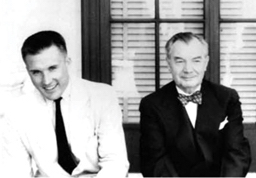
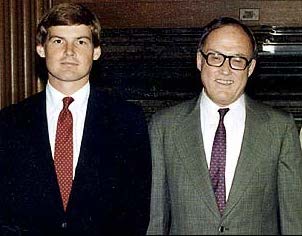
Above: Rehnquist and Jackson; below: Roberts and Rehnquist.

"This ruling," Jarrow said, "brought the three branches of government into balance again and became the basis for many later Court decisions."

In one of his final cases, recovering from a heart attack, Jackson was part of one of the most important cases in U.S. history, Brown v. Board of Education.

The year before he'd heard the reasoned arguments of then-attorney Thurgood Marshall against school segregation. "Jackson made up his mind that the Court should reverse the 1896 Supreme Court ruling Plessy v. Ferguson," Jarrow writes. The decision, issued by Chief Justice Earl Warren, was unanimous.
Jackson did not achieve his dream of becoming chief justice, but his legacy was profound.
"Although Robert Jackson never became chief justice, he is connected to a line of chief justices. His law clerk in 1952-1953 was William Rehnquist, who served as chief from 1986 to 2005. When Rehnquist died in 2005, his former law clerk John Roberts took the position. Robert Jackson dedicated his life to the law, first as a lawyer, then as a judge. He believed that the basis of a government was its laws, not the whims of its leaders. Shortly before his death, he wrote: 'There are only two real choices of government open to a people. It may be governed by law or it may be governed by the will of one or of a group of men. Law, as the expression of the ultimate will and wisdom of the people, has so far proven the safest guardian of liberty yet devised.'"
Jarrow's biography includes a timeline, notes, bibliography, index and resources for more information. Among the resources are oral histories, presidential libraries (Wilson, Hoover, Roosevelt, Truman and Eisenhower) and the Robert H. Jackson Center of Jamestown, New York – www.roberthjackson.org – a site with comprehensive coverage of the Nuremberg trials of Nazi war criminals.

Jackson saw the value of working closely with Allies. He recognized the dangers of totalitarianism and fascism. And he believed in the awe-inspiring power of Constitutional Democracy. He embraced freedom, rejected fear, spoke truth to power and put his faith in critical thinking.


Robert H. Jackson, Associate Justice of the Supreme Court, in 1953: second from the left, in the back row. Also pictured are, from left, in the bottom row: Felix Frankfurter; Hugo Black; Earl Warren (Chief Justice); Stanley Reed; William O. Douglas. Back row: Tom Clark; Jackson; Harold Burton; Sherman Minton.