Showing posts sorted by relevance for query barbary. Sort by date Show all posts

Saturday, September 27, 2014

Captain John Paul Jones – Conflicted

by Bill Doughty

When Thomas Jefferson's letter to Captain John Paul Jones arrived asking him to lead an expedition against Islamic Barbary Pirates in North Africa it was too late. Jones had died days before the letter arrived.

No doubt John Paul Jones would have jumped at the chance to deploy and fight again. After all, he had earlier taken Jefferson's advice to become an admiral in the Russian Navy and serve under Tsarina Catherine in the Black Sea. Two decades earlier he had served under George Washington and other Founders in missions attempting to rescue prisoners of war, even deploying forward into the littorals of England, Ireland and his native Scotland.
Mutinous crews, weather, political circumstances and Jones's own ego often hampered the ship captain's success, however, according to biographer Evan Thomas in "John Paul Jones: Sailor, Hero, Father of the American Navy."

David McCullough, author of "John Adams" and "1776," endorses Thomas's book, and that's high praise. "Evan Thomas captures all the incongruities, vanities, blazing ambition, and phenomenal courage of his subject. And, importantly, he writes with vigor and a sailor's knowledge of the sea. The accounts of Jones's historic triumphs in battle and of one terrible storm are brilliant, unforgettable."

Thomas describes life in the age of sail – the stink, disease, rum allowances, cruelty of the lash and close combat. 
Two hundred and thirty-five years ago this week (Sept. 23, 1779) aboard the merchantman Bonhomme Richard, Jones achieved immortality in his seemingly hopeless battle against the larger Royal Navy HMS Serapis, cannons muzzle-to-muzzle, a "battle of the tops" – snipers on the sails, cutlasses in hand on deck, Jones standing in the face of fire, fearless, unwavering, victorious.

Born from a fleet of privateers the new American navy was a handful of sailing ships whose mission was to intercept British ships. Jones was a gifted seaman, navigator and commander. His patron in the Continental Congress, Robert Morris, saw in Jones "a quality that was utterly missing from the minds of most men of the new Navy." Jones was a "strategic seer."
Jones was effective despite veins of bad luck and occasional bad behavior running through his life. Among the author's descriptions of the great captain/commodore: "thin skinned," "far-sighted but with resentments," "lover of poetry," "whose highs and lows bordered on the manic," "futurist," "shrewd and prescient," "self-centered," "resilient," "articulate," "fastidious," "demanding and brooding," "always keen to burnish his reputation," and "tactless, vain and selfish."
"All through his life, Jones struggled to put forth his more virtuous ... self, his capacity for self-sacrifice and noble-mindedness. But his anger and insecurity eventually showed through. He would have had faster and better ships to sail in harm's way if he had followed Franklin's advice and shared credit more generously and if he had been less prickly and pushy with his superiors. Jones was sufficiently self-aware to know what to do, but tragically incapable of doing it. His ambition rendered him both gullible and self-absorbed. His sarcastic asides and demanding perfectionalism often defeated his efforts to show 'cheerful ardor' and reach out to colleagues. And, yet, his pride masked sensitivity and a longing to be loved and forgiven ... If only Jones had been able to take his own advice and hid his contempt for others, they might have forgiven him. But he could not, and they did not."
Roosevelt speaks at a Jones commemoration at the Naval Academy, 1906.
Jones had busts of himself made in the later years of his life (the ultimate 3D selfie) and sent them to Washington, Adams, Jefferson and other statesmen. He "rarely conceded error," according to Thomas, and "His sense of grandeur, his belief that he strode on a great stage, allowed him to appreciate the larger stakes."

Jones's self-awareness helped him sense change and purpose in the world in the wake of the Enlightenment. He was a true patriot fighting for freedom and against despotism. A contemporary of Thomas Paine, Jones said, "I have drawn my sword in the present generous struggle for the Rights of Men."

Reading about Jones's ego makes a quote that opens the Thomas book all the more poignant. It's from 1906 by President Theodore Roosevelt, a man who had a similar driving personality and, as revealed in the recent Ken Burns series on PBS, "The Roosevelts," plenty of personal demons to outrun. Roosevelt, a former Assistant Secretary of the Navy, said, "Every officer in our navy should know by heart the deeds of John Paul Jones."

Another book about the deeds and the man – not the myths – was written by the great naval historian Samuel Eliot Morison. He received the 1959 Pulitzer prize for biography for "John Paul Jones: A Sailor's Biography." Like Thomas, Morison looked behind the curtain of fabrication and fiction to reveal the complicated character of the naval hero.
Jefferson
In 1792 Thomas Jefferson, who dealt with his own character inconsistencies as a slaveowner, wrote to ask John Paul Jones to deal with Islamic states and Barbary pirates in North Africa who had captured American sailors and held them for ransom. Thomas writes:
"For years, Jones had been corresponding with Thomas Jefferson about the fate of 'our poor countrymen' imprisoned by the Dey of Algiers. Jones had been all for raising a fleet to put down the Barbary Coast pirates (hearing of Jones's agitation and employment with the Russian infidels, the Dey had put a price on Jones's head). Lacking the will or funds, Congress had dawdled. But now some thirteen American prisoners, sailors seized from merchantmen and thrown in grim cells of Algiers, were writing pleading letters, saying they would have to covert to Islam if help did not come soon. In the late spring of 1792 Congress was at last moved to create a delegation to negotiate with the Dey. Remembering Jones and his deep concern for the fate of prisoners, Jefferson, the first American Secretary of State, appointed Jones to lead the American delegation. But Jones was dead by the time his commission and instructions reached Paris at the end of July."
Jones died at the age of 45. Congress authorized payment of "tributes" as ransom to Barbary Coast Pirates. But, when more tributes were demanded, Jefferson called for a strong naval response, which led to the First Barbary War in 1801.

Sunday, August 14, 2011

To the Shores of Tripoli

Review by Bill Doughty
The War of 1812, in which the young U.S. Navy defeated the British Fleet, was preceded by a war against terrorists -- Barbary pirates and their sponsor states along the northern coast of Africa in and around what is now Libya.
To the Shores of Tripoli -- The Birth of the U.S. Navy and Marines by A.B.C. Whipple, is the account of the original United States war against Arab tyrants and introduces us to colorful characters such as President Thomas Jefferson, Commodore Edward Preble, Consul William Eaton, Marine Lieutenant Presley Neville O’Bannon and Navy Captain Stephen Decatur.
These main characters are revealed with all of their strengths and weaknesses in the context of political intrigue and, quite literally, personal battles.  The book describes two duels to the death.
Duels occurred frequently in the new U.S. Navy, whose officers were overzealous about rank and “honor.”  Two thirds as many naval officers were killed in duels as by enemy action in all U.S. naval engagements from 1798 until the Civil War.
The greater "duel," of course, was between freedom of the seas and piracy.  Credit is given to Thomas Jefferson for his commitment to end the tradition of paying tribute and ransom to pirates who preyed on American shipping, capturing and imprisoning sailors in the late 1700s and early 1800s.
Jefferson saw the dangers of trading arms for hostages.  He lobbied for more and better Navy ships.
Yet, Jefferson was criticized for not waging all out naval war on the pirates and their sponsors and for settling for peace treaties.
According to Whipple:
Such criticism overlooks both Jefferson’s determination to fight rather than pay off the Barbary powers, and the fact that it was Congress that denied his requests to declare war against them.
Naval hero Stephen Decatur fights pirates in Tripoli.
Still, President Jefferson was in office when the first major interaction of the Barbary War occurred 210 years ago this month -- Aug. 1, 1801 -- when Lt. Andrew Sterett led the sloop-of-war Enterprise against the 14-gun warship Tripoli, commanded by Adm. Rais Mahomet Rous, known for raiding American and other commercial shipping.
After Rous pretended surrender and then opened fire on the Enterprise twice, Sterett and his Marines, led by Lt. Enoch Lane, used precision firepower and seafaring prowess to utterly defeat the enemy -- 30 killed, 30 injured out of a crew of 80, with not even one injury to Sterett’s men.
In several examples, the author shows the power of discipline, training and readiness over laziness and political expediency.
The heart of Whipple’s book deals with several key events: the 500-mile march across the desert to Tripoli, a courageous attack on the fort at Derna, sea battles in the Mediterranean and gunboat assaults against pirates and tyrants.
Commodore Preble, mentor to a generation of heroes.
The author shows how the Navy and Marine Corps team developed and became stronger.
He also shows the importance of books in developing leaders.  Eaton was inspired after reading Plutarch’s Lives as a young man.  Preble, a mentor to a generation of U.S. naval heroes, whose flagship was USS Constitution, had more than 100 books in his cabin.

Today, USS Preble (DDG 88) is part of the USS Ronald Reagan (CVN 76) Carrier Strike Group.  Preble was one of the first U.S. Navy assets on the scene in Japan last March to provide rescue and relief support as part of Operation Tomodachi in the wake of the tragic earthquake and tsunami there.
After reading and enjoying Whipple’s To the Shores of Tripoli (written twenty years ago in 1991) I checked out Jefferson’s War by Joseph Wheelan (published in 2003), a book which examines the same period and, like Whipple’s work, is carefully researched and documented.
To comprehend the present and future, one should read to understand the past...

Saturday, September 20, 2014

Thomas Jefferson Calls for Submarines

by Bill Doughty
The third president of the United States was the first to expand into the American West, combat religious fundamentalism and terrorists abroad, and think about the future of naval warfare: using submarines and surface ships to provide defense of the States and forward-deploying forces for maritime security. He foresaw peace through global commerce between nations – globalization.

In "Thomas Jefferson: The Art of Power" Jon Meacham explores the complicated way Jefferson combined pure reason with muddy politics as Governor of Virginia, congressman, Secretary of State, President, diplomat in France, and as statesman and philosopher, always trying to achieve "the Founders' dream of a nation beyond partisanship."
Battle of Tripoli Harbor, Aug. 3, 1804
Facing bitter opposition, Jefferson called for naval power against a Muslim caliphate in the Barbary states (Morocco, Algiers, Tunis and Tripoli). Barbary pirates had harassed and kidnapped merchants and captured an American ship. Rather than paying ransom, Jefferson, in a letter to James Monroe, suggested a reasoned approach with hard consequences.

Jefferson wrote, "Would it not be better to offer them an equal treaty? If they refuse, why not go to war with them? ... We ought to begin a naval power, if we mean to carry on our own commerce. Can we begin it on a more honorable occasion or with a weaker foe?"
According to Meacham:
"On Saturday, August 1, 1801, Andrew Sterett of the Enterprize (Enterprise), who was serving under [Commodore Richard] Dale, defeated the Tripolitan vessel Tripoli near Malta. 'Too long ... have those barbarians been suffered to trample on the sacred faith of treaties, on the rights and laws of human nature,' Jefferson told Sterett. 'You have shown your countrymen that that enemy cannot meet bravery and skill united.'"
Meacham judges Jefferson as "more of a chess player than a traditional warrior."

"The Art of Power" is carefully researched and backed up with good source material on both sides of the Atlantic, including unpublished papers. Unfortunately there's not much more discussion about Jefferson's complicated views about developing a Navy. Meacham piques our interest in other writings by Jefferson. 
In a letter published in a collection by the Library of America, "Writings: Autobiography, Notes on the State of Virginia, Public and Private Papers, Addresses, Letters," and written in 1807, President Jefferson communicates his views about naval strategy with Robert Fulton, inventor of the steam engine. Jefferson discusses use and limitations of torpedoes (mines), which would be used extensively a few years later in the War of 1812, and half a century later in the Civil War by Cmdre. David Farragut in the Battle of New Orleans.

In his letter to Fulton, Jefferson calls for more commitment to developing and employing submarines. And he floats the idea of creating a corps of submariners.
"I consider your torpedoes as very valuable means of defence of harbors, & have no doubt that we should adopt them to a considerable degree. Not that I go the whole length (as I believe you do) of considering them as solely to be relied on ... But I have ever looked to the submarine boat as most to be depended on for attaching them [torpedoes], & tho' I see no mention of it in your letter, or your publications, I am in hopes it is not abandoned as impracticable. I should wish to see a corps of young men trained to this service. It would belong to the engineers if at land, but being nautical, I suppose we must have a corps of naval engineers, to practise & use them. I do not know whether we have authority to put any part of our existing naval establishment in a course of training, but it shall be the subject of a consultation with the Secretary of the Navy. Genl Dearborne has informed you of the urgency of our want of you at N Orleans for the locks there. I salute you with great respect & esteem."
Jefferson's views of the Navy seem to have evolved over time. Earlier writings in the 1780s questioned the need for a naval force to compete with European powers. (Eventually, though, especially in response to the Barbary threats, Jefferson understood the need for a strong means to back up peaceful intentions.)

In Query XXII of his "Notes on the State of Virginia" written in 1781-1782, Jefferson offers predictions that have been realized centuries later after wars against Britain, Japan and Germany – cooperative interaction with other nations:
"It should be our endeavour to cultivate the peace and friendship of every nation, even of that which has injured us most, when we shall have carried our point against her. Our interest will be to throw open the doors of commerce, and to knock off all its shackles, giving perfect freedom to all persons for the vent of whatever they may chuse to bring into our ports, and asking the same in theirs."
Jefferson's own words, found in separate collections, help expand revelations in Meacham's biography, which in words and impressive artwork shows many of the key people in Jefferson's life.
Jon Meacham
Meacham's work is personalizing. It focuses on many of Jefferson's relationships, including  with John Adams, Aaron Burr, George Washington, Alexander Hamilton, Sarah "Sally" Hemings, Thomas Paine and Patsy Jefferson Randolph. Meacham writes about Jefferson's friendships, loves and rivalries. Unlike other Founders, Thomas Jefferson did not succumb to bitterness. He took on a recalcitrant Congress and achieved his strategic goals.

The dustcover of Meacham's book proclaims:
"The father of the ideal of individual liberty, of the Louisiana Purchase, of the Lewis and Clark expedition, and the settling of the West, Jefferson recognized that the genius of humanity – and the genius of the new nation – lay in the possibility of progress, of discovering the undiscovered and seeking the unknown. From the Declaration of Independence to elegant dinners in Paris; from politics in Philadelphia and New York to the capital on the Potomac; from his complicated life at Monticello, his breathtaking house and plantation in Virginia, to the creation of the University of Virginia, Jefferson was central to the age."
Jefferson's passion and courage gave us the Declaration of Independence, Constitution and Bill of Rights. Some could say Jefferson's foresight and commitment to progressive development gave us the birth of maritime strategy. And one could even say his expansion of the American West – eventually through Colorado to Washington State – led directly to this weekend's NFL rematch between Peyton Manning of Denver and Russell Wilson of Seattle.

Sunday, May 17, 2015

Jefferson, Monty Python, UCMJ and Magna Carta at 800

by Bill Doughty

Terry Jones of Monty Python narrates a really cool video synthesizing the history of Magna Carta on the occasion of its 800 year birthday this weekend and recognizing it as one of the cornerstones of democracy and human rights.


The animated video is part of a project sponsored by the British Library:

"Why was Magna Carta agreed at Runnymede in 1215? What did the document say, and how was it interpreted over the next 800 years? Why is it still important today, and how does it affect our culture, laws and rights?"

The ideas captured in the document crossed the Atlantic with colonists and immigrants searching for liberty and an escape from gross inequality.

Penn reprinted Magna Carta in 1687.
Magna Carta influenced growth of freedom in Philadelphia under William Penn in the century before the American Revolution. Penn, founder of Philadelphia ("City of Brotherly Love") was persecuted, even jailed, for freely expressing his religious beliefs as a Quaker. He stood for the belief, expressed in Magna Carta that the innate rights of people should not be infringed upon by the Church or State. Penn had the full text of Magna Carta reprinted in Philadelphia in 1687.

The U.S. National Archives offers an exhibit and series of programs this summer commemorating the 800th anniversary of Magna Carta.

From the Archives website: "During the American Revolution, Magna Carta served to inspire and justify action in liberty’s defense. The colonists believed they were entitled to the same rights as Englishmen, rights guaranteed in Magna Carta. They embedded those rights into the laws of their states and later into the Constitution and Bill of Rights."

Interestingly, Thomas Paine in his "Rights of Man" denounced Magna Carta for not going far enough, in that it was merely a bargain with the barons and other nobles and did not represent the interest of all people. Perhaps Paine's argument was influenced by his strong ties to France.

Nevertheless, Thomas Jefferson saw Magna Carta as a turning point in the history of human rights.

Thomas Jefferson
Jefferson, who as president was commander in chief during the Navy's victory in the the Barbary Wars, wrote a letter in 1814 referencing Magna Carta. It was the same year British troops burned the Library of Congress in the War of 1812 (Jefferson would donate 6,000 books from his personal library in response).
In Jefferson's letter to Dr. Thomas Cooper, dated Feb. 10, 1814, the statesman reminisces about "a time of life when I was bold in the pursuit of knowledge, never fearing to follow truth and reason to whatever results they had, and bearding every authority which stood in the way."

He reasons that Magna Carta, also spelled "Magna Charta," was significant in that it marked a turning point in history from common law to statute law.
"For we know that the common law is that system of law which was introduced by the Saxons on their settlement in England, and altered from time to time by proper legislative authority from that time to the date of Magna Charta, which terminates the period of the common law, or lex non scripta, and commences that of the statute law, or Lex Scripta. This settlement took place about the middle of the fifth century."
Jefferson's letter makes the case that American law and justice evolved from legislative authority based on fundamentals of human reasoning, rights and freedom.

In "Thomas Jefferson: A Life" author Willard Sterne Randall reveals that "whether he knew it or not (Jefferson) was descended, on his mother's side ... from one of the barons who signed the Magna Carta in 1215."

Magna Carta also influenced the thinking and philosophy of Mohandas Gandhi and therefore Dr. Martin Luther King, Jr.

King John is compelled to sign Magna Carta May 15, 1215.
2nd Lt. Allen Ernst, of 71st FTW Legal Office of Vance Air Force Base, Oklahoma, offers this perspective as to why the 800-year-old document is relevant to members of the armed forces as a keystone for Uniformed Code of Military Justice:

"The UCMJ governs all US military personnel around the world, from the chief of staff to the newest airman basic, and protects the rights of service members by laying out strict guidelines for the due process of military law," he writes. "For example, Article 7(e) prohibits confinement of individuals without probable cause, and Article 55 specifically prohibits cruel and unusual punishment."
According to Ernst, "The Magna Carta was a response to a problem. King John of England was abusing his supreme power, supposedly by divine right, acting selfishly at best and destructively at worst."

Navy JAGs visit Library of Congress Magna Carta exhibit Jan. 14, 2015. (Photo by Lt.j.g. Hood)
Lt.j.g. Colin Hood of the Region Legal Service Office Naval District Washington wrote in a post in March on DOD Navy Live U.S. Navy JAG Corps blog:

"Although the original charter was nullified by Pope Innocent III a few weeks after its distribution, language from the document would be recycled in subsequent royal charters and decrees. The interpretation and implementation of ideas expressed in the Magna Carta would eventually lead to the beginnings of several legal theories (the right to due process, the jury system, etc.) we depend on today."

Eventually, in 20th century, Magna Carta would even influence the United Nations' Universal Declaration of Human Rights.

In addition to the funny and informative Monty Pythonesque video, the British Library's comprehensive site offers a series of essays about Magna Carta, including more about how early American history was influenced by the landmark document.

(Special thanks to friend and colleague Brandon Bosworth for his suggestion to do a Navy Reads post on this topic. Check out Brandon's A Gent In Training blog. Mind-expanding reads.)

Saturday, July 20, 2013

‘Did You Have a Friend on the Good Reuben James?’

by Bill Doughty
Woody Guthrie wrote “Sinking of the Reuben James” in 1942, a poetic ode to a mighty destroyer, the first American ship sunk in World War II.  

Guthrie’s song concludes with this verse, showcasing the resolve of the Navy and nation during the war:

Now tonight there are lights in our country so bright
In the farms and in the cities they're telling of the fight.
And now our mighty battleships will steam the bounding main

And remember the name of that good Reuben James.
The refrain: “What were their names, tell me, what were their names?  Did you have a friend on the good Reuben James?”

Guthrie’s song, about the sinking of the original USS Reuben James (DD 245) by a German submarine (just weeks before Imperial Japan’s attack of Oahu, Hawaii) was also performed by the Kingston Trio, the Highwaymen and Johnny Horton (of “Battle of New Orleans” and “Sink the Bismark” fame), among other performers.  

With the sinking of the destroyer Reuben James, the Navy lost 115 Sailors, with only 44 survivors.

That original USS Reuben James had been first commissioned in 1919 and served with the Atlantic Fleet.  The ship was decommissioned in 1931 but was recommissioned 13 months later to serve in the Atlantic, Pacific and Caribbean, before being assigned to fateful duty escorting war materials to Britain in WWII.

In song, film and books, USS Reuben James has captured the imagination of artists and the public.

It started with the ship’s namesake.  

James saves Decatur in an engraving by Alonzo Chappel, 1858.
Boatswain's Mate Reuben James was a hero aboard the American frigate Philadelphia in the Barbary Wars against piracy, putting his body in harm’s way to protect Lt. Stephen Decatur.  He served in the War of 1812 and aboard early frigates including USS Constitution and USS Constellation.  Taken prisoner, James was released after the war and went on to serve again with Captain Decatur, aboard the Guerriere.

When Woody Guthrie, who hated fascism in all forms, sang about mighty “battleships” steaming the bounding main, we can imagine not only the surface forces and actual battleships (BBs) but also the American submarines, air power and ground forces and other warfighters that came back with a vengeance to win peace and freedom 70-plus years ago.

“Back with a Vengeance” is the motto of the “world-famous” recently decommissioned guided-missile frigate USS Reuben James (FFG 57).  The latest of three ships to bear the proud name of the boatswain of two centuries ago, the frigate Reuben James made its own mark in the history books. 

Its first mission was Operation Earnest Will, in which the Navy provided protection to Kuwaiti oil tankers threatened by attack during the Iran-Iraq War.  The “Fightin’ 57” had a key role at the end of the Cold War, provided maritime security in the 80s and 90s, and deployed to provide extended support in Operations Enduring Freedom in Afghanistan and Iraqi Freedom in the 21st century.  

From its homeport of Pearl Harbor, Reuben James operated forward to build partnerships, trained with international navies including in RIMPAC, provided humanitarian assistance, interdicted drug smugglers, and protected fishing areas alongside the U.S. Coast Guard.

USS Reuben James has been featured in novels (and movies) including Tom Clancy’s “Red Storm Rising” and “Hunt for Red October.”

Nonfiction and fiction writers have included references to the original Reuben James destroyer and now decommissioned frigate in their works.  These include, “Blood on the Sea” by Robert Sinclair Parkin, “Chosin File” by Dale Dye, “The Malacca Conspiracy” by Don Brown, “Battle for the North Atlantic” by John R. Bruning, “The USS Reuben James,” by Harold Charles, “Shepherds of the Sea” by Robert F. Cross, “Ghosts of the USS Yorktown,” by Bruce Orr, “Turning the Tide” by Ed Offley, and “Linebakers of the Sea” by Ray Lubeski.

The older frigates are leaving the Navy as littoral combat ships (LCS) such as USS Freedom (LCS 1) with near shore capabilities, are now operating forward.  

Machinist’s Mate 2nd Class William Shammas, one of the crew members at the decommissioning ceremony at Joint Base Pearl Harbor-Hickam this past week, said he’s sorry to see the frigates retire from service.

USS Reuben James (FFG 57) CO Cmdr. Dan Valascho speaks at the July 18, 2013 decommissioning.
“The U.S. Navy’s real first ships were frigates,” Shammas said.  “The first one, and the oldest ship in the United States Navy is a frigate -- the USS Constitution,” he observed.

The Reuben James was the first guided-missile frigate homeported in Hawaii, and the last to be retired there, leaving 17 frigates operating in the Navy.  The crew is transferring to other ships on the waterfront; their ship will transfer to the inactive ships list, gone for now.

Perhaps someday another USS Reuben James will be called to sail the world’s oceans and “steam the bounding main” -- "back with a vengeance" to confront new threats from piracy, terrorism or fascism.http://www.public.navy.mil/surfor/FFG57/Pages/ourship.aspx#Namesake

Monday, February 20, 2012

War of 1812: USS Constitution and Freedom

by Bill Doughty
Just as slavery would become the defining reason for the Civil War by mid-19th Century, impressment was the match-to-the-fuse to the War of 1812.
HMS Guerriere's masts go over the side as Constitution
rakes her from ahead. Painting by Anton Otto Fischer.
“Impressment” describes the practice by the British Navy in the 1700s and 1800s of capturing suspected deserters -- even boarding and seizing American ships and confiscating property to do so.
The violation of freedom and sovereignty angered President Thomas Jefferson at the turn of the century and became an explosive issue for President James Madison in his first term starting in 1809.  Impressment and embargoing by Britain led to the United States Congress to declare war “in defense of freedom of the seas and sailors’ rights,” according to Charles E. Bodine Jr., Michael J. Crawford and Christine F. Hughes.
The authors explain how the War of 1812 became necessary, was fought and is remembered -- with USS Constitution as a centerpiece -- in Interpreting Old Ironsides.
"Confirming America’s political and economic independence dominated the new republic’s foreign relations during the first twenty-five years of its existence.  Fear that Britain’s maritime policies robbed the United States of its honor and relegated it to a colonial status convinced the Madison administration that war was the only alternative... While war came reluctantly to both sides, once engaged, they both anticipated a quick resolution -- the United States expected the British to come to terms quickly and the latter predicted a swift military victory.  Both parties underestimated the other’s resolve.  A combination of economic and military circumstances, in tandem with some astute American diplomacy, brought the war to an end."
Interpreting Old Ironsides, An Illustrated Guide to USS Constitution is published by the Naval Historical Center, with a forward by former director of the center Rear Adm. Paul E. Tobin Jr.
The book is designed as a tool, according Tobin, a training guide in three parts -- basic, advanced and master -- for understanding the “national icon.”  USS Constitution is described from blueprint to warship to symbol of diplomacy and freedom, the heart of OPSAIL cruises.
In the Basic section the authors show in great detail the armaments, strategies and discipline aboard Old Ironsides.
The Advanced Level presents the key history and context of the Barbary Wars, Preble’s Boys, and a short history of the War of 1812.
It’s in Part III, the Master Level, that the book explores the diplomatic and political nuances of the War of 1812 and its aftermath.
Part IV provides reprints of actual logbook entries from USS Constitution in 1812, a journal extract from Commodore William Bainbridge, letters to the Secretary of the Navy, a chronology of Constitution in the War of 1812, and U.S. Navy Regulations from 1814, among other fascinating artifacts.
As an illustrated guide, the book offers photos, drawings and diagrams to give a comprehensive look at Old Ironsides.  This authors provide a good balance of the “who, what, when, where and why,” of USS Constitution’s past in the context of “how” -- illuminating the causes of a war that helped the United States win freedom of the seas 200 years ago.

USS Constitution conducts an underway demonstration in Boston Harbor Sept. 16, 2011.  Photo by MC2 Kathryn E. Macdonald.

Sunday, April 21, 2013

‘Web-feet’ of Lincoln and His Admirals


by Bill Doughty

Esteemed Lincoln historian (and Navy Reads contributor) Eric Foner said this about Craig L. Symonds’s “Lincoln and His Admirals”:  “Despite the numerous volumes on Lincoln and the land Civil War, this is the first full study of Lincoln's relationship to the war at sea, and it reveals him mastering the nuances of naval warfare.”

The War of 1812 has been called the second Revolutionary War and the real birth of the United States Navy; the Civil War was an internal revolutionary rebellion over slavery, in which the Union fought for a “new birth of freedom” for all. It was also a watershed event for the Navy.  By the end of the Civil War, the Navy proved its worth as a littoral and open-ocean force with global implications.

Symonds’s brilliant “Lincoln and his Admirals” shows strengths and weaknesses of military and political leaders, the Army-Navy relationship, and the president’s intense interest in the strategy and management of the Navy, through Secretary of the Navy Gideon Welles.

Symonds explores the relationship of Admirals Farragut, Porter, DuPont, Dahlgren and Wilkes, not only with Welles and Lincoln but also with Generals Grant, McLernand and Halleck, among others.

Ego, politics and power are revealed behind the curtain of history.  Symonds shows how Lincoln sought to understand before being understood, as “a neutrally patient navigator.” “Lincoln remained a reluctant commander in chief, and once he had a command team in place that he trusted, he backed away,” Symonds writes.

Du Pont
“Lincoln and his Admirals” is a great read, showing the personalities of the leaders and containing fascinating side notes that go further behind the curtain.  These are just a few examples:  The interesting case of Cmdr. George Preble, grandson of Edward Preble, hero of the Barbary Wars; the vanity, weakness and overreaction of Rear Adm. Samuel Francis Du Pont (to a newspaper story written April 15, 1863); and the sweet-and-sour opposites of Lincoln, the forgiving, and Welles, the vengeful.

“Welles’s tendency to chastise, however, was as instructive as Lincoln’s to soothe,” Symonds writes.  Lincoln’s natural empathy and political skill helped him deal with a fiery cabinet and strong-willed military leaders.

Sometimes flawless, occasionally dysfunctional, the joint efforts of the Union Army and Navy were an important reason the North prevailed.  Lincoln could see the effectiveness of combined operations when there was a willingness to operate outside of narrow and arbitrary lines of authority.  He valued collaboration and cooperation, he encouraged innovation and new technology, and he rewarded aggressive, decisive action in battle.

Read “Lincoln and his Admirals” to understand not only the Navy’s achievements in saving the Union but also the strategies and tactics of good leaders who see bigger themes.

According to Symonds, Lincoln showed “determination to put the good of the country ahead of personal ambition.  He expected his admirals -- and his generals -- to tolerate inconvenience and disappointment for the good of the cause.  The broader goals of Union and victory were more important than anyone’s personal trials, including his own.”  Through it all he continued to support modernization of the Navy.

The Navy had 588 warships by the end of 1863, according to Symonds, with 75 of the ships armored and with more and bigger ironclads coming.  Some of the ironclads featured 11-inch and 15-inch guns.

Anticipating the arguments of Alfred Thayer Mahan a generation later, Lincoln wrote, “Our country has advantages superior to any other nation in our resources of iron and timber, with inexhaustible quantities of fuel in the immediate vicinity of both, and all available and in close proximity to navigable waters.”  Although “other governments have been making large expenditures ... with a view to attain naval supremacy,” it seemed likely to him that “this government is destined to occupy a leading position among maritime powers.  After he wrote this passage, however, he (or perhaps [Secretary of State] Seward) decided that the British might construe it as too direct a challenge to their maritime supremacy, and he deleted it, replacing it with a slightly less confrontational sentence: “The events of war give an increased interest and importance to the navy which will probably extend beyond the war itself.”

In the summer of 1863 Lincoln wrote this in a public letter to James C. Conkling, showing his appreciation for the Navy team: “Nor must Uncle Sam’s Web-feet be forgotten.  At all the watery margins they have been present.  Not only in the deep sea, the broad bay, and the rapid river, but also up the narrow bayou, and wherever the ground was a little damp, they have been, and made their tracks.”

(CNO Adm. Greenert unveiled the latest iteration of the Navy’s Professional Reading Program at the Ford Center for Education and Leadership in front of a sculpture of 6,000 books about President Lincoln.  His program and list of books are focused on history, tradition, and leadership/management, tailored around his three tenets (warfighting first, operate forward, be ready)   We’ll continue to showcase the influence of Lincoln this year, along with books from and related to the CNO’s reading list.  In the previous blog post, Symonds shared a list of top five books with Navy Reads.)

Sunday, October 22, 2017

John Finn / Seton's Halloween Story

Review by Bill Doughty
World War II's first Medal of Honor recipient (former Navy Chief and Lieutenant) John Finn came to Pearl Harbor Dec. 6, 2009 to ride in a whiteboat named for him. He was 100.

Ernest Thompson Seton
I had the special privilege of interviewing John Finn that day during his boat ride. He told me his favorite author, beginning early in his life, was Ernest Thompson Seton, the naturalist, artist, writer, adventurer and Native American Indian advocate.
Finn said Seton was a great writer who captured his imagination and influenced his love of the West.

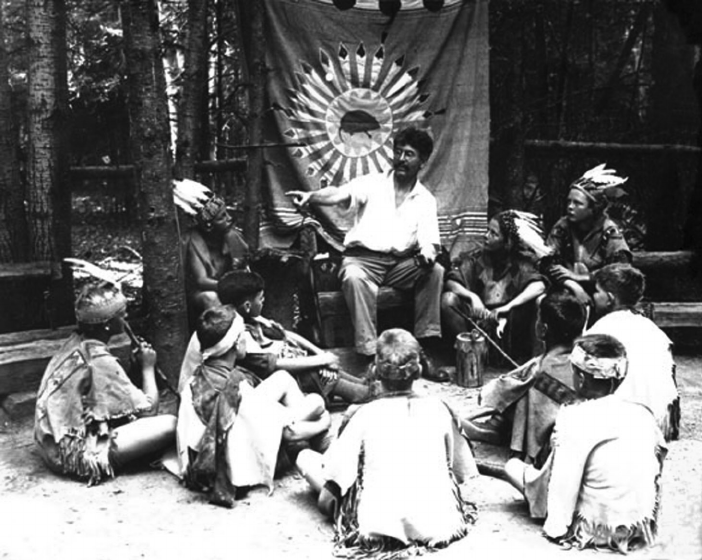
Seton had a significant role in the birth of Scouting in the United States. He is the reason there are such strong ties with Scouting and Native American culture.
Recently I read Seton's "The Arctic Prairies: A Canoe-Journey of 2,000 Miles in Search of the Caribou; Being the Account of a Voyage to the Region North of Aylmer," first published in 1911 – when John Finn was nearly two years old – and reprinted in 1917 in the version I held. The subject of the book, the journey itself, started in 1907.
Seton recounts stories, does science experiments, makes sketches of wildlife and narrates the journey to "unbroken forest and prairie leagues." This richly rewarding book follows the six-month journey Seton made with Edward A. Preble.
Preble was a naturalist whose bloodline included a distant great-great-great grandfather, the brother of Commodore Edward Preble, who defeated the Barbary Pirates in the Mediterranean on orders of President Thomas Jefferson.
It was naturalist Preble who became the center of a campfire Halloween story just as the journey was coming to a close, after various adventures with lynxes, buffaloes, musk-ox, caribou, wolves, bears, coyotes, Arctic foxes and a myriad of birds. Many of the creatures in the cold North were hungry, some dying of starvation in the early winter.
One particular animal became the focus of October 28, leading up to the end of the Seton-Preble journey on Halloween 1907.
"On that same night we had a curious adventure with a weasel. All were sitting around the camp-fire at bed-time, when I heard a distinct patter on the leaves. 'Something coming,' I whispered. All held still, then out of the gloom came bounding a snow-white weasel. Preble was lying on his back with his hands clasped behind his head and the weasel fearlessly jumped on my colleague's broad chest, and stood peering about. In a flash Preble's right elbow was down and held the weasel prisoner, his left hand coming to assist. Now, it is pretty well known that if you and a weasel grab each other at the same time he has choice of holds. 'I have got him,' said Preble, then added feelingly, 'but he got me first. Suffering Moses! The little cuss is grinding his teeth in deeper.' The muffled screaming of the small demon died away as Preble's strong left hand crushed out its life, but as long as there was a spark of it remaining, those desperate jaws were grinding deeper into his thumb. It seemed a remarkably long affair to us, and from time to time, as Preble let off some fierce ejaculation, one of us would ask, 'Hello! Are you two still at it,' or 'How are you and your friend these times, Preble?' In a few minutes it was over, but that creature in his fury seemed to have inspired himself with lock-jaw, for his teeth were so driven in and double-locked, that I had to pry the jaws apart before the hand was free. The weasel may now be seen in the American Museum, and Preble in the Agricultural Department at Washington, the latter none the worse. So wore away the month, the last night came, a night of fireside joy at home (for was it not Hallowe'en?), and our celebration took the form of washing, shaving, mending clothes, in preparation for our landing in the morning."
Seton admitted to a wanderlust desire to go to unexplored regions. He traveled the Nyarling River and camped at the Great Slave Lake, White Fish River, Salt River, Athabska River and Little Buffalo River. He met with Native Americans he called Cree, Chipewyan, Grand Lake Algonquin and Blackfoot Indians.
He describes – and sketches drawings of – dozens of fauna and flora, presented in scientific sketches. Black-and-white photos show the beautiful desolation of the open country.
In the final chapter, "The End," Seton writes:
"All that night of Hallowe'en, a partridge drummed near my untented couch on the balsam boughs. What a glorious sound of woods and life triumphant it seemed; and why did he drum at night? Simply because he had more joy than the short fall day gave him time to express. He seemed to be beating our march of victory, for were we not in triumph coming home? The gray firstlight came through the trees and showed us lying each in his blanket, covered with leaves, like babes in the woods. The gray jays came wailing through the gloom, a faroff cock-of-the-pines was trumpeting in the lovely, unplagued autumn woods; it seemed as though all the very best things in the land were assembled and the bad things all left out, so that our final memories should have no evil shade. The scene comes brightly back again, the sheltering fir-clad shore, the staunch canoe skimming the river's tranquil reach, the water smiling round her bow, as we push from this, the last of full five hundred camps. The dawn fog lifts, the river sparkles in the sun, we round the last of a thousand headlands. The little frontier town of the Landing swings into view once more – what a metropolis it seems to us now!"
We can picture a young John Finn reading this book rapturously and enjoying the photos and drawings by the author.

USS John Finn (DDG 113) in Pearl Harbor. (Photo by Ens. Britney Duesler.
Last summer, in Pearl Harbor the Navy commissioned a new guided-missile destroyer: USS John Finn (DDG 113). The ship is homeported in San Diego.

Meanwhile, the John Finn whiteboat, one of several in Pearl Harbor with Sailors at the helm, is used nearly every day to take about 150 visitors per trip to the USS Arizona Memorial – more than a million-and-a-half people per year from throughout the world. 

Among the groups who visit Pearl Harbor each year are Boy Scouts and Girl Scouts. Interestingly, Ernest Thompson Seton is considered to one of the "fathers" of Scouting. 
Politics, patriotism and even spirituality/religion are intertwined in a fascinating essay by David C. Scott and presented by Johnny Walker about Seton's role in the early days of Scouting.
Ernest Thompson Seton founded The Woodcraft Movement in 1901 and wrote the first Boy Scouts of America handbooks. The original 1910 BSA manual is subtitled "A Handbook of Woodcraft, Scouting, and Life-craft" (Seton and Baden-Powell, 1910). Seton also wrote "The Woodcraft Manual for Girls" in 1916. 
For perspective on Seton, consider that he was born in England in April 14, 1860, nearly one year to the day before the start of America's Civil War. He moved to Canada, where he lived and studied, before eventually moving to the United States and becoming a U.S. citizen, settling near Santa Fe, New Mexico – in the heart of his (and Finn's) beloved West.

Seton teaches young people about Indian culture as part of his Woodcraft Movement, 1903.
A complicated individual, Seton became enmeshed in an early 20th century controversy that ended up putting him somewhat at odds with his President Theodore Roosevelt over anthropomorphic portrayals of animals in nature. TR reportedly advised Seton to back up his views with facts, leading to volumes of academic and scientific investigations about animals.

Though apparently hobbled by his own ego and patriarchal thinking toward other races, he was an early champion of equal rights for women, and he had deep respect for Native American Indian culture.

Seton also reached across the Atlantic to his native England and sought to strengthen ties in World War I, reinforcing the ideal of service. 

In his "The Gospel of the Redman: An Indian Bible" Seton writes: "The culture of the Redman is fundamentally spiritual; his measure of success is, 'How much service have I rendered to my people?' His mode of life, his thought, his every act are given spiritual significance, approached and colored with complete realization of the spirit world."

Seton died 71 years ago on Oct. 23, 1946, one year after the end of the war John Finn helped win. Today the Navy remembers the service of John Finn, who, though wounded and vulnerable, fought back, firing his mounted machine gun at attacking enemy planes on December 7, 1941 at Naval Station Kaneohe Bay, now Marine Corps Base Hawaii. We can imagine Finn's spirit aboard USS John Finn, at MCBH and in Pearl Harbor.


Extended family members and friends of the late John Finn visit his namesake whiteboat in Pearl Harbor July 17, 2017. (Photo by Ens. Britney Duesler)