Showing posts sorted by relevance for query uss midway. Sort by date Show all posts

Sunday, June 2, 2013

‘Midway Magic,’ Legacy of Battle of Midway

by Bill Doughty

Forty years ago, October 5, 1973, USS Midway (CV 41) -- named for the Battle of Midway -- pulled into its new forward-deployed port: Yokosuka, Japan.
Built in Newport News, Virginia and commissioned just after Imperial Japan’s surrender in 1945 in Tokyo Bay, near Yokosuka, USS Midway would become America’s longest serving aircraft carrier in the 20th Century, deployed near the Arctic and in the Atlantic, Pacific and Indian Oceans.  Midway projected power and presence in a variety of conflicts throughout the Cold War, Korean War, Vietnam War and beyond, including in Operation Desert Storm.

Scott McGaugh’s “Midway Magic: An Oral History of America’s Legendary Aircraft Carrier” is a tribute to the continually deploying, hard-working carrier.  “Midway became known as one of the best operating carriers in the Navy in the 1970s and 80s,” he writes.
The author recognizes by name many of the COs and deckplate Sailors who served aboard Midway over the decades.  He lauds Sailors and civilians -- including Japanese civilian workers who worked on the ship, including in drydock in Yokosuka.

“Each time Midway put in at the Yokosuka ship repair facility, Japanese shipyard workers overhauled a designated portion of the carrier.  Every few months, part of Midway was enhanced, repaired, or replaced.  Other carriers went into the yard periodically for two-year overhauls.  Midway was usually in port for no more than a month.  Hundreds of Japanese ship workers descended on Midway upon arrival in Yokosuka.  The honesty and dedication of Japanese welders, electricians, pipe fitters, and plumbers working on Midway became legendary.”
In 1942 it was American civilian shipyard workers in Pearl Harbor who repaired, refitted and rearmed the aircraft carrier USS Yorktown (CV-5) to play a key role in helping the Navy win the Battle of Midway.
If the Battle of Midway represented a turnaround in the War in the Pacific, 30 years later the arrival of the USS Midway in Japan marked a solidarity of partnership as allies, with the U.S. Navy and Japan Self-Defense Force as the best of friends.
It was the first time for a U.S. Navy aircraft carrier to be assigned to the forward-deployed naval forces stationed in Japan.  While there were decidedly mixed feelings by the people of Japan, demonstrations against the carrier were mostly because of opposition to the war in Vietnam.

Midway’s arrival in October 1973 occurred just 36 weeks after the Paris Peace Accords were signed to end the war.  Coincidentally, that month saw the beginning of the world embargo of oil by Arab members of the Organization of Petroleum Exporting Countries (OPEC) during the Arab-Israeli War.  World War II in the Pacific began in 1941, in large part, because of an embargo against Japan because of that country’s expansion into other Asian countries for oil and other resources.
Lt. George Gay with his squadron just prior to the Battle of Midway.
The Battle of Midway, 71 years ago this week, was a historic milestone against fascism and for freedom.  It was a watershed moment for aviation, too, proving the era of battleships was ending and the time of naval aviation and aircraft carriers had begun.  The Battle of Midway showed the spirit of a bonded and enervated force, dedicated to working together using new technology and exploring innovative new tactics to achieve victory for the common good.
McGaugh’s “Midway Magic” begins with an introduction by a naval (and Air Force exchange program) aviator who served aboard USS Midway after his commissioning from the U.S Naval Academy -- astronaut Wally Shirra.  “I was one of the fresh-faced kids aboard Midway in 1950, a hot-shot aviator at the dawn of the jet age.”  Shirra writes:
Midway Pilot and Astronaut Wally Shirra

“For men and nations alike, Midway did more than influence our world.  Midway dictated the course of world events, sometimes by her mere presence as a beat cop stepping into the middle of a heated dispute, at other times as the fireman rushing into harm’s way to save lives.  For me and thousands of other young men over the expanse of nearly 50 years, Midway Magic showed each of us our backbone, inspired us to never cut our dreams to fit, and taught us values and ideals that served as guideposts for rest of our lives.  And in the hearts and souls of the men who served aboard her, the magic continues to this day.”
McGaugh describes with emotion the decommissioning ceremony of USS Midway 21 years ago, attended by, among others, aviators Adm. Riley Mixson, Mugs McKeown, Dick Parker and George Gay.  It was one of the last public appearances by Gay, the famed survivor of the Battle of Midway who was also present at the ship’s launching.
USS Midway was remembered for its role in war and peace, including in humanitarian missions such as its final mission in 1991, after the Mt. Pinatubo volcanic eruption in the Philippines.  Along with USS Abraham Lincoln (CVN 72), Midway provided emergency evacuation of 15,000 military and civilian personnel from Clark Air Base and Subic Naval Base.
The decommissioning wasn’t the end of the Magic.
Ten years ago, Aug. 29, 2003, the ship was awarded to the San Diego Aircraft Carrier Museum nonprofit.  It was towed from Bremerton to Oakland to San Diego and opened as a museum in 2004.
Today, USS Midway Museum sits proudly at Navy Pier, off Harbor Drive, part of downtown San Diego.
“Midway Magic’s” appendix includes a work of poetry from the ship’s 1989-1990 cruise book.  Here’s an excerpt:
For more than forty-five years 
Midway has steamed,
Returning to safe harbor --
Mission following mission.

Amid the pulsation of four shafts
And the throb of jets at military power,
The true beat of her heart
Depends on the courageous --

Those who tread the decks,
Populate the compartments,
Operate the machinery,
Serve in Harmony.

Remember the faithful
Whose final service
Was given in full measure
On this Gray Lady...


(I was a student in Japan and worked for the Navy Exchange in 1973.  I watched the USS Midway arrive at its new forward-deployed port of Yokosuka in October of that year.  Several years later I served as editor of the base newspaper Seahawk.  -- Bill Doughty)

Sunday, September 11, 2022

September Remember: USS Midway in Japan

by Bill Doughty––

I was attending school in Tokyo and living in Yokosuka in 1973 when USS Midway (CV-41) arrived in Yokosuka –– the first U.S. aircraft carrier to be stationed in Japan as part of the Forward-Deployed Naval Forces. It was a big deal, less than thirty years after World War II, and just months after the U.S. military departed Vietnam.


Midway was commissioned 77 years ago, Sept. 10, 1945, just eight days after Imperial Japan surrendered. Stationing the ship in Japan was hugely symbolic; Midway is named for the historic and pivotal battle in 1943 that turned the tide in WWII.


USS Midway (CV-41) arrives in Yokosuka, Oct. 7, 1973. Photo from Midway cruise book. (Ryo Isobe, DVIDS)
But that’s only one reason the carrier’s arrival in Yokosuka was opposed by many Nihonjin, sometimes violently.

Hundreds of Japanese citizens, loudly opposed to America’s war in Vietnam, came to Yokosuka in 1973 to protest the arrival of Midway.

I remember scores of demonstrators in headbands and helmets, faces covered, white-knuckled fists gripping bamboo poles. The demonstrators assembled by the Yokosuka JNR station and marched to the closed gates of the base. Japanese police in riot gear formed a human shield. Marine guards stood ready behind them. Some radical demonstrators attacked the police and were repelled with fire hoses.


Midway had been a recent (and repeated) participant in what was then called the Vietnam Conflict, a war for which the ship received the Presidential Unit Citation from President Nixon in early 1973.


Two years later, Midway would join with other ships of the U.S. 7th Fleet in Operation Frequent Wind, the evacuation of Saigon.


Three years after Midway’s arrival in Yokosuka, the United States celebrated its bicentennial, 1776-1976. By then, I was just out of college and contributing stories to the Seahawk base newspaper on my way to becoming editor and eventually a public affairs officer.

Early in its career, Midway participated in historic operations in the Caribbean, near the Arctic, throughout the Mediterranean, and in both the Atlantic and Pacific, including near North Korea.

Midway would go on to participate in various peacekeeping operations, including Operation Desert Shield and Desert Storm, after Iraq failed to obey a United Nations ultimatum to withdraw from its invasion of Kuwait.


Just as it did in the evacuation of refugees after the fall of Saigon, Midway played a key role with other ships in rescuing evacuees from the Philippines in Operation Fiery Vigil after the eruption of Mt. Pinatubo. That was in June of 1991.


I was still living in Yokosuka and working for the Navy when USS Midway departed Yokosuka for the final time in August 1991. The workhorse aircraft carrier was headed to retirement 31 years ago this month –– via Pearl Harbor, Seattle, and Bremerton –– eventually to San Diego.


USS Midway arrives in Pearl Harbor, August 23, 1991.
By 1991, more Japanese people came to realize the value of having a strong U.S. Navy presence, working cooperatively with the Japan Maritime Self-Defense Force to maintain freedom of the seas. 

Just as the United States Constitution was a model for Japan’s form of government, the United States Navy served as a model for the JMSDF –– with direct help and guidance from Adm. Arleigh A. Burke.


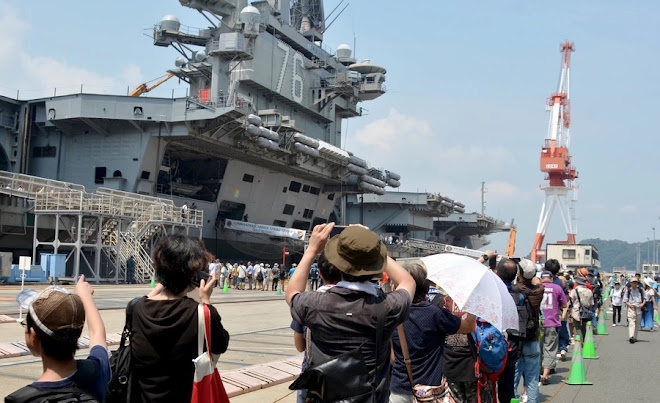
Over many years, Yokosuka has held hugely popular base open-house events, inviting tens of thousands of Japanese citizens onto the base to participate in games, enjoy food booths, attend concerts, and go aboard U.S. Navy ships.


The most popular draw at base open-house events? Tours of an aircraft carrier.


After Midway’s departure, other carriers followed its lead to become forward-deployed in Japan: USS Independence (CV-62), USS Kitty Hawk (CV-63), USS George Washington (CVN-73), and USS Ronald Reagan (CVN-76).


Japanese guests line up to board USS Ronald Reagan (CVN-76), October 10, 2015, during Yokosuka's Friendship Day open-base event. (MC1 Peter Burghart)

Open-base events were suspended for a time in the aftermath of attacks on the United States by religious zealots –– Islamist terrorists –– on September 11, 2001. (I remember the gates being locked down for weeks. Everyone who lived off base were required to park a few miles away and were offered rides to work or schools on base in carefully screened shuttle buses.)


In September 2003, USS Midway departed its temporary home of Bremerton, WA, to become a museum and memorial in San Diego. It welcomes an average of more than one million visitors per year. As with the USS Arizona Memorial in Pearl Harbor, many of the visitors to the USS Midway Museum include people from Japan who come to pay respect and learn about history.


Operation Sandy (Midway Museum Archives)
The museum offers a robust website highlighting the ship’s proud legacy, including operations in the Arctic, Taiwan Strait, and Vietnam, among others. I found some fascinating Midway photos available for download from Flikr, courtesy of the Museum. Some of the photos on the museum’s site include ringside views of Operation Sandy, the world’s first test-firing of a ballistic missile from a ship at sea.

There are numerous resources on the museum’s website, including videos and first-person accounts. This line stands out: “When history speaks, turn up the volume.”


In reading the history of the USS Midway, we can see the evolution of the modern Navy, from the immediate postwar, through the entire Cold War, and operations in Vietnam. But the ship is remembered most fondly, perhaps, for its role in helping people and promoting peaceful protection, especially for eighteen years in Yokosuka, Japan.


USS Midway’s strategic role in the Cold War, is a key part of James D. Hornfischer’s fascinating “Who Can Hold the Sea: The U.S. Navy in the Cold War, 1945-1960” (Bantam Books, 2022).


I have a two-part review of Hornfischer's final work posted in recent weeks. Hornfischer has been a favorite over the years. In May 2012, he offered a guest mini-review of five books he recommended to Navy Reads.


Saturday, May 12, 2012

Happy Birthday Joe Rochefort - Midway Legacy


by Bill Doughty
Today is the 112th anniversary of the birth of Joseph John Rochefort.  Tomorrow, May 13, 2012, is the 70th anniversary of Rochefort’s discovery of the Imperial Japanese Navy’s plan to attack Midway Atoll.
The Battle of Midway altered the course of World War II and saved Hawaii, Australia and perhaps the West Coast of the United States from further attacks by Japan.
With a reporter’s skills, Elliott Carlson shows the influence of one man on the outcome of Midway in “Joe Rochefort’s War: The Odyssey of the Codebreaker Who Outwitted Yamamoto at Midway.”
Carlson employs dogged research, personal interviews, presentation of facts and a resistance to speculate.  Thanks to his access to Rochefort’s family members and Navy archives he is able to paint a picture of the complicated man and the political intrigue that marked his naval career.
Rochefort is revealed as a “restless maverick” -- caustic, acerbic, sarcastic.  But he was also gifted with extraordinary memory, able to solve puzzles and synthesize complex shifting information.
These abilities proved indispensable in the Pacific War.  Rochefort implemented actionable intelligence in an independent, decentralized setting at Pearl Harbor’s Station Hypo -- predicting the future for Adm. Nimitz and Adm. King and allowing them to develop strategies to defeat the enemy.
Rochefort, the youngest of seven children, was born May 12, 1900 to Irish immigrant parents.  To put things into historical context: his father, Frank, was born in Dublin 160 years ago (1852), only forty years after the War of 1812 and nine years before the American Civil War.  One hundred years ago (1912), the Rochefort family moved from Dayton, Ohio to Los Angeles, where Joe would be recruited into the Navy.
With no college or even a high school diploma, Joe Rochefort joined the Navy in 1918.  His science and math abilities propelled him to the rank of ensign, and he served on training ships, tankers, a mine sweeper, and a destroyer.  He served aboard the cruisers USS New Orleans and USS Indianapolis, as he was recruited into the intelligence field, and on several battleships, including USS Maryland, USS California, USS Pennsylvania and USS Arizona.
Author Carlson shows how Rochefort was haunted by the attack on Pearl Harbor, Dec. 7, 1941.  Rochefort felt a sense of guilt for not being able to predict the attack.  But Pearl Harbor motivated him, as it did for the rest of the nation.
Rochefort redoubled his efforts to crack the JN-25(b) code, analyze radio transmissions and track the Imperial Japanese Navy.  Carlson provides just enough information about the art of codebreaking -- in an era of nascent computing and related technology -- to show how daunting the task was for Rochefort’s team: 50,000 possible meanings of 33,333 5-digit codes with an indeterminate, shifting beginning.
Despite the challenges, Rochefort correctly predicted the location of the Imperial Fleet in the western Pacific as early as January 1942.  He gave Nimitz information that proved correct in the Battle of the Coral Sea, setting the stage for Midway.
“Gains registered in cryptanalysis and codebreaking permitted Rochefort to practically look over Yamamoto’s shoulder as he moved his forces around the Pacific,” Carlson writes.
On May 13, 1942, Rochefort decrypted information that the IJN was focusing on areas near Midway and the Aleutians.  Rochefort analyzed the information and made a case for an impending attack on Midway, suspected as being “AF” in the Japanese code.  He presented his analysis on sheets of paper on plywood and wooden sawhorses; PowerPoint would not be available for decades.
With help from former submariner, engineer and University of Hawaii faculty member Jasper Holmes, who knew Midway’s infrastructure, Rochefort devised a ruse so the Japanese would reveal their plans.  Nimitz approved the plan, and a fake message was issued that Midway was running short of fresh water.  The IJN then sent out their own message about the water shortage in code, thus confirming that “AF,” “Affirm Fox,” was indeed Midway.
Scene on board USS Yorktown (CV-5) during Battle of Midway. (Navy photo) 
Nimitz carried out his own subterfuge, directing fake carrier transmissions in the Coral Sea and a bombing of Tulagi by PBYs that fooled the Japanese into thinking that U.S. aircraft carriers were still on location.
With intelligence, guts and luck the United States Navy defeated the Imperial Japanese Navy at Midway.
Carlson writes: “Eventually the Battle of Midway would be compared with Trafalgar, Jutland, and other major campaigns at sea that turned the tide of history.  The battle transformed the conflict between the United States and Japan.  Many agonizing years of combat loomed ahead, but after Midway the United States would remain on the offensive.  ‘Midway was the crucial battle of the Pacific War, the engagement that made everything else possible,’ Nimitz said after the war.”
Rochefort’s contributions continued despite political intrigue and infighting within the intelligence community and a resistance to innovation and free-thinking by some leaders and colleagues.
Rochefort tracked Japanese action in Guadalcanal, acoustic mines, oil supplies and access to sea lanes and even the Japanese view of the situation in Germany late in the war.  He had other challenging assignments, as well, including working on floating drydocks, but he soon retired on Jan. 1, 1947 at the rank of captain and at 46 years old, returning to the Navy briefly during the Korean War.
The attack of Dec. 7, 1941 brings inevitable comparisons to Sept. 11, 2001, and, though he does not make the comparisons himself, several jump out in Carlson’s book.  Among the biggest: a lack of imagination in predicting the attack and a failure for agencies to share information, what Carlson quotes as “fatal defects in the Army-Navy relationship.”
Interservice rivalry continued to challenge Rochefort when the Army’s 7th Air Force doubted Hypo’s information analysis and resisted the evidence that Midway would be a target in June 1942.
Another 9/11 comparison comes after the war when consipiracy theories abounded.  Groups targeted FDR, accusing former President Roosevelt of knowing about the attack on Oahu and allowing it to happen in order to push the country into WWII.
Carlson shows the lack of evidence for the conspiracy theories and gives credit to Rochefort for resisting political and peer pressure to fix blame.
Author Elliot Carlson speaks at the National WWII Museum.
Time and perspective, combined with evidence and good sources, are a strong combination, and Carlson wields a deft pen in describing the life and impact of Joe Rochefort and his role in winning the Battle of Midway.
The book is made even better with the inclusion of photos, including rare family pictures.  Among the more fascinating are photos of a young Rochefort in Tokyo, 1929-32, where he studied Japanese and gained an understanding of the culture.
“Joe Rochefort’s War” is a tour de force and a top ten read for the history of the Battle of Midway.

Saturday, May 17, 2014

'God-Awful Luckiest' Battle of Midway

by Bill Doughty
Fleet Adm. Chester W. Nimitz
How did the United States Navy achieve victory at Midway and turn the tide in the Pacific so early in World War II?  An anthology from the Naval Institute Press shows the answer: Sailor ingenuity, science and skill blended with Admiral Nimitz's wisdom and determination -- along with some luck.

Other factors contributed, including miscalculations and overconfidence of Imperial Japan, whose military leaders were set on taking out "Hawaii's sentry," Midway Atoll. But fortune favored many of the U.S. carrier aviators who fatally damaged three enemy carriers, writes John B. Lundstrom in historian Thomas C. Hone's "The Battle of Midway: The Naval Institute Guide to the U.S. Navy's Greatest Victory."  Imperial Japan would lose four carriers that attacked Pearl Harbor and more than 100 of its aviators.

Lundstrom notes, "The actual sequence of events was stranger than anyone could have imagined; as [Rear Adm. Murr] Arnold wrote in 1965, it was 'the most god-awful luckiest coordinated attack.'"
In "The Battle of Midway" editor Hone brings together a gifted roster of writers and leaders including Craig L. Symonds, E.B. Potter, James Schlesinger, Adm. Raymond A. Spruance, Rear Adm. Edwin T. Layton, Elliot Carlson, Mitsuo Fuchida, Masatake Okumiya, Lundstrom and Mark R. Peattie, among others.

Throughout this book of mostly essays written over a span of seven decades, Hone adds context and analysis. In his introduction to Chapter 9, "Prelude to Midway," he explains Imperial Japan's motive for the attack.
"The Midway operation had two central objectives. The first and more limited one was the seizure of Midway as an advance air base to facilitate early detection of enemy carrier forces operating toward the homeland from Hawaii, with the attack on the Aleutians as a diversion ... The second, much broader objective was to draw out what was left of the United States Pacific Fleet so that it could be engaged and destroyed in decisive battle. Were these objectives achieved, the invasion of Hawaii itself would become possible, if not easy."
America's fury against Imperial Japan and commitment to avenge at Midway immediately after the attack on Oahu of December 7, 1941 was fueled by lies: pretended diplomacy in Washington D.C. even after the "Rising Sun's" torpedo bombs exploded in Pearl Harbor. Americans, led by President Roosevelt, called the act illegal, ignoble and infamous.
Eri Hotta's "Japan 1941: Countdown to Infamy," published by Alfred A. Knopf Publisher, describes how the two emissaries, Nomura and Kurusu, were set up by the military government "warmongers" in Japan. The two were returned to Japan in a citizen exchange via Rio de Janeiro in the Atlantic, Mozambique in the Indian Ocean and finally Yokohama in Pacific, arriving August 20, 1942. Hotta writes:
"By then, Japan's preponderance at sea was declining precipitously. The balance of power had been tipped. From June 4 to 7, the Imperial Japanese Navy fought one of the most devastating naval battles in modern history, the Battle of Midway. The same men who planned the Pearl Harbor attack conceived of the Midway strategy, hoping to eliminate the United States from the Pacific once and for all. The operation ended in disaster for Japan. By this time the Japanese military code had been broken by the United States ... The Japanese navy was dragged down from its glorious pinnacle only six months after it had reached it."
Hotta's "Japan 1941" shows how misunderstanding, miscalculations and misinformation not only led Japan into war but also perpetuated the fighting even after defeat was inevitable.

Hone's "The Battle of Midway" opens with Part I, which explores Nagumo's kido butai (air fleet), presents Admiral Yamamoto from a Japanese perspective, and shows why Imperial Japan's carrier pilots were so skilled in the first year of the war with the U.S. Navy; it was because they had already gained experience in the previous decade in China. Part II is titled "Approach to Midway" and includes a brief but powerful piece from Proceedings, "Lest We Forget: Civilian Yard Workers," by Lt. Cmdr. Thomas J. Cutler, USN (ret.). Cutler is author of "Bluejacket's Manual," "A Sailor's History of the U.S. Navy" and numerous other books.

USS Yorktown struggles in vain to survive during the Battle of Midway.
Part III, "The Battle," recounts the battle Kurosawa-like, from different angles and viewpoints including several from an Imperial Japanese perspective. "I Sank the Yorktown at Midway," by Yahachi Tanabe and Joseph D. Harrington, is one provocative title. Parts IV and V deal with the aftermath of the battle, its finale and the official report by Commander-in-Chief, U.S. Pacific Fleet. 

Part VI of "The Battle of Midway" explores the personalities, strategies and relationships of the commanders: Nimitz, Spruance, Nagumo, Yamato, Fletcher and Mitscher. Part VII shows how code-breaking helped provide some of the "god-awful luck" that gave U.S. Navy the edge against the enemy fleet. Editor Hone leads with an analysis of the complicated state of affairs with regard to code-breaking, and he includes an excerpt from Elliot Carlson's excellent "Joe Rochefort's War: The Odyssey of the Codebraker Who Outwitted Yamamoto at Midway."

Hone's book concludes with Part VIII "Assessments of the Battle" and appendixes, including the USS Enterprise Action Report and Spruance's Letter to Fletcher of June 8, 1942. 

There are several implied and outright pleas by historians to ensure Midway is understood and commemorated. Since Adm. Jonathan Greenert became CNO, The Battle of Midway has been part of a curriculum for Sailors and has been honored at every command.

The source materials, oral histories, chronologies and analysis in "The Battle of Midway" make this book a compelling overview of the heroic battle while leaving some mysteries, fog-of-war questions, and the impact of luck as still part of the story and lessons of Midway.

Chief of Naval Operations (CNO) Adm. Jonathan Greenert, members of the official party and ceremony attendees salute a wreath at the U.S. Navy Memorial placed there in honor of the Battle of Midway Commemoration Day ceremony in Washington, D.C. June 4, 2012, the 70th Anniversary of the decisive Battle of Midway. (U.S. Navy photo by Mass Communication Specialist 1st Class Peter D. Lawlor/Released)

Monday, May 30, 2011

Truth, Consequences at Midway

Review by Bill Doughty
Written by a former flight deck Sailor who was at the Battle of Midway -- as an 18-year-old aviation ordnanceman aboard USS Enterprise (CV 6) -- The Unknown Battle of Midway by Alvin Kernan is a loving tribute to “brave men and old shipmates.”
It’s a compelling look at some of the personalities, tactics, aircraft and lessons of the Battle of Midway, under Kernon’s subtitle: The Destruction of the American Torpedo Squadrons.
Historian-scholars Donald Kagan and Frederick Kagan endorse Princeton Professor Emeritus Kernan in a foreward to the book:
“His new book (2005, Yale University) is a model of scholarship of an unusual kind.  The Unknown Battle of Midway is the clearest and most persuasive story of the Battle of Midway we have ever read or heard.  It asks the right questions directly and answers them clearly, simply and convincingly, basing its conclusions on keen analysis of the primary sources and much new evidence rarely if ever used by other accounts.”
The book opens with the Imperial Japanese attack on Pearl Harbor of Dec. 7, 1941, at once a success -- destruction of the U.S. Navy battleships -- and a failure -- no aircraft carriers in port at the time, as expected.
Kernan gives a first-person account of what he saw from the deck of USS Enterprise in the aftermath of the attack.
When the Enterprise entered the harbor to refuel, late in the afternoon of December 8, we were flabbergasted by the devastation we saw as we proceeded to our dock, moving slowly around the harbor from east to west.  One battleship, the Nevada, was lying athwart the narrow entrance channel, beached bow first, allowing barely enough room for the carrier to squeeze by and move past the great battle fleet lying in ruins at its anchorages alongside Ford Island.  The water was covered with oil, fires were burning still, ships were resting on the bottom mud, superstructures had broken and fallen.  Great gaps loomed where magazines had exploded, and smoke was roiling up everywhere.  For sailors who had considered these massive ships invincible, it was a sight to be seen not not comprehended, and as we made our way to a dock on the west side of Ford Island, just beyond the old target battleship Utah, turned turtle, we seemed to be mourners at a spectacular funeral.
As the “battle line” was destroyed, a new more multi-dimensional era -- based on naval aviation -- was born.  After Pearl Harbor, Kernan says, it became critical to ask, “where are the enemy aircraft carriers?” as what would become known as the centennial of naval aviation entered its fourth decade.
Pearl Harbor marked the end of an ancient mode of warfare -- of ironclads and broadsides on a vast watery plain.  Kernan reminds us what the great American author Herman Melville said about those ancient sea battles in beautiful prose from 1854’s Israel Potter:
There is something in a naval engagement which radically distinguished it from one on the land.  The ocean, at times, has what is called its sea and its trough of the sea; but it has neither rivers, woods, banks, towns, nor mountains.  In mild weather, it is one hammered plain.  Strategems, -- like those of disciplined armies, ambuscades -- like those of Indians, are impossible.  All is clear, open, fluent.  The very element which sustains the combatants, yields at the stroke of a feather.  One wind and one tide operate upon all who here engage.  This simplicity renders a battle between two men-of-war, with their huge white winds, more akin to the Miltonic contests of archangels than to the comparatively squalid tussles of earth.
In the new generation of warfare, almost unimaginable in Melville’s time, the Navy and nation embraced sea-based, forward operating, power projecting naval aviation.
The Battle of Midway, a turning point in the war in the Pacific, was won, according to Kernan, in spite of well-documented problems associated with defective torpedoes, insufficient training, lack of communication and poor alignment of tactics.
Lt. Cmdr. John C. Waldron
Where other authors -- Gordon W. Prange (Miracle at Midway), Samuel Eliot Morison (Vol. 4 of History of United States Naval Operations in World War II) and Jonathan Parshall and Anthony Tully (Shattered Sword) -- discuss the shortcomings associated with Cmdr. Stanhope C. Ring, commander of the Hornet Air Group at the Battle of Midway, Kernan provides an eviscerating portrayal. Decisions taken and routes flown (or not flown) contributed to the loss of 44 of 51 torpedo planes and their aviators.
Despite the losses and mistakes, the Battle of Midway was a great overall success thanks to Cmdr. Rochefort’s communication intelligence at Station Hypo; strong leadership by Admirals Nimitz, Fletcher and Spruance; round-the-clock efforts by Pearl Harbor Naval Shipyard to repair USS Yorktown (CV 5); and the courage and sacrifice of heroes like Lt. Cmdr. John C. Waldron and Lt. Cmdr. Gus Widhelm.
Like Molly Kent’s USS Arizona’s Last Band, The Unknown Battle of Midway introduces us to key individuals and shows their real-life characters and quirks through personal description.
Like David McCullough’s 1776, Kernon paints the battle from all sides and brings history to life, spicing the narrative with literary references and contextual insights. 
But Kernon adds the priceless perspective of a deckplate Sailor -- a member of the flight crew at the Battle of Midway.  He was there.

Saturday, May 30, 2015

Catching Up on Names, Namesakes

by Bill Doughty
New Jersey, John Finn, Midway and Craig Symonds, Mary Roach, Jimmy Carter and John S. McCain – all in the news recently and each with featured spots in Navy Reads. Make the connections...

A state of the Navy is New Jersey. Secretary of the Navy Ray Mabus announced this week that the newest Virginia-class attack submarine to be named after the Garden State would be SSN 796, USS New Jersey. A DOD story this week reminds us that the Navy’s first submarine, USS Holland, was designed and built in New Jersey in 1900.

Medal of Honor recipient John Finn, Dec. 7, 2006.
In Mabus's home state of Mississippi, at the beginning of this month, USS John Finn was christened at Ingalls Shipbuilding in Pascagaoula. According to an informative post about John Finn on Navy Live Blog, "The future USS John Finn is the 63rd Arleigh Burke class destroyer, and the first of the DDG 51 Flight IIA restart ships."

John Finn passed away five years ago this week, May 27, 2010. We interviewed him for Navy Reads in late 2009, when he told us his favorite author prior to World War II was Ernest Thompson Seton – author, artist and naturalist. “I always loved books about wildlife,” he said. 

Finn was a hero who fought back against Imperial Japanese Navy planes attacking Oahu, Hawaii on December 7, 1941.

Craig Symonds
On Oahu next week Craig L. Symonds will be featured speaker at the Pacific Aviation Museum on Ford Island, Pearl Harbor to commemorate the 73rd anniversary of the Battle of Midway, which became the namesake for a great aircraft carrier, USS Midway (CV 41), now a museum in San Diego. The battle is considered the turning point of the war in the Pacific, just six months after the attack on Pearl Harbor and Oahu.
Dr. Symonds, a scholar of naval history and the Civil War, will conduct several book-signing events and interviews during the week leading up to the event at PAM, Saturday, June 6, 2015.

Mary Roach
Meanwhile, another gifted author who has contributed to Navy Reads, Mary Roach, is up in Skagway, Alaska this week as keynote speaker for "Exploring the Frontiers of Language / Let Skagway Inspire You," sponsored by North Word Writers Symposium. Roach – a champion of science, humor and critical thinking – is author of the New York Times bestsellers "Gulp: Adventures on the Alimentary Canal," "Packing for Mars: The Curious Science of Life in the Void," "Stiff: The Curious Lives of Human Cadavers," "Bonk: The Curious Coupling of Science and Sex," and "Spook: Science Tackles the Afterlife." 

Yesterday, 90-year-old Navy veteran and former U.S. President Jimmy Carter – author of numerous books on human rights, history, international relations and peace – attended a change of command ceremony for his namesake submarine, Seawolf-class attack submarine USS Jimmy Carter (SSN 23) during a ceremony at Naval Base Kitsap, Bangor, Wash.

Cmdr. Melvin Smith (right) assumes command of USS Jimmy Carter.
Cmdr. Melvin Smith relieved Cmdr. Brian Elkowitz as commanding officer.


A Navy.mil story noted that "the 39th president and 2002 Nobel Peace Prize winner is the only U.S. president to graduate from the Naval Academy and the only one to qualify on submarines."

Carter, who graduated from the Naval Academy in 1946 and served in the Navy until 1953, said: "Of all the honors I have ever received, I've never had anything of greater honor than the chance to be the namesake of USS Jimmy Carter."

Vice Adm. John S. McCain Sr. and Cmdr. John S. McCain Jr. in 1945.
In a ceremony May 28 in Yokosuka Japan, the forward-deployed Arleigh Burke-class USS John S. McCain conducted a change of command ceremony. Cmdr. Chad Graham relieved Cmdr. Chase Sergeant as CO. McCain is named for Admirals John S. McCain Sr. and John S. McCain Jr., both WWII veterans and leaders, grandfather and father to Senator John McCain, Vietnam veteran, Navy pilot and former POW.

Sen. McCain's book "Character is Destiny" was featured on Navy Reads last year. The book, written with Mark Salter, is filled with short biographies and inspirational stories about core values, leadership, and the importance of good character.


Sunday, September 18, 2022

Not Forgotten: Adm. Joseph M. Reeves

Review by Bill Doughty––

Saratoga’s bow cut through the black water, her stern leaving a luminescent trail in her wake as she moved through the darkness in the early hours of 26 January 1929 … On her flag bridge, standing in the cool night air, stood Rear Adm. Joseph Mason Reeves, the commander of the Aircraft Squadrons, Battle Fleet.”

That’s from the opening paragraph of a book that takes readers back nearly a hundred years to the nascent development of aircraft carrier warfare tactics and strategies: “All the Factors of Victory: Adm. Joseph Mason Reeves and the Origins of Carrier Airpower” by Thomas Wildenberg (Naval Institute Press, 2003).


This not-to-be-overlooked book covers more than a half-century of Admiral Reeves’s service in a Navy uniform and beyond.


Aboard Saratoga, as described in the book’s prologue, Reeves demonstrated the power of a carrier task force. It was “a stunning success of the aerial operations” under his command, according to Wildenberg, who presents an indispensable biography and history of Reeves and his achievements.


The author takes us into the U.S. Naval Academy with Reeves, who became a star on the Navy’s football team, especially against Army. Wildenberg describes how Reeves developed his own football headgear –– made of moleskin –– the first helmet used in collegiate football.


As a junior officer, Reeves saw action in the Spanish-American War at the Battle of Santiago. His career was “intertwined” with that of his colleague and fellow junior officer aboard USS Oregon (BB-3), William D. Leahy. Leahy would later become Reeves’s chief of staff in the spring of 1946.


Reeves and Leahy (NHHC)
This book shows Reeves’s connections with cryptanalyst Joseph Rochefort, well-before the intelligence officer reported to Station Hypo, Pearl Harbor, and cracked the code to help the Navy win at the Battle of Midway. We see the admiral's influence on Adm. "Bull" Halsey, Adm. Marc Mitscher, and Adm. Ernest J. King, among others.

In an unadorned style, Wildenberg introduces us to the people, places, and events that shaped the early days of naval air power and the man considered “the father of carrier warfare” and a stickler for training and preparedness. “[H]e was a major, if not the leading, proponent of readiness in the entire prewar Navy.”


Reeves's aggressive style was a double-edged sword, winning praise from some but alienating others, especially those who were stuck to the past or worried only about making rank. One of the best Reeves quotes is: “A commander who stops to appraise the impact of a military decision upon his personal fortunes has no right to be entrusted with command.”


Prior to USS Saratoga becoming his flag ship, Reeves commanded the U.S. Fleet aboard USS Pennsylvania (BB-38).


Admirals assemble aboard USS Pennsylvania, which would become flagship of Adm. Reeves (front, second from left). The full caption is at the bottom of this post.
Reeves, Wildenberg notes, was the first U.S. naval officer qualified in aviation promoted to flag rank; the first officer in the Navy to carry the title of Carrier Commander, U.S. Fleet; and the first flying officer to be selected as Commander in Chief, U.S. Fleet.

President Franklin D. Roosevelt appointed Reeves to lead “lend-lease” efforts to supply Navy ships to Great Britain.


Lend-lease was FDR’s way to legally equip Churchill’s Royal Navy in the early months of World War II, prior to United States’ entry into the war after the attack by Imperial Japan on Hawaii on Dec. 7, 1941.


Reeves also played a pivotal role for the Navy and the nation in the aftermath of the attack on Pearl Harbor and other targets on Oahu.


SECNAV Frank W. Knox and Secretary of War Henry L. Stimson selected Reeves, along with Admiral William H. Standley, as Navy representatives on a commission directed by FDR to investigate readiness failures at Pearl Harbor. The Army appointed two senior general officers. Supreme Court Associate Justice Owen J. Roberts led the commission.


At Fort Shafter, an Army base near Pearl Harbor, the commission members interviewed their first witness, Lt. Gen. Walter C. Short, commander of all Army forces in Hawaii.

“It was obvious from his responses to the commission’s questions that Short, veteran infantry officer, did not have a good grasp of the Army’s mission to protect the fleet while it was anchored in Pearl Harbor. When Reeves’s turn came, he ‘raked the general over the coals’ with his probing questions about the status of Hawaii’s air defense system, the Army’s inability to detect the threat of a carrier attack, and its communication procedures with the Navy. Short, who had been obsessed with sabotage and training, freely admitted that he had made a serious mistake by not placing his forces on alert against the threat of an all-out attack.”

Adm. Joseph M. Reeves
The commission also heard from Adm. Husband E. Kimmel, the Navy commander of Pearl Harbor who was faulted for lack of preparedness, even though the Navy had held simulated air attacks on Pearl Harbor, led by Reeves himself. Kimmel was faulted for not protecting the harbor against torpedo attacks and his failure to order 360-degree air patrols.

Reeves insisted on the need for accountability for the military’s lack of readiness at Pearl Harbor. Wildenberg writes, “Reeves regarded the debacle at Pearl Harbor as a disgrace to the United States Navy.”


You’ll find captivating vignettes, photos, leadership examples, and a sweep of history in this excellent and timeless book.


In All the Factors of Victory's: epilogue, Wildenberg discusses the leadership qualities that made Reeves a great admiral:

“...knowing the job thoroughly, setting examples, and taking care of one’s personnel, gaining their confidence, and then making them feel stronger than they actually are.” Reeves, he said, could both take initiative and delegate authority, always thinking about new, innovative ways to achieve goals. Wildenberg lists a number of other key qualities Reeves possessed, “well-versed in all aspects of naval science … a teacher and a tactician who had a lifelong commitment to learning.”

“Perhaps Reeves’s greatest legacy to the Navy, however, lay in the contribution he made to carrier warfare. As historian William F. Trimble was quick to note, ‘Reeves more than any other single figure, pointed the way to making carrier aviation an indispensable part of the fleet.’ He was a farsighted man who did more to shape the future role of carrier aviation than any other officer in the Navy. His ‘Thousand and One Questions’ fostered the development of a host of innovative doctrines and tactics that laid the foundations for all of the major tenets of modern carrier doctrine. He was the first flag officer to employ the aircraft carrier as an offensive weapon that could be used to mount long-range attacks on an enemy’s coast. Under his leadership, carrier commanders began to exercise the freedom of movement that later [would] become the hallmark of U.S. naval operations in the Pacific during World War II. Most important of all, Reeves deftly fashioned an offensive role for carrier aviation that did not threaten the supremacy of the battleship, thereby assuring that the resources needed to further the development of carrier-borne air power would continue to be allocated during the lean years of the Depression.”

In other words, Reeves’s insistence in readiness and training, coupled with his commitment to innovation in carrier aviation, would lead to the U.S. Navy’s success in the Pacific War, especially in the Battle of Midway. That success would be carried forward into the Cold War by USS Midway (CV-41), among other great aircraft carriers.


USS Reeves (CG-24) underway in the Indian Ocean, Aug. 20, 1975. (PH1/AC R. H. Green, NHHC)
I was working for the Navy when USS Reeves (CG-24), namesake of the great admiral, transferred from Pearl Harbor, Hawaii, to Yokosuka, Japan, arriving Aug. 14, 1980. Reeves swapped with USS Worden (CG-18), to become “the Only Cruiser in Town” of the Forward-Deployed Naval Forces.

Reeves was the anti-aircraft warfare (AAW) picket for Battle Group Alpha for Midway.


USS Pennsylvania photo caption: Aboard USS PENNSYLVANIA, flagship of the U.S. fleet. Quoted from the Long Beach Press-Telegram: The largest gathering of flag officers of the United States Fleet was recorded aboard the USS PENNSYLVANIA. Twenty Rear Admirals, Vice Admirals, and Admirals assembled at the request of Admiral David Foote Sellers, Commander in Chief of the Unites States Fleet, to discuss final details of the Atlantic Cruise which begins Monday morning. L to R (seated): Vice Admiral Harris Laning, COM Cruisers, Scouting Force; Admiral Joseph M. Reeves, COM Battle Force; Admiral Sellers; Vice Admiral Frank H. Brumby, COM Scouting Force; Vice Admiral Walton R. Sexton, COM Battleships, Battle Force. (Standing): Rear Admiral Manley H. Simons, Chief of Staff to Vice Admiral Laning; Rear Admiral Sinclair Gannon, Ordered AS COM Minecraft, Battle Force; Rear Admiral A.E. Watson, COM Destroyers, Scouting Force; Rear Admiral H.E. Lackey, COM CRUDIV 4, Scouting Force; Rear Admiral Edward B. Fenner, COM CRU Battle Force; Rear Admiral John Halligan, COM Aircraft, Battle Force; Rear Admiral Henry V. Butler, COM Battleship DIV 3; Rear Admiral Charles P. Snyder, Chief of Staff to Admiral Sellers; Rear Admiral Thomas T. Craven, COM Battleship DIV 1; Rear Admiral W.T. Tarrant, COM 11th N.D; Rear Admiral E.C. Kalbfus, COM DES, Battle Force; Rear Admiral C.E. Courtney, Ordered as COM CRU, Battle Force; Rear Admiral Frederick J. Horne, COM Base Force; Rear Admiral Adolphus Andrews, Chief of Staff to Admiral Reeves; Rear Admiral W.S. Pye, Chief of Staff to Vice Admiral Brumby. Photo taken April 6, 1934. (NHHC)