Showing posts sorted by date for query dawkins. Sort by relevance Show all posts

Sunday, June 27, 2021

Universal Truths in McRaven’s ‘Code’

Review by Bill Doughty

Leadership skills and virtuous behavior are built into the human DNA.


That’s the conclusion of Adm. William H. McRaven (U.S. Navy Retired) author of “The Hero Code: Lessons Learned from a Life Well Lived” (Grand Central Publishing, Hachette Book Group, 2021).

“There is a hero in all of us. There is an innate code that has been there since the birth of mankind. It is written in our DNA. It is what drove the great expansion of humanity out of Africa. It summoned the explorers to cross the deserts and the seas. It helped create the great faiths. It emboldened the early scientists and philosophers. It nurtured the ill and infirm. It spoke truth to the masses. It brought order to chaos and hope to the desperate. This code is not a cipher, or a cryptograph, or a puzzle to be solved. It is a moral code, an internal code of conduct that drives the human race to explore, to nurture, to comfort, to inspire, and to laugh so that societies can flourish.”

McRaven helps readers and leaders tap into their innate evolved DNA. Like Richard Dawkins in “Unweaving the Rainbow,” McRaven calls for humility, respect, and courage as he gently reminds us of our mortality and relative insignificance in space and time.

McRaven writes this universal truth:

“To be humble is to recognize that one’s intellect, one’s physical strengths, one’s wealth all pale when compared to the vastness, the complexity, the richness, the power, and the grandeur of the universe. And if we are humbled by our place in the universe, then we are much more likely to see that our differences are infinitely small. We are much more likely to see that our understanding is equally fraught and that our power to overcome even he tiniest challenges is similarly difficult. Humility is born out of respect. Respect for what we do not know. Respect for what we cannot readily see. But out of this humble approach to life, we are more likely to appreciate the beauty that surrounds us, more likely to gaze into a microscope or peer at the stars and be awed, more likely to be inspired by little acts of kindness. And we are much more likely to treat others as we would have them treat us.”
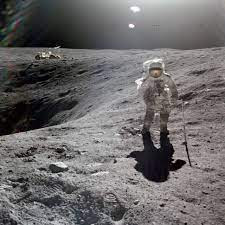
Charles Duke steps on the moon during Apollo 16, April 1972. 
In a poignant post-Trump insight, McRaven writes: “The power of humility is that it brings us closer together, and the role of every hero is to unite people, not divide them.”

Throughout this compact but powerful book McRaven tells stories of true heroes such as Air Force General Charles Duke, the youngest astronaut (so far) to walk on the moon; Marine Private First Class Ralph Johnson, who in 1968 leapt on a grenade and “gave his last full measure of devotion to the men he served with;” Gary Sinise, who selflessly brought educational supplies to a war zone in Afghanistan as part of Operation International Children; and Sen. John S. McCain III, a POW survivor and true American hero, who showed McCraven humility, gratitude, honor, and a sense of humor.


Abraham Lincoln
Being able to laugh at oneself is the sign of strength, and McRaven presents a self-deprecating joke Abraham Lincoln told to people: “(Lincoln) loved to tell the story of a man who approached him on a train one day. The man said, ‘I have an article in my possession which belongs to you.’ Taking a jack-knife from his pocket, the man explained, ‘This knife was placed in my hands with the promise that I was to keep it until I found a man uglier than myself. Allow me now to say, sir, that I think you are fairly entitled to the property.’”

McRaven introduces lesser-known heroes, too, including Navy Capt. Ted Grabowsky, who taught that “honesty is the cornerstone of integrity, the foundation upon which all other aspects of your character will be built.” He tells us of cancer researcher Dr. Jim Allison, who personifies perseverance (and has an interesting connection to the great Willie Nelson). And, he shares a personal story about cancer doctor Michael Keating, who shows that hope and change can be the strongest forces in the universe.


Ten years ago this year McRaven, under Commander in Chief President Barack Obama, commanded the Navy SEALs who brought justice to Osama bin Laden. If that was a career high for him, surely one of his deepest lows came in a separate combat action when some of the military forces under McRaven’s command mistakenly killed two non-enemy sons and a daughter of a father in Afghanistan. In the tenth chapter McRaven relates in heartbreaking detail how he met with that father and how forgiveness can be transforming.

During a Profiles in Leadership seminar, Retired U.S. Navy Adm. William H. McRaven speaks to service members inside the Pfingston Reception Center located on Joint Base San Antonio – Lackland, Texas, Jan. 10, 2018, about character and how it applies to leadership. (TSgt. Ave I. Young)

The "Forgiveness" chapter’s epigram is by Mahatma Gandhi: “The weak can not forgive; forgiveness is the attribute of the strong.” We can tie McRaven’s wisdom –– giving up the burden of hatred –– to the current state of society in 2021: intolerant political correctness, QAnon conspiracies, cancel culture, voter suppression, and domestic extremism and terrorism, including the Jan. 6 insurrection attack on the Capitol –– seeking to divide rather than unite.

“Society today seems to be easily offended. We are quick to anger, and some people believe every offensive act, no matter the intent, requires a swift rebuke. The hardest thing any hero can do is to forgive. It is easier to storm the hill, fight the fire, and stop a madman with a gun. It is hard to forgive, because we are afraid. Afraid that forgiving will take away the anger that drives us, the hatred that motivates us, the righteous indignation of being wronged. We want more than anything to harness the outrage, feel the power of injustice, and the fury of discontent, so we can lash out at the offender and feel justified. We think that retribution, no matter how small or how large, will sooth our soul.

It will not.”

He advises, “Be the victor, not the victim.”


Boatswain's Mate Seaman Apprentice Esau Arellano aboard guided-missile destroyer USS Ralph Johnson (DDG 114), Aug. 4, 2020. (MC3 Anthony Collier)

His code begins with “courage.” He advises, “Take one step forward and face your inner demons. And if you take that one step forward you will find the courage you seek…”


It takes profound individual courage, for example, to confront the universal human truth of our mortality. Which reminds me again of Richard Dawkins, who writes in “Unweaving the Rainbow”: “We are going to die, and that makes us the lucky ones. Most people are never going to die because they are never going to be born. The potential people who could have been here in my place but who will in fact never see the light of day outnumber the sand grains of Arabia.”


In “Hero Code” McRaven gives respect to courageous heroes. He quotes John Adams, William Penn, Mark Twain, Winston Churchill, Anne Frank, Fyodor Dostoevsky, Nelson Mandela, Helen Keller, Sonia Sotomayor, among others.


McRaven distills his perspective on heroism down to each individual. He recommends readers find their talent “and use it to inspire others –– to give hope, to make tomorrow a better day.”


This compact book is packed with bite-sized philosophy, common-sense ethos, and universal wisdom.

Monday, April 5, 2021

‘Forging the Trident’ –– TR and Navy Infrastructure

Review by Bill Doughty

Theodore Roosevelt was appointed as Assistant Secretary of the Navy in April 1897, 124 years ago this month. In that position and later as President of the United States, TR helped build the infrastructure of the modern Navy. But, in his attempt to fortify deterrence, did he build inadvertently toward war a generation later?


Editors John B. Hattendorf and William P. Leeman draw up their own blueprint of TR's history with the Navy. They deploy a team of scholars, historians, and essayists to construct an argument for TR’s remarkable role to transform the Navy in “Forging the Trident: Theodore Roosevelt and the United States Navy” (Naval Institute Press, 2020). In complementing essays, various authors show TR’s leadership and influence after the Civil War, through the Spanish-American War and World War I, and –– through his cousin FDR –– in World War II.

TR was born three years before the start of the Civil War. His father was an ardent supporter of the Union, but members of his mother’s family were part of the Confederacy. In fact, his maternal grandparents were slave owners, and his uncles served in the Confederate navy, which is where TR acquired his love of ships and the open ocean.


The authors of “Forging the Trident” show how TR, who came from the party of Abraham Lincoln, negotiated and cajoled to keep the South and North united. Author Sarah Goldberger writes about the politics of reconciliation in “An Indissoluble Union.”

“Upon Roosevelt assuming the presidency, southern Republicans immediately approached him on the importance of taking control of the Republican Party in the South. John Wise, a lawyer from Virginia who now lived in self-appointed exile in New York, brought Roosevelt up to date on the sad state of affairs in Virginia –– that the commonwealth, like the other southern states, would soon disfranchise black voters. Some Republicans –– ‘Lily Whites,’ as they were called –– believed that this was perhaps a good thing, as it would make white men more likely to join the Republican Party; other Republicans saw the elimination of the black voters as fatal to the party. Wise, who considered himself in the latter category, served as the attorney of a group of black plaintiffs who fought disfranchisement. As president, Roosevelt became immersed in the very complex intersection of southern racial politics and federal patronage. Although the majority of federal employment now required civil service examinations, there was still patronage enough to bestow, such as the coveted position of local postmaster.”

TR became determined to change the system of discriminatory and patriarchal patronage into a merit-based system that rewarded performance.


“Roosevelt was determined to appoint only the most qualified people,” Goldberger writes. He invited Booker T. Washington to dinner at the White House to help judge African American appointees, but the backlash from white Southerners was extensive (and would have a lasting effect until the Nixon presidency).

TR delivers a speech on U.S. naval preparedness, Haverhill, MA, 1902.

Following in the footsteps of Lincoln, TR put his faith in the Constitution, the Union, and progressive values. He was also a champion of the environment as a true conservative and conservationist. And he strongly supported the Navy throughout his life.


Under TR’s leadership, the Navy enacted the Personnel Act of 1899. He wanted every Navy officer to be an engineer. He saw the advent of submarines and supported the possibility of developing “flying machines,” including for the Navy. Roosevelt communicated –– like few before him –– the need for public support for the Navy and understanding of its global maritime mission.


In “Checking the Wake While Looking Beyond the Horizon,” David Kohnen observes this about infrastructural changes in the Navy and nation after the Civil War as the country looked beyond its own borders:

“The naval outlook of Roosevelt reflected the confidence associated with industrialization and economic prosperity. Americans viewed the U.S. Navy as a symbol of national unity, as the Reconstruction era culminated in the stunning success of the Spanish-American War. The oceanic borders having been connected with the transcontinental railroad, the armored warships driven by coal-fired steam propelled the U.S. Navy forward in the global maritime arena. The economic rise of the United States remained closely connected to the watery lines of maritime communications –– as the empires of Europe and Asia also competed for economic dominance through naval power.”

Forward-thinking Roosevelt believed in having an international profile. And he strenuously promoted naval innovation.


TR
Under TR, the Navy shifted from coal to oil, deployed wireless communication, and developed new gunnery for its large battleships. “Forging the Trident” explains in several essays how Lt. Cmdr. William S. Sims –– with the support and protection of Roosevelt –– became more influential than most admirals and captains in the era of change in the early 20th century, often in the face of opposition from older traditionalists.


The ghost of Adm. Alfred Thayer Mahan haunts this book. In fact, Mahan’s name appears in all but one chapter. TR owed much to Mahan. But, as president, Roosevelt saw that the great geostrategic theorist was also a bureaucratic authoritarian whose “apostasy” stood in TR’s way. So, in order to advance many of the new technologies and strategies of the time, TR gently nudged him into retirement.


Kohnen writes, “As for Mahan, in late 1914 he died, as did the era of coal and multi-caliber battleship guns … The death of Mahan enabled the generation of Sims to pick up the torch in defining the future of American sea power.” 


Volatility extended to the top level of Navy leadership. Historian Branden Little lays out a fascinating review of TR’s turnover of SECNAVs –– six men served as Navy Secretaries during TR’s time as president.


FDR
In another chapter, “Legacy,” Craig Symonds presents an thoughtful look at the similarities as well as the differences between TR and his cousin FDR. “Among their shared values was a belief that government had both the authority and responsibility to proactively improve the lives of American citizens.”


Both men held the same jobs, and both had to be reigned in during their tenures as Assistant Secretary of the Navy. FDR, who married TR’s niece Eleanor, shared “Uncle Ted’s” deep love of the maritime service. He continued TR’s commitment to preparedness of a powerful, modern fleet able to have an impact on the international stage. As presidents, however, FDR proved to be more cerebral and cautious –– and perhaps more effective than TR as a communicator and consensus-builder. FDR, working with allies and former enemies, built a lasting infrastructure of a post-war era of peace for Europe and Asia.


Navy Reads readers may find James R. Holmes’s essay to be the biggest gem in this collection. It appears in chapter 9 and is titled “Why Deterrence Failed: The Imperial Japanese Navy, Strategic Memes, and the Great White Fleet.” 


Using Richard Dawkins’s insights about memes –– published in “The Selfish Gene” –– as a way to explain the history, psychology, and sociology leading to WWII, Holmes examines TR’s strategy to deploy the Great White Fleet as a “Big Stick” intended to show the world the power, prestige, and peacekeeping abilities of the United States.


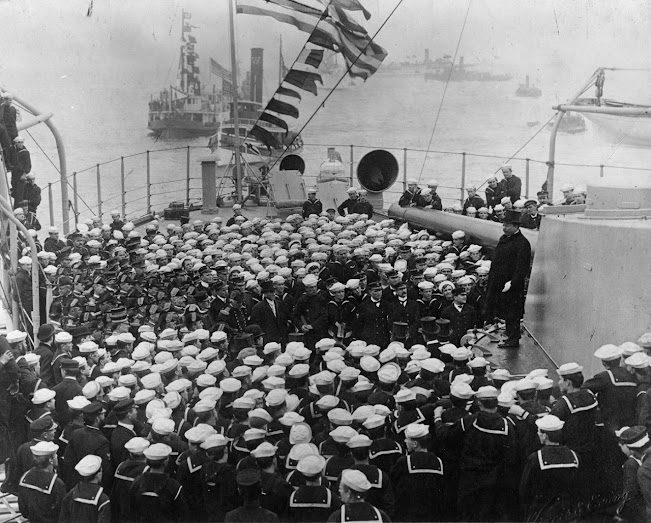
President Theodore Roosevelt addresses sailors on the after deck aboard USS Connecticut (Battleship #18), in Hampton Roads, Virginia, Feb. 22, 1909. (NHHC)

But was the GWF actually a deterrent? TR may not have fully appreciated the nationalism memes running through Japanese society after the IJN’s victories in the Sino-Japanese War, 1894-95, and Russo-Japanese War, 1904-05, which “forged the IJN’s access-denial strategy.” TR believed the circumnavigating voyage would foster peace. “The truth is murkier,” Holmes says. In the end, the GWF “message” may have piqued Japan’s pride and hubris –– an incentive for militaristic Japan to build the IJN even stronger, leading to an inevitable clash over Hawaii and the Pacific during FDR’s presidency.

Holmes’s conclusions –– and the legacy of both TR and FDR –– are relevant when thinking about innovative infrastructure initiatives in the United States in 2021.

“Few institutions are are exempt from bureaucratic dynamics –– or stasis. Dynamists typically fare better in armed competition than services set in their ways. Perhaps the way to remain supple and innovative is for top leaders to inscribe one indelible precept on the institutional culture, setting it above all others: No Precept Is Forever. That is one meme worth making permanent. The Imperial Japanese Navy offers an example to avoid –– or to exploit if some future foe appears likewise prone to fixed ideas.”

Reading “Forging the Trident” is like sitting alone with gifted historians and informed communicators telling you about how a great president served as a key architect of the modern Navy at the beginning of the last century. Editors Hattendorf and Leeman have succeeded in designing an indispensable edition –– and addition –– to the Roosevelt bookshelf. No precept is forever, but some concepts can last and improve over time.


OYSTER BAY, New York (Oct. 26, 2018) Cmdr. Julie Schmidt (right), the commanding officer of Navy Operational Support Center Long Island, and Cmdr. Christopher Kendrick, the executive officer of Navy Recruiting District New York, saluting a presidential wreath after placing it beside the grave of President Theodore Roosevelt in Youngs Memorial Cemetery. Students from nearby Theodore Roosevelt Elementary School were on hand to place flowers and play "Taps" to commemorate his birthday. (U.S. Navy photo by Bruce Howard/Released)

Monday, May 6, 2019

Clarence Darrow's Love of Life, Sea, Liberty

Clarence Darrow
Review by Bill Doughty––

Read Darrow's autobiography, "The Story of My Life" (Scribner, 1932), and you can see the great attorney's love for life, critical thinking, and the sea.

Darrow, famous for his courtroom oratory on behalf of (usually) the underdog or "the damned," was a complicated and compelling figure and a deep thinker.

Early in "Story" he contemplates the difference between youth and old age, using some nautical themes:
"The young man's reflections of unfolding life concern the future – the great, broad, tempestuous sea on whose hither shore he stands eagerly waiting to learn of other lands and climes. The reactions and recollections of the old concern the stormy journey drawing to a close; he no longer builds castles or plans conquests of the unknown; he recalls the tempests and tumults encountered on the way, and babbles of the passengers and crew that one by one dropped silently into the icy depths. No longer does the aging transient yearn for new adventures or unexplored highways. His greatest ambition is to find some snug harbor where he can doze and dream the fleeting days away. So, elderly men who speak or write turn to autobiography. This is all they have to tell, and they cannot sit idly in silence and wait for the night to come."
Darrow the philosopher sounds like another reasoned thinker, Richard Dawkins, in finding a humble perspective as he introduces his autobiography:
"Doubtless a certain vanity has its part in moving me to write about myself. I am quite sure that this is true, even though I am aware that neither I nor any one else has the slightest importance in time and space. I know that the earth where I have spent my life is only a speck of mud floating in the endless sky. I am quite sure that there are millions of other worlds in the universe whose size and importance are most likely greater than the tiny graveyard on which I ride. I know that at this time there are nearly two billion other human entities madly holding fast to this ball of dirt to which I cling. I know that since I began this page hundreds of these have loosened their grip and sunk to eternal sleep. I know that for half a million years men and women have lived and died and been mingled with the elements that combine to make our earth, and are known no more. I know that only the smallest fraction of my fellow castaways have even so much as heard my name, and that those who have will soon be a part of trees and plants and animal and clay. Still, here am I sitting down, with the mists already gathering about my head, to write about the people, desires, disappointments and despairs that have moved me in my brief stay on what we are pleased to call this earth."
1917 recruiting poster, courtesy NHHC
In a later chapter, Darrow writes this about our collective journey through life: "We are like a body of shipwrecked sailors clutching to a raft and desperately engaged in holding on ... The best that we can do is to be kindly and helpful toward our friends and fellow passengers."

Darrow's self-deprecation and sharp wit are revealed periodically. About his first name, Clarence, which he considered his "cross" to bear, he reveals: "The one satisfaction I have had in connection with this cross was that the boys never could think up any nickname half so inane as the real one my parents adorned me with."

He discusses books, reading and education; fundamentalism and science; free will and justice; inequality in society; civil rights and the Ku Klux Klan; prohibition; cause and effect; capital punishment; religion; and war, especially the First World War. WWI was thought then to be the war to end all wars.

In analyzing the "Great War" and its causes, Darrow understands Germany's desire for expansion and access to the Atlantic as well as England's desire for superiority in controlling the seas. "England wished to own the seas, because to control the seas meant to control the lands."

Darrow believed in building toward and sustaining peace, but his pacifism turned quickly to support for U.S. involvement after Germany invaded Belgium. "I discovered that pacifism is probably a good doctrine in time of peace," he wrote, "but of no value in war time."

Darrow and his nemesis William Jennings Bryan at the Scopes Trial
His personal lifetime war was against intolerance, greed, injustice and hate. He shows sharp wit in describing one of his chief adversaries, William Jennings Bryan. Bryan was the attorney who prosecuted John T. Scopes in the "evolution case" in Dayton, Tennessee but who was trumped by Darrow. Here's Darrow's no-holds-barred description of Bryan, who he said "represented the spirit of intolerance":
"He had greatly changed in recent years. The one-time sense of humor that softened his nature had been driven out by disappointments and vain ambitions. In his last days he had the appearance of one who felt the injustice of many defeats and welcomed the chance to get even with an alien world. He did not grow old gracefully. Instead of disarming the enemy with a smile and a joke as once was his wont, he now snarled and scolded when any one stood in the way of his dreams ... The merry twinkle had vanished from his eyes, his head was entirely bald save for two tufts of bristles back of the ears, his thin lips set in a long straight line across his face, his huge jaw pushed forward, stern and cruel and forbidding, immobile and unyielding as an iron vise. His speculations had ripened into unchangeable convictions. He did not think. He knew. His eyes plainly revealed mental disintegration. He had always been inordinately conceited and self-confident, but he had not been cruel or malignant. But his whole makeup had evidently changed, and now he was a wild animal at bay. I told my associates that I could see the rapid decay that had come upon him. He had reached a stage of hallucination that would impel him to commit any cruelty that he believed would help his cause. History is replete with men of this type, and they have added sorrow and desolation to the world."
Daguerrotype of Ralph Waldo Emerson
Darrow shows his own patriotism and strong faith in America as well as his love for liberty and the Constitution in references throughout this book, including this one:
"Emerson long ago said that a good citizen should not be too obedient of the law. Men came before laws, and will be here after laws are in limbo. Nothing is so loved by tyrants as obedient subjects. Nothing so soon destroys freedom as cowardly and servile acquiescence. Men will never have any more liberty than they demand and are ready to fight and preserve."
He condemned prohibition, comparing the Eighteenth Amendment to the alien and sedition laws that were passed under President John Adams but opposed by "the giant figure and vigorous intellect of Thomas Jefferson." When Jefferson became president he demanded Congress repeal the alien and sedition laws, which Congress, as the co-equal branch of government, did. "The statesman knows that laws should be like clothes, made to fit the citizens that make up the State," Darrow said.

Multilateral operations in the Mediterranean Sea ,March 26, 2019. (MC2 Krystina Coffey).
In chapters "A Year in Europe" and "Learning to Loaf," Darrow waxes about his travels in Great Britain, France and Switzerland. He name-drops meeting W. Somerset Maugham and H. G. Wells among other notables of the time. And he offers this nautical reflection about one of the Seven Seas of the Middle Ages:
"As a rule, I am not given to sentiment over inanimate things or historical events. But, somehow, I could never think of the Mediterranean Sea, much less look at it, without being profoundly moved by its remarkable story. The earliest, and even the latest civilization was closely hugged her shores. The first knowledge we have of man's origin and development clings to its blue waters. The first ships of which we have record sailed those beautiful waters. One after another, nations and civilizations have risen and vanished around the Mediterranean Sea. Egypt, Asia Minor, Arabia, Syria, Greece, and the Roman world; Spain, Italy, France, all have been washed by this sea. The Pharaohs, Caesar, Pompey, Hannibal, Anthony and Cleopatra, too, made the Mediterranean immortal in history, song and story. Even now it lies in the heart of the civilization of the world. Most of the history of the Western world has been written there, and no other body of water anywhere near its size has the same importance in the world."
Darrow's worldview is understandably Western-oriented. No doubt, he would have benefited from travel and more exposure to Asia. Nevertheless, he experienced and appreciated his Hawaii when he visited in the early 1930s. Then and now, Hawaii is a melting pot of East and West.

A view of Diamond Head Crater from the National Memorial Cemetery of the Pacific, "Punchbowl" in August 2017. (Master Sgt. Kendra M Owenby)

Darrow closes his book with this passage, reminiscent of Mark Twain's love for the Hawaiian Islands, again with a maritime perspective:
Oahu (NASA)
"[F]rom the morning when I opened my eyes to see Diamond Head towering from the soft South Seas, standing guard, with its huge light at its pinnacle, over this picturesque place, to the afternoon when I slowly floated away, watching Diamond Head fade from my sight, lost in the mist, I loved Honolulu and the island that it adorns. I realize that many things enter into one’s likes and dislikes of people and places, and I am aware that everything somehow seemed to conspire to impress me with the beauty and charm of this land; somehow, I have never seen such a gem as Oahu, rising from the mighty ocean that rolls over the coral reefs, to wash the shores of that fairyland. Her gentle mountains, her tropical forestry, her warm, hospitable people, and the perfume of flowers in varieties unlike anything I have found anywhere else will be among my most lasting and pleasing memories. How kind and friendly people were! I dare not attempt to speak of them individually, for it is not easy to say that one impressed me more than another; but some portraits are indelibly etched upon my brain, and some pictures will reappear and delight me to the last of my days. I would like very much to go back, to see and enjoy it all once more, as it is. And I should like to find it still more enchanting in that Nature specially fitted this magic spot to help work out the old problem of race with its loves, its hatreds, its hopes and fears. It seems fit that the Hawaiian Islands, basking in the great sea between the oldest and newest civilizations of the world, might one day lead the union of the diverse races of man. I would like to believe that this favored land might prove to be the place where the only claim to aristocracy would be the devotion to justice and truth and a real fellowship on earth. Perhaps I am only dreaming about Honolulu. But whether asleep or awake, I trust I may see it all again ... away from the stress and strain of court and contention to rest and talk, and even listen, about the endless problems that have ever been too deep and complicated for the minds of men. From there, I would like to gaze again upon those wonderful waters that have come almost a third of the distance around the earth to greet and charm me. I would like once more to watch the rows upon rows of waves as they dash into foam and iridescent colors over the coral reefs that protect the shore... I hope I shall see Honolulu again, its palms, its Pali and Diamond Head, its flowers and friends – and if I weary of too much beauty and joy, I may steal, once more, to the shelter of that veranda beside the sea for a still longer siesta in the shade of the cocoanut (sic) trees, close my eyes to all else, rest my mind from thinking, let the lull of the salt breeze soothe my senses, and mayhap sweetly dream that I am softly sailing out over the languorous Pacific, midst showers of 'liquid sunshine' – surrounded by daylight and moonlight rainbows – never to come back again."
Writing at 75, Darrow also expressed a longing to revisit Europe and see the Mediterranean once more, traveling across the Atlantic by ship, and seeing that voyage again as a metaphor to life's journey. How we plan and conduct our lives requires flexibility and resilience: "The mariner who steers his ship across the sea does not fasten the rudder so that he will straight ahead; the best he can do is to change his course according in time and tide and wave and wind, keeping in view only the general direction and the journey's end."

Sunday, December 9, 2018

New York Says What to Read. Wait, What?


Review by Bill Doughty

The trouble with a book that recommends 1,000 books for your bucket-list is this: What prism is the editor/compiler looking through.

"A Thousand Books to Read Before You Die" (Workman Publishing, 2018, New York, NY) is a beautiful book offering an impressive spectrum of colorful titles and great authors.

You'll find great writers and thinkers like Isaac Asimov, Ulysses S. Grant, Maya Angelou, Stephen J. Gould, George Orwell, Mark Twain, Leo Tolstoy, Oliver Sacks, Homer, Dorothy Parker, D.H. Lawrence, J.K. Rowling, Jon Krakauer and Agatha Christie.

There are a relative handful of selected books that would appeal to Navy readers, including Tim O'Brien's "The Things They Carried," Tom Clancy's "The Hunt for Red October," Erich Maria Remarque's "All Quiet on the Western Front," "The Personal Memoirs of Ulysses S. Grant," Shelby Foote's "The Civil War," Robert Hughes's "The Fatal Shore," William Manchester's "Goodbye Darkness," John Keegan's "The Face of Battle," David McCullough's "Truman," David Halberstam's "The Best and the Brightest," Herman Melville's "Moby Dick," Ernest Hemingway's "The Old Man and the Sea," Kurt Vonnegut's "Slaughterhouse Five," Joseph's Heller's "Catch-22" and Orson Scott Card's "Ender's Game":
"...Just try to put it down. Tracing Ender's path to Battle School – a space center in which the best and the brightest children are trained for high-tech war – and, ultimately, to Command School, on the edge of the interstellar front lines. Orson Scott Card's novel is riveting... Ender's fierce initiation reveals his unparalleled gifts for warfare. As the stakes mount, the simulated battles he dominates are transformed from complex and dangerous games into sinister – and spectacular – realities."
Author James Mustich features his one thousand books, mentions many others and merely names a slew of extras. In other words, there are thousands of books discussed in this readable, interesting and hefty offering: a beautiful book about books.

So, what's the problem?

BM3 Ivan Naranjo reads aboard USS Anchorage (LPD 23), 2018. Photo by MC3 Ryan M. Breeden
As great as this book is, the personal lens of the editor understandably distorts reason, trumps objectivity, and begs questions as to how some of the authors and their works were selected. 

I mean, Anne Rice? Moss Hart's show business autobiography? Richard Ford's adventures in making artisan bread and pizza? "Adventures on the Wine Route: A Wine Buyer's Tour of France"? "When French Women Cook"? "Between Meals: An Appetite for Paris"? "The Auberge of the Flowering Hearth"? 

Mustich, a New York bookseller with an apparent deep love of fashion, fine dining, Broadway, the Big Apple, Provence and France, all but admits his bias and certainly is upfront about his selections not being perfect. "Hot dogs to haute cuisine," as he says. But if comfort foods of literature are allowed, where are Edgar Rice Burroughs, Mario Puzo, Louis L'Amour and Zane Grey?

Stephen King gets "Carrie" and "11/22/1963," but where are "The Stand," "The Shining" and "Cujo"?


William Shakespeare
As one would expect from a polished bookseller, this is like a bookstore readers can hold, complete with a detailed general index and 1,000 book checklist.

Overall, Mustich does a pretty good job of ensuring diversity, including different age groups and interests – both fiction and non-fiction; poetry and philosophy; youth and adult; U.S. and international; escapist and pay-attention-this-is-important.

The Bhagavad Gita, Bible and The Book of Job find themselves co-located, thanks to alphabetical listings, as are Plato, Pliny the Younger and Plutarch. Shakespeare is the overall winner in number of works listed, with 13 titles.

Nice surprises include personal favorites such as Gould's "The Panda's Thumb," Loren Eiseley's "The Immense Journey," Larry McMurtry's "Lonesome Dove," Richard Dawkins's "The Selfish Gene," "Portable Dorothy Parker," Taylor Branch's "Parting the Waters," "Narrative of the Life of Frederick Douglass, an American Slave," Carl Sagan's "Dragons of Eden," Edward O. Wilson's "The Naturalist," and Charles Darwin's "The Voyage of the Beagle."

Thankfully there's a heavy helping of science, including Thomas's wonderful collection of essays, "The Lives of a Cell":
"Every genre has its native charms, and the allure of the essay is its easy way with rumination. In the best examples of the form, the essayist communicates not just learning, but thinking, inviting the reader to share the satisfactions of a mind at play on a field of observation or experience. When an essay's author is as masterful as Lewis Thomas, it can shine like a jewel, glittering with truths small and large."
But where are shining lights by Christopher Hitchens, Steven Covey, Desmond Morris ("The Naked Ape"), John Hersey ("Hiroshima"), Thomas Paine ("The Age of Reason"), Steven Pinker, William Zinsser, Mary Roach, Craig Symonds, Jared Diamond, Nathaniel Philbrick, Erik Larson, James D. Hornfischer, Hector Hugh Munro a.k.a. Saki, Doris Kearns Goodwin, Thomas Friedman, Noah Yuval Harari and Stephen Hawking?

It's a tragedy that Mary Roach and Hope Jahren ("Lab Girl") are missing.

So many great authors are left on forgotten shelves, so many books. It can be difficult to choose any individual one. That's where a book like this can help. Perhaps there will be more versions of "1,000 Books to Read" – even someday "1,000 Navy Books to Read."

Bazelon, Richardson and Plotz of Slate's Political Gabfest.
This book first came to my attention after hearing it recommended by David Plotz, anchor of Slate Magazine's Political Gabfest podcast with Emily Bazelon and John Richardson.

Plotz said this about editor Mustich: "He's a reader of such joy and bouyancy. ... He has a real knack for recognizing what in a book is wonderful ... He's a spirit you'll want to spend time with."

And Plotz said this about the book itself: "Over 948 magnificent pages, well-illustrated. The familiar and the highly unfamiliar ... It's so much fun."

Gabfest's John Dickerson said, "So, does that make it a thousand and one?"

The best endorsement may be through the prism of writer, historian, producer Ken Burns: "If you've ever doubted that books were the greatest invention of all time, and that they carry within them our collective memories and dreams as well as any semblance of intelligence we have as a species, pick up this book and start reading."

Sunday, April 1, 2018

Science Evangelist: Climate Blasphemy?

Hope Jahren presents to a joint audience at NOAA, Pearl Harbor, April 10, 2017 (MC1 Troutman),
Review by Bill Doughty

Friend of Navy Reads, Hope Jahren, author of "Lab Girl," edits "The Best American Science and Nature Writing 2017" (Houghton Miflin Harcourt Publishing Company, 2017).

Jahren reminds us that "science is essential and frivolous, jubilant and despairing, lovely and brutal, perfect and broken – all at the same time – just like the scientists who fashion it." 

She brings us essays on emerging fields of study, changing areas of our world, and the "real life" of scientists, warts and all, who wonder, discover, contemplate and explain.

In her introduction Jahren focuses on a theme that runs throughout this book and appeared in "Lab Girl": the effects of increasing carbon in our atmosphere and the resulting climate change and inevitable impacts: hotter summers, more severe storms and rising seas.

Hayhoe quotes from authors of the Bible such as Peter and John.
Sounds Old Testament, right? Which is fitting because one of the best works in this collection is by Sonia Smith, "Unfriendly Climate," from Texas Monthly, about a compelling scientist named Katharine Hayhoe who uses the Bible to explain why people should care about climate change, not just as a scientific issue, but also "a moral issue." Hayhoe consults for DOD and other agencies.

Called by others a "climate-change evangelist," Hayhoe says, "I feel more like a Cassandra, or an Old Testament prophet spreading bad news." 

But Hayhoe, we learn, is also optimistic about the opportunity to preach about renewable energy and the potential for solar and wind energy to eclipse our reliance on fossil fuels – especially in her home state of Texas.

The CoServ Solar Station in Krugerville, Texas. (Photo by Ken Oltmann)
Author Sonia Smith writes: "Over the past 15 years, climate change has emerged as one of the most polarizing issues in the country, ahead of guns, the death penalty and abortion." Yet, the basic science was worked out more than a century ago when scientists Joseph Fourier, Jon Tyndall and Svante Arrhenius came up with and proved the greenhouse effect of carbon dioxide in the atmosphere.
"Today there is robust scientific consensus that global warming is 'real, caused by humans and dangerous'; a study found that 97 percent of climate scientists agree with those conclusions. The Department of Defense calls climate change a 'threat multiplier,' because it exacerbates existing problems. And the year 2015 was the warmest on record, breaking the previous mark, which was set in 2014."
Katharine Hayhoe hopes. (Photo by M. Voelker)
Hayhoe, we read, uses passages from the Bible in her slide presentations to make her point, including this New Testament quote from John 13:34-35" "Let me give you a new command: Love one another. In the same way I loved you, you love one another. This is how everyone will recognize that you are my disciples – when they see the love you have for each other."

Agnodike (or Agnodice), Greek scientist.
In another essay we learn about ancient women scientists who contributed to their societies in Greece, Egypt and Babylon: Agnodike, Aglaonike, Hypatia, Aspasia, Merit Ptah, Tapputi, Artemisia and En Hedu-Anna.

The writers who contributed to this volume take us from the mountains and jungle of Virunga to the icy edge of the Arctic, from Assateague Island on the East Coast to Houston and Los Angeles, from the Marshall Islands south to the Chukchi Sea north, from our own DNA to the Milky Way and beyond.

We explore a wide spectrum of topics: effects of overuse of antibiotics, study of rats in Vancouver, hot Santa Ana winds, evolution of altruism, wave piloting, use of public wilderness lands, darkness studies, gravity and quantum theory, space exploration, and down-to-earth investigations of sexual harassment in the workplace.

Elizabeth Kolbert and Eric Rignot in Greenland, where Kolbert reports on the shrinking ice sheet.
But the stifling threats to the world's climate resurface time and again throughout this book. Elizabeth Kolbert's remarkable "A Song of Ice," published in the New Yorker, explains calving and melting ice in Greenland, at the U.S. Army outpost Camp Century and beyond. "I keep finding myself drawn back to the ice – to its beauty, to its otherworldliness, to its sheer, ungodly significance," Kolbert writes.
"I first visited the Greenland ice sheet in the summer of 2001. At that time vivid illustrations of climate change were hard to come by. Now they’re everywhere—in the flooded streets of Florida and South Carolina, in the beetle-infested forests of Colorado and Montana, in the too warm waters of the Mid-Atlantic and the Great Lakes and the Gulf of Mexico, in the mounds of dead mussels that washed up this summer on the coast of Long Island and the piles of dead fish that coated the banks of the Yellowstone River."
In a New York Times Magazine piece by Nathaniel Rich, "The Invisible Catastrophe," we read that "the World Health Organization has called climate change the greatest health threat of the 21st century." Rich writes about the godawful health effects to people and pets from methane gas pollution in Aliso Canyon, Orange County, California.
"The most dangerous threats to our species are precisely those that are most difficult to visualize: long-term, slow-to-emerge, amorphous. These threats include not only warming temperatures but also mutating viruses and political corruption and tend to be invisible, dimensionless and pervasive, like death. Like natural gas."
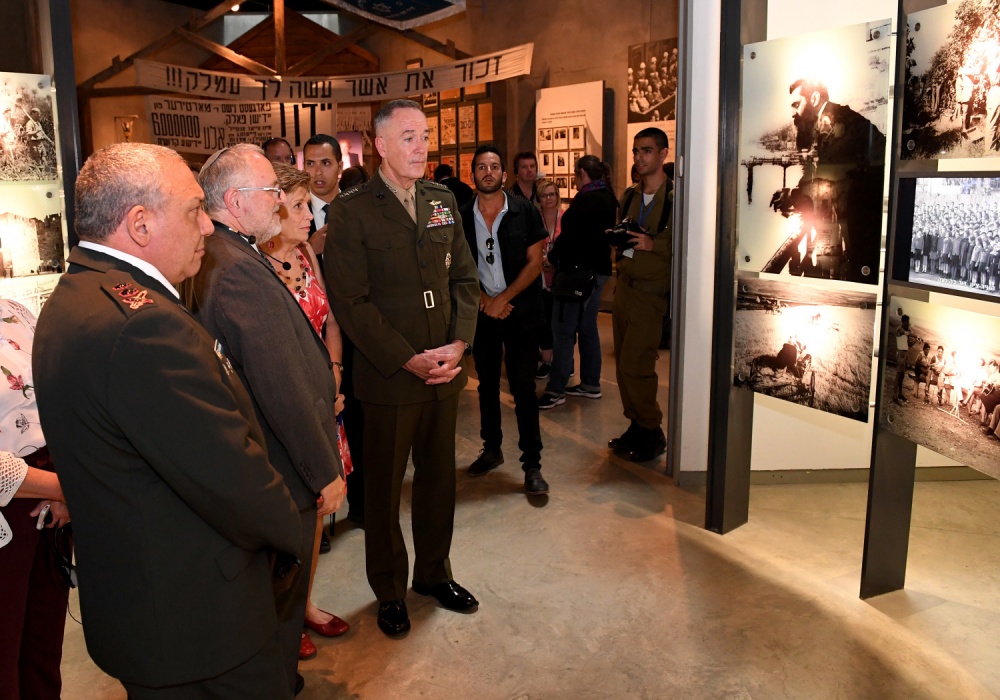
CJCS General J. Dunford tours Yad Vashem Holocaust Memorial Museum May 9, 2017.
Tim Folger is the series editor for "The Best American Science and Nature Writing," and he writes a passionate plea for freedom of research, respect for the truth, and the need to heed reality. He compares attacks on science to events in Germany in the 1930s, when mobs of young men burned the works of scientists and Jewish writers considered blasphemous to the Nazis. Authoritarianism thrives when the free press, justice system and electoral process are threatened.
"One measure of the health of any modern society must be the degree to which it supports its scientists. A few days before I started to write this foreword, hundreds of thousands of people in dozens of cities across the country participated in the March for Science. It was an event at once inspiring and worrisome: inspiring because so many took a stand for rationalism ... worrisome because who would have thought that in the 21st century scientists and citizens would feel the need to gather in support of something so self-evidently valuable as unfettered scientific research?"
Hope Jahren joins a roster of other great science writers who have helmed the series since it began in 2000, among them: Oliver Sacks, Steven Pinker, Edward O. Wilson, Richard Dawkins, and another friend of Navy Reads, Mary Roach.

In Jahren's introduction to this volume, she jumps into a charge of "allegorizing human endeavors by way of plant biology," something that makes "Lab Girl" so personal and relatable. Jahren studies how extra carbon dioxide in the atmosphere helps some plants thrive, and she tests how much may be too much.

"Right here, right now, I'll suggest that the Internet is like carbon dioxide for science writers, who are themselves like plants, and that we are living in an unprecedented era of diverse and thriving journalism in the service of science – albeit one that could be cut off and mowed down if we don't actively value and defend it."