Showing posts sorted by relevance for query War of 1812. Sort by date Show all posts

Sunday, January 1, 2012

1812: The Navy’s War


by Bill Doughty
We don’t know what we don’t know, and ignorance of history condemns us to repeat past mistakes.
That could explain why the bicentennial of the War of 1812 -- which has lots of lessons from the past, of the present, and for the future -- is so important to the Navy.
It was:
  • Our second war for independence;
    • A war with Great Britain and Canada, now among our strongest allies; and
    • A rebirth for the U.S. Navy, inspiring the Star Spangled Banner.
    Author George C. Daughan gives a Navy-oriented history lesson in his 2011 overview, 1812: The Navy’s War.  A reading of the history of the War of 1812 teaches why this conflict was so important to the nation’s development, especially as a world economic power.
    We see familiar themes and how they apply today in chapters like “Free Trade and Sailors’ Rights,” “Jefferson’s Embargo and the Slide to War,” and “From Temporary Amistice to Lasting Peace: The Importance of the War.”
    The book reveals how the Navy committed to being a blue water, forward-deployed and ready force for a nation that was less than 40 years old, just 25 years since the Constitutional Convention of 1787, and a mere five years after two big milestones: Robert Fulton development of the first practical steamboat and the British Parliament’s declaration that it was illegal to buy, sell and transport slaves.
    Daughan shows that the strength of the Navy -- demonstrated at Lake Erie, Plattsburgh Bay, Baltimore and New Orleans -- proved to the British that their former colonies made a formidable partner.  The collaboration and cooperation earned on the seas and in the littorals in 1812 would prove invaluable in the next century in two world wars.
    Madison - Painting by Chet Jezierski 
    The book begins and ends with a discussion of economics and commerce.  President Madison was enthralled with the British Empire’s economic might but, like Thomas Jefferson, championed the more French ideals of human rights and equality.
    Daughan shows how Madison’s pragmatic approach with former enemies and strategic conduct of the War of 1812, “within the confines of the Constitution,” contributed to lasting military and diplomatic success.  “In conducting himself in this manner, he immeasurably strengthened the democratic forces that had been building in America since the start of the Revolution and that had accelerated under Jefferson.”
    1812: The Navy’s War inspires the reader to think about the rise of nationalism, the effects of the Industrial Revolution, and everything else that was happening in the world during that pivotal time, including and how it might affect history in generations to come:
    • 1812 - Napoleon led his Grand Army from France, Germany and Poland into Russia (read Tolsoy’s War and Peace), which had just finished fighting the Russo-Finnish War and was already fighting the Russo-Turkish and Russo-Persian Wars; 
    • From 1808 to 1813 - Napoleonic Peninsular War in Spain and Portugal;
    • From 1811 to 1818 - the Egyptian war with Wahhabis, with Egyptian forces retaking Mecca from the Wahhabis in 1813;
    • From 1811 to 1825 - Latin-American wars of independence;
    • 1812 - Russian establishment of Fort Ross outpost near Bodea Bay in Northern California, Fort Ross. (The Russians tried to lay claim to Alaska in the previous century and established three forts on Kauai, Hawaii beginning in 1817.)
    • From 1804 to 1813 - Serbian Insurrection (with WWI implications); and 
    • 1812 - Siamese invasion of Cambodia.
    Connecting all of those nations, directly or indirectly: the world's oceans and a still-developing world economy.  The slogan for the bicentennial is  "America's Navy... Keeping the sea free for more than 200 years."  The Navy has a 200-years-ago-today timeline on its 1812 bicentennial site as well as an interactive map, historic paintings, classroom curricula, and a list of events, starting with the Navy's kickoff event in April 2012 in Washington, D.C.

    Last year we reviewed books tied to the Centennial of Naval Aviation.  This year we look forward to exploring the significance of the bicentennial of the War of 1812 and how it shaped the Navy, the United States and the world.


    The USS Constitution had a special role to play in 1812, as did its skipper.
    According to history.navy.mil: "Captain Hull's time on Constitution was eventful. He took the ship on a European cruise in 1811-12, returning home before the War of 1812 broke out between the United States and Great Britain. An enemy squadron closely pursued his ship off the East Coast in July, but Hull skillfully evaded them. On 19 August 1812, Constitution encountered the British frigate Guerriere at sea and pounded her to a wreck in an action that electrified the Nation and demonstrated that the small U.S. Navy was a worthy and dangerous opponent for Britain's otherwise overwhelming maritime might."

    Sunday, August 11, 2013

    Picturing the War of 1812, ‘Rise of U.S. Navy’

    Review by Bill Doughty

    National Geographic’s gorgeous “The War of 1812 and the Rise of the U.S. Navy” is a coffee-table book that is literally a work of art.

    The pages pop with high-resolution photographs of paintings, drawings and artifacts reminiscent of the great Dorling Kindersley DK Eyewitness Books (works of nonfiction from England for all ages, with sharp visual-bites of illustrations, information and insights) on topics of science, history and exploration.

    Like some of the DK books, “The War of 1812 and the Rise of the U.S. Navy,” produced under the auspices of the Naval History and Heritage Command, is both nonlinear and linear; readers can open for a rewarding browse or follow events from 200 years ago in chronological order.  

    For example, if you want to see what was happening 200 years ago this month, turn to page 140.  In August 1813, as Lt. Thomas MacDonough rebuilt a small force led by the sloops President, Commodore Preble and Montgomery, on Lake Champlain a British squadron attacked American facilities.

    Meanwhile, British Commodore Sir James Lucas Yeo, aboard his flagship HMS Wolfe, played a cat-and-mouse game with Captain Isaac Chauncey while confronting storms on Lake Ontario, in which two armed schooners, Hamilton and Scourge were lost, along with more than 70 sailors.

    “Neither commander, it seemed, had anything to spare for Lake Erie,” the authors write.

    The book focuses on the events, equipment and personalities -- and drama -- of the war.  Commodore Oliver Hazard Perry is shown as an honorable leader facing the British at Lake Erie in August 2013 leading up to the inevitable confrontation.

    “By August, a bad situation was made much worse when Perry's little flotilla effectively blockaded Barclay (in charge of the gunboat division on the St. Lawrence River before assuming command of the Provincial Marine squadron with HMS Detroit on Lake Erie under appointment by Commodore Yeo) in Amhertsburg.  The specter of starvation then reared its ugly head; it was critical that the water highway to the east be reopened.  The young Royal Navy lieutenant could no longer resist the pressure to give battle.  Off Malden, the Americans staked out his operation, finding him and his men hard at the task of making preparations for engagement.  Detroit was almost, but not quite, ready.  Some of Perry’s officers recommended striking them unawares, but Perry wouldn’t have it. ‘No,’ he said.  ‘I will take no dishonorable advantage of them, but wait until they get in readiness, and meet them fairly and openly on the lake.”

    Perry moved on to Put-in-Bay the following month, leading to the Battle of Lake Erie in which Perry wrote, “We have met the enemy and they are ours...”
    William Powell's painting of Oliver Hazard Perry and sailors: "Battle of Lake Erie"

    Authors Mark Collins Jenkins and David A. Taylor present the history of the war from Boston Harbor to the Great Lakes, from Baltimore and D.C. to New Orleans, with a brief visit to the other side of the Atlantic.

    The book features a personal and heartfelt foreward by Douglas Brinkley.  The preface by Hon. Ray Mabus, Secretary of the Navy, discusses the tradition of the Navy related to the War of 1812 and  puts in context not only in the lessons in leadership, commitment and sea-power but also lessons for the future:

    “Much has changed in the past two hundred years,” writes Mabus.  “Britain, once our staunch foe, has become our strong friend.  Where we once depended upon the wooden walls of our sailing ships, we now sail ships of steel.  The smoothbore cannons of 1812 have become the modern naval guns, missiles, and torpedoes of today.  Wind power has given way consecutively to coal-fired steam power, then oil and nuclear power and now the fleet is on the cusp of another change to biofuel and renewable energy.  Situational awareness was once limited to the horizon, based on the eyesight of a keen lookout from a ship’s tops.  This has given way to instantaneous communications to any point on the globe, to submarines sailing the depths, to aircraft soaring the skies and rocketing into outer space, and to sailors on the cyber sea."

    The book brings to mind CNO Adm. Greenert's tenets "warfighting first, operate forward and be ready." 

    CNO Adm. Jon Greenert and SECNAV Mabus (second from right) kick off the War of 1812 Bicentennial.
    Interestingly, the first introductory quote in this book is from Alfred Thayer Mahan from his “Sea Power in Its Relations to the War of 1812”

    “Both parties to the War of 1812 being conspicuously maritime in disposition and occupation, while separated by three thousand miles of ocean, the sea and its navigable approaches became necessarily the most extensive scene of operations.”

    Monday, February 20, 2012

    War of 1812: USS Constitution and Freedom

    by Bill Doughty
    Just as slavery would become the defining reason for the Civil War by mid-19th Century, impressment was the match-to-the-fuse to the War of 1812.
    HMS Guerriere's masts go over the side as Constitution
    rakes her from ahead. Painting by Anton Otto Fischer.
    “Impressment” describes the practice by the British Navy in the 1700s and 1800s of capturing suspected deserters -- even boarding and seizing American ships and confiscating property to do so.
    The violation of freedom and sovereignty angered President Thomas Jefferson at the turn of the century and became an explosive issue for President James Madison in his first term starting in 1809.  Impressment and embargoing by Britain led to the United States Congress to declare war “in defense of freedom of the seas and sailors’ rights,” according to Charles E. Bodine Jr., Michael J. Crawford and Christine F. Hughes.
    The authors explain how the War of 1812 became necessary, was fought and is remembered -- with USS Constitution as a centerpiece -- in Interpreting Old Ironsides.
    "Confirming America’s political and economic independence dominated the new republic’s foreign relations during the first twenty-five years of its existence.  Fear that Britain’s maritime policies robbed the United States of its honor and relegated it to a colonial status convinced the Madison administration that war was the only alternative... While war came reluctantly to both sides, once engaged, they both anticipated a quick resolution -- the United States expected the British to come to terms quickly and the latter predicted a swift military victory.  Both parties underestimated the other’s resolve.  A combination of economic and military circumstances, in tandem with some astute American diplomacy, brought the war to an end."
    Interpreting Old Ironsides, An Illustrated Guide to USS Constitution is published by the Naval Historical Center, with a forward by former director of the center Rear Adm. Paul E. Tobin Jr.
    The book is designed as a tool, according Tobin, a training guide in three parts -- basic, advanced and master -- for understanding the “national icon.”  USS Constitution is described from blueprint to warship to symbol of diplomacy and freedom, the heart of OPSAIL cruises.
    In the Basic section the authors show in great detail the armaments, strategies and discipline aboard Old Ironsides.
    The Advanced Level presents the key history and context of the Barbary Wars, Preble’s Boys, and a short history of the War of 1812.
    It’s in Part III, the Master Level, that the book explores the diplomatic and political nuances of the War of 1812 and its aftermath.
    Part IV provides reprints of actual logbook entries from USS Constitution in 1812, a journal extract from Commodore William Bainbridge, letters to the Secretary of the Navy, a chronology of Constitution in the War of 1812, and U.S. Navy Regulations from 1814, among other fascinating artifacts.
    As an illustrated guide, the book offers photos, drawings and diagrams to give a comprehensive look at Old Ironsides.  This authors provide a good balance of the “who, what, when, where and why,” of USS Constitution’s past in the context of “how” -- illuminating the causes of a war that helped the United States win freedom of the seas 200 years ago.

    USS Constitution conducts an underway demonstration in Boston Harbor Sept. 16, 2011.  Photo by MC2 Kathryn E. Macdonald.

    Saturday, December 29, 2012

    War on the Waters – How the Navy Saved the Nation

    by Bill Doughty

    When the USS Monitor was lost in a storm Dec. 31, 1862, exactly 150 years ago, the future of the nation hung in the balance.

    In his insightful new book, “War on the Waters,” James M. McPherson shows how Union naval leaders, technology and strategies combined to overcome setbacks and losses to the Confederacy – and eventually win the war.

    Civil War SECNAV Gideon Welles
    “To say that the Union navy won the Civil War would state the case much too strongly.  But it is accurate to say that the war could not have been won without the contributions of the navy,” concludes McPherson.

    The Pulitzer Prize winning author writes about the wisdom of Secretary of the Navy Gideon Welles, the courage of Rear Adm. David Glasgow Farragut and the power of working jointly.  General Ulysses S. Grant worked hand-in-hand with Rear Adm. David D. Porter, the son and namesake of the War of 1812 hero.

    Rear Adm. David D. Porter
    We also meet Cmdr. John Rodgers (another son and namesake of a War of 1812 Captain) and Cmdr. George H. Preble (grandson of one of the Navy’s greatest leaders, Capt. Edward Preble).  The ties to the War of 1812 – in people, foreign alliances and brown-water naval tactics – are enlightening.

    President Lincoln ordered the Army to provide its fleet of vessels to the Navy but promoted the idea of one-two punches by the Navy and Army from river ports to river forts. McPherson describes the fearless leadership of 19-year-old ship driver Colonel Charles Rivers Ellet.

    Quoting letters, diary entries, first-person reports and dispatches, the author presents a broad history of naval warfare on both sides of the Civil War.  He describes “asymmetrical war on the waters” in blockades and blockade running, riverbank guerrilla warfare, subterfuge at sea, and night attacks, and he follows the development of ironclad ships, submersible vessels and mines (torpedoes).

    Civil War gunship USS Commodore Perry.
    The Civil War saw the watershed shift from wooden ships of previous centuries that would lead to the development of battleships by the end of the century.  Innovation would continue.  Less than 50 years after end of the Civil War the era of naval aviation would begin.

    Well-worn strategies of blockading commerce and targeting blockade runners would be expanded into the next century.  A naval embargo against Imperial Japan in 1941 led to the beginning of the War in the Pacific.

    Against the Confederacy in the 1860s, blockades were important in preventing the exporting of cotton and importing of salt.  The role of salt in the southern economy and the targeting of salt production in the south by the Union Navy are fascinating side notes showing the importance of a healthy economy to a strong military.

    McPherson describes the overall sociological effect of naval strategies on people in the north and south, too.

    “Modern historical scholarship has shown how the Union army became a powerful force in the liberation of slaves, and how the 180,000 liberated black Union soldiers (most of them liberated slaves) in turn helped the Union army win the war.  Less well known is the role of the Navy in freeing slaves and the vital contribution of black sailors to the navy’s campaigns.  In 1861-1862 the Navy penetrated earlier and more deeply than the army into tidewater regions of the South Atlantic coast and into the valleys of the lower Mississippi River and its tributaries...”

    “War on the Waters: The Union & Confederate Navies, 1861-1865” starts as a dry treatise but picks up steam.  With nearly two dozen photos and illustrations and 19 easy-to-read maps, this book is filled with information, details and insights.  It deserves a place on every military historian’s book shelf.

    McPherson proves his conclusion: The Navy played a key role in winning the Civil War and saving the United States – a mere 150 years ago.

    Photos courtesy of National Archives and Naval History and Heritage Command.

    Saturday, October 13, 2012

    Warfighting: 1775-1812-2012


    Review by Bill Doughty

    On Friday, October 13, 1775, meeting in Philadelphia, the Continental Congress voted to fit out two sailing vessels, armed with ten carriage guns, as well as swivel guns, and manned by crews of eighty, and to send them out on a cruise of three months to intercept transports carrying munitions and stores to the British army in America.”  Thus begins a description of the birth of the United States Navy 237 years ago on the Naval History and Heritage Command website.

    Over the next 37 years the fate of the Navy hung in the balance as Republicans, Federalists and independents either fought against or for a standing Navy.  Donald R. Hickey describes the politics, tactics and strategies in his 1989 detailed work, “The War of 1812: A Forgotten Conflict.”

    It took a second war with Great Britain for the Navy to prove its worth.

    Having to compete with privateers and fight for resources, the Navy languished in the decade prior to 1812 -- not yet a ready force, barely able to forward and not fully tested as a warfighting force with a clear vision.

    In the early 1800s anti-Navy forces “had taken a heavy toll on the navy, but seventeen ships still survived in 1812,” writes Hickey.  “Seven were frigates.”  The were Constitution, President, United States, Constellation, Chesapeake, Congress and Essex.  “The frigates were the heart of the navy.”

    “The nation also had the advantage of a rich maritime tradition.  Officers and men alike were excellent seamen and skilled marksmen with cannon and small arms.  Most of the officers had seen action in the Quasi-War (1798-1801) or the War with Tripoli (1801-1805).  Many of the men had fought in those wars, too, or had served on British warships.  The morale of the service was high, and the men were trained incessantly to perfect their skills.  In addition, the navy did not face the same logistical problems as the army.  The fleet was small, and once supplied a ship could remain at sea for months.”

    The book provides a deeper look into the causes and effects of the war and takes in Canadian, American Indian and European perspectives.  It is dense and more heavy-handed than Daughan’s “1812: The Navy’s War,” a title on the CNO’s Professional Reading List.

    Hickey, however, does provide interesting details of life for Sailors in 1812, when they were as likely to serve on lakes and rivers as on ocean-going vessels.

    “The usual term of service for navy personnel was a year, and normally there was no bounty.  The pay ranged from $6 a month for boys and landsmen to $20 for sailmakers. Ordinary seamen earned $10, able-bodied seamen $12, and gunners $18.  Most could earn more on a merchantman and a lot more on a lucky privateer.  To compete, the navy began offering incentives on some stations as early as 1812, a practice that became almost universal by the end of the war.”

    Hickey shows how the War of 1812 validated the Navy, stimulated peacetime defense spending and promoted nationalism as well as sectionalism, setting the stage for stronger states’ rights arguments in the south and the abolitionist movement in the north.

    “The war had a dramatic impact on the American economy, too,” Hickey contends.  “For most Americans, the economic opportunities were greater before and after the war than during it.”

    President James Madison
    The War of 1812 marked a turning point for the nation and Navy.  New, more progressive army officers moved up the ranks.  “A number of navy officers also burned their names into the history books during the conflict,” Hickey writes.  “Among these were Perry, Macdonough, Hull, Bainbridge, Decatur and Stewart.”

    National leaders now saw the need for warfighting readiness, including through a strong Navy.  

    “President Madison echoed an old Federalist plea by calling for preparedness,” Hickey writes:

    “Experience has taught us that a certain degree of preparation for war is not only indispensable to avert disasters in the onset, but affords also the best security for the continuance of peace.” -- President Madison.

    Saturday, June 7, 2014

    Cyber Part III - Trust, War of 1812 and China

    by Bill Doughty
    Part III of "Cybersecurity and Cyberwar" has one of the book's best aha moments. The authors link piracy and privateering in the War of 1812 with an insight into U.S. relations with China and then examine what can be done to strengthen security and prevent Internet War.

    Subtitled, "What Everyone Needs to Know," P.W. Singer's and Allan Friedman's work calls for a global standard with built-in resilience to ensure network security and protection.

    Resilience, the ability to adapt to adverse conditions and overcome attacks, should be preceded by inoculation. The authors recommend a comparison with the Centers of Disease Control rather than the Cold War. They are skeptical of hyped warnings of an imminent "cyber Pearl Harbor" as long as governments, private industry and citizens adopt "vaccination" against attack. 
    During and after the War of 1812, maritime piracy ran rampant, and patriot privateers assisted in fighting the pirates, damaging the British economy. The authors report that two hundred years ago there were 517 American privateer ships compared with U.S.Navy's fleet of 23 ships.

    When it came to maritime piracy, "As in cyberspace today, one of the biggest challenges for major powers was that an attacker could quickly shift identity and locale, changing its flags and often taking advantage of third-party harbors with loose local laws."

    Just like today, nations depended on a network of treaties and norms and the rule of law to preserve peace. Less than fifty years after the War of 1812 and just before the Civil War, both pirates and privateers were considered pariahs, and a global code of conduct was established.

    No wonder this book was recently added to the CNO's Professional Reading Program's essential list. Consider the Navy's commitment to keeping sea lanes open and the global commons free.

    Here's that "aha moment":
    "The cyber parallel today, again, is that all netizens have a shared global expectation of freedom of action on the Internet, particularly online trade, just as it is ensured on the open ocean. If you knowingly host or abet maritime pirates or privateers, their actions reflect back on you. The same should be true online. Building those norms will motivate both states and companies to keep a better check on individual hackers and criminals (the pirate equivalent). It will also weaken the value of outsourcing bad action to patriotic hackers (the latter-day privateers).
    "In addition to encouraging new accountability, this approach also offers opportunities for what are known as 'confidence-building measures,' where two states that don't get along can find ways to work together and build trust. After the War of 1812, for example, the British Royal Navy and nascent U.S. Navy constantly prepared for hostilities against each other, which made sense since they had just fought two outright wars. But as the network of norms began to spread, they also began to cooperate in antipiracy and antislavery campaigns. That cooperation did more than underscore global norms: it built familiarity and trust between the two forces and helped mitigate the danger of military conflict during several crises. Similarly, today the United States and China are and will certainly continue to bolster their own cyber military capabilities. But like the Royal Navy and new American Navy back in the 1800s, this should not be a barrier to building cooperation. Both countries, for instance, could go after what the Chinese call 'double crimes,' those actions in cyberspace that both nations recognize as illegal."
    A similar insight comes from World War II. This past week was the 72nd anniversary of the Battle of Midway, turning point of the war in the Pacific against Imperial Japan and a victory for cryptology mathematics (codebreaking) and intelligence analysis. Today, Japan is our strong ally and friend, with a good self-defense force thanks in large measure to forward-thinking leaders like Adm. Arleigh Burke, Gen. Douglas MacArthur and Fleet Adm. Chester Nimitz.

    So, when it comes to cybersecurity, can people look beyond short-term selfish gain and take a long view toward future good? 

    Nations have come together in the past to agree to universal standards and rules. They have agreed on ways to use new technologies without imposing restrictive regulations or giving up privacy. An example the authors give is the telegraph and adoption of Germany's version of Morse Code. By the way, this week was also the 70th anniversary of D-Day, and today former enemy Germany, like Japan, is a bulwark of democracy and freedom in its region.

    The next questions, then: Can we trust government, industry and each other? And, whether we can trust or not, can we come up with the mechanisms and arrangements to reach agreement?

    Despite recent and not-so-recent examples of mistrust and distrust, there are many success stories about self-regulation and cooperation on the Web to deal with bothersome spam, dishonest scams and the evils of child porn.

    The authors applaud opportunities for nations to train together, conducting cyber exercises and simulations. Such events have been sponsored by think-tanks from Beijing and Washington with the State Department and DoD participating, along with China's counterparts.  "The hope is that in the long run such exchanges will help build trust and reduce the likelihood of miscommunication during a real crisis or under poor assumptions." 
    President Barack Obama and President Hu Jintao of China greet guests on the south lawn
    of the White House, Jan. 19, 2011. (Official White House Photo by Pete Souza)
    When you read "Cybersecurity and Cyberwar," you'll see the authors' conclusions for what's ahead.  You'll learn about where jobs are in the field and be reminded why it's imperative to promote STEM (science, technology, engineering and mathematics).

    The authors include a thorough set of notes and an informative glossary.

    Admiral James Stavridis, U.S. Navy (Ret), former Supreme Allied Commander at NATO, calls this, "The most approachable and readable book ever written on the cyber world."  P. W. Singer is author of "Wired For War," reviewed on Navy Reads in 2010.

    Sunday, January 15, 2012

    Warfighting First - Schneller’s ‘Top Ten’

    (In 2012 I am pleased to present a series of guest posts offering “top ten” choices of books and authors for our Navy Reads audience.  In the months ahead we’ll have “top ten” recommendations from noted thinkers.  The recommendations in this post -- books on American naval history -- are from historian Robert J. Schneller Jr., Ph.D., historian with the U.S. Naval Historical Center and author of Farragut: America’s First Admiral, which Navy Reads reviewed last September.  Schneller’s suggestions align with the first tenet in the CNO’s Sailing Directions:  Warfighting First. -- Bill Doughty)
    by Dr. Bob Schneller
    This list reflects my own personal interests as well as the books I think everyone connected with the naval services should read. Most of the books focus on war, for that always has been and always will be the Navy and Marine Corps's primary reason for existence. As you will soon notice, I like stories about the past told by those who were there; hence my list is heavily laden with memoirs and biographies. It is also rife with recently published books, because the focus on the individual's experience in war is a relatively recent historiographic phenomenon. Narrowing the list to ten proved impossible for me, hence the fourteen titles, listed in chronological order of subject. Enjoy!
    Despite the amount of historical literature that has come out since The Naval War of 1812 appeared in print a century ago, Roosevelt's book remains arguably the most accurate, impartial, and intrepid account yet written. A particularly timely book this is, too, with the bicentennial commemoration kicking off this year.
    The historical literature on the Civil War is so vast that I would have great difficulty in choosing only ten from that conflict alone. Renowned Civil War scholar Holzer and his sidekick Mulligan have presented us with a collection of essays from fellow experts William C. Davis, who provides an overview of the battle; Craig Symonds, who recounts the construction of the ironclads; and Howard Fuller, who examines the battle from the British perspective, as well as the renowned historian of technology David Mindell, who tells us what life was like aboard the ironclads. There's also a nifty essay on the battle's historiography. The slugfest at Hampton Roads was neither the most significant nor costly naval battle of the War of Rebellion by a longshot, but it remains the most written about, most famous, and most symbolic.
    For the big one, World War II, I have to list more than one title, as the war included history's most titanic clashes at sea. This book, although dated -- for example, information about codebreaking remained classified when Morison wrote up the battle of Midway -- remains the best introduction to the war at sea. Morison, a Harvard grad, two-time Pulitzer Prize winner, and buddy of President Franklin D. Roosevelt, gained unparalleled access to records, interviewees, and staff assistance to produce a 15-volume history of the war (of which this is a condensation), as well as a commission as a rear admiral in the Naval Reserve and permission to take part in operations. Morison was a gifted writer, too.
    Frank's brilliantly researched and well written book seems to be exactly what it claims to be. Subsequent scholarship has overturned some of his findings, but I remain convinced that Guadalcanal was the Pacific War's most important campaign. It was also, by necessity, a joint campaign.
    Pacific War expert Wukovits gives us a deeply personal window on the life of a Marine Corps aviation icon. The author lays bare Gregory Boyington's chequered life as a boozer, brawler, and iconoclast. All this the Marine Corps forgave Boyington, because he excelled at two things -- shooting down enemy aircraft and commanding men in battle. During the months he flew in the Solomons, his "Black Sheep" squadron ruled the skies. This book strips away the myths behind the man, yielding an unbiased, unflinching, but sympathetic portrait of a true war hero, with "warts and all," to borrow a phrase from Samuel Eliot Morison.
    Here we have an autobiography straight from the deck plates, written by an enlisted destroyerman who served in the Pacific throughout World War II. Officers who read this book might want to avoid becoming martinets, for stewards might urinate in their coffee, as happened with one of Jernigan's unpopular officers. Enlisted men will learn what it was like to experience combat against the weather and the enemy inside a small ship, the vital importance of teamwork and bonding with shipmates and the value of "leading up" good officers.
    The 1st Marine Division fights in Okinawa.
    Photo by SSgt. Walter F. Kleine, Okinawa, 1945. 
    William T. Sherman said "war is all hell" and Sledge leads us right into the inferno. Written from the grunt's perspective, Sledge's memoir exposes the horror, brutality and ugliness of war more fully than any other book I've read. A gently raised teenager, Sledge witnessed the way war strips away the thin veneer of civilization and results in unthinkable acts by beloved comrades. His patriotism never wavers, but neither does the grittiness of his story. Anyone who has the power to declare war or to command people in battle, as well as those who will experience battle, must read this book. If I had to narrow my list to one, this would be it.
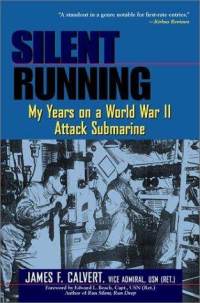
    This is my favorite book on the Silent Service during the war because it provides a view from the deck plates, or in this case, from inside the pressure hull. Silent Running opens with the renowned submariner Ned Beach's renowned screed against early war U.S. torpedoes, and then Calvert recounts his nine war patrols in the Pacific against the Japanese. World War II certainly included more renowned and controversial submariners than Calvert, but his understated style and clarity of expression landed his book on my list.
    Winner of many prestigious awards, Dower argues that the Pacific War was essentially a race war between the Americans and Japanese, with each race believing itself superior to the other. On both sides the results included poor estimates of the enemy's capabilities, other military miscalculations, and a much higher level of brutality than Americans faced in Northwest Europe. War Without Mercy yields vital insights into what can happen when two different cultures clash; when each side uses a different rulebook for warfare.

    Daws, Gavan. Prisoners of the Japanese: POWs of World War II in the Pacific. William Morrow, 1994.


    Daws dwells on one particular product of the Pacific War culture clash -- the brutal Japanese treatment of POWs. The book is, in many ways, a collection of horror stories, including the fact that Japanese "physicians" performed vivisection -- dissection of a living being without anesthetic -- vivisection, on members of downed B-29 aircrews. I still shudder to think of it. The warning implicit in Prisoners of the Japanese, like that in War Without Mercy, is that different cultures have different rules of warfare than we do and will not behave as we do in fighting wars.
    Naval officers and enlisted men and women do lots more than fight, including, among other things, conducting humanitarian operations, performing rescues at sea, and exploring space. With exclusive access to private papers and interviews with his subject's family and closest friends, Thompson examines the life of one of the first men to fly off aircraft carriers, one of the world's most fearless test pilots, and one of the Navy's iciest, brashest, cockiest and most competitive officers, beating out John Glenn for the first Mercury spaceflight and then later, as a crew member of Apollo 14, whacking a golf ball on the moon. I recommend this one because the Navy still needs test pilots, and Thompson is a brilliant writer.
    In this book Reardon, one of America's finest military historians, recounts the history of Medium Attack Squadron 75 from multiple perspectives (the cockpit, the bomb handler, the wives left behind), and sets it within multiple layers of context. The Journal of Military History described it as "a model unit history." So here we have a group biography.
    Honestly, I'm not including this to stroke my ego, but I consider this book, along with its predecessor, Breaking the Color Barrier, to be my masterpieces. Using a deep dive into the documentary records along with scores of interviews with largely black midshipmen, I've examined how the Naval Academy was transformed from a racist institution into one that genuinely ranks diversity among its fundamental tenets. The documentary research lays out the Naval Academy's racial policies, how they changed over time, and why. The interviews provide the impact these policies had on the experiences of black midshipmen, told through their own words. The third part of the book includes information on integration of women into the Academy, because many of those women are black. Naval officers and enlisted men and women should read Blue & Gold and Black because it explains the price minority and female shipmates will have to pay as long as parents teach prejudice to their children.
    During his 22-year career as a CIA Intelligence Officer, Scheuer served as chief of the Bin Laden Issue Section from 1996 to 1999 and as special advisor to the chief of the bin Laden unit from September 2001 to November 2004. He began this book in 1999 as an unclassified manual for counterterrorism officers. Initially, Potomac Books listed the author as "Anonymous," but with the publication of his follow-on book, Imperial Hubris, his name came to light. As for Through Our Enemies' Eyes, "The crux of my argument," declares Scheuer, "is simply that America is in a war with militant Islamists that it cannot avoid; one that it cannot talk or appease its way out of; one in which our irreconcilable Islamist foes will have to be killed, an act which unavoidably will lead to innocent deaths; and one that is motivated in large measure by the impact of U.S. foreign policies in the Islamic world, one of which is unqualified U.S. support for Israel." It is a harrowing argument, but one that must be understood by all who are serving in the global war on terrorism, the current war, the war we are now in, or whatever we're calling it now.
    (A big thanks to Dr. Schneller for sharing his thoughts and recommendations... Look for more thinkers’ suggestions in the weeks and months ahead. -- BD)