Showing posts sorted by relevance for query McChrystal. Sort by date Show all posts

Sunday, January 27, 2019

McChrystal: 'Leadership' Includes Self-Serving, Evil Leaders


"My Share of the Task: A Memoir," by General Stanley McChrystal, 2013, Portfolio/Penguin.

Review by Bill Doughty

Gen. Stan McChrystal, the cat who caught the rat Abu Musab al-Zarqawi, has a tale to tell. The chase after the "itinerant terrorist" Al Qaeda operative takes up a good part of this book, which focuses on service, sacrifice and the true meaning of leadership – a "crushing burden" that can be good or bad, depending on the leader.

McChrystal follows Gen. David Petraeus's footsteps in several positions. Adm. Mike Mullen, one of the most respected Chiefs of Naval Operations and Chairs of the Joint Chiefs, selected McChrystal as director of the Joint Staff (chief of staff to the JCS). In this memoir McChrystal takes readers from Fort Benning to Fort Bragg and from Iraq and Afghanistan to NATO and Washington D.C.
"At the heart of the story is Afghanistan itself, a complex swirl of ethnic and political rivalries, cultural intransigence, strains of religious fervor, and bitter memories overlaid on a beautiful, but harshly poor, landscape. Without internal struggles or outside interference, Afghanistan would be a difficult place to govern, and a challenge to develop. And there have always been struggles and interference. But it's not just that. In her beauty and coarseness, in her complexity and tragedy Afghanistan possesses a mystical quality, a magnetism. Few places have such accumulated layers of culture, religion, history, and lore that instill both fear and awe. Yet those who seek to even budge her trajectory are reminded that dreams often end up buried in the barren slopes of the Hindu Kush or in the muddy fields alongside the Helmand River."
Winter on the Parwan Plains and Hindu Kush mountains Jan. 2, 2010, viewed from Bagram Air Field, Afghanistan. Photo by Capt. Thomas Cieslak, DVIDS.
He shows how dealing with fatalism and pessimism and "a sense of insecurity" was key to the success and viability of the mission. First step, drive out fear and lead with honor and a sense of duty.

But throughout this important book, McChristal shows why we cannot oversimplify war, surrender to hostage-takers or create a "false drama" through fear and tyranny.

The killing of Zarqawi, after bringing down walls of his hideaway, reads like Tom Clancy:
"At 6:12 p.m., a laser-guided, five-hundred-pound GBU-12 bomb traveling nine hundred feet per second hit the house. The explosion flashed, turning our screens in the JOC white for a split second, as smoke and dust burst up and out laterally in three columns, like the prongs of a toy jack. The F-16 circled again, and a  minute and thirty-six seconds later, using GPS coordinates, a GBU-38 hit the same spot.Thick billows of smoke streamed diagonally up from the house and frontage road, thinning over the tops of the palm grove..."Our medic leaned over the Man in Black, who was alive, but barely. Under the medic's forefingers, Zarqawi's carotid artery was deflated. His breathing was shallow, and blood seeped out of his nose and ears. The pressure caused by the blast waves had cascaded through the concrete walls of the house and pulsed through his chest cavity, bursting vessels and air sacs in his lungs..."The medic continued to work on Zarqawi. When he cleared his airway, the Green team had descended, under an orange evening sun and the long shadows of palm trees extending across the crater, beneath the clenched faces of the operators standing over him, Zarqawi's lungs failed. At 7:04 p.m., our medic called it. Zarqawi was dead."
Wyeth's Navy hero John Paul Jones
We read McChrystal's thoughts about the capture of Saddam Hussein, decision-making of President Obama, the tragic death of Cpl. Pat Tillman, the relationship with generals Charlie and Mike Flynn, the fallout from the Rolling Stone interview and his leadership influences, including John Paul Jones, George Washington, Horatio Nelson, the Scot Robert Bruce and Ulysses S. Grant.

At the end of "My Share" McChrystal shares what he learned about being a leader. Leadership, he says, "is the single biggest reason organizations succeeded or failed." In hindsight, one need only see how the leadership of Gen. McChrystal and Adm. McRaven trumps that of Gen. Mike Flynn.

"Leadership is the art of influencing others," McChrystal writes, acknowledging "it is difficult to measure and often difficult to adequately describe."
"All leaders are human. They get tired, angry, and jealous and carry the same range of emotions and frailties common to mankind. Most leaders periodically display them. The leaders I most admired were totally human but constantly strove to be the best humans they could be..."Leaders make mistakes, and they are often costly. The first reflex is normally to deny the failure to themselves; the second is to hide it from others, because most leaders covet a reputation for infallibility. But it's a fool's dream and is inherently dishonest... "There are few secrets to leadership. It is mostly just heard work. More than anything else it requires self-discipline. Colorful, charismatic characters often fascinate people, even soldiers. But over time, effectiveness is what counts. Those who lead most successfully do so while looking out for their followers' welfare... "In the end, leadership is a choice. Rank, authority, and even responsibility can be inherited or assigned, whether or not an individual desires or deserves them. Even the mantle of leadership occasionally falls to people who haven't sought it. But actually leading is different. A leader decides to accept responsibility for others in a way that assumes stewardship of their hopes, their dreams, and sometimes their very lives. It can be a crushing burden, but I found it an indescribable honor."
McChrystal is agnostic about whether leaders can be good or evil.

He uses Adolf Hitler and Zarqawi as examples of effective leaders who had a sway over believers. Bad leaders can be elected to lead nations or closed-minded minions at least for a time. "Self-serving or evil intent motivates some of the most effective leaders I saw," he said.

More recently, McChrystal – writing with former Navy SEAL and Special Assistant to the President for National Security Affairs Jeff Eggers and former United States Marine Jason Mangone – published "Leaders: Myth and Reality," a book in our Navy Reads reading queue.

Gates presents McChrystal with Distinguished Service Medal in 2010.
He and his co-authors examine both tyrannical leaders and leaders of principle, with some eclectic choices: Walt Disney, Harriet Tubman, Zheng He, Robespierre, Robert E. Lee and, yes, rat-leader Zarqawi, among others.

Former Secretary of Defense Robert Gates calls "Leaders: Myth and Reality" "a superb, thought-provoking challenge to conventional understandings of the nature of leadership. An enlightening, entertaining must-read about why we revere so many leaders who are often deeply flawed and even unsuccessful, and the lessons for thinking about and teaching leadership in the future."

In "My Share of the Task" McChrystal reveals: Evil or incompetent leaders can be shut down by honorable and ethical free-thinking leader-followers who realize that strong leadership is not the same as being a "good" leader.

Saturday, March 30, 2019

McChrysal: Reality of Sailor Harriet Tubman

Review by Bill Doughty

A standout essay in General Stanley McChrystal's latest book, "Leaders: Myth and Reality" (Portfolio/Penguin, 2018) begins on a Union Navy vessel in the littorals of the Deep South during the heart of the Civil War.
"As she boarded the USS John Adams that evening, the white officers tipped their caps to the black woman they knew as 'Moses.' Apart from this polite gesture, she was paid no special attention. The 300 troops had business to take care of, and Harriet Tubman was a part of that team, with duties of her own."
Colonel James Montgomery, who commanded the 2nd South Carolina Volunteer Regiment, relied on Tubman – who had been serving as a nurse and spy for the Union Army – to guide him, his officers and 300 mostly black troops twenty-five miles up the Combahee River. They left from Beaufort, South Carolina to destroy Confederate communication and supplies and free slaves if possible.
USS John Adams depicted (in 1846)
"When the boats set off upriver, Tubman, as head scout, assumed her place next to Colonel Montgomery. It's an incongruous scene: a five-foot-tall, forty-one-year-old black woman going on a raid to free slaves in the middle of the Civil War. Heading to a battle, the officers and soldiers of the 2nd South Carolina didn't show concern with the symbolism of a middle-aged, formerly enslaved woman wearing a dress amid all the men in blue uniforms. All they cared about was her competence as a scout."
In terse prose that attempts to separate fact from myth, McChrystal and his co-authors Jeff Eggers and Jason Mangone show the difficulties Tubman faced as a slave before she escaped to become a matriarch and leader of the abolitionist movement.

She suffered separations, beatings and brain damage that left her with stupors, seizures and religious visions.
"According to a journalist who wrote about Tubman in 1863, her head injury made her 'subject to a sort of stupor or lethargy at times; coming upon her in the midst of conversation, or whatever she may be doing, and throwing her into a deep slumber, from which she will presently rouse herself, and go on with her conversation or work.' Though Tubman and her family were deeply religious well before her head injury, her skull fracture marks the time when Tubman began having religious visions, which would stay with her for the remaining eighty years of her life and contributed to what she felt was her calling."
Despite her challenges, Tubman made 13 trips into the Deep South during the 1850s as part of the Underground Railroad, a support network of black and white ministers, freethinkers and others opposed to the sin of slavery. Each trip was 450 miles both ways, and the slaves had to travel to Canada or risk being caught and returned.

Tubman is recognized for her leadership qualities of "modesty, duty, perfect truthfulness and integrity." She built relationships and valued cooperation, but she could also be fearless and demanding.

Congressman John Lewis
McChrystal's dedication of this book is: "To John Lewis and John McCain, who remind us that it's possible to keep our humanity while leading with courage and commitment."

The eclectic leaders profiled by the authors include geniuses like Albert Einstein, zealots like Maximilien Robespierre, and reformers like Dr. Martin Luther King Jr., among others.

McChrystal and his co-authors offer no clear and simple formulas on being a leader. "It is our hope that by helping to dismantle some common myths we will create space for you and other leaders to interact with reality and respond to your challenges with clear thinking and humility."

In the book's prologue, McChrystal writes, "Finally, by itself, 'Leaders' will not make you into a great leader. It won't overcome weak values, a lack of self-discipline, or personal stupidity. Instead of simplifying the challenges of leading, 'Leaders' will outline and underscore the complexities."

McChrystal and his team offer no paint-by-numbers formulas for being a good leader. They recommend dismantling common myths in order to "interact with reality and respond to your challenges with clear thinking and humility."

Frederick Douglass
To highlight the Tubman essay, McChrystal and his co-authors choose a quote from former slave and abolitionist Frederick Douglass. Part of Douglass's quote becomes a "found" haiku:


what you have done would
seem improbable to those
who do not know you

In the book's prologue, McChrystal concludes, "Finally, by itself, 'Leaders' will not make you into a great leader. It won't overcome weak values, a lack of self-discipline, or personal stupidity. Instead of simplifying the challenge of leading, 'Leaders' will outline and underscore the complexities."


Union Sailor George Commodore, 
"Leaders" recommends reading Joseph Campbell, Churchill, Plutarch and tales of Greek and Roman heroes. In fact, the book starts with McChrystal's love of reading.  For the Tubman essay, he recommends Kate Clifford Larson's "Bound for the Promised Land: Harriet Tubman, Portrait of an American Hero" (One World, 2003).

The best leaders are good readers.

Postscript: Interest in this topic and how African Americans served in the Navy in the Civil War led me to this essay by Joseph P. Reidy in Prologue Magazine, online at the National Archives: "Black Men in Navy Blue During the Civil War." 

Wednesday, July 15, 2020

People First, Mission Always

A Turkish army soldier briefs U.S. Army Gen. Stanley A. McChrystal on the situation at a police check-point in Kabul province. (PO1 Mark O'Donald)

Review by Bill Doughty––

The military adage "mission first, people always" is reversed in real life and on the best teams. It's about people, first and foremost.

"Good people purposely and proactively put people first in their decision making," writes Anthony Tjan in "Good People: The Only Leadership Decision That Really Matters" (Penguin Random House, 2017).

Raising Commitment core value banner at Norco (Greg Votjko)
Missions cannot be planned, trained for, or carried out successfully without good people of good character –– starting  in leadership positions.

Good leaders put good people for their teams. They continually seek to improve themselves; they instill core values; they strive for balance; and, they believe goodness is something that needs to be habitual and practiced even when no one is looking.

They are not in it only for themselves.

Putting goodness into practice means, in part, being a mentor. Tjan challenges readers to strive to provide inspiration and positive influence to at least ten other people. Using an eclectic group of people, he shows how they can share the "North Star" of good character.

He describes how the great Navy veteran jazz artist Clark Terry ("known by his friends as CT"), then in his eighties, mentored a 20-year-old musical prodigy named Justin Kauflin. Terry was losing his eyesight due to diabetes; Kauflin was blind.

CT had mentored Quincy Jones decades earlier; Quincy heard Justin play piano at CT's home and sponsored him. And Jones introduced Justin at the 47th Montreux Jazz Festival. See the video of a performance dedicated to Clark Terry:


The bond between Justin and Clark Terry is chronicled in "Keep on Keepin' On," a documentary, which opens with a letter CT once wrote to young Kauflin, and published in "Good People":
"Dear Justin, challenges are a part of life. As you know, your mind is a powerful asset. Use it for positive thoughts and you'll learn what I learned. I believe in your talents and I believe in you."
Clark Terry and Justin Kauflin provide a good "soundtrack for this book." (By the way, if you like laid-back quiet jazz, check out jazzgroove.org.)

Other folks featured, mentioned or quoted in "Good People" –– in no particular order –– include Tom Brady, Bono, Tippi Hedron, Brené Brown, Dalai Lama, Coach John Wooden, Herbie Hancock, Charlie Chaplin, JFK, Lee Kuan Yew, C. S. Lewis, Alice Waters, Warren Buffet. Trader Joe's Doug Rauch, and Jet Blue's David Neeleman. We get their advice for success in life, business and other fields.

Capt. Dee Mewbourne, left, then-commanding officer of the aircraft carrier USS Dwight D. Eisenhower, and then-Rear Adm. Phil Davidson, commander of Carrier Strike Group 8, speak with and Gen. Stanley McChrystal, then-commander of the NATO International Security Assistance Force and U.S. Forces Afghanistan, on the bridge of Dwight D. Eisenhower, June 17, 2010. McChrystal was on a battlefield circulation visit to the ship during Operation Enduring Freedom. (PO1 Mark O'Donald)

For example, here's how Gen. Stanley McChrystal puts people first through systemic flattening of the organization and empowerment beyond delegation:
"You might be surprised to learn that for many years, the key military leader in charge of America's war on terror was a strong proponent of open, distributed leadership. When now-retired four-star general Stanley McChrystal took the leadership of the Joint Special Operations Command in 2003, he quickly saw that the military's traditional, hierarchical, highly centralized command-and-control model would fail to defeat al-Qaeda in Iraq. The only way to beat al-Qaeda would be to transform the military into an open, collaborative network that moved power out from the center to enable people in the field to engage in autonomous decision making. So in the midst of the war, McChrystal dismantled existing decision-making structures and implemented a faster, flatter, and more agile organizational model. In McChrystal's 'team of teams' approach, transparent communication of information became more important because each person was empowered to be a potential decision maker. It wasn't delegation –– it was truly equally distributed decision making that required soldiers to open up and trust their colleagues to make the right decision at the right time. No wonder high-ranking military personnel like McChrystal identify 'soft' values –– like humility, empathy, openness, and compassion –– as critical predictors of soldiers' success."
That's the heart of the advice in this book: be good, choose well, and choose "good."

Tjan creates a pyramid, charts and lists to illustrate and inspire. He publishes Benjamin Franklin's thirteen virtues. At least one –– #4 Resolution –– is a "found haiku:"
Resolve to perform
what you ought; perform without
fail what you resolve
Tjan resolves that "These three cornerstone qualities of goodness are our anchors in the pursuit of goodness:" truth, compassion, fulfillment and gratitude.

Sen. Tammy Duckworth, of Illinois, is interviewed by Command Master Chief David Twiford, command master chief of Recruit Training Command (RTC), Great Lakes, Aug. 12, 2019, about her experiences and philosophy. (Mass Communication Specialist Second Class Camilo Fernan)

The emphasis on character is at the heart of Senator Tammy Duckworth's philosophy and "the values we hold dear — respect, compassion, and tolerance." Duckworth served in Iraq as an Army National Guard helicopter pilot. She lost both legs and partial use of her right arm in a rocket-propelled grenade attack. She served as U.S. Assistant Secretary of Veterans Affairs before her election to the Senate. At the VA she became known for her caring outreach to veterans.

While reading Tjan's book I thought of her and other strong-yet-compassionate leaders –– well-read leaders –– who focused on people of character in order to meet the mission.

General James Mattis, former Secretary of Defense, said,
"Reading is an honor and a gift from a warrior or historian who—a decade or a thousand decades ago—set aside time to write." His list of recommended books include titles by Max Boot, Barbara Tuchman, Ulysses S. Grant, Nelson Mandella, George P. Shulz, and Will and Ariel Durant, among others.

Like General James Mattis, Tjan knows good, thoughtful leaders are readers. "Read broadly, read deeply," Than advises. "The more you read, the better you think."

One of the many books he highlights is "Adrift," a memoir by Steven Callahan, who was a naval architect and lifelong seaman.

"The book, originally published in 1986, chronicles Callahan's experience alone and lost at sea for seventy-six days, clinging to a survival raft, and remains among the most amazing stories of grit, resilience, acceptance, and, ultimately, triumph that I've ever read," Tjan says.

Callahan battled sharks, changing weather conditions, and hunger. Because he was w
ell-read on survival at sea he knew how to "create his own ecosystem," distilling water, spearing fish, and fighting off sickness. All the while, he dealt with ever-changing situations with agility, stoicism, and a positive resilience.

Tjan's own book is filled with memorable examples of principled core values, critical thinking, and inspiring servant leadership.

As with a lot of business books, sometimes the advice comes across as simplistic common sense, but the optimism and hopefulness here are timely and appreciated in this summer of 2020: people first, mission always.

Sunday, March 25, 2018

Enough Marches

Washington and Lafayette with the militia at Valley Forge. (Lib. of Congress)
Review by Bill Doughty

Fear of a standing army and navy prompted the Framers to draft the stilted wording and punctuation of the Second Amendment to the Constitution that called for citizens to arm themselves as part of civilian "well regulated militia." But after the Revolutionary War, when members of the militia were not compensated for their service, officers threatened to mutiny and march on Washington D.C. The mutiny was put down by George Washington himself. That was in March 1783 – 285 years ago this month.

Michael Waldman recounts the story in "The Second Amendment: A Biography" (Simon & Schuster, 2014), a good primer for anyone interested in how fear and paranoia of tyranny brought on a passion for firearms in the United States.

Waldman explores the meanings of "the right of the people," "the security of a free state," and "militia" in what it means to keep and bear arms and not infringing on that right.

Fear and paranoia have been potent weapons for decades in preventing legislation for sensible gun laws, according to Gabrielle Giffords and Mark Kelly, authors of "Enough: Our Fight to Keep America Safe from Gun Violence" (Scribner, 2014), a personal but clear-eyed look at the issue.

Senator John McCain and General Stanley McChrystal both endorsed their book, with McChrystal calling the authors, "inspiring voices for responsibility. We need to listen."

Giffords and Kelly show how  "wannabe military" militia  try to look the part, speak in acronyms to sound cool, and align themselves with fundamentalist, white supremacist survivalists who, like the National Rifle Association, pose a real threat to society. The NRA is dangerous to citizens when they attack background checks, prohibit research into gun violence, and prevent voting on restrictions on armor-piercing bullets, ultra-capacity magazines, and assault-style military grade weapons, according to the authors.

Astronaut Capt. Kelly recounts his time in the Navy and having to lock his handgun in the Yokosuka base armory while he was stationed aboard USS Midway in 1990. "We tried to handle the deadly weapons of war with the utmost respect," he writes. Kelly lived off base, where firearms (and gun incidents) are unheard of. He fought – and dodged incoming fire as an F-14 fighter pilot in the Gulf War, Operation Desert Storm.

Both authors are gun owners who, even after Giffords was nearly assassinated by a gunman in 2011, shoot at ranges. Kelly is an avid hunter. Neither wants to do away with the Second Amendment. But they don't understand why the United States, which has only around one percent of the world's population of children, has 85 percent of the world's children deaths by guns.

"Enough" was one of the first words Giffords said after the senseless massacre of twenty young children and six adults at Sandy Hook Elementary School in Newtown, Connecticut just before Christmas, 2012. This powerful book walks us through the preventable tragedies of Tucson, Virginia Tech, Columbine, Aurora and Newtown. The book was written before mass shootings and killings in Orlando, Las Vegas and, of course, at Marjory Stoneman Douglas High School in Lakeland, Florida last month.

Gun control was part of society in the 1800s, including in Tombstone and Dodge City. Laws have come and gone, depending on the fear-inducing power and intimidation of the NRA: The National Fire Arms Act of 1934 after an assassination attempt on FDR; The Gun Control Act of 1968 in the wake of assassinations of JFK, RFK and MLK; the Brady Bill of 1993 after an attempted assassination of President Reagan; and the Assault Weapons Ban of 1994 after a spike of violence.

In the mid-90s white identity fundamentalists at Waco, Ruby Ridge and Oklahoma City (Timothy McVeigh) fomented hate, fear and violence. McVeigh had been a member of the NRA and shared NRA leader Wayne LaPierre's "demonization of the ATF" (Bureau of Alcohol, Tobacco, Firearms and Explosives). In the wake of McVeigh's bombing of the Murrah federal building that killed 168 people, including children in the day-care center, and wounded more than 680 others, George H. W. Bush resigned his life membership in the NRA.

Domestic terrorism can still explode in our society. Witness the bombings this month in Austin, Texas. But the number of bombing incidents pales in comparison to mass shootings. Those who fear tyranny are causing a tyranny of violence. Navy Veteran Kelly rejects their paranoia, promoted by the NRA:
"The NRA has, in essence, turned the tables on the Declaration of Independence. Forget about a government designed to protect 'life, liberty and the pursuit of happiness.' Most of us trust our government: even if, sure, the average ninth grader can build a better website, we believe the men and women we elect to represent us have our best interest at heart. But to hear the NRA tell it, once federal or state governments start to pass laws to reduce gun violence in any way, shape, or form, it's a 'slippery slope' or 'jackbooted' federal agents banging on a gun owner's door to demand he turn over his firearm. As a Navy pilot who risked his life during bombing missions over Iraq and Kuwait, I find that preposterous and offensive. I was fighting to protect the ideals of a country and a government that I believed in. I blasted into space for my country, in a government-financed spaceship. The NRA'S slippery slope is a fantasy, and a dangerous one. If the NRA gets its way, we'll be left with a country where everyone is armed but no one is safe."
When Gabby Giffords was shot, the shooter was tackled while trying to reload. When a bystander grabbed the shooter's gun, the bystander was nearly shot by someone responding with a concealed weapon. In the chaos of a shooting, more guns may not be the answer. And in a peaceful society, more guns indiscriminately in hands of more people is not the answer, according to the authors.

As long as there are lax laws for background checks, mentally ill people, including paranoid conspiracy theorists, Islamist terrorists and other end-times believers, have relatively easy access to firearms in the United States.

The irony is that crazed assassins who want to become famous for killing a public figure can instead become famous for spurring responsible gun control regulations and legislation.


"March for Our Lives": Yesterday, an estimated 800,000 students, survivors and supporters marched in Washington D.C. and thousands more marched in more hundreds of cities across the United States in a call for positive change for safer schools and streets and sensible gun laws, including restrictions on offensive military style weapons designed to kill people rather than for hunting or defense.

Yolanda Renee King stands with Jackie Corin.
Marjory Stoneman Douglas student Jackie Corin said last week, "The people of America care," adding, "The love outweighs the hate, no matter what." Corin said she and other students are following the inspiration of "students during the Vietnam War era" as well as the nonviolent philosophy of Dr. Martin Luther King, Jr.

Corin stood with MLK's nine-year-old granddaughter Yolanda Renee King yesterday. King said, "My grandfather had a dream that his four little children will not be judged by the color of their skin, but by the content of their character," adding, "I have a dream that enough is enough."

David Hogg at March for Our Lives March 24, 2018.
Fellow student David Hogg, hoping for common ground in the debate, said, "People get afraid and then misunderstand people. We're not trying to take your guns; we're trying to save the future of America."

In Michael Waldman's Second Amendment "biography," which calls for focusing on the phrase "the right of the people," the author concludes this about gun violence:
"This is a remarkably dense and thorny issue. The controversy is thick with symbolic politics. It pits rural culture against urban norms. It asks us to avoid emotionalism, to rely more on research, to find policies that actually work. Efforts to enact sensible regulations of guns face many obstacles: powerful organizations, inflamed opponents, cowardly politicians, a media culture that (when not suffused with violence itself) quickly loses interest. To surmount these will require grit and wisdom. It should not have to require overcoming a hostile judiciary, misreading history, over-interpreting text, and imposing political views in the guise of judicial philosophy."
The burning of Washington D.C. in 1814 proved the weakness of relying on the states' militia.
After Waldman recounts venerated George Washington's role in preventing a march by a mutinous militia on Philadelphia, the nation's capital at the time, he tells how the militia service itself "withered."

In the War of 1812, the British overran state militias and they marched on Philadelphia, burning the White House. It was clear that a well-regulated and equipped military was needed more than a "well-regulated militia." Fear of a standing army and navy gradually gave way to a sense of confidence in the strength of a free democracy, relying on the people and their right to vote, being able to withstand a rise of tyranny, even from within.

Waldman reminds us of this quote from Abraham Lincoln while debating slavery and an earlier Supreme Court decision: "Public sentiment is everything. With public sentiment, nothing can fail; without it, nothing can succeed. Consequently he who molds public sentiment goes deeper than he who enacts statutes or pronounces decisions."

Thursday, September 9, 2021

BJR2: ’The World As It Is’ post-9/11

Review by Bill Doughty––

A "found haiku" while reading Ben Rhodes:


the tension between

the world as it is and … the

world that ought to be


“After the Fall” (reviewed in the previous Navy Reads post) drops onto book shelves three years after writer Benjamin J. Rhodes’s other reflections, similarly profound and just as achingly personal: “The World As It Is: A Memoir of the Obama White House” (Random House, 2018), where Rhodes dissects, among other things, the “forever war.” This is a sweeping look back at the United States after September 11, 2001.

In announcing the beginning of bombing of Afghanistan twenty years ago, just weeks after 9/11, then-President George W. Bush told military service members: “Your mission is defined; your objectives are clear; your goal is just. You have my full confidence, and you will have every tool you need to carry out your duty.” Then, in 2003, Bush and neoconservatives invaded Iraq under false pretenses.


Unfortunately, the original mission to fight terrorists in Afghanistan morphed into a long-term counterinsurgency initiative and a doomed nation-building effort in the middle of a perpetual virtual civil war, with no end in sight.

While some progress was made in Afghanistan over two decades, especially for women and girls, the changes were neither deep nor long-lasting, as evidenced by the immediate fall of the government and Afghan military and ascension of the Taliban.

Just as Reagan invited the mujahideen to the White House in the early 80s (photo above), Trump invited the Taliban and Afghan government to Camp David two years ago this week, a secret meeting that was canceled at the last minute after it became public knowledge. Then, Trump and his Secretary of State Mike Pompeo made a deal with the Taliban but did not include the Afghanistan government. Trump announced there would be a U.S. withdrawal by May 2021, but Biden postponed the withdrawal till the end of August.


Future historians likely will not question whether the American war in Afghanistan should have continued after twenty years; rather, they will dissect how the end of the war evacuation was conducted. Some have already asked why the United States stayed so long, left so much infrastructure and equipment behind, and provided (albeit unintentionally) so much combat training to the Taliban and regional terrorists. Why didn’t we leave sooner?

In “The World As It Is” Rhodes takes us back to nearly the mid-point of the twenty-year war in Afghanistan, to Obama’s Afghan Review. Rhodes was in the room where it happened. In fact, he provided a critical role as an advisor to Obama. Other advisors who weighed in as part of the Afghan Review included Vice President Joe Biden, Secretary of State Hillary Clinton, Secretary of Defense Robert Gates, CIA Director John Brennan, General Stanley McChrystal, General David Petraeus, and Chairman of the Joint Chiefs of Staff Admiral Mike Mullen*.


Rhodes writes:

“Gates argued that he wasn’t for a CT (counterterrorism) strategy or a full COIN (counterinsurgency) strategy –– he was for something in between, something that promoted a strong, effective government that delivers services to the people. When the shortcomings of the Afghan government were pointed out, Gates said that we should not give ‘one dollar or soldier’ for a corrupt government –– even though that’s exactly what we were doing. Petraeus said our goal was not to defeat the Taliban but to deny them population centers. Mullen talked about the psychological piece –– the need to create the impression that the Taliban will lose. For the same reason, Clinton said that putting in troops wouldn’t work but you still need to put in troops. It seemed to sum things up perfectly: We had created political pressure on ourselves to send in troops based on a theory of COIN; the review was determining that COIN couldn’t succeed; but all of the arguments still pointed to sending in the same number of troops. We are not going to defeat the Taliban, Obama kept saying. We need to knock them back to give us space to go after al Qaeda.”

Vice President Joe Biden was against any escalation, and CIA Director John Brennan recommended a limited surge just in order to target al Qaeda. When Obama asked Rhodes for his opinion, Rhodes said he agreed with Brennan –– and Obama. “Target, train, transition” became their framework for their strategy and tactics.

“Ultimately, Obama decided to send thirty thousand American troops to Afghanistan, with NATO getting us the rest of the way to forty thousand. We would announce it as a temporary surge –– in eighteen months, the troops would start to draw down. We’d secure Afghanistan’s major population centers, then shift to training and counterterrorism –– essentially endorsing the Petraeus-McChrystal approach for two years, and then shifting to the Biden-Brennan approach sooner than the military wanted. At Biden’s suggestion, Obama had all the principals memorialize their agreement with the plan in writing. It felt like a big much, but his was the lesson from Vietnam: Limit escalation.”


Prior to Biden, three presidents were unable to end the war in Afghanistan. But Obama ended the war in Iraq, ordered the killing of Osama bin Laden, and greatly reduced the cost of lives and cost of war in Afghanistan. Rhodes notes:

“Obama wanted to extricate the United States from the permanent war that had begun on 9/11. On the day he took office, there were roughly 180,000 troops in Iraq and Afghanistan. By late 2014, the number of troops in Afghanistan was down to 15,000. All U.S. troops were out of Iraq. These were meaningful achievements; they saved American lives, as casualty numbers fell from nearly a hundred Americans killed each month to nearly zero, and the cost of war shrank by tens of billions of dollars.”

*Rhodes now cohosts the podcast Pod Save the World. On a recent episode he noted how former CNO and CJCS retired Adm. Mike Mullen (pictured below with then-SECDEF Gates) expressed regret for not ending the American war in Afghanistan sooner.


In an interview with veteran journalist Martha Raddatz on ABC’s This Week, Mullen said, regarding the Afghanistan government and security forces, ” I thought we could build the army and give them a chance to create structures which would run a country in a much more modern fashion. That just is not the case.” Mullen added, “What I thought we could do and I advised President Obama that –– accordingly is I thought we could turn it around. Obviously, I was wrong.”

Mullen said, “I don't think it was possible for us to just abruptly walk away right after we killed bin Laden. But, clearly, we could have gone earlier than we did. As I look back and -- and a lot of people are critical of the president right now, President Biden had it right back then. He was focused singly on counterterrorism. His advice was along those lines. And he certainly said that. And I give him credit for that.”


(Ben Rhodes is President Obama’s former National Security Advisor for Strategic Communication and Speech Writing.)


Top photo: President Barack Obama meets with his national security team on Afghanistan and Pakistan in the Situation Room of the White House, June 23, 2010. Seated at the table are, from left, General David Petraeus, head of US Central Command, Admiral Michael Mullen, Chairman of the Joint Chiefs of Staff, Defense Secretary Robert M. Gates, Vice President Joe Biden, the President, National Security Advisor Gen. James L. Jones, Secretary of State Hillary Rodham Clinton, Chief of Staff Rahm Emanuel, Deputy National Security Advisor Tom Donilon, and John Brennan, Assistant to the President for Homeland Security and Counterterrorism. (Official White House Photo by Pete Souza)

Sunday, August 2, 2015

A 'Chasm' Between Civilians and Their Military?

Review by Bill Doughty

Is the gap between the military and civilians growing? What are the lessons of wars in Korea and Vietnam, Iraq and Afghanistan? What are the changing roles for women in combat? What is the nature of future warfare?

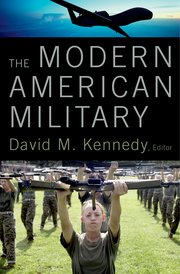
David M. Kennedy and more than a dozen contributors explore these questions and others in "The Modern American Military" (Oxford University Press, 2013), a volume of scholarly essays that looks into the All Volunteer Force and the history of evolving conflict in the world.

"The dropping of nuclear bombs on Hiroshima and Nagasaki ended World War II but ushered in an entirely new form of conflict that came to be called the Cold War." That's how the foreword to the book by former U.S. Secretary of Defense William J. Perry begins.

Perry notes:
"The security dangers we face today must be dealt with at least as much with political, social, and economic strength (soft power) as with military strength (hard power). Our need to exert military power can no longer be met by the large conventional forces used during World War II, or the large nuclear forces accumulated during the Cold War. Today, our armed forces have been reconfiguring to meet these new demands, but many more changes are required ... Our naval forces should continue to focus on their mission of establishing sea control that can be projected worldwide on relatively short notice. Also, all our military services must become more proficient in operating in an environment of cyber threats to military technologies."
William Perry (left) and Kennedy (center) at Stanford in 2010. (L.A. Cicero)
Setting the stage for the essays that follow, Perry concludes:
"The world has been changing in very important ways since the end of the Cold War, and new and dangerous threats are emerging every day. But, against all odds, the world has not had a nuclear bomb used in anger since World War II; there has not been, nor is there likely to be, a World War III; and the average standard of living worldwide has increased since the end of the Cold War. The U.S. military has played an important role in these positive results and will be called upon to continue to play that positive role in the future. In order to do this, the U.S. military will have to adapt to economic, political, technological, and social changes, as well as evolve to meet the changing global threat environment."
David M. Kennedy
This insightful book, which zeroes in on the All Volunteer Force, is edited by Pulitzer Prize-winning historian David M. Kennedy. He assembles contributions by such distinguished thinkers as Perry, Lawrence J. Korb, Karl W. Eikenberry, Mady Wechsler Segal, Renée de Nevers, and others.

Much of this book examines the AVF, established in 1973, and its effects on society and the military, with reference to such standout personalities in military history as Gen. George C. Marshall, Gen. Creighton Abrams, Gen. Charles Krulak, Gen. Stanley McChrystal and Adm. Mike Mullen.

In a chapter titled "Manning and Financing the Twenty-First-Century All-Volunteer Force," David R. Segal and Lawrence J. Korb outline the "undue strain" placed on people and systems since 9/11.
"Despite the fact that the George W. Bush administration deployed more than two hundred thousand people on a continuous basis in Iraq and Afghanistan, and although Congress approved these conflicts, our political and military leaders did not have the courage to activate the draft. Many of the volunteers in the active and reserve ground forces were abused, physically and psychologically, while Americans went shopping. The military and the nation will pay the costs of this moral failure for a long time. Let us hope that the next time we engage in large campaigns, political and military leaders will not again forget their obligations to the country and those who serve it."
Adm. Mike Mullen (right) congratulates 2nd Lt. Erin Anthony at West Point. (Tommy Gilligan)
Kennedy has been focusing on years on the dilemma of a military being at war while the nation is not. He quotes Mullen, former CNO and Chairman of the Joint Chiefs, in an address to West Point graduates in May 2011: "I fear they [civilian Americans] do not know us. I fear they do not comprehend the full weight of the burden we carry ... We're also fairly insular, speaking our own language of sorts, living within our own unique culture."

From the abstract to an essay called "American Military Culture from Colony to Empire":
"In the midst of a civilian society that is increasingly pacifistic, easygoing and well adjusted, the Army (career and non-career soldiers alike) remains flinty, harshly results oriented, and emotionally extreme. The inevitable and necessary civil-military gap has become a chasm."
While readers may wince, many of the authors' conclusions are often backed up by strong research in the costs over the past 15 years – financial, physical and psychological.

But despite the problems presented here about the AVF, there are no calls for an immediate return to the draft.

North Korean soldier conscripts.
In fact, balancing the argument for conscription is the situation in North Korea, as described by James Sheehan in "The Future of Conscription":
"In Kim Jong Un's first public appearance following his father's death, the new leader reaffirmed Kim Jong Il's emphasis on the military: it was, he declared, his government's 'first, second, and third' priority. With terms of active duty from five to twelve years and reserve obligations up to the age of sixty, North Korea has what is perhaps the world's most extensive and socially intrusive system of conscription."
Sheehan also describes historical and comparative use of conscription in Europe and other regions and countries over the past century.

This book is recommended by former Secretary of State Condoleezza Rice, who lauds the exploration of use of contractors in war zones and new technologies that are changing the nature or warfare. "We owe it to our servicemen and women and to those who command them to examine critically and debate the state of military affairs," Rice writes. "This book is a significant contribution to that cause."

The size of the gap or "chasm" between the U.S. military and the civilian society it serves is debatable. According to Kennedy, "This volume aims not only to measure the range of that distance, but to help close it."