Showing posts sorted by relevance for query marjory stoneman douglas. Sort by date Show all posts

Saturday, March 10, 2018

Who Was Marjory Stoneman Douglas?

Review by Bill Doughty

Regrettably, "Marjory Stoneman Douglas" High School will always be remembered the way "Sandyhook" and "Columbine" are remembered – places of learning devastated by murderous gunfire. Students at MSD High School, "the Eagles," are demonstrating resilience and redirecting their anger and grief toward positive change.


So who was Marjory Stoneman Douglas?

Seventy-one years ago Marjory Stoneman Douglas (1890-1998), newspaper journalist and freelance writer, wrote "The Everglades: River of Grass" (Pineapple Press, 1947).

The book is a fascinating history of "the great pointed paw of Florida," describing its nature, peoples, history of conquest, and challenges in the face of development and destruction of the Everglades.

Fellow writer John Hersey, author of "Hiroshima," called Stoneman Douglas's description of the Everglades "an unearthliness, a strong rhythm, a compactness of natural imagery that is dazzling, and, above all an organization and discipline that approaches poetic form."
Here's an example of her poetry in prose:
"The water moves. The saw grass, pale green to deep-brown ripeness, stands rigid. It is moved only in sluggish rollings by the vast push of the winds across it. Over its endless acres here and there the shadows of the dazzling clouds quicken and slide, purple-brown, plum-brown, mauve-brown, rust-brown, bronze. The bristling, blossoming tops do not bend easily like standing grain. They do not even in their own growth curve all one way but stand in edged clumps, curving against each other, all the massed curving blades making millions of fine arching lines that at a little distance merge to a huge expanse of brown wires or bristles or, farther beyond, to deep-piled plush. At the horizon they become velvet. The line they make is an edge of velvet against the infinite blue, the blue-and-white, the clear fine primrose yellow, the burning brass and crimson, the molten silver, the deepening hyacinth sky. The clear burning light of the sun pours daylong into the saw grass and is lost there, soaked up, never given back. Only the water flashes and glints. The grass yields nothing."

Science meets art in her writing, much like Rachel Carson, as Stoneman Douglas paints with her words.


Baby bald eagle in the Everglades. (National Park Service)
She describes the destruction of birds, killed out of greed for their feathers, their plumes. At sunset, like birds everywhere, birds of the Everglades would return "in their white thousands and tens of thousands, with the sounds of great stiff still banners ... rivers of birds pouring against the sunset back to the rookeries ... down to the right next in the clamor and squawking and curious yelping, and queer deep grunting of the fuzzy open-beaked hungry young."
"When the sun rose the ethereal whiteness of the plumed parent birds shone like frost against the blue, blue sky. They  were white in the nights under the moon, or to the torches and firepans of the men with clubs in canoes slipping along behind the lights. A few men with clubs or shotguns rising suddenly by those low rookeries could kill and scalp hundreds of birds in a night. By morning the bloody bodies would be drawing the buzzards and alligators. The great black Florida crows that shed the light like water from their feathers would clean out the dying young. Ants in long lines as fine as pepper would carry off the rotting pieces of their bones."
White egret (Photo courtesy National Park Service)
In "The Everglades: River of Grass" Stoneman Douglas takes us through millennia – Cretaceous, Eocene, Oligocene, Miocene – to more recent history of the Age of Exploration and Conquest, through the Civil War and into the first half of the 20th century.
"History," she writes, "the recorded time of the earth and of man, is in itself something like a river."

So is childhood – or a journey through high school.

We learn about colorful characters in Florida's history, including Billy Bowlegs, King Carlos, Juan Ortiz, Juan Ponce de Leon, Hernando De Soto, Col. Zachary Taylor, Maj. Francis Dade, Andrew Jackson (who waged war against the indigenous people 200 years ago, 1817-1818), Napoleon Bonaparte Broward, and Osceola.


Osceola
Osceola would become a "patriot and warrior" hero who was to "epitomize for future history the highhanded injustice" of captivity, a symbol in the first half of the 1800s to  those, including Indians and escaped slaves, who fought for freedom and righteousness. A town, lake, county, many individuals, and even a species of snake were named after him. So were several U.S. Navy vessels, including a gunboat during the Civil War, harbor tug and seagoing tug #47, all called Osceola.

Stoneman Douglas brings the imagery of the sea into her writing, and she seems to have a special affinity to the tough and gritty sailors who ventured aboard wooden ships and into the unknown.
"These were not the men of the Mediterranean galleys, the long narrow ships that went mincingly on the tideless inner sea, from headland to known headland, by the banked oars of slaves. These were free men of that limitless, turbulent ocean, the men of the bucking, hardy cargo carriers, the round ships, broad of bow and beam, that thrashed forward only before the wind in their single, clumsy square sails. They came about only by a miracle and could hardly beat to windward at all. Many a ship and crew was blown far out into the unknown and disappeared under the unturning, savage, westgoing wind. Not that that mattered. There were men in every port eager to follow them. Their concern was not safety. Their concern was going out. Sailing. Finding out. Seeing. Never mind the coming back."
Seagoing tug USS Osceola
We see how early explorers, Spanish Catholic crusaders, and English traders fought over the "paw" of Florida and subjugation of the people there. 
The U.S. Navy, under USS Flirt and Fort Flirt, played an important role in Florida's early history, protecting against piracy and bootlegging and eventually in the Civil War fighting against "the accepted evil of slavery."
Admiral David Porter – and later his son David Dixon Porter – protected Florida, commercial trade and the United States on both sides of the peninsula.
Stoneman Douglas offers a meticulous description of the lives of the earliest residents of the Everglades, the indigenous "Indians": Calusa, Mayaimi, Tekesta, Talasi, Yochi, Tallahasee and others. Eventually they would be lumped together under a catch-all name: Seminole.

Calusa
By the mid 18th century the original people of the Everglades had disappeared. "Only the scattered Calusas were left, ranging throughout the area. It has been repeated often that after 1763 they left for Cuba en masse. I do not believe that there was ever a time when the Glades were empty of villages," Stoneman Douglas concludes.

"They had great courage. They came of people who had lived hard and savage lives and their children were not weakened," she writes.

The author was successful in convincing people to conserve and preserve much of the precious Everglades. In December 1947, the year her book was published, President Truman dedicated the Everglades National Park, helping people realize the life-giving value of the ecosystem – and the dangers of draining the water, leading to fires and rising salt water.
"Unless the people will act the fires will come again. Overdrainage will go on. The soil will shrink and burn and be wasted and destroyed in a continuing ruin. The salt will lie in wait. Yet the springs of fine water had flowed again. The balance still existed between the forces of life and of death. There is a balance in man also, one which has set against his greed and his inertia and his foolishness; his courage, his will, his ability slowly and painfully to learn, and to work together."
The Courage... the will... the "ability slowly and painfully to learn, and to work together."

Her legacy lives on.

The Marjory Stoneman Douglas High School family – students, teachers and loved ones – are taking a stand on behalf of those who were killed by promoting common sense gun safety to prevent more tragedies. Their school's namesake channeled her passion toward positive change on behalf of something she deeply loved too, part of a resilient ecosystem that supports life.

Marjory Stoneman Douglas

Sunday, March 25, 2018

Enough Marches

Washington and Lafayette with the militia at Valley Forge. (Lib. of Congress)
Review by Bill Doughty

Fear of a standing army and navy prompted the Framers to draft the stilted wording and punctuation of the Second Amendment to the Constitution that called for citizens to arm themselves as part of civilian "well regulated militia." But after the Revolutionary War, when members of the militia were not compensated for their service, officers threatened to mutiny and march on Washington D.C. The mutiny was put down by George Washington himself. That was in March 1783 – 285 years ago this month.

Michael Waldman recounts the story in "The Second Amendment: A Biography" (Simon & Schuster, 2014), a good primer for anyone interested in how fear and paranoia of tyranny brought on a passion for firearms in the United States.

Waldman explores the meanings of "the right of the people," "the security of a free state," and "militia" in what it means to keep and bear arms and not infringing on that right.

Fear and paranoia have been potent weapons for decades in preventing legislation for sensible gun laws, according to Gabrielle Giffords and Mark Kelly, authors of "Enough: Our Fight to Keep America Safe from Gun Violence" (Scribner, 2014), a personal but clear-eyed look at the issue.

Senator John McCain and General Stanley McChrystal both endorsed their book, with McChrystal calling the authors, "inspiring voices for responsibility. We need to listen."

Giffords and Kelly show how  "wannabe military" militia  try to look the part, speak in acronyms to sound cool, and align themselves with fundamentalist, white supremacist survivalists who, like the National Rifle Association, pose a real threat to society. The NRA is dangerous to citizens when they attack background checks, prohibit research into gun violence, and prevent voting on restrictions on armor-piercing bullets, ultra-capacity magazines, and assault-style military grade weapons, according to the authors.

Astronaut Capt. Kelly recounts his time in the Navy and having to lock his handgun in the Yokosuka base armory while he was stationed aboard USS Midway in 1990. "We tried to handle the deadly weapons of war with the utmost respect," he writes. Kelly lived off base, where firearms (and gun incidents) are unheard of. He fought – and dodged incoming fire as an F-14 fighter pilot in the Gulf War, Operation Desert Storm.

Both authors are gun owners who, even after Giffords was nearly assassinated by a gunman in 2011, shoot at ranges. Kelly is an avid hunter. Neither wants to do away with the Second Amendment. But they don't understand why the United States, which has only around one percent of the world's population of children, has 85 percent of the world's children deaths by guns.

"Enough" was one of the first words Giffords said after the senseless massacre of twenty young children and six adults at Sandy Hook Elementary School in Newtown, Connecticut just before Christmas, 2012. This powerful book walks us through the preventable tragedies of Tucson, Virginia Tech, Columbine, Aurora and Newtown. The book was written before mass shootings and killings in Orlando, Las Vegas and, of course, at Marjory Stoneman Douglas High School in Lakeland, Florida last month.

Gun control was part of society in the 1800s, including in Tombstone and Dodge City. Laws have come and gone, depending on the fear-inducing power and intimidation of the NRA: The National Fire Arms Act of 1934 after an assassination attempt on FDR; The Gun Control Act of 1968 in the wake of assassinations of JFK, RFK and MLK; the Brady Bill of 1993 after an attempted assassination of President Reagan; and the Assault Weapons Ban of 1994 after a spike of violence.

In the mid-90s white identity fundamentalists at Waco, Ruby Ridge and Oklahoma City (Timothy McVeigh) fomented hate, fear and violence. McVeigh had been a member of the NRA and shared NRA leader Wayne LaPierre's "demonization of the ATF" (Bureau of Alcohol, Tobacco, Firearms and Explosives). In the wake of McVeigh's bombing of the Murrah federal building that killed 168 people, including children in the day-care center, and wounded more than 680 others, George H. W. Bush resigned his life membership in the NRA.

Domestic terrorism can still explode in our society. Witness the bombings this month in Austin, Texas. But the number of bombing incidents pales in comparison to mass shootings. Those who fear tyranny are causing a tyranny of violence. Navy Veteran Kelly rejects their paranoia, promoted by the NRA:
"The NRA has, in essence, turned the tables on the Declaration of Independence. Forget about a government designed to protect 'life, liberty and the pursuit of happiness.' Most of us trust our government: even if, sure, the average ninth grader can build a better website, we believe the men and women we elect to represent us have our best interest at heart. But to hear the NRA tell it, once federal or state governments start to pass laws to reduce gun violence in any way, shape, or form, it's a 'slippery slope' or 'jackbooted' federal agents banging on a gun owner's door to demand he turn over his firearm. As a Navy pilot who risked his life during bombing missions over Iraq and Kuwait, I find that preposterous and offensive. I was fighting to protect the ideals of a country and a government that I believed in. I blasted into space for my country, in a government-financed spaceship. The NRA'S slippery slope is a fantasy, and a dangerous one. If the NRA gets its way, we'll be left with a country where everyone is armed but no one is safe."
When Gabby Giffords was shot, the shooter was tackled while trying to reload. When a bystander grabbed the shooter's gun, the bystander was nearly shot by someone responding with a concealed weapon. In the chaos of a shooting, more guns may not be the answer. And in a peaceful society, more guns indiscriminately in hands of more people is not the answer, according to the authors.

As long as there are lax laws for background checks, mentally ill people, including paranoid conspiracy theorists, Islamist terrorists and other end-times believers, have relatively easy access to firearms in the United States.

The irony is that crazed assassins who want to become famous for killing a public figure can instead become famous for spurring responsible gun control regulations and legislation.


"March for Our Lives": Yesterday, an estimated 800,000 students, survivors and supporters marched in Washington D.C. and thousands more marched in more hundreds of cities across the United States in a call for positive change for safer schools and streets and sensible gun laws, including restrictions on offensive military style weapons designed to kill people rather than for hunting or defense.

Yolanda Renee King stands with Jackie Corin.
Marjory Stoneman Douglas student Jackie Corin said last week, "The people of America care," adding, "The love outweighs the hate, no matter what." Corin said she and other students are following the inspiration of "students during the Vietnam War era" as well as the nonviolent philosophy of Dr. Martin Luther King, Jr.

Corin stood with MLK's nine-year-old granddaughter Yolanda Renee King yesterday. King said, "My grandfather had a dream that his four little children will not be judged by the color of their skin, but by the content of their character," adding, "I have a dream that enough is enough."

David Hogg at March for Our Lives March 24, 2018.
Fellow student David Hogg, hoping for common ground in the debate, said, "People get afraid and then misunderstand people. We're not trying to take your guns; we're trying to save the future of America."

In Michael Waldman's Second Amendment "biography," which calls for focusing on the phrase "the right of the people," the author concludes this about gun violence:
"This is a remarkably dense and thorny issue. The controversy is thick with symbolic politics. It pits rural culture against urban norms. It asks us to avoid emotionalism, to rely more on research, to find policies that actually work. Efforts to enact sensible regulations of guns face many obstacles: powerful organizations, inflamed opponents, cowardly politicians, a media culture that (when not suffused with violence itself) quickly loses interest. To surmount these will require grit and wisdom. It should not have to require overcoming a hostile judiciary, misreading history, over-interpreting text, and imposing political views in the guise of judicial philosophy."
The burning of Washington D.C. in 1814 proved the weakness of relying on the states' militia.
After Waldman recounts venerated George Washington's role in preventing a march by a mutinous militia on Philadelphia, the nation's capital at the time, he tells how the militia service itself "withered."

In the War of 1812, the British overran state militias and they marched on Philadelphia, burning the White House. It was clear that a well-regulated and equipped military was needed more than a "well-regulated militia." Fear of a standing army and navy gradually gave way to a sense of confidence in the strength of a free democracy, relying on the people and their right to vote, being able to withstand a rise of tyranny, even from within.

Waldman reminds us of this quote from Abraham Lincoln while debating slavery and an earlier Supreme Court decision: "Public sentiment is everything. With public sentiment, nothing can fail; without it, nothing can succeed. Consequently he who molds public sentiment goes deeper than he who enacts statutes or pronounces decisions."

Wednesday, December 2, 2020

History Has Its Eyes on – Hong Kong

Review by Bill Doughty–

The soundtrack to Joshua Wong's account of the trials and tribulations in Hong Kong can be found in Lin Manuel Miranda's "Hamilton."

"Unfree Speech: The Threat to Global Democracy and Why We Must Act, Now" by Joshua Wong (Penguin Books, 2020) is written by a young man who is "young, scrappy and hungry" and ready to "rise up." He seems to echo Hamilton: "I'm not going to waste my shot."


Wong's is the voice of a boy becoming a man –– a self-described "diehard fanboy" of Gundam, OnePiece, Marvel and DC comics, as well as a student of Gandhi and MLK. He and his close friends Agnes Chow and Ivan Lam (top photo) were sentenced to prison this week by a court in Hong Kong for a pro-democracy protest they held last year.*

Wong offers a brief history of the situation in Hong Kong since the time of the transfer of sovereignty from Great Britain to China, July 1, 1997: The recession in '97, the SARS outbreak in 2002, "misguided housing policies," the National Security Bill, the barring of political organizations, growing demands for more democracy, and the rise of the Umbrella Revolution/Movement.

"The movement didn't happen in a social vacuum. The broken promise of electoral reform and subsequent police crackdown catalysed the unrest, but they didn't cause it. It took decades of pent-up frustration over income inequality, social immobility and other injustices for public anger to finally boil over. Martin Luther King Jr famously said that freedom is never voluntarily given by the oppressor and that it must be demanded by the oppressed. The Umbrella Movement was our way of making our demands heard."

"The movement's symbol, the yellow umbrella, captured both the humility and humanity of the non-violent protesters," Wong writes. From Hamilton: "I was aiming for the sky," "Forgiveness, can you imagine it?" and "Tomorrow there'll be more of us."

As important as the history is Wong's explanation of structure of Hong Kong's government: The Executive is chosen by Communist Party loyalists and controlled by Beijing. The Legislature is not truly representative (two 35-member chambers: GC-geographical, chosen by region, and FC-functional, chosen by Beijing-friendly business and industry. The Judiciary, supposedly independent, is becoming more deferential to the executive, where "the criminal justice system is increasingly used as a political tool to silence dissent."


Voter suppression, election interference and punishment of free speech are hallmarks of Communist China's war on democracy. "Hong Kong is gradually becoming an autocracy," Wong writes. He calls it ominously like Star Wars's "The Empire Strikes Back."


Much of this book, disjointed and rough at times, comes from his diary from prison, both at the Stanley Prison for adults and earlier while at the Pik Uk Correctional Institution for juveniles. He gives a commentary on friends, prison food, entertainment, and hunkering down during a hurricane. Again from Hamilton: "In the eye of a hurricane, there is quiet" ... "Blow us all away" ... "Look around, look around" ... "I'll write my way out, overwhelm them with honesty."


Wong describes a "perfect storm" building, and even though this book was published this year, it was before COVID-19 was part of that storm.


Agnes Chow
Wong and many of his fellow protesters, including Lam and Chow, began their activism at a tender age. They venerate earlier freedom advocates such as Ai Weiwei, who writes this book's introduction, and they commemorate the young students killed in the Tiananmen protests and massacre of June 4, 1989.


The cover of the book features a quote from Greta Thunberg: "Together we are one loud voice that cannot be silenced." Young people are at the heart of global calls for freedom and equality. Wong was inspired by Malala's memoir. We're reminded of the young people of Parkland, Florida who sparked a movement for gun safety in the wake of the killing of 17 people at Marjory Stoneman Douglas High School. 


The subtitle of this book is "The Threat to Global Democracy and Why We Must Act, Now."

"From Turkey and Ukraine to India, Myanmar and the Philippines, citizens are pushing back oppressive regimes in defence of their diminishing rights. But nowhere else in the world is the struggle between free will and authoritarianism more clearly demonstrated than here. In the new trans-Pacific cold war, Hong Kong is the first line of defence to stop or at least slow down the dangerous rise of a totalitarian superpower. Like the canary in the coal mine or the early warning system on a tsunami-prone coastline, we are sending out a distress signal to the rest of the world so that countermeasures can be taken before it is too late. As much as Hong Kong needs the international community, the international community needs Hong Kong. Because today's Hong Kong is the rest of the world's tomorrow."

Wong points out Russia's aggression and annexation of Crimea, India's invasion of semi-autonomous Kashmir, and Turkey's military regime's imprisonment of journalists and displacement of millions of Kurds. "Their motivation is singular: self-perpetuation. To consolidate and maintain power," he writes.


Military power is flexed, Wong writes, to impress and intimidate –– and so leaders can remain in power. "Oceans rise; empires fall" ... "The world was wide enough for both."


Ensign Ashley Welker, a Los Angeles native, along with other Sailors, speaks to a tour group visiting Arleigh Burke-class guided-missile destroyer USS Sterett (DDG 104) during the ship’s port visit to Hong Kong, May 2, 2017. (MC1 Byron C. Linder)


In a call to action, Wong offers a 10-point action plan for civil action. He expresses appreciation to and for the United States and speaks glowingly of the support he received in Washington D.C. In September of 2019 he testified to the U.S. Congressional-Executive Commission on China (CECC).


U.S. Speaker of the House Nancy Pelosi and Wong
He received support directly from Speaker Nancy Pelosi, Sen. Marco Rubio, Rep. Jim McGovern, and Rep. Eliot Engle. Rubio sponsored the "Hong Kong Human Rights and Democracy Act." Pelosi told Wong, "You are an inspiration to young people everywhere. Thank you for your courage and resolve."


As "Hamilton" says, "It must be nice to have Washington on your side."


"Who lives, who dies, who tells your story,” in the words of Lin-Miranda.


Wong and U.S. Senator Marco Rubio
The late U.S. Representative John Lewis personified democracy and called for the "good trouble" as practiced by Wong and friends. Lewis, of course, played a pivotal role in passage of the Voting Rights Act signed into law by President Lyndon B. Johnson in 1965. And he advocated strongly for each reauthorization of the Voting Rights Act in 1970, 1975, 1982, and 2006.


In the face of voter suppression in some states, the House of Representatives passed Bill HR 1 –– The "For the People Act" in 2019. But "wait for it," as Hamilton intones: HR 1 is still awaiting a vote by the U.S. Senate.


*(Wong was sentenced to 13.5 months in prison; Chow, called the “Goddess of Democracy,” was sentenced to ten months in prison; and Lam received a sentence of seven months for inciting the pro-democracy protest.)

Saturday, March 3, 2018

Women Who Changed the World

Review by Bill Doughty

"Throughout history many women have risked everything in the name of science. This book tells the stories of some of these scientists, from ancient Greece to the modern day, who in the face of 'No' said, 'Try and stop me.'"

With cool-weird drawings and sparkling insights, writer-illustrator Rachel Ignotofsky profiles some of the women who stand out in fields of Science, Technology, Engineering and Mathematics in "Women in Science: 50 Fearless Pioneers Who Changed the World" (Ten Speed Press, 2016).

Among the 50 women featured are Wang Zhenyi, Ada Lovelace, Karen Horney, Marie Curie, Marjory Stoneman Douglas, Rachel Carson, Katherine Johnson, Valentina Tereshkova, Jane Goodall, Maryam Mirzakhani, and Grace Hopper, "Navy admiral and computer scientist."
"Grace Hopper was ... a relentless trailblazer, recognized as the mother of computer programming," Ignotofsky writes. The author spices her profiles with one-liners like: "Invented the first compiler, forever changing how we use computers," "Her great-grandfather was also in the Navy," and "Pioneered the standards for testing computer systems."
Grace Hopper, born in 1906, was fourteen years old when women in the United States achieved the right to vote, a step toward greater equality for women. She earned a PhD in mathematics at Yale fourteen years after passage of the 19th Amendment. Hopper joined the Women Accepted for Volunteer Emergency Service (WAVES) in 1943, bringing her mathematics skills to the war effort.
"After the war, Grace joined the private sector. At the time, programmers needed the skills that came with an advanced degree in mathematics and used binary code to program. Grace Hopper thought it would be easier to just 'talk' to a computer in English. Everyone thought Grace was nuts, but she proved them wrong when she invented the first compiler. This led to create COBOL, the first universal computer language. Thanks to Grace just about anyone can learn to code! Grace returned to the Navy in 1967. Even after she retired as the oldest person on active duty (just a few months short of turning 80), she continued to lecture, consult, and teach – always reminding the world that 'the most damaging phrase in the language is 'we've always done it this way.'"
Along with the short biographies of the fifty featured women are a timeline, statistics in STEM, an illustrated list of lab tools and a glossary. While this book appeals to young readers it, like the works of Mary Roach and Hope Jahren, can inspire any readers to see how women have contributed to progress in the world.

The author's other books (this one was her first) include "I Love Science" and "Women in Sports."

Ignotofsky, who supports critical thinking and evidence-based decision-making exemplified in the "March for Science," writes in her conclusion:
"Women make up half of our population, and we simply cannot afford to ignore that brain power – the progress of humankind depends on our continual search for knowledge. The women in this book prove to the world that no matter your gender, your race, or your background, anyone can achieve great things. Their legacy lives on. Today, women all over the world are still risking everything to discover and explore."
Don't try to stop them.

Monday, February 18, 2019

Green New Deal Imagined in 'This Moment on Earth'

Review by Bill Doughty

Vietnam branded John Kerry. His missions in the Navy, as a senator and as Secretary of State informed his life. And his confrontation with mortality brought insight and wisdom.
Kerry focuses that perspective on his most important mission on "protecting the planet." That's the last chapter in his new autobiography, "Every Day is Extra," and it's the subject of a book he and wife Teresa Heinz Kerry wrote in 2007, "This Moment on Earth" (PublicAffairs, Perseus Books).

Kerry and Gore at Yale University.
If the seeds for the Green New Deal were first planted by Ralph Waldo Emerson, Theodore Roosevelt, Marjory Stoneman Douglas and Rachel Carson – and in 1970 with the world's first "Earth Day" – those seeds were certainly watered and given sunshine by Bill McKibben (350.org), Al Gore ("An Inconvenient Truth") and the Kerrys.

"This Moment on Earth" is a call for action, acknowledging the reality of global climate change, the hazards of relying on fossil fuels for our energy, and the poisoning of earth's air and water. The authors offer a number of examples of individuals and communities – from Pittsburgh and the Carolinas to New Mexico, Washington State and Portland – taking responsibility and action.

United States Marines to the Rescue

Former Marine Bob Boyle organized fellow fishermen and helped clean up the Hudson Bay, inspired "by their growing disgust about the deterioration of the environment and our poor stewardship," demonstrating how Americans are a government of, by and for the people.

Former United States Marine Rick Dove, a Riverkeeper enforcer.
Another Marine, Rick Dove, a retired colonel, took on the unregulated hog farming industry and their political supporters.
"Listening to Rick talk about his work is inspirational. Sixty-seven years old – a marine – he could have been doing almost anything else; he'd earned it. But his personal sense of responsibility and love for the river kept him on the job. 'Semper Fi' – 'Always faithful' – the motto of the Marines, was his for life. His story conclusively demonstrates the connection between the choices we make and health of our communities. Few of us likely give much consideration to how our everyday choices – such as the seemingly straightforward decisions we make at the grocery store to provide food for our families – may have an impact on people we will never meet, in places we may never visit."
Americans Connected
"In recent times, particularly since the 2000 presidential election, we have generally bought into the idea of blue states and red states. But it takes people like Rick to remind us that, regardless of how we vote or which party we align ourselves with, we all share many very basic ideals. All of us certainly want clean water. No fisherman should be sickened by toxins in the water. No mother should worry that her child will become sick from swimming at the local beach. Nobody among us – young or old, farmer or artist, Democrat or Republican – should demand anything less than safe, available water. This is not a matter of politics; it is a matter of common sense, morality, and responsibility."
True conservatives are conservationists, by their very name. "Evangelicals talk of "creation-care" – that any damage that we do to God's world is an offense against God," an idea that "appeals to all religions of the world and to anyone with a moral guidepost."

President John F. Kennedy and First Lady Jacqueline Kennedy watch the first race of the 1962 America's Cup from aboard the USS Joseph P. Kennedy, Jr. Also pictured: Hugh D. Auchincloss; Under Secretary of the Navy, Paul "Red" Fay; Jamie Auchincloss; Janet Auchincloss; John Forbes Kerry; Press Secretary, Pierre Salinger; Naval Aide to the President, Captain Tazewell Shepard; Rep. Fernand St. Germain (Rhode Island). Newport, Rhode Island. (JFK Library)
In his recent autobiography, "Every Day Is Extra," Kerry reprises a JFK quote also published in "This Moment on Earth" in a chapter called "The Water of Life." 
"As (Navy veteran) President John F. Kennedy said in a speech he gave in Newport, Rhode Island, in 1962: 'All of us have in our veins the exact same percentage of salt in our blood that exists in the ocean, and therefore, we have salt in our blood, in our sweat, in our tears. We are tied to the ocean. And when we go back to the sea – whether it is to sail or to watch it – we are going back from whence we came.' Water accounts for up to 90 percent of the weight of cells in the human body and three-fourths of the body's total weight. Essential to our survival, so powerfully linked to our history and culture, such a precious resource ought to receive the highest level of protection – nothing short of uncompromising stewardship."
John Kerry speaks of books and "storytellers of the sea" and rivers that influenced him over the years: Herman Melville's "Moby Dick," Rudyard Kipling's "Captains Courageous," Sebastian Junger's "The Perfect Storm," Richard Henry Dana's "Two Years Before the Mast," and Mark Twain's "Huckleberry Finn."

A Call for Boldness: 'The Green Rush is On'

John Kerry and Teresa Heinz Kerry
Kerry's "This Moment on Earth" with Teresa Heinz Kerry – along with the final chapter of "Every Day Is Extra" – calls for the acknowledgment, will and action to combat climate change. His call, to include "an innovative and strategic national energy policy," is reflected in calls for a Green New Deal.
"There's no excuse for inertia. Even if, contrary to all science, the proponents of action on global climate change were proven wrong, what harm would the actions to combat global warming cause? We would have produced healthier people with cleaner air, sustainable farming and fishing practices, more healthful food, and more effective sources of cleaner energy, all of which adds to greater security. But if those who deny climate change get their way and then are proved wrong, we will suffer catastrophe beyond description."
The U.S. Army Corps of Engineers uses solar energy at a remediation project at the former Nebraska
Ordnance Plant – energy-saving technology to treat groundwater and power equipment. (U.S. Army)
A Green New Deal would push innovation and ingenuity. "That ingenuity is alive and well among individuals and corporations engaged in the discovery of new and better ways to address our energy challenges" in a "post-carbon period," Kerry writes. "Americans have always pushed the frontier of discovery. We didn't become the most powerful economy on Earth by holding back. Innovation after innovation has unfolded because the American spirit has always pushed the limits. Innovation is in the American DNA."

The Kerrys call for individual action and offer to appendices: "The Energy Plan" and "What You Can Do," with a list of sites to get more information and get involved.

Monday, March 29, 2021

‘Gutsy’ Women Knocking on the Door

Review by Bill Doughty

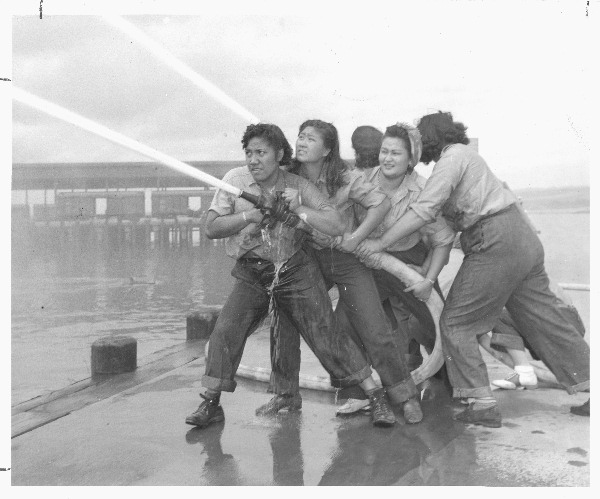
In an iconic photo, four Asian American Pacific Islander women at the Pearl Harbor Naval Shipyard train in firefighting. Long mislabeled as taken during the attack of Dec. 7, 1941, the photo in fact portrays some of  the strong women who applied to support the Navy’s war efforts in the wake of that attack. From left to right: Elizabeth Moku, Alice Cho, Katherine Lowe, and Hilda Van Gieson.


Over time, history usually has a way of sorting out fact from fiction.


Rear Adm.Grace Hopper, "Mother of Computing"
The facts and highlights of strong women of grit and grace are spotlighted in a book recommended for Women’s History Month. Profiles of more than 100 women come to life in “The Book of Gutsy Women” by Hillary Rodham Clinton and Chelsea Clinton (Simon & Schuster, 2019).

Among the women profiled are some we featured in Navy Reads posts: Rear Adm. Grace Hopper, Ada Lovelace, Rachel Carson, Marjory Stoneman Douglas, Margaret Chase Smith, Malala Yousafzai, and Maya Angelou. This book includes mini-biographies of both famous (Clara Barton, Helen Keller, Ida B. Wells, Maya Lin, Gabby Giffords, Greta Thunberg, and Venus and Serena Williams) as well as less-well-known women (Rigoberta Menchu Tum, Dr. Gao Yaojie, Nelba Marquez-Greene, Wangari Maathai, and Jineth Bedoya Lima).


Chelsea and Hillary Clinton, 2011
Hillary and Chelsea each provide essays about their subjects. They also offer personal perspectives about the women who have inspired and enlightened them – women who have made a difference in the world. The book is organized in sections: early inspirations, education pioneers, earth defenders, explorers and inventors, healers, athletes, advocates and activists, storytellers, elected leaders, groundbreakers, and women’s rights champions.

Chelsea writes, “I learned of Grace (Hopper) in 1996, when the navy named a new ship the USS Hopper (DDG 70) in her honor … I learned even more about her when I spoke many years later at the Grace Hopper celebration, the largest gathering of women technologists in the world.”


Former First Lady, senator, and Secretary of State Hillary Clinton reflects about the suffragists who knocked on the door, marched in the street, and fought for women to be able to vote in the United States one hundred years ago. That right was guaranteed with the passing of the Nineteenth Amendment to the U.S. Constitution, but it was a right that took decades to apply to women of color:

“Reading the words of the Nineteenth Amendment today, it’s hard not to wonder why it took so long” ‘The right of citizens of the United States to vote shall not be denied or abridged by the United States or by any State on account of sex. Congress shall have the power to enforce this article by appropriate legislation.’ But, of course, it was a long struggle because it was about so much more than the right of women to vote. It was about race, class, and deeply held cultural and religious views about women’s subordinate roles to men in society. It was about men’s –– and some women’s –– insecurities and fears of the unknown. These challenges are still present today.

The franchise –– the basic right of citizenship –– is still being fought over between those of us who believe every citizen should be able to vote and have that vote counted, and those who want to restrict the vote by erecting barriers against people, largely still based on race.”

Celia Ou, a graduate student at Scripps Institution of Oceanography, monitors computer screens displaying detailed sonar imaging of the ocean floor aboard the Auxiliary General Oceanographic Research (AGOR) vessel R/V Sally Ride, Dec. 15, 2016. (John F. Williams)


Nearly all the Gutsy women featured in this book faced and overcame some kind of obstacles of discrimination. Chelsea Clinton says this about space pioneer astronaut Sally Ride, the first American woman in space (in 1983) and a champion of STEM education for young people worldwide:

“Even after her death in 2012, Sally Ride kept breaking barriers. She came out as a lesbian quietly, without fanfare … Not long after her death, Tam [O’Shaughnessy, her partner of 27 years] received a call that surprised her, from Ray Mabus, then secretary of the navy. The navy hoped to honor Sally by naming a research vessel after her. Secretary Mabus was calling to ask whether Tam would be the ship’s sponsor – a role that had, up until that point, been filled by the wife of the man for whom the ship was named. ‘I think it is fitting the the celebration of Sally’s legacy as a pioneering space explorer and a role model includes an acknowledgment of who she really was and what she cared about,’ said Tam. The R/V Sally Ride, commissioned in 2016, is the first navy research ship named for a woman. Her legacy lives on in the scientific curiosity sparked in the girls and boys she continues to inspire, the ship that bears her name, and a spot on the moon named after her by NASA.”

Military readers may find fascinating nuggets of history in the essays about Sylvia Earle, Mary McLeod Bethune, Florence Nightingale, Eleanor Roosevelt, and Mary Edwards Walker. Chelsea writes this about Walker:

“…Dr. Mary Edwards Walker, the only woman in her medical school class at Syracuse Medical College in 1855. She was a practicing physician when the Civil War broke out. She desperately wanted to enlist in the Union Army as a surgeon but wasn’t allowed to because she was a woman. Initially she was called a nurse, since women generally weren’t considered doctors. Because women were not allowed to enlist, Mary had to volunteer, working for free at a temporary hospital, first in Washington and then in Virginia, where she traveled to Union field hospitals across the commonwealth … When her medical credentials were finally accepted she moved to Tennessee and became a War Department surgeon – a paid position that was the equivalent of a lieutenant in status.”


Dr. Sylvia Earle became chief scientist at the National Oceanic and Atmospheric Administration in 1990. She pioneered research in preserving 
and protecting the ocean, including the study of damage to coral reefs. Her inspiring TED talk, above, is a call to action. Hillary writes:

“When I think of Sylvia’s work, I am reminded how important it is for all of us to peruse and consider what we want to leave to the generations who come after us –– how they’ll honor the past, imagine the future, and give gifts to those who will live out their lives long after we’re gone. That’s exactly what Sylvia’s life as a scientist, an engineer, a teacher, and an explorer should inspire all of us to do: we must preserve our oceans for the future.”

Last year, this book generated controversy because of the women who were not included. For example, there is an unfortunate dearth of women who have served in or with the military. Surely, the authors could have included a “protectors” section filled with inspiring women who served in uniform.


Despite the intriguing photo on the cover, there is little focus on the women who served on the Homefront during the Second World War. In fact, there’s no explanation of the colorized photo of the women firefighters at the Pearl Harbor Naval Shipyard.

Yet, considering the general lack of attention toward the achievements of women in American and world history for many generations, it is refreshing to see a book of this scope. Women continue to knock on the door, push through the glass ceiling, and demand equality.


“The Book of Gutsy Women” illustrates the strengths of women throughout history, often in the face of sexism, misogyny, harassment, and patriarchy. It highlights the facts of women’s history and showcases women’s contributions to creating a better world now and in the future.