Showing posts sorted by relevance for query rachel carson stoneman. Sort by date Show all posts

Saturday, April 29, 2023

Three Navy-blue Green Presidents

Review by Bill Doughty––

Six United States presidents in my lifetime were Navy veterans: John Kennedy, Lyndon Johnson, Richard Nixon, Gerald Ford, Jimmy Carter, and George H.W. Bush. Each in his own way and to varying degrees was an optimistic champion of the environment.


Efforts of the first three –– JFK, LBJ and RMN –– led to the first Earth Day in 1970, now Earth Month in April.


The environmental movement is sometimes overshadowed by the other tectonic shifts during that era: The Cold War, Civil Rights, and the Vietnam War. But Douglas Brinkley takes the history of the green movement out of the shadows by centering on the three presidents of the era, as well as highlighting the life and work of ecologist-writer Rachel Carson, in “Silent Spring Revolution: John F. Kennedy, Rachel Carson, Lyndon Johnson, Richard Nixon, and the Great Environmental Awakening” (HarperCollins, 2022).


Sailor JFK
The Navy had a large part in shaping the vision of the presidents who defended pristine wilderness, clean air and water, and preservation of the environment.

For Kennedy of Massachusetts, it began with a deep love of the sea and shoreline, according to Brinkley, who opens the book with this:

“Beguiled by the way sea and sky played together, almost always unpredictably, John F. Kennedy was enthralled by the complexity of the Atlantic Ocean: the moody sky, the invisible might of the tides, shifting clouds, and the yaw and pitch of movement. To be on the water in a sailboat, even in a cruel wind, provided him with a profound connection with nature.”

Kennedy saw, in his own words, the human “biological fact that all of us have, in our veins, the same percentage of salt in our blood that exists in the ocean, and, therefore, we have salt in our blood, in our sweat, in our tears. We are tied to the ocean,” he said.


Johnson of Texas, was saddled with fighting the Vietnam War, poverty, segregation, and voter suppression. Environmentalism took somewhat of a back seat to other priorities. Brinkley writes:

“On the conservation front, Johnson probably should have been aware of of the importance of intelligent land stewardship. His favorite novel –– John Steinbeck’s ‘The Grapes of Wrath’ (1939) –– was based on a man-made ecological catastrophe during the Great Depression that destroyed ranches and farms in Texas, New Mexico, and Oklahoma. It was soil depletion that led to the Dust Bowl. Johnson, however, was left wanting to help the rural poor, without setting an equal priority on nurturing the natural world around them. Johnson liked Bureau of Reclamation dams, because he knew first-hand how electricity lit up forgotten regions, literally and figuratively.”

LBJ’s penchant for dam-building, both at home and abroad, as well as his escalation of the Vietnam war, caused consternation for environmentalists.

LBJ
Yet, in 1968, Johnson signed the Wild and Scenic Rivers Act. “Rivers, Johnson believed, from the far-flung waterways of Alaska, Idaho, and Wyoming to those coursing through the rural countryside of Vermont and Maine were the lifeblood of America,” Brinkley observes.

Johnson “forged ahead on conservation legislation to protect wild places because it was part of America’s frontier heritage.” LBJ is responsible for bringing about the Wilderness Act, Highway Beautification Act, and a commitment to “a green legacy for tomorrow.” According to Brinkley, Johnson should be given more credit for his advocacy to conservation, particularly of America’s rivers (just as President Eisenhower is recognized for the national highway system). As regards LBJ, “His Wild and Scenic Rivers Act was a visionary law passed purely on behalf of the aesthetics of rivers.”


Nixon of California, was captivated by the Pacific Ocean, as a child in Orange County. In 1969 he would make his home, as Kennedy did, next to the ocean. In Nixon’s case, it was in San Clemente, where he enjoyed whale watching. Though facing his own corruption issues that would eventually lead to his expulsion from office, Nixon still managed to achieve positive global initiatives such as rapprochement with China and arms control talks with Russia. And he not only supported the Clean Air Act, Clean Water Act, and National Environmental Policy Act, but he also created the Environmental Protection Agency.

“If Nixon’s signing of NEPA and his Everglades protection were the first big time indications of the administration’s serious commitment to environmental protection, the State of the Union address on January 22, with its plea that ‘Restoring nature to its natural state is a cause beyond party and beyond factions,’ was seen by surprised Democrats as the Great Reconfirmation that Nixon indeed harbored a genuine TR streak … When Nixon delivered a Special Message to the Congress on Environmental Quality on February 10 (1970), he listed fourteen executive orders and twenty-three legislative proposals to combat pollution and provide parkland. ‘The time has come when we can wait no longer to repair the damage already done,’ he told Congress.”

Brinkley notes several times that Nixon was “suspicious” of liberal traps, so he did not appear on TV for the first Earth Day. He even asked FBI director J. Edgar Hoover, to spy on high-profile Earth Day events on college campuses, fearful of their ties with the anti-Vietnam War movement.


Yet, Nixon’s support of conservation, preservation, and a clean environment persisted.


Nixon
In 1970 he created the EPA (Environmental Protection Agency) and NOAA (National Oceanic and Atmospheric Association, and he signed the Clean Air Act.

On October 21, 1972, Nixon signed the Federal Environmental Pesticide Control Act of 1972, an achievement to the legacy of Rachel Carson. He signed the Marine Mammal Protection Act in 1972 and the Endangered Species Act of 1973.


And he signed the Emergency Highway Energy Conservation Act (limiting nationwide speed limits to 55) and the Federal Energy Administration Act in 1974 (the same year he was forced to resign because of Watergate).


Brinkley briefly shows how the Navy stopped pumping sewage into San Francisco Bay while in port. He also discusses how, during the Nixon administration, Marines at Camp Pendleton helped protect endangered wildlife. In coordination with the Department of Interior and NASA, the Navy sponsored the first all-women team of aquanauts in Tektite II to study the ecosystem at the bottom of the sea.


All three Navy-veteran presidents –– two Democrats and one Republican –– were following the lead of conservationist Republican President Theodore Roosevelt of another generation, and who had his own strong ties to the Navy and who championed nature and national parks. 


In two appendices Brinkley lists scores of national wildlife refuges and national parks created or authorized by Kennedy, Johnson, and Nixon.


One of President Nixon’s many environmental preservation initiatives included establishing a federally designated Wilderness area, the Cumberland Island National Seashore. “Because Cumberland National Seashore encompassed twenty-three different ecological communities, Nixon agreed that only three hundred tourists at a time be allowed on Cumberland Island. Georgia Governor Jimmy Carter, a moderate Democrat, played a major conservation role regarding the saving of Cumberland…"


Rachel Carson talks about "Silent Spring" in April 1963
This massive book (857 pages!) includes dozens of evocative photos, memorable stories, and captivating personalities of the people who created the environmental enlightenment and “awakening” in the 1950s, 60s, and early 70s.

Rachel Carson provided much of the inspiration for the environmental movement leading up to the first Earth Day and the public’s demand for clean water, air, and land. She wisely connected the long-lasting danger of atmospheric tests of nuclear weapons with the hazards related to DDT, a pernicious pesticide that altered ecosystems. We have referenced or featured Carson’s works several times here on Navy Reads.


Carson’s “Silent Spring” and her Sea Trilogy inspired John F. Kennedy. Family matriarch Rose Kennedy gave a copy of “Under the Sea-Wind,” published in 1941, to JFK in the mid-1950s.


“Although ‘Under the Sea-Wind’ sold in low numbers, perhaps because Pearl Harbor occurred right after it debuted, it became celebrated by marine biologists and other lovers of the animal kingdom,” Brinkley writes.


Carson was, in turn, inspired by Albert Schweitzer. And it seems everyone was inspired by Henry David Thoreau. 


Brinkley also follows the influence and positive impact of artists, writers, scientists, and politicians: Ansel Adams, John Muir, Carl Sandburg, Marjorie Stoneman Douglas, William O. Douglas, Linus Pauling, Harold Ickes, Wallace Stegner, Robert Frost, Ted Sorensen, Robert F. Kennedy, Cesar Chavez, Jacques Cousteau, Sylvia Earle, Barry Commoner, David Brower, Lady Bird Johnson, Howard Zahniser, Ralph Nader, Robert Boyle, John Saylor, Katherine Ordway, Chief Luther Standing Bear, Laurance Rockefeller, Russell Train, Stewart Udall, Ronald Dellums, Daniel Patrick Moynihan, Henry “Scoop” Jackson, Frank Church, Philip Hart, Gaylord Nelson, Edmund Muskie, William Ruckelshaus, Walter Hickel, Al Gore, and John Ehrlichman.


In the book’s preface, Brinkley praises those “serving a cause bigger than oneself” and warns against the ostrich syndrome of ignoring ongoing threats to the environment, including climate chaos. 

He writes: “The poisonous climate cocktail of ravaging wildfires, mega floods, and monstrous blizzards costs American taxpayers billions of dollars every year (soon to climb to trillions), disrupts lives, causes vast displacement, ruins communities, and kills countless citizens.”

Brinkley says, “In some small way, I hope this book illuminates how an engaged citizenry can bring America’s natural beauty back from the brink.” He writes, “Optimism must remain in our oxygen.”


I remember the feeling of optimism, hope, and activism of the first Earth Day in 1970, the first recognition that something needed to be done to confront pollution, overpopulation, and other ecological threats.


Among more than a dozen books, Brinkley is the author of “The Wilderness Warrior: Theodore Roosevelt and the Crusade for America” (2009) and “The Unfinished Presidency: Jimmy Carter’s Journey Beyond the White House” (1998).

Saturday, March 10, 2018

Who Was Marjory Stoneman Douglas?

Review by Bill Doughty

Regrettably, "Marjory Stoneman Douglas" High School will always be remembered the way "Sandyhook" and "Columbine" are remembered – places of learning devastated by murderous gunfire. Students at MSD High School, "the Eagles," are demonstrating resilience and redirecting their anger and grief toward positive change.


So who was Marjory Stoneman Douglas?

Seventy-one years ago Marjory Stoneman Douglas (1890-1998), newspaper journalist and freelance writer, wrote "The Everglades: River of Grass" (Pineapple Press, 1947).

The book is a fascinating history of "the great pointed paw of Florida," describing its nature, peoples, history of conquest, and challenges in the face of development and destruction of the Everglades.

Fellow writer John Hersey, author of "Hiroshima," called Stoneman Douglas's description of the Everglades "an unearthliness, a strong rhythm, a compactness of natural imagery that is dazzling, and, above all an organization and discipline that approaches poetic form."
Here's an example of her poetry in prose:
"The water moves. The saw grass, pale green to deep-brown ripeness, stands rigid. It is moved only in sluggish rollings by the vast push of the winds across it. Over its endless acres here and there the shadows of the dazzling clouds quicken and slide, purple-brown, plum-brown, mauve-brown, rust-brown, bronze. The bristling, blossoming tops do not bend easily like standing grain. They do not even in their own growth curve all one way but stand in edged clumps, curving against each other, all the massed curving blades making millions of fine arching lines that at a little distance merge to a huge expanse of brown wires or bristles or, farther beyond, to deep-piled plush. At the horizon they become velvet. The line they make is an edge of velvet against the infinite blue, the blue-and-white, the clear fine primrose yellow, the burning brass and crimson, the molten silver, the deepening hyacinth sky. The clear burning light of the sun pours daylong into the saw grass and is lost there, soaked up, never given back. Only the water flashes and glints. The grass yields nothing."

Science meets art in her writing, much like Rachel Carson, as Stoneman Douglas paints with her words.


Baby bald eagle in the Everglades. (National Park Service)
She describes the destruction of birds, killed out of greed for their feathers, their plumes. At sunset, like birds everywhere, birds of the Everglades would return "in their white thousands and tens of thousands, with the sounds of great stiff still banners ... rivers of birds pouring against the sunset back to the rookeries ... down to the right next in the clamor and squawking and curious yelping, and queer deep grunting of the fuzzy open-beaked hungry young."
"When the sun rose the ethereal whiteness of the plumed parent birds shone like frost against the blue, blue sky. They  were white in the nights under the moon, or to the torches and firepans of the men with clubs in canoes slipping along behind the lights. A few men with clubs or shotguns rising suddenly by those low rookeries could kill and scalp hundreds of birds in a night. By morning the bloody bodies would be drawing the buzzards and alligators. The great black Florida crows that shed the light like water from their feathers would clean out the dying young. Ants in long lines as fine as pepper would carry off the rotting pieces of their bones."
White egret (Photo courtesy National Park Service)
In "The Everglades: River of Grass" Stoneman Douglas takes us through millennia – Cretaceous, Eocene, Oligocene, Miocene – to more recent history of the Age of Exploration and Conquest, through the Civil War and into the first half of the 20th century.
"History," she writes, "the recorded time of the earth and of man, is in itself something like a river."

So is childhood – or a journey through high school.

We learn about colorful characters in Florida's history, including Billy Bowlegs, King Carlos, Juan Ortiz, Juan Ponce de Leon, Hernando De Soto, Col. Zachary Taylor, Maj. Francis Dade, Andrew Jackson (who waged war against the indigenous people 200 years ago, 1817-1818), Napoleon Bonaparte Broward, and Osceola.


Osceola
Osceola would become a "patriot and warrior" hero who was to "epitomize for future history the highhanded injustice" of captivity, a symbol in the first half of the 1800s to  those, including Indians and escaped slaves, who fought for freedom and righteousness. A town, lake, county, many individuals, and even a species of snake were named after him. So were several U.S. Navy vessels, including a gunboat during the Civil War, harbor tug and seagoing tug #47, all called Osceola.

Stoneman Douglas brings the imagery of the sea into her writing, and she seems to have a special affinity to the tough and gritty sailors who ventured aboard wooden ships and into the unknown.
"These were not the men of the Mediterranean galleys, the long narrow ships that went mincingly on the tideless inner sea, from headland to known headland, by the banked oars of slaves. These were free men of that limitless, turbulent ocean, the men of the bucking, hardy cargo carriers, the round ships, broad of bow and beam, that thrashed forward only before the wind in their single, clumsy square sails. They came about only by a miracle and could hardly beat to windward at all. Many a ship and crew was blown far out into the unknown and disappeared under the unturning, savage, westgoing wind. Not that that mattered. There were men in every port eager to follow them. Their concern was not safety. Their concern was going out. Sailing. Finding out. Seeing. Never mind the coming back."
Seagoing tug USS Osceola
We see how early explorers, Spanish Catholic crusaders, and English traders fought over the "paw" of Florida and subjugation of the people there. 
The U.S. Navy, under USS Flirt and Fort Flirt, played an important role in Florida's early history, protecting against piracy and bootlegging and eventually in the Civil War fighting against "the accepted evil of slavery."
Admiral David Porter – and later his son David Dixon Porter – protected Florida, commercial trade and the United States on both sides of the peninsula.
Stoneman Douglas offers a meticulous description of the lives of the earliest residents of the Everglades, the indigenous "Indians": Calusa, Mayaimi, Tekesta, Talasi, Yochi, Tallahasee and others. Eventually they would be lumped together under a catch-all name: Seminole.

Calusa
By the mid 18th century the original people of the Everglades had disappeared. "Only the scattered Calusas were left, ranging throughout the area. It has been repeated often that after 1763 they left for Cuba en masse. I do not believe that there was ever a time when the Glades were empty of villages," Stoneman Douglas concludes.

"They had great courage. They came of people who had lived hard and savage lives and their children were not weakened," she writes.

The author was successful in convincing people to conserve and preserve much of the precious Everglades. In December 1947, the year her book was published, President Truman dedicated the Everglades National Park, helping people realize the life-giving value of the ecosystem – and the dangers of draining the water, leading to fires and rising salt water.
"Unless the people will act the fires will come again. Overdrainage will go on. The soil will shrink and burn and be wasted and destroyed in a continuing ruin. The salt will lie in wait. Yet the springs of fine water had flowed again. The balance still existed between the forces of life and of death. There is a balance in man also, one which has set against his greed and his inertia and his foolishness; his courage, his will, his ability slowly and painfully to learn, and to work together."
The Courage... the will... the "ability slowly and painfully to learn, and to work together."

Her legacy lives on.

The Marjory Stoneman Douglas High School family – students, teachers and loved ones – are taking a stand on behalf of those who were killed by promoting common sense gun safety to prevent more tragedies. Their school's namesake channeled her passion toward positive change on behalf of something she deeply loved too, part of a resilient ecosystem that supports life.

Marjory Stoneman Douglas

Saturday, March 3, 2018

Women Who Changed the World

Review by Bill Doughty

"Throughout history many women have risked everything in the name of science. This book tells the stories of some of these scientists, from ancient Greece to the modern day, who in the face of 'No' said, 'Try and stop me.'"

With cool-weird drawings and sparkling insights, writer-illustrator Rachel Ignotofsky profiles some of the women who stand out in fields of Science, Technology, Engineering and Mathematics in "Women in Science: 50 Fearless Pioneers Who Changed the World" (Ten Speed Press, 2016).

Among the 50 women featured are Wang Zhenyi, Ada Lovelace, Karen Horney, Marie Curie, Marjory Stoneman Douglas, Rachel Carson, Katherine Johnson, Valentina Tereshkova, Jane Goodall, Maryam Mirzakhani, and Grace Hopper, "Navy admiral and computer scientist."
"Grace Hopper was ... a relentless trailblazer, recognized as the mother of computer programming," Ignotofsky writes. The author spices her profiles with one-liners like: "Invented the first compiler, forever changing how we use computers," "Her great-grandfather was also in the Navy," and "Pioneered the standards for testing computer systems."
Grace Hopper, born in 1906, was fourteen years old when women in the United States achieved the right to vote, a step toward greater equality for women. She earned a PhD in mathematics at Yale fourteen years after passage of the 19th Amendment. Hopper joined the Women Accepted for Volunteer Emergency Service (WAVES) in 1943, bringing her mathematics skills to the war effort.
"After the war, Grace joined the private sector. At the time, programmers needed the skills that came with an advanced degree in mathematics and used binary code to program. Grace Hopper thought it would be easier to just 'talk' to a computer in English. Everyone thought Grace was nuts, but she proved them wrong when she invented the first compiler. This led to create COBOL, the first universal computer language. Thanks to Grace just about anyone can learn to code! Grace returned to the Navy in 1967. Even after she retired as the oldest person on active duty (just a few months short of turning 80), she continued to lecture, consult, and teach – always reminding the world that 'the most damaging phrase in the language is 'we've always done it this way.'"
Along with the short biographies of the fifty featured women are a timeline, statistics in STEM, an illustrated list of lab tools and a glossary. While this book appeals to young readers it, like the works of Mary Roach and Hope Jahren, can inspire any readers to see how women have contributed to progress in the world.

The author's other books (this one was her first) include "I Love Science" and "Women in Sports."

Ignotofsky, who supports critical thinking and evidence-based decision-making exemplified in the "March for Science," writes in her conclusion:
"Women make up half of our population, and we simply cannot afford to ignore that brain power – the progress of humankind depends on our continual search for knowledge. The women in this book prove to the world that no matter your gender, your race, or your background, anyone can achieve great things. Their legacy lives on. Today, women all over the world are still risking everything to discover and explore."
Don't try to stop them.

Monday, February 18, 2019

Green New Deal Imagined in 'This Moment on Earth'

Review by Bill Doughty

Vietnam branded John Kerry. His missions in the Navy, as a senator and as Secretary of State informed his life. And his confrontation with mortality brought insight and wisdom.
Kerry focuses that perspective on his most important mission on "protecting the planet." That's the last chapter in his new autobiography, "Every Day is Extra," and it's the subject of a book he and wife Teresa Heinz Kerry wrote in 2007, "This Moment on Earth" (PublicAffairs, Perseus Books).

Kerry and Gore at Yale University.
If the seeds for the Green New Deal were first planted by Ralph Waldo Emerson, Theodore Roosevelt, Marjory Stoneman Douglas and Rachel Carson – and in 1970 with the world's first "Earth Day" – those seeds were certainly watered and given sunshine by Bill McKibben (350.org), Al Gore ("An Inconvenient Truth") and the Kerrys.

"This Moment on Earth" is a call for action, acknowledging the reality of global climate change, the hazards of relying on fossil fuels for our energy, and the poisoning of earth's air and water. The authors offer a number of examples of individuals and communities – from Pittsburgh and the Carolinas to New Mexico, Washington State and Portland – taking responsibility and action.

United States Marines to the Rescue

Former Marine Bob Boyle organized fellow fishermen and helped clean up the Hudson Bay, inspired "by their growing disgust about the deterioration of the environment and our poor stewardship," demonstrating how Americans are a government of, by and for the people.

Former United States Marine Rick Dove, a Riverkeeper enforcer.
Another Marine, Rick Dove, a retired colonel, took on the unregulated hog farming industry and their political supporters.
"Listening to Rick talk about his work is inspirational. Sixty-seven years old – a marine – he could have been doing almost anything else; he'd earned it. But his personal sense of responsibility and love for the river kept him on the job. 'Semper Fi' – 'Always faithful' – the motto of the Marines, was his for life. His story conclusively demonstrates the connection between the choices we make and health of our communities. Few of us likely give much consideration to how our everyday choices – such as the seemingly straightforward decisions we make at the grocery store to provide food for our families – may have an impact on people we will never meet, in places we may never visit."
Americans Connected
"In recent times, particularly since the 2000 presidential election, we have generally bought into the idea of blue states and red states. But it takes people like Rick to remind us that, regardless of how we vote or which party we align ourselves with, we all share many very basic ideals. All of us certainly want clean water. No fisherman should be sickened by toxins in the water. No mother should worry that her child will become sick from swimming at the local beach. Nobody among us – young or old, farmer or artist, Democrat or Republican – should demand anything less than safe, available water. This is not a matter of politics; it is a matter of common sense, morality, and responsibility."
True conservatives are conservationists, by their very name. "Evangelicals talk of "creation-care" – that any damage that we do to God's world is an offense against God," an idea that "appeals to all religions of the world and to anyone with a moral guidepost."

President John F. Kennedy and First Lady Jacqueline Kennedy watch the first race of the 1962 America's Cup from aboard the USS Joseph P. Kennedy, Jr. Also pictured: Hugh D. Auchincloss; Under Secretary of the Navy, Paul "Red" Fay; Jamie Auchincloss; Janet Auchincloss; John Forbes Kerry; Press Secretary, Pierre Salinger; Naval Aide to the President, Captain Tazewell Shepard; Rep. Fernand St. Germain (Rhode Island). Newport, Rhode Island. (JFK Library)
In his recent autobiography, "Every Day Is Extra," Kerry reprises a JFK quote also published in "This Moment on Earth" in a chapter called "The Water of Life." 
"As (Navy veteran) President John F. Kennedy said in a speech he gave in Newport, Rhode Island, in 1962: 'All of us have in our veins the exact same percentage of salt in our blood that exists in the ocean, and therefore, we have salt in our blood, in our sweat, in our tears. We are tied to the ocean. And when we go back to the sea – whether it is to sail or to watch it – we are going back from whence we came.' Water accounts for up to 90 percent of the weight of cells in the human body and three-fourths of the body's total weight. Essential to our survival, so powerfully linked to our history and culture, such a precious resource ought to receive the highest level of protection – nothing short of uncompromising stewardship."
John Kerry speaks of books and "storytellers of the sea" and rivers that influenced him over the years: Herman Melville's "Moby Dick," Rudyard Kipling's "Captains Courageous," Sebastian Junger's "The Perfect Storm," Richard Henry Dana's "Two Years Before the Mast," and Mark Twain's "Huckleberry Finn."

A Call for Boldness: 'The Green Rush is On'

John Kerry and Teresa Heinz Kerry
Kerry's "This Moment on Earth" with Teresa Heinz Kerry – along with the final chapter of "Every Day Is Extra" – calls for the acknowledgment, will and action to combat climate change. His call, to include "an innovative and strategic national energy policy," is reflected in calls for a Green New Deal.
"There's no excuse for inertia. Even if, contrary to all science, the proponents of action on global climate change were proven wrong, what harm would the actions to combat global warming cause? We would have produced healthier people with cleaner air, sustainable farming and fishing practices, more healthful food, and more effective sources of cleaner energy, all of which adds to greater security. But if those who deny climate change get their way and then are proved wrong, we will suffer catastrophe beyond description."
The U.S. Army Corps of Engineers uses solar energy at a remediation project at the former Nebraska
Ordnance Plant – energy-saving technology to treat groundwater and power equipment. (U.S. Army)
A Green New Deal would push innovation and ingenuity. "That ingenuity is alive and well among individuals and corporations engaged in the discovery of new and better ways to address our energy challenges" in a "post-carbon period," Kerry writes. "Americans have always pushed the frontier of discovery. We didn't become the most powerful economy on Earth by holding back. Innovation after innovation has unfolded because the American spirit has always pushed the limits. Innovation is in the American DNA."

The Kerrys call for individual action and offer to appendices: "The Energy Plan" and "What You Can Do," with a list of sites to get more information and get involved.

Monday, March 29, 2021

‘Gutsy’ Women Knocking on the Door

Review by Bill Doughty

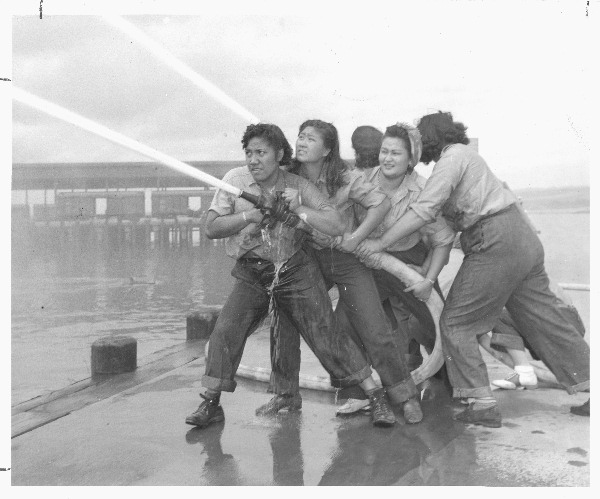
In an iconic photo, four Asian American Pacific Islander women at the Pearl Harbor Naval Shipyard train in firefighting. Long mislabeled as taken during the attack of Dec. 7, 1941, the photo in fact portrays some of  the strong women who applied to support the Navy’s war efforts in the wake of that attack. From left to right: Elizabeth Moku, Alice Cho, Katherine Lowe, and Hilda Van Gieson.


Over time, history usually has a way of sorting out fact from fiction.


Rear Adm.Grace Hopper, "Mother of Computing"
The facts and highlights of strong women of grit and grace are spotlighted in a book recommended for Women’s History Month. Profiles of more than 100 women come to life in “The Book of Gutsy Women” by Hillary Rodham Clinton and Chelsea Clinton (Simon & Schuster, 2019).

Among the women profiled are some we featured in Navy Reads posts: Rear Adm. Grace Hopper, Ada Lovelace, Rachel Carson, Marjory Stoneman Douglas, Margaret Chase Smith, Malala Yousafzai, and Maya Angelou. This book includes mini-biographies of both famous (Clara Barton, Helen Keller, Ida B. Wells, Maya Lin, Gabby Giffords, Greta Thunberg, and Venus and Serena Williams) as well as less-well-known women (Rigoberta Menchu Tum, Dr. Gao Yaojie, Nelba Marquez-Greene, Wangari Maathai, and Jineth Bedoya Lima).


Chelsea and Hillary Clinton, 2011
Hillary and Chelsea each provide essays about their subjects. They also offer personal perspectives about the women who have inspired and enlightened them – women who have made a difference in the world. The book is organized in sections: early inspirations, education pioneers, earth defenders, explorers and inventors, healers, athletes, advocates and activists, storytellers, elected leaders, groundbreakers, and women’s rights champions.

Chelsea writes, “I learned of Grace (Hopper) in 1996, when the navy named a new ship the USS Hopper (DDG 70) in her honor … I learned even more about her when I spoke many years later at the Grace Hopper celebration, the largest gathering of women technologists in the world.”


Former First Lady, senator, and Secretary of State Hillary Clinton reflects about the suffragists who knocked on the door, marched in the street, and fought for women to be able to vote in the United States one hundred years ago. That right was guaranteed with the passing of the Nineteenth Amendment to the U.S. Constitution, but it was a right that took decades to apply to women of color:

“Reading the words of the Nineteenth Amendment today, it’s hard not to wonder why it took so long” ‘The right of citizens of the United States to vote shall not be denied or abridged by the United States or by any State on account of sex. Congress shall have the power to enforce this article by appropriate legislation.’ But, of course, it was a long struggle because it was about so much more than the right of women to vote. It was about race, class, and deeply held cultural and religious views about women’s subordinate roles to men in society. It was about men’s –– and some women’s –– insecurities and fears of the unknown. These challenges are still present today.

The franchise –– the basic right of citizenship –– is still being fought over between those of us who believe every citizen should be able to vote and have that vote counted, and those who want to restrict the vote by erecting barriers against people, largely still based on race.”

Celia Ou, a graduate student at Scripps Institution of Oceanography, monitors computer screens displaying detailed sonar imaging of the ocean floor aboard the Auxiliary General Oceanographic Research (AGOR) vessel R/V Sally Ride, Dec. 15, 2016. (John F. Williams)


Nearly all the Gutsy women featured in this book faced and overcame some kind of obstacles of discrimination. Chelsea Clinton says this about space pioneer astronaut Sally Ride, the first American woman in space (in 1983) and a champion of STEM education for young people worldwide:

“Even after her death in 2012, Sally Ride kept breaking barriers. She came out as a lesbian quietly, without fanfare … Not long after her death, Tam [O’Shaughnessy, her partner of 27 years] received a call that surprised her, from Ray Mabus, then secretary of the navy. The navy hoped to honor Sally by naming a research vessel after her. Secretary Mabus was calling to ask whether Tam would be the ship’s sponsor – a role that had, up until that point, been filled by the wife of the man for whom the ship was named. ‘I think it is fitting the the celebration of Sally’s legacy as a pioneering space explorer and a role model includes an acknowledgment of who she really was and what she cared about,’ said Tam. The R/V Sally Ride, commissioned in 2016, is the first navy research ship named for a woman. Her legacy lives on in the scientific curiosity sparked in the girls and boys she continues to inspire, the ship that bears her name, and a spot on the moon named after her by NASA.”

Military readers may find fascinating nuggets of history in the essays about Sylvia Earle, Mary McLeod Bethune, Florence Nightingale, Eleanor Roosevelt, and Mary Edwards Walker. Chelsea writes this about Walker:

“…Dr. Mary Edwards Walker, the only woman in her medical school class at Syracuse Medical College in 1855. She was a practicing physician when the Civil War broke out. She desperately wanted to enlist in the Union Army as a surgeon but wasn’t allowed to because she was a woman. Initially she was called a nurse, since women generally weren’t considered doctors. Because women were not allowed to enlist, Mary had to volunteer, working for free at a temporary hospital, first in Washington and then in Virginia, where she traveled to Union field hospitals across the commonwealth … When her medical credentials were finally accepted she moved to Tennessee and became a War Department surgeon – a paid position that was the equivalent of a lieutenant in status.”


Dr. Sylvia Earle became chief scientist at the National Oceanic and Atmospheric Administration in 1990. She pioneered research in preserving 
and protecting the ocean, including the study of damage to coral reefs. Her inspiring TED talk, above, is a call to action. Hillary writes:

“When I think of Sylvia’s work, I am reminded how important it is for all of us to peruse and consider what we want to leave to the generations who come after us –– how they’ll honor the past, imagine the future, and give gifts to those who will live out their lives long after we’re gone. That’s exactly what Sylvia’s life as a scientist, an engineer, a teacher, and an explorer should inspire all of us to do: we must preserve our oceans for the future.”

Last year, this book generated controversy because of the women who were not included. For example, there is an unfortunate dearth of women who have served in or with the military. Surely, the authors could have included a “protectors” section filled with inspiring women who served in uniform.


Despite the intriguing photo on the cover, there is little focus on the women who served on the Homefront during the Second World War. In fact, there’s no explanation of the colorized photo of the women firefighters at the Pearl Harbor Naval Shipyard.

Yet, considering the general lack of attention toward the achievements of women in American and world history for many generations, it is refreshing to see a book of this scope. Women continue to knock on the door, push through the glass ceiling, and demand equality.


“The Book of Gutsy Women” illustrates the strengths of women throughout history, often in the face of sexism, misogyny, harassment, and patriarchy. It highlights the facts of women’s history and showcases women’s contributions to creating a better world now and in the future.