Showing posts sorted by relevance for query coach John wooden. Sort by date Show all posts

Sunday, March 30, 2014

March Madness 2: Giants

by Bill Doughty

It was 1968. I was on a Brookhurst Junior High School eighth grade field trip to the campus of the University of California at Los Angeles when Lew Alcindor walked by.
From http://kareemabduljabbar.com
My buddies and I had been looking down, amazed by the huge roots of trees that broke apart the sidewalk, when a human tree walked past. Lew Alcindor, 7 feet and 2 inches tall, one of the greatest basketball players of all time.

Lew Alcindor. My buddies and I stopped and stared, open-mouthed, wide-eyed. The future Kareem Abdul-Jabbar had a serious look on his face and a huge stack of books under his arm.

Books.

It was an indelible image that had a huge impact on my life.

Abdul-Jabbar was an avid reader and writer even before he began playing college basketball. Now he's a successful author.
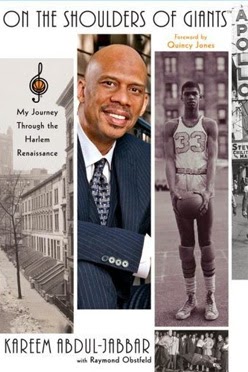
Among his books: "Brothers in Arms: The Epic Story of the 761st Tank Battalion, WWII's Forgotten Heroes" with Anthony Walton (2004); "On the Shoulders of Giants: My Journey Through the Harlem Renaissance" with Raymond Obstfeld (2007); and "What Color Is My World? The Lost History of African American Inventors" with Raymond Obstfeld (2012). I look forward to featuring some of Abdul-Jabbar's work in future posts.

In "Giant Steps," Abdul-Jabbar writes about his first impression of his coach at UCLA, the great John Wooden, who out of respect called him "Lewis."

"I found myself liking Mr. Wooden right away. People would always tell me they cared about me, but I felt Mr. Wooden really meant it. I came of his office knowing I was going to UCLA."

Perhaps it was their mutual interest in books. Each man's fathers, "Hugh" Wooden and "Big Al" Alcindor, had instilled in their sons a lifelong passion for reading. 

In "My Personal Best: Life Lessons from an All-American Journey" by John Wooden with Steve Jamison, the coach reflects in a chapter, "The Age of Alcindor," about self-control and poise being fundamental to achieving success.  "Lewis had the bearing of an eagle. He also reminded  me so much of my own father, Joshua Hugh Wooden."

"Wooden: A Coach's Life" by Seth Davis, opens with:
"The first thing you noticed were the books. Big books, little books, picture books, children's books, art books, religious books, coaching books, sports books, fiction books, science books. Before I walked through the door, they were there to greet me in tall, neat piles in the front hallway. The books were stacked on floors, lined up on tables, piled on desks, jammed into bookcases. The apartment was barely two thousand square feet, yet it seemed that most of it was covered by something that could be read."
Wooden was an English teacher before he was a coach. But he was also a lieutenant in the United States Navy providing physical readiness training for naval aviators during World War II. Davis writes:
"After World War II broke out, Wooden could have avoided being drafted because he was a married father and high school teacher, but eventually duty compelled him to enlist in the navy, a little more than a year after the bombing of Pearl Harbor."
One of Wooden's assignments was on the campus of the University of North Carolina in Chapel Hill. He also served at other college campuses, at an Iowa preflight school and as an underway watch officer aboard USS Sable (IX-81), an aircraft carrier training ship anchored in Lake Michigan.


Like fellow Sailor Red Auerbach, he never served overseas.  In Wooden's case, a bout of appendicitis prevented him from deploying to the carrier USS Franklin (CV-13) in the South Pacific, including off the coast of Samar, Philippines.
"As it turned out, Wooden knew well the man who replaced him aboard the Franklin. He was Freddy Stalcup, a former Purdue football player who was Wooden's fraternity brother in Beta Theta Pi. Several months later, Wooden received a piece of news that left him dumbstruck: Stalcup was working a gun position aboard the Franklin when the ship was struck by a Japanese kamikaze pilot. He was killed along with dozens of other men on board. Had Wooden's appendix not become inflamed, he could very well have lost his life that day."
Davis presents a lifetime of detail in nearly 600 pages of Wooden's biography, including details about the Coach's commitment to conditioning and the fast break, Wooden's complicated relationship with Bill Walton, his love of poetry (even on his deathbed), discussions of religion and racism, and the Coach's insights on leadership, including the development of his core values and Pyramid of Success, which reaches a pinnacle in "Competitive Greatness" -- requiring toughness, your best performance, and "real love of a hard battle."

When Wooden passed away in 2010, UCLA issued a statement that included a quote from Kareem Abdul-Jabbar, the former Lew Alcindor, who I saw carrying that armful of books back in 1968:

"It's kind of hard to talk about Coach Wooden simply, because he was a complex man. But he taught in a very simple way. He just used sports as a means to teach us how to apply ourselves to any situation.  He set quite an example. He was more like a parent than a coach. He really was a very selfless and giving human being, but he was a disciplinarian. We learned all about those aspects of life that most kids want to skip over. He wouldn't let us do that."

Wooden, known for his pithy words of wisdom, famously said, "What you are as a person is far more important that what you are as a basketball player."  He also advised, "Drink deeply from good books."

The dust jacket of "Wooden: A Coach's Life," calls the book, "A provocative and revelatory new biography of the legendary UCLA coach John Wooden, by one of America's top college basketball writers."

Saturday, April 4, 2015

Duke's Coach K and Navy Core Values

by Bill Doughty

Coach K after 1,000 wins with his 2014/2015 team.
Victory starts with strong defense and execution through power projection. That's the theme of today's victory by the Duke Blue Devils over the Michigan State Spartans.

The best teams have strong, good and caring coaches, and each of the coaches for this year's NCAA Final Four tournament in Indianapolis has a good, experienced coach on the bench.

"But the strongest bench job of the season has been done by arguably the best coach of any sport on the planet: Mike Krzyzewski," writes Steve DeShazo of Fredericksburg.com on the eve of today's game.


Coach K and Coach Izzo have fun yesterday.
Coach K is the picture of sustained honor, courage and commitment.

"After 35 years at Duke, his program is almost self-sustaining," DeShazo writes. "He’s won a record 1,016 games, four national titles and will tie the legendary John Wooden today with his 12th Final Four appearance ... Krzyzewski’s role with USA Basketball enriches his status even more."

Krzyewski knows when to be serious yet he shows he can have fun.

Coach K is author of several books, including "The Gold Standard: Building a World-Class Team," "Beyond Basketball: Coach K’s Keywords For Success" and "Leading with the Heart: Coach K’s Successful Strategies for Basketball, Business, and Life." We featured "Leading with the Heart" in a recent Navy Reads review; the book is on the CNO's Professional Reading Program.

Coach K on Honor, Courage and Commitment:

Honored to coach Team USA in the Olympics.
Honor as head coach of USA team in the Olympics – “For me, this is the ultimate honor in coaching,” said Krzyzewski. “It is a chance to represent the United States at this elite level of basketball. I am honored to be chosen and look forward to the opportunity to develop this team that will represent our great country in its own sport, both on and off the court.”

Courageous leadership – “It takes courage not only to make decisions, but to live with those decisions afterward.”

Committed teamwork – “Mutual commitment helps overcome the fear of failure—especially when people are part of a team sharing and achieving goals. It also sets the stage for open dialogue and honest conversation.”

Sunday, August 21, 2016

Honor, Courage, Commitment: Grit Wins the Gold

Review by Bill Doughty

Like having Michael Phelps and Katie Ledecky as anchors, the last few chapters of Dr. Angela Duckworth's milestone, "Grit" (2016, Scribner, Simon & Schuster), completes an extended relay of a book–filled with life advice and examples of achievement and success.

In fact, Duckworth talks about Phelps, Ledecky, Kevin Durant and other Olympics heroes–along with dozens of other public and private individuals in this powerful book subtitled "The Power of Passion and Perseverance."

Readers will want to race through this book to pick up valuable tips about potential, resilience, character, training and achievement. From diverse fields or endeavors such as sports, zookeeping, NASA, cartooning, spelling bees and more, Duckworth delivers examples from her own life as well the lives of people including Jeff Bezos, Steve Young, Tom Seaver, Julia Child, John Irving, Aristotle, Ta Nehishi Coates, Benjamin Franklin, Will Shortz, Warren Buffet, and the nation of Finland.


A Navy SEAL monitors youth training camp. (Photo by MC3 Geneva G. Brier.)
Duckworth explores West Point's "The Beast" (barracks boot camp) as she and other scientists attempt to predict who will succeed and who will drop out. The same evaluation is done, no doubt, in all military branches especially in hyper-competitive areas such as Navy BUDS (Basic Underwater Demolition/SEAL) training.

Natural talent, initial physical strength, and inherent skills are not most important. Mental toughness–grit–is.

Winners like Michael Phelps, Katie Ledecky and Usain Bolt want to go head-to-head with other people, are willing to train continuously and with passion, and can accept failure as motivation for the next challenge. They understand "there are no shortcuts to excellence."

It helps, Duckworth notes, to have "purpose-driven grit"–a vision and calling, whether it's the Olympics, service in the military or as part of an NBA or NFL team. Each has its culture of teamwork,service and, some more than others, a concept of a greater good.

After seeing Duckworth's TED talk on grit, Seattle Seahawks head coach Pete Carroll, author of "Win Forever," contacted her and invited her to the Seahawks camp. Carroll's philosophy is, "Do things better than they have ever been done before."


The day after Carroll's team beat the Denver Broncos to win Superbowl XLVIII in 2014, he said this in an interview:

"We're looking for great competitors. That's really where it starts. And that's the guys that really have grit. The mindset that they're always going to succeed, that they've got something to prove. They're resilient, they're not going to let setbacks hold them back. They're not going to be deterred, you know, by challenges and hurdles and things ... It's that attitude–we really refer to it as grit."

Carroll had this to say about Duckworth after he shared a town hall with her in Seattle last year: “She has such a big personality and attitude, she’s really fun to work with. She goes really fast with her thoughts and ideas, which is just fine with me, so we’ll cover a lot of stuff in a short amount of time. She’s got a real sense of urgency about discovery as well, so we see things in a similar fashion in that regard as well.”

Duckworth examines Carroll's reaction to the next year's Superbowl XLIX and the Coach's decision to pass rather than run the ball with Marshawn Lynch, resulting in a historic loss. Failure became another opportunity for resilience.

Carroll's idol-mentor was Coach John Wooden, a World War II Navy veteran and epic winning coach of UCLA Bruins basketball team. Wooden's advice comes across in this found (unintentional) haiku from the great coach:


success is never
final; failure is never
fatal; ... courage ... counts

Duckworth is impressed by this Japanese saying: "Fall seven, rise eight." People with grit don't give up. They rise to the challenge. They learn that it takes at least 10 years and 10,000 repetitions to become an expert or master. They have purpose and passion.

Duckworth offers great words of wisdom, including her own found haiku:


our potential is
one thing; what we do with it
is quite another

As a neurobiologist and psychologist, Dr. Duckworth can explain the neuroplasticity of a "remarkably adaptive" brain that allows people to achieve their vision.
"Like a muscle that gets stronger with use, the brain changes itself when you struggle to master a new challenge. In fact, there's never a time in life when the brain is completely 'fixed.' Instead, all our lives, our neurons retain the potential to grow new connections with one another and to strengthen the ones we already have. What's more, throughout adulthood, we maintain the ability to grow myelin, a sort of insulating sheath that protects neurons and speeds signals traveling between them."
This book is packed with advice for individuals, leaders and parents. It includes a self-test and practical how-to advice, along with personal and public examples of people and situations where grit wins "the gold."

It's a perfect Navy read in the context of preserving a resilient workforce and fostering core values: Honor, Courage, Commitment."

Wednesday, November 27, 2019

Naval Gazing: 'Sailing True North'

DC2 Reginald Selgren looks out at the horizon on the flight deck of USS Stockdale (DDG 106) while underway in the Pacific Ocean. (MC3 Abigayle Lutz)
Review by Bill Doughty

The deck of a ship provides a platform to simultaneously contemplate eternity and look within to understand our place in the universe.
"... any sailor can walk out on a rolling deck at night and stare at the distant point where the sky meets and sea and recognize that we are merely the smallest part of a huge and diverse universe that stretches forever unto the mind of God, and which will last far beyond the age of human beings. This combination of attributes – the endless vision of eternity dangling before our eyes – creates a deepening of character in the best of sailors ... and deepen our own characters."
Adm. James Stavridis, USN (ret.), brings us aboard with short biographical stories in "Sailing True North: Ten Admirals and the Voyage of Character" (Penguin Press, 2019). The bios and stories illustrate key character traits: creativity/innovation, resilience, humility, balance, honesty, empathy, justice, decisiveness, determination, and perspective.


Stavridis poses with instructors at the Naval Surface and Mine Warfighting Development Center in 2018. (Lt. M. Stroup)
Contemplating "great deep waves" and endless stars above and over the horizon provides perspective through deep reflection. 

Stavridis laments shortened attention spans and constant distractions in recent years that prevent us from reflection and true awareness. The antidote: reading, thinking and learning – reflection.

We can see the future and understand the present by looking into the past as well as the horizon. 

Through personal anecdotes and stories from history, Stavridis teaches about how to achieve a good character and practice good leadership.

Reagan, Lehman and Rickover in 1982.
He compares humble Rear Adm. Grace Hopper with irascible Adm. Hyman Rickover and offers a powerful story of Rickover's confrontation of Secretary of the Navy John Lehman and President Reagan in the Oval Office. Sometimes exemplary (and often flawed) character traits are illustrated in sea stories about such diverse figures as Themistocles, Zheng He, Sir Francis Drake, Mahan, Zumwalt and Nimitz ("In so many ways he was the greatest of the Navy's admirals").

Among the character traits that seem to really set the good apart from the bad are humility, justice, empathy and honesty. "Truth matters for us all," Stavridis writes, "but especially for leaders whose decisions shape the world. Character that is built around a respect, really a veneration, for the truth is the sort of character to have."

As for empathy, this trait when conducted – like gazing at the horizon from a ship's deck – helps us get out of our own skulls, escape the notion that we are the center of world. In that context, Stavridis introduces us to the "brilliant and memorable" speech by David Foster Wallace, delivered at Kenyon College in 2005, "This is Water."


Wallace calls for valuing lifelong education, caring for others, and awareness in living "life BEFORE death." Wallace demands we question what we worship and be open to new ideas. "Blind certainty," had says, is "a close-mindedness that amounts to an imprisonment so total that the prisoner doesn't even know he's locked up."
"If you worship money and things, if they are where you tap real meaning in life, then you will never have enough, never feel you have enough. It's the truth. Worship your body and beauty and sexual allure and you will always feel ugly. And when time and age start showing, you will die a million deaths before they finally grieve you. On one level, we all know this stuff already. It's been codified as myths, proverbs, clichés, epigrams, parables; the skeleton of every great story. The whole trick is keeping the truth up front in daily consciousness. Worship power, you will end up feeling weak and afraid, and you will need ever more power over others to numb you to your own fear. Worship your intellect, being seen as smart, you will end up feeling stupid, a fraud, always on the verge of being found out. But the insidious thing about these forms of worship is not that they're evil or sinful, it's that they're unconscious. They are default settings."
Obviously, Stavridis is open to inspiration from diverse sources in order to overcome our personal default settings. 

Two of Stavridis's mentors, Secretary of Defense Leon E. Panetta and Chairman of the Joint Chiefs of Staff Adm. Mike Mullen, testify at a hearing of the Senate Armed Services Committee on the U.S. strategy in Afghanistan and Iraq, Sept. 22, 2011. (PO1 Chad McNeeley)
"True North" reveals the author's mentors Adm. Mike Mullen, Gen. Colin Powell, and secretaries of defense Bob Gates and Leon Panetta. We read profiles on Adm. Bill McRaven and Adm. Michelle Howard, and we get quotes from Coach John Wooden, Shakespeare and Oscar Wilde.

Wilde's quote, by the way, is a found haiku:


"We are all in the
gutter but some of us are
looking at the stars"

Stavridis offers a wealth of books in his "selected bibliography and further reading." 

"True North" is worth a place on any sailor's bookshelf and is recommended for anyone interested in what it takes to lead an examined life as a good leader.

Happy Thanksgiving indeed.

Wednesday, July 15, 2020

People First, Mission Always

A Turkish army soldier briefs U.S. Army Gen. Stanley A. McChrystal on the situation at a police check-point in Kabul province. (PO1 Mark O'Donald)

Review by Bill Doughty––

The military adage "mission first, people always" is reversed in real life and on the best teams. It's about people, first and foremost.

"Good people purposely and proactively put people first in their decision making," writes Anthony Tjan in "Good People: The Only Leadership Decision That Really Matters" (Penguin Random House, 2017).

Raising Commitment core value banner at Norco (Greg Votjko)
Missions cannot be planned, trained for, or carried out successfully without good people of good character –– starting  in leadership positions.

Good leaders put good people for their teams. They continually seek to improve themselves; they instill core values; they strive for balance; and, they believe goodness is something that needs to be habitual and practiced even when no one is looking.

They are not in it only for themselves.

Putting goodness into practice means, in part, being a mentor. Tjan challenges readers to strive to provide inspiration and positive influence to at least ten other people. Using an eclectic group of people, he shows how they can share the "North Star" of good character.

He describes how the great Navy veteran jazz artist Clark Terry ("known by his friends as CT"), then in his eighties, mentored a 20-year-old musical prodigy named Justin Kauflin. Terry was losing his eyesight due to diabetes; Kauflin was blind.

CT had mentored Quincy Jones decades earlier; Quincy heard Justin play piano at CT's home and sponsored him. And Jones introduced Justin at the 47th Montreux Jazz Festival. See the video of a performance dedicated to Clark Terry:


The bond between Justin and Clark Terry is chronicled in "Keep on Keepin' On," a documentary, which opens with a letter CT once wrote to young Kauflin, and published in "Good People":
"Dear Justin, challenges are a part of life. As you know, your mind is a powerful asset. Use it for positive thoughts and you'll learn what I learned. I believe in your talents and I believe in you."
Clark Terry and Justin Kauflin provide a good "soundtrack for this book." (By the way, if you like laid-back quiet jazz, check out jazzgroove.org.)

Other folks featured, mentioned or quoted in "Good People" –– in no particular order –– include Tom Brady, Bono, Tippi Hedron, Brené Brown, Dalai Lama, Coach John Wooden, Herbie Hancock, Charlie Chaplin, JFK, Lee Kuan Yew, C. S. Lewis, Alice Waters, Warren Buffet. Trader Joe's Doug Rauch, and Jet Blue's David Neeleman. We get their advice for success in life, business and other fields.

Capt. Dee Mewbourne, left, then-commanding officer of the aircraft carrier USS Dwight D. Eisenhower, and then-Rear Adm. Phil Davidson, commander of Carrier Strike Group 8, speak with and Gen. Stanley McChrystal, then-commander of the NATO International Security Assistance Force and U.S. Forces Afghanistan, on the bridge of Dwight D. Eisenhower, June 17, 2010. McChrystal was on a battlefield circulation visit to the ship during Operation Enduring Freedom. (PO1 Mark O'Donald)

For example, here's how Gen. Stanley McChrystal puts people first through systemic flattening of the organization and empowerment beyond delegation:
"You might be surprised to learn that for many years, the key military leader in charge of America's war on terror was a strong proponent of open, distributed leadership. When now-retired four-star general Stanley McChrystal took the leadership of the Joint Special Operations Command in 2003, he quickly saw that the military's traditional, hierarchical, highly centralized command-and-control model would fail to defeat al-Qaeda in Iraq. The only way to beat al-Qaeda would be to transform the military into an open, collaborative network that moved power out from the center to enable people in the field to engage in autonomous decision making. So in the midst of the war, McChrystal dismantled existing decision-making structures and implemented a faster, flatter, and more agile organizational model. In McChrystal's 'team of teams' approach, transparent communication of information became more important because each person was empowered to be a potential decision maker. It wasn't delegation –– it was truly equally distributed decision making that required soldiers to open up and trust their colleagues to make the right decision at the right time. No wonder high-ranking military personnel like McChrystal identify 'soft' values –– like humility, empathy, openness, and compassion –– as critical predictors of soldiers' success."
That's the heart of the advice in this book: be good, choose well, and choose "good."

Tjan creates a pyramid, charts and lists to illustrate and inspire. He publishes Benjamin Franklin's thirteen virtues. At least one –– #4 Resolution –– is a "found haiku:"
Resolve to perform
what you ought; perform without
fail what you resolve
Tjan resolves that "These three cornerstone qualities of goodness are our anchors in the pursuit of goodness:" truth, compassion, fulfillment and gratitude.

Sen. Tammy Duckworth, of Illinois, is interviewed by Command Master Chief David Twiford, command master chief of Recruit Training Command (RTC), Great Lakes, Aug. 12, 2019, about her experiences and philosophy. (Mass Communication Specialist Second Class Camilo Fernan)

The emphasis on character is at the heart of Senator Tammy Duckworth's philosophy and "the values we hold dear — respect, compassion, and tolerance." Duckworth served in Iraq as an Army National Guard helicopter pilot. She lost both legs and partial use of her right arm in a rocket-propelled grenade attack. She served as U.S. Assistant Secretary of Veterans Affairs before her election to the Senate. At the VA she became known for her caring outreach to veterans.

While reading Tjan's book I thought of her and other strong-yet-compassionate leaders –– well-read leaders –– who focused on people of character in order to meet the mission.

General James Mattis, former Secretary of Defense, said,
"Reading is an honor and a gift from a warrior or historian who—a decade or a thousand decades ago—set aside time to write." His list of recommended books include titles by Max Boot, Barbara Tuchman, Ulysses S. Grant, Nelson Mandella, George P. Shulz, and Will and Ariel Durant, among others.

Like General James Mattis, Tjan knows good, thoughtful leaders are readers. "Read broadly, read deeply," Than advises. "The more you read, the better you think."

One of the many books he highlights is "Adrift," a memoir by Steven Callahan, who was a naval architect and lifelong seaman.

"The book, originally published in 1986, chronicles Callahan's experience alone and lost at sea for seventy-six days, clinging to a survival raft, and remains among the most amazing stories of grit, resilience, acceptance, and, ultimately, triumph that I've ever read," Tjan says.

Callahan battled sharks, changing weather conditions, and hunger. Because he was w
ell-read on survival at sea he knew how to "create his own ecosystem," distilling water, spearing fish, and fighting off sickness. All the while, he dealt with ever-changing situations with agility, stoicism, and a positive resilience.

Tjan's own book is filled with memorable examples of principled core values, critical thinking, and inspiring servant leadership.

As with a lot of business books, sometimes the advice comes across as simplistic common sense, but the optimism and hopefulness here are timely and appreciated in this summer of 2020: people first, mission always.

Monday, October 8, 2018

Navy SEALs, Pixar, Spurs and Storied Cultures

Review by Bill Doughty

Former Marine Al Haynes had the controls of United Airlines 232 out of Denver heading for Chicago when he and first engineer and flight engineer heard an explosion – the tail engine had blown. "Shrapnel had sliced the main and backup hydraulic control lines through which the pilots operated the rudder, ailerons, and wing flaps." The pilots could not fly the plane and seemingly could not land.

Tail section of the DC-10 after UA-232 crashed July 10,, 1989.
The plane danced and porpoised thousands of feet each minute, wobbling above Iowa. Attendants moved through the cabin and tried to restore calm. In the cockpit Haynes and his first officer wrestled with controls, fighting a complete hydraulic failure.

Fortunately for the crew and passengers (185 people in all), United pilot trainer Denny Fitch happened to be aboard. He offered his help: "Tell me what you want, and I'll help you." Captain Haynes welcomed his and others' input: "Anybody have any ideas?" The team communicated in short bursts, called notifications.

The open, honest communication and willingness to express vulnerability built a team able to tackle the unbelievable challenge they faced. "They chose routes, calculated descent rates, prepared for evacuation, and even cracked jokes." Through it all, Captain Haynes remained calm and cool.


As they attempted to land Flight 232, "A wingtip dipped and dug into the runway, sending the plane into a fiery cartwheel. The crash was terrible, but 185 people survived, including the entire crew. Some walked out of the wreckage into a cornfield. The survival of so many passengers was termed a miracle."

This chicken-skin true story of an event that occurred nearly 30 years ago is one of several great stories and numerous examples presented in "The Culture Code: The Secrets of Highly Successful Groups" by Daniel Coyle (Bantam Books, 2018). The stories reinforce Coyle's points.
"What matters is telling the story. We tend to use the word 'story' casually, as if stories and narratives were ephemeral decorations for some unchanging underlying reality. The deeper neurological truth is that stories do not cloak reality but create it, triggering cascades of perception and motivation. The proof is in brain scans: When we hear a fact, a few isolated areas of our brain light up, translating words and meanings. When we hear a story, however, our brain lights up like Las Vegas, tracing the chains of cause, effect, and meaning. Stories are not just stories, they are the best invention ever created for delivering mental models that drive behavior."
Coyle's great examples and the quality of his storytelling show not only how one person can make a difference, but also how a group can come together to excel. He discovers and shares how to foster trust, keep people close, make connections and build belonging in a group. He reveals why it's important for leaders to be humble, honest, gracious and good listeners.

Examples include NBA coach Greg Popovich of the San Antonio Spurs and NCAA coaches John Wooden (UCLA) and Mike Krzyzewski (Duke). Coyle references former USS Benfold CO Michael Abrashoff, author of "It's Your Ship," who made a concerted effort to listen to every crew member and get their perspectives and suggestions. We are reminded of the Johnson & Johnson Tylenol crisis and how a corporation responded correctly to a crisis by sticking to its credo to always do the right thing: Core values.

Coach Greg Popovich (second row, second from left) and San Antonio Spurs visit with staff and Wounded Warriors at Brooke Army Hospital, Oct. 21, 2015.
Coyle compares the cultures of two seemingly related groups, Air Force Minuteman missileers and Navy submariners aboard nuclear-powered submarines.

The missileers "are part of a system designed in the late 1940s by General Curtis LeMay, a larger-than-life figure..." Coyle rolls out a litany of failures over the past decade-plus. "Everyone agrees that missileer culture is broken," he writes.
"It's useful to contrast the missileers' dysfunctional culture with that of their navy counterparts who work in nuclear submarines. At first glance, the two groups seem roughly similar: Both spend vast amounts of time isolated from the rest of society, both are tasked with memorizing and executing tedious protocols, and both are oriented toward Cold War nuclear deterrence missions whose time has passed. Where they differ, however, is in the density of the belonging cues in their respective environments. Sailors in submarines have close physical proximity, take cpart in purposeful activity (global patrols that include missions beyond deterrence), and are part of a career pathway that can lead to the highest positions in the navy. Perhaps as a result, the nuclear submarine fleet has thus far mostly avoided the kinds of problems that plague the missileers, and in many cases have developed high-performing cultures."
Leaders must understand the importance of trust and proximity to achieve group cohesion, creativity and toughness. Good organizations value their history, heritage and artifacts.

SEAL training in TRIDENT 18-4 July 7.  (Photo bySSgt Corban Lundborg)
Coyle talks to Navy SEALs and Pixar executives and shows how their common approaches to building teams and creating the right environment contribute to mission success. "Showing fallibility is crucial." "Support, save, trust, listen." "Rank switched off, humility switched on."

This book is filled with military and civilian stories of how to build and maintain a team in order to meet a mission.

WWII veterans of USS Indiana (BB 58) salute at commissioning of Navy's 16th Virginia-Class fast-attack submarine USS Indiana (SSN 789), Sept. 29. 
Retired Navy SEAL CO Rich Diviney, director of outreach for the Barry-Wehmiller Leadership Institute, endorses "The Culture Code," saying, "Daniel Coyle has a gift for demystifying elite performance and breaking it down into empirical facts. This book is indispensable for anyone looking to lead, built, or find and elite culture." 

Tuesday, February 8, 2022

Book Ban or Legitimate Political Discourse?

Review by Bill Doughty––

When some parents and politicians moved to ban Toni Morrison’s “Beloved” from school curricula and libraries, it moved me to read her award-winning novel about an escaped slave family and the nearly unimaginable horrors they endured.


“Beloved” contains references to explicit sex, violent rape, child murder, and bestiality. It’s definitely not a book for very young and immature readers. Some call it a “dirty” book. Others consider it a masterpiece of American literature by a Nobel Laureate and Pulitzer Prize winning author. 


The book is based loosely on a true story. According to essayist Walter Johnson, it is set in “the moment when the Indians were removed, the woodlands stripped of trees, and the Lower South put under the dominion of a single plant –– king cotton.” 


Johnson adds, “Morrison presents her readers with the terrifying excesses of violence imposed upon enslaved people.”


Essayist Tiya Miles writes, “‘Beloved’ is a spiritual and psychological drama about the lasting wounds of cruelty and the wrenching difficulty of holding together damaged selves and human relationships in the aftermath of unspeakable tragedy.”

The book depicts the depravity of slavery: “White wardens treated these black men worse than chattel, locking them up nights in wooden pens dug into a trench, forcing them to perform unwanted sex acts, humiliating them with caustic words of defilement, and working them in an unrelenting grind,” according to Miles.


In “Beloved,” Morrison describes how one chained man, Paul D, felt locked in one of those pens in a trench, along with 45 other slaves:

“A flutter of a kind, in the chest, then the shoulder blades. It felt like rippling –– gentle at first and then wild. As though the further south they led him the more his blood, frozen like an ice-on for twenty years, began thawing, breaking into pieces that, once melted, had no choice but to swirl and eddy.”

“All forty-six men woke to rifle shot. All forty-six. Three whitemen walked along the trench unlocking the doors one by one. No one stepped through. When the last lock was opened, the three returned and lifted the bars, one by one. And one by one the blackmen emerged –– promptly and without the poke of a rifle butt if they had been there more than a day; promptly with the butt if, like Paul D, they had just arrived. When all forty-six were standing in a line in the trench, another rifle shot signaled the climb out and up to the ground above, where one thousand feet of the best hand-forged chain in Georgia stretched. Each man bent and waited.  The first man picked up the end and threaded it through the loop on his leg iron. He stood up then, and, shuffling a little, brought the chain tip to the next prisoner, who did likewise. As the chain was passed on and each man stood in the other’s place, the line of men turned around, facing the boxes the had come out of. Not one spoke to the other. At least not with words.

Morrison further paints the scene, within nature but unnatural: “Chain-up completed, they knelt down. The dew, more likely than not, was mist by then. Heavy sometimes and if the dogs were quiet and just breathing you could hear doves.”

Those who seek to ban Morrison’s book(s) and other works of art base their opinions on alleged "sexually explicit language,” "LGBTQIA+ content," "anti-police messages,” "divisive language,” and themes of race, according to the American Library Association. 


Another of Morrison’s books, “The Bluest Eye” is on the ALA’s top ten list of challenged books. So are Harper Lee’s “To Kill a Mockingbird” and John Steinbeck’s “Of Mice and Men.” Mark Twain’s works have long been “canceled” before “cancel culture” was part of the vernacular.


Last month Art Spiegelman’s “Maus,” a graphic novel about the Holocaust, came under attack. And last week, a Christian pastor led a book burning in Tennessee. Books thrown into a bonfire included young adult fantasy fiction including from J.K. Rowling’s “Harry Potter” series.


Book burnings: Germany 1933 and Tennessee 2022.

‘Beloved’ Found Haiku


On my Navy Reads blog I've featured unintentional "found" haiku from Senator John McCain, President Abraham Lincoln, Coach Mike Krzyzewski, and others. I found this Toni Morrison haiku from “Beloved”:


Who would have thought that

a little old baby could

harbor so much rage


That quote is used as an epigraph to a chapter about Morrison’s novel in the funny and rewarding “25 Great Sentences: And How They Got That Way” by Geraldine Woods (Norton, 2020): Woods picks apart the words and focuses understandably on the phrase “little old baby.” The baby and its spirit is at the heart of Morrison’s magical and “impossible” realism.

After reading “Beloved,” I turned to a relatively recent book of essays edited by Davîd Carrasco, Stephanie Paulsell, and Mara Willard titled “Toni Morrison: Goodness and the Literary Imagination” (University of Virginia Press, 2019). The collection contains the Walter Johnson and Tiya Miles quotes at the beginning of this review.


Another “found haiku” by Toni Morrison comes from the "Goodness" collection. It is from Morrison herself, captured in her Ingersoll address of 2012, and it happens to be a pivotal point arguing against book banning and for teaching about slavery, racism, and other evils of America’s past:

Thinking about good-

ness implies, indeed requires, a view

of its opposite


The argument for studying the past while not wearing rose-colored glasses is this: confront what was wrong in order to do what is right. Reject racism, misogyny, and imperialism; embrace equality, respect, and freedom. Repel hate; stick with love.

A slave cabin in Barbour County, Alabama (LOC)

On Feeling Uncomfortable


Book-banning groups want to protect children’s self-esteem and not make them uncomfortable: White children should not be made to feel bad that their ancestors may have been oppressors, and children of color should not be made to feel like victims. Children (even, apparently college advanced-placement literature students) should be protected from what they consider obscene “dirty” books.


But, isn’t it necessary to know where the real dirt is in order to become clean?


Jonathan L. Walton explores the Morrison concept of "dirty" in his essay “Luminous Darkness.”

“…Morrison refers to the dirtying process of slavery in her novel 'Beloved.' Black Folk are dirtied, first by the racial imagination of white supremacy. Racial visions are then transformed into laws, statues, and cultural practices that dehumanize and dirty their targets. These are the conditions from which those on the underside of freedom and autonomy, and power seek to break free. These are the conditions from which Morrison seeks to reconsider goodness by reframing who and what we deem as inherently evil.”

The institution of slavery, itself, was a dirty shame. Some could argue that we didn’t start to live up to the ideals in the Constitution until the mid-1960s with the passing of the Civil Rights Act and Voting Rights Act, which were brought about by President John F. Kennedy and President Lyndon B. Johnson (both U.S. Navy veterans).


      From Civil War to Civil Rights (NPS)
Parents and politicians who want to ban books say teaching about slavery will divide people along racial lines. But studying the truth of the past can show how much progress we’ve made in the past hundred years –– which can be a uniting force.

Tenured Professor of Women and Gender Studies Brittney Cooper appeared on Ari Melber’s “The Beat” on MSNBC on January 28 and spoke about slavery, book banning, and what makes people uncomfortable. She notes that black people were kidnapped and brought to America to make white  people “more comfortable.”


Brittney Cooper
Cooper says, “Sure, racism –– learning about racism –– is perhaps uncomfortable. But you know what`s more uncomfortable? Racism. Learning about slavery might be a bit uncomfortable. But you know what was more uncomfortable? Slavery.”

Fighting the Civil War to end slavery was more than uncomfortable. Marching for civil rights and voting rights was uncomfortable.

Cooper adds, “Learning that one is ignorant might be a bit uncomfortable. But you know what`s more uncomfortable, ultimately? Remaining ignorant, even as these problems continue to encroach upon our lives.” Legislating against books and learning, she says, “is nothing but a return to the very history we fought to get out of.”


Shouldn’t the freedom to read and discuss literature be protected as truly “legitimate political discourse?” Choosing to learn more about Toni Morrison and her books is especially legitimate during Black History Month.