Wednesday, December 15, 2021

‘Wildland: The Making of America’s Fury’

Review by Bill Doughty––

“Wildland” by Evan Osnos (Farrar, Straus, and Giraux, 2021) is a deceptively easy-to-read roadmap of a book, a journalist’s journey to three hometowns to discover the reasons for the rifts that rend American culture today.


Osnos takes readers with him to Clarksburg, West Virginia; Chicago; and Greenwich, Connecticut. We meet people in poor and rich neighborhoods, and we learn about the history of discontent and division that has been driving our politics. Sounds simple, but this is a powerful and necessary book.


Clearly, the most poignant story in this book is about former U.S. Marine Sidney Muller and his fellow West Virginian battle buddy Herman Lubbe. They served together in Sangin, Afghanistan, and their ordeals and near-death experiences are vividly portrayed in Chapter eight, “Getting Loaded.”


U.S. Marines with 1st Squad, 3rd Platoon, Bravo Company, 1st Battalion, 7th Marine Regiment, Regimental Combat Team 6, conduct a security patrol in Sangin, Helmand province, Afghanistan, Sept. 9, 2012. (DVIDS)


For Lubbe, life changed forever in the spring of 2011, midway through the 20-year war in Afghanistan.

“Lubbe was on patrol when a marine near him stepped on a bomb the tore off his legs from the thigh down. In the chaos after the explosion, Lubbe crouched over the stricken marine and started to light a smoke grenade that might be able to guide an incoming helicopter. That’s when another marine stepped on another IED. This second blast blew Lubbe into the air. When he landed, he felt a wave of pain and heat settle, like a blanket, across his face. The explosion had torn open his chin and nearly amputated his right ear. Down below, his legs were a tangle of broken bones and flesh. A lieutenant crouched over him. Lubbe pleaded for morphine, and then blacked out. He spent the next two years at Walter Reed Medical Center. Doctors repaired his face and ear, and mended his legs. He learned to walk again. He felt lucky; most of his fellow patients had no legs.”

For Muller, life changed forever after he left the Marine Corps, when he suffered PTSD –– anxiety, insomnia, and anger-control issues.


Muller abused alcohol and pills. He took opioids, such as Percocet, and drank bottles of prescription cough syrup. He lost his driver’s license and opportunities for jobs. “He had come to believe his mistake was not joining the Marines, but leaving them,” Osnos writes.

Osnos reports the horrific details –– as only a journalist can, of what came next in Muller’s life, including four murders. And he adds context in a heartbreaking wake of destruction: “It turned it over in my mind for a long time, considering the sheer waste of it all…”


“When Muller unraveled, nobody caught him –– not his family, his hometown, or his country. It was a conspiracy of failures.”


Osnos explores other failures, too, in “Wildland”: the failure of the coal industry in West Virginia to protect the environment and provide a sustainable economy; the failure of Chicago to deal with guns and violent crime on its streets; and the failure of Greenwich, like a lot of communities, to deal with inequality, corruption, and housing problems. Failures of unfulfilled promises.


Out of the failures arose a feeling of fear, suspicion, and even persecution that connects some areas of the country. “Black Chicagoans and white Appalachians had come to share a sensation that was calcifying in America’s political culture –– a feeling of being trapped by an undertow of economics and history of being ill-served by institutions, of being estranged from a political machinery that was refined, above all, to serve itself.”


Self-serving politicians are then attracted to any means to stay in power, which is alarming to anyone committed to supporting and protecting the Constitution. “Compromise” and “cooperation” become dirty words. Norms and ethics are thrown out. Democracy is subverted, and tyranny is embraced.


Osnos’s journey is bookended primarily by two attacks: September 11, 2001 and January 6, 2021. But he also takes a winding road through history to examine potholes that slow progress and grow division, including: Barry Goldwater, Tea Party, Pat Buchanan, Rodney King riots, NRA, Confederate monuments, Birtherism, police shootings, Kanye West, and the Covid pandemic.

The pandemic caused people to choose sides: science, masks, and vaccines on one side –– conspiracies, misinformation, and disinformation on the other side. “The fault lines in America’s political coherence, which had been expanded for years, broke wide open,” Osnos says. Compared to 9/11, “American unity had given way to bitter rivalries …”


Violent rhetoric by politicians, including President Trump, became normalized.


The election of President Joe Biden in 2020 was verified by election officials, certified by the states, recognized by the courts, and confirmed by Attorney General Bill Barr and other Republican and Democratic leaders. But not by Trump, who called his supporters from across the nation to Washington D.C. and directed them toward the Capitol, saying, “If you don’t fight like hell, you’re not going to have a country at all.” Osnos notes that Trump used the word “fight” twenty times in his remarks on the morning of Jan. 6.


Thousands of Trump supporters, some carrying Confederate flags, assaulted the Capitol and attempted a coup. They erected a gallows and hanging rope. They called for Speaker of the House Nancy Pelosi’s head and trashed her office. And they searched for Vice President Pence, shouting “Hang Mike Pence!” They injured and killed Capitol Police officers.

Osnos was there.


In his superb reporter’s voice, he speaks with some of the rioters and then explains in “Wildland” both their actions and their motives, using their own words. He asks them where they get their information. He asked them about their die-hard support for Trump. One person he spoke with was Stacie Dunbar of Seneca Missouri, who said, “I did this for my kids. I have a son in the Navy, and Trump’s done more for the military than any president ever has.”
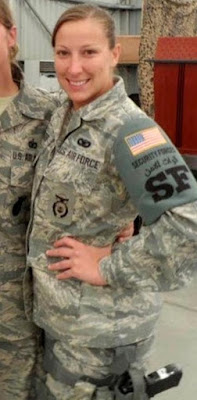

Babbitt
Osnos briefly examines the life and death of Ashlii Babbitt, who was shot while trying to enter a window of the Capitol. He sees similarities with former Marine and Afghanistan War veteran Sidney Muller.

“Babbitt’s fortunes had followed the course of the country’s. In 2002, after graduating from high school, she had been drawn to the military, much as Sidney Muller had, in pursuit of a purpose larger than herself. Babbitt enlisted in the Air Force and was assigned to guard the gates at air bases around the world. She served in Afghanistan, Iraq, and the United Arab Emirates. She was discharged in 2016… her debts piled up.

“As her financial life deteriorated, she poured more of her energy into politics. She filled her social-media channels with paeans to QAnon and Trump, and rants against immigration, drugs, and Democrats…

“In its particulars, Ashlii Babbitt’s life was an uncanny reflection of the population that stormed the Capitol the day. After police had arrested more than a hundred of them, patterns emerged. Nearly 20 percent had served in the military, according to an analysis by NPR. And nearly 60 percent had a history of financial trouble…”

(A more recent study by George Washington University shows that the number of active duty service members and veterans is closer to 12 percent, but the study shows other troubling information related to the U.S. military and extremist groups, as reported by Military Times.)


Lincoln and Seward
Osnos reflects on why “Donald Trump’s insurrection failed” and how close it came to succeeding.

The preservation of democracy depends on enough good people willing to put country ahead of self.

“When I paused to consider just how far the coup progressed,” Osnos says, “it often put me in mind of an observation from the Civil War by Abraham Lincoln’s Secretary of State, William Seward: ‘There was always just enough virtue in this republic to save it; sometimes none to spare.’”


People who love good books will be pleased with some of Osnos’s references, many touching on the rise of autocracy and threat of tyranny –– works by: Hannah Arendt, Anne Applebaum, Phil Klay, Susan Jacoby, Rick Perlstein, Norman Mailer, Martha Nussbaum, Joanne B. Freeman, and Wendell Berry.


U.S. Marine Corps veteran 2nd Lt. Phil Klay, signs his book 'Redeployment' as fans bring the book to him at the Marine Corps Exchange aboard Marine Corps Base Quantico, Va., March 11, 2015. Klay’s book offers a dozen short stories based on the perspectives and views of Iraq veterans. (LCpl. Nathaniel S. McAllister)


These authors will help anyone have the widest possible rear-view mirror to see the road we’ve been on toward division in our country, up to and including the attempted coup of 1/6. They also give hope and inspiration to patriots dedicated to defending the Constitution.


Evan Osnos has written a compelling work of contemporary and contextual history in “Wildland: The Making of America’s Fury” to help us get to a final destination of understanding –– and accountability.


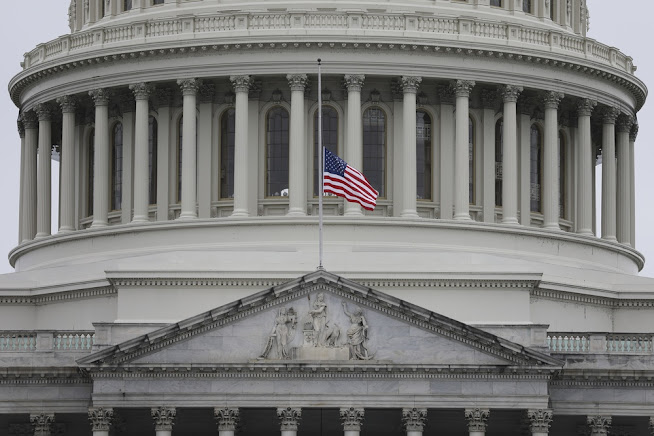
Top photo: The U.S. Flag at the Capitol building flies at half-staff for fallen Capitol Police officer Brian Sicknick, Jan. 11, 2021. Sicknick sacrificed his life to protect members of Congress during the insurrection at the Capitol on Jan. 6, 2021. (U.S. Air National Guard photo by Staff Sgt. Devlin Drew)

Monday, December 6, 2021

Stavridis’s 50: ‘The Sailor’s Bookshelf’

Review by Bill Doughty––

The FedEx van pulled up in front of my home as I backed into my driveway. It’s a special feeling when a wished-for book arrives. I carefully sliced through the padded mailer and there it was: “The Sailor’s Bookshelf: Fifty Books to Know the Sea” by Admiral James Stavridis, arriving just days before Pearl Harbor Remembrance Day. This year’s commemoration comes on the 80th anniversary of the attack on Oahu of Dec. 7, 1941.


Stavridis gives a very personal reflection of some of the favorite books on his bookshelf, and some relate to Pearl Harbor, Hawaii, and the Pacific, which he calls “the mother of all oceans.” Others center on Europe and his favorite ocean, the Atlantic. Still others offer a diverse window into the art of reading, the lure of history –– and the terrible yet tempting beauty of the sea.


Some of the books in his collection go back to Stavridis's childhood. Many were influential in his choosing to apply to the U.S. Naval Academy or were part of his life throughout his distinguished careers both in and after the Navy.


Retired Adm. James Stavridis, former supreme allied commander, Europe, gives the keynote speech during the Armed Forces Communication and Electronics Association-U.S. Naval Institute (AFCEA/USNI) West 2016 conference. (MC2 Liam Kennedy)

His midshipman cruise in 1972 was to Pearl Harbor.

So was his first cruise as an ensign and anti-submarine warfare officer aboard USS Hewitt (DD-996), in which Stavridis sailed first to Hawaii and then westward across the Pacific in some of the same waters once explored by Capt. James Cook. 


Cook’s voyages come to life in one of Stavridis’s recommendations, “Blue Latitudes: Boldly Going Where Captain Cook Has Gone Before.” The book follows Cook’s “three epic cruises in the mid-1700s” when only about a third of the world globe was known and mapped for navigation.


The flag flies at half mast while Marines of 3rd Marine Regiment "man the rails" of the USS Arizona Memorial in 2011. (Maj. Alan Crouch)

In the Explorers section of his book, Stavridis also features James P. Delgado’s “Across the Top of the World: The Quest for the Northwest Passage.” Delgado is a maritime archeologist and veteran diver who has explored hundreds of shipwrecks, including USS Arizona (BB-39) and USS Nevada (BB-36), both hit in the attack on Pearl Harbor. Delgado goes far, far north to present a history and heritage of exploration of the Arctic region. Sir John Franklin’s perilous journey in 1845 is at the heart of the story.

Rear Adm. Fiske (NHHC)
Another intrepid explorer of a sort is a “consummate seaman” and commander who invented technology in the late 1800s and turn of the century to help sailors on steam vessels and promote sea control and sea power. Admiral Bradley A. Fiske is author of “The Navy as a Fighting Machine.” Like Alfred Thayer Mahan, who is also featured in this collection, Fiske lobbied for and helped establish the position of Chief of Naval Operations. 

He was a champion for readiness as “a persuasive and thoughtful operational maritime thinker and writer.”


Exactly one hundred years ago, Fiske was president of USNI.


Stavridis writes:

“He was also a prescient strategic analyst. He served as president of the U.S. Naval Institute, the intellectual heart of the naval profession, for eleven years, 1912-1923, thinking, writing, and publishing constantly. As late as 1924 he was commenting on international affairs, correctly predicting the inevitability of a U.S.-Japanese war. He lived to see that dire proclamation come to pass with the 1941 attack on Pearl Harbor in his eighty-seventh year but sadly not quite long enough to see the pivotal battle of Midway in the early summer of 1942 turn the tide in the Pacific.”

Speaking of heroes and Pearl Harbor, Stavridis features a book in the “Oceans” section co-authored by Adm. Chester W. Nimitz, along with Professor E.B. Potter, titled “Sea Power: A Naval History.” Nimitz, of course, commanded the Pacific Fleet from Pearl Harbor and led the effort to defeat Imperial Japan in less than four years. In this classic 932-page book, first published in 1960, Potter and Nimitz provide a history of the American and world navies and how naval warfare has evolved to become a fundamental part of national power.


Stavridis, who was a student of Potter’s at the Naval Academy, wrote his own book with the same name but “different in tone and style” and in homage to his former professor. Adm. Stavridis’s “Sea Power: The History and Geopolitics of the World’s Oceans” is one of many of his works I’ve featured on Navy Reads over the past decade. 


Stavridis acknowledges he could have chosen to showcase many other books about the War in the Pacific in addition to the Potter-Nimitz “Sea Power.” He considered Samuel Eliot Morison’s multi-volume “History of Naval Operations in World War II” and Craig L. Symonds’s single-volume “World War II at Sea: A Global History."


Lt. Cmdr. Ernest E. Evans, at commissioning ceremonies of USS Johnston (DD-557), Seattle, WA, 27 October 1943. He was Johnston's commanding officer from then until she was sunk in the Battle off Samar, 25 October 1944, and was lost with the ship. (U.S. Naval History and Heritage Command)


The “cornerstone book about the naval war in the Pacific during World War II” he chooses, however, is the captivating “Sea of Thunder: Four Commanders and the Last Great Naval Campaign, 1941-1945.” The book centers on the Battle of Leyte Gulf in October 1944 and, as the subtitle says, four commanders:

“Admiral William ‘Bull’ Halsey, a swaggering (and deeply racist) commander of the American fleet for much of the combat; the elegant Japanese admiral Takeo Kurita, a battleship force commander who launched a near-suicidal attack on the American forces poised to retake the Philippine Islands; another Japanese admiral, Matome Ugaki, who saw himself as the purest of samurai and led the kamikaze forces at the end of the war; and –– the most appealing of the four –– the relatively junior Navy commander Ernest Evans, captain of USS Johnston (DD-557), a small destroyer that undertook a deeply heroic attack on a far larger Japanese force … In the course of telling the story of the battle, Thomas takes the reader through the vast U.S. maritime strategy to reconquer to Pacific Ocean and its hundreds of atolls, islands, barrier reefs, and littoral nations after the Japanese offensive wave of conquest had swept over much of it in the early days of the war” [in the aftermath of Pearl Harbor]

Pearl Harbor is just one of the many themes touched on in this wonderful collection that also includes diverse works by Rachel L. Carson, Simon Winchester, Thomas J. Cutler, Caroline Alexander, Nathan Philbrick, Herman Wouk, Patrick O’Brian, Sebastian Junger, and Joan Druett.


Throughout the collection, Stavridis shares personal joys and discoveries through reading. He expresses his deep love for the sea, starting in childhood. “What fascinated me then, and still does so many decades later, was the unpredictability of the ocean. It could change color, smell, wave pattern, surface condition, and a dozen other variables in an hour. It was a chameleon…”


The admiral’s curiosity also drives unpredictability in his selection of books in this collection, which features a book of poetry (“Moods of the Sea: Masterworks of Sea Poetry” by George C. Solley and Eric Steinbaugh), a book about art (“Turner & the Sea” by Christine Riding and Richard Johns, about artist J. M. W. Turner, who painted "The Battle of Trafalgar" and "The Fighting termeraire tugged to her last Berth to be broken up," pictured above), and a book of magical fiction (“Life of Pi” by Yann Martel), requiring the reader to suspend the constraints of science.

“I have always loved magical realism in the world of literature. This is a strain of fiction writing in which things exist in a novel or short story (or even a poem) that cannot quite be squared with the real world. The most famous writer of magical realism, who is especially prominent in the literature of Latin America, is the Nobel Prize-winner Gabriel García Márquez. His extraordinary novel “One Hundred Years of Solitude” is widely regarded as the classic example of magical realism. Some other authors who deal in this style of writing include Toni Morrison (“Beloved”), Salman Rushdie (“Midnight’s Children”), Haruki Murakami (“IQ84”), Günter Grass (“The Tin Drum”), and Neil Gaiman (“The Ocean at the End of the Lane”). In such novels there are often ghostly visitations, dreamlike sequences, mythological gods, talking animals, imagined events, and unreliable narrators.”

Stavridis is a most-reliable narrator and navigator as he takes us on his voyage to “The Sailor’s Bookshelf” and a journey of self discovery. “I’ve always believed that reading allows an individual to essentially expand their life every time they open a book,” he writes in the book’s preface.


U.S. Navy Airman Benjamin Adams, from Panama City, Fla., reads a book on the fantail of the aircraft carrier USS Nimitz (CVN 68), July 5, 2017, in the South China Sea. Nimitz was on deployment in the U.S. 7th Fleet area of operations. The U.S. Navy has patrolled the Indo-Asia Pacific routinely for more than 70 years promoting regional peace and security. (MC3 Ian Kinkead)

While he provides ample inclusion of fiction titles, most of the selections in “The Sailor’s Bookshelf” are nonfiction and history. Based on his recommendation, I added this title to my to-read list: “Empires of the Sea: The Siege of Malta, the Battle of Lepanto, and the Contest for the Center of the World,” a book about the Battle of Lepanto, and a book that had special meaning to Stavridis when he was the Supreme Allied Commander of NATO.

“For a sailor to read ‘Empires of the Sea’ is to almost feel the ships under way and hear the sails snapping in the breeze. You can smell the gunpowder and hear the crack of cannons over the waves and wind. Crowley focuses on the geopolitics as backdrop, but the great strength of this book is a realistic focus on war at sea. It includes descriptions of the sea battles and sieges against the islands of Cyprus and Malta as well as the more or less constant activities of pirates. The centerpiece, of course, is Lepanto, and there is not a better description written. The entire book is truly an engrossing read, and one that keeps the reader’s sensibility under way with every page.”

The subtitle of “The Sailor’s Bookshelf” says “50 books,” but the author can’t help himself. Readers will find hundreds of titles of great books tucked inside “bonus” suggestions, lists, and notes as well as the fifty essays themselves.


                                                                                                                                         (PO2 Patrick Kelly)
Among the recommended reads are titles of books that were read by Pearl Harbor Survivors and other World War II veterans. I’ve had the honor to meet and interview many Pearl Harbor Survivors, most of whom are gone. Before and after and sometimes even during the war they read Jules Verne, Herman Melville, and Ernest Hemingway, all featured in this collection. Stavridis’s “The Sailor’s Bookshelf” is a labor of love.

It is dedicated “To my parents who taught me to love reading, To my teachers who taught me to love writing, To my shipmates who taught me to love the sea, and To my wife and daughters who taught me to love life.”


I will revisit this collection for a future Navy Reads “Bookshelf Part II.”


-----------------------------------------------------------------------


RIP Senator Robert J. Dole


American statesman Sen. Bob Dole of Kansas died yesterday, Dec. 5, 2021, after a long bout with lung cancer. Like another of his colleagues, late Sen. Daniel K. Inouye of Hawaii, Dole wanted to become a doctor prior to the attack on Oahu and the start of American involvement in World War II. And like Inouye, Dole joined the Army shortly after Pearl Harbor and was severely, nearly mortally, wounded but recovered and dedicated his life to continued public service.


Senator Bob Dole and President Gerald Ford, Oval Office, 1976. (Bob and Elizabeth Dole Archives, KU)

While in Congress, Dole helped bring about the Civil Rights Act, the Voting Rights Act, and the Americans with Disabilities Act. He helped save Social Security when it came under threat in 1983, and he was a lifelong strong supporter of national defense.


Dole, known for his dry-wit sense of humor, support for the Constitution, and general grace in defeat, was vice presidential running mate to Navy/WWII Veteran President Gerald Ford in the 1976 U.S. campaign; Dole became the Republican nominee for president in 1996. President Bill Clinton presented Dole with the Presidential Medal of Freedom in 1997 (pictured below).


Flags are flying at half-staff to honor both Dole and Pearl Harbor Remembrance Day on the 80th anniversary of the attack.

Friday, November 26, 2021

‘Undaunted’

Review by Bill Doughty––

Sometimes an old book can inspire a new understanding.


Stephen E. Ambrose’s “Undaunted Courage: Meriwether Lewis, Thomas Jefferson, and the Opening of the American West” (Simon & Schuster, 1996) has been sitting on my library shelf for more than 20 years. Ambrose is no McCullough, but he was passionate to the point of near obsession about this subject. I finally slogged through “Undaunted” over the summer because I wanted to learn more about the Lewis & Clark trail.


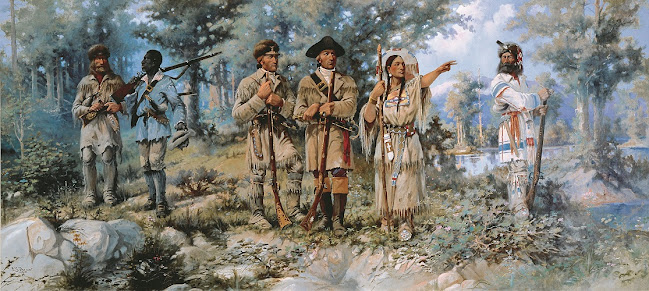
Written primarily as a biography of Lewis, “Undaunted Courage” also explores the age of empire in North America and European Americans’ encounters with indigenous peoples –– the actual descendants of discoverers of the continent. We meet the peaceful Mandans, humble Shoshone, helpful Nez Percé, wily Ciatsops, friendly Chinooks, and warlike Teton Sioux of the early 19th century. We meet 15-year-old pregnant Sacagawea, who provides lifesaving medicine, care, and guide skills to the mission. (The Sacagawea statue, right, at Cascade Locks, Columbia River Gorge, was created by artist Heather Söderberg in 2010.)

The mission itself was an unsuccessful attempt to find a water route across the continent. The Lewis & Clark team was an infantry company of the U.S. Army called the “Corps of Discovery.” Jefferson commissioned the expedition as the Louisiana Purchase came to light and efforts were made to fend off French and British claims. An objective was “to establish American sovereignty, peace, and a trading empire.”


This book comes with wonderful charts by A. Karl and J. Kemp showing the various routes the team took along the Missouri River, through what are now Iowa, Nebraska, the Dakotas, Montana, Idaho, Washington, and Oregon, all the way to the Pacific Ocean.

At the time, Virginia pointed toward the West, and St. Louis was the very edge of the American frontier in the early 1800s.


Trained in exploration, armed with mapping tools, and taught how to preserve specimens, Lewis discovered species of animals and plants previously unknown to Europeans. He received help from Clark and two dozen enlisted soldiers, from many civilians who lived among or traded with the Indians, and from hundreds of Indians themselves.

Jefferson was inspired to commission the expedition after reading a book by Alexander Mackenzie, a Scotsman who explored parts of the Pacific Northwest and called for a British claim to a Northwest Empire in 1793. Both Jefferson and Lewis were inspired by Capt. James Cook’s 1784 book, “A Voyage to the Pacific Ocean.” 


Ambrose paints a time of antiquity –– where slavery, patriarchy, and hardship were normal and accepted. Where time itself was measured in how long it took to travel by horse. No telephones. No engines. No antibiotics. No mosquito repellant. No sunglasses or sunscreen. No GPS.


How most of the members of the expedition managed to survive the arduous journey is a story of luck, grit, and resilience. And it’s a story of the abundance of the North American continent in the early 1800s. The expedition killed thousands of deer, buffalo, elk, beaver, and other wildlife. They gorged on salmon and, when necessary, ate horses and dogs.


Lacking humility but with an abundance of confidence, Lewis met with various tribes and tried to “coerce through commerce,” trading beads, tobacco, and tools for horses, information, and services. He promised the Indians their “father” in Washington would take care of them. He gave them American flags, certificates, and medals. He cajoled and threatened.


“Lewis did all this with the utmost seriousness,” Ambrose writes. “It never occurred to him that his actions might be characterized as patronizing, dictatorial, ridiculous, and highly dangerous.”

But, “Virtually all Indian parties proved resistant to change and suspicious of American motives.” Nevertheless, many tribes helped the expedition find food, trails, and water routes. Lewis and Clark astutely tried to identify the chiefs and deal directly with them. As with U.S. military leaders, the chiefs were often chosen from those who had proved themselves in combat.


Ambrose praises Lewis’s ability as a “near-perfect army officer” and a “great company commander, the greatest of all American explorers, and in the top rank of world explorers.”  The U.S. Navy has named several ships related to the expedition. Most notably, the current class of dry cargo replenishment ships is known as Lewis and Clark and includes the namesakes USNS Lewis and Clark (T-AKE 1) and USNS Sacagawea (T-AKE 2).


Airman Brandy Phillips, aviation boatswain's mate (fuels), stands watch in primary flight control aboard the multi-purpose amphibious assault ship USS Bataan during a vertical replenishment with the Military Sealift Command dry cargo and ammunition ship USNS Sacagawea in support of Operation Unified Response off the coast of Haiti after a 7.0 magnitude earthquake, Jan. 12, 2010. (CPO Tony Sisti)


Lewis’s journals were eventually published. His book inspired the great movement West and creation of the American Empire that Jefferson envisioned.


After his return, Lewis went to Philadelphia and went to parties and dinners with his best friend, Mahlon Dickerson, a lawyer who later served as governor of New Jersey, Senator from New Jersey, and Secretary of the Navy under President Andrew Jackson. Lewis, who showed signs of depression, became a heavy drinker and took opium at night.


Lewis, Clark, and Jefferson
Jefferson appointed Lewis governor of Louisiana, but Lewis was not good at politics. His depression got worse. Ambrose writes, “He was tortured” and “his pain was unbearable.” Ambrose describes a gruesome suicide.

Ambrose does not shy away from showing the shortcomings of Meriwether Lewis, William Clark, and Thomas Jefferson. All were privileged and dedicated slave owners who also took advantage of native Americans. They wanted to “civilize” and move the Indians out of the way so white settlers could move in a set up a fur trade and land trade. Lewis’s policies were, in Ambrose’s words, “nothing short of genocide.”


Sometimes an old book can inspire a new understanding. Today is Native American Heritage Day.


Friday, November 19, 2021

Eddie Gallagher & Alpha ‘Loyalty’

Review by Bill Doughty––

David Philipps gives a passionate and compassionate profile of a case that hit the U.S. Navy like a “missile” –– that of former U.S. Navy SEAL Chief Petty Officer Eddie Gallagher, accused of war crimes after his deployment with the Alpha platoon of SEAL Team 7 in “ALPHA: Eddie Gallagher and the War for the Soul of the Navy SEALS” (Penguin Random House, 2021).


This is a book about accountability and justice. And karma.


SEALs in Alpha Platoon, wearing their tridents and under the logo of the “Bad Karma Chick,” saw their role as the embodiment of bad karma: “Alpha was there to make sure that bad things happened to bad people.”

“ALPHA” reads less like a book about war and more like a Shakespearean tragedy of an elite American warfighter who chose a noble journey but somehow took a wrong path. Eddie Gallagher began his career as a Hospital Corpsman and tried in vain to become a SEAL until the Afghanistan and Iraq wars opened a sudden need for more of the Navy’s special operations warfare specialists and Gallagher was accepted. He deployed seven times overseas in the so-called war on terror.


Philipps describes the warfighter after seventeen years of service this way:

“Eddie looked like a Navy SEAL poster boy. He had close-cropped blond hair, glacier-like blue eyes, a strong, square jaw, the shoulders of a lion, and a lion’s killer instinct. He was fast, agile, strong, and a dead shot. But a closer look revealed a face deeply lined from years in the desert sun. After so many deployments, the mileage was starting to show. He was thirty-nine years old. In the military, where the average age is twenty-seven, he was closing in on obsolescence. His back hurt. His neck hurt. His shoulders hurt. He had ringing in his ears from too many gunfights. Sometimes he had trouble remembering  things. Not that he regretted any of it. For all the talk about post-traumatic stress disorder and the unfair burden the nation had put on its warfighters, Eddie never once saw combat as a hardship. He had chosen it. He was good at it. He thrived on it. Truth be told, it was cool as hell. He loved the heart-pounding exhilaration of gunfights. He loved the simple intensity of war. Sometimes he felt it was the only thing that made sense. If there were bad guys out there looking to take on the United States and become martyrs, he was happy to punch their ticket.”

But –– “Beneath that SEAL veneer was a history of disappointments and screw-ups that had dogged him for much of his life,” Philipps writes later in “ALPHA.”


This book reveals a tectonic struggle: rule-of-law ethos exemplified by Adm.(Ret.) William McRaven versus a no-rules “pirate” death-cult personified by former Vietnam-era SEAL Cmdr.(Ret.) Richard “Demo Dick” Marcinko –– and Gallagher.

One side prefers to be quiet, humble, and righteous in their work. The other side is all bravado, might-makes-right, and anything goes, including killing unarmed civilians and prisoners when necessary.


One side meant it when they took their oath to support and defend the Constitution; they are loyal to each other and to the mission. The other side abuses power and demands loyalty in a cult of personality, often putting the mission and team in unnecessary danger.


One side has to work silently within the constraints of the Uniformed Code of Military Justice, committed to truth and justice. The other side uses TV, radio, and social media to bend information, threaten opponents, and smear the Navy chain of command.


One side lives by the SEAL Ethos. The other does not.

“…My loyalty to Country and Team is beyond reproach. I humbly serve as a guardian to my fellow Americans always ready to defend those who are unable to defend themselves. I do not advertise the nature of my work, nor seek recognition for my actions. I voluntarily accept the inherent hazards of my profession, placing the welfare and security of others before my own. 

“I serve with honor on and off the battlefield. The ability to control my emotions and my actions, regardless of circumstance, sets me apart from others. Uncompromising integrity is my standard. My character and honor are steadfast. My word is my bond…”

Gallagher stood trial for allegedly murdering a defenseless Iraqi teenager aligned with ISIS by stabbing him with a knife. Gallagher was turned in by a number of his SEAL teammates, who also claimed to have witnessed him shooting indiscriminately into civilian areas as well as deliberately shooting an unarmed girl and an old man.


Philipps provides damning information about Gallagher’s character, including allegations of stealing from the Navy as well as fellow SEALs, illegal habitual drug use, false claims for a Purple Heart and other medals, lying and putting SEALs in harms way for personal gain, and threatening murder in an attempt to cover up his crimes.


The truth emerges thanks to information from key members of the Alpha Team as well as evidence gathered by NCIS and New York Times, where Philipps is a Pulitzer Prize winning national correspondent.


“ALPHA”
presents a brief history of the Navy SEALs, from their founding by Navy WWII veteran President John F. Kennedy, through Vietnam and into the 21st century. Philipps describes the rigorous body-breaking BUD/S training SEALS undergo in Coronado, San Diego –– a crucible where instructors are “striking down hubris like ancient gods.”

He introduces readers to a fascinating cast of characters, each on a spectrum of loyalty to each other, to Navy core values, and to the Constitution. There’s LPO (now Chief) Craig Miller, in many ways the hero of this tragedy; CAPT Matt Rosenbloom, a leader of leaders who put his SEALs ahead of outside threats, including to his career; and Secretary of the Navy Richard Spencer, who, like other characters in this story, tries to build a bridge to what was right, only to see his infrastructure crumble under politics and undue influence by the commander in chief.


When SECNAV Spencer was fired for appearing to disobey the president’s bidding immediately, Spencer said it was “just politics,” but was it “just” –– in both meanings of the word? Spencer, a former Marine whose mentor was SECDEF James Mattis, believed in strong standards and values. He tried to allow the SEALs to conduct an ethical review. Philipps writes, “Civilian rule of the military was a delicate thing. It required respect, deference, and a mutual understanding.” It did not do well with heavy-handed tipping of the scale of justice.


Trump and Gallagher
Philipps shows former President Trump’s role in the Gallagher case; disgraced Trump acolytes Bernard Kerik and Duncan Hunter as well as Trump lawyer Marc Mukasey helped Gallagher. Later, Gallagher hobnobbed with Michael Flynn, Erik and Donald Trump Jr., and Rudy Giuliani. Gallagher endorsed and campaigned for Donald Trump, and was feted at Mar a Lago. Trump granted clemency to Gallagher and pardoned two other service members who had been found guilty of war crimes.

The dark side of “loyalty” can be seen in the insurrection of Jan. 6, 2021. It can be seen in the code of silence over police brutality and killings that prompted the BLM protests and riots in the summer of 2020. The dark side of “loyalty” can be found in grievance and resentment and fear of the Other. It can be seen in anyone forgetting their oath to the Constitution and pledging their loyalty to a Big Lie and cult of personality that rejects democracy and embraces fascism and autocracy.


Facebook provides a platform for SEALs to express their support of Gallagher and the “pirate” ethos. “None of the SEALs on Facebook seemed to care that a chief had targeted civilians,” Philipps says. “They were just mad that guys in Alpha had said anything about it.”


"ALPHA" tells the story of true loyalty. Some characters, notably another former corpsman and SEAL, Corey Scott, fail in their commitment to the truth. Others, like Chief Craig Miller, rise to the challenge and stand tall.


Karma is on their side.


Miller, the leading petty officer of Alpha platoon during the Iraq deployment of 2017, uses his experience to teach young SEAL leaders about ethical choices, norms and virtues. Philipps describes Miller’s view: “In real ways, the future of humanity was built by the small actions of millions of everyday folks, and it could be torn down the same way.”


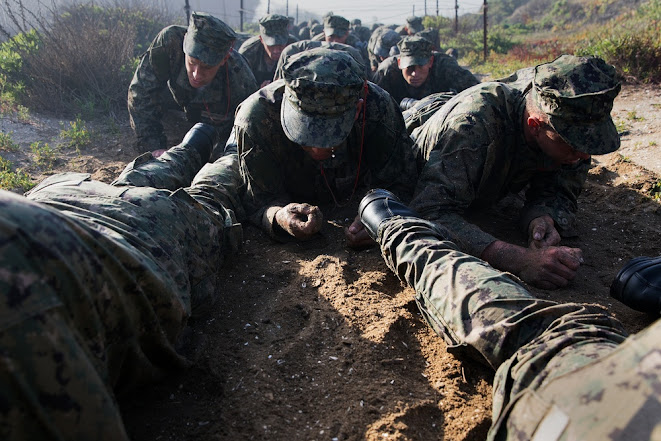
U.S. Navy SEAL candidates participate in Basic Underwater Demolition/SEAL (BUD/S) training. SEALs are the maritime component of U.S. Special Forces and are trained to conduct a variety of operations from the sea, air and land. (U.S. Navy photo by Petty Officer 1st Class Abe McNatt)

(This year a podcast called “The Line” explored various sides of the Eddie Gallagher saga and his war crimes trial in 2019 based on witness reports that he stabbed the ISIS teenager to death. In the podcast Gallagher says, “We killed that guy. Our intention was to kill him.” Gallagher admits. “It was to do medical scenarios on him until he died,” adding “He was going to die regardless. ... We weren't taking any prisoners.”

Speaking of karma: 

A new four-part documentary video series on Apple+, also called "The Line,” airs starting today.

"The Line" is by a team led by filmmaker Alex Gibney, Oscar winner for 2007’s Afghanistan War documentary "Taxi to the Dark Side." Directors Doug Shultz and Jeff Zimbalist obtained the participation of Gallagher; his wife, Andrea; and the members of SEAL Team 7 who stepped forward to accuse Gallagher of war crimes, and all appear on camera.)


Saturday, November 13, 2021

A True Patriot and Statesman: Max Cleland

By Bill Doughty––

When Joseph Maxwell "Max" Cleland spoke at the 72nd Pearl Harbor Day commemoration ceremony, Dec. 7, 2013, with Pearl Harbor itself as a backdrop, he was nearly overcome with emotion. He saw the dozens of World War II veterans seated in the front rows of the audience, and he thought of his father. Cleland spoke without notes, from the heart, about the sacrifice of military service and the joy of homecomings.


Army CPT Max Cleland in Vietnam
Hugh Cleland, Max’s dad, joined the Navy after the attack on Oahu in 1941. In 1965, Max volunteered for the Army to serve in combat in Vietnam, where he earned the Silver Star and Bronze Star.

Cleland was severely wounded and nearly killed. Yet, he personified resilience to become head of the Veterans Administration and a U.S. Senator.

Cleland died earlier this week. He was a great statesman, military veteran, and advocate for veterans, especially those with lasting physical and mental wounds.


President Joe Biden issued a statement November 9 on Cleland’s passing:

“Max Cleland was an American hero whose fearless service to our nation, and to the people of his beloved home state of Georgia, never wavered.

As a 25-year-old serving in the 1st Cavalry Division of the U.S. Army during the Vietnam War, Max lost both of his legs and his right arm in a grenade explosion at Khe Sanh. After grueling months in the hospital, enduring multiple surgeries and a long road back to recovery, Max turned his pain into purpose. He continued his distinguished public service, becoming a lifelong champion of the dignity and rights of working people and America’s wounded veterans. His leadership was the essential driving force behind the creation of the modern VA health system, where so many of his fellow heroes have found lifesaving support and renewed purpose of their own thanks in no small part to Max’s lasting impact... He was a man of unflinching patriotism, boundless courage, and rare character... He will be remembered as one of Georgia’s and America’s great leaders.”

I was fortunate to help plan the Navy’s Pearl Harbor Day commemoration ceremony in 2013 and to hear Max Cleland speak about honor, courage, and commitment –– as well as true family values and patriotism.


In 2013 I posted a Navy Reads review featuring Cleland’s autobiography, “Heart of a Patriot.”

Cleland, who chaired the armed services subcommittee on personnel in the Senate, was known for working closely with both Democratic and Republican colleagues.


Cleland reads about JFK.
From Navy Reads: “His colleagues, mentors and friends in the Senate included fellow combat veterans Chuck Hagel, Dan Inouye, John Kerry and ‘my Vietnam veteran brother’ John McCain. Cleland describes the pride of wearing his dad's WWII Navy peacoat as a U.S. Senator during a presidential inauguration.”


Prior to serving in the Navy for three years during WWII, Max Cleland’s father, Hugh, had served in the Civilian Conservation Corps, an environmental infrastructure program created by President Franklin D. Roosevelt during the Great Depression. FDR was an inspiration to a young Max Cleland. Cleland loved books and reading. He authored several books.


Like Biden, Secretary of Defense Lloyd Austin issued a statement about Senator Cleland’s passing; fittingly, Austin includes references to literature.


In part, SECDEF Austin says:

“The Department of Defense stands united in mourning the loss of Senator Max Cleland, an extraordinary public servant and a great patriot…He served his country and his community from a wheelchair, following in the gallant tradition of his hero President Franklin Roosevelt.”


SECDEF Austin notes that as head of the Veterans Administration, Cleland “fought fiercely for his fellow veterans, made PTSD an official VA diagnosis, and helped create the groundbreaking Vet Centers program. Later, after being elected a U.S. senator from Georgia, he continued his passionate focus on defense and veterans' issues, serving with distinction on the Senate Armed Services Committee and leading on such issues as health care, bioterrorism preparedness, and homeland security. He also served on the 9/11 Commission before being nominated for the board of the Export-Import Bank. His final act of public service was leading the American Battlefield Monuments Commission. When battle maps of Vietnam were added to the National Memorial Cemetery of the Pacific in Hawaii, he asked to add an inscription from the poet Archibald MacLeish: ‘We leave you our deaths: give them their meaning.’

With courage and grit, Senator Cleland struggled with PTSD and depression—seeking help through counseling, medication, and attendance at a recovery group. He said that he drew strength from being around his fellow veterans and wounded warriors, including those from Iraq and Afghanistan. As the head of the VA, he made psychological counseling available to his fellow veterans. And I hope that his example will encourage others carrying unseen wounds to seek out the help they need and deserve. 

Senator Cleland liked to quote Hemingway, who wrote, ‘The world breaks everyone and afterward many are strong at the broken places.’ He surely was. Max Cleland's civic-minded spirit, optimism, and resilience will stand as an inspiration to every American.”

Funeral services are planned for early next week.


Senator Max Cleland, RIP.


Vietnam War veteran Max Cleland, a triple amputee, holds a photograph of himself as a child with his father, Hugh, and mother, Juanita, at the National Memorial Cemetery of the Pacific at Punchbowl in 2013. (Jamm Aquino, Honolulu Star-Advertiser)


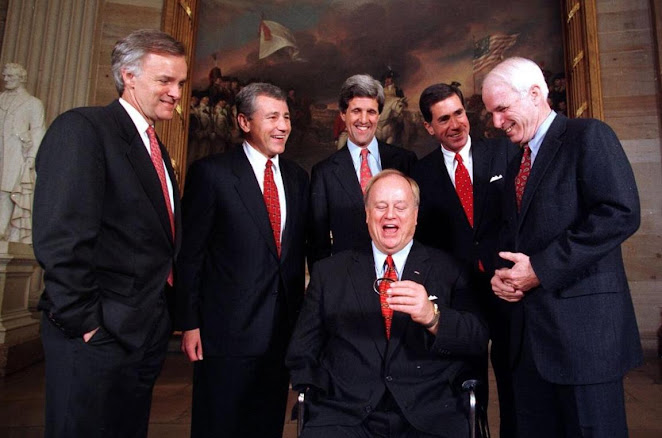
The Senate had six Vietnam combat veterans in January 1997. Sen. Max Cleland, D-Ga., is in the front. Behind him, from left: Bob Kerrey, D-Neb., Chuck Hagel, R-Neb., John Kerry, D-Mass., Chuck Robb, D-Va., and John McCain, R-Ariz. This photo was taken by The World-Herald during Senate orientation the previous month. (Kiley Cruse, The World-Herald)

Top photo: Secretary Max Cleland, American Battle Monuments Commission, delivers keynote remarks during the 72nd anniversary commemoration of the Dec. 7, 1941, attack on Oahu. This year’s commemoration theme, “Sound the Alarm,” examines how thousands of Americans answered the call to duty in the wake of the attack. More than 2,500 people attended the Pearl Harbor commemoration. (MC2 Nardel Gervacio)