Showing posts with label Native Americans. Show all posts

Monday, July 18, 2022

Smashing Ideas About Monuments

Review by Bill Doughty––

More than 250 years ago the federal government hired sculptor Clark Mills to cast a statue called Freedom, pictured above, that would be placed atop the U.S. Capitol Building in Washington D.C.


The first plaster model of Freedom, created in 1854, was rejected by then-U.S. Secretary of War (SECDEF) Jefferson Davis (future president of the Confederacy) because it wore a “liberty cap,”as Erin L. Thompson explains in “Smashing Statues: The Rise and Fall of America’s Public Monuments” (W.W. Norton, 2022).


Davis insisted the cap, which represented emancipation, be replaced with a helmet. But the new design looked “more suited to a Vegas showgirl than a warrior, with a starry headband topped with feathers sprouting from a popeyed eagle.” Eventually the symbol of liberty created by Clark Mills and his team of workers moved forward and upward, headgear and all:

“When Freedom was finally hoisted into place in December 1863, it was hailed as a symbol of the universal liberty the Emancipation Proclamation had declared in January of that year. More than 150 years later, many avowed white supremacists undertook a deadly invasion of the Capitol building to dispute the results of the presidential election. You might think that a symbol of the liberty America is supposed to offer to all would have dissuaded or at least shamed them. Looking more deeply into Freedom’s history reveals why the monument instead inspired them. It is a white supremacists vision of freedom.”

To help create the cast and melt bronze for Freedom, Mills depended on his workmen, including Philip Reed, a man born into slavery in South Carolina, who was paid $1.25 per day by Mills, but was considered his property. As Mills gained fame and made more money he purchased more enslaved people.


The symbol of Freedom was, in actuality, a symbol of slavery. “Slavery shaped everything about her,” Thompson writes.


Despite an attempt to promote emancipation and liberty, seditionists in the South staged the ultimate insurrection, led by Jefferson Davis. Construction of the Capitol Building stopped for a while, but was restarted under orders from President Abraham Lincoln, who said, “If people see the Capitol going on, it is a sign we intend the Union shall go on.”


The supreme irony of the statue atop the Capitol –– symbolizing liberty but built by enslaved people –– is matched in the story of Horatio Greenough, eugenic “father of our monuments,” whose “blatant racism” is found in his work.
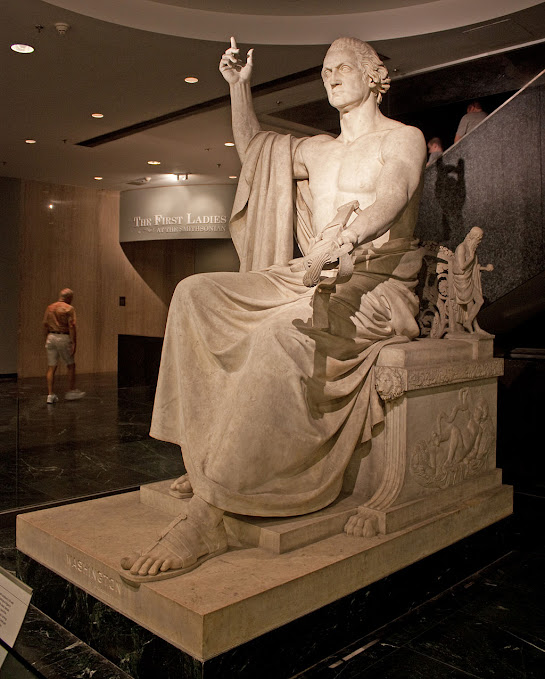

Greenough's George Washington (Wikimedia)
Greenough created a bizarre god-like statue of George Washington that includes a subjugated indigenous “Indian chief” in the design, under Washington’s hips, as the first president holds a sword and points to the sky. Greenough had planned to include “a negro” along with the indigenous figure, but abolitionist Charles Sumner convinced him not create a tie to slavery. The sculptor included a depiction of Christopher Columbus instead.

The public and press mocked the semi-nude statue of the first president. “American audiences paid less attention to deciphering the meaning of Washington’s symbolic sword and more to his nipples.” The statue, Thompson notes, "is on display at the Smithsonian’s National Museum of American History, awkwardly wedged next to an escalator. Today, the sculptures upraised hand looks as though it points the way up to the next floor."


Greenough's "Rescue." (LOC)
Greenough’s next work was received more favorably, at least by white Americans. In many ways it was even more bizarre and offensive. Like other monuments to follow, Rescue celebrated the genocide of Native Americans, particularly after President Andrew Jackson’s “Indian Removal Act” of 1830.

Rescue is in effect a monument to Manifest Destiny –– the idea of a god-given right of white people to subjugate indigenous people –– and for men to have an ordained role as dominant protectors of women. Thompson explains the scene of a white settler holding a dying indigenous warrior he'd just shot; his wife and child hover beneath him, and a dog watches balefully. The symbolism is clear and cringe-inducing.


At Abraham Lincoln’s inauguration in 1861, Rescue was prominently on display. It was removed from the eastern front of the Capitol Building in 1958 after decades of complaints. Thompson writes, “The removal of Rescue is another example of what happens when enough people decide that the messages encoded in a monument are unacceptable to them.”

“Greenough’s sculptures, the first thoroughly American national monuments, were also the first in a long line of public artworks to address questions of how much Black and Indigenous lives matter in America. He and his monuments claimed these lives didn’t matter at all. Greenough’s monuments assert that only people of a certain gender, class, and race deserve honor.

“Greenough’s beliefs informed not only his own sculpture but all the subsequent American public monuments based on his influential examples.”

A natural progression to other monuments highlighting white supremacy extended in the wake of the Civil War, even in Thomas Ball’s controversial Freedmen’s Memorial, dedicated in 1876.


Also known as Emancipation Memorial, it depicts a fully clothed Lincoln standing over a nearly naked kneeling black man. One interpretation is of a gracious leader bestowing freedom, but another view is of ongoing patriarchal and racial inequality.

Freedmen’s Memorial was unveiled on the eleventh anniversary of Lincoln’s assassination. President Ulysses S. Grant, members of Congress, and Supreme Court justices all attended and listened to Frederick Douglass’s speech. Several days later, Douglass wrote a letter to the editor of the National Republican in which he said, “What I want to see before I die is a monument representing the negro, not couchant on his knees like a four-footed animal, but erect on his feet like a man.”


Douglass’s descendants would live to see many hundreds of monuments erected to honor the seditionists of the Confederacy.


The rise of many of those monuments coincided with the rise of the rights and equality of African Americans as guaranteed under the Constitution.


An example is the statue of Robert E. Lee erected in Charlottesville, Virginia, in 1924, shortly after Virginia’s Racial Integrity Act made segregation lawful and outlawed in interracial marriage (not overturned by the Supreme Court until 1967 in Loving v. Virginia).


“The conflict at the heart of America,” Thompson writes, is “the conflict between the freedom for all and freedom for some.”


Thompson enlightens readers with the psychology, politics, and intent of Civil War monument creators. She delves into the meaning of statues’ poses, shows the influence of donations in creating profit motives for monuments, and explains the role of the Ku Klux Klan and other white supremacists.


Then there's Christopher Columbus.


Columbus Fountain in Washington D.C. (NPS)
Thompson reminds readers about Columbus’s contemporary, the priest Bartolemé de las Casas, who wrote about the real Christopher Columbus during his cruel reign as governor of Hispaniola (now Dominican Republic and Haiti). Columbus is condemned for overseeing torture, rape, slavery and genocide. Columbus shipped young girls back to Spain to be sold into slavery.

In recent years more people have assembled, protested, and demanded statues honoring Columbus, like monuments to the Confederacy, be taken down.


Thompson explores how, despite widespread opposition to their presence, some monuments remained in place for years. “We think our monuments celebrate our democracy, but really, they are held in place by some of America’s least democratic uses of power.”

Complacency and willful ignorance kept monuments up until catalysts of violence created a backlash: “Unite the Right” white supremacists' march (and killing of Heather Heyer) in Charlottesville; the horrific mass murder at a church in Charleston, South Carolina; and the senseless murder of George Floyd in Minneapolis, Minnesota, as examples.


Acts of civil disobedience are often the result of willful acts of bureaucratic lethargy, intransigence, and not listening to peaceful protesters. Thompson writes, "Talking about monuments is not easy. But we need to do it. We need to come together as communities to make sure our monuments leave room for everyone's life, liberty, and pursuit of happiness."


Towering over all the monuments to the Confederacy is the incomparable Stone Mountain in Georgia. Cut into the face of the mountain, it is the world’s largest bas-relief sculpture: images of Confederate President Jefferson Davis, along with Civil War generals Stonewall Jackson and Robert E. Lee on horseback. The sculpture inspires white racists and believers in the Lost Cause Big Lie, including the KKK.

Thompson writes about eccentric anti-semitic sculptor and con artist Gutzon Borglum, who was involved in creating the Stone Mountain monument. Borglum would go on to create the monument at Mount Rushmore, South Dakota, on land that was sacred to indigenous people.

There’s a lot more in this book about Borglum and Stone Mountain –– stories “to startle us out of our assumptions,” as Thompson writes.


[While reading this book I came across a new Americana CD by Bill Edwards, “61356,” with a great song from the perspective of a statue of a Union soldier on a Civil War monument in Illinois: “We Don’t See It Yet.” Edwards sings: “Since nineteen hundred and thirteen/I’ve stood in my place on this stone/In the middle of my Bureau County/But I haven’t stood here alone/Above me, a guardian angel/To my right, left and back, over Vets/We watch the horizon for justice/Alas, we don’t see it yet.” It’s a terrific song and album, highly recommended. Read more about "61356" on The Stratton Setlist.]


In “Smashing Statues” Thompson laments the lack of monuments to African Americans who fought for the Union in the Civil War.


There are also a relatively small number of monuments to women in the United States, but last week Speaker of the House of Representatives Nancy Pelosi unveiled a statue of Mary McLeod Bethune in the Capitol Building. Behune was “an unyielding force for racial justice, a pioneering voice for gender equity” from Florida, who was also “a devoted advocate for education,” Pelosi said in her remarks.


Bethune statue unveiled at Capitol Building July 13, 2022. (CNN)
The statue of Bethune joins statues of Rosa Parks, Sojourner Truth, Frederick Douglass and Martin Luther King, Jr. in the Capitol’s Statuary Hall. Bethune’s statue replaces that of a Confederate general.

On January 6, 2021, Trump-supporting insurrectionists, many wearing helmets or other headgear, walked through Statuary Hall during the coup attempt. Some rioters carried Confederate flags into the Capitol. High above them, on top of the building stood the statue in plumed helmet with an American eagle, mouth agape, eyes bulging –– Freedom.


This is an indispensable book for military readers interested in the reasons for the initiative to rename installations, facilities, and ships named for Confederate white supremacists or Confederate battle victories.

Friday, November 26, 2021

‘Undaunted’

Review by Bill Doughty––

Sometimes an old book can inspire a new understanding.


Stephen E. Ambrose’s “Undaunted Courage: Meriwether Lewis, Thomas Jefferson, and the Opening of the American West” (Simon & Schuster, 1996) has been sitting on my library shelf for more than 20 years. Ambrose is no McCullough, but he was passionate to the point of near obsession about this subject. I finally slogged through “Undaunted” over the summer because I wanted to learn more about the Lewis & Clark trail.


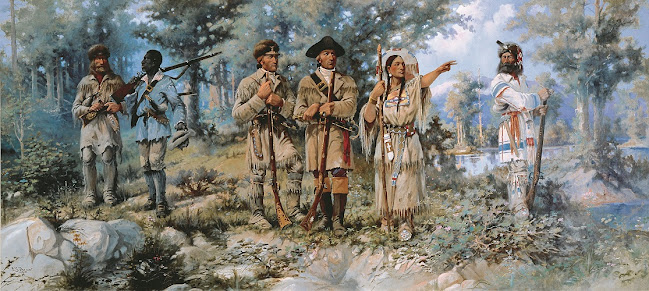
Written primarily as a biography of Lewis, “Undaunted Courage” also explores the age of empire in North America and European Americans’ encounters with indigenous peoples –– the actual descendants of discoverers of the continent. We meet the peaceful Mandans, humble Shoshone, helpful Nez Percé, wily Ciatsops, friendly Chinooks, and warlike Teton Sioux of the early 19th century. We meet 15-year-old pregnant Sacagawea, who provides lifesaving medicine, care, and guide skills to the mission. (The Sacagawea statue, right, at Cascade Locks, Columbia River Gorge, was created by artist Heather Söderberg in 2010.)

The mission itself was an unsuccessful attempt to find a water route across the continent. The Lewis & Clark team was an infantry company of the U.S. Army called the “Corps of Discovery.” Jefferson commissioned the expedition as the Louisiana Purchase came to light and efforts were made to fend off French and British claims. An objective was “to establish American sovereignty, peace, and a trading empire.”


This book comes with wonderful charts by A. Karl and J. Kemp showing the various routes the team took along the Missouri River, through what are now Iowa, Nebraska, the Dakotas, Montana, Idaho, Washington, and Oregon, all the way to the Pacific Ocean.

At the time, Virginia pointed toward the West, and St. Louis was the very edge of the American frontier in the early 1800s.


Trained in exploration, armed with mapping tools, and taught how to preserve specimens, Lewis discovered species of animals and plants previously unknown to Europeans. He received help from Clark and two dozen enlisted soldiers, from many civilians who lived among or traded with the Indians, and from hundreds of Indians themselves.

Jefferson was inspired to commission the expedition after reading a book by Alexander Mackenzie, a Scotsman who explored parts of the Pacific Northwest and called for a British claim to a Northwest Empire in 1793. Both Jefferson and Lewis were inspired by Capt. James Cook’s 1784 book, “A Voyage to the Pacific Ocean.” 


Ambrose paints a time of antiquity –– where slavery, patriarchy, and hardship were normal and accepted. Where time itself was measured in how long it took to travel by horse. No telephones. No engines. No antibiotics. No mosquito repellant. No sunglasses or sunscreen. No GPS.


How most of the members of the expedition managed to survive the arduous journey is a story of luck, grit, and resilience. And it’s a story of the abundance of the North American continent in the early 1800s. The expedition killed thousands of deer, buffalo, elk, beaver, and other wildlife. They gorged on salmon and, when necessary, ate horses and dogs.


Lacking humility but with an abundance of confidence, Lewis met with various tribes and tried to “coerce through commerce,” trading beads, tobacco, and tools for horses, information, and services. He promised the Indians their “father” in Washington would take care of them. He gave them American flags, certificates, and medals. He cajoled and threatened.


“Lewis did all this with the utmost seriousness,” Ambrose writes. “It never occurred to him that his actions might be characterized as patronizing, dictatorial, ridiculous, and highly dangerous.”

But, “Virtually all Indian parties proved resistant to change and suspicious of American motives.” Nevertheless, many tribes helped the expedition find food, trails, and water routes. Lewis and Clark astutely tried to identify the chiefs and deal directly with them. As with U.S. military leaders, the chiefs were often chosen from those who had proved themselves in combat.


Ambrose praises Lewis’s ability as a “near-perfect army officer” and a “great company commander, the greatest of all American explorers, and in the top rank of world explorers.”  The U.S. Navy has named several ships related to the expedition. Most notably, the current class of dry cargo replenishment ships is known as Lewis and Clark and includes the namesakes USNS Lewis and Clark (T-AKE 1) and USNS Sacagawea (T-AKE 2).


Airman Brandy Phillips, aviation boatswain's mate (fuels), stands watch in primary flight control aboard the multi-purpose amphibious assault ship USS Bataan during a vertical replenishment with the Military Sealift Command dry cargo and ammunition ship USNS Sacagawea in support of Operation Unified Response off the coast of Haiti after a 7.0 magnitude earthquake, Jan. 12, 2010. (CPO Tony Sisti)


Lewis’s journals were eventually published. His book inspired the great movement West and creation of the American Empire that Jefferson envisioned.


After his return, Lewis went to Philadelphia and went to parties and dinners with his best friend, Mahlon Dickerson, a lawyer who later served as governor of New Jersey, Senator from New Jersey, and Secretary of the Navy under President Andrew Jackson. Lewis, who showed signs of depression, became a heavy drinker and took opium at night.


Lewis, Clark, and Jefferson
Jefferson appointed Lewis governor of Louisiana, but Lewis was not good at politics. His depression got worse. Ambrose writes, “He was tortured” and “his pain was unbearable.” Ambrose describes a gruesome suicide.

Ambrose does not shy away from showing the shortcomings of Meriwether Lewis, William Clark, and Thomas Jefferson. All were privileged and dedicated slave owners who also took advantage of native Americans. They wanted to “civilize” and move the Indians out of the way so white settlers could move in a set up a fur trade and land trade. Lewis’s policies were, in Ambrose’s words, “nothing short of genocide.”


Sometimes an old book can inspire a new understanding. Today is Native American Heritage Day.


Friday, November 10, 2017

Good Leadership at the Top

Review by Bill Doughty

Walter Isaacson distills the qualities that make a good leader in "Profiles in Leadership: Historians on the Elusive Quality of Greatness" (W.W. Norton, 2010), featuring essays from writers including Evan Thomas,  Alan Brinkley, Glenda Gilmore, Robert Dallek and David M. Kennedy.

The "toughest part of political leadership," he contends, "is knowing when to compromise versus when it is necessary to stand firm on principle."

An advisor to presidents, Benjamin Franklin, 81 years old at the Constitutional Convention of 1787, proposed a compromise between small and large states: "a House proportioned by population and a Senate with equal votes per state." Franklin united the convention and nation with his compromise.

Isaacson writes, "Compromisers may not make great heroes, but they do make great democracies."

Unfortunately, Franklin also compromised on the issue of slavery, a position that "soon haunted him" and propelled him to become an abolitionist.
"He realized that humility required tolerance for other people's values, which at times required compromise of one's own; however, it was important to be uncompromising in opposing those who refused to show tolerance of others."
In an essay perfect for Veterans Day, Sean Wilentz reintroduces us to Ulysses S. Grant, who as a former Union general and U.S. president visited Berlin, Germany in 1877 and met with Chancellor Otto von Bismarck.

Andrew Johnson and Ulysses S. Grant
In conversation with Bismarck, Grant corrected the perception that America's Civil War was fought only to save the Union. Grant told him, "As soon as slavery fired upon the flag it was felt, we all felt, even those who did not object to slaves, that slavery must be destroyed. We felt that it was a stain to the Union that men should be bought and sold like cattle."

According to Wilentz, Grant, who, like Washington and Jefferson, had his own complicated history as a slaveowner, had to clean up "the mess left behind by the pro-southern obstructionist president Andrew Johnson." Grant eventually strongly opposed Johnson when Johnson "hardened his defense of white supremacy and obstructed congressional efforts to guarantee the civil and political rights of the ex-slaves."

During Reconstruction and the years that followed, Grant took on the Ku Klux Klan and "subterfuges that might disqualify black voters" and intimidation "with the express purposes of scaring black voters from the polls." But President Grant, "as a career military officer, was particularly sensitive about any display of executive power that might be interpreted as the actions of a would-be Caesar."

Like every leader, Grant had blemishes, but his achievements should be recognized and appreciated, according to Wilentz.
"Grant left behind the most admirable and politically courageous record on race relations of any president from Abraham Lincoln to Lyndon B. Johnson. For that leadership, he sustained broad approval among the American people – but he earned the enmity of southern racists and northern 'liberal' reformers of his own time and then earned, from generations of later historians, a lasting reputation for incompetence and worse. It is long past time that the reconstruction of our understanding of Reconstruction came to include President Ulysses S. Grant."
The essay writers in "Profiles in Leadership" examine a diverse groups of leaders and influencers including, among others, George Washington, Pauli Murray, Charles Finney, Chief Joseph, W.E.B Dubois, Franklin D. Roosevelt, Wendell Willkie and Dwight Eisenhower.
"Wendell Willkie is an interesting, and overlooked, case of a leader who was both principled and willing to seek common ground with his political opponents. As David Levering Lewis explains in his essay, when Willkie won the 1940 nomination of the Republican Party, his best political strategy would have been to embrace the prevailing isolationist Republican sentiment and oppose any intervention in what was to become World War II. But Willkie followed his own principles and supported a consensus approach on foreign policy. After his loss Willkie helped devise, with great clarity of vision, a Republican internationalism."Eisenhower was also good at eliciting consensus, as David Kennedy points out in his essay. When given a clear mission, he was able to bring people along and nurture a practical optimism. He did this not by being assertive. He never bought the notion that bullying and leadership were synonymous. But he was bold in his conduct of war because he was given a clear goal. Eisenhower was less effective, however, when he had to develop his own sense of mission and his own moral vision. That is why, Kennedy argues, he was timid on the race issue. He also valued comity over disruptive crusades for social justice. Added to that, I think, was that Eisenhower, like many people in the [1950s], did not believe integration was something that should be rushed."
Dwight D. Eisenhower
"Justice too long delayed is justice denied," Martin Luther King Jr. would write a decade later in his "Letter from a Birmingham Jail" when he was imprisoned in Alabama.

While Eisenhower, who David Kennedy calls "no bigot," showed tolerance for integration to a point, including finishing what Truman started with integration of the military, he failed to call for integration on the national stage and he stalled legislation for civil rights.

"The walls have ears."
He also did not condemn the murder of 14-year-old Emmet Till or other acts of violence and discrimination against blacks, offering no opinion on the subject of racial justice. His armed intervention in the face of riots in Little Rock, Arkansas was based, he said, on "his duty to maintain order and respect for the directives of the federal courts."

Isaacson, author of "The Innovators" and biographies of Benjamin Franklin and Steve Jobs, recently published what promises to be a fascinating study on Leonardo da Vinci.

Isaacson sees patterns and context in history, creativity and leadership. He commends humility, integrity, commitment and the courage of one's convictions – all important leadership qualities.

He concludes, "The history of a nation is probably best served by a mix of leadership styles over the years, sometimes creating a pattern of reactions and then counterreactions to what went before ... The greatest challenge of leadership is to know when to be flexible and pragmatic, on the one hand, and when it is, instead, a moment to stand firm on principle and clarity of vision." Like a lot of things in life, it's 'the wisdom to know the difference.'"

Saturday, November 22, 2014

State of the Navy: New Jersey

Review by Bill Doughty

Every state in the Union has some tie to the Navy. New Jersey's connections include people like George Washington, Adm. "Bull" Halsey, Cmdr. Joy Bright Hancock, Ruth Cheney Streeter and Medal of Honor recipient Marine Sergeant John Basilone and places like Asbury Park, Camden, Princeton and Naval Air Station Wildwood.

Henry Schnakenberg's "Indians Trading with Half Moon," Fort Lee Post Office.
"New Jersey: A History of the Garden State," edited by Maxine N. Lurie and Richard Veit (Rutgers University Press, 2012), is a history of the Garden State beginning with a "12,000-year odyssey" of archeology and discussion about the Delaware or "Lenni Lenape" Native Americans of the region.

Populated by the Dutch, Swedes, English and other Europeans, New Jersey has always been in the shadow of its neighbor colonies/states New York and Pennsylvania. Overlooked, according to the authors, is the state's diversity and complexity, even early on as immigrants first arrived. "The 'Dutch' themselves were of many nationalities, including French, Walloon, Scandinavian, Pole, Hungarian, Italian, German, and Finnish."

Emanuel Leutze's depiction of Washington crossing the Delaware, 1851.

A chapter by John Fea, "Revolution and Confederation Period," gives a succinct history of New Jersey during the Revolutionary War, including the pivotal year 1776. The British Navy attacked Gen. George Washington's Army in the northern part of the state. Washington's forces used the littorals – Delaware and Hudson rivers – and fought against British troops at Staten Island and Sandy Hook.

The Revolutionary War sparked support for abolition of slavery, especially in Monmouth County after the Battle of Trenton, according to Fea. 

In the Wake of the Continental Congress, New Jersey feared domination by larger states but eventually signed the Articles of Confederation 236 years ago, November 20, 1778.
"Some of the more thoughtful of New Jersey's citizens wondered how the new Confederation would foster a sense of national unity and common purpose. An unstable economy and an increase in popular participation in government was a recipe for individuals to place self-interest over the public good. Many of these observers knew that in order for a republic to survive, the people needed to be willing to sacrifice their own interests for the success of the republic whenever the two came into conflict. Calls for virtue were quite common in the 1770s and 1780s. In an August 7, 1776 address to the citizens of Cumberland county, Jonathan Elmer told his audience that a 'new era in politics had commenced.' The American Revolution would be successful in the long run only if the people were 'actuated by principles of virtue and genuine patriotism' and would agree to 'make the welfare of our country the sole aim of all our actions.'"
Other authors walk us through American history milestones as experienced in New Jersey, including women's suffrage and other civil rights, Civil War, the Industrial Revolution (and Thomas Edison's role), the Progressive Era and Great Depression and War. Like the rest of the nation, New Jersey was torn between isolationism and the need to prevent Hitler's violent subsumption of Europe.
"Despite America's worsening relations with Germany and Japan, New Jersey residents were stunned when the Japanese attacked Pearl Harbor on December 7, 1941. Fears of sabotage led state and federal authorities to take measures to protect key facilities and transportation centers throughout New Jersey. Army soldiers, members of the recently organized state guard, and state police troopers guarded key bridges, tunnels, and other vital facilities. An elaborate civil defense network staffed by thousands of volunteer air raid wardens prepared for possible attack from enemy bombers. Residents were urged to cover windows and municipalities initiated blackout drills. To prevent the landing of saboteurs, the United States Coast Guard instituted foot patrols of the Jersey coastline."
F4U-1A Corsair of VBF-4 at NAS Wildwood 1945.
German submarines patrolled off the coast, according to G. Kurt Piehler, who reveals the strong connections between the Garden State and the Navy, Marine Corps and other services:  Fort Hancock and Cape May were set up as locations for artillery batteries, Atlantic City and Asbury Park hotels were converted into barracks and later as hospitals for wounded warriors, and Naval Air Station Wildwood and Millville Army Airfield in South Jersey were used to train pilots. 

Camden was a center for industrial support to the military. New York Ship Building in Camden built 29 major capital ships including air craft carriers, battleships and cruisers. [Although built in Philadelphia, the battleship USS New Jersey (BB-62) would become the flagship for Adm. Halsey in 1944.] Campbell Soup, headquartered in Camden, produced millions of ready-to-eat meals. In Paterson, Curtiss-Wright Corporation manufactured nearly 140,000 airplane engines. Labor surged, housing was built, and citizens stepped up to support the war effort both indirectly and directly:
GySgt. Basilone by C.C. Beall

"More than 560,500 men and women from New Jersey served in all branches of the armed forces and virtually every corner of the world. Of those who served, 13,000 were killed and an even higher number wounded. Navy Admiral William F. Halsey was perhaps the most prominent senior commander with ties to New Jersey, and he scored an impressive number of victories in the Pacific against Japanese naval forces. Seventeen residents won the Medal of Honor. The most famous was Marine Sergeant John Basilone of Rariton, who earned the award for gallantry while fighting the Japanese at the Battle of Guadalcanal in 1942. Like other war heroes, Basilone was brought home to aid the war effort by touring the country and urging Americans to buy war bonds. More than 30,000 people turned out for one rally at Doris Duke's estate in Somerville. At his own request, Basilone was reassigned to the combat ranks and later killed during costly assaults agains the Japanese-held island of Iwo Jima in February 1945. In contrast to earlier wars, women served in the armed services in unprecedented numbers – more than 10,000 enlisted from New Jersey. Ruth Cheney Streeter of Morristown served as head of the U.S. Marine Corps Women Reserves, and Joy Bright Hancock of Wildwood rose to the rank of commander in the U.S. Navy WAVES (Women Accepted for Volunteer Emergency Service) and played an instrumental role in convincing the Navy to train women in aircraft maintenance and other technical positions."
Piehler shows how World War II transformed society in New Jersey thanks to industrialization and the effects of the GI Bill. "Ideologically, the war fostered important shifts in attitudes toward race and ethnicity. Supporters of American intervention prior to Pearl Harbor argued that the United States must enter the conflict in order to preserve human rights."  FDR's "four freedoms" speech in 1941 – universal rights to freedom of/from religion, speech, want and fear – helped ignite protests against discrimination and segregation.
"Pressure on the Roosevelt administration forced the Marine Corps to accept African Americans in its ranks for the first time, pushed the Navy to commission the first group of black officers, and led to the eventual desegregation of officer training in all branches of the armed forces. The latter reform had important implications for Princeton University. During the war years there emerged an intense debate among students, faculty and administrators over the wisdom of continuing to bar African Americans from the undergraduate student body. In 1945 the Navy forced Princeton to admit four black students sent there under the Navy V-12 Program, and one of them became the first African American to earn a B.A. from this Ivy League institution. In 1945 New Jersey was the second state, after New York, to pass a statewide fair employment act barring discrimination by employers on the basis of race, ethnicity or religion."
Readers interested in post-WWII contemporary history of the state may be hungry to learn more about the state in the decades since, though the book does go into some detail about the suburbanization of the state and the ongoing effects of immigration.

Other states can claim more ties to the Navy and naval history, no doubt. California, Virginia, Massachusetts, Florida and Hawaii come to mind. But this book shows connections between New Jersey and the Navy from the beginning of the nation's history and during the most pivotal international event for America in the 20th century, World War II.