Showing posts sorted by relevance for query civil war. Sort by date Show all posts

Saturday, December 29, 2012

War on the Waters – How the Navy Saved the Nation

by Bill Doughty

When the USS Monitor was lost in a storm Dec. 31, 1862, exactly 150 years ago, the future of the nation hung in the balance.

In his insightful new book, “War on the Waters,” James M. McPherson shows how Union naval leaders, technology and strategies combined to overcome setbacks and losses to the Confederacy – and eventually win the war.

Civil War SECNAV Gideon Welles
“To say that the Union navy won the Civil War would state the case much too strongly.  But it is accurate to say that the war could not have been won without the contributions of the navy,” concludes McPherson.

The Pulitzer Prize winning author writes about the wisdom of Secretary of the Navy Gideon Welles, the courage of Rear Adm. David Glasgow Farragut and the power of working jointly.  General Ulysses S. Grant worked hand-in-hand with Rear Adm. David D. Porter, the son and namesake of the War of 1812 hero.

Rear Adm. David D. Porter
We also meet Cmdr. John Rodgers (another son and namesake of a War of 1812 Captain) and Cmdr. George H. Preble (grandson of one of the Navy’s greatest leaders, Capt. Edward Preble).  The ties to the War of 1812 – in people, foreign alliances and brown-water naval tactics – are enlightening.

President Lincoln ordered the Army to provide its fleet of vessels to the Navy but promoted the idea of one-two punches by the Navy and Army from river ports to river forts. McPherson describes the fearless leadership of 19-year-old ship driver Colonel Charles Rivers Ellet.

Quoting letters, diary entries, first-person reports and dispatches, the author presents a broad history of naval warfare on both sides of the Civil War.  He describes “asymmetrical war on the waters” in blockades and blockade running, riverbank guerrilla warfare, subterfuge at sea, and night attacks, and he follows the development of ironclad ships, submersible vessels and mines (torpedoes).

Civil War gunship USS Commodore Perry.
The Civil War saw the watershed shift from wooden ships of previous centuries that would lead to the development of battleships by the end of the century.  Innovation would continue.  Less than 50 years after end of the Civil War the era of naval aviation would begin.

Well-worn strategies of blockading commerce and targeting blockade runners would be expanded into the next century.  A naval embargo against Imperial Japan in 1941 led to the beginning of the War in the Pacific.

Against the Confederacy in the 1860s, blockades were important in preventing the exporting of cotton and importing of salt.  The role of salt in the southern economy and the targeting of salt production in the south by the Union Navy are fascinating side notes showing the importance of a healthy economy to a strong military.

McPherson describes the overall sociological effect of naval strategies on people in the north and south, too.

“Modern historical scholarship has shown how the Union army became a powerful force in the liberation of slaves, and how the 180,000 liberated black Union soldiers (most of them liberated slaves) in turn helped the Union army win the war.  Less well known is the role of the Navy in freeing slaves and the vital contribution of black sailors to the navy’s campaigns.  In 1861-1862 the Navy penetrated earlier and more deeply than the army into tidewater regions of the South Atlantic coast and into the valleys of the lower Mississippi River and its tributaries...”

“War on the Waters: The Union & Confederate Navies, 1861-1865” starts as a dry treatise but picks up steam.  With nearly two dozen photos and illustrations and 19 easy-to-read maps, this book is filled with information, details and insights.  It deserves a place on every military historian’s book shelf.

McPherson proves his conclusion: The Navy played a key role in winning the Civil War and saving the United States – a mere 150 years ago.

Photos courtesy of National Archives and Naval History and Heritage Command.

Sunday, May 24, 2020

A 'Dear and Sacred' Memorial Day


By Bill Doughty–

Col. Oliver Wendell Holmes Jr., in a profound speech 236 years ago in Keene, New Hampshire, said he hoped generations of Americans would continue to remember and honor Memorial Day, a day of commemoration that arose over time from the ashes of the Civil War. Would a divided nation heal completely?

It took a while for the Union and Confederacy to agree on a national day of commemoration. Veterans steeped in the stench and sounds of battlefields often did not want to remember, according to author John Keegan in "The American Civil War: A Military History" (Alfred A. Knopf, 2009). "That was a dimension of the war never to be commemorated."

Less than a century later, Adm. Nimitz would have the same feeling about commemorating the attack on Pearl Harbor. He was at first against any commemoration.

USS Bennington (CVA-20) passes the wreck of USS Arizona (BB-39) in Pearl Harbor on Memorial Day, 31 May 1958. Bennington's crew is in formation on the flight deck, spelling out a tribute to Arizona's crewmen who were lost in the 7 December 1941attack on Pearl Harbor by Imperial Japan. (NHHC)
As for the Civil War, according to Keegan, "there was no catharsis after 1865." While "Decoration Day" started with gravesites, including those at Arlington, decorated with flowers on various days, "Memorial Day" eventually became a reality for northern states on May 30, yet the south could not agree and for a time continued to commemorate three different dates.

Keegan contends, rightly, that the Civil War was the crucible that cemented a nation in a commitment to harmony. Here's what it meant for the warriors who fought on the righteous side of the Constitution –– and ultimately against slavery:
"There was no more graphic means of apprehending the power of the state than to stand in the line of battle, a voluntary act with unintended consequences. Men who performed the act and survived the consequences were transformed as citizens. They became pillars of the republic and pillars of their communities. It is often overlooked that hundreds of thousands of Americans of the Gilded Age had been touched by fire and hardened by it. Antebellum American had been a gentle society. Postbellum America was a nation as well as a society and one hardened by the Civil War to embark on a rendezvous with greatness."
Marbury, Gilbert A., drummer, Company H, 22d New York Infantry. (Natl. Archives)
In "The Civil War: A Narrative III, Volume 3: Red River to Appomatix" (Random House, 1974), historian and author Shelby Foote writes that years later, veterans of the terrible Civil War would gather to honor their fallen comrades:
"Once a year at least –– aside, that is, from regimental banquets and mass reunions, attended more and more sparsely by middle-aged, then old, then incredibly ancient men who dwindled finally to a handful of octogenarian drummer boys, still whiskered for the most part in a clean-shaven world that had long passed them by –– these survivors got together to honor their dead."
Earlier in the book Shelby Foote reminds us that Holmes, as a young Army captain, brashly yelled at President Abraham Lincoln, "Get down, you damn fool" when 6-foot-4 Lincoln stood above the parapets observing the battle near Washington (D.C.).

Twenty years after yelling at the president, Holmes gave remarks on that Memorial Day in 1884. Foote tells us:
"He began by expressing his respect, not only for the veterans gathered to hear him, but also for the men they had fought, and he told why he felt it. 'You could not stand up day after day, in those indecisive contests where overwhelming victory was impossible because neither side would run as they ought when beaten, without getting at last something of the same brotherhood for the enemy that the north pole of a magnet has for the south, each working in an opposite sense to the other, but unable to get along without the other.' Such scorn as he felt he reserved for those who had stood aside when the call came for commitment. 'I think that, as life is action and passion, it is required of a man that he should share the passion and action of his time at peril of being judged not to have lived.' Memorial Day was for him and his listeners 'the most sacred of the year,' and he believed it would continue to be observed with pride and reverence. 'But even if I am wrong, even if those who are to come after us are to forget all that we hold dear, and the future is to teach and kindle its children in ways as yet unrevealed, it is enough for us that to us this day is dear and sacred.… For one hour, twice a year at least — at the regimental dinner, where the ghosts sit at table more numerous than the living, and on this day when we decorate their graves — the dead come back and live with us. I see them now, more than I can number, as once I saw them on this earth.' He saw them, and he saw what they stood for, even now in the midst of what Mark Twain had dubbed the Gilded Age. 'The generation that carried on the war has been set aside by its experience. Through our great good fortune, in our youth our hearts were touched with fire. It was given to us to learn at the outset that life is a profound and passionate thing. While we are permitted to scorn nothing but indifference, and do not pretend to undervalue the worldly rewards of ambition, we have seen with our own eyes, beyond and above the gold fields, the snowy heights of honor, and it is for us to bear the report to those who come after us.”
Shelby Foote
Foote makes a powerful statement about the context of the Civil War, one which perhaps can be applied in this era of COVID and feelings of division:
"...But the pride remained: pride in the segment reabsorbed, as well as in the whole, which now for the first time was truly indivisible. This new unity was best defined, perhaps, by the change in number of a simple verb. In formal as in common speech, abroad as well as on this side of its oceans, once the nation emerged from the crucible of that war, 'The United States are' became 'the United States is.'"
Oliver Wendell Holmes Jr. as Supreme Court justice.
This is a "dear and sacred" concept for what the United States is and continues to be: e pluribus unum – out of many, one. Those Americans willing to sacrifice their lives in a commitment to defending the Constitution are honored on Memorial Day.

In his speech, Holmes said, in words that President John F. Kennedy would echo nearly one hundred years later: "...It is now the moment when by common consent we pause to become conscious of our national life and to rejoice in it, to recall what our country has done for each of us, and to ask ourselves what we can do for our country in return."

Holmes concluded his Memorial Day speech in 1884 this way: "I see beyond the forest the moving barriers of a hidden column. Our dead brothers still live for us, and bid us think of life, not death – of life to which in their youth they lent the passion and glory of the spring. As I listen, the great chorus of life and joy begins again, and amid the awful orchestra of seen and unseen powers and destinies of good and evil our trumpets sound once more a note of daring, hope, and will."

Naval Special Warfare Force Master Chief (SEAL) Bill King and his wife, Robin, lay a wreath on the Extortion 17 Memorial May 19, 2020, in observance of Memorial Day at the Naval Special Warfare Command Headquarters aboard Naval Amphibious Base Coronado. The Extortion 17 helicopter crash claimed the lives of 38 people, including 22 NSW personnel in Afghanistan Aug. 6, 2011. (MC1 Sean Furey)

Sunday, August 12, 2012

The Admirals... Who Won the War at Sea

Review by Bill Doughty

Through the lives of the Navy’s four five-star admirals, author Walter R. Borneman explains not just the history of World War II in the Pacific but also the fascinating role of personality -- good traits and bad -- in leadership.

Adm. King
“The Admirals: Nimitz, Halsey, Leahy, and King: The Five-Star Admirals Who Won the War at Sea” shows how these leaders’ lives were interconnected: Chester W. Nimitz, William F. Halsey Jr., William D. Leahy and Ernest J. King.  Born to a generation who served in the Civil War, as young men they witnessed the Spanish-American War, Russo-Japanese War and World War I.

“...their diverse personalities and methods would transform Theodore Roosevelt’s Great White Fleet of their youth into his cousin Franklin’s ultimate weapon of global supremacy,” writes Borneman.

Adm. Leahy
Leahy the ambassador, King the strategist, Halsey the fighter, and Nimitz the consummate leader embraced the changes to warfare in varying degrees as the era of battleships waned and submarines and aviation became vital in naval armament.

Borneman explores the lives and careers of each leader.

“It is remarkable that out of the military names readily associated with World War II, two of the men who did the most to advance grand strategy are largely unknown to the general public -- King and William D. Leahy.  Nimitz and Halsey would come to overshadow them in the public’s eye because they held more glamorous, media-rich battlefield commands.  But Leahy and King participated in the major strategic decisions that ultimately directed Nimitz and Halsey’s tactical roles.”

The book is a sweep of history from early 1900s to the Dec. 7, 1941 attack on Pearl Harbor, Battles of Coral Sea and Midway, Guadalcanal and Leyte Gulf and post-war into the admirals’ retirements.

Adm. Halsey
Leahy’s father, like MacArthur’s father, fought for the Union from Wisconsin in the Civil War.  Leahy championed battleships throughout his career, even after they were proved by the Army Air Corps and by naval air forces to be nearly obsolete.  He served as a diplomat and ambassador, loyal to both Presidents Franklin D. Roosevelt and Harry Truman.

As a boy, King “borrowed book after book about the men and battles of that recent conflict (Civil War).”  He had a strong tie to Congressman Carl Vinson and should be remembered for establishing Junior and Senior War Colleges, General Line School, Naval Reserve Officers Training Corps (NROTC) and accreditation for the Naval Academy’s Naval Postgraduate School.

When the Great White Fleet of 16 battleships returned from its around-the-world cruise to be greeted by President Theodore Roosevelt in 1909, Halsey was an ensign on the battleship Kansas.  (Spruance was a midshipman aboard Minnesota, and Halsey’s close friend Kimmel was an ensign aboard Georgia.)  Halsey was a consummate destroyerman.  According to Borneman, “Like him, destroyers were small, tough, nimble yet hard-hitting.”

Adm. Nimitz
Described as an always-positive and patient leader with the style of a coach, willing to listen to and empower subordinates, Nimitz was the submariner who built the submarine base at Pearl Harbor twenty years before Imperial Japan attacked.  He was an early leader of integrated strategies in fleet operations at sea.  

Nimitz understood projected power on a grand scale and human nature at the deckplates.  

About Nimitz, Borneman writes: “His manner was not to bark orders and intimidate with ultimatums, as Ernie King might have done, but rather to convey his expectations quietly yet firmly from top to bottom.”

Borneman, whose other books include “1812: The War that Forged a Nation” and “Alaska: Saga of a Bold Land,” writes with a flowing, engaging and clear style.  

He pieces together the lives and legacies of Nimitz, Halsey, King and Leahy -- from birth to death -- like pieces of a jigsaw puzzle, showing a panoramic picture of the past century of naval history and the difference a leader can make on that history.

Friday, November 1, 2019

Civil War 2020 in 'Hateland'?

Fort Hood first responders use a table to move a shooting victim, Nov. 5, 2009. (1SG Jon Soucy)
Review by Bill Doughty

Ten years ago, Nov. 5, 2009, U.S. Army psychologist Nidal Hasan murdered 13 people at Fort Hood in the name of hate and his faith. Daryl Johnson mentions Hasan, along with dozens of other deranged hate-filled killers, in "Hateland: A Long, Hard Look at America's Extremist Heart" (Prometheus Books, 2019).

Hasan's hatred was apparently fueled by a feeling of persecution and victimization against his beliefs. He called himself a "Soldier of Allah."

Author Johnson profiles Islamic extremists, black nationalists, white supremacists, Christian Identitarians, Posse Comitatus militia, anti-government right-wing conspiracy believers, and other groups often created in anger, resentment and hate.

Shortly after the Fort Hood attack, Huffington Post published an article by Brian Levin of the Center for the Study of Hate and Extremism. Levin wrote that Hasan's case combines issues of ideology, terrorism and mental distress. Levin explored and compared the role of religion to the beliefs of Scott Roeder, a Christian who murdered abortion-provider Dr. George Tiller. Hate-filled killers such as Roeder and Hasan "often self-radicalize from a volatile mix of personal distress, psychological issues, and an ideology that can be sculpted to justify and explain their anti-social leanings."

In "Hateland" Johnson shows how individuals gravitate to and are radicalized by such ideologies. He explains how hate and violence beget more hate and violence. And he investigates whether extreme hate and partisanship could lead to another civil war in the United States.
A memorial stands outside of the Armed Forces Recruiting Center Chattanooga in 2015 to honor  the four Marines and one Sailor who were killed in a shooting at the Navy Operational Support Center Chattanooga July 16, 2015. (U.S. Navy photo by Mass Communication Specialist 2nd Class Justin Wolpert/Released)
The book opens and closes with an exploration of three examples of hate from three different perspectives: African-American Micah Johnson, who assassinated Dallas police officers; Islamic-inspired terrorist Muhammad Abdulazeez, who killed four Marines and a Navy recruiter in Chattanooga; and white supremacist Dylann Roof, who murdered nine African-American Christian parishioners in Charleston.

Author Daryl Johnson presents the psychological factors, including a "wall of frustration" that can bring a person's hate to a boiling level. He also shows how radical extremist groups recruit from and within the military.
"A government survey of 17,080 soldiers that found 3.5 percent of soldiers have, in fact, been contacted for recruitment by an extremist organization. There are over two million Americans serving in the military and National Guard, which means extremist organizations have approached more than seventy thousand active duty military. More than twice that number, 7.1 percent, said they knew another soldier who was actually part of an extremist organization."
Micah Johnson, like bombers Timothy McVeigh and Eric Rudolf (also spotlighted in this book), was an Army veteran.

Maj. Hasan's rampage at Fort Hood illustrates how the internet has been an accelerant to the growth of hate crimes in recent years. That growth was further spurred with the rise of social media.


Six months before Hasan's attack, Ashton Kutcher appeared on the Oprah Winfrey show to demonstrate the power of a new social media app, Twitter. Designed to create online communities, bring people together, and achieve positive change, social media –including Facebook, YouTube and Twitter – have also helped mainstream extremism and false information among a diverse group of haters.
"But not only were all these extremist actors in play at once, these groups were also re-emerging into a country where politics, media, and even intrapersonal relationships were now processed through a web-enabled, hyper-partisan, outrage-fueled, troll-driven, click-hungry, conspiracy-laced, all-immersive media culture. This time, any actions – even peaceful ones – ricocheted rapidly around the media ecosystem, creating a uniquely American conflagration."
This is a phenomenon affecting not only the United States but also the world. "Like the white supremacists before, (ISIS) effectively hijacked the web to spread violent anti-western rhetoric," Johnson writes. Analytics reinforce the message to each individual.

"More than anything else, perhaps, social media and other online content strive to make every online activity, including radicalization, more convenient, fun and addictive."

Now – with anonymity and no accountability – trolls, hackers, doxers, click-baiters and lulz-chasers create a diet of eye candy that leads to intellectual diabetes. The antidote, of course, is reading, critical thinking and, as trite as it may sound, an appeal to "love and understanding."

If acts of hate and violence lead continually to backlashes – and Johnson shows they do – could that then lead to another civil war in America, particularly if condoned and encouraged among vigilantes by some elected leaders? How does the easy availability of military-grade assault weapons contribute to the threat?

Talk of a possible civil war has increased over the past three years, but Johnson is ambivalent about the possibility of outright war, especially as compared with our Civil War just over 150 years ago.
"Despite all the divisiveness and partisanship, there is no single irreconcilable issue like slavery. Abolitionists saw it as an unforgivable evil. Southerners believed that its destruction would mean tearing apart the entire economic and quasi-feudal cultural and social fabric of Southern life. The nation is much more integrated now, economically and socially. For most people, immigration, abortion, gun control, and other wedge issues have nowhere near the same overall impact as slavery did, particularly in the South."
Perhaps we'll continue to have a sort of Cold Civil War. Most certainly, we now have respected voices of reason from federal civilians and the military, including retired admirals and generals, calling for calm, reason, the rule of law, and a return to character and core values.


CHATTANOOGA, Tenn. (July 28, 2015) Pallbearers carry the casket of Logistics Specialist 2nd Class Randall Smith at Chattanooga National Cemetery. (U.S. Navy photo by Mass Communication Specialist 2nd Class Justin Wolpert/Released)

Sunday, January 15, 2012

Warfighting First - Schneller’s ‘Top Ten’

(In 2012 I am pleased to present a series of guest posts offering “top ten” choices of books and authors for our Navy Reads audience.  In the months ahead we’ll have “top ten” recommendations from noted thinkers.  The recommendations in this post -- books on American naval history -- are from historian Robert J. Schneller Jr., Ph.D., historian with the U.S. Naval Historical Center and author of Farragut: America’s First Admiral, which Navy Reads reviewed last September.  Schneller’s suggestions align with the first tenet in the CNO’s Sailing Directions:  Warfighting First. -- Bill Doughty)
by Dr. Bob Schneller
This list reflects my own personal interests as well as the books I think everyone connected with the naval services should read. Most of the books focus on war, for that always has been and always will be the Navy and Marine Corps's primary reason for existence. As you will soon notice, I like stories about the past told by those who were there; hence my list is heavily laden with memoirs and biographies. It is also rife with recently published books, because the focus on the individual's experience in war is a relatively recent historiographic phenomenon. Narrowing the list to ten proved impossible for me, hence the fourteen titles, listed in chronological order of subject. Enjoy!
Despite the amount of historical literature that has come out since The Naval War of 1812 appeared in print a century ago, Roosevelt's book remains arguably the most accurate, impartial, and intrepid account yet written. A particularly timely book this is, too, with the bicentennial commemoration kicking off this year.
The historical literature on the Civil War is so vast that I would have great difficulty in choosing only ten from that conflict alone. Renowned Civil War scholar Holzer and his sidekick Mulligan have presented us with a collection of essays from fellow experts William C. Davis, who provides an overview of the battle; Craig Symonds, who recounts the construction of the ironclads; and Howard Fuller, who examines the battle from the British perspective, as well as the renowned historian of technology David Mindell, who tells us what life was like aboard the ironclads. There's also a nifty essay on the battle's historiography. The slugfest at Hampton Roads was neither the most significant nor costly naval battle of the War of Rebellion by a longshot, but it remains the most written about, most famous, and most symbolic.
For the big one, World War II, I have to list more than one title, as the war included history's most titanic clashes at sea. This book, although dated -- for example, information about codebreaking remained classified when Morison wrote up the battle of Midway -- remains the best introduction to the war at sea. Morison, a Harvard grad, two-time Pulitzer Prize winner, and buddy of President Franklin D. Roosevelt, gained unparalleled access to records, interviewees, and staff assistance to produce a 15-volume history of the war (of which this is a condensation), as well as a commission as a rear admiral in the Naval Reserve and permission to take part in operations. Morison was a gifted writer, too.
Frank's brilliantly researched and well written book seems to be exactly what it claims to be. Subsequent scholarship has overturned some of his findings, but I remain convinced that Guadalcanal was the Pacific War's most important campaign. It was also, by necessity, a joint campaign.
Pacific War expert Wukovits gives us a deeply personal window on the life of a Marine Corps aviation icon. The author lays bare Gregory Boyington's chequered life as a boozer, brawler, and iconoclast. All this the Marine Corps forgave Boyington, because he excelled at two things -- shooting down enemy aircraft and commanding men in battle. During the months he flew in the Solomons, his "Black Sheep" squadron ruled the skies. This book strips away the myths behind the man, yielding an unbiased, unflinching, but sympathetic portrait of a true war hero, with "warts and all," to borrow a phrase from Samuel Eliot Morison.
Here we have an autobiography straight from the deck plates, written by an enlisted destroyerman who served in the Pacific throughout World War II. Officers who read this book might want to avoid becoming martinets, for stewards might urinate in their coffee, as happened with one of Jernigan's unpopular officers. Enlisted men will learn what it was like to experience combat against the weather and the enemy inside a small ship, the vital importance of teamwork and bonding with shipmates and the value of "leading up" good officers.
The 1st Marine Division fights in Okinawa.
Photo by SSgt. Walter F. Kleine, Okinawa, 1945. 
William T. Sherman said "war is all hell" and Sledge leads us right into the inferno. Written from the grunt's perspective, Sledge's memoir exposes the horror, brutality and ugliness of war more fully than any other book I've read. A gently raised teenager, Sledge witnessed the way war strips away the thin veneer of civilization and results in unthinkable acts by beloved comrades. His patriotism never wavers, but neither does the grittiness of his story. Anyone who has the power to declare war or to command people in battle, as well as those who will experience battle, must read this book. If I had to narrow my list to one, this would be it.
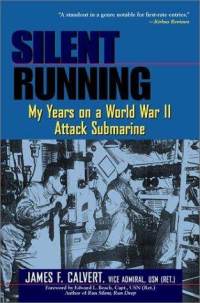
This is my favorite book on the Silent Service during the war because it provides a view from the deck plates, or in this case, from inside the pressure hull. Silent Running opens with the renowned submariner Ned Beach's renowned screed against early war U.S. torpedoes, and then Calvert recounts his nine war patrols in the Pacific against the Japanese. World War II certainly included more renowned and controversial submariners than Calvert, but his understated style and clarity of expression landed his book on my list.
Winner of many prestigious awards, Dower argues that the Pacific War was essentially a race war between the Americans and Japanese, with each race believing itself superior to the other. On both sides the results included poor estimates of the enemy's capabilities, other military miscalculations, and a much higher level of brutality than Americans faced in Northwest Europe. War Without Mercy yields vital insights into what can happen when two different cultures clash; when each side uses a different rulebook for warfare.

Daws, Gavan. Prisoners of the Japanese: POWs of World War II in the Pacific. William Morrow, 1994.


Daws dwells on one particular product of the Pacific War culture clash -- the brutal Japanese treatment of POWs. The book is, in many ways, a collection of horror stories, including the fact that Japanese "physicians" performed vivisection -- dissection of a living being without anesthetic -- vivisection, on members of downed B-29 aircrews. I still shudder to think of it. The warning implicit in Prisoners of the Japanese, like that in War Without Mercy, is that different cultures have different rules of warfare than we do and will not behave as we do in fighting wars.
Naval officers and enlisted men and women do lots more than fight, including, among other things, conducting humanitarian operations, performing rescues at sea, and exploring space. With exclusive access to private papers and interviews with his subject's family and closest friends, Thompson examines the life of one of the first men to fly off aircraft carriers, one of the world's most fearless test pilots, and one of the Navy's iciest, brashest, cockiest and most competitive officers, beating out John Glenn for the first Mercury spaceflight and then later, as a crew member of Apollo 14, whacking a golf ball on the moon. I recommend this one because the Navy still needs test pilots, and Thompson is a brilliant writer.
In this book Reardon, one of America's finest military historians, recounts the history of Medium Attack Squadron 75 from multiple perspectives (the cockpit, the bomb handler, the wives left behind), and sets it within multiple layers of context. The Journal of Military History described it as "a model unit history." So here we have a group biography.
Honestly, I'm not including this to stroke my ego, but I consider this book, along with its predecessor, Breaking the Color Barrier, to be my masterpieces. Using a deep dive into the documentary records along with scores of interviews with largely black midshipmen, I've examined how the Naval Academy was transformed from a racist institution into one that genuinely ranks diversity among its fundamental tenets. The documentary research lays out the Naval Academy's racial policies, how they changed over time, and why. The interviews provide the impact these policies had on the experiences of black midshipmen, told through their own words. The third part of the book includes information on integration of women into the Academy, because many of those women are black. Naval officers and enlisted men and women should read Blue & Gold and Black because it explains the price minority and female shipmates will have to pay as long as parents teach prejudice to their children.
During his 22-year career as a CIA Intelligence Officer, Scheuer served as chief of the Bin Laden Issue Section from 1996 to 1999 and as special advisor to the chief of the bin Laden unit from September 2001 to November 2004. He began this book in 1999 as an unclassified manual for counterterrorism officers. Initially, Potomac Books listed the author as "Anonymous," but with the publication of his follow-on book, Imperial Hubris, his name came to light. As for Through Our Enemies' Eyes, "The crux of my argument," declares Scheuer, "is simply that America is in a war with militant Islamists that it cannot avoid; one that it cannot talk or appease its way out of; one in which our irreconcilable Islamist foes will have to be killed, an act which unavoidably will lead to innocent deaths; and one that is motivated in large measure by the impact of U.S. foreign policies in the Islamic world, one of which is unqualified U.S. support for Israel." It is a harrowing argument, but one that must be understood by all who are serving in the global war on terrorism, the current war, the war we are now in, or whatever we're calling it now.
(A big thanks to Dr. Schneller for sharing his thoughts and recommendations... Look for more thinkers’ suggestions in the weeks and months ahead. -- BD)

Wednesday, August 4, 2021

Monuments: Human Values or States’ Rights


Review by Bill Doughty

Last summer some of the statues of heroes of the Confederacy were removed from Monument Avenue in Richmond, Virginia. Gone are JEB Stuart and Stonewall Jackson. The removal of Robert E. Lee and his horse, Traveler, seems just a matter of time.


Lee and the horse, like other monuments to the insurrection of the 1860s, will likely travel to a cemetery, museum, or warehouse. How those monuments came to be on display in the first place is revealed in “No Common Ground: Confederate Monuments and the Ongoing Fight for Racial Justice” by Karen L. Cox (University of North Carolina Press, 2021). Cox dedicated her book: “For everyone who speaks truth to power.”

A photo of General Lee and horse –– and a Black Lives Matter projection –– are featured prominently on the cover of “No Common Ground.”


Cox explains why monuments were erected and why some military bases were named (or renamed) for leaders of the Confederacy. She shows how believers and supporters of the “Lost Cause” wanted desperately to hold onto their positions of privilege and power in the face of a changing culture of inclusion, integration, and equal rights.


Above all, United Daughters of the Confederacy (UDC) and white supremacists said they believed in vindication and “states’ rights,” even if those rights included the right to own other people as property.

“Through a broad-based agenda to perpetuate Confederate memory, the Daughters gave inspiration to southern white men intent on dominating black Southerners at every step, and by violence if necessary. Two generations removed from the Civil War, these women saw their efforts as part of an overall program of vindicating the Confederacy and those who sought to preserve it. Their battle to maintain Confederate culture –– by perpetuating pro-southern history, educating white children, and yes, building monuments –– required that the men of their generation be victorious in creating a southern power structure that their forefathers had failed to achieve. And they were. Those men established a political foundation based on white supremacy, disenfranchised black men, compelled entire black communities into submission through racial violence, and wielded states’ rights like a saber to thwart racial progress, while the federal government turned a blind eye and the Supreme Court upheld segregation. While states’ rights for the Confederate generation meant maintaining the racial status quo through laws and customs that gutted African Americans’ rights as citizens, underfunded their schools, re-enslaved them through mass incarceration, and made it nearly impossible for black southerners to break free from systems of inequality that limited where they could live and work.”

Robert E. Lee statue is unveiled in Richmond, Virginia, in summer of 1890.

Monuments to the Confederacy, especially at court houses and state capitols, were polarizing symbols inspiring either continued white supremacy or greater civil rights. 

“To understand their history is to understand how white southerners memorialized men who fought in a war to preserve slavery and created a ‘new’ South that sought to limit the freedom of black southerners whose ancestors were enslaved. Yet at the same time, to fully understand their history is also to understand how generations of black southerners have demonstrated their scorn for monuments they have always believed were symbols of slavery and oppression.”

Forrest
Despite initial institutional racism, the United States military has been on the leading edge of gradual integration and equality throughout American history. In fact, the UDC, KKK, and other white supremacists built more monuments as they witnessed that greater post-war integration in the United States after World War I, World War II, and the Korean War. The building of Lost Cause monuments saw an uptick in the mid-60s during the civil rights movement and the centennial of the Civil War in 1965.

Cox presents some history pertinent to military readers:

  • How the Army renamed Camp Peay in Tennessee, as Camp Nathan Bedford Forrest, the founder of the Ku Klux Klan, Dec. 7, 1940.
  • How Air Force Sgt. James Meredith, an African American, tried to get an education at the University of Mississippi in 1961 but was blocked by a crowd led by retired Air Force Gen. Edwin Walker, a white supremacist, at the pedestal of a Confederate monument.
  • How 21-year-old Sammy Younge Jr., a black U.S. Navy veteran and student at Tuskegee University, was murdered in 1966 and how his white murderer was acquitted by an all-white jury. Protesters gathered at the town’s Confederate monument.
  • How middle-aged WWII veteran James Holley –– Portsmouth, Virginia’s first African American elected to the city council –– fought the UDC to decorate the town’s Confederate monument on Memorial Day with American flags instead of the traditional Confederate flags, “primarily battle flags.”

Marines of Range Company, Weapons and Field Training Battalion, walk through a museum on Fort Sumter during an educational trip Feb. 21, 2014, to Charleston, S.C. The Marines visited Battery Park, the Fort Sumter National Monument and rode a ferry to Fort Sumter itself, which is the site of the first shots of the Civil War. The trip was part of the company’s professional military education program, which helps Marines expand their knowledge outside their primary occupational specialties. The Marines of Range Company train recruits and Marines in marksmanship on Parris Island, S.C. (Photo by Cpl. Octavia Davis)


Cox considers monuments to be weapons of the culture wars, erected ostensibly to teach history but in reality teaching or perpetuating something else.

“Confederate monuments are not innocuous symbols,” she writes. “They are weapons in the larger arsenal of white supremacy, artifacts of Jim Crow not unlike the ‘whites only’ signs that declared black southerners to be second-class citizens. Removing a monument from the public square is no more an act of erasing history than removing those signs from public accommodations.”

The war over secessionist monuments to the Civil War includes marches and battles for voter registration and against gerrymandering as well as fights over flying the Confederate flag or keeping it as part of several southern states. The Lost Cause is losing this war too, with symbols falling and statues being removed. Selma, Alabama became the first city in the nation to remove a Confederate monument and relocate it to a cemetery. New Orleans removed several monuments exactly six months after nine people were murdered at the Emanuel African Methodist Episcopal Church by a white nationalist June 17, 2015.


Karen L. Cox
Yet, state laws about monuments remain an obstacle to change, Cox notes, where “states rights” overrule local communities’ votes. Legislatures that came into power thanks to redistricting and gerrymandering through voter suppression are passing laws to keep the Lost Cause monuments in their states. “Voter suppression, in fact, is key to understanding not only the current state of Confederate monuments but also the battle over their construction in the nineteenth century,” Cox writes.

While some southern leaders, notably in Texas, Alabama, and Tennessee, have resisted removal of Confederate monuments, the trend to reject and remove the memorials, especially from public land, continues to grow. Monuments came down this summer in Charlottesville, Virginia –– site of a deadly riot at a white nationalist rally centered around a monument to Robert E. Lee. A statue of Confederate General Alfred Mouton was removed July 17 in Lafayette, Louisiana. Even officials in Tennessee voted to remove a bust of KKK leader Nathan Bedford Forrest this summer from the Tennessee Capitol.


But removal of statues, like the monuments themselves, is just symbolic unless people consider human values and American ideals of equality and justice.

“Removing a monument does not remove the systemic racism with which it has long been associated. It is a symbolic act only, although it may also serve as an important first step. The hard work of dismantling racism and honestly confronting racial inequality within that community must come next. After all, it was a movement against white supremacy that initially brought public concerns about Confederate monuments into the open. Today’s protests against Confederate monuments, therefore, are but one stage in a much longer fight for racial justice.”

Truth to power.


DOD will likely rename hundreds of names of bases, buildings, and streets, etc. in coming years. The “Commission on the Naming of Items of the Department of Defense that Commemorate the Confederate States of America or Any Person Who Served Voluntarily with the Confederate States of America” –– commonly called the “Naming Commission –– is chaired by retired Navy Adm. Michelle Howard, former VCNO. The commission, which includes retired Gen. Robert Neller, former Marine Corps commandant, is visiting Army bases this summer. The Naming Commission is mandated to update Congress by Oct. 11 and continue its work through FY22.

Aviation Ordnanceman 2nd Class Teven Reed (left), from Cottonport, La., and Aviation Maintenance Administrationman 3rd Class Makayla Cabel, from Smithville, Mo., shift colors on the flight deck of the aircraft carrier USS Abraham Lincoln (CVN 72) April 5, 2021, in San Diego. Abraham Lincoln is underway conducting routine operations in the U.S. 3rd Fleet area of operations. (MC3 Michael Singley)

TOP PHOTO:

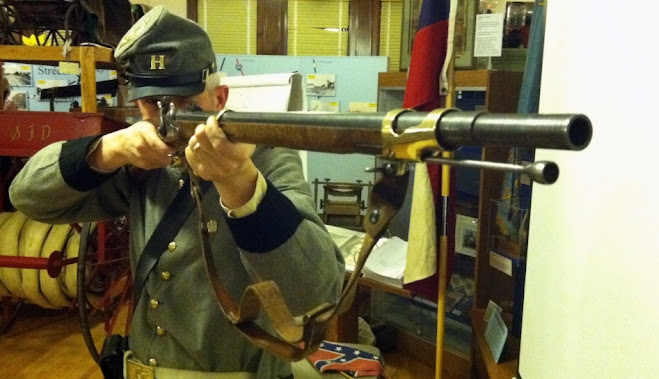
Ward Zischke, a native of Cedar Falls, Iowa, and historian for the Army Reserve 88th Regional Support Command, explains the Confederacy mind-set to an audience, April 19, 2012, during a Civil War lecture series at the Deke Slayton Memorial Space Museum in Sparta, Wis. Zischke is also an Army Reserve lieutenant colonel with 3rd Brigade of the 75th Battle Command Training Division. (Sgt. 1st Class Osvaldo Sanchez)