Monday, February 22, 2021

THE Book: ’A Promised Land’

Review by Bill Doughty

Barack Obama’s “A Promised Land” (Crown, 2020) is THE book to read this month.


Supremely self-aware and filled with empathy, Obama weaves his own life experiences –– as a son, grandson, husband, dad, and friend –– with his career, focusing especially on early 21st century history and the first two years of his presidency.

Obama’s experience growing up in Hawaii, living in Indonesia, having grandparents from Kansas, and working in Chicago helped him develop a wider perspective –– outside looking in. Introspection is part of his very being: “As an African American, I’d experienced what it was like not to be fully seen inside my own country.”


Books captivated him at an early age. Mohandas Gandhi, Abraham Lincoln, Martin Luther King Jr., and James Baldwin informed his world view. Later, Elie Wiesel became a big influence. “Reading his books," Obama writes, "I’d found an impregnable mortal code that both fortified me and challenged me to be better."


Philosophy, humor, and pathos mix with a practical but lyrical narrative in this captivating book, the first in what promises to be two volumes. (I won’t be surprised or disappointed if it becomes three.) It is dedicated "To Michelle –– my love and life's partner and Malia and Sasha –– whose dazzling light makes everything brighter."


CJCS Adm. Mullen and President Obama at 9/11 ceremony at Pentagon, Sept. 11, 2009.
Dozens of characters appear on history’s stage in “A Promised Land,” including Chairman of the Joint Chiefs Gen. Mike Mullen, Gen. Stanley McChrystal, German Chancellor Angela Merkel, Russian President Vladimir Putin, and businessman Donald Trump. Obama writes them into the story with deft pen strokes. He admits in the book's preface that he composes first by hand on yellow legal pads.

Obama’s mindfulness, self-awareness, and critical thinking are the tools he uses to weave together this tapestry of his history. That history includes confronting the economy debacle of the previous administration, dealing with the H1N1 pandemic, facing the BP Deep Water Horizon oil drilling catastrophe, approving Navy SEALS’ mission to rescue Richard Phillips from Somali pirates, and many other crises and achievements.


For Navy Reads readers “A Promised Land” provides invaluable insights into nuclear disarmament efforts, a first-hand perspective on hunting Osama bin Laden, various commander-in-chief challenges, and a deep reverence for military service and sacrifice and about the nature of true patriotism. Obama writes extensively about his visits to meet wounded warriors and their families.

“How those men inspired me! Their courage and determination, their insistence that they’d be back at it in no time, their general lack of fuss. It made so much of what passes for patriotism –– the gaudy rituals at football games, the desultory flag waving at parades, the blather of politicians –– seem empty and trite. The patients I met had nothing but praise for the hospital teams responsible for their treatment –– the doctors, nurses, and orderlies, most of them service members themselves, but some of them civilians, a surprising number of them foreign-born, originally from places like Nigeria, El Salvador, or the Philippines. Indeed, it was heartening to see how well these wounded warriors were cared for, beginning with the seamless, fast-moving chain that allowed a Marine injured in a dusty Afghan village to be medevaced to the closest base, stabilized, then transported to Germany and onward to Bethesda or Walter Reed for state-of-the-art surgery, all in a matter of days.

“Because of that system –– a melding of advanced technology, logistical precision, and highly trained and dedicated people, the kind of thing that the U.S. military does better than any other organization on earth –– many soldiers who would have died from similar wounds during the Vietnam era were now able to sit with me at their bedside, debating the merits of the Bears versus the Packers. Still, no level of precision or care could erase the brutal, life-changing nature of the injuries these men had suffered. Those who lost a single leg, especially if the amputation was below the knee, often described themselves as being lucky. Double or even triple amputees were not uncommon, nor were severe cranial trauma, spinal injuries, disfiguring facial wounds, or the loss of eyesight, hearing, or any number of basic bodily functions. The service members I met were adamant that they had no regrets about sacrificing so much for their country and were understandably offended by anyone who viewed them with even a modicum of pity. Taking their cues from their wounded sons, the parents I met were careful to express only the certainty of their child’s recovery, along with their deep wells of pride.

“And yet each time I entered a room, each time I shook a hand, I could not ignore how incredibly young most of these service members were, many of them barely out of high school. I couldn’t help but notice the rims of anguish around the eyes of the parents, who themselves were often younger than me. I wouldn’t forget the barely suppressed anger in the voice of a father I met at one point, as he explained that his handsome son, who lay before us likely paralyzed for life, was celebrating his twenty-first birthday that day, or the vacant expression on the face of a young mother who sat with a baby cheerfully gurgling in her arms, pondering a life with a husband who was probably going to survive but found no longer be capable of conscious thought.”

President Obama visits a wounded warrior for a Purple Heart presentation at Walter Reed National Military Medical Center in Bethesda, Md., Oct. 10, 2011. (Pete Souza)


Obama’s many visits to Bethesda/Walter Reed, as well as his participation in dignified transfer ceremonies at Dover Air Force Base informed and inspired him about the nature and cost of war.

“I was never more clear-eyed than on the flights back from Walter Reed and Bethesda. Clear about the true costs of war, and who bore those costs. Clear about war’s folly, the sorry tales we humans collectively store in our heads and pass on from generation to generation –– abstractions that fan hate and justify cruelty and force even the righteous among us to participate in carnage. Clear that by virtue of my office, I could not avoid responsibility for lives lost or shattered, even if I somehow justified my decisions by what I perceived to be some larger good.”

Vaclav Havel speaks to U.S. Congress in 1990.
Those visits informed him, as well, of the importance and value of affordable health care on a national scale.

This book is filled with nuggets of wisdom, such as:

  • Hearing this wisdom from Vaclav Havel, former president of the Czech Republic: “‘Today, autocrats are more sophisticated. They stand for election while slowly undermining the institutions that democracy possible. They champion free markets while engaging in the same corruption, cronyism, and exploitation as existed in the past.’”
  • Thinking about the roots of autocracy, whether from communism or religious fundamentalism: “Abstract theories and rigid orthodoxy can curdle into repression.
  • Speaking to WWII Veterans at Normandy: “Our history has always been the sum total of the choices made and the actions taken by each individual man and woman. It has always been up to us.”
  • Questioning political opponents for their fear-filled petty castigation after he bowed to the Japanese emperor, as called for by diplomatic protocol: “I wondered when exactly such a sizable portion of the American Right had become so frightened and insecure that they’d completely lost their mind.”
  • Reflecting about the aftermath of 9/11: “President Bush had done some things right, including swiftly and consistently trying to tamp down anti-Islamic sentiment in the United States –– no small feat, especially given our country’s history with McCarthyism and Japanese internment –– and mobilizing national support for the early Afghan campaign.”
  • Experiencing the joy of coaching his daughter’s basketball team: “Every parent savors such moments, I suppose, when the world slows down, your strivings get pushed to the back of your mind, and all that matters is that you are present, fully, to witness the miracle of your child growing up.”

While accepting the Nobel Peace Prize early in his presidency, Obama spoke to an international audience about the need at times for righteous war, such as when the United States joined with the Allies and confronting and defeating fascism and imperialism in World War II.

Near the end of “A Promised Land’s” 700-plus pages, Obama reflects on war again: “The truth is that war is never tidy and always results in unintended consequences, even when launched against seemingly powerless countries on behalf of a righteous cause.”


This is THE book to read now during Black History Month, in honor of America’s first African American president. It is also a book to read for years to come for anyone interested in understanding the cost of war, the need to preserve peace, and the demand to prevent the rise of autocracy and tyranny –– and achieve greater unity.


Navy Reads looks forward to reading the next volume.


ABOVE: President Barack Obama tours the United States Holocaust Memorial Museum in Washington, D.C., with Sara Bloomfield, museum director, and Elie Wiesel, Nobel Peace Prize laureate and Holocaust survivor, April 23, 2012. (Pete Souza) 
TOP PHOTO: President Barack Obama delivers his remarks to about 3,500 Sailors, Marines and other service members. Obama thanked them for their service during a rally held at Naval Air Station Jacksonville, Oct. 26, 2009. (MCC Anthony Casullo)

Sunday, February 14, 2021

McCarthyism/Trumpism III: Endless ‘Anxiety’

Review by Bill Doughty

In this third book review (in a Navy Reads trilogy) about Senator Joe McCarthy and his legacy, author Haynes Johnson provides more unintended parallels and links to Trumpism in “The Age of Anxiety: McCarthyism to Terrorism” (Harcourt, 2005).

Anxiety at the time this book was written came from the smoldering memories of 9/11 and fear of ongoing terrorism as the American military waged war in Afghanistan and in Iraq. Haynes makes a connection from 9/11 to the anxiety of communism in the 50s –– which would lead to the Vietnam War debacle.


Today, there are still fears of socialism and communism, as well as anxiety about fascism in the aftermath of a failed insurrection Jan. 6 at the Capitol by Trump supporters.


Presciently, Haynes writes this more than fifteen years ago: “The age of anxiety has not ended, nor is it likely to end soon.”


Here are some more parallels and links, including page numbers in the first edition version of this insightful book:


Like Trump, McCarthy tried to paint his opponents, including democrats, as unpatriotic, irreligious and unAmerican. Both Trump and McCarthy warned of “godless communism” in their speeches calling for their version of patriotism. (p.314)


After an earlier hearing in the Senate in the wake of the Tydings report (somewhat comparable to Trump’s first impeachment hearing) “McCarthy was rebuked, but not rejected. From then until the November elections, he became the Republican Party’s most tireless, sought-after, and effective campaigner.” (p. 188)


“The Democrats remained clueless. They believed that McCarthy’s falsehoods were so transparent and outrageous that they would emerge victorious from any encounter with him.” “McCarthy had poked the tigers of the Senate and showed them to be toothless.” (p.159)


McCarthy sued opponents, including a $2M libel suit against Sen. William Benton, admittedly for intimidation purposes and to “force him to spend money to defend himself.” (p.221)

Eisenhower makes a point with McCarthy
President Eisenhower, who is considered a moderate –– or even liberal –– Republican, worked behind the scenes to fight McCarthy. He “was becoming so frustrated with the obstructionism of McCarthy and other ultraconservatives, [he] … was considering the formation of a new party bringing together all the sensible people in the great middle of American life.” (p.260)

Haynes writes, “Over the decades, a more rigidly ideological Republican Party has emerged, forged by many of the forces McCarthy unleashed or harnessed.” (p.461) 


Navy readers will find a fascinating parallel between the swift-boating of John Kerry  and the smear of another Vietnam veteran Max Cleland, both former Senators who had been awarded multiple Purple Heart medals. (p.498)


In Kerry’s case, in which wealthy Texas Republicans funded TV ads with false claims that Kerry falsely received his combat medals, including the Silver Star. “Constant repetition over cable outlets had an echo chamber effect the greatly magnified the ads’ false charges.” (p.499)


Here’s some irony: McCarthy lied about his service in the Marine Corps, and he falsified records after the war to get Distinguished Flying Cross and Air Medal commendations. “The deceit was breathtaking,” Haynes writes. A later investigation revealed McCarthy had apparently drafted his own letter praising his war record and forged the signature of his CO, Maj. Glenn A. Todd. McCarthy then forwarded the letter to be countersigned by Admiral Chester Nimitz, commander of the U.S. Pacific Fleet, as a matter of routine. (p. 53)


The McCarthy “hearings were a landmark in American History. They were consequential, and they stamped indelible images in the public mind.” (p.388) So was the second impeachment of Donald J. Trump, which included indelible images of bloodthirsty Trump supporters attempting to overturn an election and transfer of power. Rioters were summoned to D.C., incited to fight, directed toward the Capitol, and allowed to attack police and the Capitol itself for hours.


Are McCarthyism and Trumpism names for the same phenomenon, describing ultranationalism, patriarchy, racism, and misguided patriotism? Examples in American history abound: slavery, actual witch hunts, Alien and Sedition Acts, loyalty tests, disallowing women the right to vote, civil rights violations, and family child separations, and others.

Haynes reports about the first Great Red Scare just over 100 years ago as World War 1 was about to end and Lenin and Trotsky came to power in the Russian Revolution. Bombings and riots shook the United States. In 1919, in the middle of the Great Influenza Pandemic, soldiers and sailors stormed the office of a Cleveland socialist newspaper. In Chicago, a sailor shot a man for not standing and removing his hat for the Star Spangled Banner. (p.102)


SECDEF Lloyd J. Austin III
A century later: A remarkable number (reports say 12 percent or more) of insurrectionists and rioters who stormed the Capitol last month had served in the military. New Secretary of Defense Lloyd J. Austin III ordered a 60-day stand-down to confront extremism.

Endless vigilance against violence is required of those who take an oath to protect and defend the Constitution against all enemies, foreign and domestic. As Edward R. Murrow said, “We cannot defend freedom abroad by deserting it at home.”


Haynes gives an excellent presentation of the Army hearings in which the Army's lead defense attorney Joseph Welch confronted and ended McCarthy’s reign of terror with the immortal rebuke: “… You have done enough. Have you no sense of decency at long last ? Have you left no sense of decency?”


Haynes concludes, “McCarthyism remains a story without an ending.” “Extremism –– and the suspicion and hatred it engenders –– may be Joe McCarthy’s most lasting legacy.”


A Presidents Day Postscript:


Haynes writes, “As a way of indicating his own model for statesmanship, McCarthy posted on the wall of his Senate office a copy of Lincoln’s famous remark: ‘If the end brings me out all right, what is said against me won’t amount to anything. If the end brings me out wrong, ten angels swearing I was right would make no difference.’” (p.79)


Conservative anti-communists prevented the performance of “Lincoln Portrait” at Eisenhower’s inauguration, because the composer, Aaron Copland, was loosely associated with “radical causes,” although he did not belong to the Communist Party. “Portrait” includes Lincoln’s memorable and still relevant words, “Fellow citizens, we cannot escape history. We of this Congress and this Administration will be remembered in spite of ourselves.” (p.300)


Democratic presidential candidate in 1952, Adlai Stevenson, echoed Lincoln in a speech about the Republican Party divide over McCarthyism: “A political party divided against itself, half McCarthy and half Eisenhower, cannot produce national unity.” (p.375)


Just a reminder: Navy Reads is an unofficial blog of book reviews and personal views on critical thinking, core values, Constitutional issues, and political-military-diplomatic philosophy.


WASHINGTON (April 15, 2015) -- Aviation Maintenance Administrationman Airman Apprentice Zaine Ahringhoff, assigned to the Nimitz-class aircraft carrier USS Abraham Lincoln (CVN 72), admires the Lincoln Monument during a trip to Washington, D.C. to commemorate the 150th anniversary of President Abraham Lincoln's assassination, April 15.  (MC3 Brenton Poyser)

Saturday, February 6, 2021

A Heated Senate; ‘No Sense of Decency’

Review by Bill Doughty

Another book adds to the understanding of McCarthyism and how it infected the body politic in the United States but failed to destroy the U.S. military and other pillars of democracy –– despite leaving lasting ailments.


Robert Shogan presents vignettes and the cast of characters in “No Sense of Decency: The Army-McCarthy Hearings: A Demagogue Falls and Television Takes Charge of American Politics” (Ivan R. Dee Publisher, 2009).

Shogan shows how the U.S. Senate in the early 1950s, aided and abetted by a willing media, fueled McCarthy’s conspiracy theories and attacks on democracy under the veil of patriotism. President Eisenhower said, “It saddens me that I must feel ashamed for the United States Senate.”


McCarthy’s legacy is one of lies and prevarication, breaking of norms, disrespect for rules and codes of conduct, prioritizing personality over substance, and a love for power and personal ambition over public interest.


In our previous post, we covered other parallels between McCarthyism and Trumpism as revealed in Larry Tye’s “Demagogue.” Shogan’s “No Sense of Decency" reveals more links and parallels. 


For instance:


Gen. George Marshall
McCarthy’s slander of war heroes, including General Marshall, a leader in World War II and a chief military advisor to President Truman as well as Secretary of State (p. 75) reads like Donald Trump’s reported disrespect for fallen soldiers and his slander of Senator John McCain, a Navy veteran and Vietnam War POW.


McCarthy attacked opponents’ family members, including Maj. Gen. Miles Reber’s brother as part of his Big Lie conspiracies. (p. 146)


Despite haranguing people who used the fifth amendment, McCarthy became known as the “Fifth Amendment Senator” when he, himself, was under investigation. (p. 244)


McCarthy weakened and divided his Republican Party but ironically brought about some bipartisanship in how the Senate eventually dealt with him, leading to a vote for censorship. (p. 248)


Shogan writes:

“The Senate faced a tortuous choice. For many of its members, conscience and a sense of obligation toward the legislative body whose prerogatives McCarthy now professed to be defending inclined them in favor of censure. But for many –– including those leading toward censure –– political considerations raised a red flag. McCarthy may have lost ground with the majority of Americans, but he still had a hard cadre of supporters, and these partisans felt bound even closer by the threat of censure.”

Sen. Joseph McCarthy
In the end, McCarthy refused to apologize.“He now wanted to become a victim and to use his martyrdom to expand and strengthen his own personal political base outside the Republican Party,” Shogan writes.


The characters in the Senate seventy years ago during the McCarthy hearings included young John F. Kennedy, democratic leader Lyndon B. Johnson, Richard M. Nixon, Stuart Symington, Everett Dirkson, Margaret Chase Smith, and Prescott Bush (father and grandfather of future presidents). Many of the senators were military veterans of World War II; some fought in World War I or in earlier conflicts.


Studying the list of senators from the 82nd and 83rd Congress (during McCarthy’s reign of terrorizing), it’s fascinating to see how many were born before the turn of the 20th century. Their parents or grandparents fought in or lived through the Civil War. The oldest senator in the group, Theodore F. Green of Rhode Island, was born in 1867 and served as a first lieutenant in the Spanish-American War.


Senator John F. Kennedy
All of the senators lived through the 1918 pandemic, including JFK, born May 29, 1917 and Russell Billiu Long, born Nov. 3, 1918. Long, who served as a Navy lieutenant in World War II, commanded a landing craft transport vessel. (He was the son of Louisiana governor and senator Huey Long.) None lived long enough to see the current coronavirus pandemic.


“No Sense of Decency” is a well-written, fast-paced accounting of the people, legacy, politics, and characters surrounding Joe McCarthy and McCarthyism.


“The politics of fear and paranoia, while they ebbed and flowed, never really went away,” Shogan concludes.


Reading about the history of the Cold War in general and McCarthyism in particular provides an insight to help understand current surrealism –– as well as other isms and ailments in its wake.

Saturday, January 30, 2021

Parallels of Trumpism/McCarthyism

Review by Bill Doughty

Some isms are based in fear, hate, anger, paranoia, and ignorance. They take hold because they operate in emotional shadows rather than in the light of logic. McCarthyism is worth studying because of obvious parallels that would eventually be revealed nearly seven decades later in Trumpism.

Far from being a caricature, Senator Joe McCarthy, junior Republican senator from Wisconsin through most of the 1950s, was “more layered and counterintuitive than the two-dimensional demagogue enshrined in history.”


Author Larry Tye gives a colorful biography of the senator with new information from recently revealed personal and professional papers, financial files, previously sealed Senate subcommittee testimony, and medical records from Bethesda Naval Hospital. 


“Demagogue: The Life and Long Shadow of Senator Joe McCarthy” (Houghton Mifflin Harcourt, 2020) shows that McCarthy was a hard-working “whizkid” entrepreneur and good student at Marquette University who became an attorney and circuit court judge and then a United States Marine before campaigning (while in uniform) for the U.S. Senate.


Some family members and friends knew McCarthy as tender and supportive in private. But his public persona was one of “a tyrant who recognized no restraints and would do anything –– anything –– to win.” He blamed his “roughness in fighting the enemy to his training in the Marine Corps.”

“Barely three years into Joe’s judicial term, the Empire of Japan sucker punched the United States of America, unleashing a crippling assault on the naval fleet at Pearl Harbor and letting loose a stampede of American boys raring to pound back. Judges like Joe, however, were deemed to be doing their part already, and most watched from the sidelines with nobody doubting their manliness or their patriotism. That was not enough for Joe McCarthy. He believed in public service, which was one reason he’d run twice for office at Marquette and two more time soon after graduation. He was also unabashedly ambitious, which had him eyeing Carl Zeidler, the wunderkind mayor of Milwaukee, who could someday be a rival for statewide office and who, in early 1942, scored page-one headlines by enlisting in the Navy. There was always more than one thing driving Joe, and now it was defending his country and one-upping his imagined opponent. The way to do that, he reasoned, was to sign on with the most hallowed of the armed services: the leathernecks of the US Marines.”

McCarthy in the Marines
Military records show McCarthy joined as a first lieutenant, but in “his first wartime fib” he claimed he joined as a “buck private.” McCarthy would lie about a leg injury he claimed to receive in combat but which he actually got 600 miles away, slipping and falling as a “pollywog” in a crossing-the-equator initiation aboard USS Chandeleur (AV-10). There were other embellishments and distortions about his time in uniform.


McCarthy’s active duty service lasted only 29 months, and the Marine Corps accepted his resignation March 29, 1945, just before the battles of Iwo Jima and Luzon. McCarthy then returned to the circuit court bench in full military dress uniform and accelerated his campaign for the Senate.


Joe McCarthy and Donald Trump are different in some obvious ways: military service (Trump avoided the draft); family origins (Trump was born rich but McCarthy started as a chicken farmer); complicated relationship with the FBI (McCarthy was friends with Hoover, while Trump fired FBI directors); views on Russia and the Soviet Union (although both opposed communism); and alcohol consumption (McCarthy died of the effects of severe alcoholism, but Trump claims not to drink alcohol).


But McCarthy/Trump parallels, as revealed in “Demagogue,” are astounding –– and plentiful:


Sunday, January 24, 2021

‘Compromised’ Democracy


Review by Bill Doughty

This is an important book for anyone who takes an oath of allegiance promising to uphold and defend the Constitution. It’s also a timely review of foreign and domestic attacks on U.S. democracy over recent decades.


Peter Strzok has taken that oath many times, including in uniform. He is a good writer, and there are a lot of hard truths in “Compromised” (Houghton Mifflin Harcourt; 2020).


As a child, much like many military family members, Strzok grew up overseas. He was an eye witness to the Iranian Revolution, and watched his father, an Army veteran and civilian contractor, burn documents before his family had to flee the country in December 1978.


Years later, Strzok followed his father’s path and joined the Army. He served as an artillery officer with the 101st Airborne Division at Fort Campbell, Kentucky. “There I was embedded in an infantry company in the 502nd Infantry Brigade, which traced its proud lineage to World War II; its D-Day heroics memorialized in a famous picture of General Eisenhower speaking to its paratroopers before they loaded onto airplanes to cross the English Channel to liberate Nazi-occupied France.”


After his service in the Army, Strzok attended Georgetown University with an ROTC scholarship.

“By the time I entered college, I had lived through four revolutions on three continents. Whether in Iran, West Africa, or Haiti, all shared common characteristics, and all taught me lessons about dictators and authoritarians and their hunger to consolidate power and obtain –– or at least convey –– legitimacy. That quest for legitimacy played out in a host of ways. One was the desire to manipulate, control, or discredit media. A relentless distortion of reality numbs a country’s populace to outrage and weakens its ability to discern truth from fiction.

Another way dictators sought to secure power and legitimacy was by co-opting the power of the state –– its military, law enforcement, and judicial systems –– to carry out personal goals and vendettas rather than the nation’s needs.

Still another was by undermining dissent, questioning the validity of opposition and refusing to honor public will, up to and including threatening or preventing the peaceful transfer of power.”

In 1995 Strzok wanted to continue to work in government service. That opportunity came with expanded recruitment for FBI agents after the Oklahoma City bombing. White nationalist Timothy McVeigh murdered 86 people, including many children at a day care center in the Alfred P. Murrah federal building.


Here’s an example of the quality of Strzok’s writing:

“September 11, 2001, irreparably changed our country. It wounded the nation’s collective psyche, and it individually scarred anyone old enough to remember the sight of the Twin Towers collapsing, of the Pentagon’s smashed west face, and of the furrowed earth in Shanksville, Pennsylvania, where Flight 77 disintegrated as it plowed into the earth. Thousands dead and missing. Nineteen perpetrators dead. The mastermind, Osama bin Laden, deep in Afghanistan, under the protection of the Taliban. A network of Internet-savvy radical Islamists spread across the globe, deftly manipulating technology to communicate and recruit new adherents. The crime scenes –– the planes and the buildings –– obliterated in a volcanic inferno. Evidence incinerated or crushed into the earth, pulverized into dust, and, in New York, belched out over the now hellish moonscape of lower Manhattan.”

The attacks changed how the FBI and other agencies conducted business, but back then counterintelligence was still conducted with analog systems in a burgeoning digital world.


FBI members learn how an Alternate Light Source as part of the tools and techniques used to collect evidence. (Courtesy Photo)


This book is marked with sublime storytelling, and the stories are true, including the case of Andrey Bezrukov and Yelena Vavilova (“Donald Heathfield” and” Tracey Lee Ann Foley”), Russian “illegals” who were spies the FBI investigated and caught. The fictionalized version of their story was depicted in the show, “The Americans.”


We get perspectives on Russian disinformation, cyber theft, and assaults on U.S. elections as well as an inside look at Operation Crossfire Hurricane, which Strzok named while thinking of The Rolling Stones song “Jumping Jack Flash.”


This book spells out in compelling detail the events known so far at the center of the nation’s devastating corruption case involving President Trump and Russia, hinting more will be revealed in the future about Trump Tower Moscow and other financial ties and arrangements.


McCabe and Strzok
Like former FBI deputy director Andrew McCabe’s “The Threat,” this book shows how investigators take their oath to uphold the Constitution seriously –– even in the face of a “nerve-racking” decision to investigate then-President Trump. We get an inside look at the Mueller investigation and how the Mueller Report was misrepresented.

“Although I’ve said it before, I’ll repeat it here as plainly as I can: from McCabe down to the Crossfire team, everyone who had a hand in opening an investigation into the president was acting with a clearheaded purpose of upholding the Constitution and protecting the American people. No one had hoped or wished for this. No one was happy. No one celebrated. No one questioned it. We had avoided it as long as we could. So, as we had so many times before, we gritted our teeth and got on with our work.”

Threats to the Constitution continue in 2021, and the need for vigilance and commitment to core values remains. Strzok’s warnings are relevant even now with President Biden in office, “Because the Russians haven’t gone away,” Strzok warns.

“That is still my fear. I expect that future elections will see the Russians engaging in all the sorts of active measures we saw in 2016, and they’ll be bringing new tactics to the fight as well: Altering voter rolls. Tampering with voting results, in however limited a way, and amplifying the news of that meddling on social media. Hacking into and crashing voting infrastructure. Spreading false stories of disenfranchisement and voting fraud. Releasing kompromat that Russia has spent years collecting and that has the potential to be greatly disruptive.

We’ll find out soon enough.”

Strzok offers a mea culpa for his personal and professional mistakes while a lead FBI agent, and his honesty and perspective are inspiring and ought to be appreciated in context.


The Federal Bureau of Investigation reportedly tried to warn about the Capitol attack of January 6, 2021 by white nationalist insurrectionists. The deadly attack threatened people, the rule of law, the peaceful transfer of power, and our Constitutional democracy.

Friday, January 15, 2021

The Long Arc: ’What Unites US’


Review by Bill Doughty

The long arc of history bends toward justice, as Martin Luther King observed, but the arc is jagged –– two steps forward, one step backward. Yet with age, education, and knowledge, often comes wisdom and a clear perspective of the way forward to a “more perfect union.”


Dan Rather acknowledges this in his heartwarming book, written with Elliot Kirschner, “What Unites Us: Reflections on Patriotism” (Algonquin Books of Chapel Hill: 2017). Rereading this quietly powerful book is a way to see clearly how we can heal and unite through truth, understanding, and accountability, especially after the attack on the Capitol by domestic terrorists and misguided believers.

Some key insights Rather shares: We can find strength through kindness and diversity. We can be patriotic through empathy and inclusion. We can be responsible citizens by caring for the environment, getting an education, and finding ways to serve. (At right: Service – Sailors aboard USNS Comfort (T-AH 20) evaluate a Guatemalan infant, June 27, 2007, during a humanitarian deployment, DVIDS).


And we can achieve greatness as individuals and as a nation by repairing our faults, to paraphrase de Tocqueville (who the author quotes in his epigraph). Another quote Rather shares is from George Washington, who “in his famous Farewell Address, warned future generations ‘to guard against the impostures of pretended patriotism.’”


What does it mean to love America and to be committed to moving forward along the arc toward justice? “It is important not to confuse patriotism with nationalism,” he writes. “Patriotism –– active, constructive patriotism –– takes work. It takes knowledge, engagement with those who are different from you, and fairness in law and opportunity. It takes coming together for good causes.”


Here’s a found haiku in “What Unites Us”:


We are a nation

not only of dreamers, but

also of fixers


“We have looked at our land and people, and said, time and again, this is not good enough; we can do better,” he writes.


Houston, circa 1935
Rather takes us back to his childhood in 1930s/40s Houston, Texas in “What Unites Us.” He weaves together themes of freedom, community, exploration, responsibility, and character –– in other words, cherished American values and ideals. 

As a child, Rather was an eyewitness to the Second World War on the Homefront. As a young man he enlisted in the Marine Corps. But he regretted having to be forced to leave boot camp after suffering health issues from having contracted rheumatic fever in childhood

Rather found another way to serve in war zones; he became a renowned reporter, following in the footsteps of his hero Edward R. Murrow. Now, at 89 years old, Rather reflects on the American history he has seen and experienced.


Rather shares anecdotes about people he knew on the Homefront after the traumas of the Great Depression in the 1930s and World War II in the early-to-mid 40s, and he explains how the war mobilized and united the nation, especially after Pearl Harbor.

“It is perhaps not surprising that Nazi Germany and Imperial Japan looked at a nation so traumatized and felt they could defeat us. Of course, history turned out differently. The same generation that had been driven to such depths in the 1930s rose up to push back the forces of totalitarianism in a two-ocean global war in the 1940s. Perhaps those authoritarians, who felt no empathy for their own people or those they conquered, underestimated the strength of our empathy. Empathy builds community. Communities strengthen a country and its resolve and will to fight back. We were never as unified in national purpose as we were in those days. What had weakened us had also made us stronger.”

WWII and Korea (“the forgotten war”), he says, were turning points for our nation.

“We have never fully regained the confidence we felt at the end of World War II, or the unity. Korea led to a long and arduous path of questioning our place in the world. We did not always win wars, as we would soon have to relearn in Vietnam. We could not take our destiny for granted, as we began to realize under the shadow of the Cold War. There were deep ruptures and injustices within our nation, as we would see when the national spotlight shifted from the fissures of McCarthyism to the difficult struggle for civil rights.”

Truman integrated the military in 1948
Peaceful demonstrations and street marches against poverty, racism, voter suppression, and the Vietnam War were part of the jagged arc toward justice in the 60s, but courageous decisions made decades earlier paved the way. “In 1948, President Harry Truman would desegregate the armed forces, six years before Brown v. Board of Education ended segregation in our public schools.”

“Indeed, this sweep of empathy continued after the war. One of the best foreign policy efforts in American history was to help rebuild Europe and Japan. Our enemies became our friends through acknowledgment of the common bonds of humanity. The postwar world order was built on that foundation. And when the GIs returned home, we treated them empathetically as well. The Servicemen’s Readjustment Act of 1944, more commonly known as the GI Bill, was one of the greatest pieces of social legislation in our nation’s history. Among other benefits, the GI Bill ensured that servicemen’s tuitions to college or technical school were fully paid. Empathy makes for wise foreign and domestic policy.”

Nixon is interviewed by Rather in the White House, Jan. 2, 1972.
Rather showcases the steady, courageous, and audacious leadership of Presidents Abraham Lincoln, Teddy Roosevelt, Truman, FDR, JFK, and LBJ. Those leaders stand in sharp contrast to any president who lies, cheats, threatens, and incites violence in order to get elected or try to stay in power.

Reflecting on the situation in the early 70s, after Nixon resigned in the face of impeachment and Navy veteran Vice President Gerald Ford assumed office, Rather writes, “The steadiness of the nation contrasted sharply with the increasing unsteadiness of President Nixon –– the full measure of which we would not comprehend until after he’d left office.”


“We would do well to study our history,” Rather observes. “For in it lies not only evidence of American greatness, but also the need for humility.”


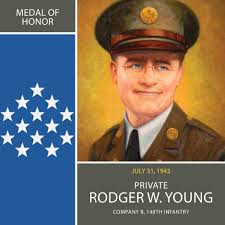
He reminds us of humble American hero Rodger Young, an Army soldier of the Ohio National Guard who fought and died in the Pacific War during the Battle of Munda Point in the Solomon Islands. 


In the Battle of Munda Point, Private Young, shot twice by machine gun fire, continued to move forward, firing his rifle and throwing hand grenades to take out an enemy pillbox and save his team. Young was posthumously awarded the Medal of Honor. 


Rather speaks with reverence about visiting cemeteries in Normandy and Honolulu. Rather's/Kirschner’s prose is crisp and unsentimental, but there are still glimmers of poetic insight.


Here is another found haiku in “What Unites Us”:


We live in debt to

those who have served and died, a

debt tallied in blood


Rather reveals truly patriotic American values –– perfect for this challenging time in the wake of a failed coup attempt, in the middle of a deadly pandemic, and as we confront an ongoing threat to our Constitution and democratic republic. Dan Rather provides a strong and hopeful commitment to truth, justice, and accountability in 2021 in this uplifting book. He helps smooth the jagged edges of the long arc of history.


National Memorial Cemetery of the Pacific, "Punchbowl Crater," Oahu, Hawaii, with Diamond Head in the background.

Panoramic view of the "National Memorial Cemetery of the Pacific" at Punchbowl Crater, Oahu, Hawaii, 2 September 1949, four years after the end of World War II. Fleet Admiral Chester W. Nimitz, USN, made a speech at the dedication ceremony.