Showing posts sorted by relevance for query preble barbary. Sort by date Show all posts

Sunday, October 22, 2017

John Finn / Seton's Halloween Story

Review by Bill Doughty
World War II's first Medal of Honor recipient (former Navy Chief and Lieutenant) John Finn came to Pearl Harbor Dec. 6, 2009 to ride in a whiteboat named for him. He was 100.

Ernest Thompson Seton
I had the special privilege of interviewing John Finn that day during his boat ride. He told me his favorite author, beginning early in his life, was Ernest Thompson Seton, the naturalist, artist, writer, adventurer and Native American Indian advocate.
Finn said Seton was a great writer who captured his imagination and influenced his love of the West.

Seton had a significant role in the birth of Scouting in the United States. He is the reason there are such strong ties with Scouting and Native American culture.
Recently I read Seton's "The Arctic Prairies: A Canoe-Journey of 2,000 Miles in Search of the Caribou; Being the Account of a Voyage to the Region North of Aylmer," first published in 1911 – when John Finn was nearly two years old – and reprinted in 1917 in the version I held. The subject of the book, the journey itself, started in 1907.
Seton recounts stories, does science experiments, makes sketches of wildlife and narrates the journey to "unbroken forest and prairie leagues." This richly rewarding book follows the six-month journey Seton made with Edward A. Preble.
Preble was a naturalist whose bloodline included a distant great-great-great grandfather, the brother of Commodore Edward Preble, who defeated the Barbary Pirates in the Mediterranean on orders of President Thomas Jefferson.
It was naturalist Preble who became the center of a campfire Halloween story just as the journey was coming to a close, after various adventures with lynxes, buffaloes, musk-ox, caribou, wolves, bears, coyotes, Arctic foxes and a myriad of birds. Many of the creatures in the cold North were hungry, some dying of starvation in the early winter.
One particular animal became the focus of October 28, leading up to the end of the Seton-Preble journey on Halloween 1907.
"On that same night we had a curious adventure with a weasel. All were sitting around the camp-fire at bed-time, when I heard a distinct patter on the leaves. 'Something coming,' I whispered. All held still, then out of the gloom came bounding a snow-white weasel. Preble was lying on his back with his hands clasped behind his head and the weasel fearlessly jumped on my colleague's broad chest, and stood peering about. In a flash Preble's right elbow was down and held the weasel prisoner, his left hand coming to assist. Now, it is pretty well known that if you and a weasel grab each other at the same time he has choice of holds. 'I have got him,' said Preble, then added feelingly, 'but he got me first. Suffering Moses! The little cuss is grinding his teeth in deeper.' The muffled screaming of the small demon died away as Preble's strong left hand crushed out its life, but as long as there was a spark of it remaining, those desperate jaws were grinding deeper into his thumb. It seemed a remarkably long affair to us, and from time to time, as Preble let off some fierce ejaculation, one of us would ask, 'Hello! Are you two still at it,' or 'How are you and your friend these times, Preble?' In a few minutes it was over, but that creature in his fury seemed to have inspired himself with lock-jaw, for his teeth were so driven in and double-locked, that I had to pry the jaws apart before the hand was free. The weasel may now be seen in the American Museum, and Preble in the Agricultural Department at Washington, the latter none the worse. So wore away the month, the last night came, a night of fireside joy at home (for was it not Hallowe'en?), and our celebration took the form of washing, shaving, mending clothes, in preparation for our landing in the morning."
Seton admitted to a wanderlust desire to go to unexplored regions. He traveled the Nyarling River and camped at the Great Slave Lake, White Fish River, Salt River, Athabska River and Little Buffalo River. He met with Native Americans he called Cree, Chipewyan, Grand Lake Algonquin and Blackfoot Indians.
He describes – and sketches drawings of – dozens of fauna and flora, presented in scientific sketches. Black-and-white photos show the beautiful desolation of the open country.
In the final chapter, "The End," Seton writes:
"All that night of Hallowe'en, a partridge drummed near my untented couch on the balsam boughs. What a glorious sound of woods and life triumphant it seemed; and why did he drum at night? Simply because he had more joy than the short fall day gave him time to express. He seemed to be beating our march of victory, for were we not in triumph coming home? The gray firstlight came through the trees and showed us lying each in his blanket, covered with leaves, like babes in the woods. The gray jays came wailing through the gloom, a faroff cock-of-the-pines was trumpeting in the lovely, unplagued autumn woods; it seemed as though all the very best things in the land were assembled and the bad things all left out, so that our final memories should have no evil shade. The scene comes brightly back again, the sheltering fir-clad shore, the staunch canoe skimming the river's tranquil reach, the water smiling round her bow, as we push from this, the last of full five hundred camps. The dawn fog lifts, the river sparkles in the sun, we round the last of a thousand headlands. The little frontier town of the Landing swings into view once more – what a metropolis it seems to us now!"
We can picture a young John Finn reading this book rapturously and enjoying the photos and drawings by the author.

USS John Finn (DDG 113) in Pearl Harbor. (Photo by Ens. Britney Duesler.
Last summer, in Pearl Harbor the Navy commissioned a new guided-missile destroyer: USS John Finn (DDG 113). The ship is homeported in San Diego.

Meanwhile, the John Finn whiteboat, one of several in Pearl Harbor with Sailors at the helm, is used nearly every day to take about 150 visitors per trip to the USS Arizona Memorial – more than a million-and-a-half people per year from throughout the world. 

Among the groups who visit Pearl Harbor each year are Boy Scouts and Girl Scouts. Interestingly, Ernest Thompson Seton is considered to one of the "fathers" of Scouting. 
Politics, patriotism and even spirituality/religion are intertwined in a fascinating essay by David C. Scott and presented by Johnny Walker about Seton's role in the early days of Scouting.
Ernest Thompson Seton founded The Woodcraft Movement in 1901 and wrote the first Boy Scouts of America handbooks. The original 1910 BSA manual is subtitled "A Handbook of Woodcraft, Scouting, and Life-craft" (Seton and Baden-Powell, 1910). Seton also wrote "The Woodcraft Manual for Girls" in 1916. 
For perspective on Seton, consider that he was born in England in April 14, 1860, nearly one year to the day before the start of America's Civil War. He moved to Canada, where he lived and studied, before eventually moving to the United States and becoming a U.S. citizen, settling near Santa Fe, New Mexico – in the heart of his (and Finn's) beloved West.
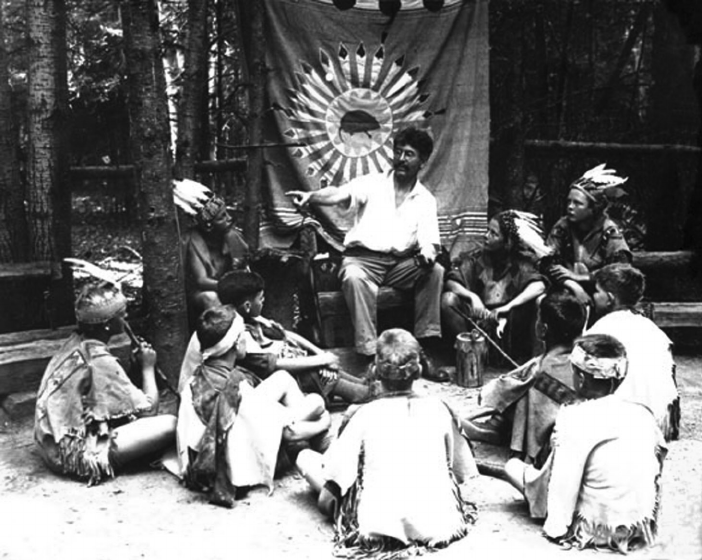
Seton teaches young people about Indian culture as part of his Woodcraft Movement, 1903.
A complicated individual, Seton became enmeshed in an early 20th century controversy that ended up putting him somewhat at odds with his President Theodore Roosevelt over anthropomorphic portrayals of animals in nature. TR reportedly advised Seton to back up his views with facts, leading to volumes of academic and scientific investigations about animals.

Though apparently hobbled by his own ego and patriarchal thinking toward other races, he was an early champion of equal rights for women, and he had deep respect for Native American Indian culture.

Seton also reached across the Atlantic to his native England and sought to strengthen ties in World War I, reinforcing the ideal of service. 

In his "The Gospel of the Redman: An Indian Bible" Seton writes: "The culture of the Redman is fundamentally spiritual; his measure of success is, 'How much service have I rendered to my people?' His mode of life, his thought, his every act are given spiritual significance, approached and colored with complete realization of the spirit world."

Seton died 71 years ago on Oct. 23, 1946, one year after the end of the war John Finn helped win. Today the Navy remembers the service of John Finn, who, though wounded and vulnerable, fought back, firing his mounted machine gun at attacking enemy planes on December 7, 1941 at Naval Station Kaneohe Bay, now Marine Corps Base Hawaii. We can imagine Finn's spirit aboard USS John Finn, at MCBH and in Pearl Harbor.


Extended family members and friends of the late John Finn visit his namesake whiteboat in Pearl Harbor July 17, 2017. (Photo by Ens. Britney Duesler)

Sunday, August 14, 2011

To the Shores of Tripoli

Review by Bill Doughty
The War of 1812, in which the young U.S. Navy defeated the British Fleet, was preceded by a war against terrorists -- Barbary pirates and their sponsor states along the northern coast of Africa in and around what is now Libya.
To the Shores of Tripoli -- The Birth of the U.S. Navy and Marines by A.B.C. Whipple, is the account of the original United States war against Arab tyrants and introduces us to colorful characters such as President Thomas Jefferson, Commodore Edward Preble, Consul William Eaton, Marine Lieutenant Presley Neville O’Bannon and Navy Captain Stephen Decatur.
These main characters are revealed with all of their strengths and weaknesses in the context of political intrigue and, quite literally, personal battles.  The book describes two duels to the death.
Duels occurred frequently in the new U.S. Navy, whose officers were overzealous about rank and “honor.”  Two thirds as many naval officers were killed in duels as by enemy action in all U.S. naval engagements from 1798 until the Civil War.
The greater "duel," of course, was between freedom of the seas and piracy.  Credit is given to Thomas Jefferson for his commitment to end the tradition of paying tribute and ransom to pirates who preyed on American shipping, capturing and imprisoning sailors in the late 1700s and early 1800s.
Jefferson saw the dangers of trading arms for hostages.  He lobbied for more and better Navy ships.
Yet, Jefferson was criticized for not waging all out naval war on the pirates and their sponsors and for settling for peace treaties.
According to Whipple:
Such criticism overlooks both Jefferson’s determination to fight rather than pay off the Barbary powers, and the fact that it was Congress that denied his requests to declare war against them.
Naval hero Stephen Decatur fights pirates in Tripoli.
Still, President Jefferson was in office when the first major interaction of the Barbary War occurred 210 years ago this month -- Aug. 1, 1801 -- when Lt. Andrew Sterett led the sloop-of-war Enterprise against the 14-gun warship Tripoli, commanded by Adm. Rais Mahomet Rous, known for raiding American and other commercial shipping.
After Rous pretended surrender and then opened fire on the Enterprise twice, Sterett and his Marines, led by Lt. Enoch Lane, used precision firepower and seafaring prowess to utterly defeat the enemy -- 30 killed, 30 injured out of a crew of 80, with not even one injury to Sterett’s men.
In several examples, the author shows the power of discipline, training and readiness over laziness and political expediency.
The heart of Whipple’s book deals with several key events: the 500-mile march across the desert to Tripoli, a courageous attack on the fort at Derna, sea battles in the Mediterranean and gunboat assaults against pirates and tyrants.
Commodore Preble, mentor to a generation of heroes.
The author shows how the Navy and Marine Corps team developed and became stronger.
He also shows the importance of books in developing leaders.  Eaton was inspired after reading Plutarch’s Lives as a young man.  Preble, a mentor to a generation of U.S. naval heroes, whose flagship was USS Constitution, had more than 100 books in his cabin.

Today, USS Preble (DDG 88) is part of the USS Ronald Reagan (CVN 76) Carrier Strike Group.  Preble was one of the first U.S. Navy assets on the scene in Japan last March to provide rescue and relief support as part of Operation Tomodachi in the wake of the tragic earthquake and tsunami there.
After reading and enjoying Whipple’s To the Shores of Tripoli (written twenty years ago in 1991) I checked out Jefferson’s War by Joseph Wheelan (published in 2003), a book which examines the same period and, like Whipple’s work, is carefully researched and documented.
To comprehend the present and future, one should read to understand the past...

Sunday, April 21, 2013

‘Web-feet’ of Lincoln and His Admirals


by Bill Doughty

Esteemed Lincoln historian (and Navy Reads contributor) Eric Foner said this about Craig L. Symonds’s “Lincoln and His Admirals”:  “Despite the numerous volumes on Lincoln and the land Civil War, this is the first full study of Lincoln's relationship to the war at sea, and it reveals him mastering the nuances of naval warfare.”

The War of 1812 has been called the second Revolutionary War and the real birth of the United States Navy; the Civil War was an internal revolutionary rebellion over slavery, in which the Union fought for a “new birth of freedom” for all. It was also a watershed event for the Navy.  By the end of the Civil War, the Navy proved its worth as a littoral and open-ocean force with global implications.

Symonds’s brilliant “Lincoln and his Admirals” shows strengths and weaknesses of military and political leaders, the Army-Navy relationship, and the president’s intense interest in the strategy and management of the Navy, through Secretary of the Navy Gideon Welles.

Symonds explores the relationship of Admirals Farragut, Porter, DuPont, Dahlgren and Wilkes, not only with Welles and Lincoln but also with Generals Grant, McLernand and Halleck, among others.

Ego, politics and power are revealed behind the curtain of history.  Symonds shows how Lincoln sought to understand before being understood, as “a neutrally patient navigator.” “Lincoln remained a reluctant commander in chief, and once he had a command team in place that he trusted, he backed away,” Symonds writes.

Du Pont
“Lincoln and his Admirals” is a great read, showing the personalities of the leaders and containing fascinating side notes that go further behind the curtain.  These are just a few examples:  The interesting case of Cmdr. George Preble, grandson of Edward Preble, hero of the Barbary Wars; the vanity, weakness and overreaction of Rear Adm. Samuel Francis Du Pont (to a newspaper story written April 15, 1863); and the sweet-and-sour opposites of Lincoln, the forgiving, and Welles, the vengeful.

“Welles’s tendency to chastise, however, was as instructive as Lincoln’s to soothe,” Symonds writes.  Lincoln’s natural empathy and political skill helped him deal with a fiery cabinet and strong-willed military leaders.

Sometimes flawless, occasionally dysfunctional, the joint efforts of the Union Army and Navy were an important reason the North prevailed.  Lincoln could see the effectiveness of combined operations when there was a willingness to operate outside of narrow and arbitrary lines of authority.  He valued collaboration and cooperation, he encouraged innovation and new technology, and he rewarded aggressive, decisive action in battle.

Read “Lincoln and his Admirals” to understand not only the Navy’s achievements in saving the Union but also the strategies and tactics of good leaders who see bigger themes.

According to Symonds, Lincoln showed “determination to put the good of the country ahead of personal ambition.  He expected his admirals -- and his generals -- to tolerate inconvenience and disappointment for the good of the cause.  The broader goals of Union and victory were more important than anyone’s personal trials, including his own.”  Through it all he continued to support modernization of the Navy.

The Navy had 588 warships by the end of 1863, according to Symonds, with 75 of the ships armored and with more and bigger ironclads coming.  Some of the ironclads featured 11-inch and 15-inch guns.

Anticipating the arguments of Alfred Thayer Mahan a generation later, Lincoln wrote, “Our country has advantages superior to any other nation in our resources of iron and timber, with inexhaustible quantities of fuel in the immediate vicinity of both, and all available and in close proximity to navigable waters.”  Although “other governments have been making large expenditures ... with a view to attain naval supremacy,” it seemed likely to him that “this government is destined to occupy a leading position among maritime powers.  After he wrote this passage, however, he (or perhaps [Secretary of State] Seward) decided that the British might construe it as too direct a challenge to their maritime supremacy, and he deleted it, replacing it with a slightly less confrontational sentence: “The events of war give an increased interest and importance to the navy which will probably extend beyond the war itself.”

In the summer of 1863 Lincoln wrote this in a public letter to James C. Conkling, showing his appreciation for the Navy team: “Nor must Uncle Sam’s Web-feet be forgotten.  At all the watery margins they have been present.  Not only in the deep sea, the broad bay, and the rapid river, but also up the narrow bayou, and wherever the ground was a little damp, they have been, and made their tracks.”

(CNO Adm. Greenert unveiled the latest iteration of the Navy’s Professional Reading Program at the Ford Center for Education and Leadership in front of a sculpture of 6,000 books about President Lincoln.  His program and list of books are focused on history, tradition, and leadership/management, tailored around his three tenets (warfighting first, operate forward, be ready)   We’ll continue to showcase the influence of Lincoln this year, along with books from and related to the CNO’s reading list.  In the previous blog post, Symonds shared a list of top five books with Navy Reads.)

Monday, February 20, 2012

War of 1812: USS Constitution and Freedom

by Bill Doughty
Just as slavery would become the defining reason for the Civil War by mid-19th Century, impressment was the match-to-the-fuse to the War of 1812.
HMS Guerriere's masts go over the side as Constitution
rakes her from ahead. Painting by Anton Otto Fischer.
“Impressment” describes the practice by the British Navy in the 1700s and 1800s of capturing suspected deserters -- even boarding and seizing American ships and confiscating property to do so.
The violation of freedom and sovereignty angered President Thomas Jefferson at the turn of the century and became an explosive issue for President James Madison in his first term starting in 1809.  Impressment and embargoing by Britain led to the United States Congress to declare war “in defense of freedom of the seas and sailors’ rights,” according to Charles E. Bodine Jr., Michael J. Crawford and Christine F. Hughes.
The authors explain how the War of 1812 became necessary, was fought and is remembered -- with USS Constitution as a centerpiece -- in Interpreting Old Ironsides.
"Confirming America’s political and economic independence dominated the new republic’s foreign relations during the first twenty-five years of its existence.  Fear that Britain’s maritime policies robbed the United States of its honor and relegated it to a colonial status convinced the Madison administration that war was the only alternative... While war came reluctantly to both sides, once engaged, they both anticipated a quick resolution -- the United States expected the British to come to terms quickly and the latter predicted a swift military victory.  Both parties underestimated the other’s resolve.  A combination of economic and military circumstances, in tandem with some astute American diplomacy, brought the war to an end."
Interpreting Old Ironsides, An Illustrated Guide to USS Constitution is published by the Naval Historical Center, with a forward by former director of the center Rear Adm. Paul E. Tobin Jr.
The book is designed as a tool, according Tobin, a training guide in three parts -- basic, advanced and master -- for understanding the “national icon.”  USS Constitution is described from blueprint to warship to symbol of diplomacy and freedom, the heart of OPSAIL cruises.
In the Basic section the authors show in great detail the armaments, strategies and discipline aboard Old Ironsides.
The Advanced Level presents the key history and context of the Barbary Wars, Preble’s Boys, and a short history of the War of 1812.
It’s in Part III, the Master Level, that the book explores the diplomatic and political nuances of the War of 1812 and its aftermath.
Part IV provides reprints of actual logbook entries from USS Constitution in 1812, a journal extract from Commodore William Bainbridge, letters to the Secretary of the Navy, a chronology of Constitution in the War of 1812, and U.S. Navy Regulations from 1814, among other fascinating artifacts.
As an illustrated guide, the book offers photos, drawings and diagrams to give a comprehensive look at Old Ironsides.  This authors provide a good balance of the “who, what, when, where and why,” of USS Constitution’s past in the context of “how” -- illuminating the causes of a war that helped the United States win freedom of the seas 200 years ago.

USS Constitution conducts an underway demonstration in Boston Harbor Sept. 16, 2011.  Photo by MC2 Kathryn E. Macdonald.