Showing posts with label Madison. Show all posts

Thursday, March 31, 2022

‘Insurrection’ (& Creation of Military)

Review by Bill Doughty––

When Chairman of the Joint Chiefs of Staff Gen. Mark Milley testified to Congress and defended the study of racism, hatred, and rage, he could have been speaking about the people involved in key incidents depicted in “Insurrection: Rebellion, Civil Rights, and the Paradoxical State of Black Citizenship” by Hawa Allan (W.W. Norton & Company, 2022).


This timely book examines the history of insurrections in the America. Insurrections and riots began in the 1600s, continued through the Civil War, and kept occurring in a plague of lynchings and riots, often after KKK political rallies. “Insurrection” also briefly contextualizes the J6 insurrection of the Capitol. And some of its insights even apply, unintentionally, to the current catastrophe of Putin’s invasion and war in Ukraine.

The U.S. Insurrection Act got is start even before there was a United States. Variations of early insurrection acts were instituted to repress rebellions against slavery. But there have been other reasons to call up responses to restore “order.”


The Founders created the military, in part, to respond to insurrections, without relying solely on state militias and federalism (power dispersed primarily within the states), yet state militias were still needed as part of a balance-of-power equation. Allan explains:

“As elaborated in The Federalist Papers, Alexander Hamilton advocated for ‘a force constituted differently from the militia to preserve the peace of the community and to maintain the just authority of the laws against those violent invasions of them which amount to insurrections and rebellions.’ In other words, framers advocated for the establishment of a federal military force, which was eventually enumerated in Article 1, referring to the power of Congress to 'raise and support Armies’ and ‘provide and maintain a Navy.’ The concerns raised at the time about establishing federal military forces –– the modern-day equivalent to the federal military corps that includes the Army, Navy, and Coast Guard –– had less to do with the enslaved and seemed to generally arise from that threat that such an armed body could pose to white citizens themselves.

“To dispel concerns about any abuse of federal military power, James Madison surmised in The Federalist Papers that the state militia together with armed civilians would be sufficiently numerous to repel a federal army. In other words, federal military forces could be easily repelled by the ‘people.’ Hamilton, however, also sought to quell fears about the federal military by assuring doubters that the federal military would, in fact, be constituted by the ‘people.’ ‘Where in the name of common sense are our fears to end if we may not trust our sons, our brothers, our neighbors, our fellow-citizens?’ Hamilton rhetorically asked in The Federalist Papers. ‘What shadow of danger can there be from men who are daily mingling with the rest of their countrymen and who participate with them in the same feelings, sentiments, habits, and interests?’”

The military and/or militias have been on both ends of insurrection acts, both as responders and as perpetrators. In 1786-7, veterans of the Revolutionary War, stormed court houses and attempted to take over a federal arsenal in what’s known as Shay’s Rebellion.


A sea change occurred during the Civil War and especially after the Emancipation Proclamation and during the years of Reconstruction. No longer was there a federal effort to repress slave rebellions; instead, riots arose from racism, hatred, and rage of white supremacists against fellow free black citizens.


A "KKK Services" 1929 rally. National Photo Company Collection (Library of Congress)

President Ulysses S. Grant, top former Union General during the Civil War, initiated actions to quell uprisings by groups, including especially the Ku Klux Klan. Insurrection acts and riot acts have been called up most often in former Confederate states, including Mississippi, Alabama, and Virginia.


The U.S. military has always had a role in suppressing insurrection, but Congress put guard rails on that role under the Posse Comitatus Act of 1878, which “heralded the end of the Reconstruction era by formally prohibiting the deployment of federal troops to enforce the law –– that is unless otherwise authorized by the Constitution or Congress.”


[Of note, this week President Biden signed the Emmitt Till anti-lynching bill in belated response to the killing of an African American teenager by a white mob in 1955.]


Gov. Orval Faubus calls for rejecting integration at Little Rock State Capitol, Arkansas, in 1959. (John T. Bledsoe; LOC)
President Eisenhower deployed the 101st Airborne Division and federalized the entire Arkansas National Guard in the face of Gov. Faubus's blockade of schools. Faubus fomented a white supremacist crowd against school integration.

Many white citizens in the South were rallied to oppose integration and "race mixing" in the name of Christianity and anti-Communism. Faubus contended that Arkansas had sovereignty, and that the federal government was "occupying Arkansas." Parents should have rights over schools and the government, including the right to segregation.


White segregationists demonstrate, calling race mixing "Communism" and "march of the Anti-Christ." (John T. Bledsoe; LOC)
The Insurrection Act was invoked many times in U.S. history, including during the Civil Rights era. Navy veteran Presidents John F. Kennedy and Lyndon B. Johnson used it to help continue desegregating schools after the Supreme Court’s “Brown v. Board of Education” ruling.

Throughout her presentation of the history of U.S. insurrections, Allan scatters anecdotes of personal experience dealing with issues of race. She contemplates the meaning of dreams, silence, rage, and peace as she explores concepts from psychology, sociology, and philosophy..


Frederick Douglass
Among the philosophers, writers, and historians quoted are Georg Hegel, Gustave Le Bon, Toni Morrison, Abraham Lincoln, Hanna Arendt, and Frederick Douglass. We’ve spotlighted Douglass in several posts here on Navy Reads. He was “a vocal proponent of the enlistment of Negroes into the Union Army, and agitated for an end to the formal exclusion of Negro soldiers from service.”

Douglass, “a fugitive slave turned grand orator and editor,” said, “No man can put a chain around the ankle of his fellow man without at last finding the other end fastened around his own neck.”


That particular Douglass quote brings to mind the tragedy of Putin’s terror campaign in Ukraine and how it’s also affecting the people of Russia. Putin’s expanded kinetic war in Ukraine began three weeks ago. Brave Russians are risking their lives stand up and speak out against the war.


Citing the findings of Le Bon, Allan talks about the psychology of crowds –– and dangers of being a bystander who acquiesces or, worse, supports a deranged leader of their country or party.


These insights apply to the Lost Cause of the Civil War, lies by Hitler and Nazi Germany, and falsehoods and pretexts by Putin to justify invading Ukraine. Unfortunately, albeit on a smaller scale, the insights also apply to the Big Lie of a “stolen” 2020 U.S. election and resultant coup attempt at the U.S. Capitol, January 6, 2021.

“If the crowd is vulnerable to suggestion –– to having its collective unconscious tapped into and its drives channeled into unified action –– then who, exactly, is doing the hypnotizing? Le Bon puts forth a charismatic leader who, through his projection of strength and confidence, can transform a mere group of individuals into a crowd at his command. Such a charismatic leader can, perhaps, also transfer a government of laws into a government of men. Yet, as Le Bon suggests, this charismatic leader alone may not have the influence to muster a crowd. Though largely parroting the repetitive slogans of a strongman, the crowd also tends to be formed by members primed to defend their long-standing beliefs …

“The crowd, as Le Bon says, is inherently conservative, and seeks to either preserve the present or reinstate the conditions of the past. Only the crowd’s erratic violence might cause its members to be mischaracterized as revolutionary instead of what they actually are, which is reactionary. ‘It is precisely crowds that cling most tenaciously to traditional ideas and oppose their being changed with the most obstinacy,’ Le Bon writes. ‘The crowd does not usher in the new, but, instead, clears the way for the reinstatement of the old, and such beliefs, once finally implanted in the crowd, are difficult to uproot, and can only ‘be changed at the cost of violent revolutions.’ As Le Bon also writes, ‘The beginning of a revolution is in reality the end of a belief.’”

Allan assesses how populations are impacted by disasters, including in the aftermaths of hurricanes Hugo, Andrew, and Katrina. But the storm of war also applies, and our thoughts turn to Ukraine, especially as the toll of war dehumanizes people.


Hawa Allan
Allan admits to feeling uncomfortable and embarrassed in high school learning about the ultimate dehumanization of slavery –– people owning other people. But, even though it made her and other students feel uncomfortable, she notes the importance of learning history that is not selectively imparted and fearfully sanitized, the need to learn the “why,” not just the who, what, when, where, and what.

How the Insurrection Act and related acts were used in history is told in black and white by Hawa Allan, who takes into account the motives of those who called for the Act and those who were impacted by it –– as well as the anger and rage they lived through.


Allan’s writing is well-paced and balanced, although some readers may find her style to be a bit scattered and off-point. I would have liked to see discussion of Milley’s rejection (along with other military leaders) of former President Trump’s threats and attempts to deploy the military against civilian protests, especially in the summer of 2020.
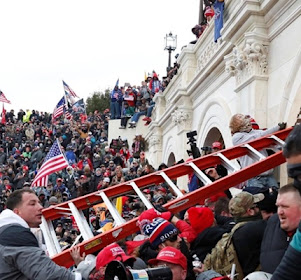
In the name of "law and order," Trump often threatened to enact the Insurrection Act during riots and protests after the murder of George Floyd and various police shootings of African Americans.


Yet, on January 6, 2021, “As commander in chief of the D.C. National Guard, it is clear that Trump and his administration could have authorized its deployment –– that is, if they actually interpreted the riot to be a threat to law and order.”


[Public hearings of the U.S. Congress’s J6 Select Committee could begin in April or May 2022, and the committee announced it intends to release an interim report in June.]

This is another worthwhile book by a gifted woman writer and yet another recommended read for Women’s History Month. General Milley would no doubt appreciate the wisdom Allan shares.


Top Photo: Army Gen. Mark A. Milley (chairman of the Joint Chiefs of Staff), then-Army Chief of Staff in 2016. (Sgt. 1st Class Jim Greenhill)

Sunday, December 31, 2017

'Madison's Music: On Reading the First Amendment'

Review by Bill Doughty

CNO Adm. John Richardson recommends works that are the foundation of American Government in his "Canon" of professional reading. Chief among the recommendations is the United States Constitution, which military service members swear to defend.

The First Amendment to the Constitution in the Bill of Rights is a mere 45 words, focusing on key freedoms worth defending.

In "Madison's Music" (The New Press, 2015) author Burt Neuborne argues that the words are meant to be read as a poem that creates its own music. Far from that being an abstract exercise, however, Neuborne gives practical reasons and logical ways to find the music. He uses examples from James Madison's own writings and other founders' insights. And he presents historical and legal examples.

U.S. Navy participation in Normandy landing June 6, 1944 (Watercolor, Dwight C. Shepler, NHHC)
But before he begins his exploration, the author does a most poignant and personal tribute dedication to his Navy veteran father, "Odysseus the Tailor":
Odysseus the Tailor's real name was Sam. A gentle, unassuming man who stood all of five five, my father was one of a dozen U.S. Navy frogmen dropped into the English Channel several hours before the Normandy invasion in 1944, with instructions to attach explosives to a wall of underwater steel spikes designed to tear the bottoms out of Allied landing craft. Once the explosives were in place, Pop and his buddies swam to the beach and crouched in the surf until the invasion boats neared the French coast. Then they blew a hole in the steel wall, opening a bloody path to the liberation of Europe. After D-Day, Pop was assigned to “Patton's Navy,” a small combat unit supporting amphibious crossings of French rivers during the Third Army's push toward Paris. From our kitchen in the Greenpoint section of Brooklyn, my mother and I anxiously plotted Odysseus's progress across Europe. My job was to keep Pop up-to-date on his beloved New York Giants. Each letter from me contained baseball box scores laboriously clipped from the Brooklyn Eagle. Pop's heavily censored replies promised a glorious future when we would see a baseball game together at the Polo Grounds.When Odysseus the Tailor finally came home in the summer of 1946, I oiled my baseball glove and waited for the great day. July passed into August – but no baseball. Pop reopened his tailor shop, and we sat comfortably in the warm sunlight while silver needles danced in his thimbled fingers – but no baseball. School began after Labor – but no baseball. Finally, in mid-September, I broke down at dinner. “What have I done,” I wailed, “that we can't go to a Giants game.” My father, who had forgotten his wartime promise, was stricken. He hugged me. “I love you, Butchie,” he whispered. “But we can't go to a Giants game yet ...They still don't let black people play, and we just don't support things like that.”Instead, we took the ferry across the Hudson River to see the world champion Newark Eagles play a Negro League game at Ruppert Stadium. I don't remember much about the game, other than the beautifully dressed, multiracial crowd, the noise, the sunlight, and the joy of being my father's son.– Farewell, Odysseus of the silver needles. This book is for you.
In "Madison's Music" Neuborne expresses his reverence for the Bill of Rights: "No documents in the history of self-government prefigures such a carefully drawn, chronologically organized blueprint of democracy in action." 

Looking at a blueprint for a house, we have to imagine not just the building but also the home to be brought to life. The "enduring text" of "Jefferson's lieutenant" Madison needs to be read as "a great poem about freedom and democracy," Neuborne says. "The unique beauty of great poetry is found in the text itself, in the imagery, emotions, and meaning produced by the order, cadence, structure and content of the words."
"Congress shall make no law respecting an establishment of religion, or prohibiting the free exercise thereof; or abridging the freedom of speech, or of the press; or the right of the people peaceably to assemble, and to petition the government for a redress of grievances."
With understanding and mutual respect (and the wisdom to see the poetry and hear the music) "the apparent paradox resolves into structural harmony," Neuborne writes.

This book is filled with enigmas and paradoxes. What's the case for military and prison chaplains but against prayer in public schools or legislatures? How can "fear and emotion erode the protections in the Constitution" in times of crises? How do gerrymandering, voter suppression and excessive money in politics threaten democracy? What's the true story behind "Marbury vs. Madison"? What did Putin do with the Russian Orthodox Church to ensure religion was an arm of his government? How is false speech (especially by people in power) corrosive to dignity, freedom and democracy?

Mao and Pol Pot and Hitler and Stalin and ISIS "leaders" didn't hear the music or read the "poem" about freedoms of religion, speech, and the press, including the rights to assemble and petition the government. Authoritarian dictators abhor literary or artistic innovation and free expression.

"Would-be tyrants have always understood that control over speech about the full range of human experience – not just politics – is crucial to the maintenance of authoritarian rule," Neuborne writes.

Burt Neuborne
The CNO's Canon features this quote from President Harry S. Truman: "Not all readers are leaders, but all leaders are readers!" Perhaps Truman would want to amend the quote in 2017 and 2018 with an adjective in front of "leaders," like "good" or "worthy" or "thoughtful."
"(Madison) knew that the habits of thought that enable free people to govern themselves justly and well – respect for others, skepticism about absolutes, toleration of disagreement, and openness to change – cannot thrive without a steady flow of unfiltered information, ideas, and opinions about art, philosophy, literature, science, technology, history, ethics, economics, psychology, sociology, sex, leisure, and business."
Professor Neuborne credits the late Supreme Court Justice Antonin Scalia for inspiring and challenging him. He builds his argument on a "great literary poem" by Wallace Stevens called "The House Was Quiet and the World Was Calm" about the joy of reading.

Kurt Vonnegut
In 1984 Kurt Vonnegut's essay "The Most Censored Writer of His Time Defends the First Amendment" the venerated author of "Slaughterhouse Five" captures and riffs on the music of the First Amendment. The essay, a nod to Thomas Jefferson and the other founders, as well as George Orwell and Mark Twain, is published in Vonnegut's collection "If This Isn't Nice, What Is?" (Seven Stories Press, 2016).
"Our founding fathers never promised us that this would be a painless form of Government, that adhering to the Bill of Rights would invariably be delightful. Nor are Americans proud of avoiding pain at all costs. On patriotic holidays, in fact, we boast of how much pain Americans have stood in order to protect their freedoms – draped over barbed wire, drowning in water-filled shell holes, and so on."  So it is not too much to ask of Americans that they not be censors, that they run the risk of being deeply wounded by ideas so that we may all be free. If we are wounded by an ugly idea, we must count it as part of the cost of freedom and, like American heroes in the days gone by, bravely carry on."
Vonnegut was an Army veteran who, like Neuborne's Navy veteran father, Sam "Odysseus the Tailor," fought in Europe against Nazi Germany in the Second World War.

Monday, February 20, 2012

War of 1812: USS Constitution and Freedom

by Bill Doughty
Just as slavery would become the defining reason for the Civil War by mid-19th Century, impressment was the match-to-the-fuse to the War of 1812.
HMS Guerriere's masts go over the side as Constitution
rakes her from ahead. Painting by Anton Otto Fischer.
“Impressment” describes the practice by the British Navy in the 1700s and 1800s of capturing suspected deserters -- even boarding and seizing American ships and confiscating property to do so.
The violation of freedom and sovereignty angered President Thomas Jefferson at the turn of the century and became an explosive issue for President James Madison in his first term starting in 1809.  Impressment and embargoing by Britain led to the United States Congress to declare war “in defense of freedom of the seas and sailors’ rights,” according to Charles E. Bodine Jr., Michael J. Crawford and Christine F. Hughes.
The authors explain how the War of 1812 became necessary, was fought and is remembered -- with USS Constitution as a centerpiece -- in Interpreting Old Ironsides.
"Confirming America’s political and economic independence dominated the new republic’s foreign relations during the first twenty-five years of its existence.  Fear that Britain’s maritime policies robbed the United States of its honor and relegated it to a colonial status convinced the Madison administration that war was the only alternative... While war came reluctantly to both sides, once engaged, they both anticipated a quick resolution -- the United States expected the British to come to terms quickly and the latter predicted a swift military victory.  Both parties underestimated the other’s resolve.  A combination of economic and military circumstances, in tandem with some astute American diplomacy, brought the war to an end."
Interpreting Old Ironsides, An Illustrated Guide to USS Constitution is published by the Naval Historical Center, with a forward by former director of the center Rear Adm. Paul E. Tobin Jr.
The book is designed as a tool, according Tobin, a training guide in three parts -- basic, advanced and master -- for understanding the “national icon.”  USS Constitution is described from blueprint to warship to symbol of diplomacy and freedom, the heart of OPSAIL cruises.
In the Basic section the authors show in great detail the armaments, strategies and discipline aboard Old Ironsides.
The Advanced Level presents the key history and context of the Barbary Wars, Preble’s Boys, and a short history of the War of 1812.
It’s in Part III, the Master Level, that the book explores the diplomatic and political nuances of the War of 1812 and its aftermath.
Part IV provides reprints of actual logbook entries from USS Constitution in 1812, a journal extract from Commodore William Bainbridge, letters to the Secretary of the Navy, a chronology of Constitution in the War of 1812, and U.S. Navy Regulations from 1814, among other fascinating artifacts.
As an illustrated guide, the book offers photos, drawings and diagrams to give a comprehensive look at Old Ironsides.  This authors provide a good balance of the “who, what, when, where and why,” of USS Constitution’s past in the context of “how” -- illuminating the causes of a war that helped the United States win freedom of the seas 200 years ago.

USS Constitution conducts an underway demonstration in Boston Harbor Sept. 16, 2011.  Photo by MC2 Kathryn E. Macdonald.