Showing posts sorted by relevance for query canon. Sort by date Show all posts

Saturday, April 15, 2017

Reading Deeper with CNO

By Bill Doughty

Chief of Naval Operations Adm. John Richardson's reading list is online, and it offers an opportunity to dive deep into a sea of history, heritage, strategic thinking and practical advice for sailors and civilians interested in seapower and national defense.

Published several weeks ago and maintained by the Naval War College, the list includes about 150 titles for the revived Navy Professional Reading Program and includes a core "Canon" of books that provide thought-provoking insights for leaders and communicators.

Titles in The Canon include: Handel's "Masters of War," Hart's "Strategy," Madison's "The Constitution," Jefferson's "The Declaration of Independence," Sun Tzu's "Art of War," and Richardson's "Navy Leader Development Framework," among others. "Framework" includes a great quote from President John F. Kennedy: "Learning and leadership are indispensable to each other." Read to lead.
Chief of Naval Operations Adm. John Richardson.

Last year in Proceedings magazine, Richardson promised this updated reading list. And he has delivered on that promise.


"Reading can teach us the fundamentals of our business. Thucydides, Clausewitz, Mahan, Corbett . . . these masters wrote works of the highest quality that have stood the test of time. As the challenges the naval service faces have multiplied, knowledge required to meet those challenges has also grown. This means that I cannot possibly dictate a comprehensive list of 'the' books to read. Still, I will soon share with you what I consider to be a canon of classic works. I am also thinking of ways I can highlight other books that I have found interesting because they helped me to think through a problem or see things differently. I will make it easy to obtain these books through an e-book program that can be easily accessed through your personal electronic devices. Finally, I will open up a way for all of us to talk about what we are reading."


The CNO outlined his plans in that article, written with Lt. Ashley O'Keefe, which resonates in his Design for Maritime Superiority. Richardson notes that warfare requires sharp thinking and the ability to adapt.
 
FN Matt Baumgardt reads aboard the aircraft carrier USS Dwight D. Eisenhower (CVN 69)
last April.  (Photo by MC3 Taylor Jackson)
"Usually, the team that can think better and adapt faster will win. Today, as we prepare for operations and war with an increasingly complex set of potential adversaries, we must do more to sharpen our thinking, learn the lessons from history, and expand our minds. The margins of victory will be razor-thin—we cannot be complacent. What we do in peace will be decisive in war."
"I want to revitalize the intellectual debate in our Navy. We all—officers, enlisted, and civilians—need to develop sound and long-term habits for reading and writing during the entire course of our careers. We must challenge our own assumptions, be informed by the facts, and be aware of the current context. We must commit to self-improvement, through formal schools and courses, and especially through self-education. I strongly encourage you to read, think, and write about our naval profession. Our Navy benefits from a vigorous intellectual debate."

Lt. j.g. Shelby Naughton of USNS Mercy (T-AH 19), reads a book to a Timorese child 
during Pacific Partnership 2016. (Photo by MC3 Trevor Kohlrus)
The 150 titles in the new Navy Professional Reading Program are categorized in The Canon, Core Attributes, Naval Power, Fast Learning, Navy Team and Partnerships and include authors such as Kaplan, Stavridis, Winchester, Toll, Daughn, Hornfischer, Morison, Carlson, Singer, Leavitt and Gladwell. One criticism of the choices offered so far: a dearth of women authors. 

But the commitment to provide e-book availability is noteworthy. And for the first time we see movies, series and documentaries recommended, including "Saving Private Ryan," "Band of Brothers," "Zulu," "Black Hawk Down," "John Adams," "Lawrence of Arabia," and "Eye in the Sky," which stars Helen Mirren: "Col. Katherine Powell, a military officer in command of an operation to capture terrorists in Kenya, sees her mission escalate when a girl enters the kill zone triggering an international dispute over the implications of modern warfare."
CNO Richardson values reading professional journals as well as books. And he encourages online discourse.
CNO Adm. Richardson speaks with Sailors in Pearl Harbor in 2015.
(Photo by MC2 Jeff Troutman)
"...more recently, online blogs, have hosted professional conversations. Thoughtful, well-researched articles can offer useful insights and, when needed, can help us change our minds," he writes – as he encourages his sailors to write.

"As reading leads to broader thinking, writing leads to clearer thinking. If you have not written much, I urge you to get started. A sharp pen reflects a sharp mind. But writing is not for the weak. The writer must form and then expose his or her ideas to public scrutiny. That takes confidence. But an argument properly conceived and defended can be of great value to our profession."

"It is not my purpose to offer writing lessons," Richardson says, "but in my experience, simple is better. Avoid acronyms or code. Be clear and concise. Keep in mind Mark Twain’s warning, 'The more you explain it, the more I don’t understand it.'”

He also recommends Zinsser's "On Writing Well," a Navy Reads favorite and a book recommended by former Chief of Navy Information Rear Adm. (ret.) John Kirby.

So, dive deep into reading and writing.

And in our humble opinion, books offer the deepest dives into insight and wisdom.
"No matter how busy you may think you are, you must find time for reading, or surrender yourself to self-chosen ignorance." – Confucius
Bill Dawson, the last surviving member of the first Naval Combat Demolition Unit (NCDU) shows CNO Adm. John Richardson a copy of "Before they were SEALs they were Frogs" during Navy appreciation night at Nationals Park last May. Photo by MC1 Nathan Laird.

Friday, July 13, 2018

Conversation III: CNO, Drones & Beer w/ Mahan

Interview by Bill Doughty

Professor John Jackson, creator of the Navy Professional Reading Program
He's the originator of the Navy's Professional Reading Program (NPRP, or CNO PRP), and this is our third interview. In this "conversation with the creator III" Naval War College Professor John Jackson, an expert in robotics and unmanned systems, provides insights into how the CNO's reading program, now 12 years old, has evolved over the years. Our interview begins with how the NPRP was personally reinvigorated by Chief of Naval Operations Adm. John Richardson. Like Navy Reads, Jackson aims to support reading and critical thinking.

Q. What was CNO ADM Richardson's contribution to the latest incarnation of the NPRP?

Adm. Richardson has been very “hands-on” in shaping his Professional Reading Program. In fact, we met with him prior to his assumption of the CNO job so we could get a head-start in ensuring that his program met his expectations. He has personally selected the books on the various lists and sub-lists, and has updated them about every six-months. He is a “true-believer” in the value of reading as a primary tool to improve the professionalism of our force. 

Adm. John Richardson, Chief of Naval Operations
Q. The Canon seems to be a foundation – and a good starting point – for Navy readers.

The Canon represents books with which every Sailor should be familiar. It was very difficult to limit the number of books in this category since Navy professionals work in such a wide variety of jobs and specialties. Choices were made that cut across all communities and provided a baseline valuable to everyone in Navy blue and gold.  

Q. The NPRP has evolved since it started under CNO Adm. Mike Mullen. What are some of the biggest changes you've seen in how it's organized and presented?

Our original list in 2006 was categorized by “skills” such as leadership and critical thinking, and was further divided into collections based on experience/rank. The “junior enlisted” collection focused on issues young Sailors would contend with, and the “senior leaders” collection focused more command and large organization issues. We have now evolved into a reading program that is “rank agnostic” and allows everyone to read any book they desire.   

MASN Trevor Miller browses the LiveSafe app on a smartphone. (MC2 Ricks)
Q. Speaking of changes, how has the audience changed? What are some of the ongoing challenges of reaching the digital generations who seem to be tied to their smart phones?

Because of the issues you raise, the CNO-PRP is now based on e-books and digital content. We no longer distribute hard-copy books. As an old guy who likes paper, I tend to read more in hard-copy, but the younger crowd of “digital natives” prefers to read on Kindles, Nooks, or other readers… or to squint and read them on their phones. We don’t care, as long as they are READING!

Fleet Adm. Nimitz and Gen. Eisenhower loved reading about history.
Q. Does reading develop better leadership skills?

I can think of no better way to improve a person’s leadership skills than to read about successful leaders from today and yesterday. It is often said that no one can live long enough to make all the mistakes, but rather should learn from others' experiences whenever possible. It has been said that “not all readers are leaders, but all leaders are readers”!

Q. How can reading and writing help develop better trained and ready Sailors?

Reading and writing demand concentration, much more so than watching a movie or a television program. Your brain must be fully engaged in translating the letters into words and the words into ideas. You can’t be a passive reader.  There are thousands of books on nearly every subject, so Sailors who want to be better at the profession should seek out the biographies and autobiographies of people who have succeeded on the paths they are beginning to walk.

Q. What are the best books right now in your specialty, the study of Unmanned Vehicle Systems?

P.W. Singer’s “Wired For War” is a bit dated, but is still a great source for understanding how we arrived at the place we are in the development and use of Unmanned Systems. “Killing Without Heart” by M. Shane Riza raises many thoughtful questions about what it means to fight a “robot war.” 

And there is a new book being published by the U.S. Naval Institute called “One Nation, Under Drones.” I am the editor, and 10 highly qualified chapter authors write at length about the world of “drones” as it exists today and how it will probably develop in the future. OK, so I plugged my own book! It will be out in December, and I know what everyone on MY Christmas list is getting!

Professor Sally Paine, USNWC
Q. Who are some good women writers you'd recommend?

Naval War College professor Sally Paine has written a number of top-quality books about Asian affairs and other subjects. "The Wars for Asia 1911–1949" (by S. C. M. Paine) is an award winner book that is highly regarded for its use of original source material in the native languages of the originators. 

Q. In May 2017 Navy Reads published a list of 50 books (for 50 years) about the Vietnam War. What are a few of your favorite titles about Vietnam?

Jim Webb’s novel “Fields of Fire” which describes in painful and searing details how U.S. marines faced the challenges of ground combat in the jungles of South East Asia, and “Two Souls Indivisible” by James S. Hirsch that tells the story of the friendship that saved two POWs in Vietnam. My close personal friend CDR Porter Halyburton, USN (ret), lectures annually at the Naval War College and shares the lessons he learned from his seven-and-a-half year ordeal in the prisons of North Vietnam. His inspiring recollections are full of faith, friendship and forgiveness.   

Q. If you could have lunch or a beer with any four or five historians (living or dead) who would be at the table? Why?

I have been blessed to be able to interact with a number of incredible historians, and have shared a meal or a drink with: 

1. David McCullough for his ability to capture the essences of historical events by mining the intimate details of the simple men and women involved. 

2. Craig Symonds, the author of 12 books and the editor of another 9, taught history at the U.S. Naval Academy for three decades and has been on the faculty of the Naval War College. His books (mostly on maritime subjects) are all considered classics. His book “The U.S. Navy: A Concise History” is THE source for understanding how our Navy grew into the incredible fighting force it is today. 

3. George Baer, whose book “100 Years of Seapower” is a classic in every sense. He helped shape thousands of young military officers during his long tenure at the Naval War College. 

…. And in addition to the remarkable men above, I would make special room for Winston Churchill and Alfred Thayer Mahan.   

Q. Adm. Richardson encourages writing as well as reading. For my money, Zinsser's "On Writing Well," is indispensable (a recommendation from Adm. Richardson and Rear Adm. (ret) John Kirby). What's your advice for writers? What should be in their toolbox?

The best way to become a good writer is to write as frequently as possible. You must exercise your “writer’s brain” and seek out other authors/writers and ask them to critique your work. You must have tough skin, since the comments could be harsh. But accept the criticism with the good intention with which it is provided…. write another draft….. “rinse and repeat.” 

Q. What do you see on the horizon? What's ahead for the Navy's Professional Reading Program?

The CNO-PRP will continue to provide digital access to books that matter. We will do all that we can to promote a reading culture within our Navy and help every Sailor become more effective as they labor in support of our great Navy and our treasured nation. I salute “Navy Reads” for doing a superb job of fanning the flames of learning through reading!

Professor John Jackson (right), program manager for the CNO-PRP, discusses reading with U.S. Navy Cmdr. Daniel Dolan and Rear Adm. Walter E. Carter Jr. (center), president of the Naval War College, in Newport, R.I., in Dec. 10, 2013. (Photo by MCC James E. Foehl)

Sunday, December 31, 2017

'Madison's Music: On Reading the First Amendment'

Review by Bill Doughty

CNO Adm. John Richardson recommends works that are the foundation of American Government in his "Canon" of professional reading. Chief among the recommendations is the United States Constitution, which military service members swear to defend.

The First Amendment to the Constitution in the Bill of Rights is a mere 45 words, focusing on key freedoms worth defending.

In "Madison's Music" (The New Press, 2015) author Burt Neuborne argues that the words are meant to be read as a poem that creates its own music. Far from that being an abstract exercise, however, Neuborne gives practical reasons and logical ways to find the music. He uses examples from James Madison's own writings and other founders' insights. And he presents historical and legal examples.

U.S. Navy participation in Normandy landing June 6, 1944 (Watercolor, Dwight C. Shepler, NHHC)
But before he begins his exploration, the author does a most poignant and personal tribute dedication to his Navy veteran father, "Odysseus the Tailor":
Odysseus the Tailor's real name was Sam. A gentle, unassuming man who stood all of five five, my father was one of a dozen U.S. Navy frogmen dropped into the English Channel several hours before the Normandy invasion in 1944, with instructions to attach explosives to a wall of underwater steel spikes designed to tear the bottoms out of Allied landing craft. Once the explosives were in place, Pop and his buddies swam to the beach and crouched in the surf until the invasion boats neared the French coast. Then they blew a hole in the steel wall, opening a bloody path to the liberation of Europe. After D-Day, Pop was assigned to “Patton's Navy,” a small combat unit supporting amphibious crossings of French rivers during the Third Army's push toward Paris. From our kitchen in the Greenpoint section of Brooklyn, my mother and I anxiously plotted Odysseus's progress across Europe. My job was to keep Pop up-to-date on his beloved New York Giants. Each letter from me contained baseball box scores laboriously clipped from the Brooklyn Eagle. Pop's heavily censored replies promised a glorious future when we would see a baseball game together at the Polo Grounds.When Odysseus the Tailor finally came home in the summer of 1946, I oiled my baseball glove and waited for the great day. July passed into August – but no baseball. Pop reopened his tailor shop, and we sat comfortably in the warm sunlight while silver needles danced in his thimbled fingers – but no baseball. School began after Labor – but no baseball. Finally, in mid-September, I broke down at dinner. “What have I done,” I wailed, “that we can't go to a Giants game.” My father, who had forgotten his wartime promise, was stricken. He hugged me. “I love you, Butchie,” he whispered. “But we can't go to a Giants game yet ...They still don't let black people play, and we just don't support things like that.”Instead, we took the ferry across the Hudson River to see the world champion Newark Eagles play a Negro League game at Ruppert Stadium. I don't remember much about the game, other than the beautifully dressed, multiracial crowd, the noise, the sunlight, and the joy of being my father's son.– Farewell, Odysseus of the silver needles. This book is for you.
In "Madison's Music" Neuborne expresses his reverence for the Bill of Rights: "No documents in the history of self-government prefigures such a carefully drawn, chronologically organized blueprint of democracy in action." 

Looking at a blueprint for a house, we have to imagine not just the building but also the home to be brought to life. The "enduring text" of "Jefferson's lieutenant" Madison needs to be read as "a great poem about freedom and democracy," Neuborne says. "The unique beauty of great poetry is found in the text itself, in the imagery, emotions, and meaning produced by the order, cadence, structure and content of the words."
"Congress shall make no law respecting an establishment of religion, or prohibiting the free exercise thereof; or abridging the freedom of speech, or of the press; or the right of the people peaceably to assemble, and to petition the government for a redress of grievances."
With understanding and mutual respect (and the wisdom to see the poetry and hear the music) "the apparent paradox resolves into structural harmony," Neuborne writes.

This book is filled with enigmas and paradoxes. What's the case for military and prison chaplains but against prayer in public schools or legislatures? How can "fear and emotion erode the protections in the Constitution" in times of crises? How do gerrymandering, voter suppression and excessive money in politics threaten democracy? What's the true story behind "Marbury vs. Madison"? What did Putin do with the Russian Orthodox Church to ensure religion was an arm of his government? How is false speech (especially by people in power) corrosive to dignity, freedom and democracy?

Mao and Pol Pot and Hitler and Stalin and ISIS "leaders" didn't hear the music or read the "poem" about freedoms of religion, speech, and the press, including the rights to assemble and petition the government. Authoritarian dictators abhor literary or artistic innovation and free expression.

"Would-be tyrants have always understood that control over speech about the full range of human experience – not just politics – is crucial to the maintenance of authoritarian rule," Neuborne writes.

Burt Neuborne
The CNO's Canon features this quote from President Harry S. Truman: "Not all readers are leaders, but all leaders are readers!" Perhaps Truman would want to amend the quote in 2017 and 2018 with an adjective in front of "leaders," like "good" or "worthy" or "thoughtful."
"(Madison) knew that the habits of thought that enable free people to govern themselves justly and well – respect for others, skepticism about absolutes, toleration of disagreement, and openness to change – cannot thrive without a steady flow of unfiltered information, ideas, and opinions about art, philosophy, literature, science, technology, history, ethics, economics, psychology, sociology, sex, leisure, and business."
Professor Neuborne credits the late Supreme Court Justice Antonin Scalia for inspiring and challenging him. He builds his argument on a "great literary poem" by Wallace Stevens called "The House Was Quiet and the World Was Calm" about the joy of reading.

Kurt Vonnegut
In 1984 Kurt Vonnegut's essay "The Most Censored Writer of His Time Defends the First Amendment" the venerated author of "Slaughterhouse Five" captures and riffs on the music of the First Amendment. The essay, a nod to Thomas Jefferson and the other founders, as well as George Orwell and Mark Twain, is published in Vonnegut's collection "If This Isn't Nice, What Is?" (Seven Stories Press, 2016).
"Our founding fathers never promised us that this would be a painless form of Government, that adhering to the Bill of Rights would invariably be delightful. Nor are Americans proud of avoiding pain at all costs. On patriotic holidays, in fact, we boast of how much pain Americans have stood in order to protect their freedoms – draped over barbed wire, drowning in water-filled shell holes, and so on."  So it is not too much to ask of Americans that they not be censors, that they run the risk of being deeply wounded by ideas so that we may all be free. If we are wounded by an ugly idea, we must count it as part of the cost of freedom and, like American heroes in the days gone by, bravely carry on."
Vonnegut was an Army veteran who, like Neuborne's Navy veteran father, Sam "Odysseus the Tailor," fought in Europe against Nazi Germany in the Second World War.

Friday, April 19, 2019

Bill Nye Wants Your Help


Review by Bill Doughty

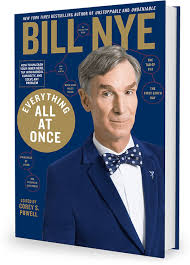
Nye reflects on the "overview effect" in his mind-opening "Everything All at Once," (Rodale, 2017). He offers a cool perspective on how we can help heal the world. That perspective comes from space, from inside the human psyche and the down-to-earth reality of the greatest threat facing our planet.

Nye is another critical thinker who calls for a Green New Deal for current and future generations: infrastructure and support for renewable energy, clean water and internet connectivity. Last month he formally endorsed the idea at SXSW.

"Everything All at Once" is a good Earth Day read with some strong Navy ties and with a fascinating insight on how his father survived as a prisoner of war in WWII.

Bill Nye's mom, Lt. Jacquie Jenkins, served in WWII.
In remarks at the Reason Rally in Washington D.C. in the late spring of 2016 he reminds us what the Second World War generation achieved:
"To those who think we can't get renewable sources in place quickly enough, I give you this response ... Both my parents were in World War II; their ashes are interred across the river from here (the Lincoln Memorial) in the Arlington National Cemetery. My father survived nearly 4 years as a prisoner of war captured from Wake Island. My mother was recruited by the U.S. Navy to work deciphering the Nazi Enigma code. They were part of what came to be called the Greatest Generation, but they didn't set out to be great. They just played the hand they were dealt. In barely 5 years, their generation resolved a global conflict and started building a new, democratic, technologically advancing world. With and emphatic sense of purpose, they embraced progress."The current generation must employ critical thinking and our powers of reason just as they did. This time, the global challenge is climate change. We also must play the hand we have been dealt and get on with it. Together we can change the world."
Self-described nerd, Bill Nye, also offers pun-ishing humor throughout, balancing irony and serious reality. He writes with a light yet respectful touch, open to other voices, always seeking to understand.

Nye shows the power of strong parents instilling core values, including honesty, courage and commitment. He notes, "there are such things as inviolable truth and facts."

His father, Ned Nye, and his dad's fellow prisoners witnessed a sailor "beheaded with a sword in a weird reenactment of a 17th-century Edo ceremony, just to show the prisoners that their captors meant business." 

How did the prisoners deal with physical and mental abuse? He writes, "Every day these guys were subjected to beatings. Every day they were hungry. Every day they were exhausted. In summer, they worked in oppressive heat. In winter, they were chilled to the bone." The prisoners created a fake language they called "Tut" to communicate privately. 

The prisoners found pleasure in recognizing and highlighting the absurdity of their situation, including the actions of a swaggering martinet in their own ranks who tried to impress them by "peppering his sentences with the term 'disirregardless.'" Being able to self-reflect, shift perspective and find humor in any situation helped is dad survive as a POW. The nonword "disirregardless" became an "essential distraction" and part of Nye family lore that lives on to this day for Bill and his sister. When a pompous leader takes himself too seriously and loses humanity he can become the butt of a joke.

But Nye says the threats to our climate are no joking matter.

As far back as the nation's first Earth Day, April 22, 1970, Nye was motivated. "I was convinced that we were headed for trouble as a species," he writes, "unless we could start using our brains more rationally, and it shaped how I approach my own environmental impact and goals for the future."

Bill Nye (The Science Guy) talks about the LC-130 with its navigator, Air Force Maj. Amanda Coonradt, during a visit to Antarctica. (Photo by Katie Lange)
Nye reflects on the global commons, the fact that Richard Nixon created the Environmental Protection Agency, Carl Sagan's warning of a "nuclear winter," the human impact to the planet as shown in Kentucky and Greenland, and the fact that carbon dioxide in the atmosphere moved beyond 400 parts per million in 2016.

He calls for shared action to address the dangers of global climate change. "To save the planet for us humans, we have to pay attention to our shared interests rather than stumble into chaos as unconnected, self-interested individuals. We have to harness both knowledge and responsibility," he advises.

"Everybody knows something you don't," he says. It's a profound and humbling concept. And it's a call for cooperation.

Finding answers in a collective consciousness, he says, helps us design practical solutions to face fear and confront challenges, including climate change.
"Instead of running around in circles, waving our arms – or, worse, going about our business in willful ignorance – we could get to work know. We could erect wind turbines off the east coast of the United States, Canada, and Mexico. We could install photovoltaic panels practically everywhere the Sun shines. We could heat and cool a lot of our dwellings, offices, and factories using geothermal sources. We'd create jobs, boost the economy, clean the air, and address climate change. If you really want to make America great (and the rest of the world, too), these are the main things you, I mean we, need to do. It sounds like an enormous undertaking, and it is, but we've seen again and again, the enormous ones begin with small perceptual shifts."
The blueprint for coming together to create and sustain a better world for children and grandchildren occurred in Europe and Asia/Pacific in the last century:
"World War II showed the terrifying possibility of global self-destruction; its aftermath inspired new institutions to promote constructive collaboration on a world-wide scale. Some of it appeared in the form of international treaties. Some of it appeared as networks of related science, technology, and environmental-research programs. The United Nations, despite its limits and shortcomings, provides a forum for international discussion and decision-making. Doctors Without Borders engages physicians from all over to provide medical services to those in need. The Convention on International Trade in Endangered Species (CITES) and Conservation International work to stop poaching and conserve threatened species. The Conference of Parties in Paris in 2015, known as COP21, produced the most meaningful international agreement yet on reducing greenhouse gases."
Even if progress is not linear or the horizon seems too far, "The longest journey begins with but a single step," Nye says.

How big a nerd is he? Bill Nye gets tied in knots in his excitement about knot-tying, and gives an interesting twist on the joys of physics. He speaks of the joys of the square knot, the square bow, two half-hitches, bowline, clove hitch and sheepshank, among others.

Bill Nye talks with 14-year-ole Joey Hudy about his Extreme Marshmallow Cannon at
a science fair held at the White House on Feb. 7, 2012 (NASA/Bill Ingalls)
This book is a treasure-trove for critical thinkers and nerds, with discussion on the scientific method, Occam's razor, entropy, anti-vaxxers, high school physics, electric vehicles, James Cameron, GMOs, the National Archives, and confirmation bias – "the tendency to confirm our our assumptions as valid and true."

Nye relates a wonderful story about a flight attendant and an unruly passenger; it's another call for shifting perspective and showing respect for one another. He reflects on what it was like working at Boeing, tells how he helped his parents quit smoking (using exploding cigarettes), writes about his grandfather fighting (on horseback) in the World War I, and challenges us to rediscover missions in space, including a possible journey to Europa and continued journeys to Mars.

Curiosity journeyed to Mars. Another more advanced rover is planned in the months ahead. (NASA)
With respect and awe, Nye writes about how the scientists at NASA created previous Mars rovers, especially Curiosity. NASA teams are working to send an "even more advanced rover, currently called Mars 2020. Both rovers are about the size and mass of a Chevrolet Spark automobile. So how are they going to do it?"
"If you have the naive confidence of a budding engineer, you might think, 'It can't be all that hard. We just have to slow down enough to roll or skid to a stop. We land airplanes all over the place every day. We landed all sorts of things on the Moon.. Surely we've got the basics of that figured out by now.' In other words, you'd start with the problem you know ... But it turns out that this business of setting down intact on the surface of Mars is some kinda crazy complicated. On Earth you have a lot of air to work with, and even the fastest fighter jets are dealing with much, much lower speeds. When the probe carrying the Curiosity rover approached Mars, it was moving at more than six times as fast as an F-35, with the throttle at the firewall – going all out. That's a lot of energy to dissipate."
Tackling problems starts with good design, ideals and values. That includes running a government. Nye shows reverence to the canon of our nation in the Declaration of Independence, Constitution, and Bill of Rights. Notably, these founding documents are in the Canon of the CNO's Professional Reading Program.

Our founders, he says, put us on a path toward a more perfect union. "Just as science doesn't claim to attain absolute truth, the Constitution does not claim to achieve the utopian ideal of government," Nye writes. "Fortunately, the founders embraced a never-ending search for better ideas and better solutions."

This review of "Everything All at Once" just scratches the surface of what is a fun, thoughtful and compelling read, especially for Earth Day. Highly recommended.


Bill Nye, left, executive director of The Planetary Society, and science educator, gets excited as the Chief of Naval Research Rear. Adm. Nevin Carr presents him with a powered by Naval Research pocket protector during the Navy Office of General Counsel Spring 2011 Conference. (Photo by John Williams)

Sunday, December 3, 2017

David McCullough Now & Then: Time to Take a Stand


Review by Bill Doughty

Rarely does a relatively thin and small book command so much respect. McCullough's "The American Spirit: Who We Are and What We Stand For" (2017, Simon & Schuster) is a collection of a sampling of the great historian's speeches from 1989 through 2016.

Naturally the speeches include topics like history, U.S. presidents, art, education and books. The central theme, however, is captured in the title. This is an inspirational book to read on the eve of the 76th anniversary of the attack on Pearl Harbor to help us reflect on the origins of American freedom and equality, ideals carried by Soldiers, Marines and Sailors who stood up to authoritarian nationalism and fascism in World War II: ideals reflected in the American spirit.

Thomas Jefferson
An essential read in this collection is the speech, "The Spirit of Jefferson," which McCullough gave in a naturalization ceremony at Monticello, Charlottesville, Virginia in 1994.

In 1776, the founders gathered together to stand up to authoritarian imperial control of King George and Great Britain. "To Jefferson," McCullough writes, "the Revolution was more than a struggle for independence; it was a struggle for democracy, and thus what he wrote was truly revolutionary. Why do some men reach for the stars and so many others never look up? Thomas Jefferson reached for the stars:"

"We hold these truths to be self-evident, that all men are created equal, that they are endowed by their Creator with certain unalienable Rights, that among these are Life, Liberty and the pursuit of Happiness. — That to secure these rights, Governments are instituted among Men, deriving their just powers from the consent of the governed..."

The Declaration of Independence, Articles of Confederation and the Constitution are included in the canon of reading published by Chief of Naval Operations Adm. John Richardson in the CNO's Navy Professional Reading Program, considered fundamental. 

These founding documents demand, establish and perpetuate equal dignity of human beings, separation of powers, freedom of the press (among others) and self-government by the people.

"Never, never anywhere, had there been a government instituted on the consent of the people," McCullough reminds us. 
"When he wrote the Declaration of Independence he was speaking to the world then, but speaking to us also across time. The ideas are transcendent, as is so much else that is bedrock to what we believe as a people, what we stand for, so many principles that have their origins here, with the mind and spirit of Thomas Jefferson. Sadly, too many today take for granted public schools, freedom of religion, freedom of speech, equality before the law, forgetting that these were ever novel and daring ideas."
David McCullough
McCullough isn't sure if Jefferson meant to include "women" when he used the term "men," as in "mankind" or "humans." And, could he have meant to include black people? Hopefully yes, but "practically, no," McCullough admits. Like the other founders, Jefferson was a product of his time – the 18th century. Like other humans, the founders were flawed when it came to living up to the ideals they espoused. But those ideas were to be realized later.

Abraham Lincoln, certainly one of our greatest presidents, called on Americans to honor Jefferson on the eve of the Civil War. Lincoln interpreted Jefferson's words in the Declaration to be "an abstract truth, applicable to all men and all times."

McCullough shares a poignant moment standing on the South Portico balcony of the White House, built there on orders of Truman after the Second World War, "in keeping, as he explained to a critical press, with Jefferson's designs for the University of Virginia." 

It should be noted that one of Truman's greatest achievements was issuing an executive order ending segregation and promoting integrating of the military, further realizing Jefferson's and Lincoln's ideals.
"On that evening, beside me, stood the highest ranking officer in the military services, General Colin Powell. We were looking across the Mall, past the Washington Monument to the Jefferson Memorial, which was just catching the last light of the day. It is his favorite of all the memorials in Washington, the general told me. Then, slowly and with feeling he recited the line – 'I have sworn upon the altar of God eternal hostility against every form of tyranny over the mind of man.'"
The Thomas Jefferson Memorial reflects its image on the Potomac River in Washington, D.C. in 2004. The memorial honors the Nation's 3rd President Thomas Jefferson, author of the Declaration of Independence. (U.S. Navy photo by Photographers Mate 2nd Class Daniel J. McLain)

McCullough says, "The Declaration of Independence was not a creation of the gods, but of living men, and, let us never forget, extremely brave men." By signing the Declaration of Independence that Jefferson wrote, the founders pledged "our lives, our fortunes, our sacred honor." They placed their lives and reputations on the line, McCullough notes. "It was their code of integrity, their code of leadership."

Other speeches focus on cities, colleges, historic preservation, the presidency, lessons of history, and books. Lots of books. We'll save that topic for another Navy Reads review, because McCullough offers so much to consider about reading and readers.

As for the American presidency, that topic also deserves its own blogpost. 

Sailors spell out "#USA" standing with the American flag on the flight deck of the aircraft carrier USS Theodore Roosevelt in the Arabian Gulf in 2015.
(U.S. Navy photo by Mass Communication Specialist 3rd Class Jackie Hart/Released)

Several times McCullough highlights the influence of the Navy, directly or indirectly, in how (former assistant Secretary of the Navy) President Theodore Roosevelt and World War II veteran President John F. Kennedy led the nation as commanders in chief. McCullough's speech, originally delivered in Dallas in 2013 on the 50th anniversary of Kennedy's assassination, features a huge amount of JFK's own thoughts and words from his inaugural address. This is another must-read chapter. Here are some of JFK's words:

"The goal of a peaceful world ... is our guide for the present and our vision for the future ... the quest is the greatest adventure of our century. We sometimes chafe at the burden of our obligations, the complexity of our decisions, the agony of our choices. But there is no comfort or security ... in evasion, no solution in abdications, no relief in irresponsibility."
"The problems of the world cannot possibly be solved by skeptics or cynics, whose horizons are limited by the obvious realities. We need men who can dream of things that never were, and ask why not?"

Kennedy "knew words matter," McCullough says. "His words changed lives. His words changed history Rarely has a commander-in-chief addressed the nation with such command of language."

McCullough concludes:
"Again and again John Kennedy's words are fired with his love of life, his love of his country and its history. He read history, he wrote history, and he understood that history is not just about times past, but also about those who populate the present, each new generation as he liked to say, and that we, too, will be judged by history ... He also knew from his reading and from experience that very little of consequence is ever accomplished alone, but by joint effort."
As a companion to this book, I borrowed the audio book from my public library and listened to it while driving to Pearl Harbor. It's uplifting to hear David McCullough's works in his own voice.  

Seventy-six years ago we were about to be drawn into a war against Imperial Japan and fascist Germany. Today both former enemies are free democracies and our strong allies, their governments based on Jeffersonian principles. McCullough reminds us of the spirit that unites Americans – who we are and what we stand for.

PEARL HARBOR (Nov. 29, 2017) A U.S. Navy Sailor aboard the aircraft carrier USS Nimitz (CVN 68), renders honors to the USS Arizona as the ship departs Joint Base Pearl Harbor-Hickam. The Nimitz Carrier Strike Group is on a regularly scheduled deployment to the Western Pacific. The U.S. Navy has patrolled the Indo-Asia-Pacific region routinely for more than 70 years promoting peace and security. (U.S. Navy photo by MC3 Cole Schroeder)

Saturday, January 15, 2011

Roots/Routes to Choose: ‘The Other Wes Moore’

Review by Bill Doughty
Considered by many as one of the best U.S. nonfiction books of the past year, The Other Wes Moore is a story of choice.  Two men share the same name and neighborhood, same options.  One chooses education, service and freedom; the other falls into drugs, violence and life in prison.
What gave author Wes Moore an awareness of his freedom of choice?
At least one answer: books.
Author Moore’s enjoyment of reading and study was ignited in high school by a book about sports, a book that led to other inspiring works.

Posted here, with the permission of the publisher:

My mother, sensing my apathy toward reading, had bought me the Mitch Albom book Fab Five.  The book is about the Michigan basketball team led by Chris Webber, Jalen Rose, and Juwan Howard, a team with five freshman starters who made it all the way to the national championship game.  The Fab Five sported baggy shorts, bald heads, and a swagger I recognized from the streets of the Bronx, all reflective of the way the hip-hop generation was changing the face of sports, and college basketball in particular.  I was riveted by that book.  The characters jumped off the page, and I felt myself as engulfed in their destiny as I was in my own.  I finished Fab Five in two days.  The book itself wasn’t what was important -- in retrospect, I see that it was a great read but hardly a work of great literature -- but my mother used it as a hook into a deeper lesson: that the written word isn’t necessarily a chore but can be a window into new worlds.
From there I leaped into every new book with fervor.  My fresh love of reading brought me to the transformational writers who have worked their magic on generations of readers.  I explored Spain with Paulo Coelho.  I listened to jazz on the North Shore of Long Island with F. Scott Fitzgerald.  I was reminded by Walt Whitman to think of the past, and I awaited “The Fire Next Time” with James Baldwin.  But there was a more recent author and public figure whose work spoke to the core of a new set of issues I was struggling with: the Bronx’s own Colin Powell.  His book, My American Journey, helped me harmonize my understanding of America’s history and my aspiration to serve in her uniform.  In his autobiography he talked about going to the Woolworth’s in Columbus, Georgia, and being able to shop but not eat there.  He talked about how black GIs during World War II had more freedoms when stationed in Germany than back in the country they fought for.  But he embraced the progress this nation made and the military’s role in helping that change to come about.  Colin Powell could have been justifiably angry, but he wasn’t.  He was thankful.  I read and reread one section in particular:  “The Army was living the democratic ideal ahead of the rest of America.  Beginning in the late fifties, less discrimination, a truer merit system, and leveler playing fields existed inside the gates of our military posts more than in any Southern city hall or Northern corporation.  The Army, therefore, made it easier for me to love my country, with all its flaws, and to serve her with all my heart.”

The canon of black autobiography sensibly includes scores of books about resistance to the American system.  For instance, reading The Autobiography of Malcolm X -- a book that begins and ends in the madness and pathology of America’s racial obsessions -- is a rite of passage for young black men.  Malcolm never stopped pursuing truth and the right course, based on the best information he had at any given moment.  His response to the world he confronted in the middle of the twentieth century was profound and deeply felt, but he didn’t speak to my experience as well as Colin Powell did.  Powell, in his pragmatic way, wanted what I wanted:  A fair shot.  A place to develop himself.  A code that would instill discipline, restrain passion, and order his steps.  A way to change the world without first unleashing the whirlwind.  In the chaos of the world I grew up in, those were as appealing to me as Malcolm’s cry for revolution was to his generation.  I don’t claim that Powell had it all figured out:  American history bedevils the most earnest attempts to make sense of it.  And, of course, the problems of race that Malcolm confronted have not disappeared by any means.  But Powell gave me another way to think about the American dilemma and, more than that, another way to think about my own life.
Excerpted from The Other Wes Moore by Wes Moore Copyright C 2010 by Wes Moore. Excerpted by permission of Random House Group, a division of Random House, Inc. All rights reserved. No part of this excerpt may be reproduced or reprinted without permission in writing from the publisher.

Wes Moore chose service in the U.S. military, became an Army paratrooper and served in combat in Afghanistan. He became a Rhodes Scholar like former President Bill Clinton and worked as a special assistant to Secretary of State Condoleeza Rice as a White House Fellow. The other Wes Moore portrayed in this book chose a different path toward hate, murder of a police officer in Philadelphia and a sentence of life in prison without possibility of parole.

Tavis Smiley endorses Moore’s book with a “call to action” following the epilogue:  “My call to action, our call to action, is this: read these words but, more important, absorb their meanings and create your own plan to act and leave a legacy.”

Smiley spotlights the central message of The Other Wes Moore: “The choices we make about the lives we live determine the kinds of legacies we leave.” 


This weekend Americans contemplate the legacy of Dr. Martin Luther King, Jr. and his commitment toward nonviolence, civility and justice for all. Here’s what King said in his Letter from Birmingham Jail in 1963:
Injustice anywhere is a threat to justice everywhere.  We are caught in an inescapable network of mutuality, tied in a single garment of destiny.  Whatever affects one directly, affects all indirectly.  -- MLK
As the world becomes even more connected and humanity more threatened with senseless acts of violence (as in Tucson last weekend), King’s observation provides inspiration and hope.  

So does The Other Wes Moore.