Showing posts sorted by relevance for query jefferson. Sort by date Show all posts

Saturday, September 20, 2014

Thomas Jefferson Calls for Submarines

by Bill Doughty
The third president of the United States was the first to expand into the American West, combat religious fundamentalism and terrorists abroad, and think about the future of naval warfare: using submarines and surface ships to provide defense of the States and forward-deploying forces for maritime security. He foresaw peace through global commerce between nations – globalization.

In "Thomas Jefferson: The Art of Power" Jon Meacham explores the complicated way Jefferson combined pure reason with muddy politics as Governor of Virginia, congressman, Secretary of State, President, diplomat in France, and as statesman and philosopher, always trying to achieve "the Founders' dream of a nation beyond partisanship."
Battle of Tripoli Harbor, Aug. 3, 1804
Facing bitter opposition, Jefferson called for naval power against a Muslim caliphate in the Barbary states (Morocco, Algiers, Tunis and Tripoli). Barbary pirates had harassed and kidnapped merchants and captured an American ship. Rather than paying ransom, Jefferson, in a letter to James Monroe, suggested a reasoned approach with hard consequences.

Jefferson wrote, "Would it not be better to offer them an equal treaty? If they refuse, why not go to war with them? ... We ought to begin a naval power, if we mean to carry on our own commerce. Can we begin it on a more honorable occasion or with a weaker foe?"
According to Meacham:
"On Saturday, August 1, 1801, Andrew Sterett of the Enterprize (Enterprise), who was serving under [Commodore Richard] Dale, defeated the Tripolitan vessel Tripoli near Malta. 'Too long ... have those barbarians been suffered to trample on the sacred faith of treaties, on the rights and laws of human nature,' Jefferson told Sterett. 'You have shown your countrymen that that enemy cannot meet bravery and skill united.'"
Meacham judges Jefferson as "more of a chess player than a traditional warrior."

"The Art of Power" is carefully researched and backed up with good source material on both sides of the Atlantic, including unpublished papers. Unfortunately there's not much more discussion about Jefferson's complicated views about developing a Navy. Meacham piques our interest in other writings by Jefferson. 
In a letter published in a collection by the Library of America, "Writings: Autobiography, Notes on the State of Virginia, Public and Private Papers, Addresses, Letters," and written in 1807, President Jefferson communicates his views about naval strategy with Robert Fulton, inventor of the steam engine. Jefferson discusses use and limitations of torpedoes (mines), which would be used extensively a few years later in the War of 1812, and half a century later in the Civil War by Cmdre. David Farragut in the Battle of New Orleans.

In his letter to Fulton, Jefferson calls for more commitment to developing and employing submarines. And he floats the idea of creating a corps of submariners.
"I consider your torpedoes as very valuable means of defence of harbors, & have no doubt that we should adopt them to a considerable degree. Not that I go the whole length (as I believe you do) of considering them as solely to be relied on ... But I have ever looked to the submarine boat as most to be depended on for attaching them [torpedoes], & tho' I see no mention of it in your letter, or your publications, I am in hopes it is not abandoned as impracticable. I should wish to see a corps of young men trained to this service. It would belong to the engineers if at land, but being nautical, I suppose we must have a corps of naval engineers, to practise & use them. I do not know whether we have authority to put any part of our existing naval establishment in a course of training, but it shall be the subject of a consultation with the Secretary of the Navy. Genl Dearborne has informed you of the urgency of our want of you at N Orleans for the locks there. I salute you with great respect & esteem."
Jefferson's views of the Navy seem to have evolved over time. Earlier writings in the 1780s questioned the need for a naval force to compete with European powers. (Eventually, though, especially in response to the Barbary threats, Jefferson understood the need for a strong means to back up peaceful intentions.)

In Query XXII of his "Notes on the State of Virginia" written in 1781-1782, Jefferson offers predictions that have been realized centuries later after wars against Britain, Japan and Germany – cooperative interaction with other nations:
"It should be our endeavour to cultivate the peace and friendship of every nation, even of that which has injured us most, when we shall have carried our point against her. Our interest will be to throw open the doors of commerce, and to knock off all its shackles, giving perfect freedom to all persons for the vent of whatever they may chuse to bring into our ports, and asking the same in theirs."
Jefferson's own words, found in separate collections, help expand revelations in Meacham's biography, which in words and impressive artwork shows many of the key people in Jefferson's life.
Jon Meacham
Meacham's work is personalizing. It focuses on many of Jefferson's relationships, including  with John Adams, Aaron Burr, George Washington, Alexander Hamilton, Sarah "Sally" Hemings, Thomas Paine and Patsy Jefferson Randolph. Meacham writes about Jefferson's friendships, loves and rivalries. Unlike other Founders, Thomas Jefferson did not succumb to bitterness. He took on a recalcitrant Congress and achieved his strategic goals.

The dustcover of Meacham's book proclaims:
"The father of the ideal of individual liberty, of the Louisiana Purchase, of the Lewis and Clark expedition, and the settling of the West, Jefferson recognized that the genius of humanity – and the genius of the new nation – lay in the possibility of progress, of discovering the undiscovered and seeking the unknown. From the Declaration of Independence to elegant dinners in Paris; from politics in Philadelphia and New York to the capital on the Potomac; from his complicated life at Monticello, his breathtaking house and plantation in Virginia, to the creation of the University of Virginia, Jefferson was central to the age."
Jefferson's passion and courage gave us the Declaration of Independence, Constitution and Bill of Rights. Some could say Jefferson's foresight and commitment to progressive development gave us the birth of maritime strategy. And one could even say his expansion of the American West – eventually through Colorado to Washington State – led directly to this weekend's NFL rematch between Peyton Manning of Denver and Russell Wilson of Seattle.

Sunday, December 3, 2017

David McCullough Now & Then: Time to Take a Stand


Review by Bill Doughty

Rarely does a relatively thin and small book command so much respect. McCullough's "The American Spirit: Who We Are and What We Stand For" (2017, Simon & Schuster) is a collection of a sampling of the great historian's speeches from 1989 through 2016.

Naturally the speeches include topics like history, U.S. presidents, art, education and books. The central theme, however, is captured in the title. This is an inspirational book to read on the eve of the 76th anniversary of the attack on Pearl Harbor to help us reflect on the origins of American freedom and equality, ideals carried by Soldiers, Marines and Sailors who stood up to authoritarian nationalism and fascism in World War II: ideals reflected in the American spirit.

Thomas Jefferson
An essential read in this collection is the speech, "The Spirit of Jefferson," which McCullough gave in a naturalization ceremony at Monticello, Charlottesville, Virginia in 1994.

In 1776, the founders gathered together to stand up to authoritarian imperial control of King George and Great Britain. "To Jefferson," McCullough writes, "the Revolution was more than a struggle for independence; it was a struggle for democracy, and thus what he wrote was truly revolutionary. Why do some men reach for the stars and so many others never look up? Thomas Jefferson reached for the stars:"

"We hold these truths to be self-evident, that all men are created equal, that they are endowed by their Creator with certain unalienable Rights, that among these are Life, Liberty and the pursuit of Happiness. — That to secure these rights, Governments are instituted among Men, deriving their just powers from the consent of the governed..."

The Declaration of Independence, Articles of Confederation and the Constitution are included in the canon of reading published by Chief of Naval Operations Adm. John Richardson in the CNO's Navy Professional Reading Program, considered fundamental. 

These founding documents demand, establish and perpetuate equal dignity of human beings, separation of powers, freedom of the press (among others) and self-government by the people.

"Never, never anywhere, had there been a government instituted on the consent of the people," McCullough reminds us. 
"When he wrote the Declaration of Independence he was speaking to the world then, but speaking to us also across time. The ideas are transcendent, as is so much else that is bedrock to what we believe as a people, what we stand for, so many principles that have their origins here, with the mind and spirit of Thomas Jefferson. Sadly, too many today take for granted public schools, freedom of religion, freedom of speech, equality before the law, forgetting that these were ever novel and daring ideas."
David McCullough
McCullough isn't sure if Jefferson meant to include "women" when he used the term "men," as in "mankind" or "humans." And, could he have meant to include black people? Hopefully yes, but "practically, no," McCullough admits. Like the other founders, Jefferson was a product of his time – the 18th century. Like other humans, the founders were flawed when it came to living up to the ideals they espoused. But those ideas were to be realized later.

Abraham Lincoln, certainly one of our greatest presidents, called on Americans to honor Jefferson on the eve of the Civil War. Lincoln interpreted Jefferson's words in the Declaration to be "an abstract truth, applicable to all men and all times."

McCullough shares a poignant moment standing on the South Portico balcony of the White House, built there on orders of Truman after the Second World War, "in keeping, as he explained to a critical press, with Jefferson's designs for the University of Virginia." 

It should be noted that one of Truman's greatest achievements was issuing an executive order ending segregation and promoting integrating of the military, further realizing Jefferson's and Lincoln's ideals.
"On that evening, beside me, stood the highest ranking officer in the military services, General Colin Powell. We were looking across the Mall, past the Washington Monument to the Jefferson Memorial, which was just catching the last light of the day. It is his favorite of all the memorials in Washington, the general told me. Then, slowly and with feeling he recited the line – 'I have sworn upon the altar of God eternal hostility against every form of tyranny over the mind of man.'"
The Thomas Jefferson Memorial reflects its image on the Potomac River in Washington, D.C. in 2004. The memorial honors the Nation's 3rd President Thomas Jefferson, author of the Declaration of Independence. (U.S. Navy photo by Photographers Mate 2nd Class Daniel J. McLain)

McCullough says, "The Declaration of Independence was not a creation of the gods, but of living men, and, let us never forget, extremely brave men." By signing the Declaration of Independence that Jefferson wrote, the founders pledged "our lives, our fortunes, our sacred honor." They placed their lives and reputations on the line, McCullough notes. "It was their code of integrity, their code of leadership."

Other speeches focus on cities, colleges, historic preservation, the presidency, lessons of history, and books. Lots of books. We'll save that topic for another Navy Reads review, because McCullough offers so much to consider about reading and readers.

As for the American presidency, that topic also deserves its own blogpost. 

Sailors spell out "#USA" standing with the American flag on the flight deck of the aircraft carrier USS Theodore Roosevelt in the Arabian Gulf in 2015.
(U.S. Navy photo by Mass Communication Specialist 3rd Class Jackie Hart/Released)

Several times McCullough highlights the influence of the Navy, directly or indirectly, in how (former assistant Secretary of the Navy) President Theodore Roosevelt and World War II veteran President John F. Kennedy led the nation as commanders in chief. McCullough's speech, originally delivered in Dallas in 2013 on the 50th anniversary of Kennedy's assassination, features a huge amount of JFK's own thoughts and words from his inaugural address. This is another must-read chapter. Here are some of JFK's words:

"The goal of a peaceful world ... is our guide for the present and our vision for the future ... the quest is the greatest adventure of our century. We sometimes chafe at the burden of our obligations, the complexity of our decisions, the agony of our choices. But there is no comfort or security ... in evasion, no solution in abdications, no relief in irresponsibility."
"The problems of the world cannot possibly be solved by skeptics or cynics, whose horizons are limited by the obvious realities. We need men who can dream of things that never were, and ask why not?"

Kennedy "knew words matter," McCullough says. "His words changed lives. His words changed history Rarely has a commander-in-chief addressed the nation with such command of language."

McCullough concludes:
"Again and again John Kennedy's words are fired with his love of life, his love of his country and its history. He read history, he wrote history, and he understood that history is not just about times past, but also about those who populate the present, each new generation as he liked to say, and that we, too, will be judged by history ... He also knew from his reading and from experience that very little of consequence is ever accomplished alone, but by joint effort."
As a companion to this book, I borrowed the audio book from my public library and listened to it while driving to Pearl Harbor. It's uplifting to hear David McCullough's works in his own voice.  

Seventy-six years ago we were about to be drawn into a war against Imperial Japan and fascist Germany. Today both former enemies are free democracies and our strong allies, their governments based on Jeffersonian principles. McCullough reminds us of the spirit that unites Americans – who we are and what we stand for.

PEARL HARBOR (Nov. 29, 2017) A U.S. Navy Sailor aboard the aircraft carrier USS Nimitz (CVN 68), renders honors to the USS Arizona as the ship departs Joint Base Pearl Harbor-Hickam. The Nimitz Carrier Strike Group is on a regularly scheduled deployment to the Western Pacific. The U.S. Navy has patrolled the Indo-Asia-Pacific region routinely for more than 70 years promoting peace and security. (U.S. Navy photo by MC3 Cole Schroeder)

Sunday, May 17, 2015

Jefferson, Monty Python, UCMJ and Magna Carta at 800

by Bill Doughty

Terry Jones of Monty Python narrates a really cool video synthesizing the history of Magna Carta on the occasion of its 800 year birthday this weekend and recognizing it as one of the cornerstones of democracy and human rights.


The animated video is part of a project sponsored by the British Library:

"Why was Magna Carta agreed at Runnymede in 1215? What did the document say, and how was it interpreted over the next 800 years? Why is it still important today, and how does it affect our culture, laws and rights?"

The ideas captured in the document crossed the Atlantic with colonists and immigrants searching for liberty and an escape from gross inequality.

Penn reprinted Magna Carta in 1687.
Magna Carta influenced growth of freedom in Philadelphia under William Penn in the century before the American Revolution. Penn, founder of Philadelphia ("City of Brotherly Love") was persecuted, even jailed, for freely expressing his religious beliefs as a Quaker. He stood for the belief, expressed in Magna Carta that the innate rights of people should not be infringed upon by the Church or State. Penn had the full text of Magna Carta reprinted in Philadelphia in 1687.

The U.S. National Archives offers an exhibit and series of programs this summer commemorating the 800th anniversary of Magna Carta.

From the Archives website: "During the American Revolution, Magna Carta served to inspire and justify action in liberty’s defense. The colonists believed they were entitled to the same rights as Englishmen, rights guaranteed in Magna Carta. They embedded those rights into the laws of their states and later into the Constitution and Bill of Rights."

Interestingly, Thomas Paine in his "Rights of Man" denounced Magna Carta for not going far enough, in that it was merely a bargain with the barons and other nobles and did not represent the interest of all people. Perhaps Paine's argument was influenced by his strong ties to France.

Nevertheless, Thomas Jefferson saw Magna Carta as a turning point in the history of human rights.

Thomas Jefferson
Jefferson, who as president was commander in chief during the Navy's victory in the the Barbary Wars, wrote a letter in 1814 referencing Magna Carta. It was the same year British troops burned the Library of Congress in the War of 1812 (Jefferson would donate 6,000 books from his personal library in response).
In Jefferson's letter to Dr. Thomas Cooper, dated Feb. 10, 1814, the statesman reminisces about "a time of life when I was bold in the pursuit of knowledge, never fearing to follow truth and reason to whatever results they had, and bearding every authority which stood in the way."

He reasons that Magna Carta, also spelled "Magna Charta," was significant in that it marked a turning point in history from common law to statute law.
"For we know that the common law is that system of law which was introduced by the Saxons on their settlement in England, and altered from time to time by proper legislative authority from that time to the date of Magna Charta, which terminates the period of the common law, or lex non scripta, and commences that of the statute law, or Lex Scripta. This settlement took place about the middle of the fifth century."
Jefferson's letter makes the case that American law and justice evolved from legislative authority based on fundamentals of human reasoning, rights and freedom.

In "Thomas Jefferson: A Life" author Willard Sterne Randall reveals that "whether he knew it or not (Jefferson) was descended, on his mother's side ... from one of the barons who signed the Magna Carta in 1215."

Magna Carta also influenced the thinking and philosophy of Mohandas Gandhi and therefore Dr. Martin Luther King, Jr.

King John is compelled to sign Magna Carta May 15, 1215.
2nd Lt. Allen Ernst, of 71st FTW Legal Office of Vance Air Force Base, Oklahoma, offers this perspective as to why the 800-year-old document is relevant to members of the armed forces as a keystone for Uniformed Code of Military Justice:

"The UCMJ governs all US military personnel around the world, from the chief of staff to the newest airman basic, and protects the rights of service members by laying out strict guidelines for the due process of military law," he writes. "For example, Article 7(e) prohibits confinement of individuals without probable cause, and Article 55 specifically prohibits cruel and unusual punishment."
According to Ernst, "The Magna Carta was a response to a problem. King John of England was abusing his supreme power, supposedly by divine right, acting selfishly at best and destructively at worst."

Navy JAGs visit Library of Congress Magna Carta exhibit Jan. 14, 2015. (Photo by Lt.j.g. Hood)
Lt.j.g. Colin Hood of the Region Legal Service Office Naval District Washington wrote in a post in March on DOD Navy Live U.S. Navy JAG Corps blog:

"Although the original charter was nullified by Pope Innocent III a few weeks after its distribution, language from the document would be recycled in subsequent royal charters and decrees. The interpretation and implementation of ideas expressed in the Magna Carta would eventually lead to the beginnings of several legal theories (the right to due process, the jury system, etc.) we depend on today."

Eventually, in 20th century, Magna Carta would even influence the United Nations' Universal Declaration of Human Rights.

In addition to the funny and informative Monty Pythonesque video, the British Library's comprehensive site offers a series of essays about Magna Carta, including more about how early American history was influenced by the landmark document.

(Special thanks to friend and colleague Brandon Bosworth for his suggestion to do a Navy Reads post on this topic. Check out Brandon's A Gent In Training blog. Mind-expanding reads.)

Monday, December 27, 2021

A Not-Burned Book Helped Create USA

Review by Bill Doughty––

Thomas Jefferson –– America’s first scientist/philosopher president –– reached for a book to hone his thinking about “the pursuit of happiness” in drafting the Declaration of Independence. The book was Titus Lucretius Carus’s “De rerum natura,” “On the Nature of Things” (c 60 BCE).

On his bookshelf Jefferson had five copies of Lucretius’s homage to Epicureanism, a philosophy promoting freedom from fear, including fear from death. The book focuses on enjoyment of life, especially based in reason and critical thinking.


It’s remarkable that copies of “On the Nature of Things” made it through the purge of book burnings in Europe during the Inquisition and Dark Ages and then made its way into Jefferson’s hands centuries later. Pulitzer Prize-winning author Stephen Greenblatt tells how the book, as well as its powerful messages, survived in “The Swerve: How the World Became Modern” (W. W. Norton & Company, 2011).


This is a book about courage. The courage to face fears to find –– and accept –– truth.


In that sense, it meets the criteria laid out by Chief of Naval Operations Adm. M. M. Gilday on the Navy’s Professional Reading Program website, “Read Well to Lead Well.” In order “to outthink our competitors, we must study and apply lessons we’ve learned from our past, Gilday says. It is critically important for our Navy to be a learning organization. And one of the very best ways to do that is to foster an environment where every Sailor deepens their level of understanding and learning.”


Deeper understanding comes, in part, through studying history. While “Swerve” will likely never be part of a CNO’s NPRP list, it certainly dovetails with some of the titles endorsed by Navy and Marine Corps leaders like Mullen, Mattis, Stavridis, and Richardson to enhance critical thinking. Chairman of the Joint Chiefs of Staff Gen. Mark Milley encourages reading books about history and philosophy and learning the perspectives of others.


In “Swerve,” Greenblatt explores the earliest Western seeds of critical thinking from Ancient Greece, how those seeds took root in the Roman Empire, and what it took to reap a harvest of knowledge centuries ago, eventually informing humanists like Thomas Jefferson, Benjamin Franklin, and John Adams. Epicurus was one of the seed planters.

Jefferson statue at U.S. State Department (Sgt. Amber I. Smith)
Jefferson considered Greek philosopher Epicurus his muse: “I am,” he wrote, “an Epicurean.” Roman Lucretius reached back to Epicurus and another philosopher, Democritus, for his inspiration too.

Lucretius’s “On the Nature of Things,” amazingly explores concepts of atoms, chaos theory, and natural selection –– all modern accepted theories of life, science, and laws of the universe. Epicurus and Democritus conceived that all matter was made of invisible, indestructible, and infinite particles. Those ancient Greek thinkers called the tiny particles “atoms.”


While the power of atoms can cause fear, understanding of atoms can be a joy, not just to nuclear engineers, but to anyone who wants the intellectual freedom of knowledge and wisdom. From Greenblatt’s “Swerve”:

“In constant motion, atoms collide with each other, Epicurus reasoned, and in certain circumstances, they form larger and larger bodies. The largest observable bodies –– the sun and the moon –– are made of atoms, just as are human beings and water-flies and grains of sand. There are no supercategories of matter; no hierarchy of elements. Heavenly bodies are not divine beings who shape our destiny for good or ill, nor do they move through the void under the guidance of gods: they are simply part of the natural order, enormous structures of atoms subject to the same principles of creation and destruction that govern everything that exists. And if the natural order is unimaginably vast and complex, it is nonetheless possible to understand something of its basic constitutive elements and its universal laws. Indeed, such understanding is one of human life’s deepest pleasures.

This pleasure is perhaps the key to comprehending the powerful impact of Epicurus’s philosophy: it was as if he unlocked for his followers an inexhaustible source of gratification hidden within Democritus’s atoms … And the enlightenment he offered did not require sustained scientific inquiry. You did not need a detailed grasp of the actual laws of the physical universe; you needed only to comprehend that there is a hidden natural explanation for everything that alarms or eludes you. That explanation will inevitably lead you back to atoms. If you can hold on to and repeat to yourself the simplest fact of existence –– atoms and void and nothing else –– your life will change. You will no longer fear Jove’s wrath, whenever you hear a peal of thunder, or suspect that someone has offended Apollo, whenever there is an outbreak of influenza. And you will be freed from a terrible affliction –– what Hamlet, many centuries later, described as ‘the dread of something after death,/The undiscovered country from whose bourn/No traveller returns.’”

Lucretius
Lucretius wrote “On the Nature of Things” in Latin hexameters. His poetry is rich with “verbal textures,” “subtle rhythms,” and “cunning precision and poignancy of its imagery,” according to Greenblatt, who takes us back not only to Greece and Rome, but also 15th century Germany and England. We meet characters like reformer priest Jan Hus, theologian Jerome of Prague, and Dominican friar Giordano Bruno. All three were burned at the stake for heresy against the Church.

Yet, despite people- and book-burnings, Lucretius’s enlightened work survived destruction. That was thanks to people like calligrapher Poggio Bracciolini, the fascinating hero of this story, who worked for a disgraced flamboyant pope who was eventually imprisoned. Poggio’s rescue of “On the Nature of Things” is fraught with intrigue in a time of great superstition, persecution, torture, and death to nonbelievers. That the book survived “is something one could be tempted to call a miracle.”


Botticelli's "Birth of Venus," inspired by Lucretius: "For you the ocean levels laugh, the sky is calmed and glows with diffused radiance."
“On the Nature of Things” and Lucretian love of beauty and pleasure inspired other great thinkers: Leonardo da Vinci, Francis Bacon, Galileo, Machiavelli, Shakespeare, and Einstein, among hundreds of artists during the Renaissance, including Botticelli.

Freedom in art and through reason became an antidote to a “toxic form of superstition, combining in equal measure absurd arrogance and absurd fear.”


Lucretius embraced science and cold reality of the laws of nature. He envisioned unexpected, unpredictable movement of atoms and codes within matter –– the “swerve.” We see in his philosophy, a garden of ideas about relativity, chaos theory, DNA, natural selection, and the punctuated equilibrium mechanism for evolution. His science wasn’t perfect, but it was perfectly forward-thinking for his time.

While the book and philosophies it describes are deeply rooted in Western thought, there are stunning similarities to Eastern thinking in Epicureanism and its contemporaneous philosophy Stoicism. According to Professor Richard Jenkyns, Epicureanism, “often caricatured as a religion of sensuous self-indulgence, is in reality rather austere.” Jenkyns wrote the introduction to the Penguin Classics “The Nature of Things” by Lucretius (translated by A.E. Stallings, 2007), “If you were looking for an analogy in modern spirituality, you might turn to Buddhism.”


Epicurus
At points in Western history, before and even after Epicurus and Lucretius, people generally believed the sun revolved around the earth, that the earth and sun would last forever, and that humans were given “dominion” over the earth and therefore had a right to plunder the planet and damage the environment.

“In a universe so constituted, Lucretius argued, there is no reason to think that the earth or its inhabitants occupy a central place, no reason to set humans apart from all other animals, no hope of bribing or appeasing the gods, no place for religious fanaticism, no call for ascetic self-denial, no justification for dreams of limitless power or perfect security, no rationale for wars of conquest or self-aggrandizement, no possibility of triumphing over nature, no escape from the constant making and unmaking and remaking of forms. On the other side of anger at those who either peddled false visions of security or incited irrational fears of death, Lucretius offered a feeling of liberation and the power to stare down what had once seemed so menacing. What human beings can and should do, he wrote, is to conquer their fears, accept the fact that they themselves and all the things they encounter are transitory, and embrace the beauty and pleasure of the world.”

In the current era of conspiracies, insurgencies, hubris, and questioning of norms and rules, there is great relevancy in the ancient insights of Epicurus and Lucretius: happiness over anger, pleasure over pain, love over hate.


Today “Epicurean” has come to identify a love of beauty and sensual pleasure in living and especially in food. U.S. Navy chefs and cooks have competed in Epicurean culinary competitions, for example.


Naval Hospital Bremerton's Culinary Specialist 2nd Class Anh Vu and Culinary Specialist 3rd Class Timothy Mitchell participate in the Battling Chef challenge in the Armed Forces Culinary Arts Competition, May 4, 2019, an epicurean event with culinary specialists from varied service branches showcasing their skills in such categories as desserts, garnish displays, chili, gumbo, wings, ribs, gourmet burgers, and a Battling Chef challenge to a panel of judges. (Douglas H Stutz)


Epicurus and Lucretius set the table, so to speak, for a harvest of new ideas that would lead to a Declaration of Independence and the phrase, “pursuit of happiness” as a right later to be guaranteed in the Constitution.


Jefferson, a dedicated botanist, saw the wisdom of Epicurean insights planted in Lucretius’s “On the Nature of Things” and how those liberating ideas could grow a living democracy –– a united republic –– and a government of “We the People.”


The Marine Corps Silent Drill Platoon marches in front of the Thomas Jefferson Memorial , April 12, 2014. (Sgt. Bryan Nygaard)

Of interest to SECNAVs and CNOs: Jefferson also imagined a global maritime strategy for the new nation. He envisioned the development of submarines. And he deployed the first American naval expeditionary force with both Sailors and Marines to fight terrorism overseas.

Jefferson’s ideas of nature –– one of his favorite words, and a word he frequently capitalized as Nature –– led eventually to emancipation and the expansion of civil rights. According to scholar Charles A. Miller in “Jefferson and Nature: An Interpretation” (Johns Hopkins University Press, 1988), “The natural rights doctrines of the antislavery movement sprang directly from the Declaration of Independence.”


Although Jefferson had his own personal ethics issues, especially about equality and slavery, he can be seen as a citizen of his time, where ideas of freedom often outran the realities of culture and society. Yet he helped create a country where Constitutionally guaranteed freedoms could grow; autocracy, authoritarianism and book-burning could be rejected; beauty can be appreciated and the “pursuit of happiness” could flourish.


(A post about "On the Nature of Things" –– "De rerum natura" –– follows this blogpost.

Friday, November 26, 2021

‘Undaunted’

Review by Bill Doughty––

Sometimes an old book can inspire a new understanding.


Stephen E. Ambrose’s “Undaunted Courage: Meriwether Lewis, Thomas Jefferson, and the Opening of the American West” (Simon & Schuster, 1996) has been sitting on my library shelf for more than 20 years. Ambrose is no McCullough, but he was passionate to the point of near obsession about this subject. I finally slogged through “Undaunted” over the summer because I wanted to learn more about the Lewis & Clark trail.


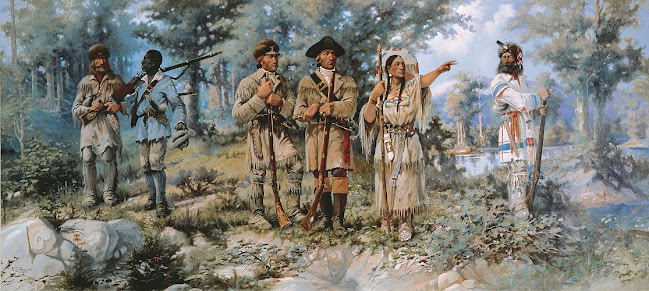
Written primarily as a biography of Lewis, “Undaunted Courage” also explores the age of empire in North America and European Americans’ encounters with indigenous peoples –– the actual descendants of discoverers of the continent. We meet the peaceful Mandans, humble Shoshone, helpful Nez Percé, wily Ciatsops, friendly Chinooks, and warlike Teton Sioux of the early 19th century. We meet 15-year-old pregnant Sacagawea, who provides lifesaving medicine, care, and guide skills to the mission. (The Sacagawea statue, right, at Cascade Locks, Columbia River Gorge, was created by artist Heather Söderberg in 2010.)

The mission itself was an unsuccessful attempt to find a water route across the continent. The Lewis & Clark team was an infantry company of the U.S. Army called the “Corps of Discovery.” Jefferson commissioned the expedition as the Louisiana Purchase came to light and efforts were made to fend off French and British claims. An objective was “to establish American sovereignty, peace, and a trading empire.”


This book comes with wonderful charts by A. Karl and J. Kemp showing the various routes the team took along the Missouri River, through what are now Iowa, Nebraska, the Dakotas, Montana, Idaho, Washington, and Oregon, all the way to the Pacific Ocean.

At the time, Virginia pointed toward the West, and St. Louis was the very edge of the American frontier in the early 1800s.


Trained in exploration, armed with mapping tools, and taught how to preserve specimens, Lewis discovered species of animals and plants previously unknown to Europeans. He received help from Clark and two dozen enlisted soldiers, from many civilians who lived among or traded with the Indians, and from hundreds of Indians themselves.

Jefferson was inspired to commission the expedition after reading a book by Alexander Mackenzie, a Scotsman who explored parts of the Pacific Northwest and called for a British claim to a Northwest Empire in 1793. Both Jefferson and Lewis were inspired by Capt. James Cook’s 1784 book, “A Voyage to the Pacific Ocean.” 


Ambrose paints a time of antiquity –– where slavery, patriarchy, and hardship were normal and accepted. Where time itself was measured in how long it took to travel by horse. No telephones. No engines. No antibiotics. No mosquito repellant. No sunglasses or sunscreen. No GPS.


How most of the members of the expedition managed to survive the arduous journey is a story of luck, grit, and resilience. And it’s a story of the abundance of the North American continent in the early 1800s. The expedition killed thousands of deer, buffalo, elk, beaver, and other wildlife. They gorged on salmon and, when necessary, ate horses and dogs.


Lacking humility but with an abundance of confidence, Lewis met with various tribes and tried to “coerce through commerce,” trading beads, tobacco, and tools for horses, information, and services. He promised the Indians their “father” in Washington would take care of them. He gave them American flags, certificates, and medals. He cajoled and threatened.


“Lewis did all this with the utmost seriousness,” Ambrose writes. “It never occurred to him that his actions might be characterized as patronizing, dictatorial, ridiculous, and highly dangerous.”

But, “Virtually all Indian parties proved resistant to change and suspicious of American motives.” Nevertheless, many tribes helped the expedition find food, trails, and water routes. Lewis and Clark astutely tried to identify the chiefs and deal directly with them. As with U.S. military leaders, the chiefs were often chosen from those who had proved themselves in combat.


Ambrose praises Lewis’s ability as a “near-perfect army officer” and a “great company commander, the greatest of all American explorers, and in the top rank of world explorers.”  The U.S. Navy has named several ships related to the expedition. Most notably, the current class of dry cargo replenishment ships is known as Lewis and Clark and includes the namesakes USNS Lewis and Clark (T-AKE 1) and USNS Sacagawea (T-AKE 2).


Airman Brandy Phillips, aviation boatswain's mate (fuels), stands watch in primary flight control aboard the multi-purpose amphibious assault ship USS Bataan during a vertical replenishment with the Military Sealift Command dry cargo and ammunition ship USNS Sacagawea in support of Operation Unified Response off the coast of Haiti after a 7.0 magnitude earthquake, Jan. 12, 2010. (CPO Tony Sisti)


Lewis’s journals were eventually published. His book inspired the great movement West and creation of the American Empire that Jefferson envisioned.


After his return, Lewis went to Philadelphia and went to parties and dinners with his best friend, Mahlon Dickerson, a lawyer who later served as governor of New Jersey, Senator from New Jersey, and Secretary of the Navy under President Andrew Jackson. Lewis, who showed signs of depression, became a heavy drinker and took opium at night.


Lewis, Clark, and Jefferson
Jefferson appointed Lewis governor of Louisiana, but Lewis was not good at politics. His depression got worse. Ambrose writes, “He was tortured” and “his pain was unbearable.” Ambrose describes a gruesome suicide.

Ambrose does not shy away from showing the shortcomings of Meriwether Lewis, William Clark, and Thomas Jefferson. All were privileged and dedicated slave owners who also took advantage of native Americans. They wanted to “civilize” and move the Indians out of the way so white settlers could move in a set up a fur trade and land trade. Lewis’s policies were, in Ambrose’s words, “nothing short of genocide.”


Sometimes an old book can inspire a new understanding. Today is Native American Heritage Day.


Sunday, August 14, 2011

To the Shores of Tripoli

Review by Bill Doughty
The War of 1812, in which the young U.S. Navy defeated the British Fleet, was preceded by a war against terrorists -- Barbary pirates and their sponsor states along the northern coast of Africa in and around what is now Libya.
To the Shores of Tripoli -- The Birth of the U.S. Navy and Marines by A.B.C. Whipple, is the account of the original United States war against Arab tyrants and introduces us to colorful characters such as President Thomas Jefferson, Commodore Edward Preble, Consul William Eaton, Marine Lieutenant Presley Neville O’Bannon and Navy Captain Stephen Decatur.
These main characters are revealed with all of their strengths and weaknesses in the context of political intrigue and, quite literally, personal battles.  The book describes two duels to the death.
Duels occurred frequently in the new U.S. Navy, whose officers were overzealous about rank and “honor.”  Two thirds as many naval officers were killed in duels as by enemy action in all U.S. naval engagements from 1798 until the Civil War.
The greater "duel," of course, was between freedom of the seas and piracy.  Credit is given to Thomas Jefferson for his commitment to end the tradition of paying tribute and ransom to pirates who preyed on American shipping, capturing and imprisoning sailors in the late 1700s and early 1800s.
Jefferson saw the dangers of trading arms for hostages.  He lobbied for more and better Navy ships.
Yet, Jefferson was criticized for not waging all out naval war on the pirates and their sponsors and for settling for peace treaties.
According to Whipple:
Such criticism overlooks both Jefferson’s determination to fight rather than pay off the Barbary powers, and the fact that it was Congress that denied his requests to declare war against them.
Naval hero Stephen Decatur fights pirates in Tripoli.
Still, President Jefferson was in office when the first major interaction of the Barbary War occurred 210 years ago this month -- Aug. 1, 1801 -- when Lt. Andrew Sterett led the sloop-of-war Enterprise against the 14-gun warship Tripoli, commanded by Adm. Rais Mahomet Rous, known for raiding American and other commercial shipping.
After Rous pretended surrender and then opened fire on the Enterprise twice, Sterett and his Marines, led by Lt. Enoch Lane, used precision firepower and seafaring prowess to utterly defeat the enemy -- 30 killed, 30 injured out of a crew of 80, with not even one injury to Sterett’s men.
In several examples, the author shows the power of discipline, training and readiness over laziness and political expediency.
The heart of Whipple’s book deals with several key events: the 500-mile march across the desert to Tripoli, a courageous attack on the fort at Derna, sea battles in the Mediterranean and gunboat assaults against pirates and tyrants.
Commodore Preble, mentor to a generation of heroes.
The author shows how the Navy and Marine Corps team developed and became stronger.
He also shows the importance of books in developing leaders.  Eaton was inspired after reading Plutarch’s Lives as a young man.  Preble, a mentor to a generation of U.S. naval heroes, whose flagship was USS Constitution, had more than 100 books in his cabin.

Today, USS Preble (DDG 88) is part of the USS Ronald Reagan (CVN 76) Carrier Strike Group.  Preble was one of the first U.S. Navy assets on the scene in Japan last March to provide rescue and relief support as part of Operation Tomodachi in the wake of the tragic earthquake and tsunami there.
After reading and enjoying Whipple’s To the Shores of Tripoli (written twenty years ago in 1991) I checked out Jefferson’s War by Joseph Wheelan (published in 2003), a book which examines the same period and, like Whipple’s work, is carefully researched and documented.
To comprehend the present and future, one should read to understand the past...