Showing posts sorted by relevance for query grace hopper computer. Sort by date Show all posts

Sunday, July 31, 2011

‘Amazing Grace’ Hopper’s 2011 Milestones

Review by Bill Doughty
If she didn’t invent the computer revolution in the United States, Rear Adm. Grace Murray Hopper gave it a voice – and a language in which to communicate.

“Amazing Grace” Hopper (1906-1992) played a pivotal role in developing COBOL (COmmon Business-Oriented Language) and creating FLOW-MATIC (the first data processing language to use English).
She promoted computer standardization for the Navy with the Air Force and eventually throughout DoD. A lifelong inventor who preached common sense, she considered herself a discoverer rather than an inventor, according to Kathleen Broome Williams, author of Grace Hopper – Admiral of the Cyber Sea, recommended by the Navy Professional Reading Program.
Always unconventional in her thinking, Hopper scorned the customary and traditional, was impatient with the status quo, and approached problem solving with instinctive innovation.
In 2011, and especially in August, there are some significant Grace Hopper milestones to remember:

Eighty years ago, 1931, Hopper began teaching at Vassar College.
Seventy years ago, 1941, she earned a faculty fellowship at Vassar. On Dec. 7, 1941, there were no women serving as commissioned officers in the Navy, but Hopper wanted to join the war effort. She became one of the early WAVES – Women Appointed for Voluntary Emergency Service – during WWII and began working at Harvard on the Mark I computer (which was formally dedicated Aug. 7, 1944). 
At the time, the few computers that existed in the world were the size of a room and were known as “computing machines.” The term “computer” was used for the women who operated the machines, entering data to generate calculations, according to Williams.
Sixty-five years ago, 1946, Hopper was promoted to lieutenant, recognized for her computer programming skills.
Sixty years ago, 1951, she began working on the world’s first compiler, completing it the following year. A compiler is a program or set of programs that transforms complex source code into a simpler code. Hopper’s invention or “discovery” was a fundamental contribution to the evolution of computing.
Grace Hopper helped develop COBOL.
In Grace Hopper – Admiral of the Cyber Sea, Williams takes us through “Amazing Grace’s” career. The author shows us that the biggest challenge Hopper faced was an established bureaucracy’s resistance to change, but many leaders in the Navy began to fully embrace the potential of computing between 1950 and 1960. In the 50s Hopper and her team developed some of the world’s first compiler-based languages for programming: ARITH-MATIC, MATH-MATIC and FLOW-MATIC; by the end of the decade she was playing a key leadership role in developing COBOL.
Fifty years ago, in August 1961, Hopper was promoted and appointed director of research in systems and programming for the Remington Road division of Sperry Rand.
Forty-five years ago, 1966, as Hopper was about to turn 60, then-Cmdr. Hopper received a letter from the Chief of Naval Personnel, asking her to apply for a resignation from the Navy due to her age and length of service. When she then retired, Hopper called it, “the saddest day of my life.”
But, on August 1, 1967, the Navy recalled her from the Reserves to active duty. The computer age was accelerating.
Thirty-five years ago, August 1976
Hopper, who wrote curriculum for the Navy’s “A” and “C” schools (basic and advanced training) and set up an operational analysis division for the Bureau of Naval Personnel, was now a recognized leader in computer science and the information technology revolution.
Forty years ago, in August 1971, 12,000 copies of Hopper’s manual, Fundamentals of COBOL, had been sold – 25 years after she’d worked on the Mark I.
Williams describes Hopper’s principal role working with the Air Force, Secretary of Defense and Government Services Administration to standardize computer language throughout federal agencies.
On August 2, 1973 Hopper was promoted to Captain.
She continued to be a teacher, mentor and recruiter for the Navy in the 70s and early-mid 80s.  Then, 25 years ago, on Aug. 14, 1986, Grace Hopper retired a second time, at the rank of Rear Admiral. Her retirement was held aboard USS Constitution in Boston Harbor. She was awarded the Defense Distinguished Service Medal.
Twenty years ago, on Sept. 16, 1991, Grace Hopper was awarded the National Medal of Technology, the highest honor of its type in the United States. (Steve Jobs and Bill Gates are other recipients of the medal, now known as the National Medal of Technology and Innovation.)  Williams reports what President George H. W. Bush said at the time, that it was Hopper who “pioneered the revolution that put personal computers on the desks of millions of Americans – and dragged even this president into the computer age.”
The voice of Navy’s computer revolution was silenced when Hopper passed away on New Year’s Day in 1992.
Fifteen years ago, during the summer of 1996, Sailors – men and women – began reporting aboard a new guided-missile destroyer bearing Hopper’s name. USS Hopper (DDG 70), “Amazing Grace,” was commissioned Sept. 6, 1997. The Arleigh Burke class destroyer,  homeported at Joint Base Pearl Harbor-Hickam, Hi, is equipped with state-of-the-art computerized systems.
Author Williams achieves both a history of the development of computing in the Navy and a look at the professional milestones of this dynamic woman whose voice continues to echo decades later.
On July 30, 2009 USS Hopper (DDG 70) launches a standard missile (SM) 3 Blk IA, successfully intercepting a sub-scale short range ballistic missile, launched from the Kauai Test Facility, Pacific Missile Range Facility (PMRF), Barking Sands, Kauai. (U.S. Navy photo)

Saturday, March 3, 2018

Women Who Changed the World

Review by Bill Doughty

"Throughout history many women have risked everything in the name of science. This book tells the stories of some of these scientists, from ancient Greece to the modern day, who in the face of 'No' said, 'Try and stop me.'"

With cool-weird drawings and sparkling insights, writer-illustrator Rachel Ignotofsky profiles some of the women who stand out in fields of Science, Technology, Engineering and Mathematics in "Women in Science: 50 Fearless Pioneers Who Changed the World" (Ten Speed Press, 2016).

Among the 50 women featured are Wang Zhenyi, Ada Lovelace, Karen Horney, Marie Curie, Marjory Stoneman Douglas, Rachel Carson, Katherine Johnson, Valentina Tereshkova, Jane Goodall, Maryam Mirzakhani, and Grace Hopper, "Navy admiral and computer scientist."
"Grace Hopper was ... a relentless trailblazer, recognized as the mother of computer programming," Ignotofsky writes. The author spices her profiles with one-liners like: "Invented the first compiler, forever changing how we use computers," "Her great-grandfather was also in the Navy," and "Pioneered the standards for testing computer systems."
Grace Hopper, born in 1906, was fourteen years old when women in the United States achieved the right to vote, a step toward greater equality for women. She earned a PhD in mathematics at Yale fourteen years after passage of the 19th Amendment. Hopper joined the Women Accepted for Volunteer Emergency Service (WAVES) in 1943, bringing her mathematics skills to the war effort.
"After the war, Grace joined the private sector. At the time, programmers needed the skills that came with an advanced degree in mathematics and used binary code to program. Grace Hopper thought it would be easier to just 'talk' to a computer in English. Everyone thought Grace was nuts, but she proved them wrong when she invented the first compiler. This led to create COBOL, the first universal computer language. Thanks to Grace just about anyone can learn to code! Grace returned to the Navy in 1967. Even after she retired as the oldest person on active duty (just a few months short of turning 80), she continued to lecture, consult, and teach – always reminding the world that 'the most damaging phrase in the language is 'we've always done it this way.'"
Along with the short biographies of the fifty featured women are a timeline, statistics in STEM, an illustrated list of lab tools and a glossary. While this book appeals to young readers it, like the works of Mary Roach and Hope Jahren, can inspire any readers to see how women have contributed to progress in the world.

The author's other books (this one was her first) include "I Love Science" and "Women in Sports."

Ignotofsky, who supports critical thinking and evidence-based decision-making exemplified in the "March for Science," writes in her conclusion:
"Women make up half of our population, and we simply cannot afford to ignore that brain power – the progress of humankind depends on our continual search for knowledge. The women in this book prove to the world that no matter your gender, your race, or your background, anyone can achieve great things. Their legacy lives on. Today, women all over the world are still risking everything to discover and explore."
Don't try to stop them.

Thursday, January 1, 2015

Innovators: Free Your Mind & The Rest Will Follow

Review by Bill Doughty

2015! Time to take a deep breath and consider the most important inventions affecting our lives: the computer and the Internet. Time to think of their creators: "pioneers, hackers, inventors, entrepreneurs," as Walter Isaacson calls them in his recent book "The Innovators: How a Group of Hackers, Geniuses, and Geeks Created the Digital Revolution."

Milestones revealed from a 2015 perspective (not meant to be all-inclusive):

  • 80 years ago, 1935 – Tommy Flowers pioneers use of vacuum tubes as on-off switches in circuits; two years later Alan Turing publishes "On Computable Numbers," and Howard Aiken proposes construction of a large digital computer. (Aiken, born in Hoboken, New Jersey, would later become a commander in the Naval Reserve.)
  • 70 years ago, 1945 – Six women programmers of ENIAC are sent to Aberdeen for training.The previous year Lt. Grace Hopper graduates first in her class from the Naval Reserve Midshipmen's School of Smith College in Massachusetts; in 1952 she develops the first computer compiler. The first microchip would be developed by the end of the 50s.
  • 50 years ago, 1965 – Ted Nelson publishes the first article about "hypertext" and Moore's Law predicts microchips will double in power every year or so.
  • 40 years ago, 1975 – Paul Allen and Bill Gates write BASIC for Altair and form Microsoft, while Steve Jobs and Steve Wozniak launch the Apple I.
    Steve Jobs unveils the Mac.
  • 35 years ago, 1980 – IBM commissions Microsoft to develop an operating system for the PC; four years later in 1984 Apple introduces the Macintosh.
  • Over the past 20 years – Larry Page and Sergey Brin launch Google (1998), Ev Williams launches Blogger (1999), Jimmy Wales with Larry Sanger launches Wikipedia (2001), and the world welcomes Facebook, Twitter and Flickr. 

Isaacson presents the history of digital innovation and, critically, analyzes how success was achieved through teamwork of creative collaborators. "The tale of their teamwork is important because we don't often focus on how central that skill is to innovation."

"The Innovators" starts with a timeline of milestones, includes short biographies of key characters and walks us through the development of the computer, programming, the microchip, video games, the Internet, the personal computer, software, and online ultimate connectivity.

Questions he attempts to answer:
"What ingredients produced their creative leaps? What skills proved most useful? How did they lead and collaborate? Why did some succeed and others fail? ... I also explore the social and cultural forces that provide the atmosphere for innovation. For the birth of the digital age, this included a research ecosystem that was nurtured by government spending and managed by a  military-industrial-academic collaboration. Intersecting with that was a loose alliance of community organizers, communal-minded hippies, do-it-yourself hobbyists, and homebrew hackers, most of whom were suspicious of centralized authority."
Lady Ada conceived of the computer.
Just over 170 years ago Ada, Countess of Lovelace (poet Lord Byron's daughter), collaborated with mathematician and philosopher Charles Babbage and published "Notes" to describe the concept for an Analytic Engine – a machine matched with the ability to process numbers and any information that could be expressed in symbols to produce calculations and solve problems. "In other words, she envisioned the modern computer." She is admired today as an early champion of Science, Technology, Engineering and Mathematics (STEM).

Women continued to contribute to the development of the digital age, particularly in the area of programming and language – from ENIAC at the University of Pennsylvania to Mach I at Harvard near the end of World War II, where Grace Hopper came into her own. Hopper developed the world's first working compiler, Isaacson notes, which translated mathematical code into machine language accessible to human users.

President Reagan meets then Capt. Grace Hopper in 1983.
She was the ultimate free-thinking team player.
"Like a salty crew member, Hopper valued an all-hands-on-deck style of collaboration, and she helped develop the open-source method of innovation by sending out her initial versions of the compiler to her friends and acquaintances in the programming world and asking them to make improvements. She used the same open development process when she served as the technical lead in coordinating the creation of COBOL, the first cross-platform standardized business language for computers. Her instinct that programming should be machine-independent was a reflection of her preference for collegiality; even machines, she felt, should work well together. It also showed her early understanding of a defining fact of the computer age: that hardware would become commoditized and that programming would be where the true value resided. Until Bill Gates came along, it was an insight that eluded most of the men."
Hopper eventually became a commodore (rear admiral). Her namesake, USS Hopper (DDG 70), is homeported at Joint Base Pearl Harbor-Hickam. 

Among Isaacson's other conclusions:

  • The importance of not just peer collaboration but also intergenerational collaboration.
  • Aristotle was right that humans are social animals.
  • Collaboration leads to a forged partnership or symbiosis between people and machines.
  • The Digital Revolution wrested control of information from central authority only and put it in the hands of individuals at the speed of light. (Free your mind and the rest will follow.)  It's no wonder totalitarian states and ideologies want to control the Web.
  • It's important to pair visionaries who come up with the strategic ideas with operating managers who can execute them tactically.
  • Foresight: "The best innovators were those who understood the trajectory of technological change and took the baton from innovators who preceded them."
  • Success came about through a balance in government, market, and peer sharing, where no leg of the stool is  too long.
  • "Finally, I was struck by how the truest creativity of the digital age came from those who were able to connect the arts and sciences." Think Leonardo da Vinci and Vitruvian Man, pictured below.

Isaacson, who authored "Steve Jobs," "Einstein: His LIfe and Universe," "Benjamin Franklin: An American Life," and "Kissinger: A Biography," as well as other works, employs his usual detailed research, carefully selected anecdotes and remarkable insights to create this book.

Most of the profiles feature the men who achieved key milestones in the digital age. But it's noteworthy that "The Innovators" begins and ends with a focus on women, including those who conceived the very idea of the computer.

His final chapter, "Ada Forever," discusses whether machines can ever fully replicate human intelligence. In other words, as Kurzweil and others ask, will we reach the singularity predicted in 2030? Or whether, instead of replacing humans, machines will become their constant companions. For much of the world, perhaps that's already happening.

(I'm posting this during the Rose Bowl ... Check out the link between Oregon quarterback Marcus Mariota and "Unbroken's" Louis Zamperini in a recent Navy Reads post.)

Monday, March 29, 2021

‘Gutsy’ Women Knocking on the Door

Review by Bill Doughty

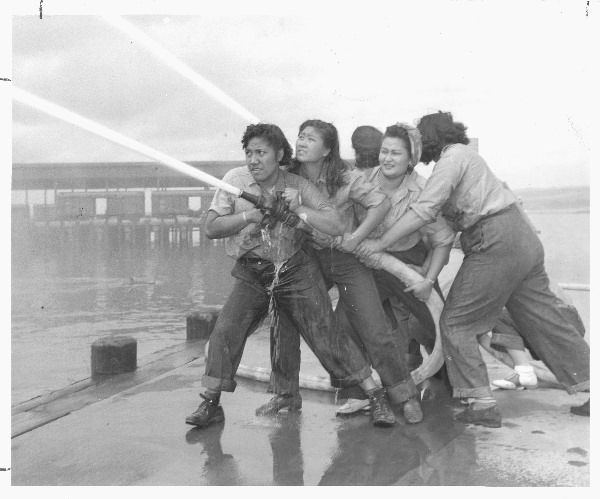
In an iconic photo, four Asian American Pacific Islander women at the Pearl Harbor Naval Shipyard train in firefighting. Long mislabeled as taken during the attack of Dec. 7, 1941, the photo in fact portrays some of  the strong women who applied to support the Navy’s war efforts in the wake of that attack. From left to right: Elizabeth Moku, Alice Cho, Katherine Lowe, and Hilda Van Gieson.


Over time, history usually has a way of sorting out fact from fiction.


Rear Adm.Grace Hopper, "Mother of Computing"
The facts and highlights of strong women of grit and grace are spotlighted in a book recommended for Women’s History Month. Profiles of more than 100 women come to life in “The Book of Gutsy Women” by Hillary Rodham Clinton and Chelsea Clinton (Simon & Schuster, 2019).

Among the women profiled are some we featured in Navy Reads posts: Rear Adm. Grace Hopper, Ada Lovelace, Rachel Carson, Marjory Stoneman Douglas, Margaret Chase Smith, Malala Yousafzai, and Maya Angelou. This book includes mini-biographies of both famous (Clara Barton, Helen Keller, Ida B. Wells, Maya Lin, Gabby Giffords, Greta Thunberg, and Venus and Serena Williams) as well as less-well-known women (Rigoberta Menchu Tum, Dr. Gao Yaojie, Nelba Marquez-Greene, Wangari Maathai, and Jineth Bedoya Lima).


Chelsea and Hillary Clinton, 2011
Hillary and Chelsea each provide essays about their subjects. They also offer personal perspectives about the women who have inspired and enlightened them – women who have made a difference in the world. The book is organized in sections: early inspirations, education pioneers, earth defenders, explorers and inventors, healers, athletes, advocates and activists, storytellers, elected leaders, groundbreakers, and women’s rights champions.

Chelsea writes, “I learned of Grace (Hopper) in 1996, when the navy named a new ship the USS Hopper (DDG 70) in her honor … I learned even more about her when I spoke many years later at the Grace Hopper celebration, the largest gathering of women technologists in the world.”


Former First Lady, senator, and Secretary of State Hillary Clinton reflects about the suffragists who knocked on the door, marched in the street, and fought for women to be able to vote in the United States one hundred years ago. That right was guaranteed with the passing of the Nineteenth Amendment to the U.S. Constitution, but it was a right that took decades to apply to women of color:

“Reading the words of the Nineteenth Amendment today, it’s hard not to wonder why it took so long” ‘The right of citizens of the United States to vote shall not be denied or abridged by the United States or by any State on account of sex. Congress shall have the power to enforce this article by appropriate legislation.’ But, of course, it was a long struggle because it was about so much more than the right of women to vote. It was about race, class, and deeply held cultural and religious views about women’s subordinate roles to men in society. It was about men’s –– and some women’s –– insecurities and fears of the unknown. These challenges are still present today.

The franchise –– the basic right of citizenship –– is still being fought over between those of us who believe every citizen should be able to vote and have that vote counted, and those who want to restrict the vote by erecting barriers against people, largely still based on race.”

Celia Ou, a graduate student at Scripps Institution of Oceanography, monitors computer screens displaying detailed sonar imaging of the ocean floor aboard the Auxiliary General Oceanographic Research (AGOR) vessel R/V Sally Ride, Dec. 15, 2016. (John F. Williams)


Nearly all the Gutsy women featured in this book faced and overcame some kind of obstacles of discrimination. Chelsea Clinton says this about space pioneer astronaut Sally Ride, the first American woman in space (in 1983) and a champion of STEM education for young people worldwide:

“Even after her death in 2012, Sally Ride kept breaking barriers. She came out as a lesbian quietly, without fanfare … Not long after her death, Tam [O’Shaughnessy, her partner of 27 years] received a call that surprised her, from Ray Mabus, then secretary of the navy. The navy hoped to honor Sally by naming a research vessel after her. Secretary Mabus was calling to ask whether Tam would be the ship’s sponsor – a role that had, up until that point, been filled by the wife of the man for whom the ship was named. ‘I think it is fitting the the celebration of Sally’s legacy as a pioneering space explorer and a role model includes an acknowledgment of who she really was and what she cared about,’ said Tam. The R/V Sally Ride, commissioned in 2016, is the first navy research ship named for a woman. Her legacy lives on in the scientific curiosity sparked in the girls and boys she continues to inspire, the ship that bears her name, and a spot on the moon named after her by NASA.”

Military readers may find fascinating nuggets of history in the essays about Sylvia Earle, Mary McLeod Bethune, Florence Nightingale, Eleanor Roosevelt, and Mary Edwards Walker. Chelsea writes this about Walker:

“…Dr. Mary Edwards Walker, the only woman in her medical school class at Syracuse Medical College in 1855. She was a practicing physician when the Civil War broke out. She desperately wanted to enlist in the Union Army as a surgeon but wasn’t allowed to because she was a woman. Initially she was called a nurse, since women generally weren’t considered doctors. Because women were not allowed to enlist, Mary had to volunteer, working for free at a temporary hospital, first in Washington and then in Virginia, where she traveled to Union field hospitals across the commonwealth … When her medical credentials were finally accepted she moved to Tennessee and became a War Department surgeon – a paid position that was the equivalent of a lieutenant in status.”


Dr. Sylvia Earle became chief scientist at the National Oceanic and Atmospheric Administration in 1990. She pioneered research in preserving 
and protecting the ocean, including the study of damage to coral reefs. Her inspiring TED talk, above, is a call to action. Hillary writes:

“When I think of Sylvia’s work, I am reminded how important it is for all of us to peruse and consider what we want to leave to the generations who come after us –– how they’ll honor the past, imagine the future, and give gifts to those who will live out their lives long after we’re gone. That’s exactly what Sylvia’s life as a scientist, an engineer, a teacher, and an explorer should inspire all of us to do: we must preserve our oceans for the future.”

Last year, this book generated controversy because of the women who were not included. For example, there is an unfortunate dearth of women who have served in or with the military. Surely, the authors could have included a “protectors” section filled with inspiring women who served in uniform.


Despite the intriguing photo on the cover, there is little focus on the women who served on the Homefront during the Second World War. In fact, there’s no explanation of the colorized photo of the women firefighters at the Pearl Harbor Naval Shipyard.

Yet, considering the general lack of attention toward the achievements of women in American and world history for many generations, it is refreshing to see a book of this scope. Women continue to knock on the door, push through the glass ceiling, and demand equality.


“The Book of Gutsy Women” illustrates the strengths of women throughout history, often in the face of sexism, misogyny, harassment, and patriarchy. It highlights the facts of women’s history and showcases women’s contributions to creating a better world now and in the future.

Sunday, July 24, 2011

Taking Nothing for Granted

by Bill Doughty
Grace Hopper -- a woman who literally gave voice to the computer revolution and the information age -- retired in 1986 as a Navy rear admiral at the age of 79.
Reading about Hopper’s struggles and achievements is rewarding in two ways...
  • It can be easy to take our laptops, iPads and smart phones for granted. From paper tape feeds to floppy disks to wireless digital computing, we’ve come so far in our ability to connect and communicate.
  • As recently as during Hopper’s lifetime -- less than one hundred years ago -- women achieved the right to vote in 1920.  Today, free nations cannot take the rights of women for granted.
My next blogpost will focus more on “Amazing Grace,” a visionary thinker who contributed so much to the information age and who, thanks to her family’s influence, valued reading, math and science.
According to Kathleen Broome Williams, author of Grace Hopper, Admiral of the Cyber Sea, “Surrounded by books in their home... Grace was raised in a family where intellectual curiosity was encouraged and acumen rewarded."
More next week...


Thirty-five years ago, August 1976, Capt. Grace M. Hopper, USNR, Head of the Navy Programming Language Section of the Office of the Chief of Naval Operations (OP 911F), works at her Desk. Official U.S. Navy photograph, by PH2 David C. MacLean. 

Saturday, June 24, 2017

A Woman's Place...

Review by Bill Doughty

... is "Serving Proudly."

This "History of Women in the U.S. Navy" by Susan H. Godson (Naval Institute Press, 2001) shows how women's roles evolved in the sea service, especially at first in Navy medicine.

Women served in defense of the nation even before there was a United States Navy, but women like Clara Barton (for the United States in the War of 1812) and Florence Nightingale (for Britain in the Crimean War) proved the value of women near the battlefield in the early and mid 1800s. By the end of the century, during the Spanish-American War, the U.S. Navy Hospital Corps was created (1898). 

The book opens with an epigraph by Rear Adm. Grace M. Hopper: "The highest award I have received is serving proudly in the U.S. Navy."
"By the end of the nineteenth century, the U.S. Navy had developed into a world-class naval power with fleets to sail and colonies to administer. The Navy's evolution had been uneven and sporadic, and growth had depended on external threats or, by the 1890s, on markets to open, colonies to supervise, and primitive people to uplift. Concurrently, training and requirements for officers and men had become professionalized... But the Medical Department still lacked a vital element: professionally trained nurses – those women who had taken two- or three-year courses in hospital training schools. Nursing, along with teaching and social work, was one of the few professions open to women. During the nineteenth century, many women emerged from their prescribed sphere and went into reform movements, clubs and associations, and higher education. And they were no strangers to the seafaring life; they had been in virtually all types of vessels, both private and naval. The Navy needed professional nurses, and such women had proven their worth during the Spanish-American War. Could the two, in fact, be mutually beneficial?"
In 1908 the Navy Nurse Corps was born. Esther Voorhees Hasson, Lenah S. Higbee and J. Beatrice Bowman were the first superintendents.

Godson examines the Navy's influence in breaking down walls, promoting education and progressing toward greater equality for women throughout the 20th century. 
"During World War I, the U.S. Navy grew in men and ships to address the demands of the European conflagration. How it met wartime requirements depended largely on Secretary of the Navy Josephus Daniels. Because of his vision and boldness, the Navy embarked on the temporary and unprecedented wartime expedient of bringing women into its enlisted ranks as yeomen (F) and Marine Reservists (F). Those women who entered the naval service had no idea that they were pioneers. They joined the Navy because the country needed their talents."
The author relates the early influence of civilians Margaret Sanger, who "launched the birth control movement, which gave women the knowledge and ability to control family size;" Alice Paul whose party proposed an equal rights amendment; and Eleanor Roosevelt, who championed social-welfare causes.

"A dramatic breakthrough for women" came during the Second World War, when some 350,000 women served in the military ashore. Women throughout the nation saw greater opportunity serving in the industrial sector. Of course, it was in WWII that  WAVES – Women Accepted for Volunteer Emergency Service – was created, in the face of quite a bit of resistance to change.

The Marine Corps, part of the Department of the Navy, was most recalcitrant about integrating women into its ranks. Although only a small number of women Marines were allowed to serve temporarily during the First World War in the Reserves, they were welcomed back in 1943, again in support roles, separate but unequal.

WAVES march in a parade for Fleet Admiral Chester W. Nimitz and Medal of Honor veterans in New York City, Oct. 9, 1945. (NHHC)

After the war, pioneers like Cmdr. Joy Bright Hancock "firmly believed that women should be allowed to serve in the regular Navy as a regular career." She traveled around the country, coordinated with the newly formed Department of Defense, and lobbied Congress, causing the "House Armed Services Committee to run up the white flag."

Women were in a "holding pattern" mid-century, but the 60s brought about great change in civil rights, including for women, and the Navy was in the forefront of the changes. A small number of WAVES served in support roles in Vietnam, but "the Navy never hesitated to dispatch nurses to the war zone," according to Godson. The 70s brought more demonstrations, class-action lawsuits and a "new brand of feminism," resulting in the Equal Opportunity Act and the Supreme Court's decision in Roe v. Wade (1973), which "represented another victory for equality."

"Guiding the Navy from 1970 to 1974 was CNO Adm. Elmo R. Zumwalt Jr., who undertook to modernize both the fleet and personnel policies... Zumwalt issued the famous (or infamous) Z-116 on 7 August (1972), giving equal rights and opportunities to Navy Women," Godson writes.

Zumwalt opened the U.S. Naval Academy to women and opened avenues for women to be able to achieve flag rank. Once again, Navy Medicine was in the lead with the first women allowed to serve aboard ships going aboard the hospital ship USS Sanctuary (AH-17). The Navy's newest warship in early 2017 is named for the visionary Navy leader. According to the Navy, "USS Zumwalt (DDG 1000) is the largest and most technologically advanced surface combatant in the world."


The 80s were a period of entrenchment, with greater participation and new roles for women in the Navy, leading to the early 90s and the repeal of combat exclusion for women, thanks to Rep. Patricia Schroeder, DACOWITS (The Defense Advisory Committee on Women in the Services) and Secretary of Defense Les Aspin.

Vice Admiral Nora Tyson, Commander U.S. Third Fleet.
Godson's book ends on a hopeful note as she wonders about the "long-term impact of these sweeping changes" (initiated more than twenty years ago). She reflects on women's achievements in the first Gulf War, at sea, in aviation, at the Naval Academy, and of course in the Navy Nurse Corps.
"The story of all Navy women is one of dedication and valor. They proudly chose to serve their country as part of the U.S. Navy and pursued their goal with dogged determination. They would not be denied such an honorable calling. As in the eighteenth and nineteenth centuries, women's familiarity with maritime matters and their nursing skills have made them essential to the naval service. Tributes to their service have been many. One of the most touching came in 1996, when the Navy named the guided-missile destroyer USS Hopper (DDG 70) in honor of Rear Adm. Grace Hopper, who had led the Navy into the computer age. And in the fall of 1997, a lasting monument to Navy woman, as well as to all 1.8 million women who have served in the military was dedicated: the women in Military Service for America Memorial at the entrance to Arlington National Cemetery, which stands as a fitting reminder of all women who have volunteered to defend American freedom."
Working with renowned Navy historians such as Jan K. Herman, Robert J. Schneller, Dean C. Allard and Edward J. Marolda, Godson provides a wealth of information and some great photos in "Serving Proudly."

She presents controversial issues such as sexual harassment, sexism, discrimination against lesbians and uniform issues. And she gives a wide-ranging history of the progress women have made in and out of the Navy, acknowledging that the history of women in the military is still being written.


Commodore Grace Hopper, special assistant to the commander, Naval Data Automation Command, gives an autograph and a length of wire representing distance an electron moves in an nanosecond during groundbreaking ceremonies for the Grace M. Hopper Navy Regional Data Automation Center at Naval Air Station, North Island, California, Sept. 27, 1985. Photo by PH2 Michael Flynn, Naval History and Heritage Command.

Sunday, October 31, 2010

ARTificial Life Imitates ART


Review by Bill Doughty

Wired For War is P.W. Singer’s big wave-catching guidebook to the tsunami of change, subtitled as The Robotic Revolution and Conflict in the 21st Century. Part history, part current state of the art, and all philosophy, his book balances ancient storytelling, futuristic thinking and current ethics.

Are we on the verge of a Singularity, a revolution in military affairs (not to mention social/human reality) not seen since the discovery of gunpowder or invention of the steam engine?What will refinement of robots and nanotechnology mean for our military and society in decades ahead?

Nearly five centuries ago, an emperor of the Incan Empire, Atahuallpa, confronted Pizarro and Spanish Conquistadors in what is now Peru -- the first encounter with swords, armor and cavalry. It was, “a powerful example of just how shocking and powerful new weapons of war can be.”

Sir Winston Churchill, featured in our previous blog post, discussed the paradigm shift of new technology. He saw Edison’s and Tesla’s inventions applied to warfare and predicted the future widespread use of drones.

Singer leads Chapter 2 with this quote from Sir Winston: “The further backward you look, the further forward you can see.”

Churchill, who embraced the advent of aviation in warfare, would no doubt appreciate the evolution of asymmetrical warfare, UAVs and development of the Predator, Raven, PackBot, Ro-Bart, Wasp, REMUS, Zeus, Robo-Lobster, Cormorant, as well as other systems and machines explained by Singer in Wired For War.

Other people, however, find it hard to predict, let alone come to terms with, fundamental shifts in technology.
That’s not new.

Singer reminds us what the New York Times said 107 years ago this month, on Oct. 9, 1903, inaccurately predicting human flight:

“The flying machine which will really fly might be evolved by the combined and continuous efforts of mathematicians and mechanicians in from one million to ten million years.”

That same day the Wright Brothers, owners of a bicycle shop in Ohio, began assembling their first airplane -- just seven years before the beginning of the Centennial of Naval Aviation.

Singer shows how the “Dennymite” became the first unmanned plane in history immediately after the Dec. 7, 1941 attack on Pearl Harbor. Its inventor, Reginald Denny, provided work for Norma Jeane Dougherty -- the future Marilyn Monroe -- who was discovered at a factory where she worked spraying Denny’s drones with fire retardant.

In WWII, John F. Kennedy famously served in the Navy. His older brother, Joseph Jr., was a Navy pilot who served in Great Britain, part of a secret pilot-and-remote-control program called Operation Aphrodite. He was killed in 1944 while flying in support of a drone mission against Germany.

Singer tells us about the important role of Navy mathematician “Amazing” Grace Hopper, who was part of a team that developed COBOL so computers could communicate. USS Hopper is named in Rear Adm. Hopper’s honor.

Chief of Naval Operations (CNO) Adm. Gary Roughead visits with Sailors aboard the Arleigh Burke-class Destroyer USS Hopper (DDG 70) at Joint Base Pearl Harbor-Hickam on June 9, 2010. Roughead is at the base to participate in the 2010 Japan-U.S. Junior Officers Symposium. U.S. Navy photo by Mass Communication Specialist 1st Class Tiffini Jones Vanderwyst.
From ancient mythology, Talos is a mechanical statue who served the Greek and Roman god of metalworks. It’s also the name used by an early Apple Computer operating system and the first computer-guided missiles on U.S. Navy Ships.

Modern “mythology” continues to inspire scientists.

Singer shows how much science fiction has predicted where we’ve come and where we’re going.

He gives a nod to former CNO, Chairman of the Joint Chiefs of Staff ADM Mike Mullen and the Navy’s Professional Reading Program, which includes SF titles by Robert Heinlein (Starship Troopers) and Orson Scott Card (Ender’s Game). [Wired For War has been included in the supplemental reading list and was recommended by Capt. John Jackson, “father” of NPRP, in his interview with Navy Reads.]

Singer credits Arthur C. Clarke with “one of the most militarily instructive stories on the dangers of being seduced by possibilities of new technology” -- Superiority.

He cites Isaac Asimov, Brian Aldiss, Joe Haldeman, William Gibson, H.G. Wells and Jules Verne and provides dozens of other sources as examples to explain how life imitates art and vice versa.

The unpredictability and uncertainty of war and unintended consequences of conflict are explored with insights from analyst Richard Clarke.

The same analyst who tried to warn against an invasion of Iraq warns about “a real digital divide” between haves and have-nots, educated and uneducated. Clarke recognizes, Singer says, that fear (including fear of change) is extremely powerful and can drive people toward violence, especially when religion is part of a volatile mix.

Nevertheless, change is not only here, it’s accelerating.

Singer gives an insightful quote from Gen. Eric Shinseki, about the constancy and inevitability of change: “If you dislike change, you’re going to dislike irrelevance even more.”

How will new forms of remote-control or robotic warfare affect the human psyche?

“The courage of a warrior ... is about victory over fear. It is not about the absence of fear,” Singer says, contending, “By removing warriors completely from risk and fear, unmanned systems create the first complete break in the ancient connection that defines warriors and their soldierly values.”

Can understanding and managing change -- like managing and controlling fear -- be part of human “wiring”?

Wired For War, with an obvious pipeline to the Pentagon, is packed with research -- but without jargon -- and backed with copious notes, explanations and examples from literature and popular culture.

Here’s just a partial list (in no particular order) of producers, authors, book titles, movies and games Singer shares:

Steven Spielberg, Clint Eastwood, James Cameron, Mel Gibson, Stephen King, Bertrand Russell, Tom Clancy, Mary Shelley, Nathaniel Hawthorne, Dan Brown, Michael Crichton, S.M. Stirling, Stephen E. Ambrose, Immanuel Kant, Charles Darwin, Ray Bradbury, Albert Einstein, George Orwell, Edgar Rice Burroughs, John Donne, Greg Bear, J. R. Rowling, Frank Herbert, Descartes, Jack London, Marvin Minsky, L. Sprague de Camp, Alien and Aliens, AI, Minority Report, Robocop, Metropolis, Terminator 2, Star Wars, Star Trek, Braveheart, Lost in Space, Matrix, Manchurian Candidate, Twilight Zone, Dr. Who, Battlestar Gallactica, Lord of the Rings, The Last Samurai, Metal Gear, Halo, Medal of Honor, Madden Football, Pixar and Japanese manga.