Wednesday, April 14, 2021

The Titan Patriot Who Helped Win WWII


Review by Bill Doughty

He was a giant of American industry and friend of the Navy, yet he’s nearly forgotten today.


Leading his own companies and as the elected chairman of a group of other companies, Henry J. Kaiser built roads, bridges, dams, and factories. And during World War II he became known as the father of modern shipbuilding as he –– and the men and women he hired –– produced Liberty Ships, Victory Ships, LSTs, CVEs, and tankers. He is credited for producing 1,500 vessels during the war effort.


Peter J. Marsh tells “the untold story of Henry Kaiser’s Oregon shipyards” in “Liberty Factory” (Seaforth Publishing, 2021), a book filled with striking black-and-white images, mostly taken by former Oregonian photojournalist Larry Barber, an Ansel Adams of shipyards in the Pacific Northwest.


Kaiser helped build:

  • Dams –– Grand Coulee, Bonneville, and Boulder (later renamed Hoover Dam)
  • San Francisco-Oakland Bay Bridge
  • Shipyards, ships, and a shipping company 
  • Kaiser Steel and Kaiser Aluminum
  • Complex highway tunnels in Western states
  • Kaiser Gypsum Company
  • Kaiser Jeep Corporation (sold to AMC in 1970)
  • Subdivisions, businesses, and other entities*

Marsh notes, “Concrete he manufactured at the Permanente Plant built docks, runways, and bases in the Pacific Theatre.” In fact, he shipped much of the concrete to Pearl Harbor for the Navy and then built a concrete-producing plant in Hawaii. On the mainland, “Electricity generated by the dams he built fueled war industries on the Columbia River and in the Bay Area.”


As an art project, Kaiser built a stunning summer retreat at Lake Tahoe (later selected by Francis Ford Coppola as the Corleone home in “The Godfather Part II”).


At his shipyards Kaiser used prefabricated mass production techniques, vertical integration, welding instead of riveting, and “other innovative ways to cut costs, save time, improve the product, and work in cooperation with a myriad of federal agencies.”


“Liberty Factory” describes in detail how Kaiser’s workers built a ship from keel to launch in ten days and kept top secret a visit by President Franklin D. Roosevelt to Portland, Oregon. FDR’s daughter Anna Boettiger launched the Liberty ship SS Joseph N. Teal on Sept. 23, 1942, less than a year after the attack on Pearl Harbor and Oahu.


Henry J. Kaiser showed how infrastructure for workers and families starts with concrete and steel but doesn’t end there.


One of Henry J. Kaiser’s most lasting achievements was the creation of Kaiser Permanente, which is a non-profit foundation, health plan, and group of for-profit hospitals and medical groups. “On his 85th birthday, he told reporters, ‘Of all the thing I’ve done, I expect only to be remembered for my hospitals. They’re the things that are filling the people’s greatest need –– good health.’”


According to Marsh, “Affordable health care was a new idea in 1961 where people could prepay for health services at Kaiser’s hospitals and clinics rather than to higher cost fee-for-service providers…”


Kaiser teamed with a military medical officer to provide TRICARE-like healthcare to his shipyard workers during WWII after success in earlier projects.

“The Kaiser Corporation had adopted the ‘pre-payment’ health care system devised by Doctor Sidney Garfield on an earlier project on the Colorado River Aqueduct. In 1939, he moved his operation to the largest construction site in history –– the Grand Coulee Dam –– to provide care for the 6500 workers and their families. He recruited a team of doctors and nurses to work in a ‘prepaid group practice’ in a local hospital that he turned into a state-of-the-art facility. But as the dam neared completion in 1941, it seemed that the grand experiments reaching the end of its life, until world history intervened. Now, Henry J. Kaiser had a bigger problem: how to provide health care for a workforce that would grow to 30,000 in the first Van-Port yard alone.

Kaiser was convinced that Dr. Garfield could scale up his system, but according to the Kaiser Permanente archive, he first had to persuade the US Army to release the good doctor from military service. This may have been the first favour Henry asked of FDR during the war effort, but it was definitely not the last!”

Kaiser and his son Edgar provided more than healthcare services at the shipyards. They also built the nation’s (and perhaps world’s) earliest first child development centers, hiring teachers who specialized in early education. 


The first women welders arrived at the Oregon Shipbuilding Company April 15, 1942 –– exactly 79 years ago this month. One of the first two women welders hired had lost a son in the Battle of Bataan in Luzon, Philippines.


The Kaisers paid their workers the highest wages around. By 1944, 30 percent of their workforce was women. They also hired wounded warriors and “found places for amputees, paralyzed workers, the deaf and dumb, the blind and many other individuals who were previously considered unemployable.”


Marsh pulls the story together from various archives, including Kaiser’s company magazine “The Bo’s’n’s Whistle.” “Liberty Factory” includes captivating photos of the men and women who worked together to help win the war in less than four years.

“After Pearl Harbor, the entire USA was mobilized in the war effort in many ways that seemed unimaginable just a year before –– and only appear more remarkable in retrospect. The emergency shipbuilding program on the West Coast immediately began drawing unemployed people from all over the western states and would eventually create over 1.5 million jobs nationwide. Throughout the country, the small cities around the new shipyards were completely unprepared for the dramatic changes the war effort would bring … Needing still more workers, Henry Kaiser scoured the country for recruits, finding thousands of willing volunteers in the prairie states where mechanization had displaced thousands of farm workers.”

Kaiser also sent trains, known as “Kaiser Karavans,” into New York and throughout the south and provided new employment opportunities to African American workers.


Kaiser, who had dropped out of school at 13 and considered a career in photography before finding his passion as a builder, was a consummate communicator and promoter. He believed in open communication and collaboration with his workforce; efficient production and innovation; and incentive, competition, and recognition. He worked closely with Rear Adm. Emory S. Land, Rear Adm. Howard Vickery, and Vice Adm. Lewis Strauss, who introduced the Battle E award.


He embraced challenges and in the footsteps of Teddy Roosevelt, was a champion of progressive practices. In 1950, when the Sailors’ Union of the Pacific picketed a Panamanian-flagged Liberty ship that tried to hire a foreign crew, “Henry Kaiser decided to support the union, bought the ship, and it became the first American ship to be crewed entirely by union members. Kaiser renamed the ship after the union president –– the SS Harry Lundeberg –– and became a public supporter of labour, stipulating union wages on all of his jobs,” according to Marsh.


This book is filled with gorgeous images and fascinating history and statistics. The presentation is a bit disjointed with various (but interesting) timelines; however, the photography more than makes up for any shortcomings in the narrative.


To learn more about the great titan of shipbuilding and other industries, Marsh recommends Mark S. Foster’s “Henry J. Kaiser: Builder in the Modern American West,” a 1989 biography of the great business leader and philanthropist.


The Navy recognized the achievements of Kaiser with the naming of a class of fleet replenishment oilers. Its lead vessel, the first ship named for Henry J. Kaiser, (T-AO-70), went into service for the Military Sealift Command in 1986. One can occasionally see the ship docked at concrete piers at Joint Base Pearl Harbor-Hickam.


*(Kaiser established the Kaiser Family Foundation in 1948, a private nonprofit organization focusing on healthcare issues. He formed Kaiser-Frazer and Kaiser Motors. He built the Hawaiian Village –– now Hilton Hawaiian Village. And, he ventured into the entertainment business, producing the Maverick TV series starring James Garner as well as Hawaiian Eye, a precursor to Hawaii Five-0. He designed and built the Hawaii Kai community in East Honolulu. And he started Kaiser Broadcasting with TV and radio stations in Hawaii.)


Chief Logistics Specialist Andre Stetz, from Krakow, Poland, monitors the distance between the Military Sealift Command fleet replenishment oiler USNS Henry J. Kaiser (T-AO 187) and the Arleigh Burke-class guided-missile destroyer USS Sterett (DDG 104) during a replenishment-at-sea while underway conducting routine operations in the Pacific in 2020. (MCSA Drace Wilson)


Military Sealift Command Fleet replenishment oiler USNS Henry J. Kaiser (T-AO 187) departs Joint Base Pearl Harbor-Hickam Aug. 5, 2016 following the conclusion of Rim of the Pacific 2016. Twenty-six nations, more than 40 ships and submarines, more than 200 aircraft and 25,000 personnel participated in RIMPAC in and around the Hawaiian Islands and Southern California. The world's largest international maritime exercise, RIMPAC provides a unique training opportunity that helps participants foster and sustain the cooperative relationships that are critical to ensuring the safety of sea lanes and security on the world's oceans. RIMPAC 2016 was the 25th exercise in the series that began in 1971. During RIMPAC 2012 USNS Henry J. Kaiser took on 900,000 gallons of a 50/50 blend of advanced biofuels and delivered the biofuels to platforms participating in the Great Green Fleet demonstration during the exercise Rim of the Pacific (RIMPAC) 2012. (MC1 Rebecca Wolfbrandt)


Top photo: Henry J. Kaiser is pictured second from left, next to son Edgar, standing, in an open car with FDR visiting the Kaiser Oregon shipyard, St. Johns, Oregon, September 23, 1942, for the launching of the SS Joseph N. Teal; Oregon Gov. Charles Sprague is at left.

Monday, April 5, 2021

‘Forging the Trident’ –– TR and Navy Infrastructure

Review by Bill Doughty

Theodore Roosevelt was appointed as Assistant Secretary of the Navy in April 1897, 124 years ago this month. In that position and later as President of the United States, TR helped build the infrastructure of the modern Navy. But, in his attempt to fortify deterrence, did he build inadvertently toward war a generation later?


Editors John B. Hattendorf and William P. Leeman draw up their own blueprint of TR's history with the Navy. They deploy a team of scholars, historians, and essayists to construct an argument for TR’s remarkable role to transform the Navy in “Forging the Trident: Theodore Roosevelt and the United States Navy” (Naval Institute Press, 2020). In complementing essays, various authors show TR’s leadership and influence after the Civil War, through the Spanish-American War and World War I, and –– through his cousin FDR –– in World War II.

TR was born three years before the start of the Civil War. His father was an ardent supporter of the Union, but members of his mother’s family were part of the Confederacy. In fact, his maternal grandparents were slave owners, and his uncles served in the Confederate navy, which is where TR acquired his love of ships and the open ocean.


The authors of “Forging the Trident” show how TR, who came from the party of Abraham Lincoln, negotiated and cajoled to keep the South and North united. Author Sarah Goldberger writes about the politics of reconciliation in “An Indissoluble Union.”

“Upon Roosevelt assuming the presidency, southern Republicans immediately approached him on the importance of taking control of the Republican Party in the South. John Wise, a lawyer from Virginia who now lived in self-appointed exile in New York, brought Roosevelt up to date on the sad state of affairs in Virginia –– that the commonwealth, like the other southern states, would soon disfranchise black voters. Some Republicans –– ‘Lily Whites,’ as they were called –– believed that this was perhaps a good thing, as it would make white men more likely to join the Republican Party; other Republicans saw the elimination of the black voters as fatal to the party. Wise, who considered himself in the latter category, served as the attorney of a group of black plaintiffs who fought disfranchisement. As president, Roosevelt became immersed in the very complex intersection of southern racial politics and federal patronage. Although the majority of federal employment now required civil service examinations, there was still patronage enough to bestow, such as the coveted position of local postmaster.”

TR became determined to change the system of discriminatory and patriarchal patronage into a merit-based system that rewarded performance.


“Roosevelt was determined to appoint only the most qualified people,” Goldberger writes. He invited Booker T. Washington to dinner at the White House to help judge African American appointees, but the backlash from white Southerners was extensive (and would have a lasting effect until the Nixon presidency).

TR delivers a speech on U.S. naval preparedness, Haverhill, MA, 1902.

Following in the footsteps of Lincoln, TR put his faith in the Constitution, the Union, and progressive values. He was also a champion of the environment as a true conservative and conservationist. And he strongly supported the Navy throughout his life.


Under TR’s leadership, the Navy enacted the Personnel Act of 1899. He wanted every Navy officer to be an engineer. He saw the advent of submarines and supported the possibility of developing “flying machines,” including for the Navy. Roosevelt communicated –– like few before him –– the need for public support for the Navy and understanding of its global maritime mission.


In “Checking the Wake While Looking Beyond the Horizon,” David Kohnen observes this about infrastructural changes in the Navy and nation after the Civil War as the country looked beyond its own borders:

“The naval outlook of Roosevelt reflected the confidence associated with industrialization and economic prosperity. Americans viewed the U.S. Navy as a symbol of national unity, as the Reconstruction era culminated in the stunning success of the Spanish-American War. The oceanic borders having been connected with the transcontinental railroad, the armored warships driven by coal-fired steam propelled the U.S. Navy forward in the global maritime arena. The economic rise of the United States remained closely connected to the watery lines of maritime communications –– as the empires of Europe and Asia also competed for economic dominance through naval power.”

Forward-thinking Roosevelt believed in having an international profile. And he strenuously promoted naval innovation.


TR
Under TR, the Navy shifted from coal to oil, deployed wireless communication, and developed new gunnery for its large battleships. “Forging the Trident” explains in several essays how Lt. Cmdr. William S. Sims –– with the support and protection of Roosevelt –– became more influential than most admirals and captains in the era of change in the early 20th century, often in the face of opposition from older traditionalists.


The ghost of Adm. Alfred Thayer Mahan haunts this book. In fact, Mahan’s name appears in all but one chapter. TR owed much to Mahan. But, as president, Roosevelt saw that the great geostrategic theorist was also a bureaucratic authoritarian whose “apostasy” stood in TR’s way. So, in order to advance many of the new technologies and strategies of the time, TR gently nudged him into retirement.


Kohnen writes, “As for Mahan, in late 1914 he died, as did the era of coal and multi-caliber battleship guns … The death of Mahan enabled the generation of Sims to pick up the torch in defining the future of American sea power.” 


Volatility extended to the top level of Navy leadership. Historian Branden Little lays out a fascinating review of TR’s turnover of SECNAVs –– six men served as Navy Secretaries during TR’s time as president.


FDR
In another chapter, “Legacy,” Craig Symonds presents an thoughtful look at the similarities as well as the differences between TR and his cousin FDR. “Among their shared values was a belief that government had both the authority and responsibility to proactively improve the lives of American citizens.”


Both men held the same jobs, and both had to be reigned in during their tenures as Assistant Secretary of the Navy. FDR, who married TR’s niece Eleanor, shared “Uncle Ted’s” deep love of the maritime service. He continued TR’s commitment to preparedness of a powerful, modern fleet able to have an impact on the international stage. As presidents, however, FDR proved to be more cerebral and cautious –– and perhaps more effective than TR as a communicator and consensus-builder. FDR, working with allies and former enemies, built a lasting infrastructure of a post-war era of peace for Europe and Asia.


Navy Reads readers may find James R. Holmes’s essay to be the biggest gem in this collection. It appears in chapter 9 and is titled “Why Deterrence Failed: The Imperial Japanese Navy, Strategic Memes, and the Great White Fleet.” 


Using Richard Dawkins’s insights about memes –– published in “The Selfish Gene” –– as a way to explain the history, psychology, and sociology leading to WWII, Holmes examines TR’s strategy to deploy the Great White Fleet as a “Big Stick” intended to show the world the power, prestige, and peacekeeping abilities of the United States.


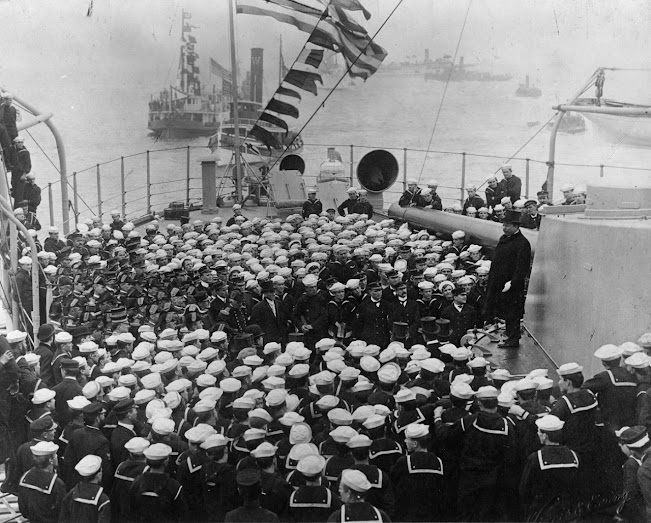
President Theodore Roosevelt addresses sailors on the after deck aboard USS Connecticut (Battleship #18), in Hampton Roads, Virginia, Feb. 22, 1909. (NHHC)

But was the GWF actually a deterrent? TR may not have fully appreciated the nationalism memes running through Japanese society after the IJN’s victories in the Sino-Japanese War, 1894-95, and Russo-Japanese War, 1904-05, which “forged the IJN’s access-denial strategy.” TR believed the circumnavigating voyage would foster peace. “The truth is murkier,” Holmes says. In the end, the GWF “message” may have piqued Japan’s pride and hubris –– an incentive for militaristic Japan to build the IJN even stronger, leading to an inevitable clash over Hawaii and the Pacific during FDR’s presidency.

Holmes’s conclusions –– and the legacy of both TR and FDR –– are relevant when thinking about innovative infrastructure initiatives in the United States in 2021.

“Few institutions are are exempt from bureaucratic dynamics –– or stasis. Dynamists typically fare better in armed competition than services set in their ways. Perhaps the way to remain supple and innovative is for top leaders to inscribe one indelible precept on the institutional culture, setting it above all others: No Precept Is Forever. That is one meme worth making permanent. The Imperial Japanese Navy offers an example to avoid –– or to exploit if some future foe appears likewise prone to fixed ideas.”

Reading “Forging the Trident” is like sitting alone with gifted historians and informed communicators telling you about how a great president served as a key architect of the modern Navy at the beginning of the last century. Editors Hattendorf and Leeman have succeeded in designing an indispensable edition –– and addition –– to the Roosevelt bookshelf. No precept is forever, but some concepts can last and improve over time.


OYSTER BAY, New York (Oct. 26, 2018) Cmdr. Julie Schmidt (right), the commanding officer of Navy Operational Support Center Long Island, and Cmdr. Christopher Kendrick, the executive officer of Navy Recruiting District New York, saluting a presidential wreath after placing it beside the grave of President Theodore Roosevelt in Youngs Memorial Cemetery. Students from nearby Theodore Roosevelt Elementary School were on hand to place flowers and play "Taps" to commemorate his birthday. (U.S. Navy photo by Bruce Howard/Released)

Monday, March 29, 2021

‘Gutsy’ Women Knocking on the Door

Review by Bill Doughty

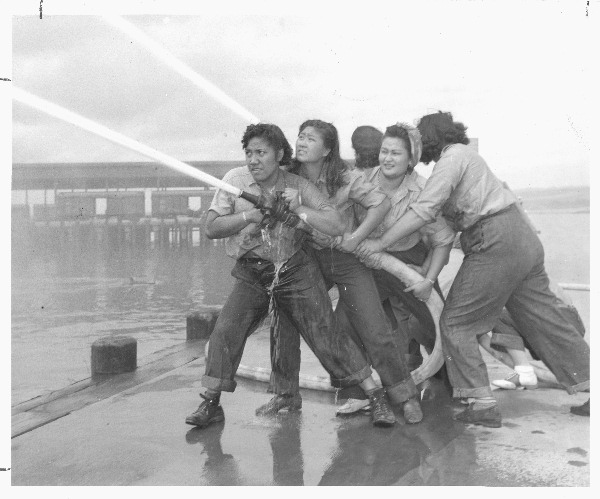
In an iconic photo, four Asian American Pacific Islander women at the Pearl Harbor Naval Shipyard train in firefighting. Long mislabeled as taken during the attack of Dec. 7, 1941, the photo in fact portrays some of  the strong women who applied to support the Navy’s war efforts in the wake of that attack. From left to right: Elizabeth Moku, Alice Cho, Katherine Lowe, and Hilda Van Gieson.


Over time, history usually has a way of sorting out fact from fiction.


Rear Adm.Grace Hopper, "Mother of Computing"
The facts and highlights of strong women of grit and grace are spotlighted in a book recommended for Women’s History Month. Profiles of more than 100 women come to life in “The Book of Gutsy Women” by Hillary Rodham Clinton and Chelsea Clinton (Simon & Schuster, 2019).

Among the women profiled are some we featured in Navy Reads posts: Rear Adm. Grace Hopper, Ada Lovelace, Rachel Carson, Marjory Stoneman Douglas, Margaret Chase Smith, Malala Yousafzai, and Maya Angelou. This book includes mini-biographies of both famous (Clara Barton, Helen Keller, Ida B. Wells, Maya Lin, Gabby Giffords, Greta Thunberg, and Venus and Serena Williams) as well as less-well-known women (Rigoberta Menchu Tum, Dr. Gao Yaojie, Nelba Marquez-Greene, Wangari Maathai, and Jineth Bedoya Lima).


Chelsea and Hillary Clinton, 2011
Hillary and Chelsea each provide essays about their subjects. They also offer personal perspectives about the women who have inspired and enlightened them – women who have made a difference in the world. The book is organized in sections: early inspirations, education pioneers, earth defenders, explorers and inventors, healers, athletes, advocates and activists, storytellers, elected leaders, groundbreakers, and women’s rights champions.

Chelsea writes, “I learned of Grace (Hopper) in 1996, when the navy named a new ship the USS Hopper (DDG 70) in her honor … I learned even more about her when I spoke many years later at the Grace Hopper celebration, the largest gathering of women technologists in the world.”


Former First Lady, senator, and Secretary of State Hillary Clinton reflects about the suffragists who knocked on the door, marched in the street, and fought for women to be able to vote in the United States one hundred years ago. That right was guaranteed with the passing of the Nineteenth Amendment to the U.S. Constitution, but it was a right that took decades to apply to women of color:

“Reading the words of the Nineteenth Amendment today, it’s hard not to wonder why it took so long” ‘The right of citizens of the United States to vote shall not be denied or abridged by the United States or by any State on account of sex. Congress shall have the power to enforce this article by appropriate legislation.’ But, of course, it was a long struggle because it was about so much more than the right of women to vote. It was about race, class, and deeply held cultural and religious views about women’s subordinate roles to men in society. It was about men’s –– and some women’s –– insecurities and fears of the unknown. These challenges are still present today.

The franchise –– the basic right of citizenship –– is still being fought over between those of us who believe every citizen should be able to vote and have that vote counted, and those who want to restrict the vote by erecting barriers against people, largely still based on race.”

Celia Ou, a graduate student at Scripps Institution of Oceanography, monitors computer screens displaying detailed sonar imaging of the ocean floor aboard the Auxiliary General Oceanographic Research (AGOR) vessel R/V Sally Ride, Dec. 15, 2016. (John F. Williams)


Nearly all the Gutsy women featured in this book faced and overcame some kind of obstacles of discrimination. Chelsea Clinton says this about space pioneer astronaut Sally Ride, the first American woman in space (in 1983) and a champion of STEM education for young people worldwide:

“Even after her death in 2012, Sally Ride kept breaking barriers. She came out as a lesbian quietly, without fanfare … Not long after her death, Tam [O’Shaughnessy, her partner of 27 years] received a call that surprised her, from Ray Mabus, then secretary of the navy. The navy hoped to honor Sally by naming a research vessel after her. Secretary Mabus was calling to ask whether Tam would be the ship’s sponsor – a role that had, up until that point, been filled by the wife of the man for whom the ship was named. ‘I think it is fitting the the celebration of Sally’s legacy as a pioneering space explorer and a role model includes an acknowledgment of who she really was and what she cared about,’ said Tam. The R/V Sally Ride, commissioned in 2016, is the first navy research ship named for a woman. Her legacy lives on in the scientific curiosity sparked in the girls and boys she continues to inspire, the ship that bears her name, and a spot on the moon named after her by NASA.”

Military readers may find fascinating nuggets of history in the essays about Sylvia Earle, Mary McLeod Bethune, Florence Nightingale, Eleanor Roosevelt, and Mary Edwards Walker. Chelsea writes this about Walker:

“…Dr. Mary Edwards Walker, the only woman in her medical school class at Syracuse Medical College in 1855. She was a practicing physician when the Civil War broke out. She desperately wanted to enlist in the Union Army as a surgeon but wasn’t allowed to because she was a woman. Initially she was called a nurse, since women generally weren’t considered doctors. Because women were not allowed to enlist, Mary had to volunteer, working for free at a temporary hospital, first in Washington and then in Virginia, where she traveled to Union field hospitals across the commonwealth … When her medical credentials were finally accepted she moved to Tennessee and became a War Department surgeon – a paid position that was the equivalent of a lieutenant in status.”


Dr. Sylvia Earle became chief scientist at the National Oceanic and Atmospheric Administration in 1990. She pioneered research in preserving 
and protecting the ocean, including the study of damage to coral reefs. Her inspiring TED talk, above, is a call to action. Hillary writes:

“When I think of Sylvia’s work, I am reminded how important it is for all of us to peruse and consider what we want to leave to the generations who come after us –– how they’ll honor the past, imagine the future, and give gifts to those who will live out their lives long after we’re gone. That’s exactly what Sylvia’s life as a scientist, an engineer, a teacher, and an explorer should inspire all of us to do: we must preserve our oceans for the future.”

Last year, this book generated controversy because of the women who were not included. For example, there is an unfortunate dearth of women who have served in or with the military. Surely, the authors could have included a “protectors” section filled with inspiring women who served in uniform.


Despite the intriguing photo on the cover, there is little focus on the women who served on the Homefront during the Second World War. In fact, there’s no explanation of the colorized photo of the women firefighters at the Pearl Harbor Naval Shipyard.

Yet, considering the general lack of attention toward the achievements of women in American and world history for many generations, it is refreshing to see a book of this scope. Women continue to knock on the door, push through the glass ceiling, and demand equality.


“The Book of Gutsy Women” illustrates the strengths of women throughout history, often in the face of sexism, misogyny, harassment, and patriarchy. It highlights the facts of women’s history and showcases women’s contributions to creating a better world now and in the future.

Wednesday, March 24, 2021

‘British Naval Intelligence’ and 007

Review by Bill Doughty

British Royal Navy Commander James Bond, Agent 007, enters the battle space, impeccably dressed. Trained to defend himself, he carries the latest hidden weapons and devices. Bond gets the best intelligence and communication technology. He trusts his American friend Felix Leiter of the CIA, and they often work together. James Bond (almost) always has secret information to be one step ahead of his enemies. He is licensed to kill.


Commander Ian Fleming
It’s not surprising that 007 is a creation of imaginative thinker Ian Fleming, who served in British naval intelligence during the Second World War.

Fleming’s real world contributions during and after the war, along with those of dozens of other personnel, are featured in “British Naval Intelligence” by Andrew Boyd (Seaforth Publishing, 2020). Fleming was the “most visible example of an extraordinary range of recruits” in British Intelligence at the beginning of World War II as Hitler threatened the world.


This book details the strategies, tactics, and methods developed from the late 19th century through two world wars. It concludes with Britain’s war in the Falklands and the end of the Cold War. Understandably, much of the book is devoted to operations, equipment, leaders, events, and policy during WWII.


One through-line is the Anglo-American intelligence relationship between the two navies. Boyd examines a “difficult” partnership early on, but shows how key leaders came together to build trust and confidence as both the Royal Navy and U.S. Navy evolved, built alliances, and confronted enemies like Nazi Germany, Imperial Japan, and the Soviet Union.


Vice Adm. Ghormley confers with Adm. Nimitz, circa 1943. (NHHC)
American readers will be interested in Nimitz’s “logical and generous” leadership in integrating intelligence operations, as well as in the roles of Adm. Harold Stark, Rear Adm. Robert Ghormley’s, and Capt. Carl Holden’s roles. Boyd describes a “notoriously anglophobic Adm. Ernest King,” Chief of Naval Operations during WWII.

Boyd shows how intelligence teams developed aerial photographic surveillance, codebreaking, prisoner-of-war interrogations, shoreline intelligence, Secret Intelligence Service monitoring of ports, other signals intelligence, and “operational research” – both successes and failures throughout the 20th century.  Over time, submarines, satellites, and towed array technology became invaluable to both British and American efforts.


“British Naval Intelligence” naturally spotlights operations and issues from a Royal Navy perspective, with a heavy emphasis on the North Atlantic, Barents Sea, and Mediterranean. Boyd writes this about Operation Torch, the allied amphibious invasion of Northwest Africa, pictured below: “Torch was the first British-American combined operation undertaken before D-Day, and it had consequences that remain underestimated.”


Boyd also describes the importance of shared intelligence at turning points: Battle of the Coral Sea, Battle of Midway, and Operation Overlord, the Normandy landings.


As WWII ended, Britain and the United States adapted to a “new world order” in facing new Soviet threats. Once again, Ian Fleming played a key role, helping to create the Joint Intelligence Bureau in August 1945.


The Cold War saw a continued warm and collaborative relationship between the two navies. British intelligence succeeded by “fostering an effective post-war relationship with the American intelligence agencies and leveraging the vastly greater American collection capability.”


Lord Mountbatten (second from left)..
On the American side, Bill Donovan, who had led the Office of Strategic Services, helped create the CIA. Across the Atlantic, Rear Adm. John Inglis became director of Naval Intelligence, colloquially known as “Room 39.” The allies focused on “the ever-growing threat posed by the Soviet submarine force.”

Cooperation was, as always, dependent on personalities – “notably the personal relationships between Lord Louis Mountbatten, who became First Sea Lord in 1955, and his American opposite number, Admiral Arleigh Burke, and the fanatical eccentric architect of the US Navy nuclear submarine programme, Rear Admiral Hiram Rickover.”


Boyd concludes his massive, 776-page book with the Falklands War, where “the strengths and weaknesses of British intelligence were evident in the only major engagement between the Argentine navy and the British task force, which led to the sinking of the Argentine cruiser Belgrano by the SSN Conqueror.”

Boyd’s comprehensive history of British naval intelligence in the previous century brings rich insights into the important Anglo-American relationship, both good and bad.


Weaknesses of American intelligence were personified during that era by Chief Warrant Officer John Walker, communication watch officer at COMSUBLANT in Norfolk, Virginia. Walker, Boyd shows, was a wannabe 007 James Bond spy who set up an espionage ring of associates (including his son) and sold out his country by providing “a vast amount of communications and cryptographic data, giving access to strategic plans, intelligence assessments, day-to-day operations, and technical capability.” Walker conspired and colluded with the Soviets starting in 1967 and then with the Russians through the 70s into the 80s, creating untold damage to the West’s anti-submarine warfare efforts.


Even 007’s creator, Ian Fleming, might have difficulty contemplating the depth, breadth, and depravity of the Walker spy debacle.


“British Naval Intelligence” adds new information to the history of the British navy and to the development of war-winning naval intelligence. This short and admittedly U.S.-centric Navy Reads review can only scratch the surface of this important and enlightening book.

Thursday, March 18, 2021

‘Woke’ or Enlightened


By Bill Doughty

The updated Navy Professional Reading Program is a treasure trove of good books recommended by Chief of Naval Operations Adm. Mike Gilday and Master Chief Petty Officer of the Navy Russell Smith. Some titles are traditional favorites by Hornfischer, Stavridis, and Marlantes, to name a few; others are unexpected and fresh choices.


That’s why it’s a little bit surprising to see National Review take a potshot this week at the list, alleging that some of the titles, including Dr. Ibram X. Kendi’s “How to Be an Antiracist,” are “woke books” that “have no place in U.S. Navy training.” The National Review screed is by someone who writes under the pen name “Roger J. Maxwell.” 


Maxwell complains about the inclusion of Jason Pierceson’s “Sexual Minorities” and Michelle Alexander’s “The New Jim Crow,” drawing more attention and interest in those authors and their views, even if readers don’t agree with everything they say. 

These books, along with several others on the list, reflect a more diverse and inclusive culture.


One of the stated aims of the NPRP is to “Develop a greater appreciation of the views of others and a better understanding of our changing world.” Ironically, National Review published the article with a photo of Kendi in a shirt proclaiming “CHANGE.”


Maxwell recently published another piece in National Review railing against the DoD stand-down to confront extremism, including white supremacism and white nationalism in the aftermath of the 1/6 insurrection at the Capitol. Maxwell concluded, “The only foreseeable outcome of Secretary Austin’s initiative is the creation of distrust in the ranks.”


Accusations of “partisan politics” and “woke ideology” in the military by National Review and Fox News, particularly by Tucker Carlson, remind us of the reaction to the initiatives of Admiral Elmo Zumwalt, who was CNO from 1970 to 1974. [Zumwalt is pictured at the top of this post talking with sailors on the messdecks aboard USS Puget Sound (AD-38) in Newport, RI, circa 1970.]

Sgt. Carrie Falls aboard USS Bataan (LHD 5). (MC2 Magen F. Reed)
Fifty years ago Zumwalt was accused of weakening national defense and creating distrust in the ranks by pushing for equality of opportunity for women and people of color. In reality, he created an enlightened reformation in the U.S. Navy even as fundamentalist conservatives derided him for pushing what they perceived as a left-wing ideology.

Zumwalt was an informed leader who recognized the need for the military to grow, adapt, and change – staying true to core values while protecting our democratic republic.


People who serve in the Department of Defense must reflect the values as well as the demographics of the United States and, above all, fulfill their oath to support and defend the Constitution, a document that was born out of the Enlightenment and Age of Reason. Constitutional Amendments and the Bill of Rights guarantee the right to vote, equality for all, and freedom of speech (including the freedom to read). That may be an ideology, per se, but it’s an ideology reflecting “We the People” and “E Pluribus Unum.”


If there is criticism of the newly updated Navy Professional Reading Program, it is the deletion of the previous version’s “Canon,” which showcased America’s founding documents, especially the Declaration of Independence, Constitution, and Bill of Rights.


Nevertheless, both the CNO and MCPON are commended for publishing titles that hone professional critical thinking skills for a continually evolving Navy, nation, and world. The NPRP motto is “Read well to lead well.”

Navy Reads, which is my personal and unofficial blog, is dedicated to promoting leadership, reading, and critical thinking. We look forward to reviewing some of the NPRP suggestions in the months ahead, including “How to Be and Antiracist.” It sounds enlightening.

Tuesday, March 16, 2021

Careers for Women: Navy+

Review by Bill Doughty


Girls and young school-age women can get a glimpse of the benefits and challenges of serving in uniform in “US Navy” by Carla Mooney (ABDO, 2020), part of ABDO’s U.S. Military Careers Series.


In simple and clear prose, Mooney briefly compares the Navy’s early history with life in the Navy today. She then focuses on a few key occupations, including aviation rescue swimmer, cryptologic technician, and nuclear operations technician, among others..

Mooney writes this about women serving aboard submarines:

“For decades, women were not permitted to work on navy submarines. In 2010, the Navy began allowing female officers to work on submarines. Nearly a decade later, in 2017, there were approximately 80 female officers and 50 enlisted women serving in submarines. The Navy expects that number to increase. To accommodate female sailors, the Navy is modifying existing submarines to add extra doors and specific washrooms for women. The Navy is redesigning new submarines to accommodate both men and women sailors.”

Mooney also highlights jobs as sonar technician, explosive ordnance disposal technician, and Navy nurse, explaining the educational requirements and training involved.

“Navy nurses are commissioned officers. They are required to have a bachelor of science degree from an accredited nursing program at a four-year college or university. They must also have a license to practice as a registered nurse in a US state or territory or in Washington, DC. Navy nurses have one year after starting active duty to obtain their nursing license. Navy nurses attend Officer Development School (ODS) in Newport, Rhode Island. This five-week program provides an intense comprehensive introduction to the responsibilities of Navy staff corps officers. Staff corps officers are commissioned officers in careers that also exist outside of the military They work as physicians, lawyers, chaplains, and nurses.”

Rear Adm. Tina Davidson
She quotes Rear Adm. Tina Davidson, former director of the Navy Nurse Corps: “Navy nurses are versatile and care for our warfighters and their families in a multitude of environments, from shipboard, to the field with marines, as flight nurses, to serving in academic positions teaching corpsmen as well as other nurses,” she said. “We also have nurses in staff jobs and executive medicine. Regardless of where we serve, we are leaders at every level and committed to lifelong learning.”

Mooney explains the differences between commissioned officers and enlisted sailors and shows various ranks and insignia. She also gives advice on getting financial assistance or other help in furthering their education. 


Reading level for this book is sixth through twelfth grade. “Some high school students choose to join the Naval Reserve Officers Training Corps (NROTC),” she notes.

Is the Navy a rewarding career? It can be.

“A career in the US Navy is not a good fit for everyone. It is very controlled, with service members being expected to follow rules, obey orders, and meet intensive physical fitness standards. Yet for many people, a Navy career can be very rewarding. Navy personnel travel the world, working in many locations on land and at sea. They receive intense training with state-of-the-art equipment that prepares them for Navy careers and future careers in the civilian world. Service members can pursue their interests and choose from many career fields.”

This small book provides an honest and informative overview for both young women and young men thinking of their future careers and possible service in uniform.


Aviation Electronics Technician 1st Class Aerial Lucky, Aviation Machinist’s Mate 2nd Class Dayna Williams, Lieutenant Junior Grade Sarah Black and Aviation Electrician’s Mate 2nd Class Annie Adams, assigned to the "Ghostriders" of Helicopter Sea Combat Squadron (HSC) 28, pose with their MH-60S Seahawk aboard the Blue Ridge-class command and control ship USS Mount Whitney (LCC 20) March 17, 2019. (MC3 Jonathan Word)


Other titles in this series for are “US Marine Corps,” “US Coast Guard,” “US Special Operations Forces,” “US Air Force,” and “US Army.”


TOP PHOTO: PHILIPPINE SEA (March 17, 2021) Cpl. Haley Wolf, from Chaska, Minn., Senior Airman Faith Malone, from Newport Beach, Calif., Intelligence Specialist 2nd Class Kyli Sinclair, from Yorba Linda, Calif., Sgt. Kaitlyn Burback, from Vernon, N.Y., and Staff Sgt. Angelica Cruz-Tovar, from Orlando, Fla., all assigned to Enforcement Coordination Cell, embarked aboard U.S. 7th Fleet's flagship the Blue Ridge-class USS Blue Ridge (LCC 19), serve as an integrated team, critical to Blue Ridge’s mission in the area of operations. As the U.S. Navy's largest forward-deployed fleet, 7th Fleet employs 50-70 ships and submarines across the Western Pacific and Indian oceans. U.S. 7th Fleet routinely operates and interacts with 35 maritime nations while conducting missions to preserve and protect a free and open Indo-Pacific Region. (MC2 Reymundo A. Villegas III)