Showing posts with label Zumwalt. Show all posts

Sunday, March 19, 2023

‘Wings’ of First Women Naval Aviators

Four of the first six women aviators (NHHC)
Review by Bill Doughty––

In celebrating the achievements of women in the Navy over the past fifty years we remember the struggles involved in reaching equality and justice. Career opportunities for women were not the same as for men just a generation ago.


One of the things that bugged the first women naval aviators, for example, was inequality of training opportunities. While their male contemporaries learned sea service skills such as navigation and operations, women were often restricted to classroom lectures on administration.


Women officer candidates in the unrestricted line had to wear skirts and heels, even when marching in the snow. Women’s restrooms were few and far between. Pregnancy was punished.


As for training, a retired captain remembers how, while her male shipmates were learning how to operate patrol boats, she and her female classmates had to listen to “a representative from Max Factor instruct us on the proper wearing of makeup.”


In the early 1970s women were not permitted to serve aboard ships. Women were also not allowed to serve as Navy pilots.


But thanks to brave women and men –– military and civilian –– equality was achieved beginning in the 70s and over the following decades.


Beverly Weintraub, a winner of the Pulitzer Prize, tells the story of the fight for equality in “Wings of Gold: The Story of the First Women Naval Aviators” (Lyons Press, 2021). The book centers on the challenges, ordeals, and achievements of naval aviation’s first women pilots: Barbara Ann Allen Rainey, Judith Ann Neuffer Bruner, Jane Skiles O’Dea, Joellen Drag Oslund, Rosemary Bryant Merims Conatser Mariner, and Ana Maria Scott. (All but one of the women were military brats –– daughters of service members or veterans).

The first women in naval aviation faced a calcified male-centric culture within the Navy that was often either patriarchal or predatory, or both.


But the predicate for women serving in the military, even as aviators, had been made half a generation earlier.


The first class of WAVES to graduate from Aviation Metalsmith School in Norman, Oklahoma, July 30, 1943. (NHHC)
In “Wings” Weintraub presents a brief history of WAFS, WASP, and WAVES. She offers lots of first-person testimonials and snippets of oral history. And she carefully recounts the milestones achieved in the 70s, 80s, and 90s, thanks to activist women, fearless politicians, and forward-thinking military leaders.

“Fortunately for the female aviators determined to make the navy their career, there were officers up the chain of command willing to become not only mentors, but friends,” Weintraub writes.


Adm. Elmo "Bud" Zumwalt
Among the strongest pillars who championed integration and equality of opportunity (both for people of color and for women) was CNO Elmo Zumwalt, who famously said, “Equal means exactly that. Equal.”

Zumwalt released his Z-gram #116 in August 1972: “Equal Rights and Opportunities for Women in the Navy.” His Z-gram #116 eventually became the blueprint for ensuring women could serve in aviation, aboard ship, and eventually in combat and aboard submarines. Zumwalt was supported by Secretary of the Navy John Warner and later by Senators William Cohen, John McCain, William Roth, and Ted Kennedy, as well as Representatives Beverly Byron and the Patricia Schroeder (a champion of women in the military who passed away last week).


Another key reformer and champion for women’s rights was the remarkable Adm. William P. Lawrence, considered by some a “radical feminist.” USS William P. Lawrence (DDG-110) is home-ported in Pearl Harbor, Hawaii. The ship’s commanding officer is Cmdr. Kellie Smith.

USS William P. Lawrence (DDG-110) participates in RIMPAC 2022 last summer. (MC3 Aleksandr Freutel)
Incremental change might have been accepted at first, but as more and more women came into the military, there was an inevitable backlash (similar to “replacement theory”). “While there is strength in numbers, there is also potential peril … As their ranks started to increase, broader resistance began to mount.” Some military men and some of their spouses felt threatened and aggrieved and took their anger out on those who championed equality.

Former SECNAV Jim Webb
On the other side were leaders who slow-rolled change or favored the male-dominated status quo: CNOs Adm. James Holloway, Adm. Thomas Hayward, Adm. Carlisle Trost, and Adm. James Watkins. Outside of the Navy, right-wing conservative Christian Phyllis Schlafly, who helped defeat the Equal Rights Amendment, said that a woman’s place is in the home, not in the cockpit. Perhaps the worst harm to women’s equality was caused inadvertently by Secretary of the Navy Jim Webb, who had come out forcefully against women serving in combat, saying “women can’t fight.” (Webb later expressed regret for publishing his opinion.)

Weintraub shows how Webb’s position fortified discrimination and justified harassment of women in the minds of some men, even helping lead to the watershed event that became a profound catalyst for change within the Navy: the Tailhook Convention at the Las Vegas Hilton in 1991.

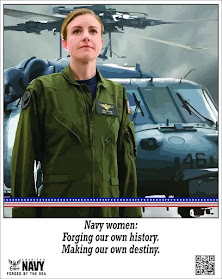
Courageous women –– feminists, activists, and military members seeking justice –– accelerated change. “It would take a series of lawsuits by military women to bring policies, if not attitudes, in synch with the times,” Weintraub writes.

Change came within the executive and legislative branches as well as the judiciary, with key rulings by Justice Ruth Bader Ginsburg and Judge John Sirica. Women themselves formed networks of support. And organizations such as DACOWITS and Women Military Aviators assisted in bringing about change.

"Wings" fills a void in the important history of the advancement of women in the Navy. One of the best features of this book is the inclusion of interviews and testimonials of the first women aviators as well as other women who pioneered progress. Weintraub does a great job of following the lives of the first women naval aviators, including into retirement.

“I will always miss the smell of jet fuel and salt air,” said Jane Skiles O’Dea.


Rosemary Mariner, who once wrote “Adm. Zumwalt changed my life,” said in an interview about women being allowed to serve on submarines, “We will have made progress when this is not a newsworthy event.”


The book opens and concludes with a historic flyover on February 2, 2019, in which the Navy executed the first all-women missing man formation flyover in navy history.


That flyover may remind readers that an all-women team from California performed a flyover at Super Bowl LVII last month to honor fifty years of women in the Navy.


The All-Women flyover team for Super Bowl LVII poses for a group photo at Luke Air Force Base, Feb. 10, 2023. (MC1 Bobby Bladock)

Happy Women’s History Month.

Thursday, March 18, 2021

‘Woke’ or Enlightened


By Bill Doughty

The updated Navy Professional Reading Program is a treasure trove of good books recommended by Chief of Naval Operations Adm. Mike Gilday and Master Chief Petty Officer of the Navy Russell Smith. Some titles are traditional favorites by Hornfischer, Stavridis, and Marlantes, to name a few; others are unexpected and fresh choices.


That’s why it’s a little bit surprising to see National Review take a potshot this week at the list, alleging that some of the titles, including Dr. Ibram X. Kendi’s “How to Be an Antiracist,” are “woke books” that “have no place in U.S. Navy training.” The National Review screed is by someone who writes under the pen name “Roger J. Maxwell.” 


Maxwell complains about the inclusion of Jason Pierceson’s “Sexual Minorities” and Michelle Alexander’s “The New Jim Crow,” drawing more attention and interest in those authors and their views, even if readers don’t agree with everything they say. 

These books, along with several others on the list, reflect a more diverse and inclusive culture.


One of the stated aims of the NPRP is to “Develop a greater appreciation of the views of others and a better understanding of our changing world.” Ironically, National Review published the article with a photo of Kendi in a shirt proclaiming “CHANGE.”


Maxwell recently published another piece in National Review railing against the DoD stand-down to confront extremism, including white supremacism and white nationalism in the aftermath of the 1/6 insurrection at the Capitol. Maxwell concluded, “The only foreseeable outcome of Secretary Austin’s initiative is the creation of distrust in the ranks.”


Accusations of “partisan politics” and “woke ideology” in the military by National Review and Fox News, particularly by Tucker Carlson, remind us of the reaction to the initiatives of Admiral Elmo Zumwalt, who was CNO from 1970 to 1974. [Zumwalt is pictured at the top of this post talking with sailors on the messdecks aboard USS Puget Sound (AD-38) in Newport, RI, circa 1970.]

Sgt. Carrie Falls aboard USS Bataan (LHD 5). (MC2 Magen F. Reed)
Fifty years ago Zumwalt was accused of weakening national defense and creating distrust in the ranks by pushing for equality of opportunity for women and people of color. In reality, he created an enlightened reformation in the U.S. Navy even as fundamentalist conservatives derided him for pushing what they perceived as a left-wing ideology.

Zumwalt was an informed leader who recognized the need for the military to grow, adapt, and change – staying true to core values while protecting our democratic republic.


People who serve in the Department of Defense must reflect the values as well as the demographics of the United States and, above all, fulfill their oath to support and defend the Constitution, a document that was born out of the Enlightenment and Age of Reason. Constitutional Amendments and the Bill of Rights guarantee the right to vote, equality for all, and freedom of speech (including the freedom to read). That may be an ideology, per se, but it’s an ideology reflecting “We the People” and “E Pluribus Unum.”


If there is criticism of the newly updated Navy Professional Reading Program, it is the deletion of the previous version’s “Canon,” which showcased America’s founding documents, especially the Declaration of Independence, Constitution, and Bill of Rights.


Nevertheless, both the CNO and MCPON are commended for publishing titles that hone professional critical thinking skills for a continually evolving Navy, nation, and world. The NPRP motto is “Read well to lead well.”

Navy Reads, which is my personal and unofficial blog, is dedicated to promoting leadership, reading, and critical thinking. We look forward to reviewing some of the NPRP suggestions in the months ahead, including “How to Be and Antiracist.” It sounds enlightening.

Sunday, October 25, 2020

‘Strike from the Sea’

The first REGULUS II is launched from US Navy submarine USS GRAYBACK (SSG 574) in the Pacific, 17 September 1958.

Review by Bill Doughty––

U.S. Naval Institute Press has another winner in “Strike from the Sea: The Development and Deployment of Strategic Cruise Missiles Since 1934” by Norman Polmar and John O’Connell (2020). This carefully researched and documented book –– filled with photos, diagrams, statistics, and appendices –– presents a history of some of the world’s most dangerous tools of war.

Told from an American and largely U.S. Navy perspective, "Strike from the Sea" shows the development of Regulus and Regulus II, Rigel, Triton, Polaris, Vertical Launch Tubes, Tomahawk, and the Virginia Payload Module, among others. (Below, painting of an undersea ballistic missile by Walter H. Bollendonk from 1961 “Polaris Underwater Firing,” USNI.)


We see the evolution of submarines and the roles of USS Barbero (SSA317) and USS Medregal (SS 480) USS Grayback (SSG 574) and USS Growler (SSG 577), USS Halibut (SSGN 587) and USS Permit (SSGN 594, and USS Providence (SSN 719) and USS Pittsburgh (SSN 730). The authors also discuss missile development on surface ships, especially cruisers and carriers, as well as related training, refinement and deployment.

Since submarines are center point, Adm. Rickover is mentioned of course. But once again, Chief of Naval Operations Adm. Elmo Zumwalt comes across as a true hero of forward-thinking leadership, including regarding the development of sea-based cruise missiles.

“In 1972, at Admiral Zumwalt’s direction, the Navy dropped [Rickover’s] concept but continued its separate strategic (Tomahawk) and tactical (Harpoon) cruise missile programs … Thanks to a strategic arms initiative of Dr. Henry Kissinger and the desire of Admiral Elmo Zumwalt to enhance the Navy’s war fighting effectiveness beyond the relatively few large-deck aircraft carriers, the U.S. Navy has generated a massive sea-based cruise missile strike capability.”


The authors show a strong influence of former Secretary of State Kissinger. They also touch on the comparative ambivalence or outright resistance of CNO Adm. James Holloway. “Admiral Holloway, a naval aviator and a former carrier commander, may have been reflecting that community’s disdain for land-attack cruise missiles that could threaten the carrier’s nuclear strike mission.”


Personalities of the people in power can affect policies and strategies. So it’s worthwhile that the authors include the influence of key players to explain how the hardware developed during the Cold War. Any hope of reducing the risk of nuclear weapons, for example, will require international collaboration.


“The Russian navy, despite severe financial, personnel, and other problems, continued a robust program of cruise missile development for surface ships, submarines, and coastal defense –– both anti-ship and land-attack weapons,” the authors note. The Russian initiatives, including development of other vehicles, “were articulated by President Vladimir Putin in March 2018.”


Collective leadership and cooperation have prevented a global nuclear confrontation despite several accidents, malfunctions, close-calls, and misunderstandings. The conclusion of “Strike from the Sea” is compelling and thought-provoking.


In a final section called “Dishonoring a Treaty,” Polmar and O’Connell write:

“The Reagan-Gorbachev Intermediate-range Nuclear Forces (INF) treaty of 1987 was the only agreement of the Cold War era that eliminated an entire class of nuclear weapons –– land-based ballistic and cruise missiles, with nuclear or conventional warheads, with ranges between 310 to 3,400 miles … In early 2008, the Russians began testing a nuclear-capable cruise missile, designated SSC-8 by Western intelligence (Russian designation 9M729). In 2014, after observing continued testing of the missile, the Obama Administration announced that Russia had violated the INF treaty. However, U.S. administration officials later said that although the missile had a range prohibited by the treaty, as of 2015 test flights apparently had not exceeded the 310-mile mark. Subsequently, Russia began a limited deployment of the missile, which has an estimated range of more than 3,400 miles, with various warhead options, some of which reduce its maximum range. In October 2018, President Donald Trump announced that the United States would withdraw from the landmark treaty because of the alleged Russian violations; the withdrawal became formal on 2 August 2019. The Secretary of Defense at the time, James Mattis, a retired Marine general, had consulted with officials from the 28 other members of NATO, seeing their ideas on how to react to the Russian violations of the INF treaty … The Russian government denied violating the INF treaty and said that U.S. withdrawal would be dangerous and could spark a new nuclear arms race.”

This insight into the Trump-Putin implosion of the bilateral INF treaty leaves a huge question: what comes next –– not only in the evolution of earth-threatening missiles, but also in the re-creation of a world without nuclear weapons?

That question led me to a remarkably interesting and well-written book by French author Guillaume Serina, translated by David A. Andelman: “An Impossible Dream: Reagan, Gorbachev, and a World Without the Bomb” (Pegasus, 2019).


Former Soviet Union leader Mikhail Gorbachev said, “We must demilitarize.” Reagan, with some advice from his Secretary of State George Shultz, told the world, “We proposed the most sweeping and generous arms control proposal in history. We offered the complete elimination of all ballistic missiles –– Soviet and American –– from the face of the Earth by 1996.”


Reagan quoted another great leader in his remarks: “Another president, Harry Truman, noted that our century has seen two of the most frightful wars in history and that ‘the supreme need of our time is for man to learn to live together in peace and harmony.’”

Serina’s book offers an introduction by Gorbachev, who says, “What we need today is precisely this: political will. We need another level of leadership, collective leadership, of course.”


Along with “Strike from the Sea’s” terrific history of cruise missile hardware development it is important to read more about the work of President Reagan, Gorbachev, and other leaders who confronted nuclear arms proliferation. What can be done to achieve nuclear disarmament and prevent global destruction?


PACIFIC OCEAN (Sept. 17, 2020) – Sailors inspect Harpoon anti-ship cruise missiles aboard the Los Angeles-class fast-attack submarine USS Chicago (SSN 721) in support of Valiant Shield 2020. Valiant Shield is a U.S. only, biennial field training exercise (FTX) with a focus on integration of joint training in a blue-water environment among U.S. forces. This training enables real-world proficiency in sustaining joint forces through detecting, locating, tracking, and engaging units at sea, in the air, on land, and in cyberspace in response to a range of mission areas. (U.S. Navy photo by Mass Communication Specialist 1st Class Derek Harkins/Released)


Monday, June 1, 2020

Navigating Now in 'Sea of Despair'

Review by Bill Doughty––

In these troubled times we can and should consider advice from good, principled leaders.

Then-Secretary of the Navy (SECNAV) Ray Mabus speaks with civil rights hero and U.S. Representative of the Fifth District of Georgia, John Lewis, Jan. 6, 2016, before the ship-naming ceremony for the future fleet replenishment oiler USNS John Lewis (T-AO 205). USNS John Lewis will be the first ship of the Navy's newest generation of fleet replenishment oilers. Photo by Mass Communication Specialist Second Class Armando Gonzales)
The most respected living civil rights leader, Representative John Lewis of Georgia, asked Americans today on the Morning Joe show to "not get lost in a sea of despair but to keep the faith" and be "true to the cause of love, peace and nonviolence." (Read another moving statement from Lewis at the end of this post.)

This week, after witnessing the horror of racially charged events –– including the killings of George Floyd, Breonna Taylor, Ahmad Aubrey –– I turned to a book by Melvin G. Williams Sr. and Melvin G. Williams Jr., "Navigating the Seven Seas: Leadership Lessons of the first African American Father and Son to Serve at the Top in the U.S. Navy" (Naval Institute Press, 2011).

The book has been a perennial recommendation on the Navy Professional Reading Program. It serves as a lighthouse of inspiration with advice on character, courage and commitment as well as other key qualities needed to be a good leader, citizen and sailor.

Williams Sr. is a retired Command Master Chief who was in charge of the SECNAV-CNO Flag Mess at the Pentagon and played a pivotal role in helping further integrate the Navy in the late 60s, including providing advice and inspiration to ADM Elmo Zumwalt Jr., then-Chief of Naval Operations.


All Hands Update "Legacy of Service" interview with Williamses about diversity in the Navy. Hosted by PO2 Patrick Gearhiser. (DVIDS)

ADM John C. Harvey Jr. publicly commended retired Master Chief Williams in 2010 saying, "You served your Navy and your nation with honor and distinction for over twenty-seven years, during a period of time when you loved your Navy far more than your Navy loved you. You never lost faith that someday, the Navy you loved so much and served so well would take the steps that had to be taken and allow a sailor's talent to be the sole measure of what a sailor can do." Williams Sr. served in the Navy for 27 years.

Vice Adm. Mel Williams Jr., commander of U.S. 2nd Fleet, salutes sideboys aboard the guided-missile frigate USS Halyburton (FFG 40) April 28, 2010 during a ship visit while Halyburton is in port for Fleet Week Port Everglades for a celebration of the maritime services. (Photo by Seaman Travis J. Kuykendall)
Williams Jr., served as a submarine officer and aboard surface ships and aircraft carriers for 32 years. He achieved the rank of vice admiral and commanded the U.S. Second Fleet, leading sailors and Marines. He coordinated closely with NATO, where he helped develop and publish the first maritime counter-piracy tactics and contributed to NATO maritime security operations.

Williams Jr. recounts his childhood briefly in "Navigating the Seven Seas":
"I arrived on this Earth in November 1955, about one month before Rosa Parks refused to give up her seat on a bus in Montgomery, Alabama. As an African American male who grew up in the United States when equal opportunity for all people was beginning, I felt a personal imperative to have the integrity and determination to fulfill the obligation that I truly believed I had to realize the dreams of those courageous African Americans who had come before me. I was not alone in this belief, which many African Americans in my generation shared."
Father and son discuss their book, "Navigating the Seven Seas"
Williams Jr. said his family instilled respect for hard work and education as well as "traits including integrity, determination, a positive attitude, fairness, a personable disposition, humility, and the elements of servant leadership."

Like all military families, there were moves and new schools. In 1968 the family moved to Washington D.C., where thirteen-year-old Mel Jr. "absorbed pivotal events of that year": Vietnam War, Tet Offensive, assassinations of Martin Luther King Jr. and Robert Kennedy, racial riots, and Mexico City Olympics.

This book is part double-autobiography, part guide to good leadership. The "Seven Seas" is a "nautical play on words," representing the maritime global commons to show how to navigate as a leader through Seven Cs:
  • Character: The first and most essential of the Cs, trumping all others –– "the commitment to take right and timely action repeatedly toward realizing the vision are central to leadership."
  • Competence: "A leader must be competent as he or she guides the organization."
  • Courage: "Leaders should consider the facts, opinions of a diverse group, instincts and intuition, and be decisive at the right time."
  • Commitment: Developing people to their full potential, trusting others, and delegating authority are essential to being a good leader.
  • Caring: Serving others is caring for others, ensuring they have "needed resources."
  • Communicating: "People want to be inspired by the leader" who must "develop forward-looking plans with the team, and take action while creating a sense of urgency."
  • Community: "With better-prepared and developed individuals, the leader works to create a cohesive team, so that the whole is greater than the sum of the individuals."
Williams Sr.'s great-grandparents on both sides were born into slavery. The veteran of the Korean War, Vietnam War and Cold War Navy nurtured a culture of love, empathy and servant leadership in his family and within his circle of influence in the Navy.

The authors provide quotes from Martin Luther King Jr., John F. Kennedy, Eleanor Roosevelt, Booker T. Washington, Thomas Paine, Lao Tzu, Albert Einstein, and others.

Among those they name in their acknowledgements (as listed): Barry Danforth, James L. Holloway III, Hugh McCracken, Elmo Zumwalt Jr., Chuck Beers, Skip Bowman, James Cartwright, Kirk Donald, Jerry Ellis, Malcolm Fages, Ed Giambastiani, the Golden Thirteen, Samuel Gravely, Mike Mullen, B.J. Penn, Hyman G. Rickover, Gary Roughead and Carl Trost.

Current and past Chiefs of Naval Operations (CNO) came to the Pentagon for the unveiling of the CNO portraits, 26 June 1986. Left to right: Admiral James L. Holloway III, USN (Retired); Admiral Carlisle A.H. Trost, USN, CNO Designate; Admiral Robert B. Carney, USN (Retired); Admiral Thomas B. Hayward, USN (Retired); Admiral James D. Watkins, USN, then-CNO; Admiral George W. Anderson, USN (Retired), seated; Admiral Elmo R. Zumwalt, Jr., USN (Retired); Admiral David L. McDonald, USN (Retired); Admiral Arleigh A. Burke, USN (Retired); and Admiral Thomas H. Moorer, USN (Retired). (NHHC)

Along with the Seven Cs, the authors highlight the Navy's Core Values (including two of the Cs): Honor, Courage and Commitment. "Courage" comes up time and again in "Navigating the Seven Seas."

Williams Jr. writes, "Throughout history, the men and women who serve in the armed forces in defense of freedom, human rights, and the rule of law have been leaders who routinely demonstrate courage." He adds, "We, the beneficiaries of freedom, should be grateful to these courageous leaders. I am."

In 2020, do we have the courage to confront inequality, achieve fundamental systemic police reform as well as protect the community by demanding nonviolence? In protesting injustice, anger is justified; violence is not.

John Lewis is a courageous leader in civil rights. He calls for peace and nonviolence in the face of riots happening in 2020 so we are not "lost in a sea of despair."

Rep. John Lewis (D Ga.) dons protective gear as he prepares to weld his initials into the keel plate of his namesake ship during the keel laying ceremony of USNS John Lewis at the General Dynamics Shipyard in San Diego, May 13, 2019. (Photo by Sarah Burford)

Statement by Rep. John Lewis, Congressman from Georgia's 5th District:

"Sixty-five years have passed, and I still remember the face of young  Emmett Till. It was 1955. I was 15 years old — just a year older than him. What happened that summer in Money, Mississippi, and the months that followed — the recanted accusation, the sham trial, the dreaded verdict — shocked the country to its core. And it helped spur a series of non-violent events by everyday people who demanded better from our country.

Martin Luther King Jr. Memorial (NPS)
“Despite real progress, I can't help but think of young Emmett today as I watch video after video after video of unarmed Black Americans being killed, and falsely accused. My heart breaks for these men and women, their families, and the country that let them down — again. My fellow Americans, this is a special moment in our history. Just as people of all faiths and no faiths, and all backgrounds, creeds, and colors banded together decades ago to fight for equality and justice in a peaceful, orderly, non-violent fashion, we must do so again.

“To the rioters here in Atlanta and across the country: I see you, and I hear you. I know your pain, your rage, your sense of despair and hopelessness. Justice has, indeed, been denied for far too long. Rioting, looting, and burning is not the way. Organize. Demonstrate. Sit-in. Stand-up. Vote. Be constructive, not destructive. History has proven time and again that non-violent, peaceful protest is the way to achieve the justice and equality that we all deserve.

“Our work won't be easy — nothing worth having ever is — but I strongly believe, as Dr. King once said, that while the arc of the moral universe is long, it bends toward justice.” –– May 30, 2020