Thursday, March 11, 2021

‘Kingdom Coming’ Came to Capitol

Review by Bill Doughty ––

Michelle Goldberg
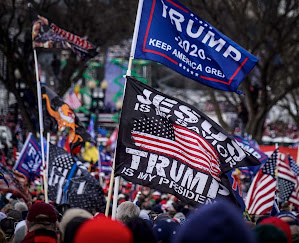
“Kingdom Coming: The Rise of Christian Nationalism” by Michelle Goldberg (WW Norton, 2006), is a book completely relevant after the January 6, 2021 attack on the Capitol by Trump-inspired insurrectionists, white supremacists, and Christian nationalists.

When, where, and who are the next targets?


Written fifteen years before the 1/6 attack, Goldberg seems to predict the violence at the Capitol as she explains the passion and self-righteousness of homegrown extremists rooted in Christian identity.


Goldberg writes, “This is what we are up against. Christian nationalists worship a nostalgic vision of America, but they despise the country that actually exists –– its looseness, its decadence, its maddening lack of absolutes.” (To be clear, most Christians condemn and regret the violence of Jan. 6, and not every rioter was a Christian fundamentalist extremist.)


In “Kingdom Coming” Goldberg reflects on the rise of fascist fundamentalism in the wake of “the Posse Comitatus, the Christian Identity-influenced paramilitary network, which in turn bred the militia movement.” By the mid-1980s and into the 90s Posse Comitatus had at least 15,000 active members and many more followers throughout the nation.

“The militia movement, which was active in several states during the mid-1990s, evolved out of the Posse Comitatus. Militia ideologues often trafficked in an explosive blend of conspiracy theory, survivalism, hatred of the federal government, and Christian Identity; the movement was part of the paranoid and violent demimonde that nurtured terrorists including Oklahoma City bombers Timothy McVeigh and Terry Nichols and Olympic bomber Eric Rudolph. As the decade came to an end, the militia movement splintered and dissipated. Yet its brand of radical religious nationalism, rather than going underground, slithered closer to the mainstream.”

McVeigh
McVeigh very nearly joined the U.S. Navy, but chose instead to enlist in the Army, where he met Nichols. McVeigh participated in Operation Desert Storm in the early 80s.

As noted in an earlier Navy Reads post, of the insurrectionists who were first arrested for attacking the Capitol Jan. 6, around 12 percent reportedly had connections to the military. So far, more than 40 of the people arrested are military veterans. (Others had ties to law enforcement. And at least one violent insurrectionist served in the previous administration as a Trump appointee.)


Goldberg explores the modern history of Christian nationalism and touches on some of its permeation in the military, including at the Air Force Academy, where cadets were made to accept Christianity as a “total ideology.” In 1961 Maj. Gen. Edwin A. Wacker, a member of the John Birch Society, was found to be “indoctrinating” U.S. troops stationed in Europe; he was denounced on the Senate floor. In 2003 Lt. Gen. William G. Boykin wore his uniform while proselytizing Christianity over Islam: “I knew that my god was a real god, and his was an idol.”


In 1986, Secretary of Defense Caspar Weinberger issued a directive decreeing that “military personnel must reject participation in white supremacy, neo-Nazi and other such groups …” But the military failed to completely root out the relatively small number of white power hate groups and individuals in uniform.


Secretary of Defense Lloyd J. Austin III speaks to service members aboard USS Nimitz, Feb. 25, 2021. (DoD Photo by U.S. Air Force Staff Sgt. Jack Sanders).


On Martha Raddatz’s Face the Nation March 7, Secretary of Defense Lloyd J. Austin III recommitted to eradicating extremism –– racists, fascists, supremacists, and anarchists –– in the ranks.


Referring to core values and the oath to protect and defend the Constitution, Austin said, “We want to make sure that our troops are reminded of what our values are, reminded of the oath that we took coming in. And my belief, my strong belief, Martha, is that 99.9 percent of our troops embrace those values, and are focused on the right things, and are doing the right things each and every day.”


The evidence of white supremacists’ and Christian nationalists’ active participation in the Jan. 6 insurrection siege is undeniable –– from images of the huge wooden cross, to signs, flags, and the words they screamed as they assaulted police officers and guards, the media, and the Constitution.


[Among the startling images captured Jan. 6 is a video by New Yorker’s Luke Mogelson, which includes a temporary takeover of the Senate chambers by Christian nationalists (at 7:55 in the video).]


Goldberg’s review of history includes several quotes from Hannah Arendt describing Germany’s conservatives in the post First World War era. They “bought into the dolchstosslegende, the myth that the military had been stabbed in the back by subversive civilian traitors –– especially Jews.”

Who could be scapegoats and targets in the years ahead if such thinking continues to grow? Atheists? Blacks? Browns? Asians? “Latte-drinking liberal elites”?

In "Kingdom Coming," published five years after the attacks of Sept. 11, 2001, Goldberg notes the similarities of fundamentalists in the Middle East and the United States. She questions the wisdom of perpetuating foreign entanglements while ignoring threats on the Homefront. Those threats include “a conscious refutation of Enlightenment rationalism” and rejection of “the idea of government religious neutrality.”

“It makes no sense to fight religious authoritarianism abroad while letting it take over at home. The grinding, brutal war between modern and medieval values has spread chaos, fear, and misery across our poor planet. Far worse than the conflicts we’re experiencing today, however, would be a world torn between competing fundamentalisms. Our side, America’s side, must be the side of freedom and Enlightenment, of liberation from stale constricting dogmas. It must be the side that elevates reason above the commands of holy books and human solidarity above religious supremacism. Otherwise, God help us all.”

Far from just presenting a problem, though, Goldberg also offers prescriptions for finding reason through critical thinking and “practical politics.” She sees the answer in big-tent moderate strategies, not radical liberalism or conservatism –– neither Goldwater nor McGovern. The answer, however, is not appeasement.


President Joe Biden talks with Secretary of Defense Lloyd J. Austin III during a visit to the Pentagon, Washington, D.C., Feb. 10, 2021. (DoD photo by Lisa Ferdinando)

Goldberg seems to envision the current Biden administration:

“My ideas are not about reconciliation or healing. It would be good for America if a leader stepped forward who could recognize the grievances of both sides, broker some sort of truce, and mend America’s ragged divides. The anxieties that underlay Christian nationalism’s appeal –– fears about social breakdown, marital instability, and cultural decline –– are real. They should be acknowledged and, whenever possible, addressed. But as long as the movement aims at the destruction of secular society and the political enforcement of its theology, it has to be battled, not comforted and appeased.”

She cites the view of Arendt again to make her point. Arendt warned of “unprecedented unpredictability” of totalitarian movements, based on her experience witnessing the rise of Nazi Germany. Can the same advice apply to the mindset of the Trump supporters and Christian nationalist insurrectionists who believed Big Lie propaganda and heeded the call to fight and march on the Capitol January 6, 2021?


Arendt wrote: “Because of its demagogic qualities, totalitarian propaganda, which long before the seizure of power clearly indicated how little the masses were driven by the famous instinct of self-preservation, was not taken seriously.”

Saturday, March 6, 2021

‘How to Lead’ -– Attributes


Review by Bill Doughty

What makes a good leader? What attributes can be found in successful ethical leadership? Listen to this.


David M. Rubenstein hears from renowned leaders in “How to Lead: Wisdom from the World’s Greatest CEO, Founders and Game Changers” (Simon & Schuster, 2020). He interviews people like Bill and Melinda Gates, Gen. David Petraeus, Speaker Nancy Pelosi, and President George W. Bush, and others. He arranges the interviews in six categories: visionaries, builders, transformers, commanders, decision-makers, and masters.

According to Rubenstein, here are attributes of a good, successful leader: luck, focus, persuasiveness, a desire to succeed, pursuit of something unique, willingness to work long hours, ability to keep learning (“nothing focuses the mind like a good book”), integrity, humble demeanor, credit-sharing, ability to keep learning, responding to crises, and rising from failure.


“Failure teaches humility and exponentially enhances the desire to succeed the next time,” he writes.


Dr. Anthony Fauci, interviewed in this book, gives this advice about good leadership: “You don’t dictate to people. But if you let them know what your vision is, hire the best people, and then don’t get in their way, those are the qualities of a good leader.”


As for other advice in responding to crises, Rubenstein writes:

“Leaders are most needed when crises occur, as we have been reminded this year during the COVID-19 pandemic and the nationwide protests over the death of George Floyd. Rising to the occasion when an existential crisis occurs can mark a leader forever –– Lincoln holding his country together during the Civil War or Churchill rallying his country to fight the Nazi attacks.”

Powell, Bush and Schwarzkopf attend a memorial service in Kuwait, Jan. 26, 2001. (Sgt. B. Beach)
In an interview with Gen. Colin Powell (former Chairman of the Joint Chiefs and former Secretary of State), Rubinstein listens to how the United States responded to a crisis –– Iraq’s invasion of Kuwait leading to the first Gulf War during George H. W. Bush’s administration.

Powell said every good leader must have a strong vision and understand “why we are here” and then instill that understanding of “why” through all levels of the organization or team. 


“That’s what leadership is all about –– inspiring others,” he says.


Powell discusses how United States Marines achieved the mission in the first Gulf War, not only following their initial orders but also seizing an opportunity to advance when they saw the chance. Agility and nimbleness are good attributes for any leader.


Powell also takes questions head-on about his role in the second Gulf War, in which the CIA provided information Powell then relayed to Congress about weapons of mass destruction in Iraq –– as justification for an invasion. He offers a thoughtful and critical analysis.


Cadet Dalton MacAfee receives the Mike Krzyzewski Teaching Character Through Sport Award May 6, 2019 at West Point Military Academy. (PO1 Bryan Ilyankoff)

Interviewing Coach Krzyzewski (“Coach K”) of Duke basketball, Rubenstein asks about what he rightly calls “one of the greatest games ever played”: the 1992 semi-final game between Duke and Kentucky. Kentucky scored an improbable basket in the last seconds of overtime, putting them up by one point. With 2.1 seconds left in the game, Duke had the ball and called a timeout.

Coach K  remembers, “The very first thing a leader has to show is strength, so I met them as they were coming to the bench, and I said, ‘We’re going to win. We are going to win.' Then he called up a creative play –– Grant Hill passing 75 feet to Christian Laettner at the top of the key for a turnaround jump shot. Duke won the game and went on to win the championship thanks to their leader’s confidence.


Among this book’s eclectic group of leaders –– including Condoleeza Rice, Justice Ruth Bader Ginsberg, Yo Yo Ma, Robert F. Smith, and James A. Baker III –– is an unexpected but rewarding choice of subjects: Lorne Michaels, creator and producer of Saturday Night Live. SNL has catapulted the careers of Bill Murray, Eddie Murphy, Steve Martin, Will Ferrell, Tina Fey, Billy Crystal, Chris Rock, Julia Louis-Dreyfus, Amy Poehler, Kristin Wiig, Jimmy Fallon, Seth Meyers, Kate McKinnon, and scores of other comedians, talk show hosts, and actors.

Second Lieutenant Leah Davis speaks with actor Bill Murray, at the Wrenwoods Golf Course, Joint Base Charleston, S.C., Aug. 17, 2012. Murray participated in the golf tournament sponsored by the Airlift/Tanker Association. (SSgt. Katie Gieratz)


Michaels discusses the challenges of leading generations of creative people. “You try to create a culture where everyone feels they’re heard,” he says. “You lead by example.” He admits to being “ruthless” in ensuring the show is good. He is equally ruthless in ensuring everyone’s voice is heard and in being flexible enough to adapt quickly to change. He listens. To everyone.

It’s interesting to hear also about the history of how SNL got started; its ties to Johnny Carson, Howard Cosell, and first host George Carlin; and how the show and comedy itself has evolved over nearly 50 years.


Most of the very best leaders, by the way, have another important attribute: a sense of humor.


Robert M. Gates praises this book in a prominent blurb: “A wonderfully entertaining book about leaders from very different professions and walks of life … Rubenstein discerns the attributes of leadership they all have in common. ‘How to Lead’ is an exceptionally instructive and inspirational book.”


Chief of Naval Operations (CNO) Adm. Mike Gilday uses the 1MC to address the crew aboard the Freedom-class littoral combat ship USS Billings (LCS 15). Gilday visited Naval Station Mayport Mar. 3, 2021 to engage with Sailors, speak to local Navy leaders, and tour a number of commands in the area. (MC3 Austin Collins/Released)

Monday, February 22, 2021

THE Book: ’A Promised Land’

Review by Bill Doughty

Barack Obama’s “A Promised Land” (Crown, 2020) is THE book to read this month.


Supremely self-aware and filled with empathy, Obama weaves his own life experiences –– as a son, grandson, husband, dad, and friend –– with his career, focusing especially on early 21st century history and the first two years of his presidency.

Obama’s experience growing up in Hawaii, living in Indonesia, having grandparents from Kansas, and working in Chicago helped him develop a wider perspective –– outside looking in. Introspection is part of his very being: “As an African American, I’d experienced what it was like not to be fully seen inside my own country.”


Books captivated him at an early age. Mohandas Gandhi, Abraham Lincoln, Martin Luther King Jr., and James Baldwin informed his world view. Later, Elie Wiesel became a big influence. “Reading his books," Obama writes, "I’d found an impregnable mortal code that both fortified me and challenged me to be better."


Philosophy, humor, and pathos mix with a practical but lyrical narrative in this captivating book, the first in what promises to be two volumes. (I won’t be surprised or disappointed if it becomes three.) It is dedicated "To Michelle –– my love and life's partner and Malia and Sasha –– whose dazzling light makes everything brighter."


CJCS Adm. Mullen and President Obama at 9/11 ceremony at Pentagon, Sept. 11, 2009.
Dozens of characters appear on history’s stage in “A Promised Land,” including Chairman of the Joint Chiefs Gen. Mike Mullen, Gen. Stanley McChrystal, German Chancellor Angela Merkel, Russian President Vladimir Putin, and businessman Donald Trump. Obama writes them into the story with deft pen strokes. He admits in the book's preface that he composes first by hand on yellow legal pads.

Obama’s mindfulness, self-awareness, and critical thinking are the tools he uses to weave together this tapestry of his history. That history includes confronting the economy debacle of the previous administration, dealing with the H1N1 pandemic, facing the BP Deep Water Horizon oil drilling catastrophe, approving Navy SEALS’ mission to rescue Richard Phillips from Somali pirates, and many other crises and achievements.


For Navy Reads readers “A Promised Land” provides invaluable insights into nuclear disarmament efforts, a first-hand perspective on hunting Osama bin Laden, various commander-in-chief challenges, and a deep reverence for military service and sacrifice and about the nature of true patriotism. Obama writes extensively about his visits to meet wounded warriors and their families.

“How those men inspired me! Their courage and determination, their insistence that they’d be back at it in no time, their general lack of fuss. It made so much of what passes for patriotism –– the gaudy rituals at football games, the desultory flag waving at parades, the blather of politicians –– seem empty and trite. The patients I met had nothing but praise for the hospital teams responsible for their treatment –– the doctors, nurses, and orderlies, most of them service members themselves, but some of them civilians, a surprising number of them foreign-born, originally from places like Nigeria, El Salvador, or the Philippines. Indeed, it was heartening to see how well these wounded warriors were cared for, beginning with the seamless, fast-moving chain that allowed a Marine injured in a dusty Afghan village to be medevaced to the closest base, stabilized, then transported to Germany and onward to Bethesda or Walter Reed for state-of-the-art surgery, all in a matter of days.

“Because of that system –– a melding of advanced technology, logistical precision, and highly trained and dedicated people, the kind of thing that the U.S. military does better than any other organization on earth –– many soldiers who would have died from similar wounds during the Vietnam era were now able to sit with me at their bedside, debating the merits of the Bears versus the Packers. Still, no level of precision or care could erase the brutal, life-changing nature of the injuries these men had suffered. Those who lost a single leg, especially if the amputation was below the knee, often described themselves as being lucky. Double or even triple amputees were not uncommon, nor were severe cranial trauma, spinal injuries, disfiguring facial wounds, or the loss of eyesight, hearing, or any number of basic bodily functions. The service members I met were adamant that they had no regrets about sacrificing so much for their country and were understandably offended by anyone who viewed them with even a modicum of pity. Taking their cues from their wounded sons, the parents I met were careful to express only the certainty of their child’s recovery, along with their deep wells of pride.

“And yet each time I entered a room, each time I shook a hand, I could not ignore how incredibly young most of these service members were, many of them barely out of high school. I couldn’t help but notice the rims of anguish around the eyes of the parents, who themselves were often younger than me. I wouldn’t forget the barely suppressed anger in the voice of a father I met at one point, as he explained that his handsome son, who lay before us likely paralyzed for life, was celebrating his twenty-first birthday that day, or the vacant expression on the face of a young mother who sat with a baby cheerfully gurgling in her arms, pondering a life with a husband who was probably going to survive but found no longer be capable of conscious thought.”

President Obama visits a wounded warrior for a Purple Heart presentation at Walter Reed National Military Medical Center in Bethesda, Md., Oct. 10, 2011. (Pete Souza)


Obama’s many visits to Bethesda/Walter Reed, as well as his participation in dignified transfer ceremonies at Dover Air Force Base informed and inspired him about the nature and cost of war.

“I was never more clear-eyed than on the flights back from Walter Reed and Bethesda. Clear about the true costs of war, and who bore those costs. Clear about war’s folly, the sorry tales we humans collectively store in our heads and pass on from generation to generation –– abstractions that fan hate and justify cruelty and force even the righteous among us to participate in carnage. Clear that by virtue of my office, I could not avoid responsibility for lives lost or shattered, even if I somehow justified my decisions by what I perceived to be some larger good.”

Vaclav Havel speaks to U.S. Congress in 1990.
Those visits informed him, as well, of the importance and value of affordable health care on a national scale.

This book is filled with nuggets of wisdom, such as:

  • Hearing this wisdom from Vaclav Havel, former president of the Czech Republic: “‘Today, autocrats are more sophisticated. They stand for election while slowly undermining the institutions that democracy possible. They champion free markets while engaging in the same corruption, cronyism, and exploitation as existed in the past.’”
  • Thinking about the roots of autocracy, whether from communism or religious fundamentalism: “Abstract theories and rigid orthodoxy can curdle into repression.
  • Speaking to WWII Veterans at Normandy: “Our history has always been the sum total of the choices made and the actions taken by each individual man and woman. It has always been up to us.”
  • Questioning political opponents for their fear-filled petty castigation after he bowed to the Japanese emperor, as called for by diplomatic protocol: “I wondered when exactly such a sizable portion of the American Right had become so frightened and insecure that they’d completely lost their mind.”
  • Reflecting about the aftermath of 9/11: “President Bush had done some things right, including swiftly and consistently trying to tamp down anti-Islamic sentiment in the United States –– no small feat, especially given our country’s history with McCarthyism and Japanese internment –– and mobilizing national support for the early Afghan campaign.”
  • Experiencing the joy of coaching his daughter’s basketball team: “Every parent savors such moments, I suppose, when the world slows down, your strivings get pushed to the back of your mind, and all that matters is that you are present, fully, to witness the miracle of your child growing up.”

While accepting the Nobel Peace Prize early in his presidency, Obama spoke to an international audience about the need at times for righteous war, such as when the United States joined with the Allies and confronting and defeating fascism and imperialism in World War II.

Near the end of “A Promised Land’s” 700-plus pages, Obama reflects on war again: “The truth is that war is never tidy and always results in unintended consequences, even when launched against seemingly powerless countries on behalf of a righteous cause.”


This is THE book to read now during Black History Month, in honor of America’s first African American president. It is also a book to read for years to come for anyone interested in understanding the cost of war, the need to preserve peace, and the demand to prevent the rise of autocracy and tyranny –– and achieve greater unity.


Navy Reads looks forward to reading the next volume.


ABOVE: President Barack Obama tours the United States Holocaust Memorial Museum in Washington, D.C., with Sara Bloomfield, museum director, and Elie Wiesel, Nobel Peace Prize laureate and Holocaust survivor, April 23, 2012. (Pete Souza) 
TOP PHOTO: President Barack Obama delivers his remarks to about 3,500 Sailors, Marines and other service members. Obama thanked them for their service during a rally held at Naval Air Station Jacksonville, Oct. 26, 2009. (MCC Anthony Casullo)

Sunday, February 14, 2021

McCarthyism/Trumpism III: Endless ‘Anxiety’

Review by Bill Doughty

In this third book review (in a Navy Reads trilogy) about Senator Joe McCarthy and his legacy, author Haynes Johnson provides more unintended parallels and links to Trumpism in “The Age of Anxiety: McCarthyism to Terrorism” (Harcourt, 2005).

Anxiety at the time this book was written came from the smoldering memories of 9/11 and fear of ongoing terrorism as the American military waged war in Afghanistan and in Iraq. Haynes makes a connection from 9/11 to the anxiety of communism in the 50s –– which would lead to the Vietnam War debacle.


Today, there are still fears of socialism and communism, as well as anxiety about fascism in the aftermath of a failed insurrection Jan. 6 at the Capitol by Trump supporters.


Presciently, Haynes writes this more than fifteen years ago: “The age of anxiety has not ended, nor is it likely to end soon.”


Here are some more parallels and links, including page numbers in the first edition version of this insightful book:


Like Trump, McCarthy tried to paint his opponents, including democrats, as unpatriotic, irreligious and unAmerican. Both Trump and McCarthy warned of “godless communism” in their speeches calling for their version of patriotism. (p.314)


After an earlier hearing in the Senate in the wake of the Tydings report (somewhat comparable to Trump’s first impeachment hearing) “McCarthy was rebuked, but not rejected. From then until the November elections, he became the Republican Party’s most tireless, sought-after, and effective campaigner.” (p. 188)


“The Democrats remained clueless. They believed that McCarthy’s falsehoods were so transparent and outrageous that they would emerge victorious from any encounter with him.” “McCarthy had poked the tigers of the Senate and showed them to be toothless.” (p.159)


McCarthy sued opponents, including a $2M libel suit against Sen. William Benton, admittedly for intimidation purposes and to “force him to spend money to defend himself.” (p.221)

Eisenhower makes a point with McCarthy
President Eisenhower, who is considered a moderate –– or even liberal –– Republican, worked behind the scenes to fight McCarthy. He “was becoming so frustrated with the obstructionism of McCarthy and other ultraconservatives, [he] … was considering the formation of a new party bringing together all the sensible people in the great middle of American life.” (p.260)

Haynes writes, “Over the decades, a more rigidly ideological Republican Party has emerged, forged by many of the forces McCarthy unleashed or harnessed.” (p.461) 


Navy readers will find a fascinating parallel between the swift-boating of John Kerry  and the smear of another Vietnam veteran Max Cleland, both former Senators who had been awarded multiple Purple Heart medals. (p.498)


In Kerry’s case, in which wealthy Texas Republicans funded TV ads with false claims that Kerry falsely received his combat medals, including the Silver Star. “Constant repetition over cable outlets had an echo chamber effect the greatly magnified the ads’ false charges.” (p.499)


Here’s some irony: McCarthy lied about his service in the Marine Corps, and he falsified records after the war to get Distinguished Flying Cross and Air Medal commendations. “The deceit was breathtaking,” Haynes writes. A later investigation revealed McCarthy had apparently drafted his own letter praising his war record and forged the signature of his CO, Maj. Glenn A. Todd. McCarthy then forwarded the letter to be countersigned by Admiral Chester Nimitz, commander of the U.S. Pacific Fleet, as a matter of routine. (p. 53)


The McCarthy “hearings were a landmark in American History. They were consequential, and they stamped indelible images in the public mind.” (p.388) So was the second impeachment of Donald J. Trump, which included indelible images of bloodthirsty Trump supporters attempting to overturn an election and transfer of power. Rioters were summoned to D.C., incited to fight, directed toward the Capitol, and allowed to attack police and the Capitol itself for hours.


Are McCarthyism and Trumpism names for the same phenomenon, describing ultranationalism, patriarchy, racism, and misguided patriotism? Examples in American history abound: slavery, actual witch hunts, Alien and Sedition Acts, loyalty tests, disallowing women the right to vote, civil rights violations, and family child separations, and others.

Haynes reports about the first Great Red Scare just over 100 years ago as World War 1 was about to end and Lenin and Trotsky came to power in the Russian Revolution. Bombings and riots shook the United States. In 1919, in the middle of the Great Influenza Pandemic, soldiers and sailors stormed the office of a Cleveland socialist newspaper. In Chicago, a sailor shot a man for not standing and removing his hat for the Star Spangled Banner. (p.102)


SECDEF Lloyd J. Austin III
A century later: A remarkable number (reports say 12 percent or more) of insurrectionists and rioters who stormed the Capitol last month had served in the military. New Secretary of Defense Lloyd J. Austin III ordered a 60-day stand-down to confront extremism.

Endless vigilance against violence is required of those who take an oath to protect and defend the Constitution against all enemies, foreign and domestic. As Edward R. Murrow said, “We cannot defend freedom abroad by deserting it at home.”


Haynes gives an excellent presentation of the Army hearings in which the Army's lead defense attorney Joseph Welch confronted and ended McCarthy’s reign of terror with the immortal rebuke: “… You have done enough. Have you no sense of decency at long last ? Have you left no sense of decency?”


Haynes concludes, “McCarthyism remains a story without an ending.” “Extremism –– and the suspicion and hatred it engenders –– may be Joe McCarthy’s most lasting legacy.”


A Presidents Day Postscript:


Haynes writes, “As a way of indicating his own model for statesmanship, McCarthy posted on the wall of his Senate office a copy of Lincoln’s famous remark: ‘If the end brings me out all right, what is said against me won’t amount to anything. If the end brings me out wrong, ten angels swearing I was right would make no difference.’” (p.79)


Conservative anti-communists prevented the performance of “Lincoln Portrait” at Eisenhower’s inauguration, because the composer, Aaron Copland, was loosely associated with “radical causes,” although he did not belong to the Communist Party. “Portrait” includes Lincoln’s memorable and still relevant words, “Fellow citizens, we cannot escape history. We of this Congress and this Administration will be remembered in spite of ourselves.” (p.300)


Democratic presidential candidate in 1952, Adlai Stevenson, echoed Lincoln in a speech about the Republican Party divide over McCarthyism: “A political party divided against itself, half McCarthy and half Eisenhower, cannot produce national unity.” (p.375)


Just a reminder: Navy Reads is an unofficial blog of book reviews and personal views on critical thinking, core values, Constitutional issues, and political-military-diplomatic philosophy.


WASHINGTON (April 15, 2015) -- Aviation Maintenance Administrationman Airman Apprentice Zaine Ahringhoff, assigned to the Nimitz-class aircraft carrier USS Abraham Lincoln (CVN 72), admires the Lincoln Monument during a trip to Washington, D.C. to commemorate the 150th anniversary of President Abraham Lincoln's assassination, April 15.  (MC3 Brenton Poyser)

Saturday, February 6, 2021

A Heated Senate; ‘No Sense of Decency’

Review by Bill Doughty

Another book adds to the understanding of McCarthyism and how it infected the body politic in the United States but failed to destroy the U.S. military and other pillars of democracy –– despite leaving lasting ailments.


Robert Shogan presents vignettes and the cast of characters in “No Sense of Decency: The Army-McCarthy Hearings: A Demagogue Falls and Television Takes Charge of American Politics” (Ivan R. Dee Publisher, 2009).

Shogan shows how the U.S. Senate in the early 1950s, aided and abetted by a willing media, fueled McCarthy’s conspiracy theories and attacks on democracy under the veil of patriotism. President Eisenhower said, “It saddens me that I must feel ashamed for the United States Senate.”


McCarthy’s legacy is one of lies and prevarication, breaking of norms, disrespect for rules and codes of conduct, prioritizing personality over substance, and a love for power and personal ambition over public interest.


In our previous post, we covered other parallels between McCarthyism and Trumpism as revealed in Larry Tye’s “Demagogue.” Shogan’s “No Sense of Decency" reveals more links and parallels. 


For instance:


Gen. George Marshall
McCarthy’s slander of war heroes, including General Marshall, a leader in World War II and a chief military advisor to President Truman as well as Secretary of State (p. 75) reads like Donald Trump’s reported disrespect for fallen soldiers and his slander of Senator John McCain, a Navy veteran and Vietnam War POW.


McCarthy attacked opponents’ family members, including Maj. Gen. Miles Reber’s brother as part of his Big Lie conspiracies. (p. 146)


Despite haranguing people who used the fifth amendment, McCarthy became known as the “Fifth Amendment Senator” when he, himself, was under investigation. (p. 244)


McCarthy weakened and divided his Republican Party but ironically brought about some bipartisanship in how the Senate eventually dealt with him, leading to a vote for censorship. (p. 248)


Shogan writes:

“The Senate faced a tortuous choice. For many of its members, conscience and a sense of obligation toward the legislative body whose prerogatives McCarthy now professed to be defending inclined them in favor of censure. But for many –– including those leading toward censure –– political considerations raised a red flag. McCarthy may have lost ground with the majority of Americans, but he still had a hard cadre of supporters, and these partisans felt bound even closer by the threat of censure.”

Sen. Joseph McCarthy
In the end, McCarthy refused to apologize.“He now wanted to become a victim and to use his martyrdom to expand and strengthen his own personal political base outside the Republican Party,” Shogan writes.


The characters in the Senate seventy years ago during the McCarthy hearings included young John F. Kennedy, democratic leader Lyndon B. Johnson, Richard M. Nixon, Stuart Symington, Everett Dirkson, Margaret Chase Smith, and Prescott Bush (father and grandfather of future presidents). Many of the senators were military veterans of World War II; some fought in World War I or in earlier conflicts.


Studying the list of senators from the 82nd and 83rd Congress (during McCarthy’s reign of terrorizing), it’s fascinating to see how many were born before the turn of the 20th century. Their parents or grandparents fought in or lived through the Civil War. The oldest senator in the group, Theodore F. Green of Rhode Island, was born in 1867 and served as a first lieutenant in the Spanish-American War.


Senator John F. Kennedy
All of the senators lived through the 1918 pandemic, including JFK, born May 29, 1917 and Russell Billiu Long, born Nov. 3, 1918. Long, who served as a Navy lieutenant in World War II, commanded a landing craft transport vessel. (He was the son of Louisiana governor and senator Huey Long.) None lived long enough to see the current coronavirus pandemic.


“No Sense of Decency” is a well-written, fast-paced accounting of the people, legacy, politics, and characters surrounding Joe McCarthy and McCarthyism.


“The politics of fear and paranoia, while they ebbed and flowed, never really went away,” Shogan concludes.


Reading about the history of the Cold War in general and McCarthyism in particular provides an insight to help understand current surrealism –– as well as other isms and ailments in its wake.