Showing posts sorted by date for query arleigh burke. Sort by relevance Show all posts

Saturday, June 17, 2023

Navy Good, Future Unraveling

Review by Bill Doughty––

Geopolitical strategist Peter Zeihan expresses high regard for the United States Navy as a global force for good. He says the U.S. is “primarily a naval power,” and it is America’s Navy that has protected sea lanes and global commons, allowing what could be the greatest period of peace and prosperity in the history of the world.


That peace was guaranteed after the Second World War and the defeat of Japanese and German imperialism and fascism, when the Americans “offered their wartime allies a deal.”

“The Americans would use their navy –– the only navy of size to survive the war –– to patrol the global ocean and protect the commerce of all. The Americans would open their market –– the only market of size to survive the war –– to allied experts so that all could export their way back to wealth. The Americans would extend a strategic blanket over all, so that no friend of America need ever fear invasion again.”

But in Zeihan’s now-dystopian view of the future, that era of peace and prosperity is over.

In “The End of the World Is Just the Beginning: Mapping the Collapse of Globalization” (HarperCollins, 2022) Zeihan presents extensive data, charts, and demographic analysis showing evidence of de-globalization, less world trade, and aging populations in many countries:

  • This is the “best it will ever be in our lifetime.”
  • “The world –– our world –– is breaking apart.”
  • China is aging “into demographic obsolescence.”
  • “We are entering a period of extreme transformation, with our strategic, political, economic, technological, demographic, and critical norms all in flux at the same time.”
  • “Everything is going to change” and “the process will be the definition of traumatic.”
  • “Living through history is messy.”

“De-globalization,” Zeihan writes, “doesn’t simply mean a darker, poorer world; it means something far worse. An unraveling.”


If he’s right, the United States will be able to weather the storm that will overcome other nations and territories, especially in Asia and Europe. Unlike those countries, America has the resources, relatively younger population, protective geography (including rivers and protected deep-water ports), and friendly next-door neighbors.


Justin Taschek, the Senior Maritime Projects Administrator for the Port of Oakland, California, gives a tour of the port to Chief of Navy Air Training Rear Adm. Daniel Dwyer, Feb. 12, 2020. Dwyer visited Oakland as part of a Navy Executive Engagement Visit designed to help educate the American public about the capability, importance and value of today's Navy to national security, global communication and trade. Oakland is a deep-water port. (MC1 Aaron Chase)

In “The End of the World…” Zeihan predicts countries are “likely to brawl over the shattered remnants of a collapsed economic system.” Just months after he wrote those lines and after the final manuscript of his book went to the publisher, Putin’s Russia launched a full invasion of  Ukraine. Zeihan and HarperCollins added a one-page note at the end of a chapter about the invasion. Perhaps his predictions –– although imperfect –– are already coming true.


He examines transportation, finance and currencies, energy, industrial materials, manufacturing, and agriculture, showing how each pillar of civilization has evolved over time and predicting the future based on current trends.


For example, he shows how Admiral (Commodore) Matthew C. Perry ignited the start of a global capital financial system when he opened Japan to trade, redefining the role of debt and unleashing “the Asian Financial Model.” In a section called “A Credit Compendium,” Zeihan gives diverse examples of “extravagances and exaggerations” and “excesses and eruptions” comparing Greece, Germany, UK, Hungary, Australia, Colombia, Indonesia, Brazil, Saudi Arabia, India, Turkey, Russia, and China.


In the final, and one of the longest sections in the book, he examines agriculture and “the geopolitics of vulnerability,” including the challenges of feeding the world amid climate change, water shortages, and his prediction of reduced global trade. The thing that keeps him up at night the most, he says, is the threat of coming famine in the world.


Service members hold the national flags of participating nations during the opening ceremony for Exercise Saber Strike at the Pabrade Training Area, Lithuania, June 8, 2015. The exercise provides an opportunity for a multilateral force to conduct operations side by side. (USMC Sgt. Paul Peterson)

As the world changes and globalization ends, what is the role of the military, especially the Navy, with its power projection capabilities?

“Expect the Navy and Marines both to be assigned a set of secondary tasks that include aggressive sanctions enforcement. Perhaps the most jarring issue all countries and companies must adapt to is the Americans not simply giving up their role as the global guarantor of order, but transforming into active agents of disorder.”

Zeihen predicts more future disorder on the seas, including the return of piracy and militarized merchant marines.


Will the nations of the world be forced to become inward looking turtles? Head-in-the-sand ostriches? Will self-interest, self-aggrandizement, greed and authoritarianism win the day? Whether he is completely correct or not, Zeihan deserves to be read and heard in what could be an unraveling world. Perhaps the U.S. Navy, “forged by the sea,” will be even more relevant and necessary as a global force for good.
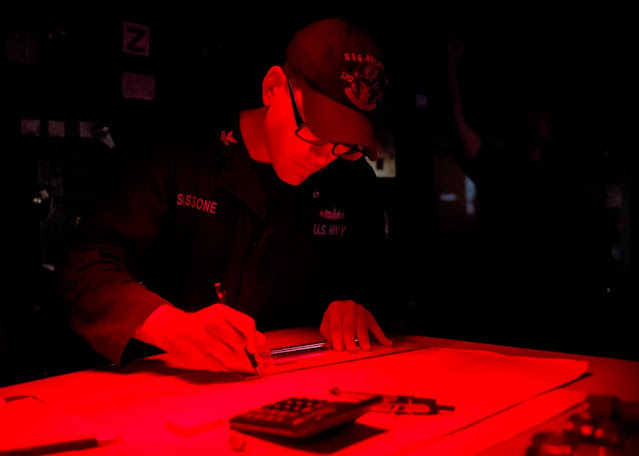


Above: Quartermaster 2nd Class Brandon Sassone, from Plainview, N.Y., plots ship position in the pilot house aboard the San Antonio-class amphibious transport dock ship USS Anchorage (LPD 23) during a scheduled deployment of the Essex Amphibious Ready Group (ARG) and the 13th Marine Expeditionary Unit (MEU), Sept. 2, 2018. They were deployed to the 5th Fleet area of operations in support of naval operations to ensure maritime stability and security in the Central Region, connecting the Mediterranean and the Pacific through the western Indian Ocean and three strategic choke points. (MC3 Ryan M. Breeden)


Top photo: The Arleigh-Burke class guided-missile destroyer USS Michael Murphy (DDG 112) participated in Australia’s Kakadu exercise in August 2018 in Darwin to enhance maritime security skills with participating nations, which highlighted information sharing and multilateral coordination. (MC3 Morgan K. Nall)

Sunday, September 11, 2022

September Remember: USS Midway in Japan

by Bill Doughty––

I was attending school in Tokyo and living in Yokosuka in 1973 when USS Midway (CV-41) arrived in Yokosuka –– the first U.S. aircraft carrier to be stationed in Japan as part of the Forward-Deployed Naval Forces. It was a big deal, less than thirty years after World War II, and just months after the U.S. military departed Vietnam.


Midway was commissioned 77 years ago, Sept. 10, 1945, just eight days after Imperial Japan surrendered. Stationing the ship in Japan was hugely symbolic; Midway is named for the historic and pivotal battle in 1943 that turned the tide in WWII.


USS Midway (CV-41) arrives in Yokosuka, Oct. 7, 1973. Photo from Midway cruise book. (Ryo Isobe, DVIDS)
But that’s only one reason the carrier’s arrival in Yokosuka was opposed by many Nihonjin, sometimes violently.

Hundreds of Japanese citizens, loudly opposed to America’s war in Vietnam, came to Yokosuka in 1973 to protest the arrival of Midway.

I remember scores of demonstrators in headbands and helmets, faces covered, white-knuckled fists gripping bamboo poles. The demonstrators assembled by the Yokosuka JNR station and marched to the closed gates of the base. Japanese police in riot gear formed a human shield. Marine guards stood ready behind them. Some radical demonstrators attacked the police and were repelled with fire hoses.


Midway had been a recent (and repeated) participant in what was then called the Vietnam Conflict, a war for which the ship received the Presidential Unit Citation from President Nixon in early 1973.


Two years later, Midway would join with other ships of the U.S. 7th Fleet in Operation Frequent Wind, the evacuation of Saigon.


Three years after Midway’s arrival in Yokosuka, the United States celebrated its bicentennial, 1776-1976. By then, I was just out of college and contributing stories to the Seahawk base newspaper on my way to becoming editor and eventually a public affairs officer.

Early in its career, Midway participated in historic operations in the Caribbean, near the Arctic, throughout the Mediterranean, and in both the Atlantic and Pacific, including near North Korea.

Midway would go on to participate in various peacekeeping operations, including Operation Desert Shield and Desert Storm, after Iraq failed to obey a United Nations ultimatum to withdraw from its invasion of Kuwait.


Just as it did in the evacuation of refugees after the fall of Saigon, Midway played a key role with other ships in rescuing evacuees from the Philippines in Operation Fiery Vigil after the eruption of Mt. Pinatubo. That was in June of 1991.


I was still living in Yokosuka and working for the Navy when USS Midway departed Yokosuka for the final time in August 1991. The workhorse aircraft carrier was headed to retirement 31 years ago this month –– via Pearl Harbor, Seattle, and Bremerton –– eventually to San Diego.


USS Midway arrives in Pearl Harbor, August 23, 1991.
By 1991, more Japanese people came to realize the value of having a strong U.S. Navy presence, working cooperatively with the Japan Maritime Self-Defense Force to maintain freedom of the seas. 

Just as the United States Constitution was a model for Japan’s form of government, the United States Navy served as a model for the JMSDF –– with direct help and guidance from Adm. Arleigh A. Burke.


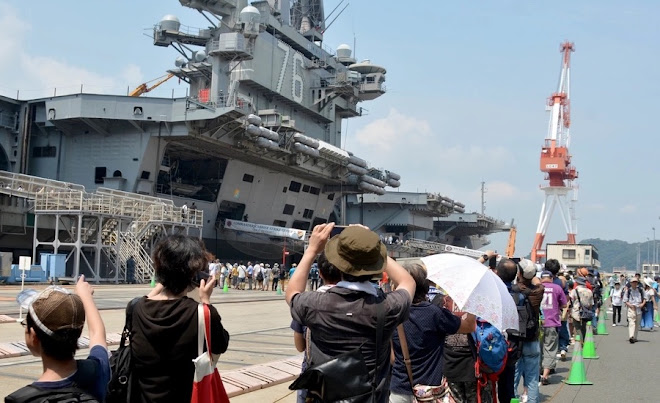
Over many years, Yokosuka has held hugely popular base open-house events, inviting tens of thousands of Japanese citizens onto the base to participate in games, enjoy food booths, attend concerts, and go aboard U.S. Navy ships.


The most popular draw at base open-house events? Tours of an aircraft carrier.


After Midway’s departure, other carriers followed its lead to become forward-deployed in Japan: USS Independence (CV-62), USS Kitty Hawk (CV-63), USS George Washington (CVN-73), and USS Ronald Reagan (CVN-76).


Japanese guests line up to board USS Ronald Reagan (CVN-76), October 10, 2015, during Yokosuka's Friendship Day open-base event. (MC1 Peter Burghart)

Open-base events were suspended for a time in the aftermath of attacks on the United States by religious zealots –– Islamist terrorists –– on September 11, 2001. (I remember the gates being locked down for weeks. Everyone who lived off base were required to park a few miles away and were offered rides to work or schools on base in carefully screened shuttle buses.)


In September 2003, USS Midway departed its temporary home of Bremerton, WA, to become a museum and memorial in San Diego. It welcomes an average of more than one million visitors per year. As with the USS Arizona Memorial in Pearl Harbor, many of the visitors to the USS Midway Museum include people from Japan who come to pay respect and learn about history.


Operation Sandy (Midway Museum Archives)
The museum offers a robust website highlighting the ship’s proud legacy, including operations in the Arctic, Taiwan Strait, and Vietnam, among others. I found some fascinating Midway photos available for download from Flikr, courtesy of the Museum. Some of the photos on the museum’s site include ringside views of Operation Sandy, the world’s first test-firing of a ballistic missile from a ship at sea.

There are numerous resources on the museum’s website, including videos and first-person accounts. This line stands out: “When history speaks, turn up the volume.”


In reading the history of the USS Midway, we can see the evolution of the modern Navy, from the immediate postwar, through the entire Cold War, and operations in Vietnam. But the ship is remembered most fondly, perhaps, for its role in helping people and promoting peaceful protection, especially for eighteen years in Yokosuka, Japan.


USS Midway’s strategic role in the Cold War, is a key part of James D. Hornfischer’s fascinating “Who Can Hold the Sea: The U.S. Navy in the Cold War, 1945-1960” (Bantam Books, 2022).


I have a two-part review of Hornfischer's final work posted in recent weeks. Hornfischer has been a favorite over the years. In May 2012, he offered a guest mini-review of five books he recommended to Navy Reads.


Tuesday, September 6, 2022

Part II: Hornfischer’s One Ocean…

Review by Bill Doughty––

James D. Hornfischer’s final book, “Who Can Hold the Sea,” opens with a poignant message from Jim’s widow, Sharon Hornfischer.


Sharon includes this advice:

“Jim believed, as I also do, that others of this generation and future generations will carry on telling the stories of our great nation’s history. Share your stories with your children and grandchildren, nieces and nephews, so that they are engaged in our nation’s history and our country’s continued fight for freedom and democracy. Encourage our next generation, take them to air shows, museums, and libraries; ignite the spark of curiosity in our future historians and writers so that they can continue to tell stories for us all to read.”

Hornfischer
It’s both sad and inspiring to read Jim Hornfischer’s final work. As both a gifted writer and historian, he created vivid true stories of Sailors and Marines and their leaders. This book’s preface, introduction, and acknowledgements bookend the story of the Cold War with tender personal messages.

Hornfischer’s “Who Can Hold the Sea” (Bantam Books, 2022) opens in the gray aftermath of World War II.


After confronting and defeating fascism, the United States and most of the Allies moved toward greater democracy, peacekeeping, rule of law, and liberty for all. The Soviet Union, on the other hand, held on to autocracy, aggression, violations of laws, and control of its citizens’ freedoms.


“For Truman,” Hornfischer observes, “the Soviet Union was a treacherous and malignant betrayer.”


Americans adjusted to postwar realities –– not only fear of spreading communism and Soviet expansion, but also budgetary turmoil that reached into the military. Some politicians proposed doing away with the Marine Corps and Navy and merging the service branches.


None other than Adm. William “Bull” Halsey spoke out against the merger in a speech thankfully excerpted by Hornfischer.


Halsey said, in part:

“Merger is not necessary. It is not desirable. It is plainly dangerous. It would destroy the initiative of individual services. It would hamstring their right to advance. It would deprive them of representation before Congress and the people. It would substitute military for civilian control. It might lead to military dictatorship.”

Admirals Chester Nimitz, Ernest J. King, Marc Mitscher, and Edward L. Cochrane –– along with Secretary of the Navy (and first Secretary of Defense) James V. Forrestal –– persuaded President Truman and others that the Navy had a strategic role in the Atomic Age; merger of the services, along with loss of the Marine Corps, would be a bad idea.


President Truman is welcomed aboard USS Franklin D. Roosevelt (CV-42) by SECNAV Forrestal and Adm. Nimitz. Adm. Leahy pictured in background. (NHHC)
Truman visited Norfolk, Virginia, in April 1946 at the invitation of Commander in Chief, U.S. Atlantic Fleet Adm. Mitscher. Truman witnessed the power of naval aviation and capabilities of aircraft carriers USS Franklin D. Roosevelt (CV-42) and the seemingly ubiquitous USS Midway (CV-41). Mitscher’s chief of staff was Capt. Arleigh Burke.

Then-SECNAV Forrestal was one of the principal architects of the post-war modern Navy. His global vision was based on peace through freedom and democracy, not communism or autocracy. Hornfischer writes, “If that world was to become a community, it would be possible, Forrestal thought, only with U.S. leadership, the victorious democracy investing its credibility and standing in the world to promote self-determination and freedom wherever it showed aspiration.” Hornfischer explores the role Forrestal played and delves into Forrestal’s controversial death at Bethesda Naval Hospital.


“Who Can Hold the Sea” vividly covers how Burke, Nimitz and Forrestal shaped the Navy during the Cold War. And strategic thinker and diplomat George Frost Kennan influenced the influencers, as Mahan had done for the first half of the century. Kennan recognized early the “perverse brutality and terror” of Joseph Stalin and Communism’s threat to Capitalism and democracy.


Watercolor of scorched USS Nevada (BB-36) as Nagato and Sakawa sink.. (Arthur Beaumont, 1946)
As a result of those fears, including the real fear that the Soviets were developing nuclear weapons, the United States rushed to conduct atomic bomb tests in the Pacific just a year after the war. In Operation Crossroads, the Navy positioned hundreds of pigs and goats, as well as 4,000 rats, aboard a target ship to test the results of radiation from a nuclear “cauliflower head.” The results were staggering and crippling.

The flagship of Adm. William H. “Spike” Blandy, who headed up Operation Crossroads, was contaminated with radiation, so “hot” it needed to “cool down” before it could be boarded.


After "Able" and "Baker," Blandy had to cancel a third "Charley" stage of the test, Hornfischer notes. “The radioactive mess had become impossible to manage.”


Later, he would celebrate the operation with a bizarre cake-cutting ceremony.


Vice Adm. Blandy and his wife cut into an Operation Crossroads cake shaped to look like a radioactive geyser, as Rear Adm. Frank J. Lowry looks on, Nov. 7, 1946.

The Navy forged forward in developing deployable nuclear weapons, supported by John L. Sullivan, Secretary of the Navy.

“The atomic bomb would shape the entire forty-four-year span of the Cold War. Made even smaller and more easily deployable, with larger and larger payloads, it would place every crook and crevice of the world under threat of ruin. War planners schemed to win atomic exchanges, even as they and every policy maker had no sense of consequences, and prudence demanded keeping the weapon in Pandora’s box. Humility, terror, curiosity, eager innovation, and abject paranoia would be the diverse by-products of the bomb.”

Louis A. Johnson
Sullivan would fight for the Navy but would resign in the face of cutbacks, cancellation of construction of the CVA-58 class aircraft carrier USS United States, and favoritism for the Air Force by SECDEF Louis A. Johnson. “The new defense secretary was an equal opportunity irritant, abrasive and arrogant and making no effort to filter it,” Hornfischer writes. “Johnson’s animus toward the Navy was an open secret.”

Despite obstacles, the Navy forged ahead in developing deployable nuclear weapons and nuclear-powered ships, including submarines. 


Hornfischer reveals how close the world came to nuclear war in the decade-and-a-half after bombs were dropped on Hiroshima and Nagasaki.


Leaders contemplated using nuclear weapons after Communist China threatened Formosa (Taiwan), after Communist North Korea invaded the South, and after Communists took power in French Indochina (Vietnam). Eisenhower was a voice of reason in nixing the idea of using the Bomb. Though not covered in this book, the Bay of Pigs incident comes to mind, when President John F. Kennedy, Navy veteran and WWII hero, proved to be the voice of reason in preventing nuclear war after the Soviet Union threatened to position nuclear weapons in Cuba.


Admittedly incomplete and somewhat unfinished, Hornfischer’s history of the Cold War is a compelling book thanks to the author’s distinctive style and grace. His writing shines in descriptions of not only events but also people, such as the great Arleigh Burke, “the son of a humble Colorado farmer,” a leader who embraced an ethos of good leadership.

“[Burke] had taken integrity, self-discipline, and strong principles from his father and mother, a teacher. In 1923, the year he graduated from the U.S. Naval Academy, the faculty had just compiled the first textbook on naval leadership. It listed the ‘essential qualities’ of a naval officer as personal dignity, honor, courage, truthfulness, faith, justice, earnestness, assiduity, judgment, perseverance, tact, self-control, simplicity, and loyalty –– to country and to service, to both one’s seniors and juniors. ‘Loyalty up and down was important because of the natural independence and self-reliance of the American sailor,’ and naval officers had to earn the respect of their men [and women] through their personal merit and example. Burke had been trained as a specialist in ordnance, earning a master’s degree in chemical engineering and becoming a design and production specialist in explosives. This background exposed Burke to the most advanced naval technologies of his time and would prepare him as CNO to promote the development of nuclear weapons, nuclear power, and guided and ballistic missiles.”

Burke helped guide the Navy through rough seas during the Cold War.


CNO Arleigh Burke on the bridge of USS Forrestal (CVA-59) March 12, 1956 as ship's CO Capt. Roy L. Johnson points out distant aircraft. (NHHC)

It’s bittersweet to read this excellent book about the Cold War knowing that Hornfischer is gone. He died last summer after a valiant fight with cancer. As mentioned, his wife Sharon offers a beautiful tribute to him and his legacy in the book’s preface.

Both Jim and Sharon offer acknowledgements at the end of this book. They thank retired Navy Admiral “Fox” Fallon, former commander of both U.S. Pacific Command and Fleet Forces Command and current board chairman of the Naval Historical Foundation. They also acknowledge and thank other graybeards, including retired Rear Admiral Samuel Cox, director of Naval History and Heritage Command and Curator of the Navy. The Hornfischers pay special tribute to the Nimitz Museum in Fredericksburg, Texas, hometown of the great admiral who led the winning strategy in the Pacific War.


This terrific book brought other books to mind that would make good companion reading: “Atlantic” and “Pacific” by Simon Winchester; "The Second Most Powerful Man in the World: The Life of Admiral William D. Leahy, Roosevelt's Chief of Staff" by Phillips Payson O'Brien; “Revolt of the Admirals: The Fight for Naval Aviation, 1945-1950” by Jeffrey G. Barlow; "The Silent War: The Cold War Battle Beneath the Sea” by John Piña Craven; “This Kind of War: The Classic Korean War History” by T. R. Fehrenbach; “Gangsters of Capitalism: Smedley Butler, the Marines, and the Making and Breaking of America’s Empire” by Jonathan M. Katz; “Opening the Great Depths: The Bathyscaph Trieste and Pioneers of Undersea Exploration” by Norman Polmar and Lee J. Mathers; and “The Blue Age: How the US Navy created Global Prosperity –– and Why We’re in Danger of Losing It” by Gregg Easterbrook. It goes without saying that every book by Hornfischer should be on the reading list for anyone interested in American maritime history.


The Hornfischers valued libraries, museums, research institutes, and, of course, books. As Jim writes, “Those interested in national and maritime affairs ought to be mindful of the major events of the past.”


Top Photo: Operation Crossroads "Baker Day" A-bomb underwater explosion, seen from shore of Bikini Atoll, 25 July 1946. NHHC


(In Part I of this review, we presented Hornfischer's view of "one global ocean." We also compared Gorbachev and Putin, discussed the rise of NATO, and presented some coincidental milestones that happened in August and September decades ago.)

Tuesday, August 16, 2022

Chilling with ‘Icebound’

Review by Bill Doughty––

As the summer heats up literally, here’s a way to cool off literarily: Andrea Pitzer’s goosebumps-inducing history-science-adventure true story, “Icebound: Shipwrecked at the Edge of the World” (Scribner, Simon & Schuster, 2021).


It’s the otherworldly true story of Dutch sailors, led by navigator William Barents, as they attempt to find an open polar sea in the Arctic in the age of sail.

Barents, who pioneered map-making in the Mediterranean, made three voyages for the Dutch Republic in the 1590s. This book covers all three ventures, but zeroes in on the third and final fraught attempt. The Dutch, along with other nations, wanted to discover a northern trade route to China.


It was time of growing empires and growing sea trade in slaves and spices.


It was also a time of war between Spain (Catholic and monarchistic) and the Netherlands (Protestant and based in liberty). While war raged in western Europe, Barents and other Dutch sailors headed East and North, hoping to find a warm sea beyond the ice.


Barents was considered a “magician” for his ability at celestial navigation. “He could look into the sun and fix their ship’s position not he globe. He could watch the stars and tell them the day of the year.”


Though no navigable route was found, the young Dutch Republic would continue to expand over the next hundred years –– thanks to the slave trade, spice trade, exploration, and art –– to become the largest economy and naval power in the world at the time, according to Pitzer.


“William Barents would play a role in that drama, but as he readied himself for his first voyage into the Arctic, his country was a blank slate, its sins and achievements still unwritten,” she writes.

Navy readers will appreciate Pitzer’s recounting of history and science, naval lore, and the courage and commitment of sailors in the face of seemingly impossible odds.


For example, as regards history and science…


We are reminded that Vikings “discovered” Ukraine and that the science of navigation relied on the discovery of trigonometry in 1080 by Arab Astronomers, as well as inventions by Babylonians, Egyptians, Indians, Chinese, Greeks, and Scandinavians. What they knew in the late 16th century, though, was dwarfed by what Barents and the sailors didn’t know. Many great scientific discoveries were yet to be made.

“As they set forth, they knew some things. They knew how to set the sails on the ship to catch the wind. They knew how to steer. They knew how to work wood, and hunt, and trap. Barents could reckon latitude and knew the stars, and those he didn’t know, he had charts for. Sailors understood that icebergs haunted the northern regions and could stretch for miles. Sometimes rising more than two hundred feet above the waterline, they were capable of rewarding vessels and the tiny human presence guiding them.

“Barents and his fellow crew members knew some things, but it wasn’t enough. They possessed no scientific understanding of gravity, no telescopes, and no calculus. Though they could find their latitude, they couldn’t yet determine longitude from aboard a ship. They were centuries away from deciphering the germ theory of disease. More than a hundred years could pass before humanity would discover that lightning was electricity. Decades remained before doctors would realize that blood circulates in the body, and that a cell is the unit of life. As he sailed into the Arctic, Barents would, in time encounter wonders and terrors without understanding most of the forces at play in his universe.”

Nenets idols, Vaigach Island.
Naturally, in the absence of information and in the embrace of superstition, early sailors believed good –– and bad –– fortune was the will of God. They believed their religion condoned slavery, for example, and ordained “man” to overcome and rule over nature.

Pitzer describes interactions with indigenous people in the far north, including the Sami and Nenets, who worshipped wooden idols, which fascinated the sailors. One sailor stole an idol and took it aboard ship only to be forced to return it later.


As the Scientific Revolution was beginning to blossom in Europe with Copernicus, Descartes, Francis Bacon, Barents and his crew were collecting and measuring polar bear pelts and walrus tusks and studying flora and fauna –– three hundred years before Darwin. Barents explained mirages, experienced the gap between Earth’s magnetic pole and true polar north, and mapped the geography at the edge of the Arctic. He also resolved a centuries-old superstition about barnacle geese: that they did not spontaneously hatch from barnacles (because no one had previously seen their nests and eggs).


Pitzer hides her history and science within harrowing tales of survival aboard their ship, at Vaigach Island, on boats, and at then-ice-covered Nova Zembla.


We feel the cold chill the crew to the bone. We hear chunks of ice hit the hull of the ship, see the men fend off frequent attacks by polar bears, smell the stink of sickness, and taste the desperation as the men are trapped in the ice over the winter: “Shipwrecked at the Edge of the World.”

Arctic fox
Navy history readers will appreciate passages about sails, masts, knees, joint pegs, and planks; scurvy; mutiny; keelhauling; and generally what life was like for age-of-sail sailors at sea –– endless routines, fear of storms, and trying to thrive in a crowded space.

Ultimately, this is a story of perseverance, the strength of the human spirit, and the will to survive.


The sailors relied on trapping Arctic foxes and finding birds and eggs. They rationed what food they could salvage from their ship. And they built a cabin and collected drift wood to keep warm.


Hampton Sides, author of the great “In the Kingdom of Ice,” blurbs: “Engrossing … Andrea Pitzer brings Barents’s three harrowing expeditions to vivid life –– while giving us fascinating insight into one of history’s most intrepid navigators.”


Pitzer visits Nova Zembla in 2019.
Pitzer bases her research on journals, material in museums, and interviews with scholars. She relies on entries in the original diary of Gerrit de Veer, one of the sailors who returned to tell the story.

She also makes a remarkable visit in August 2019 to Nova Zembla, “a numbing, desolate place,” near the ruins of Barents’s cabin. The land is now a Russian Arctic preserve.


The book concludes with a sobering account of the effects of global warming in the Arctic and the loss of ice during summer and over recent decades. Pitzer gives a stunning conclusion about the intersection of Barents’s exploration, our understanding and acceptance of science, and a context for how humans impact the planet.


Survival of individuals, and perhaps the species, depends on the will to endure, adapt, and overcome.


“Icebound” can be a springboard to confront cold, inconvenient truths.


The Arleigh Burke-class guided-missile destroyer USS Ross (DDG 71) prepares to replenish stores and fuel with the Henry J. Kaiser-class replenishment oiler USNS Laramie (T-AO-203) in the Barents Sea, Oct. 29, 2020. Ross is currently on its 10th Forward Deployed Naval Forces-Europe (FDNF-E) patrol in the U.S. Sixth Fleet area of operations in support of U.S. national security interests in Europe and Africa. (MCSN Christine Montgomery)

Sunday, March 27, 2022

A Goal for Women

Review by Bill Doughty––

I can only imagine the disappointment of the authors of this book, Ruth Margolies Beitler and Sarah M. Gerstein, for what they left out of their assessment of women in the world’s militaries.


Their “Women and the Military: Global Lives in Focus” (ABC-CLIO, LLC; 2021) is part of an ambitious series looking into issues such as health, violence, religion, sexuality, sports, education, technology, and more.


The goal of the series is spelled out in a foreword:

“The goal of the ‘Women and Society Around the World’ series is to depict the roles of women worldwide by exploring the major issues they face and the accomplishments they have made, especially in terms of bridging the gap in gender inequality and fighting for basic human rights. While readers will learn about the challenges that half of the world’s population face, they will also discover the empowering ways women succeed and overcome social and cultural barriers in their daily lives.”

The series and this contribution about the world’s militaries examines the “challenges, issues, and achievements women around the world face” in a still largely male-dominated world.

This book about the world's militaries is divided into eight regions: United States and Canada, Latin America and the Caribbean, Europe, North Africa and the Middle East, Sub-Saharan Africa, Central and East Asia, and Oceania. The authors admit that “exploring the role of women in militaries across the globe is a daunting task,” especially considering the depth, breadth, and diversity of nations and cultures.


Still, as good as this volume is, we can’t help but be dismayed about one country which has been left out. More on that in a moment.


First, let’s look at what’s really noteworthy. The authors conclude that “women are playing a larger role in militaries across the globe, but especially in the West.” Another conclusion: “When women have proven competent in their positions, and their male colleagues trust their abilities, the negative stereotypes connected to gender decrease.”


Culture change is occurring throughout much of the world as traditional roles for women change. Still, in many countries, it is forbidden for women to serve in the military.


But throughout Europe and in many international organizations, legislation dealing with gender equality has accelerated transformation.

“The UN’s adoption of UN Security Council Resolution 1325 in 2000 pushed most international organizations dealing with security issues, such as the European Union and the North Atlantic Trade (sic) [Treaty] Organization (NATO), to prioritize gender mainstreaming and the integration of women into militaries across the globe. When exploring Europe, it is critical to examine how the European Union impacts its member states’ armed forces, particularly with regard to security and gender. Each member state has different political institutions and public cultures that influence their policies on gender (Eulriet 2012, 30). At times, the legal structure of regional and international organizations affects the legal structure of states.”

Beitler
Beitler and Gerstein discuss issues such as conscription, physical strength, pregnancy, unit cohesion, combat arms, and sexual harassment as they compare attributes, traditional values, customs/laws, and roles.

Along the way, they naturally unearth some fascinating factoids:

  • In Indonesia, women who join the military have a “requirement for a virginity test.”
  • After the Sierra Leone civil war, many women there who reported they served as soldiers had been raped, and they were “encouraged to allow grandparents to raise their children or to marry their rapists.”
  • South Africa fully integrated ethnic and gender minorities after apartheid and is “an example for other nations to follow.”
  • Norway was the first country to create an all-female special forces unit, in 2014, called Hunter troops.
  • Australia and New Zealand militaries opened all roles to women at the beginning of this century, earlier than the US or UK.
  • Russian women in uniform conduct a popular beauty pageant for their strategic missile forces called “Makeup Under Camouflage.”
  • Restrictions for women exist in Japan “due to the domestic Labor Standards Law, which protects women from substances that could affect pregnancies.”


The Independence-variant littoral combat ship USS Gabrielle Giffords (LCS 10) exercises with the Japan Maritime Self-Defense Force (JMSDF) training ships JS Kashima (TV 3508) and JS Shimayuki (TV 3513), June 23, 2020, in the South China Sea. Gabrielle Giffords was on a rotational deployment, operating in the U.S. 7th Fleet area of operations to enhance interoperability with partners and serve as a ready-response force. (MC2 Brenton Poyser)

Beginning with the direct influence of Adm. Arleigh S. Burke, the U.S. Navy and the Japan Maritime Self-Defense Force have had close and lasting ties. Considering the number of American sailors and marines serving in Japan, the section on Japan’s military may be of particular interest to the naval community.

“In 2013, two women took command of the naval destroyers, JS Shimayuki and JS Setoyuki, for the first time since Japan’s modern navy began. Commander Miho Omani and Commander Ryoko Azuma were responsible largely for training missions but could be called upon for surveillance, anti-submarine warfare and anti-ship missions, as well as detecting and shooting down aircraft and ballistic missiles (Spitzer 2013). Just a few years after her successful command of the naval training destroyer, Commander Omani took command of the Yamagiri destroyer, overseeing a crew of 220. Just ten of those crew members were women. She was also one of the first female graduates at the National Defense Academy. After seeing images of the Gulf War on the news and a newspaper ad for the National Defense Academy, she joined the military, expecting some resistance. She quickly realized that opposition would emanate much closer to home. Her father was reluctant for her to join the military. Her path to success was challenging and after her marriage, she was asked when she would be leaving her job. She is currently married to a fellow destroyer captain and has been forced to make hard decisions about who would care for her daughter when both are out to sea (Demetriou 2016). Women in the Japanese military can take up to three years off after the birth of a child, though the Japanese culture has discouraged women from taking that time.”

The excerpt above gives us an idea of the personal and professional insights presented in this book, which also offers extensive “for further reading” lists, a chronology of history of women in the world’s militaries since 1572, and a fulsome bibliography.


There are surprising inclusions of various militaries: Nepalese, Zairian, Sri Lanka, Madagascar, Ecuador, Burundi, Seychelles, and Barbados, to name a few. Which makes it even more glaringly disappointing about the absence of …


... Ukraine.


There is no discussion about the Ukraine military and women’s role in the armed forces in a country currently confronting Putin’s atrocities. Today, Ukraine’s men are required to defend their homeland against the unprovoked Russian invasion in Putin’s war, but women are also increasingly picking up arms and finding other ways to fight back.


According to a report on NPR from March 19, “The combat spirit in Ukraine right now appears to be pretty robust. Only men face conscription. But lots of them haven't even been called up yet, because the military has already been inundated with volunteers — of all genders.”


The only mention of Ukraine in “Women and the Military” is in the context of conscription –– but in the Swedish armed forces (ironic considering Ukraine's deep history with Sweden, centuries ago)
.

“With changes in Swedish culture espousing gender equality, retaining the military as an all-male domain was unrealistic. The Swedish government never implemented universal conscription, and by 2010 Sweden eliminated compulsory military service. Only 5,000 soldiers were being drafted with conscription perceived as a relic of previous times (Chandler 2017). However, by 2017, the Swedish government announced the reinstatement of conscription due to Russian activity, including its aggressive behavior in Ukraine and the annexation of Crimea. Sweden also accused Russia of breaching its airspace and executing cyberattacks in Sweden (Chandler 2017). The draft includes both men and women.”

Of course, Beitler and Gerstein could have little idea that Ukraine would be the center of the world’s attention in 2022, the year after their book was published.


As for nations such as Sweden, Finland, and others near Russia, there’s a renewed desire to strengthen their nations’ defenses. According to an article by analyst Dan Kochis, posted by the Heritage Foundation, “Putin is pushing Finland and Sweden closer to NATO membership.”


While this book leans in with an Army bias, there is a broad-brush approach to various branches and to world regions. (Dr. Beitler is a professor of comparative politics at the United States Military Academy, West Point, where Maj. Gerstein is an assistant professor of international relations.)


It’s nice to see a volume about women and the military in this ABC-CLIO series that purports to present a global perspective about women. Volumes are meant to be read alone or cumulatively. The series foreword notes, “The volumes are ideal for high school students doing projects, undergraduate students writing research papers, and even general readers interested in learning about women’s lives.” Another good source of information for Women’s History Month!


––––––––––––––––––––––––––––


We remember the great political scientist and diplomat Madeleine Albright, who was the first woman to serve as United States Secretary of State. Albright died last week at 84. Albright spoke at the Pentagon on June 30, 2016, after then-Secretary of Defense Ash Carter presented Albright with the Department of Defense Medal for Distinguished Public Service. (DoD photo by Senior Master Sgt. Adrian Cadiz)

Albright was a child when her family emigrated out of autocratic Communist Czechoslovakia to the United States.


She warned of the signs of growing autocracy, tyranny, and fascism.


I posted a review of Albright's "Fascism: A Warning" in September 2018 and showed her strong connections with Navy veteran and U.S. Senator John McCain. Both stood up to fear-mongering authoritarianism.


Here again are Albright's ten questions about leaders we need to ask as either reassurance or a warning. In the case of Putin's Russia, Albright's insights were a clear warning more than four years ago:

  • Do they cater to our prejudices by suggesting that we treat people outside our ethnicity, race, creed, or party as unworthy of dignity or respect?
  • Do they want us to nurture our anger toward those who we believe have done us wrong, rub raw our grievances, and set our sights on revenge?
  • Do they encourage us to have contempt for our governing institutions and the electoral process?
  • Do they seek to destroy our faith in essential contributors to democracy such as an independent press and a professional judiciary?
  • Do they exploit the symbols of patriotism – the flag, the pledge – in a conscious effort to turn us against one another?
  • If defeated at the polls, will they accept the verdict or insist without evidence that they have won?
  • Do they go beyond asking for our votes to brag about their ability to solve all problems, put to rest all anxieties, and satisfy every desire?
  • Do they solicit our cheers by speaking casually and with pumped up machismo about using violence to blow enemies away?
  • Do they echo the attitude of Mussolini: 'The crowd doesn't have to know,' all it has to do is believe and 'submit to being shaped'?
  • Or do they invite us to join with them in building and maintaining a healthy center for our societies, a place where rights and duties are apportioned fairly, the social contract is honored, and all have room to dream and grow?
In "Fascism: A Warning," Albright described Russia's Putin, as "small and pale, so cold as to be almost reptilian." 

Last week President Biden, after visiting American troops defending NATO allies and partners, described Putin as a brutal "butcher" who must be stopped. Albright warned us; stopping the growth of fascism and authoritarianism should be a goal for everyone.

President Biden visits and takes selfies with U.S. Army paratroopers of the 82nd Airborne Division, March 25, 2022 in Rzeszów, Poland. (Sgt. Gerald Holman)