Sunday, January 27, 2019

McChrystal: 'Leadership' Includes Self-Serving, Evil Leaders


"My Share of the Task: A Memoir," by General Stanley McChrystal, 2013, Portfolio/Penguin.

Review by Bill Doughty

Gen. Stan McChrystal, the cat who caught the rat Abu Musab al-Zarqawi, has a tale to tell. The chase after the "itinerant terrorist" Al Qaeda operative takes up a good part of this book, which focuses on service, sacrifice and the true meaning of leadership – a "crushing burden" that can be good or bad, depending on the leader.

McChrystal follows Gen. David Petraeus's footsteps in several positions. Adm. Mike Mullen, one of the most respected Chiefs of Naval Operations and Chairs of the Joint Chiefs, selected McChrystal as director of the Joint Staff (chief of staff to the JCS). In this memoir McChrystal takes readers from Fort Benning to Fort Bragg and from Iraq and Afghanistan to NATO and Washington D.C.
"At the heart of the story is Afghanistan itself, a complex swirl of ethnic and political rivalries, cultural intransigence, strains of religious fervor, and bitter memories overlaid on a beautiful, but harshly poor, landscape. Without internal struggles or outside interference, Afghanistan would be a difficult place to govern, and a challenge to develop. And there have always been struggles and interference. But it's not just that. In her beauty and coarseness, in her complexity and tragedy Afghanistan possesses a mystical quality, a magnetism. Few places have such accumulated layers of culture, religion, history, and lore that instill both fear and awe. Yet those who seek to even budge her trajectory are reminded that dreams often end up buried in the barren slopes of the Hindu Kush or in the muddy fields alongside the Helmand River."
Winter on the Parwan Plains and Hindu Kush mountains Jan. 2, 2010, viewed from Bagram Air Field, Afghanistan. Photo by Capt. Thomas Cieslak, DVIDS.
He shows how dealing with fatalism and pessimism and "a sense of insecurity" was key to the success and viability of the mission. First step, drive out fear and lead with honor and a sense of duty.

But throughout this important book, McChristal shows why we cannot oversimplify war, surrender to hostage-takers or create a "false drama" through fear and tyranny.

The killing of Zarqawi, after bringing down walls of his hideaway, reads like Tom Clancy:
"At 6:12 p.m., a laser-guided, five-hundred-pound GBU-12 bomb traveling nine hundred feet per second hit the house. The explosion flashed, turning our screens in the JOC white for a split second, as smoke and dust burst up and out laterally in three columns, like the prongs of a toy jack. The F-16 circled again, and a  minute and thirty-six seconds later, using GPS coordinates, a GBU-38 hit the same spot.Thick billows of smoke streamed diagonally up from the house and frontage road, thinning over the tops of the palm grove..."Our medic leaned over the Man in Black, who was alive, but barely. Under the medic's forefingers, Zarqawi's carotid artery was deflated. His breathing was shallow, and blood seeped out of his nose and ears. The pressure caused by the blast waves had cascaded through the concrete walls of the house and pulsed through his chest cavity, bursting vessels and air sacs in his lungs..."The medic continued to work on Zarqawi. When he cleared his airway, the Green team had descended, under an orange evening sun and the long shadows of palm trees extending across the crater, beneath the clenched faces of the operators standing over him, Zarqawi's lungs failed. At 7:04 p.m., our medic called it. Zarqawi was dead."
Wyeth's Navy hero John Paul Jones
We read McChrystal's thoughts about the capture of Saddam Hussein, decision-making of President Obama, the tragic death of Cpl. Pat Tillman, the relationship with generals Charlie and Mike Flynn, the fallout from the Rolling Stone interview and his leadership influences, including John Paul Jones, George Washington, Horatio Nelson, the Scot Robert Bruce and Ulysses S. Grant.

At the end of "My Share" McChrystal shares what he learned about being a leader. Leadership, he says, "is the single biggest reason organizations succeeded or failed." In hindsight, one need only see how the leadership of Gen. McChrystal and Adm. McRaven trumps that of Gen. Mike Flynn.

"Leadership is the art of influencing others," McChrystal writes, acknowledging "it is difficult to measure and often difficult to adequately describe."
"All leaders are human. They get tired, angry, and jealous and carry the same range of emotions and frailties common to mankind. Most leaders periodically display them. The leaders I most admired were totally human but constantly strove to be the best humans they could be..."Leaders make mistakes, and they are often costly. The first reflex is normally to deny the failure to themselves; the second is to hide it from others, because most leaders covet a reputation for infallibility. But it's a fool's dream and is inherently dishonest... "There are few secrets to leadership. It is mostly just heard work. More than anything else it requires self-discipline. Colorful, charismatic characters often fascinate people, even soldiers. But over time, effectiveness is what counts. Those who lead most successfully do so while looking out for their followers' welfare... "In the end, leadership is a choice. Rank, authority, and even responsibility can be inherited or assigned, whether or not an individual desires or deserves them. Even the mantle of leadership occasionally falls to people who haven't sought it. But actually leading is different. A leader decides to accept responsibility for others in a way that assumes stewardship of their hopes, their dreams, and sometimes their very lives. It can be a crushing burden, but I found it an indescribable honor."
McChrystal is agnostic about whether leaders can be good or evil.

He uses Adolf Hitler and Zarqawi as examples of effective leaders who had a sway over believers. Bad leaders can be elected to lead nations or closed-minded minions at least for a time. "Self-serving or evil intent motivates some of the most effective leaders I saw," he said.

More recently, McChrystal – writing with former Navy SEAL and Special Assistant to the President for National Security Affairs Jeff Eggers and former United States Marine Jason Mangone – published "Leaders: Myth and Reality," a book in our Navy Reads reading queue.

Gates presents McChrystal with Distinguished Service Medal in 2010.
He and his co-authors examine both tyrannical leaders and leaders of principle, with some eclectic choices: Walt Disney, Harriet Tubman, Zheng He, Robespierre, Robert E. Lee and, yes, rat-leader Zarqawi, among others.

Former Secretary of Defense Robert Gates calls "Leaders: Myth and Reality" "a superb, thought-provoking challenge to conventional understandings of the nature of leadership. An enlightening, entertaining must-read about why we revere so many leaders who are often deeply flawed and even unsuccessful, and the lessons for thinking about and teaching leadership in the future."

In "My Share of the Task" McChrystal reveals: Evil or incompetent leaders can be shut down by honorable and ethical free-thinking leader-followers who realize that strong leadership is not the same as being a "good" leader.

Tuesday, January 8, 2019

Ladies and Gentlemen, We are Experiencing 'Turbulence'

Review by Bill Doughty

People who say Americans have never been more divided must not be aware of the history of the United States. We were more divided many times in our history, including in my lifetime during the late 1960s and early 70s.

Obviously, we were more split apart during the Civil War. Abraham Lincoln, arguably our greatest president, brought a divided nation together, arguing against a wall between North and South. 

Historian Doris Kearns Goodwin.
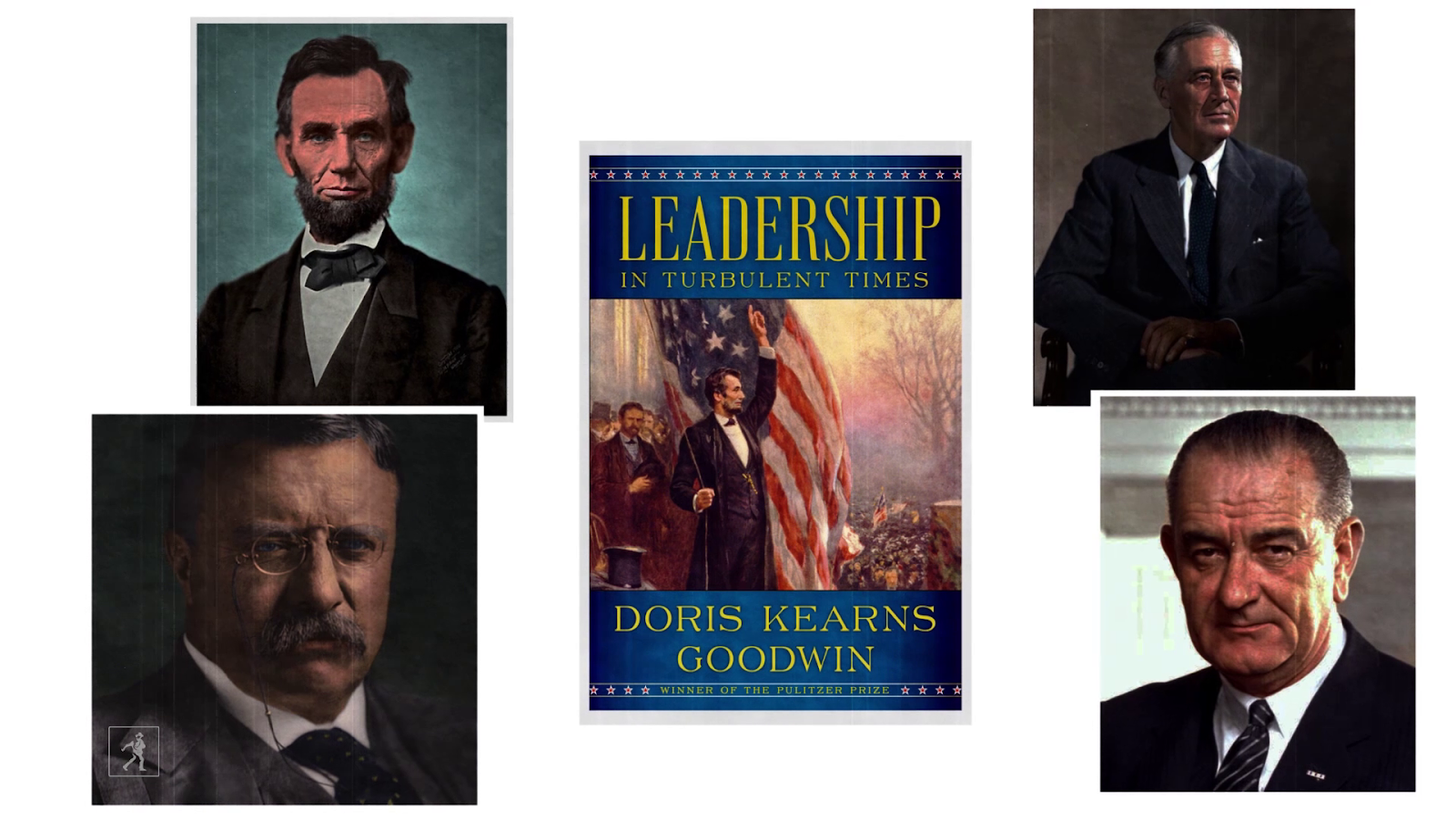
In "Leadership in Turbulent Times" (Simon & Schuster, 2018) Pulitzer Prize winner Doris Kearns Goodwin shows how Lincoln was the bridge from George Washington to Theodore Roosevelt and into the 20th century and key presidents Franklin Delano Roosevelt and Lyndon Baines Johnson.
"From childhood, Theodore Roosevelt's great hero was Abraham Lincoln, whose patient resolve sought to follow all his life. And for Abraham Lincoln, the closest he fond to an ideal leader was George Washington, whom he invoked when he bade farewell to his home in 1861, drawing strength from the first president as he left Illinois to assume a task 'greater than that which rested upon Washington.' If George Washington was the father of his country, then by affiliation and affinity, Abraham Lincoln was his prodigious son. These four men form a family tree, a lineage of leadership that spans the entirety of our country's history."
In the case of the Roosevelts, Navy readers will see TR's and FDR's roles as part of the Navy's lineage.

FDR as Assistant Secretary of the Navy.
Working as assistant secretary of the Navy under Secretary Josephus Daniels proved challenging at first for the young Franklin Delano Roosevelt, "who, despite his unfolding leadership skills, remained deficient in one essential quality – humility."

Yet he learned to harness his ego and focus his energies in collaborative and constructive efforts to strengthen the Navy.
"Those who witnessed young Roosevelt in the Navy Department, however, clearly understood that they were in the presence of a striking intelligence. 'A man with a flashing mind,' was how one rear admiral described him. 'It took my breath away,' he said, 'to see how rapidly he grasped the essentials of a situation,' how thoroughly he absorbed 'the details of the most complicated subjects.'To gain a dynamic up-to-date picture of the size and capacity of the current fleet and the disposition of the 65,000 military and civilian personnel, Franklin had fixed to his office wall a large map of the world. Colored pins denoted the position of every ship in the fleet. Whenever a ship moved, the pins were moved. Other pins indicated the numbers of people employed at various navy yards, docks and supply centers, allowing him to see what was transpiring. From the start, he formed a mental image of the Navy as a living organism rather than a moribund bureaucracy filled with 'dead wood'; he envisioned a vast organization comprised of people working in places and working in jobs that could be grown into a Navy 'second to none.'With a glance at his wall map, Roosevelt noted dozens of useless navy yards, originally designed for the maintenance of sailing vessels presently operating at great loss due to patronage and political pressure. Rather than closing these obsolete yards, he conceived of a new plan. He would convert each one into a specialized industrial plant for the manufacture of vessels and equipment needed for an expanded modern manufacture of vessels and equipment needed for an expanded modern navy. The old Brooklyn Navy Yard would specialize in radios to outfit the fleet. Ropes and anchors and chains for battleships would become the province of the Boston yard, Cruisers would be built in Philadelphia, submarines and destroyers in Norfolk. This new mode of reorganization gave Roosevelt a reputation as an 'economizer.' More importantly, such consolidation was a necessary step to ready a peacetime navy for a potential war."
When that war came, Kearns notes – two years after the German navy sank the Lusitania in 1915 – President Wilson was grateful for the "visionary" FDR, who "was certain that his insistence on preparedness would ultimately save his countrymen's lives."

FDR's commitment to readiness mirrored that of his cousin Theodore Roosevelt, who prior to becoming the 26th president, also served as assistant secretary of the Navy.

Kearns reminds readers of TR's remarks at the Naval War College in which "he drew from the wisdom of the country's first president. 'A century has passed since Washington wrote, 'To be prepared for war is the most effectual means to promote peace,''' he began. 'In all our history there has never been a time when preparedness for war was any menace to peace.' The speech garnered widespread praise, making Roosevelt a leading proponent of preparedness and war-readiness.'"

Kearns evaluates the leadership qualities and ties of both Roosevelts as well as those of Abraham Lincoln and Lyndon Baines Johnson, observing them "through the exclusive lens of leadership." She notes that Lincoln, TR and FDR "rank among our greatest presidents," despite their flaws. "The case of Lyndon Johnson is more problematic."

Young DKG with President LBJ.
She writes, "While Johnson's conduct during the (Vietnam) war will continue to tarnish his legacy, the passing years have made clear that his leadership in civil rights and his domestic vision in the Great Society will stand the test of time."

Kearns begins and ends her examination of leadership in turbulent times with the importance of leaders who learn humility and the importance of support of a majority of the people they were elected to lead. "'With public sentiment, nothing can fail,' Abraham Lincoln said, 'without it, nothing can succeed.' Such a leader is inseparably linked to the people. Such leadership is a mirror in which people see their collective reflection."

Kearns masterfully uses history to bring out key qualities found in good leaders. These include, among others:

  • Lead by example.
  • Keep temper in check.
  • Keep your word.
  • Forge a team aligned with action and change.
  • Shield colleagues from blame.
  • Set forth a compelling picture of the future.
  • Use history to provide perspective.
  • Refuse to let past resentments fester; transcend personal vendettas.
  • Set a standard of mutual respect and dignity; control anger.
  • Identify the key to success. Put ego aside.
  • Be open to experiment. Design flexible agencies to deal with new problems.
  • Address systemic problems. Launch lasting reforms.
  • Tell the story simply, directly to the people.
  • Be accessible, easy to approach.
  • Bring all stakeholders aboard.
  • Infuse a sense of shared purpose and direction.
  • Restore confidence to the spirit and morale of the people.
  • Strike the right balance of realism and optimism.
  • Honor commitments.
  • Master the power of narrative.
  • Share credit for the successful resolution.
  • Leave a record behind for the future.
  • The readiness is all.

Although we may not be as divided as we've been in the past, history shows divisions can grow. Yet in a real national emergency, even in the most turbulent times – including the Civil War, World Wars I and II, and Vietnam – Americans can come together in the aftermath under the right leadership. We can thank the founders and the Constitution for creating a system of government with checks and balances as a protection from tyranny.


(Kearns dedicates her book in part to her late husband Richard Goodwin, who we featured last year on Navy Reads.)

Sunday, December 30, 2018

Meet the Pressing Problem of our Time

Review by Bill Doughty

Science and science fiction writers Isaac Asimov and Frederick Pohl collaborated on "Our Angry Earth" (A Tor Book, McMillan, 1991) nearly 30 years ago, outlining the problems and proposing solutions to global climate change.

Reading the recently reissued (2018) "Our Angry Earth," which builds on scientific evidence from decades earlier, it's a wonder how the issue hasn't been taken more seriously until now.

Asimov called his and Pohl's book "hopeful" and a "scientific survey of the situation that threatens us all – and it says what we can do to mitigate the situation."

The first half of the book is a depressing litany of problems and challenges, including the greenhouse effect caused by burning fossil fuels and depleting forests:
"One of the most damaging effects of the greenhouse warming is likely to be a significant increase in violent weather, followed by drastic and rapid changes in the climate conditions many living things depend on for their survival. The reason for this is that the atmosphere is basically a heat engine. The more heat energy that the greenhouse gases trap in the atmosphere the more it has at its disposal to transform into kinetic energy – the energy of motion – the energy we see as winds and weather. That is a simplified statement of a complicated matter..."
Isaac Asimov and Frederick Pohl
Asimov and Pohl warn of (among other things) overfishing, rising seas, extinctions, severe storms, plastics dumping, lack of potable water and destruction of habitat. Coastal cities and nations are most at risk of the impacts.

The authors show the true cost of fossil fuels, not only in their destruction of the environment but also in the burden to the military patrolling Persian Gulf states. "The Persian Gulf War (five years before the book was published) is the war oil made," they write."

Of course the same can be said of the War in the Pacific in WWII, when Imperial Japan invaded neighbors and Southeast Asia for oil and other resources. The attack on Pearl Harbor galvanized an otherwise war-averse and skeptical United States.

Now the military, including the Navy, has been on the leading edge in confronting and battling global climate change. "Our Angry Earth" mentions the U.S. Navy and then-Soviet submarines patrolling in the Arctic. They show how the Persian Gulf War was an example of how the U.S. can lead "world opinion in the mobilization of international opposition."

The Navy has been deploying, refining and investing in solar photovoltaic arrays, wind power and ocean energy.

Chuck Todd and Meet the Press
Today, in a year-ending episode, Chuck Todd of NBC Meet the Press dedicated his program to the issue and credited the military's initiatives:

Guest Michèle Flournoy, President Obama's undersecretary of defense, said, "I think there is a very strong consensus, in the U.S. military and in the national security community, that climate change is real. This is a sort of pragmatic, clear-eyed view. And for the military, they see this as leading to a change in their mission, more humanitarian assistance, disaster-relief missions abroad and at home. They see the melting of the ice cap in the Arctic, that's going to open up an area of strategic competition with both Russia and China."

Both the Navy and Coast Guard conduct studies or facilitate research in the Arctic and Antarctic.


ARCTIC OCEAN – A team of scientists lay a cable on the Arctic ice Sunday, Sept. 30, 2018, about 350 miles northeast of Barrow, Alaska. The cable contains a series of sensors which attach to the bottom of a buoy that sits on top of the ice to measure wind speed and direction, air temperature, barometric pressure and other scientific measurements to study stratified ocean dynamics. The U.S. Coast Guard Cutter Healy (WAGB-20) is underway in the Arctic with about 100 crew members and 30 scientists to deploy sensors, buoys and semi-autonomous submarines to study how environmental factors affect the water below the ice surface for the Office of Naval Research. (NyxoLyno Cangemi/U.S. Coast Guard)

Flournoy added, "But it's also an infrastructure problem for the military. More than half of U.S. military bases and bases overseas are estimated to be severely impacted by climate change, either severe weather and/or flooding. That's our ability to project power overseas. That's our ability to operate our U.S. military. 50% of the facilities are going to be affected."

Todd framed the problem at the end of 2018: 

"This year, a series of climate reports, including one produced by 13 agencies in Mr. Trump's government, issued dire warnings of economic and human catastrophe, if there is not immediate action to reduce greenhouse gas emissions. But the federal response to the climate crisis has been political paralysis and denial," Todd said. "While the federal government lags behind, cities and states are attempting to lead their own climate efforts."

In a book that is thorough and only slightly dated, Asimov and Pohl give their own clear-eyed assessment of the changes needed, including carbon-taxes and incentives to change to green industries:
"Make no mistake about it, our environmental problems mean that large-scale changes lie ahead. Businesses will be harmed, people will have to change their jobs. The reason for this isn't that do-gooder environmentalists like ourselves insist on it because of some idealistic devotion to 'nature' or the spotted  owl. It's because our profligate ways have done so much harm that large-scale change is inevitable. The only choice we have – the only future we can invent – lies in deciding which kinds of change will be best in the long run, the ones that will come about because we try to clean the world up, or the worse ones that will come about on their own if we don't."
Both Meet the Press and "Our Angry Earth" focus on solutions that can be achieved with a consensus of support from average citizens willing to get informed, aware and engaged in supporting fair, incentivized efforts to deal with the challenges now and in the years ahead.


GREENLAND (Sep. 2, 2017) Lt. Emily Motz, right, National Ice Center (NIC) and Katrina Tiongson, Environment and Climate Change Canada, replace the parachute cone on an Air-Deployable Expendable Ice Buoy (AXIB) at Thule Air Force Base in Greenland during preparation for deployment to the high Arctic near the North Pole. The deployment team, led by the Office of Naval Research (ONR), included personnel from the NIC, Office of the Oceanographer of the Navy, Environment and Climate Change Canada, Danish Royal Navy and University of Washington. The buoys provide real-time weather and oceanographic data to enhance forecasting, and environmental models thereby reducing operational risk for assets in the Arctic. (U.S. Navy photo by John F. Williams/Released)

Saturday, December 22, 2018

Mattis/Washington & the Common Good

SECDEF James Mattis visits Sailors in Bahrain in March. (MC1 Bryan Blair) 
by Bill Doughty

When Secretary of Defense Gen. James Mattis announced his resignation this week it brought to mind the farewell speech by President George Washington, who similarly expressed his support to the Constitution, desire for other nations to become free allies, and rejection of totalitarianism.

Unlike Mattis's letter, George Washington's speech is typically dense, layered and flowery, which was the traditional style of writing at the time. Washington expresses his deep gratitude and offers this wish: 
"... that your union and brotherly affection may be perpetual; that the free Constitution, which is the work of your hands, may be sacredly maintained; that its administration in every department may be stamped with wisdom and virtue; that, in fine, the happiness of the people of these States, under the auspices of liberty, may be made complete by so careful a preservation and so prudent a use of this blessing as will acquire to them the glory of recommending it to the applause, the affection, and adoption of every nation which is yet a stranger to it."
Interestingly, just 65 years before the Civil War, Washington seems to see the coming divisions of North and South as well as differences between East Coast and the American West. He seems to present an early maritime strategy and an understanding of how trade and commerce can create national unity. 
"The North, in an unrestrained intercourse with the South, protected by the equal laws of a common government, finds in the productions of the latter great additional resources of maritime and commercial enterprise and precious materials of manufacturing industry. The South, in the same intercourse, benefiting by the agency of the North, sees its agriculture grow and its commerce expand. Turning partly into its own channels the seamen of the North, it finds its particular navigation invigorated; and, while it contributes, in different ways, to nourish and increase the general mass of the national navigation, it looks forward to the protection of a maritime strength, to which itself is unequally adapted. The East, in a like intercourse with the West, already finds, and in the progressive improvement of interior communications by land and water, will more and more find a valuable vent for the commodities which it brings from abroad, or manufactures at home. The West derives from the East supplies requisite to its growth and comfort, and, what is perhaps of still greater consequence, it must of necessity owe the secure enjoyment of indispensable outlets for its own productions to the weight, influence, and the future maritime strength of the Atlantic side of the Union, directed by an indissoluble community of interest as one nation. Any other tenure by which the West can hold this essential advantage, whether derived from its own separate strength, or from an apostate and unnatural connection with any foreign power, must be intrinsically precarious."
Washington's warning of "unnatural connection with any foreign power" is reinforced by his outright warning to remain vigilant against those who would drape themselves in the mantle of patriotism and threaten the democratic federal republic he, Jefferson and other founders created.

In her small but profound new book, "The Death of Truth" (Penguin Random House, 2018), Pulitzer Prize-winning author Michiko Kakutani, provides brilliant insights. Her epilogue examines Washington's warnings:
"George Washington's Farewell Address of 1796 was eerily clairvoyant about the dangers America now faces. In order to protect its future, he said, the young country must guard its Constitution and remain vigilant about efforts to sabotage the separation and balance of powers within the government that he and the other founders had so carefully crafted.Washington warned about the rise of 'cunning, ambitious, and unprincipled men' who might try to subvert the power of the people' and 'usurp for themselves the reins of government, destroying afterwards the very engines which have lifted them to unjust dominion.'He warned about the 'insidious wiles of foreign influence' and the dangers of 'ambitious, corrupted, or deluded citizens' who might devote themselves to a favorite foreign nation in order 'to betray or sacrifice the interests' of America."
Kakutani notes that America's founders embraced concepts of "common good," "common concerns" and "common cause." 
"Thomas Jefferson spoke in his inaugural address of the young country uniting 'in common efforts for the common good.' A common purpose and a shared sense of reality mattered because they bound the disparate states and regions together, and they remain essential for conducting a national conversation ... Jefferson wrote that because the young republic was predicated on the proposition 'that man may be governed by reason and truth,' our 'first object should therefore be, to leave open to him all the avenues to truth. The most effectual hitherto found, is the freedom of the press. It is therefore, the first shut up by those who fear the investigation of their actions' ... Without truth, democracy is hobbled. The founders recognized this, and those seeking democracy's survival must recognize it today."
Kakutani
Speaking of "common," Thomas Paine, the great agitator and critical thinker, brought reason and truth together in the unflowery and striking prose of "Common Sense," helping to bring freethinkers together against totalitarian Imperial Britain. 

What Americans can share together now is what Mattis's letter, Washington's address and Jefferson's words have in common: respect, devotion and loyalty to the Constitution and commitment to truth, justice, freedom and democracy.
Defense Secretary James N. Mattis and Chairman of the Joint Chiefs of Staff, Marine Gen. Joseph F. Dunford, Jr., brief reporters on the current U.S. air strikes on Syria during a joint press conference at the Pentagon in Washington, D.C., Apr. 13, 2018. (DoD photo by U.S. Army Sgt. Amber I. Smith.

Sunday, December 9, 2018

New York Says What to Read. Wait, What?


Review by Bill Doughty

The trouble with a book that recommends 1,000 books for your bucket-list is this: What prism is the editor/compiler looking through.

"A Thousand Books to Read Before You Die" (Workman Publishing, 2018, New York, NY) is a beautiful book offering an impressive spectrum of colorful titles and great authors.

You'll find great writers and thinkers like Isaac Asimov, Ulysses S. Grant, Maya Angelou, Stephen J. Gould, George Orwell, Mark Twain, Leo Tolstoy, Oliver Sacks, Homer, Dorothy Parker, D.H. Lawrence, J.K. Rowling, Jon Krakauer and Agatha Christie.

There are a relative handful of selected books that would appeal to Navy readers, including Tim O'Brien's "The Things They Carried," Tom Clancy's "The Hunt for Red October," Erich Maria Remarque's "All Quiet on the Western Front," "The Personal Memoirs of Ulysses S. Grant," Shelby Foote's "The Civil War," Robert Hughes's "The Fatal Shore," William Manchester's "Goodbye Darkness," John Keegan's "The Face of Battle," David McCullough's "Truman," David Halberstam's "The Best and the Brightest," Herman Melville's "Moby Dick," Ernest Hemingway's "The Old Man and the Sea," Kurt Vonnegut's "Slaughterhouse Five," Joseph's Heller's "Catch-22" and Orson Scott Card's "Ender's Game":
"...Just try to put it down. Tracing Ender's path to Battle School – a space center in which the best and the brightest children are trained for high-tech war – and, ultimately, to Command School, on the edge of the interstellar front lines. Orson Scott Card's novel is riveting... Ender's fierce initiation reveals his unparalleled gifts for warfare. As the stakes mount, the simulated battles he dominates are transformed from complex and dangerous games into sinister – and spectacular – realities."
Author James Mustich features his one thousand books, mentions many others and merely names a slew of extras. In other words, there are thousands of books discussed in this readable, interesting and hefty offering: a beautiful book about books.

So, what's the problem?

BM3 Ivan Naranjo reads aboard USS Anchorage (LPD 23), 2018. Photo by MC3 Ryan M. Breeden
As great as this book is, the personal lens of the editor understandably distorts reason, trumps objectivity, and begs questions as to how some of the authors and their works were selected. 

I mean, Anne Rice? Moss Hart's show business autobiography? Richard Ford's adventures in making artisan bread and pizza? "Adventures on the Wine Route: A Wine Buyer's Tour of France"? "When French Women Cook"? "Between Meals: An Appetite for Paris"? "The Auberge of the Flowering Hearth"? 

Mustich, a New York bookseller with an apparent deep love of fashion, fine dining, Broadway, the Big Apple, Provence and France, all but admits his bias and certainly is upfront about his selections not being perfect. "Hot dogs to haute cuisine," as he says. But if comfort foods of literature are allowed, where are Edgar Rice Burroughs, Mario Puzo, Louis L'Amour and Zane Grey?

Stephen King gets "Carrie" and "11/22/1963," but where are "The Stand," "The Shining" and "Cujo"?


William Shakespeare
As one would expect from a polished bookseller, this is like a bookstore readers can hold, complete with a detailed general index and 1,000 book checklist.

Overall, Mustich does a pretty good job of ensuring diversity, including different age groups and interests – both fiction and non-fiction; poetry and philosophy; youth and adult; U.S. and international; escapist and pay-attention-this-is-important.

The Bhagavad Gita, Bible and The Book of Job find themselves co-located, thanks to alphabetical listings, as are Plato, Pliny the Younger and Plutarch. Shakespeare is the overall winner in number of works listed, with 13 titles.

Nice surprises include personal favorites such as Gould's "The Panda's Thumb," Loren Eiseley's "The Immense Journey," Larry McMurtry's "Lonesome Dove," Richard Dawkins's "The Selfish Gene," "Portable Dorothy Parker," Taylor Branch's "Parting the Waters," "Narrative of the Life of Frederick Douglass, an American Slave," Carl Sagan's "Dragons of Eden," Edward O. Wilson's "The Naturalist," and Charles Darwin's "The Voyage of the Beagle."

Thankfully there's a heavy helping of science, including Thomas's wonderful collection of essays, "The Lives of a Cell":
"Every genre has its native charms, and the allure of the essay is its easy way with rumination. In the best examples of the form, the essayist communicates not just learning, but thinking, inviting the reader to share the satisfactions of a mind at play on a field of observation or experience. When an essay's author is as masterful as Lewis Thomas, it can shine like a jewel, glittering with truths small and large."
But where are shining lights by Christopher Hitchens, Steven Covey, Desmond Morris ("The Naked Ape"), John Hersey ("Hiroshima"), Thomas Paine ("The Age of Reason"), Steven Pinker, William Zinsser, Mary Roach, Craig Symonds, Jared Diamond, Nathaniel Philbrick, Erik Larson, James D. Hornfischer, Hector Hugh Munro a.k.a. Saki, Doris Kearns Goodwin, Thomas Friedman, Noah Yuval Harari and Stephen Hawking?

It's a tragedy that Mary Roach and Hope Jahren ("Lab Girl") are missing.

So many great authors are left on forgotten shelves, so many books. It can be difficult to choose any individual one. That's where a book like this can help. Perhaps there will be more versions of "1,000 Books to Read" – even someday "1,000 Navy Books to Read."

Bazelon, Richardson and Plotz of Slate's Political Gabfest.
This book first came to my attention after hearing it recommended by David Plotz, anchor of Slate Magazine's Political Gabfest podcast with Emily Bazelon and John Richardson.

Plotz said this about editor Mustich: "He's a reader of such joy and bouyancy. ... He has a real knack for recognizing what in a book is wonderful ... He's a spirit you'll want to spend time with."

And Plotz said this about the book itself: "Over 948 magnificent pages, well-illustrated. The familiar and the highly unfamiliar ... It's so much fun."

Gabfest's John Dickerson said, "So, does that make it a thousand and one?"

The best endorsement may be through the prism of writer, historian, producer Ken Burns: "If you've ever doubted that books were the greatest invention of all time, and that they carry within them our collective memories and dreams as well as any semblance of intelligence we have as a species, pick up this book and start reading."

Sunday, December 2, 2018

Pearl Harbor Mug Shots: 'This is No Drill'

Review by Bill Doughty

Dedicated "to the servicemen and civilians on Ford Island on 7 December 1941," this book purports to be the "comprehensive tactical history ... for the Japanese attacks on the island of Oahu."

"This Is No Drill: The History of NAS Pearl Harbor and the Japanese Attacks of 7 December 1941" (Naval Institute Press, 2018) by J. Michael Wnger, Robert J. Cressman and John F. Di Virgilio sets its sights on the island in the middle of Pearl Harbor.


Ford Island in 1941
The authors describe the building of Luke airfield and Army and Navy infrastructure on Ford Island after giving a short but fascinating history of the area: Hawaiians' use of the area; early name of Rabbit Island; first foreign owner (in 1810) Spaniard Francisco de Paula Marin; price of the island at public auction in 1865, $1,040; and then the U.S. government's purchase as the First World War loomed.
"With the coming of war in Europe in July 1914, concerned Americans 'cast a watchful eye to security in the Pacific' – a gaze that presaged the end of civilian ownership of Ford Island. A purchase price of $236,000 was arranged for 'the transfer of Ford Island to the U.S. government for military purposes'; $170,000 went to the 'I'i estate and $65,000 to the Oahu Sugar Company as lessee of the majority of the island. The government gave custody of the northwestern half to the U.S. Army, which began developing an airfield shortly thereafter."
Of course, the centerpiece of this tactical history is the attack on Pearl Harbor by Imperial Japan, and "This Is No Drill" shows how the attack happened, building suspense and giving a face to the individuals involved, both American and Japanese.

The "mug shots" are what sets this comprehensive history apart from other great books about Pearl Harbor, including Gordon Prange's "At Dawn We Slept,"  Craig Nelson's  "From Infamy to Greatness" and Samuel Eliot Morison's "The Rising Sun in the Pacific."


Fascinating historical photos of people, places and facilities come from the Naval HIstory and Heritage Command, National Archives and Records Administration, National Personnel Records Center, National Personal Records Center, Japan Defense Agency, among others.

This work is part of a Pearl Harbor Tactical Studies Series that also includes "No One Avoided Danger: NAS Kaneohe Bay and the Japanese Attack of 7 December 1941."
"The Pearl Harbor Tactical Studies series seeks to fill this wide gap in military history by exploring the deepest levels of practical, personal, and tactical details. The goal of these works is to promote a deeper understanding of the events of 7 December 1941 and to convey the chaos and magnitude of the disaster on Oahu as experienced by individuals. A careful survey of the available records and accounts from both sides has resulted in comprehensive accounts that document the epic American-Japanese struggle on and over Oahu and the intensely human tragedy of that day."
Anyone interested in the history of Pearl Harbor and the start of America's shock into World War II will find this book interesting and, as intended by the authors and series editors, comprehensive. 

Saturday, December 1, 2018

George H.W. Bush's Courage, Richardson's Insights

Review by Bill Doughty
Navy's youngest aviator in World War II, Lt. j. George H. W. Bush.
He was forged from the sea after being fished from the sea. The youngest U.S. Navy aviator in World War II was shot down in the Pacific and rescued September 22, 1944. George Herbert Walker Bush passed away late yesterday at 94. He is remembered for his honesty, which arguably cost him reelection to the presidency in 1994.

He is also revered for his courage and bold decision-making after Iraq invaded Kuwait and threatened to attack Saudi Arabia, giving Saddam Hussein control nearly half of the entire world's known oil reserves at the time. Western Europe, Japan and the United States could not tolerate such revanchism.

In "Reflections of a Radical Moderate" (1996, Pantheon Books) Elliot Richardson recounts Bush's character in the first Gulf War, committing ground troops in numbers in the Gulf in numbers that would not allow rotation home with stateside combat units. "This decision precluded keeping the troops in place and awaiting further developments. A ground attack would have to be launched no later than the early spring of 1991 and completed no later than the middle of May because from then until October the desert heat would preclude sustained combat," Richardson writes.
"The die was thus cast on November 8, 1990, when the president announced the augmented deployment. Nine weeks later he sought and obtained by narrow margins congressional support for the use of military force and on February 24, 1991, he ordered the ground attack to go forward. The American people again united behind what they believed to be a just cause. In the end, however, other countries were the principal beneficiaries of our initiative. Although we had at most a 25 percent stake in the outcome, 75 percent of the ground troops in the Gulf, 74 percent of the planes, and nearly all of the naval firepower were American. And although we succeeded in persuading other countries to assume the current costs of Operation Desert Storm, passing the hat could not diminish our share of the blood risk. Nor was it ever suggested that we should ask anyone else to help us amortize the far larger investment we had already made in training, arming and equipping our Persian Gulf forces."When it was all over I wrote the president a letter. In it I saluted the courage, vision and steadfastness with which he had guided the nation's response to Iraq's aggression. I also observed that I had been unable to think of any previous example of a presidential course of action whose foreseeable outcomes were triumph or disaster, with nothing in between."
Richardson offered sage advice, though: "...The Gulf War posted a clear warning that it should not be taken as a precedent for military intervention in conflicts that do not involve equivalent economic and strategic interests."

Keep in mind that Richardson's book was written about 22 years after Watergate and 22 years ago today – well before 9/11 – when "Bush 41," was the only George Bush on the nation's radar.

Yet, Richardson's "Reflections" is fresh as today and as timely as tomorrow. He weighs in on topics like health care, climate change, criminal justice system, education, rich-poor gap, over-fishing, celebrity, cynicism and integrity in government.
Nixon looks on as Richardson is sworn in as Secretary of Defense.
He warns, "I do not think I exaggerate the current dangers to democracy in America. They arise from our failure to achieve the balance of realism honesty and moral responsibility that our situation demands ... Let down by lack of leadership and stampeded by populism, we are increasingly torn by divisiveness."
"Serious problems crying out for government action continue to multiply even as the government's capacity to deal with them progressively deteriorates," he writes. "Americans want a safer, more stable, more orderly, and more humane world not simply because such a world is better for us but because it is better for others too."
This ethical man who served in the administrations of four presidents and who had a number of cabinet positions, including Secretary of Defense and Attorney General, speaks highly of civil and public service, including in the military, as a public trust. He introduces us to Gen. John W. Vessey, Jr.
"Having in several capacities had the good fortune to become acquainted with many of the men who have risen to the top in the uniformed services, I'm deeply impressed by their consistently high quality. For that we owe a tremendous though unacknowledged debt to the continuing perspicacity of the armed services' selection and promotion systems. These views were reinforced when, during the events in June of 1994 commemorating the fiftieth anniversary of the Allied landings in Normandy, I had the chance to talk with quite a few of our most senior officers. On the flight back from Normandy I sat across from General John W. Vessey, Jr. Now retired, he enlisted in the army at the age of seventeen, received a battlefield commission at Anzio in 1944, commanded the Fourth Division in Vietnam and U.S. armed forces in South Korea, became vice-chief of staff of the army, and ended up as chairman of the Joint Chiefs of Staff. Since then he has given large chunks of six additional years to bringing about a final accounting for those mission in action in Vietnam. In all those capacities Jack Vessey was too astute to bamboozle, too strong to push, too courageous to intimidate, too patient to outlast, and too unassuming to flatter."
Although he laments President George H.W. Bush's lack of follow-through on "the vision thing," Richardson nevertheless praises him for his courage and foresight to work cooperatively within the framework of the United Nations and global community:
"With the relaxation of tensions brought about by the end of the Cold War this had at last become possible. With the united support of the permanent members of the Security Council and under the leadership of the United States, twenty-eight nations played active parts in a counteroffensive against Iraq that destroyed the world's fourth-largest army. In hailing this mutual effort, President Bush pointed to 'the long-held promise of a new world order – where brutality will go unrewarded and aggression will meet collective resistance.'"
Richardson notes the obvious, that "We the People" of the United States are our nation's government, its public. As part of a democratic republic we are in control of our destiny."But to adapt and endure, we need as individuals both to have hope and to believe in ourselves. And we must retain a measure of loving concern for one another."

Richardson died three years after his Reflections was published, at the end of the last millennium, Dec. 31, 1999.


Former Commanders-in-Chief Presidents Bush41, Obama, Bush43, Clinton and Carter.
At the George H.W. Bush Library website, we are reminded that President Bush, who joined the Navy on his 18th birthday, logged 126 carrier landings and was awarded the Navy Cross. "Mr. Bush credited his Navy service with 'making a man out of a scared little kid,' introducing him to shipmates from all walks of life and informing his decision-making as commander-in-chief.'"