Sunday, September 27, 2015

Nature of War, War on Nature – 'Talking Peace'

Review by Bill Doughty

"As a submarine officer in the U.S. Navy ..."

That's how former Commander in Chief and President Jimmy Carter begins his 1993 book for young people, "Talking Peace: A Vision for the Next Generation."

Egyptian President Anwar Sadat, Carter and Israeli Prime Minister Menachem Begin in 1977.
The book, published eight years before 9/11, is surprisingly still relevant and timely – beginning with the first chapter, "Peace in the Middle East." Carter describes how peace was achieved between former mortal enemies Egypt and Israel via his Camp David process.

Carter acknowledges the dangers presented by displaced Kurds and Shiites. His text is accompanied by a maps of the region and a map of the world highlighting free countries and regions without conflict. He concludes:  "In the Middle East, many issues remain resolved. What happens to the people of his troubled region will have a direct effect on our own lives ... as with disturbances in other regions, our nation could once again be dragged into armed combat." Those words were written in the 1993 first edition.

Carter explains the causes of war in simple language meant for young readers:
"The reasons for going to war are many and varied. Battles may occur because a piece of land that has long been related to one group is taken over or controlled by another. Nations struggle over natural resources, including access to seas and oceans. Historically, ideas also have led to war. When one group has no tolerance for the religious opinions, race, or ethnicity of its neighbors, violent conflict can erupt. A change in the politics of a government that harms the average citizen's quality of life may inspire war. An oppressive regime's abuse of the people may eventually incite protest or outright rebellion."
A "notable graduate" of the U.S. Naval Academy. Courtesy of USNA.
Quoting Thomas Paine, he explains when and why war is necessary: "It is the object only of a war that makes it honorable," Paine wrote. Carter concludes, "Few Americans today would criticize the military actions our forefathers took to liberate America from British rule and to support democratic ideals for all people."

"Protecting the Environment" is the title of another chapter that includes short essays on "global warming," "loss of biodiversity" and "overpopulation":
"Another way in which humans have fundamentally altered the balance of nature is by reproducing. The number of people in the world is growing at an explosive rate, even as the numbers of many other species dramatically decline ... Our resources – food, water, shelter, and gainful employment – are already taxed and will not be able to keep pace with this phenomenal growth."
Pope Francis addresses the United States Congress Sept. 24, 2015.
Carter's passion about the environment was echoed last week by Pope Francis in his historic address to a joint session of the U.S. Congress. Francis said: "I call for a courageous and responsible effort to redirect our steps and to avert the most serious effects of the environmental deterioration caused by human activity... Now is the time for courageous actions and strategies, aimed at implementing a culture of care and an integrated approach to combating poverty, restoring dignity to the excluded, and at the same time protecting nature."

Pope John Paul II is hosted by then-President Carter Oct. 6, 1979.
That "culture of care" is at the heart of Carter's lifetime of work. Carter hosted Pope John Paul II for a visit to the White House Oct. 6 1979. The White House issued a statement that day about their private meeting in the Oval Office: "The Pope and the President agreed that efforts to advance human rights constitute the compelling idea of our times."

"Talking Peace" is a book filled with the former naval officer's views on world peace, democracy, health care and human rights, showing how all are interrelated.

As in his other writings, Carter credits his mother for his views about human rights and equality for all. Later, he was further inspired during his service in the Navy, he says.

"...As a submarine officer I was influenced by the policies of President Harry Truman, who sought to abolish racial discrimination in the United States armed forces," Carter writes. He expands his views about equality, including income equality, and efforts at conflict mediation in more recent books such as "A Call to Action: Women, Religion, Violence, and Power," 2014; and "A Full Life: Reflections at Ninety," 2015.

This book was published by Dutton Children's Books, a division of Penguin Books, with profits donated to the Carter Center. It has been updated since the first edition from 1993. President Carter is a recipient of the Gold Medal of the International Institute of Human Rights, the Martin Luther King Jr. Nonviolent Peace Prize and the Liberty Medal, among other honors.

Nine years after this book was published Jimmy Carter received the Nobel Prize for Peace.

In his 2002 Nobel acceptance speech, Carter said, "I am not here as a public official, but as a citizen of a troubled world who finds hope in a growing consensus that the generally accepted goals of society are peace, freedom, human rights, environmental quality, the alleviation of suffering, and the rule of law."

Carter said he remained hopeful despite the rise of fundamentalism, extremism and terrorism. "The bond of our common humanity is stronger than the divisiveness of our fears and prejudices."

Kings Bay, Ga. (Aug. 11, 2005) - Former President Jimmy Carter speaks with former Commander, Submarine Force, U.S. Atlantic Fleet, Vice Adm. Charles Munns, as they ride out to sea on the bridge aboard the Sea Wolf-class attack submarine USS Jimmy Carter (SSN 23). U.S. Navy photo by Lt. Mark Jones (RELEASED)

Monday, September 7, 2015

Civil War, "The Race Problem" and "Black Lives Matter"

by Bill Doughty

PBS will air a restored "The Civil War" series in ultra HD this week, 25 years after it first aired.

Those who tune in will hear haunting music and see the sacrifice, sadness and devastation caused by a war about freedom: The Union fought for human rights, national unity and the freedom of all people regardless of race and gender; the Confederacy fought for the freedom to enslave others. "States' rights" meant the right to treat people as less than human.

Over the past quarter century, America's renowned historian-documentarian Ken Burns took some flak from other historians for his stately portrayal of both sides in the conflict without, in their opinion, delving deeply enough into the racial disharmony before, during and after the war. 

On Face the Nation several weeks ago, Burns made it clear about the "centrality" of the cause – slavery as the "coiled serpent," in which the the Ku Klux Klan was a "homegrown terrorist organization," portrayed as noble and heroic in popular culture for decades (even in the movie "Gone With The Wind").

A slave family moving to Federal lands. (Library of Congress)
“It’s no wonder that Americans have permitted themselves to be sold a bill of goods about what happened," Burns said, but "the reason why we murdered each other ... was over essentially the issue of slavery.”

As the documentary re-airs this week, readers may be tempted to reach for the monumental works of Shelby Foote, James McPherson or Eric Foner. Each historian describes the land and naval battles, strategies and technologies that led to victory for the Union.

Foner, most of all, provides the context for why the war was fought and the results of slavery's racial divide.

Frederick Douglass as a young man.
But Frederick Douglass provides not only context but also a first-person account as a former slave. Twenty-five years after the war Douglass spoke about the aftermath in a speech to the Bethel Literary and Historical Association. Douglass addressed the terms of the day for the racial divide – "The Negro Problem" and "The Race Problem" – precursors for what's expressed by some today as "Black Lives Matter."*

In his remarks of 1890, Douglass lays out the case for understanding, respecting and speaking truth about the legacy of slavery:
"Truth is the fundamental, indispensable, and everlasting requirement in obtaining right results. No department of human life can afford to dispense with truth. The carpenter cannot join his timbers without having the parts of contacts perfectly true to each other. The mason cannot build a wall that will stand the test of time and gravitation without applying the plumb and making the wall vertical and true. No train or cars [are] safe on the road where the relations of the rails are not true. No shot is certain of its aim where the gun-barrel is not true. As in mechanics, so in politics, morals, manners, metaphysics, and philosophies, nothing can stand the test of time and experience that does not stand on the unassailable, indestructible, unchangeable, foundation of true. Considering how important this truth is, it seems strange that falsehood should hold such sway in the world. One main advantage by which error is able to darken, blight, and dominate the minds of men is the skill of its votaries in using language deceitfully, in pandering to prejudice by misstating and misapplying terms to the existing relations of men."
Douglass examines the reality of the republic as Emancipation unfolded and blacks were left out of the new "harmony" between North and South.
"Now that the Union is no longer in danger, now that the North and South are no longer enemies: now that they have ceased to scatter, tear, and slay each other, but sit together in halls of Congress, commerce, religion, and in brotherly love, it seems that the negro is to lose by their sectional harmony and good will all the rights and privileges that he gained by their former bitter enmity."
Douglass then reveals the real "problem" – not a race problem, but:
"The true problem is not the negro, but the nation. Not the law-abiding blacks of the South, but the white men of that section, who by fraud, violence, and persecution, are breaking the law, trampling on the Constitution, corrupting the ballot-box, and defeating the ends of justice. The true problem is whether these white ruffians shall be allowed by a nation to go on in their lawless and nefarious career, dishonoring the Government and making its very name a mockery. It is whether this nation has in itself sufficient moral stamina to maintain its own honor and integrity by vindicating its own Constitution and fulfilling its own pledges, or whether it has already touched the dry rot of moral depravity by which nations decline and fall, and governments fade and vanish. The United States Government made the negro a citizen, will it protect him as a citizen? This is the problem. It made him a soldier, will it honor him as a patriot? This is the problem. It made him a voter, will it defend his right to vote? This is the problem. This, I say, is more a problem for the nation than for the negro, and this is the side of the question far more than the other which should be kept in view by the American people."
Douglass's moral logic would resonate into the next two centuries. His words bridge the Civil War through the Civil Rights movement and into the civic discourse today in communities riven by racism. The sampling of quotes above, is just a taste of what readers can find in his collected works. In today's distracted Twitter and Instagram society, books can still offer deep and thoughtful perspective, cured over time. 

So can documentaries like "The Civil War."

"We live in a world in which we are being buried in an avalanche of information that comes from this mere constant present moment. And if you live in the present, in a disposable present, nothing else matters. We are desperate, though, for meaning. We're desperate for curation," Burns said.
A black regiment, circa 1861-65. Officers and civilian volunteers taught reading and writing. Some of the soldiers hold primers. (Library of Congress) 

* Regarding the term "Black Lives Matter," post Ferguson and Charleston, Kareem Abdul-Jabbar in a recent Time essay offers a carefully considered way of thinking about the term, echoing some of the same sentiments as Frederick Douglass. Abdul-Jabbar writes: "Most Americans are already in agreement that all life matters – it's just that blacks want to make sure they are included in that category of "all," which so many studies prove is not the case. In the future think of "Black Lives Matter" as a simplified version of "We Would Like to Create a Country in Which Black Lives Matter as Much as White Lives in Terms of Physical Safety, Education, Job Opportunities, Criminal Prosecution and Political Power." 

Sunday, August 30, 2015

Poisonous Legacy of China Mirage

Review by Bill Doughty

The first shocker revealed in James Bradley's "The China Mirage: The Hidden History of American Disaster in Asia" (2015; Little, Brown and Company) is how much the Delano/Roosevelt family fortune was based on opium smuggling in China in the 1800s.

Other revelations: President Theodore Roosevelt's strong ties with Japan and support for Imperial Japan's incursions in Korea; FDR's simultaneous support for the China Lobby and Japan (before Dec. 7, 1941); and the Nationalist Chinese connection threading through World War II, Korea War and Vietnam War.

Bradley, author of "Flags of Our Fathers," shows how earlier administrations were led to believe – and became convinced – that millions of Chinese wanted to be "Americanized." That mirage led to misunderstanding, misinterpretation and war, he contends, and made America (with strong influence by Time magnate Henry Luce) to choose between Chiang Kai-shek and Mao Zedong.
"American misunderstanding of China caused the nation to support Southern Methodist Chiang, bring on a world war that didn't have to be, oppose the bandit Mao, and go on to fight two bloody Asian wars. About one hundred thousand Americans died in World War II in the Pacific. About fifty-six thousand Americans died in Korea, and another fifty-eight thousand in Vietnam. The total cost of America's wars in Asia is staggering. Millions of lives terminated, trillions of dollars devoted to rifles, airplanes, and napalm, rather than to roads, schools, and hospitals. America's fabric was stretched and then torn by the latter two Asian wars, which challenged its citizens' belief that their country was a beacon of freedom."
Commodore Matthew C. Perry
The passion runs deep in the pages of this book. Bradley's father, John Bradley, was one of the six men in the iconic photograph showing the raising of the American flag on Iwo Jima in World War II. His brother was nearly killed in Vietnam.

This book is bound to be upsetting to people who see the world in black-and-white, but it's a must-read for those who want to understand the nuances of diplomacy, human nature and lessons of history. And it's helpful to see how other nations see us.

Japanese artist depiction of Perry.
Bradley reminds readers how Commodore Matthew C. Perry, father of the steam-powered United States Navy, opened Japan and helped the feudal Japanese government begin industrialization. Bradley describes how American missionaries traveled to China and attempted to convert so-called "heathen" Asian nonbelievers.

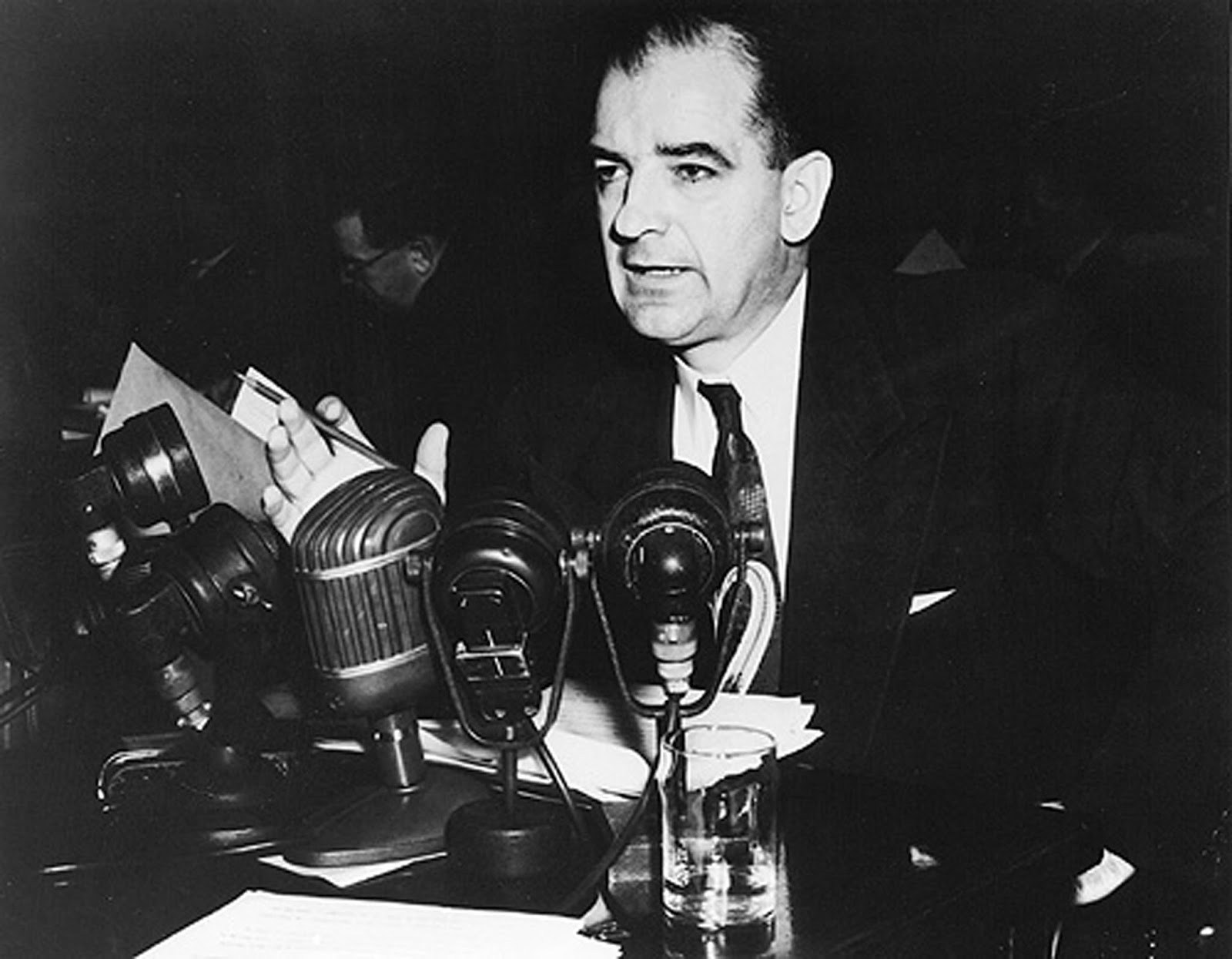
Sen. Joseph McCarthy
There are few heroes in this book. Among those depicted in a positive light are John Service and John Davies, persecuted by the FBI for speaking truth to power but later vindicated. The outright "villains" include Joseph McCarthy, Luce, Chiang, members of the Soong family and Dean Acheson, among others.

Acheson, in particular, is revealed as having a role in bringing about three wars. While FDR secretly tried to keep Japan's moderates in power by supplying Nippon with oil, Acheson found a way to impose a total oil embargo, thinking it would make Imperial Japan bow to the United States, according to Bradley. 

But: "Instead of empowering moderates in Tokyo, Washington's demands resulted in the fall of the moderate government and the military taking full control. The chief of the mad dogs, General Hideki Tojo, now became Prime Minister."

President Truman and Acheson, an architect of war in Korea.
Acheson next lobbied for war in Korea, which would eventually pit Douglas MacArthur against Mao and set McCarthy against Truman, leading to an inevitable one-term presidency of Harry Truman and cries by McCarthy and others of "Who lost China, Who Lost Korea?" Acheson's machinations for war in Vietnam would lead to another one-term presidency, that of Lyndon Baines Johnson.

Bradley quotes David Halberstam, author of "The Coldest Winter": "Acheson urged Truman not only to go to war in Korea with no congressional consultation, but also to send covert military aid to the French in Indochina for their war against Ho Chi Minh."

Another revelation: How much Harvard University was a hub into – and eventually away from – the China Influence. Connected to Harvard: Teddy Roosevelt, Franklin Delano Roosevelt, Baron Kaneko (friend of T.R.), T.V. Soong (friend of FDR), Thomas Corcoran (ran FDR's covert operation), McGeorge Bundy (stepson of Dean Acheson and advocate for expanded war in Vietnam under LBJ), Henry Kissinger (eventually led efforts toward normalized relations with China), and Daniel Ellsberg (who "revealed his evidence of executive war crimes and his belief that in a democracy the public had a right to know.")

Presidents Eisenhower, Kennedy, Johnson and Nixon each warned about the spread of Communism causing a "domino effect" in the region, something that did not happen.

Opium is not the only poison contributing to the mirage of the true believers. The China Lobby was tied to Southern Tobacco, and the War in the Pacific was brought on by an embargo of crude oil. Thoroughly researched and annotated, this book contributes to a sober understanding of how blind faith and hubris can lead to war and more war.

Sunday, August 23, 2015

Ten Sterling Insights in Life of Pearl Harbor Survivor

Review by Bill Doughty

Another Pacific Historic Parks (2014) booklet focuses on "A True American: The Story of a Pearl Harbor Survivor, World War II, Korean and Vietnam War Veteran." Here are ten insights in a remarkable life of a member of the "Greatest Generation" narrated by Sterling R. Cale to his son Sterling V. Cale.

1.  Medical: Cale served as a Pharmacist's Mate, forerunner to Navy Hospital Corpsman. Early in his career he passed out during a circumcision when the patient, supposedly anesthetized, started screaming. He thought of himself first as a farm boy from Illinois, but he had dreams of one day becoming a surgeon, dreams that were cut short later in life when he injured his thumb.

2.  Dec. 7, 1941: Cale worked the night shift at the Pearl Harbor naval dispensary, a shift that ended in the morning of Dec. 7. He walked outside to witness Japanese planes attacking Battleship Row. He broke into the armory and helped hand out Springfield rifles to fellow Sailors.

Cale salutes during a wreath presentation in 2010.
3.  Rescue: During the attack, Cale rushed toward USS Oklahoma and helped with the rescue of Sailors from the waters of Pearl Harbor. "Some of them were already dead, some burned, some wounded and some were just tired," he remembers.

4.  Recovery: After the attack, he was assigned – along with 10 other men – to "ride out to the USS Arizona and start recovering bodies." Cale climbed into a heavy suit and diver's helmet, something out of Jules Verne's "Twenty Thousand Leagues Under the Sea." His description of what he finds beneath the surface is disturbing and haunting.

5.  Risk: Cale took risks. He was written up for breaking into the armory (even though Pearl Harbor was under attack). And he was court-martialed (but cleared) for keeping a war diary. " I meticulously recorded the precise location of every item and body part" to help with identification. He eventually earned commendation instead of condemnation; luckily, common sense would trump military bureaucracy.

6.  Action: During World War II he served with the 1st Marine Division at Guadalcanal, then saw action at Saipan, Tinian, Bougainville and Espiritu Sato, later serving aboard USS Panang (AG 41), named for "the U.S. gunboat that had been sunk [by Imperial Japan's military] in Chinese waters."

7.  Love: Sterling Cale met beautiful Victoria Vienna Ventula in Honolulu in 1941. They courted, married and started a family. "We managed to live with two children on my $21 monthly military salary," he said. Cale shares poignant family photos in the booklet.

Marines in Korea.
8.  Korea: Cale left the Navy for the Army "with no break in military service" and headed to Korea with the 5th Regimental Combat Team serving with the 24th (later 25th) Infantry Division as a field medic. "The North Koreans booby trapped everything: cans, bodies, vehicles and foxholes ... I remember sleeping with a grenade in each hand because North Korean soldiers would come in to the sleeping areas to slit throats." It's no wonder that Cale was affected.  "Later in life, my family could not touch me when I was asleep or I would jump up, prepared to kill them." He faced and overcame "post traumatic stress disorder."

9.  Vietnam: Like the war itself, Cale's involvement in Vietnam was complicated. It started in 1955 and continued through the 60s, with assignments that included military advisor, intelligence, logistics, medic and hospital administrator. Cale briefly discusses his work in Da Nang and support missions to the Philippines, Taiwan and Hong Kong.

With Naval Academy Women's Glee Club aboard USS Arizona Memorial, 2012.
10. Legacy: "A True American concludes with an epilogue from Sterling Cale that shows his acceptance of the realities of life. "Pearl Harbor haunted me, but I did my best to put the past behind me, focus on the present and be positive about everything. Today, Sterling Cale volunteers at the Pearl Harbor Visitor Center where he can talk about his role in the Pacific War and other wars in the Pacific.

This booklet offers other interesting tidbits about Sterling Cale's life: as an orphan, working with the Tom Mix circus, book binding and repair at the public library, musician (trumpet and drums), Eagle Scout, Navy "frogman" training, partying with "gold hair" tobacco heiress Doris Duke Cromwell aboard her yacht, and serving as NCOIC of the honor guard and burial detail at Punchbowl National Cemetery of the Pacific.

Thanks, once again, to YNCM (ret.) Jim Taylor, Pearl Harbor Survivors Liaison and honorary USS Utah Survivor, for recommending this read. See a related Navy Reads post about another PHVC volunteer, Uncle Herb Weatherwax: "From Street Gang to WWII Veteran."

Sunday, August 9, 2015

WWII Companion: How Peace Was Achieved 70 Years Ago

Review by Bill Doughty

Starting in the aftermath of the First World War, when the world lived in "interesting times" – economically, politically and socially – David M. Kennedy shows how the fumes of discontent and aggression exploded into war. 

How and why the Allies won in Europe and the Pacific in 1945 is explained in Kennedy's encyclopedic "The Library of Congress World War II Companion" (Simon & Schuster, 2007).

Kennedy provides fascinating context alongside hard facts and historical photos in this 982-page book that shifts chronologically from East to West and back with timelines, lists, and profiles of people, places, battles and concepts.

Interesting "Times" July 26, 1940 reporting FDR's embargo on oil to Japan.
Timeline entries show how the war began, with tensions growing in 1940 after President Franklin D. Roosevelt embargoed oil and other materials to Japan in January  "in retaliation for Japan's continuing aggression in China." Volatility increased into the summer:
"July 26: Attempting to restrain Japanese expansionist policies, the United States embargoes shipments of high-octane aviation fuel and premium scrap iron and steel."
Kennedy shows the perspective from all sides, including Japan's. In a separate textbook "The American Pageant" written with Thomas A. Bailey, Kennedy and Bailey refer to the attack on Pearl Harbor that brought the United States into the war as "Japan's hara-kiri gamble in Hawaii."

Among the topics in "Companion": mobilization, operations, tactics, instruments of war, and how war affected the homefront. Kennedy compares Allied teamwork, cooperation and coordination with the Axis powers' backstabbing, subterfuge and war crimes.

Japanese officers turn in their swords to the Allies in 1945.
This week marks the 70th anniversary of the end of war in the Pacific, when "Tenno Heika" Emperor Hirohito announced Japan would surrender, signifying the end of theocratic divine rule, male dominance over society, and military control of the government.

As to how the United States led efforts in the the Pacific to bring freedom, equality and democracy to Japan, Kennedy lists the "Keys to Victory: Why the Allies Won." He has lists for both the European War and Asian-Pacific War. In the case of Asia-Pacific:

  • Allied Industrial Production. The United States quickly overcame the damage done to the U.S. Pacific Fleet at Pearl Harbor, while Japan had neither the population nor the resources to match Allied industrial output. The intense rivalry between Japan's army and naval branches greatly limited the country's production capabilities
  • Intelligence. Allied intelligence gathering, code breaking, and analysis was far superior; after the war, Japan's chief of army intelligence, Lieutenant General Seizo Arisue admitted, "We couldn't break your codes at all." The Japanese in fact broke some, but to little effect.
"VJ celebration at sea" – photo from Louis Forrisi collection, NHHC.
  • Battle of Midway. After the war, all Japanese naval officers questioned by U.S. interrogators cited the defeat at Midway as "the beginning of total failure." Japan could not make up for the tremendous loss of aircraft, warships, or experienced pilots. In 1943-1944, Japan produced seven aircraft carriers; in that same period, the United States produced ninety.
  • Island Hopping Strategy. By skipping over many fortified Japanese-held islands, the Allies isolated and kept large Japanese forces out of the fight (as at Truk and Rabaul); the strategy also kept the Japanese guessing as to where the Allies would strike next.
  • Combined Operations and Amphibious Landings. The Allies mastered these techniques to successfully capture the islands necessary for an eventual attack on Japan.
  • Destruction of the Imperial Navy. At the Battle of Leyte Gulf in October 1944, U.S. forces destroyed nearly all that remained of the Japanese navy, which was "tantamount to the [subsequent] loss of the Philippines," the Japanese naval minister said after the war. "When you took the Philippines, that was the end of our resources."
Surrender aboard USS Missouri Sept 2, 1945 aboard USS Missouri (BB 63)
  • Conventional and Atomic Bombing of Japan. Bombing from spring 1945 to August destroyed more than 2 million buildings and demolished about 40 percent of the country's urban areas. The destruction and Allied blockades put Japan on the verge of starvation.

One could argue that other key reasons deserve special recognition: the impact of submarines and inspirational naval leadership, such as that provided by Fleet Adm. Nimitz, for example. 

Balanced with the joy of victory and end of suffering, Kennedy also shows the tragic aftermath of war. He writes of a U.S. Marine, Eugene Sledge, who was on Okinawa August 14, 1945 and who remembers poignantly the Marines' reaction:
"We received the news with quiet disbelief coupled with an indescribable sense of relief. We thought the Japanese would never surrender. Many refused to believe it. Sitting in stunned silence, we remembered our dead. So many dead. So many maimed. So many bright futures consigned to the ashes of the past. So many dreams lost in the madness that had engulfed us. Except for a few widely scattered shouts of joy, the survivors of the abyss sat hollow-eyed and silent, trying to comprehend a world without war."
Today, Japan and the United States share the same values of an open and free society based on democratic principles. A commemoration in Pearl Harbor this week presented by sister cities Nagaoka and Honolulu and hosted by the U.S. Navy celebrates "70 Years of Peace."

Last week, Japan Self-Defense Force soldiers and sailors paid their respects aboard USS Arizona Memorial in Pearl Harbor.


50804-N-IU636-024 PEARL HARBOR (August 04, 2015) Japanese soldiers assigned to the Japan Ground Self-Defense Force and sailors assigned to Japan Maritime Self-Defense Force helicopter destroyer JS Hyuga (DDH 181), destroyer JS Ashigara (DDG 178) and amphibious tank landing ship JS Kunisaki (LST 4003) render honors during a wreath-laying ceremony at the USS Arizona Memorial during a scheduled port visit at Joint Base Pearl Harbor-Hickam. The ceremony was meant to pay respect to those who lost their lives during the attack on Pearl Harbor Dec. 7, 1941. The JDMSF ships are scheduled to participate in the multilateral exercise Dawn Blitz 2015 in San Diego. Dawn Blitz is a scenario-driven exercise led by U.S. Third Fleet and I Marine Expeditionary Force that will test participants in the planning and execution of amphibious operations through a series of live training event. (U.S. Navy photo by Mass Communication Specialist 2nd Class Johans Chavarro/Released)

Sunday, August 2, 2015

A 'Chasm' Between Civilians and Their Military?

Review by Bill Doughty

Is the gap between the military and civilians growing? What are the lessons of wars in Korea and Vietnam, Iraq and Afghanistan? What are the changing roles for women in combat? What is the nature of future warfare?

David M. Kennedy and more than a dozen contributors explore these questions and others in "The Modern American Military" (Oxford University Press, 2013), a volume of scholarly essays that looks into the All Volunteer Force and the history of evolving conflict in the world.

"The dropping of nuclear bombs on Hiroshima and Nagasaki ended World War II but ushered in an entirely new form of conflict that came to be called the Cold War." That's how the foreword to the book by former U.S. Secretary of Defense William J. Perry begins.

Perry notes:
"The security dangers we face today must be dealt with at least as much with political, social, and economic strength (soft power) as with military strength (hard power). Our need to exert military power can no longer be met by the large conventional forces used during World War II, or the large nuclear forces accumulated during the Cold War. Today, our armed forces have been reconfiguring to meet these new demands, but many more changes are required ... Our naval forces should continue to focus on their mission of establishing sea control that can be projected worldwide on relatively short notice. Also, all our military services must become more proficient in operating in an environment of cyber threats to military technologies."
William Perry (left) and Kennedy (center) at Stanford in 2010. (L.A. Cicero)
Setting the stage for the essays that follow, Perry concludes:
"The world has been changing in very important ways since the end of the Cold War, and new and dangerous threats are emerging every day. But, against all odds, the world has not had a nuclear bomb used in anger since World War II; there has not been, nor is there likely to be, a World War III; and the average standard of living worldwide has increased since the end of the Cold War. The U.S. military has played an important role in these positive results and will be called upon to continue to play that positive role in the future. In order to do this, the U.S. military will have to adapt to economic, political, technological, and social changes, as well as evolve to meet the changing global threat environment."
David M. Kennedy
This insightful book, which zeroes in on the All Volunteer Force, is edited by Pulitzer Prize-winning historian David M. Kennedy. He assembles contributions by such distinguished thinkers as Perry, Lawrence J. Korb, Karl W. Eikenberry, Mady Wechsler Segal, Renée de Nevers, and others.

Much of this book examines the AVF, established in 1973, and its effects on society and the military, with reference to such standout personalities in military history as Gen. George C. Marshall, Gen. Creighton Abrams, Gen. Charles Krulak, Gen. Stanley McChrystal and Adm. Mike Mullen.

In a chapter titled "Manning and Financing the Twenty-First-Century All-Volunteer Force," David R. Segal and Lawrence J. Korb outline the "undue strain" placed on people and systems since 9/11.
"Despite the fact that the George W. Bush administration deployed more than two hundred thousand people on a continuous basis in Iraq and Afghanistan, and although Congress approved these conflicts, our political and military leaders did not have the courage to activate the draft. Many of the volunteers in the active and reserve ground forces were abused, physically and psychologically, while Americans went shopping. The military and the nation will pay the costs of this moral failure for a long time. Let us hope that the next time we engage in large campaigns, political and military leaders will not again forget their obligations to the country and those who serve it."
Adm. Mike Mullen (right) congratulates 2nd Lt. Erin Anthony at West Point. (Tommy Gilligan)
Kennedy has been focusing on years on the dilemma of a military being at war while the nation is not. He quotes Mullen, former CNO and Chairman of the Joint Chiefs, in an address to West Point graduates in May 2011: "I fear they [civilian Americans] do not know us. I fear they do not comprehend the full weight of the burden we carry ... We're also fairly insular, speaking our own language of sorts, living within our own unique culture."

From the abstract to an essay called "American Military Culture from Colony to Empire":
"In the midst of a civilian society that is increasingly pacifistic, easygoing and well adjusted, the Army (career and non-career soldiers alike) remains flinty, harshly results oriented, and emotionally extreme. The inevitable and necessary civil-military gap has become a chasm."
While readers may wince, many of the authors' conclusions are often backed up by strong research in the costs over the past 15 years – financial, physical and psychological.

But despite the problems presented here about the AVF, there are no calls for an immediate return to the draft.

North Korean soldier conscripts.
In fact, balancing the argument for conscription is the situation in North Korea, as described by James Sheehan in "The Future of Conscription":
"In Kim Jong Un's first public appearance following his father's death, the new leader reaffirmed Kim Jong Il's emphasis on the military: it was, he declared, his government's 'first, second, and third' priority. With terms of active duty from five to twelve years and reserve obligations up to the age of sixty, North Korea has what is perhaps the world's most extensive and socially intrusive system of conscription."
Sheehan also describes historical and comparative use of conscription in Europe and other regions and countries over the past century.

This book is recommended by former Secretary of State Condoleezza Rice, who lauds the exploration of use of contractors in war zones and new technologies that are changing the nature or warfare. "We owe it to our servicemen and women and to those who command them to examine critically and debate the state of military affairs," Rice writes. "This book is a significant contribution to that cause."

The size of the gap or "chasm" between the U.S. military and the civilian society it serves is debatable. According to Kennedy, "This volume aims not only to measure the range of that distance, but to help close it."

Saturday, July 18, 2015

How the Wright Brothers Got to the Moon

Review by Bill Doughty––

When naval aviator and U.S. astronaut Neil Armstrong became the first man to step onto the moon he brought a physical piece of the Wright Brothers legacy with him. What the fellow Ohioan carried with him is revealed in David McCullough's latest work, "The Wright Brothers" (Simon & Schuster, 2015).

McCullough, the author of "1776," "Truman" and "John Adams," explains how and why Wilbur and Orville were successful in inventing the airplane and demonstrating the first  human-operated, powered and sustained flight of a heavier-than-air machine in 1903.

The brothers faced family ravages of typhoid and tuberculosis, swarms of "demon mosquitoes," oppressive heat and plenty of crashes before and after their first flight. Later, another challenge was just getting the scientific community, media and nation to take them seriously.

How they dealt with challenges and setbacks was key to their success.

Wilbur and Orville Wright at home in Dayton, Ohio, 1909.
The boys' father, Reverend Milton Wright, bought them educational toys and books, encouraged high standards of excellence, promoted unity of purpose and nurtured determination. "We learn much from tribulation, and by adversity our hearts are made better," the senior Wright wrote to Orville after a crash cost the life of an Army lieutenant.

The brothers' high school teacher noted "their patient persistence, their calm faith in ultimate success, their mutual consideration of each other."

Books in the Wright family collection included ecclesiastical works alongside works by Robert Ingersoll, who had an apparently significant influence on the brothers, according to McCullough.
"There could be found the works of Dickens, Washington Irving, Hawthorne, Mark Twain, a complete set of the works of Sir Walter Scott, the poems of Virgil, Plutarch's 'Lives,' Milton's 'Paradise Lost,' Boswell's 'Life of Johnson,' Gibbon's 'Decline and Fall of the Roman Empire,' and Thucydides. There were books on natural history, American history, a six-volume history of France, travel, the 'Instructive Speller,' Darwin's 'On the Origin of Species,' plus two full sets of encyclopedias."
Wilbur was interested in history and science, especially birds, equilibrium and the study of wind.

McCullough's butterscotch voice comes through the narrative as if the reader is listening to a Ken Burns documentary. McCullough's descriptive powers, so strong in all his work, are put to good effect here. For example, here is the author's description of the Outer Banks of Kitty Hawk, North Carolina:
"The previous winter on the Banks had been especially severe, one continuing succession of storms, the brothers were told, the rain coming down in such torrents as to make a lake that reached for miles near their camp. Ninety-mile-an-hour winds had lifted their building from its foundation and set it down several feet closer to the ocean. Mosquitoes were said to have been so thick they turned day into night, the lightning so terrible it turned night into day.  But the winds had also sculpted the sand hills into the best shape for gliding the brothers had seen, and the September days now were so glorious, so ideal, that instead of turning at once to setting up camp, they put the glider from the year before in shape and spent what Wilbur called 'the finest day we ever had in practice.'"
The brothers' aircraft were tested near Kitty Hawk and refined in a pasture near Dayton, Ohio, where their 1905 Flyer would become the first practical aircraft 110 years ago this year.
"It was at Huffman Prairie that summer and fall of 1905 that the brothers, by experiment and change, truly learned to fly. Then, also, at last, with a plane they could rely on, they could permit themselves enjoyment in what they had achieved. They could take pleasure in the very experience of traveling through the air in a motor-powered machine as no one had. And each would try as best he could to put the experience in words."
McCullough at Wright State University with CBS's Rita Braver.
McCullough's extensive research helps us experience the brothers' emotions and read their first-hand accounts.  The author acknowledges resources with humility, respect and appreciation, including Library of Congress, Wright State University in Dayton and Smithsonian Institution's National Air and Space Museum.

This book takes us through the early life of the Wright Brothers, their success in designing and selling bicycles and their adventures in Europe, especially in Paris, at a time when they were courted by French, British and German governments and militaries – before the American military showed real interest in their achievements.

Eventually they received honors, memorials and accolades (and unfortunately acrimonious patent infringements) from Dayton to D.C. and from Le Mans to New York. We learn about their relationship with Otto Lilienthal, Chanute Langley, Charles Lindbergh, Alexander Bell, Glenn Curtiss and other friends and rivals.

Wilbur's flight in New York around the Statue of Liberty and above the departing Lusitania in 1909 is a standout. Orville saw the 1921 commissioning of his namesake USS Wright (AV/AZ-1), a ship that was captained by commanding officers that included Ernest J. King, Aubrey W. Fitch and Marc A. Mitscher and which fought in World War II in the Pacific. Orville lived long enough to see aircraft and bombers used extensively in WWII. The first USS Kitty Hawk (APV-1) was launched in 1941 and served throughout the Second World War. Another namesake, the aircraft carrier USS Kitty Hawk II (CV(A) 63), was launched 57 years after the brothers' first flight, served nearly half a century, and was decommissioned in 2009. Read an extensive timeline history of the USS Kitty Hawk here.

When Neil Armstrong stepped on the lunar surface in 1969 he carried with him a piece of muslin from the Wright Brothers' 1903 Kitty Hawk Flyer.


Orville Wright (left) congratulates Maj. C.A. Lutz, United States Marine Corps flyer, who won the Curtiss Marine Trophy in Washington, May 18, 1928. Lutz averaged 157 miles an hour. (Photo by Harris & Ewing)

Sunday, June 28, 2015

Arctic Adventure: Sides with Science

Review by Bill Doughty

A good Navy read during hot summer months is the chilling true tale by Hampton Sides, "In the Kingdom of Ice: The Grand and Terrible Polar Voyage of the USS Jeannette" (2014, Doubleday).

Sides, author of "Ghost Soldiers," takes us to the late 19th century when science was still revealing the truth about earth's geography.

Explorers like Hudson, Barents and Barrington believed in an open polar sea. They sought to find warm currents and a temperate land beyond the ice. Navy charts at the time were incorrect.

Vain efforts to prove an open sea at the North Pole were fueled by assumptions of a deranged German mapmaker named August Petermann. He's just one of the interesting characters in the drama. 

Another is newspaper magnate James Gordon Bennett Jr., the obscenely wealthy owner of "The New York Herald." The eccentric newspaper publisher capitalized on strong feelings of nationalism and saw rich profits to be gained by backing a voyage to the Arctic. Bennett funded a U.S. Navy public-private venture to discover something that didn't exist.

This is a tale of life and death, courage and resilience.

The Navy's maps indicating a "supposed open polar sea" were developed by a naval officer respected for his oceanography, Silas Bent, who had previously served as flag lieutenant under Commodore Matthew C. Perry aboard USS Mississippi.

The Jeannette mission to the Arctic was launched in early July 1879, just 27 years after Perry sailed his "black ships" into Japan, 14 years after the Civil War (in which Silas Bent would resign his commission to side with the Confederacy) and 20 years before the Navy established a base at Pearl Harbor, Hawaii. 

Parts of the world were still being opened to trade, ships were just being converted from canvas to steam, and Thomas Edison was about to light up entire streets with his greatest invention.

One hero of the voyage is captain of the USS Jeannette, Lt. Cmdr. George Washington De Long of New York.

De Long became captivated by the Cold North on an earlier journey up "the ragged west coast of the world's largest island, Greenland."
"De Long's disdain for the polar landscape soon wore off ... something began to take hold of him. He became more and more intrigued by the Arctic, by its lonely grandeur, by its mirages and strange tricks of light, its mock moons and blood-red halos, its thick, misty atmospheres, which altered and magnified sounds, leaving the impression that one was living under a dome. He felt as though he were breathing rarefied air. He became intrigued by the phenomenon of the "ice blink," the spectral glow in the low sky that indicated the presence of a large frozen pack ahead. The scenery grew more impressive: ice-gouged fjords, towering bergs calved fresh from glaciers, the crisp sound of cold surf lapping against the pack ringed seals peeking through gaps in the ice, bowhead whales spouting in the deep gray channel. This was the purest wilderness De Long had ever seen, and he began to fall in love with it."
Sides describes De Long as frustrated by Navy bureaucracy and red tape yet fully embracing the stern, disciplinarian style of shipboard leadership, quoting a contemporary of his, Mark Twain. According to Sides:
"De Long blamed the Navy for some of his worst traits. He once wrote, 'Ship life is a hard thing on the temper. Mark Twain in his Innocents Abroad says that going to sea develops all of man's bad qualities and brings out new ones that he did not suppose himself mean enough for. I wonder if that accounts for all the rough edges of my character.' He admitted that he could be 'hard on men,' but such was the nature of a naval officer's life. 'I can only say I never allow any argument,' De Long once wrote. 'It is my office to command and theirs to obey.''"
Prior to heading north, De Long brought USS Jeannette to the Mare Island Shipyard where double trusses, new iron beam reinforcement and extra pitch were installed and applied. Mare represented the nation's original "rebalance" to the Pacific and was considered a "western outpost of America's burgeoning might."

The Navy's Chief Engineer at the turn of the 20th century, George W. Melville
Another hero of the voyage is innovative engineer George W. Melville. Years later, Melville would become chief engineer for the Navy, earning the rank of rear admiral. As the 20th century dawned, Melville "presided over an expansive redesign of the fleet, largely completing its conversion from wood to metal, and from wind to steam power.  When he retired, in 1903, the U.S. Navy boasted one of the most powerful modernized fleets in the world."

Sides, known for revealing the personalities of long-dead characters, excels here in describing more than a dozen men of De Long's ill-fated mission.  The author shows the hard choices the sailors and civilians faced so they could survive: ice or sea, boats or sleds – which dogs to cull – what to eat.

Arctic-bound USS Jeannette becomes icebound.
Books were an important part of the mission, as inspiration both before and during the months at sea: books by Twain, Stephen Crane, Walt Whitman, Edgar Allan Poe, Jules Verne, Mary Shelley and Frederick Marryat, of the British Royal Navy, whose swashbuckling tales ignited in De Long "a profound desire to enter the Naval Academy."

"Kingdom" is a fascinating book, recommended by retired Adm. James Stavridis and another favorite Navy Read author, Nathaniel Philbrick, who calls this book a "dazzling page turner ... full of unforgettable characters and vividly described scenes." For example:
"Much of their journey seemed like a dream, a long whiteout of undifferentiated days punctuated by a few moments of haunting clarity: A snowy owl staring at them. A pile of decrepit sleds they smashed up for firewood. The corpse of a native buried in a box on a hill. A crow, circling and circling and circling."
Hampton Sides used original documents and reports from the voyage, coupled with contemporaneous newspapers and letters, including some heartbreaking correspondence between De Long and his wife Emma – featured in each chapter. The author's notes and selected bibliography span 34 pages and more than 140 years.

Pick up "In the Kingdom of Ice" to read more about De Long and Melville's daring adventure, the entropy of their mission in search of the open polar sea, and the revelations found in the frozen and unforgiving Arctic. Some survived. Others perished. Those who did not return alive were called by the Secretary of the Navy, "martyrs in the cause of science."