Showing posts sorted by date for query stoneman. Sort by relevance Show all posts

Saturday, April 29, 2023

Three Navy-blue Green Presidents

Review by Bill Doughty––

Six United States presidents in my lifetime were Navy veterans: John Kennedy, Lyndon Johnson, Richard Nixon, Gerald Ford, Jimmy Carter, and George H.W. Bush. Each in his own way and to varying degrees was an optimistic champion of the environment.


Efforts of the first three –– JFK, LBJ and RMN –– led to the first Earth Day in 1970, now Earth Month in April.


The environmental movement is sometimes overshadowed by the other tectonic shifts during that era: The Cold War, Civil Rights, and the Vietnam War. But Douglas Brinkley takes the history of the green movement out of the shadows by centering on the three presidents of the era, as well as highlighting the life and work of ecologist-writer Rachel Carson, in “Silent Spring Revolution: John F. Kennedy, Rachel Carson, Lyndon Johnson, Richard Nixon, and the Great Environmental Awakening” (HarperCollins, 2022).


Sailor JFK
The Navy had a large part in shaping the vision of the presidents who defended pristine wilderness, clean air and water, and preservation of the environment.

For Kennedy of Massachusetts, it began with a deep love of the sea and shoreline, according to Brinkley, who opens the book with this:

“Beguiled by the way sea and sky played together, almost always unpredictably, John F. Kennedy was enthralled by the complexity of the Atlantic Ocean: the moody sky, the invisible might of the tides, shifting clouds, and the yaw and pitch of movement. To be on the water in a sailboat, even in a cruel wind, provided him with a profound connection with nature.”

Kennedy saw, in his own words, the human “biological fact that all of us have, in our veins, the same percentage of salt in our blood that exists in the ocean, and, therefore, we have salt in our blood, in our sweat, in our tears. We are tied to the ocean,” he said.


Johnson of Texas, was saddled with fighting the Vietnam War, poverty, segregation, and voter suppression. Environmentalism took somewhat of a back seat to other priorities. Brinkley writes:

“On the conservation front, Johnson probably should have been aware of of the importance of intelligent land stewardship. His favorite novel –– John Steinbeck’s ‘The Grapes of Wrath’ (1939) –– was based on a man-made ecological catastrophe during the Great Depression that destroyed ranches and farms in Texas, New Mexico, and Oklahoma. It was soil depletion that led to the Dust Bowl. Johnson, however, was left wanting to help the rural poor, without setting an equal priority on nurturing the natural world around them. Johnson liked Bureau of Reclamation dams, because he knew first-hand how electricity lit up forgotten regions, literally and figuratively.”

LBJ’s penchant for dam-building, both at home and abroad, as well as his escalation of the Vietnam war, caused consternation for environmentalists.

LBJ
Yet, in 1968, Johnson signed the Wild and Scenic Rivers Act. “Rivers, Johnson believed, from the far-flung waterways of Alaska, Idaho, and Wyoming to those coursing through the rural countryside of Vermont and Maine were the lifeblood of America,” Brinkley observes.

Johnson “forged ahead on conservation legislation to protect wild places because it was part of America’s frontier heritage.” LBJ is responsible for bringing about the Wilderness Act, Highway Beautification Act, and a commitment to “a green legacy for tomorrow.” According to Brinkley, Johnson should be given more credit for his advocacy to conservation, particularly of America’s rivers (just as President Eisenhower is recognized for the national highway system). As regards LBJ, “His Wild and Scenic Rivers Act was a visionary law passed purely on behalf of the aesthetics of rivers.”


Nixon of California, was captivated by the Pacific Ocean, as a child in Orange County. In 1969 he would make his home, as Kennedy did, next to the ocean. In Nixon’s case, it was in San Clemente, where he enjoyed whale watching. Though facing his own corruption issues that would eventually lead to his expulsion from office, Nixon still managed to achieve positive global initiatives such as rapprochement with China and arms control talks with Russia. And he not only supported the Clean Air Act, Clean Water Act, and National Environmental Policy Act, but he also created the Environmental Protection Agency.

“If Nixon’s signing of NEPA and his Everglades protection were the first big time indications of the administration’s serious commitment to environmental protection, the State of the Union address on January 22, with its plea that ‘Restoring nature to its natural state is a cause beyond party and beyond factions,’ was seen by surprised Democrats as the Great Reconfirmation that Nixon indeed harbored a genuine TR streak … When Nixon delivered a Special Message to the Congress on Environmental Quality on February 10 (1970), he listed fourteen executive orders and twenty-three legislative proposals to combat pollution and provide parkland. ‘The time has come when we can wait no longer to repair the damage already done,’ he told Congress.”

Brinkley notes several times that Nixon was “suspicious” of liberal traps, so he did not appear on TV for the first Earth Day. He even asked FBI director J. Edgar Hoover, to spy on high-profile Earth Day events on college campuses, fearful of their ties with the anti-Vietnam War movement.


Yet, Nixon’s support of conservation, preservation, and a clean environment persisted.


Nixon
In 1970 he created the EPA (Environmental Protection Agency) and NOAA (National Oceanic and Atmospheric Association, and he signed the Clean Air Act.

On October 21, 1972, Nixon signed the Federal Environmental Pesticide Control Act of 1972, an achievement to the legacy of Rachel Carson. He signed the Marine Mammal Protection Act in 1972 and the Endangered Species Act of 1973.


And he signed the Emergency Highway Energy Conservation Act (limiting nationwide speed limits to 55) and the Federal Energy Administration Act in 1974 (the same year he was forced to resign because of Watergate).


Brinkley briefly shows how the Navy stopped pumping sewage into San Francisco Bay while in port. He also discusses how, during the Nixon administration, Marines at Camp Pendleton helped protect endangered wildlife. In coordination with the Department of Interior and NASA, the Navy sponsored the first all-women team of aquanauts in Tektite II to study the ecosystem at the bottom of the sea.


All three Navy-veteran presidents –– two Democrats and one Republican –– were following the lead of conservationist Republican President Theodore Roosevelt of another generation, and who had his own strong ties to the Navy and who championed nature and national parks. 


In two appendices Brinkley lists scores of national wildlife refuges and national parks created or authorized by Kennedy, Johnson, and Nixon.


One of President Nixon’s many environmental preservation initiatives included establishing a federally designated Wilderness area, the Cumberland Island National Seashore. “Because Cumberland National Seashore encompassed twenty-three different ecological communities, Nixon agreed that only three hundred tourists at a time be allowed on Cumberland Island. Georgia Governor Jimmy Carter, a moderate Democrat, played a major conservation role regarding the saving of Cumberland…"


Rachel Carson talks about "Silent Spring" in April 1963
This massive book (857 pages!) includes dozens of evocative photos, memorable stories, and captivating personalities of the people who created the environmental enlightenment and “awakening” in the 1950s, 60s, and early 70s.

Rachel Carson provided much of the inspiration for the environmental movement leading up to the first Earth Day and the public’s demand for clean water, air, and land. She wisely connected the long-lasting danger of atmospheric tests of nuclear weapons with the hazards related to DDT, a pernicious pesticide that altered ecosystems. We have referenced or featured Carson’s works several times here on Navy Reads.


Carson’s “Silent Spring” and her Sea Trilogy inspired John F. Kennedy. Family matriarch Rose Kennedy gave a copy of “Under the Sea-Wind,” published in 1941, to JFK in the mid-1950s.


“Although ‘Under the Sea-Wind’ sold in low numbers, perhaps because Pearl Harbor occurred right after it debuted, it became celebrated by marine biologists and other lovers of the animal kingdom,” Brinkley writes.


Carson was, in turn, inspired by Albert Schweitzer. And it seems everyone was inspired by Henry David Thoreau. 


Brinkley also follows the influence and positive impact of artists, writers, scientists, and politicians: Ansel Adams, John Muir, Carl Sandburg, Marjorie Stoneman Douglas, William O. Douglas, Linus Pauling, Harold Ickes, Wallace Stegner, Robert Frost, Ted Sorensen, Robert F. Kennedy, Cesar Chavez, Jacques Cousteau, Sylvia Earle, Barry Commoner, David Brower, Lady Bird Johnson, Howard Zahniser, Ralph Nader, Robert Boyle, John Saylor, Katherine Ordway, Chief Luther Standing Bear, Laurance Rockefeller, Russell Train, Stewart Udall, Ronald Dellums, Daniel Patrick Moynihan, Henry “Scoop” Jackson, Frank Church, Philip Hart, Gaylord Nelson, Edmund Muskie, William Ruckelshaus, Walter Hickel, Al Gore, and John Ehrlichman.


In the book’s preface, Brinkley praises those “serving a cause bigger than oneself” and warns against the ostrich syndrome of ignoring ongoing threats to the environment, including climate chaos. 

He writes: “The poisonous climate cocktail of ravaging wildfires, mega floods, and monstrous blizzards costs American taxpayers billions of dollars every year (soon to climb to trillions), disrupts lives, causes vast displacement, ruins communities, and kills countless citizens.”

Brinkley says, “In some small way, I hope this book illuminates how an engaged citizenry can bring America’s natural beauty back from the brink.” He writes, “Optimism must remain in our oxygen.”


I remember the feeling of optimism, hope, and activism of the first Earth Day in 1970, the first recognition that something needed to be done to confront pollution, overpopulation, and other ecological threats.


Among more than a dozen books, Brinkley is the author of “The Wilderness Warrior: Theodore Roosevelt and the Crusade for America” (2009) and “The Unfinished Presidency: Jimmy Carter’s Journey Beyond the White House” (1998).

Tuesday, May 17, 2022

‘American Buffalo’ by Steven Rinella

Review by Bill Doughty––

America’s most famous living hunter-conservationist is Steven Rinella. He is the brain and heart of the MeatEater Netflix show, podcast, and franchise. Rinella believes in respect for nature, conservation, and the environment. And he sees a deep connection between us and our food.


On one of his shows Rinella takes former Navy SEAL and Navy Reservist Cmdr. Rorke Denver, for a hunt in Alaska for black bear.* Denver is a fellow author who starred in “Act of Valor.” They eventually find a bear, and when he looks through the rifle’s scope at the bear now coming closer, Denver pauses to appreciate the beauty and power of the life he is about to take.


Rinella has a similar moment when he sights a buffalo, as described in gripping detail in “American Buffalo: In Search of a Lost Icon” (Spiegel & Grau, Doubleday, Random House; 2008).


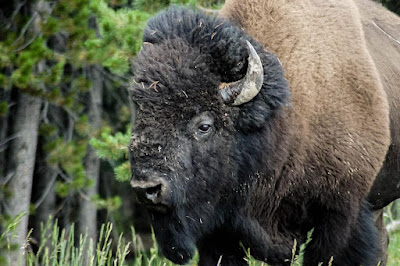
A North American buffalo.
Lucky to have won a lottery for a hunting permit for wild buffalo, Rinella is luckier still to be one of a few who actually finds and shoots one. His journey in Alaska, eluding bears and other predators, battling the elements, and navigating dangerous waterways, is compelling. So is his moment of truth as he prepares to shoot. His careful butchering of the animal is presented in precise detail. Though written fourteen years ago –– before Rinella became a world-renowned figure –– this book reveals the talents of a gifted writer and outdoorsman.

But what makes “American Buffalo” truly great and lasting is the author’s panoramic view of time and a philosophical connection to nature and life. He looks unblinkingly at the devastating destruction and near extinction of bison and other species in North America, lamenting the wanton greed and shortsightedness of people who killed only for profit and trophy. Rinella eats what he kills.


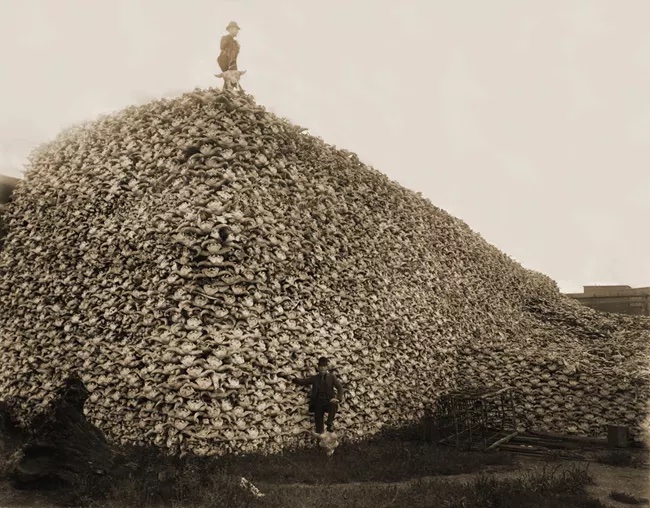
In this photo from 1892, men stand next to and atop a pile of American bison skulls waiting to be ground up for fertilizer.

Like other hunters, he sees the animal’s skull as a kind of connection to life’s mysteries.

“Buffalo skulls were put to various uses by Indians, most of a spiritual or metaphysical nature. The buffalo skull was an especially potent symbol to many Plains Indians tribes, but not because it equaled death. Rather, a skull represented a form of rebirth to many tribes. To reduce a buffalo to its skeleton was like ushering the animal back to a sort of primordial starting line, or beginning. The clean skull allowed for continuity, like a blank canvas upon which future buffalo could be created…

“I’m not a particularly religious person, though I do sense an inkling of the spiritual when I look at this buffalo skull. Many people have tried to explain to me what they feel when they look at a crucifix of Torah scroll; it’s an emotion often described as a mixture of gratitude, devotion, continuity, and awe. Looking at a buffalo skull is probably the closest I’ll ever come to experiencing those feelings, however faintly, and I’m glad to have a taste of that…”

Rinella describes how he embraces the privilege of being alive for the relatively short time we have.


Alaska's Copper River Valley
He searches for meaning and symbols. He calls the landscape he hunts in a "trophy."

And he questions the connection between his reverence for the animal he hunts and his commitment to killing and eating it.

“In a historical sense, I suppose that my confused and convoluted relationship to the buffalo is nothing new. For the entirety of man’s existence in North America, we’ve struggled with the meaning of this animal, with the ways in which its life is intertwined with our own. I think of the first hunters who walked through some long-ago gap between glaciers and stumbled onto a landscape populated with strange and massive creatures. The buffalo was just one of many then, a giant among a host of other giants, but over time these many animals were whittled away by the forces of man and nature. Eventually the buffalo stood alone, like the winning contestant in a game show.

“The prize was humanity’s never-ending attention, which was ultimately a bittersweet award. For thousands of years, the first people of North America fed on the buffalo’s meat and wore the buffalo’s skin, and then made a deity of the animal as a way of reconciling their need to slaughter the thing that granted them life. My own European ancestors came to the New World and scoffed at the heathen nature of the Indians’ ideas, then stood by as the buffalo nearly vanished from the earth beneath their notion that the animal was an expendable gift of their own God, a commodity meant to get them started before stepping aside and letting ‘civilization’ bloom in the wilderness.”

Throughout this book, Rinella blends spirituality with superstition, history with mystery, and his own life’s experiences within the context of our shared science and reality.


“American Buffalo” opens with an extended soliloquy about Neil Young and his early band Buffalo Springfield.

In a fun and mind-bending “association game,” he links “For What It’s Worth," a song against the Vietnam War ; Dances with Wolves, filmed in Canada; Hernando Cortéz of Spain; Crazy Horse of the Oglala Sioux; Springfield rifles; the Civil War; Black Diamond, the buffalo on the American nickel coin; President Theodore Roosevelt, hunter and conservationist; and the city of Buffalo, New York.

"Buffalo," is the name of cities in eighteen states. But, Rinella notes, no wild buffalo lived near Buffalo, New York.


On Saturday, Buffalo was the site of another race-based mass shooting by a white supremacist with an AR-15 "assault-style" rifle. Today, President Biden and First Lady Jill Biden visited Buffalo. Biden, a lifelong supporter of the Second Amendment, has asked Congress to pass legislation to require new background checks for gun buyers, and ban military-style "weapons of war" and large-capacity ammunition magazines.


Steven Rinella
Rinella does not hunt with AR-15s. He uses bolt-action rifles, pump shotguns, and bows and arrows for hunting. Rinella is an ethical hunter who calls himself “an evironmentalist with a gun.”

He became interested in environmental issues, according to a profile earlier this year in The New York Times by Malia Wollan, when one of his big brothers gave him a paperback of Aldo Leopold’s “A Sand County Almanac.”According to Wollan, “Most people read Leopold as belonging to the pantheon of American environmental writers, with the likes of Henry David Thoreau, Rachel Carson and John Muir. Rinella reads Leopold as a fellow hunter.” (Marjory Stoneman Douglas is another great environmentalist in that pantheon.)


On his latest podcast, Rinella discusses hunting, fishing, and books. He talks to Cameron Hanes about Hanes’s new book, “Endure: How to Work Hard, Outlast, and Keep Hammering,” with a foreword by Joe Rogan and afterword by David Goggins. Hanes says, “If you wish you could run farther and shoot straighter, this book is for you.”


Rinella, himself, is the author of a half-dozen books, with more planned for release in coming months and years, including books for children, outdoor cooking, and an “atlas for the outdoors.”


Steven Rinella, the “environmentalist with a gun,” is also a philosopher with a pen and a voice.

Some people, especially vegans and those who prefer not to think about where their super market food comes from, will be turned off by the whole MeatEater oeuvre. But that’s the beauty of American freedom, diversity, and the right to choose.


In the MeatEater episode with former Navy SEAL Rorke Denver, after Denver bags his bear, and just before he and Rinella skin and butcher it, Rinella expresses his appreciation for the service and sacrifice of Denver and other veterans who serve in the nation’s defense.


In “American Buffalo: In Search of a Lost Icon” readers can discover an ethos of honor, courage, and commitment.


*(Top photo: Denver and Rinella trek their bear meat and fur out of the Alaskan wilderness in a scene from MeatEater, YouTube.)

Monday, March 29, 2021

‘Gutsy’ Women Knocking on the Door

Review by Bill Doughty

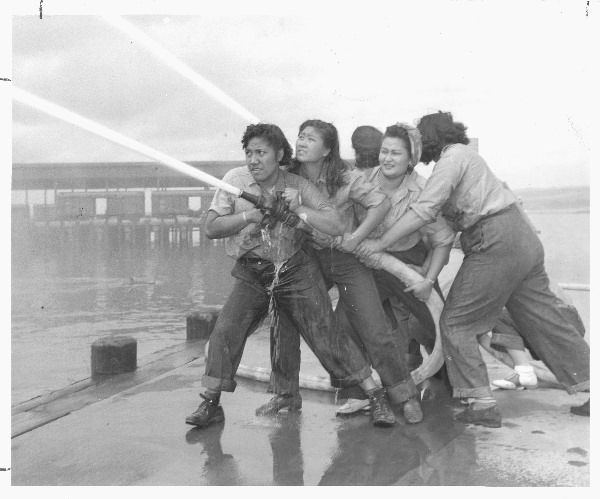
In an iconic photo, four Asian American Pacific Islander women at the Pearl Harbor Naval Shipyard train in firefighting. Long mislabeled as taken during the attack of Dec. 7, 1941, the photo in fact portrays some of  the strong women who applied to support the Navy’s war efforts in the wake of that attack. From left to right: Elizabeth Moku, Alice Cho, Katherine Lowe, and Hilda Van Gieson.


Over time, history usually has a way of sorting out fact from fiction.


Rear Adm.Grace Hopper, "Mother of Computing"
The facts and highlights of strong women of grit and grace are spotlighted in a book recommended for Women’s History Month. Profiles of more than 100 women come to life in “The Book of Gutsy Women” by Hillary Rodham Clinton and Chelsea Clinton (Simon & Schuster, 2019).

Among the women profiled are some we featured in Navy Reads posts: Rear Adm. Grace Hopper, Ada Lovelace, Rachel Carson, Marjory Stoneman Douglas, Margaret Chase Smith, Malala Yousafzai, and Maya Angelou. This book includes mini-biographies of both famous (Clara Barton, Helen Keller, Ida B. Wells, Maya Lin, Gabby Giffords, Greta Thunberg, and Venus and Serena Williams) as well as less-well-known women (Rigoberta Menchu Tum, Dr. Gao Yaojie, Nelba Marquez-Greene, Wangari Maathai, and Jineth Bedoya Lima).


Chelsea and Hillary Clinton, 2011
Hillary and Chelsea each provide essays about their subjects. They also offer personal perspectives about the women who have inspired and enlightened them – women who have made a difference in the world. The book is organized in sections: early inspirations, education pioneers, earth defenders, explorers and inventors, healers, athletes, advocates and activists, storytellers, elected leaders, groundbreakers, and women’s rights champions.

Chelsea writes, “I learned of Grace (Hopper) in 1996, when the navy named a new ship the USS Hopper (DDG 70) in her honor … I learned even more about her when I spoke many years later at the Grace Hopper celebration, the largest gathering of women technologists in the world.”


Former First Lady, senator, and Secretary of State Hillary Clinton reflects about the suffragists who knocked on the door, marched in the street, and fought for women to be able to vote in the United States one hundred years ago. That right was guaranteed with the passing of the Nineteenth Amendment to the U.S. Constitution, but it was a right that took decades to apply to women of color:

“Reading the words of the Nineteenth Amendment today, it’s hard not to wonder why it took so long” ‘The right of citizens of the United States to vote shall not be denied or abridged by the United States or by any State on account of sex. Congress shall have the power to enforce this article by appropriate legislation.’ But, of course, it was a long struggle because it was about so much more than the right of women to vote. It was about race, class, and deeply held cultural and religious views about women’s subordinate roles to men in society. It was about men’s –– and some women’s –– insecurities and fears of the unknown. These challenges are still present today.

The franchise –– the basic right of citizenship –– is still being fought over between those of us who believe every citizen should be able to vote and have that vote counted, and those who want to restrict the vote by erecting barriers against people, largely still based on race.”

Celia Ou, a graduate student at Scripps Institution of Oceanography, monitors computer screens displaying detailed sonar imaging of the ocean floor aboard the Auxiliary General Oceanographic Research (AGOR) vessel R/V Sally Ride, Dec. 15, 2016. (John F. Williams)


Nearly all the Gutsy women featured in this book faced and overcame some kind of obstacles of discrimination. Chelsea Clinton says this about space pioneer astronaut Sally Ride, the first American woman in space (in 1983) and a champion of STEM education for young people worldwide:

“Even after her death in 2012, Sally Ride kept breaking barriers. She came out as a lesbian quietly, without fanfare … Not long after her death, Tam [O’Shaughnessy, her partner of 27 years] received a call that surprised her, from Ray Mabus, then secretary of the navy. The navy hoped to honor Sally by naming a research vessel after her. Secretary Mabus was calling to ask whether Tam would be the ship’s sponsor – a role that had, up until that point, been filled by the wife of the man for whom the ship was named. ‘I think it is fitting the the celebration of Sally’s legacy as a pioneering space explorer and a role model includes an acknowledgment of who she really was and what she cared about,’ said Tam. The R/V Sally Ride, commissioned in 2016, is the first navy research ship named for a woman. Her legacy lives on in the scientific curiosity sparked in the girls and boys she continues to inspire, the ship that bears her name, and a spot on the moon named after her by NASA.”

Military readers may find fascinating nuggets of history in the essays about Sylvia Earle, Mary McLeod Bethune, Florence Nightingale, Eleanor Roosevelt, and Mary Edwards Walker. Chelsea writes this about Walker:

“…Dr. Mary Edwards Walker, the only woman in her medical school class at Syracuse Medical College in 1855. She was a practicing physician when the Civil War broke out. She desperately wanted to enlist in the Union Army as a surgeon but wasn’t allowed to because she was a woman. Initially she was called a nurse, since women generally weren’t considered doctors. Because women were not allowed to enlist, Mary had to volunteer, working for free at a temporary hospital, first in Washington and then in Virginia, where she traveled to Union field hospitals across the commonwealth … When her medical credentials were finally accepted she moved to Tennessee and became a War Department surgeon – a paid position that was the equivalent of a lieutenant in status.”


Dr. Sylvia Earle became chief scientist at the National Oceanic and Atmospheric Administration in 1990. She pioneered research in preserving 
and protecting the ocean, including the study of damage to coral reefs. Her inspiring TED talk, above, is a call to action. Hillary writes:

“When I think of Sylvia’s work, I am reminded how important it is for all of us to peruse and consider what we want to leave to the generations who come after us –– how they’ll honor the past, imagine the future, and give gifts to those who will live out their lives long after we’re gone. That’s exactly what Sylvia’s life as a scientist, an engineer, a teacher, and an explorer should inspire all of us to do: we must preserve our oceans for the future.”

Last year, this book generated controversy because of the women who were not included. For example, there is an unfortunate dearth of women who have served in or with the military. Surely, the authors could have included a “protectors” section filled with inspiring women who served in uniform.


Despite the intriguing photo on the cover, there is little focus on the women who served on the Homefront during the Second World War. In fact, there’s no explanation of the colorized photo of the women firefighters at the Pearl Harbor Naval Shipyard.

Yet, considering the general lack of attention toward the achievements of women in American and world history for many generations, it is refreshing to see a book of this scope. Women continue to knock on the door, push through the glass ceiling, and demand equality.


“The Book of Gutsy Women” illustrates the strengths of women throughout history, often in the face of sexism, misogyny, harassment, and patriarchy. It highlights the facts of women’s history and showcases women’s contributions to creating a better world now and in the future.

Wednesday, December 2, 2020

History Has Its Eyes on – Hong Kong

Review by Bill Doughty––

The soundtrack to Joshua Wong's account of the trials and tribulations in Hong Kong can be found in Lin Manuel Miranda's "Hamilton."

"Unfree Speech: The Threat to Global Democracy and Why We Must Act, Now" by Joshua Wong (Penguin Books, 2020) is written by a young man who is "young, scrappy and hungry" and ready to "rise up." He seems to echo Hamilton: "I'm not going to waste my shot."


Wong's is the voice of a boy becoming a man –– a self-described "diehard fanboy" of Gundam, OnePiece, Marvel and DC comics, as well as a student of Gandhi and MLK. He and his close friends Agnes Chow and Ivan Lam (top photo) were sentenced to prison this week by a court in Hong Kong for a pro-democracy protest they held last year.*

Wong offers a brief history of the situation in Hong Kong since the time of the transfer of sovereignty from Great Britain to China, July 1, 1997: The recession in '97, the SARS outbreak in 2002, "misguided housing policies," the National Security Bill, the barring of political organizations, growing demands for more democracy, and the rise of the Umbrella Revolution/Movement.

"The movement didn't happen in a social vacuum. The broken promise of electoral reform and subsequent police crackdown catalysed the unrest, but they didn't cause it. It took decades of pent-up frustration over income inequality, social immobility and other injustices for public anger to finally boil over. Martin Luther King Jr famously said that freedom is never voluntarily given by the oppressor and that it must be demanded by the oppressed. The Umbrella Movement was our way of making our demands heard."

"The movement's symbol, the yellow umbrella, captured both the humility and humanity of the non-violent protesters," Wong writes. From Hamilton: "I was aiming for the sky," "Forgiveness, can you imagine it?" and "Tomorrow there'll be more of us."

As important as the history is Wong's explanation of structure of Hong Kong's government: The Executive is chosen by Communist Party loyalists and controlled by Beijing. The Legislature is not truly representative (two 35-member chambers: GC-geographical, chosen by region, and FC-functional, chosen by Beijing-friendly business and industry. The Judiciary, supposedly independent, is becoming more deferential to the executive, where "the criminal justice system is increasingly used as a political tool to silence dissent."


Voter suppression, election interference and punishment of free speech are hallmarks of Communist China's war on democracy. "Hong Kong is gradually becoming an autocracy," Wong writes. He calls it ominously like Star Wars's "The Empire Strikes Back."


Much of this book, disjointed and rough at times, comes from his diary from prison, both at the Stanley Prison for adults and earlier while at the Pik Uk Correctional Institution for juveniles. He gives a commentary on friends, prison food, entertainment, and hunkering down during a hurricane. Again from Hamilton: "In the eye of a hurricane, there is quiet" ... "Blow us all away" ... "Look around, look around" ... "I'll write my way out, overwhelm them with honesty."


Wong describes a "perfect storm" building, and even though this book was published this year, it was before COVID-19 was part of that storm.


Agnes Chow
Wong and many of his fellow protesters, including Lam and Chow, began their activism at a tender age. They venerate earlier freedom advocates such as Ai Weiwei, who writes this book's introduction, and they commemorate the young students killed in the Tiananmen protests and massacre of June 4, 1989.


The cover of the book features a quote from Greta Thunberg: "Together we are one loud voice that cannot be silenced." Young people are at the heart of global calls for freedom and equality. Wong was inspired by Malala's memoir. We're reminded of the young people of Parkland, Florida who sparked a movement for gun safety in the wake of the killing of 17 people at Marjory Stoneman Douglas High School. 


The subtitle of this book is "The Threat to Global Democracy and Why We Must Act, Now."

"From Turkey and Ukraine to India, Myanmar and the Philippines, citizens are pushing back oppressive regimes in defence of their diminishing rights. But nowhere else in the world is the struggle between free will and authoritarianism more clearly demonstrated than here. In the new trans-Pacific cold war, Hong Kong is the first line of defence to stop or at least slow down the dangerous rise of a totalitarian superpower. Like the canary in the coal mine or the early warning system on a tsunami-prone coastline, we are sending out a distress signal to the rest of the world so that countermeasures can be taken before it is too late. As much as Hong Kong needs the international community, the international community needs Hong Kong. Because today's Hong Kong is the rest of the world's tomorrow."

Wong points out Russia's aggression and annexation of Crimea, India's invasion of semi-autonomous Kashmir, and Turkey's military regime's imprisonment of journalists and displacement of millions of Kurds. "Their motivation is singular: self-perpetuation. To consolidate and maintain power," he writes.


Military power is flexed, Wong writes, to impress and intimidate –– and so leaders can remain in power. "Oceans rise; empires fall" ... "The world was wide enough for both."


Ensign Ashley Welker, a Los Angeles native, along with other Sailors, speaks to a tour group visiting Arleigh Burke-class guided-missile destroyer USS Sterett (DDG 104) during the ship’s port visit to Hong Kong, May 2, 2017. (MC1 Byron C. Linder)


In a call to action, Wong offers a 10-point action plan for civil action. He expresses appreciation to and for the United States and speaks glowingly of the support he received in Washington D.C. In September of 2019 he testified to the U.S. Congressional-Executive Commission on China (CECC).


U.S. Speaker of the House Nancy Pelosi and Wong
He received support directly from Speaker Nancy Pelosi, Sen. Marco Rubio, Rep. Jim McGovern, and Rep. Eliot Engle. Rubio sponsored the "Hong Kong Human Rights and Democracy Act." Pelosi told Wong, "You are an inspiration to young people everywhere. Thank you for your courage and resolve."


As "Hamilton" says, "It must be nice to have Washington on your side."


"Who lives, who dies, who tells your story,” in the words of Lin-Miranda.


Wong and U.S. Senator Marco Rubio
The late U.S. Representative John Lewis personified democracy and called for the "good trouble" as practiced by Wong and friends. Lewis, of course, played a pivotal role in passage of the Voting Rights Act signed into law by President Lyndon B. Johnson in 1965. And he advocated strongly for each reauthorization of the Voting Rights Act in 1970, 1975, 1982, and 2006.


In the face of voter suppression in some states, the House of Representatives passed Bill HR 1 –– The "For the People Act" in 2019. But "wait for it," as Hamilton intones: HR 1 is still awaiting a vote by the U.S. Senate.


*(Wong was sentenced to 13.5 months in prison; Chow, called the “Goddess of Democracy,” was sentenced to ten months in prison; and Lam received a sentence of seven months for inciting the pro-democracy protest.)