Showing posts sorted by date for query hemingway. Sort by relevance Show all posts

Tuesday, November 1, 2022

Stavridis on Crucial Crucible of Decision

Review by Bill Doughty––

Admiral James Stavridis (USN, Ret.) offers key lessons for Sailors and Marines in “To Risk It All: Nine Conflicts and the Crucible of Decision” (Penguin Press, 2022). Most of the stories will be familiar to readers of Stavridis or his recommended reading list, but one story –– recent and still painful –– is presented with a personal and unique perspective only Stavridis could achieve.


“The Red Flare” describes the crucible faced by Navy Capt. Brett Crozier, former CO of USS Theodore Roosevelt (CVN 71). Crozier was fired for the way he responded to an outbreak of COVID-19 aboard TR in the early months of the pandemic. At that time there were more questions than answers, and self-serving politics delayed a proper national response. (We cover Crozier’s challenge and legacy in several previous Navy Reads posts.)


Stavridis begins The Red Flare by recounting his relationship with Crozier in the final days of Libyan intervention during Operation Odyssey Dawn in 2011 and subsequently as part of the NATO joint task force for Operation Unified Protector when Stavridis became Supreme Allied Commander. Crozier was considered “a talented and quite extraordinary officer.”

Crozier’s job was target selector or “targeteer,” responsible for carefully deciding how to maximize effectiveness while minimizing collateral damage and death to local citizens when planning precision-guided-air-to-ground strikes. Crozier’s decision-making during the Libya conflict was done in a pressure-cooker cauldron of international media and chain-of-command scrutiny, according to Stavridis:

“In the end, Crozier and his team planned and executed 218 air taking orders (ATOs), mammoth action orders that plan out the complex movements of aircraft in combat zones. NATO aircraft flew over 26,500 flights, including 9,700 that attacked ground targets and destroyed over 5,900 military assets, all while deconflicting operations with over 6,700 humanitarian aid flights and ground movements. And they did all this with the lowest level of collateral damage in the history of air operations. It was a stunningly successful military campaign, and Crozier’s part in it was rewarded with two significant medals: one from NATO and one from the United States. I thought then that he’d surely go on to an admiral’s stars, and over the next several years I watched his steady progress toward that goal…”

Then-Adm. James Stavridis tours NHHC, Dec. 7, 2012. (MC2 G. Morrisette)
After commanding the U.S. Seventh Fleet’s flagship, USS Blue Ridge (LCC-19), Crozier took the helm of the mighty TR.* During a WestPac cruise, which included a visit to Vietnam, a few members of the crew contracted COVID, and as can be expected on any ship, it spread fast. Crozier tried to get authorization to offload sick and infected Sailors while maintaining enough crew to remain combat-ready.

Frustrated by a lack of action and assistance from higher-ups, he sent a “red flare” message for help. The trouble was, in error, he sent the message as an unclassified email, and he did not include a key leader in his chain of command.


Crozier wrote, “We are not at war. Sailors do not need to die. If we do not act now, we are failing to properly take care of our most trusted asset –– our Sailors!”


The email found its way to the media, and the crisis aboard TR became a national news story and an embarrassment to an administration that failed to take the pandemic seriously at the time.


Stavridis evaluates Crozier’s decision-making and takes the readers to the moment that the Skipper held his finger over the “send” button before he launched the thoroughly reasoned and carefully worded email that would end his career and lead to a dissing from President Trump, who called him “Hemingway.”


Stavridis looks at the context of the events, considers the stellar record of Crozier, and makes a case for understanding the “important point” that communication is key –– and never more complicated than in the internet era.

“It is also important to remember that so often the hard choice you make is something you have to live with from that moment forward. Had Crozier been so focused on his Navy career instead of the health of his crew, he likely would have continued to go along with the shifting guidance without raising any additional complications or hesitations. Had he done that, I suspect he would have never been fired by the acting secretary of the Navy, never been investigated for the events that led up tot he outbreak, and likely would have continued with his Navy career and pinned on admiral’s stars as I’d envisioned back in 2011.”

Today, we can see clear examples of others who focus first on perpetuating their positions of power. They put their own interests ahead of country, Constitution, or the people they represent.


The sad fact is that Crozier was removed from command and, despite efforts by some senior naval officers to reinstate him in command, he was ultimately relieved for cause.


“In my view, the Navy had it right by recommending his reinstatement, and I believe some level of political pressure was exerted from the White House,” Stavridis observes.


Then-Capt. Brett E. Crozier, then-commanding officer of the U.S. 7th Fleet flagship USS Blue Ridge (LCC 19), welcomes members of the Japan Self-Defense Force Joint Staff College for a tour aboard the ship, Sept. 18, 2018. (U.S. Navy photo by Mass Communication Specialist 2nd Class Adam K. Thomas/Released)

“I believe this case study will be examined by generations of naval officers going forward, and with good reason. It perfectly outlines for the Navy the principles of caring for the crew and the difficulty of balancing with getting the mission done.”


“People versus mission is an age-old dilemma for sea captains,” Stavridis writes.


His book explores weighty decisions made by Capt. John Paul Jones, Lt. Stephen Decatur, Rear Adm. David Farragut, Commodore George Dewey, Cook Third Class Doris “Dorie” Miller, Adm. William “Bull” Halsey, Lt. Cdr. Lloyd M. Bucher, Rear Adm. Michelle Howard, and Capt. Crozier. There’s a bonus story right at the outset, too; Stavridis’s introduction leads with the story of Cdr. Ernest Evans, CO of the USS Johnston (DD-557), and his heroism in the Battle off Samar, 78 years ago on October 25, 1944.


Each story methodically evaluates the circumstances, personnel, and ramifications of decisions made in moments of often extreme stress, with lives on the line, and when there appears to be no perfect response.


Stavridis writes with his usual panache and passion. His book is accessible to any deckplate Sailor or rifleman Marine, who will be inspired by the courage and grit of Dorie Miller at Pearl Harbor. This book is also written for leaders of leaders –– military or civilian –– who want to understand the decision-making process, even when there is “no way out,” as was the case with Lloyd M. Bucher, skipper of USS Pueblo (AGER-2) after his ship was seized by North Korea on January 23, 1968 at the height of the Vietnam War.

The final chapter “To Risk It All” deploys practical advice for leaders who face hard decisions in their life’s voyage. Personally, I love Stavridis’s mention of a personal favorite book I read in high school, Mario Puzo’s “The Godfather,” which Stavridis calls “one of the greatest books ever written about leadership and decision-making…”


Thank you, Admiral, for another great collection of terrific stories, unexpected book suggestions, and indispensable insights, especially your take on a hero for Sailors, whose sacrifice will be even more understood and appreciated in years to come –– Capt. Brett Crozier.


*Top photo: Capt. Brett Crozier, commanding officer of the aircraft carrier USS Theodore Roosevelt (CVN 71), and Capt. Carlos Sardiello cut a cake in the ship’s hangar bay during a change of command ceremony reception. Crozier relieved Sardiello to become the 16th commanding officer of TR. (U.S. Navy photo by Mass Communication Specialist Seaman Olympia O. McCoy)

Monday, December 6, 2021

Stavridis’s 50: ‘The Sailor’s Bookshelf’

Review by Bill Doughty––

The FedEx van pulled up in front of my home as I backed into my driveway. It’s a special feeling when a wished-for book arrives. I carefully sliced through the padded mailer and there it was: “The Sailor’s Bookshelf: Fifty Books to Know the Sea” by Admiral James Stavridis, arriving just days before Pearl Harbor Remembrance Day. This year’s commemoration comes on the 80th anniversary of the attack on Oahu of Dec. 7, 1941.


Stavridis gives a very personal reflection of some of the favorite books on his bookshelf, and some relate to Pearl Harbor, Hawaii, and the Pacific, which he calls “the mother of all oceans.” Others center on Europe and his favorite ocean, the Atlantic. Still others offer a diverse window into the art of reading, the lure of history –– and the terrible yet tempting beauty of the sea.


Some of the books in his collection go back to Stavridis's childhood. Many were influential in his choosing to apply to the U.S. Naval Academy or were part of his life throughout his distinguished careers both in and after the Navy.


Retired Adm. James Stavridis, former supreme allied commander, Europe, gives the keynote speech during the Armed Forces Communication and Electronics Association-U.S. Naval Institute (AFCEA/USNI) West 2016 conference. (MC2 Liam Kennedy)

His midshipman cruise in 1972 was to Pearl Harbor.

So was his first cruise as an ensign and anti-submarine warfare officer aboard USS Hewitt (DD-996), in which Stavridis sailed first to Hawaii and then westward across the Pacific in some of the same waters once explored by Capt. James Cook. 


Cook’s voyages come to life in one of Stavridis’s recommendations, “Blue Latitudes: Boldly Going Where Captain Cook Has Gone Before.” The book follows Cook’s “three epic cruises in the mid-1700s” when only about a third of the world globe was known and mapped for navigation.


The flag flies at half mast while Marines of 3rd Marine Regiment "man the rails" of the USS Arizona Memorial in 2011. (Maj. Alan Crouch)

In the Explorers section of his book, Stavridis also features James P. Delgado’s “Across the Top of the World: The Quest for the Northwest Passage.” Delgado is a maritime archeologist and veteran diver who has explored hundreds of shipwrecks, including USS Arizona (BB-39) and USS Nevada (BB-36), both hit in the attack on Pearl Harbor. Delgado goes far, far north to present a history and heritage of exploration of the Arctic region. Sir John Franklin’s perilous journey in 1845 is at the heart of the story.

Rear Adm. Fiske (NHHC)
Another intrepid explorer of a sort is a “consummate seaman” and commander who invented technology in the late 1800s and turn of the century to help sailors on steam vessels and promote sea control and sea power. Admiral Bradley A. Fiske is author of “The Navy as a Fighting Machine.” Like Alfred Thayer Mahan, who is also featured in this collection, Fiske lobbied for and helped establish the position of Chief of Naval Operations. 

He was a champion for readiness as “a persuasive and thoughtful operational maritime thinker and writer.”


Exactly one hundred years ago, Fiske was president of USNI.


Stavridis writes:

“He was also a prescient strategic analyst. He served as president of the U.S. Naval Institute, the intellectual heart of the naval profession, for eleven years, 1912-1923, thinking, writing, and publishing constantly. As late as 1924 he was commenting on international affairs, correctly predicting the inevitability of a U.S.-Japanese war. He lived to see that dire proclamation come to pass with the 1941 attack on Pearl Harbor in his eighty-seventh year but sadly not quite long enough to see the pivotal battle of Midway in the early summer of 1942 turn the tide in the Pacific.”

Speaking of heroes and Pearl Harbor, Stavridis features a book in the “Oceans” section co-authored by Adm. Chester W. Nimitz, along with Professor E.B. Potter, titled “Sea Power: A Naval History.” Nimitz, of course, commanded the Pacific Fleet from Pearl Harbor and led the effort to defeat Imperial Japan in less than four years. In this classic 932-page book, first published in 1960, Potter and Nimitz provide a history of the American and world navies and how naval warfare has evolved to become a fundamental part of national power.


Stavridis, who was a student of Potter’s at the Naval Academy, wrote his own book with the same name but “different in tone and style” and in homage to his former professor. Adm. Stavridis’s “Sea Power: The History and Geopolitics of the World’s Oceans” is one of many of his works I’ve featured on Navy Reads over the past decade. 


Stavridis acknowledges he could have chosen to showcase many other books about the War in the Pacific in addition to the Potter-Nimitz “Sea Power.” He considered Samuel Eliot Morison’s multi-volume “History of Naval Operations in World War II” and Craig L. Symonds’s single-volume “World War II at Sea: A Global History."


Lt. Cmdr. Ernest E. Evans, at commissioning ceremonies of USS Johnston (DD-557), Seattle, WA, 27 October 1943. He was Johnston's commanding officer from then until she was sunk in the Battle off Samar, 25 October 1944, and was lost with the ship. (U.S. Naval History and Heritage Command)


The “cornerstone book about the naval war in the Pacific during World War II” he chooses, however, is the captivating “Sea of Thunder: Four Commanders and the Last Great Naval Campaign, 1941-1945.” The book centers on the Battle of Leyte Gulf in October 1944 and, as the subtitle says, four commanders:

“Admiral William ‘Bull’ Halsey, a swaggering (and deeply racist) commander of the American fleet for much of the combat; the elegant Japanese admiral Takeo Kurita, a battleship force commander who launched a near-suicidal attack on the American forces poised to retake the Philippine Islands; another Japanese admiral, Matome Ugaki, who saw himself as the purest of samurai and led the kamikaze forces at the end of the war; and –– the most appealing of the four –– the relatively junior Navy commander Ernest Evans, captain of USS Johnston (DD-557), a small destroyer that undertook a deeply heroic attack on a far larger Japanese force … In the course of telling the story of the battle, Thomas takes the reader through the vast U.S. maritime strategy to reconquer to Pacific Ocean and its hundreds of atolls, islands, barrier reefs, and littoral nations after the Japanese offensive wave of conquest had swept over much of it in the early days of the war” [in the aftermath of Pearl Harbor]

Pearl Harbor is just one of the many themes touched on in this wonderful collection that also includes diverse works by Rachel L. Carson, Simon Winchester, Thomas J. Cutler, Caroline Alexander, Nathan Philbrick, Herman Wouk, Patrick O’Brian, Sebastian Junger, and Joan Druett.


Throughout the collection, Stavridis shares personal joys and discoveries through reading. He expresses his deep love for the sea, starting in childhood. “What fascinated me then, and still does so many decades later, was the unpredictability of the ocean. It could change color, smell, wave pattern, surface condition, and a dozen other variables in an hour. It was a chameleon…”


The admiral’s curiosity also drives unpredictability in his selection of books in this collection, which features a book of poetry (“Moods of the Sea: Masterworks of Sea Poetry” by George C. Solley and Eric Steinbaugh), a book about art (“Turner & the Sea” by Christine Riding and Richard Johns, about artist J. M. W. Turner, who painted "The Battle of Trafalgar" and "The Fighting termeraire tugged to her last Berth to be broken up," pictured above), and a book of magical fiction (“Life of Pi” by Yann Martel), requiring the reader to suspend the constraints of science.

“I have always loved magical realism in the world of literature. This is a strain of fiction writing in which things exist in a novel or short story (or even a poem) that cannot quite be squared with the real world. The most famous writer of magical realism, who is especially prominent in the literature of Latin America, is the Nobel Prize-winner Gabriel García Márquez. His extraordinary novel “One Hundred Years of Solitude” is widely regarded as the classic example of magical realism. Some other authors who deal in this style of writing include Toni Morrison (“Beloved”), Salman Rushdie (“Midnight’s Children”), Haruki Murakami (“IQ84”), Günter Grass (“The Tin Drum”), and Neil Gaiman (“The Ocean at the End of the Lane”). In such novels there are often ghostly visitations, dreamlike sequences, mythological gods, talking animals, imagined events, and unreliable narrators.”

Stavridis is a most-reliable narrator and navigator as he takes us on his voyage to “The Sailor’s Bookshelf” and a journey of self discovery. “I’ve always believed that reading allows an individual to essentially expand their life every time they open a book,” he writes in the book’s preface.


U.S. Navy Airman Benjamin Adams, from Panama City, Fla., reads a book on the fantail of the aircraft carrier USS Nimitz (CVN 68), July 5, 2017, in the South China Sea. Nimitz was on deployment in the U.S. 7th Fleet area of operations. The U.S. Navy has patrolled the Indo-Asia Pacific routinely for more than 70 years promoting regional peace and security. (MC3 Ian Kinkead)

While he provides ample inclusion of fiction titles, most of the selections in “The Sailor’s Bookshelf” are nonfiction and history. Based on his recommendation, I added this title to my to-read list: “Empires of the Sea: The Siege of Malta, the Battle of Lepanto, and the Contest for the Center of the World,” a book about the Battle of Lepanto, and a book that had special meaning to Stavridis when he was the Supreme Allied Commander of NATO.

“For a sailor to read ‘Empires of the Sea’ is to almost feel the ships under way and hear the sails snapping in the breeze. You can smell the gunpowder and hear the crack of cannons over the waves and wind. Crowley focuses on the geopolitics as backdrop, but the great strength of this book is a realistic focus on war at sea. It includes descriptions of the sea battles and sieges against the islands of Cyprus and Malta as well as the more or less constant activities of pirates. The centerpiece, of course, is Lepanto, and there is not a better description written. The entire book is truly an engrossing read, and one that keeps the reader’s sensibility under way with every page.”

The subtitle of “The Sailor’s Bookshelf” says “50 books,” but the author can’t help himself. Readers will find hundreds of titles of great books tucked inside “bonus” suggestions, lists, and notes as well as the fifty essays themselves.


                                                                                                                                         (PO2 Patrick Kelly)
Among the recommended reads are titles of books that were read by Pearl Harbor Survivors and other World War II veterans. I’ve had the honor to meet and interview many Pearl Harbor Survivors, most of whom are gone. Before and after and sometimes even during the war they read Jules Verne, Herman Melville, and Ernest Hemingway, all featured in this collection. Stavridis’s “The Sailor’s Bookshelf” is a labor of love.

It is dedicated “To my parents who taught me to love reading, To my teachers who taught me to love writing, To my shipmates who taught me to love the sea, and To my wife and daughters who taught me to love life.”


I will revisit this collection for a future Navy Reads “Bookshelf Part II.”


-----------------------------------------------------------------------


RIP Senator Robert J. Dole


American statesman Sen. Bob Dole of Kansas died yesterday, Dec. 5, 2021, after a long bout with lung cancer. Like another of his colleagues, late Sen. Daniel K. Inouye of Hawaii, Dole wanted to become a doctor prior to the attack on Oahu and the start of American involvement in World War II. And like Inouye, Dole joined the Army shortly after Pearl Harbor and was severely, nearly mortally, wounded but recovered and dedicated his life to continued public service.


Senator Bob Dole and President Gerald Ford, Oval Office, 1976. (Bob and Elizabeth Dole Archives, KU)

While in Congress, Dole helped bring about the Civil Rights Act, the Voting Rights Act, and the Americans with Disabilities Act. He helped save Social Security when it came under threat in 1983, and he was a lifelong strong supporter of national defense.


Dole, known for his dry-wit sense of humor, support for the Constitution, and general grace in defeat, was vice presidential running mate to Navy/WWII Veteran President Gerald Ford in the 1976 U.S. campaign; Dole became the Republican nominee for president in 1996. President Bill Clinton presented Dole with the Presidential Medal of Freedom in 1997 (pictured below).


Flags are flying at half-staff to honor both Dole and Pearl Harbor Remembrance Day on the 80th anniversary of the attack.

Saturday, November 13, 2021

A True Patriot and Statesman: Max Cleland

By Bill Doughty––

When Joseph Maxwell "Max" Cleland spoke at the 72nd Pearl Harbor Day commemoration ceremony, Dec. 7, 2013, with Pearl Harbor itself as a backdrop, he was nearly overcome with emotion. He saw the dozens of World War II veterans seated in the front rows of the audience, and he thought of his father. Cleland spoke without notes, from the heart, about the sacrifice of military service and the joy of homecomings.


Army CPT Max Cleland in Vietnam
Hugh Cleland, Max’s dad, joined the Navy after the attack on Oahu in 1941. In 1965, Max volunteered for the Army to serve in combat in Vietnam, where he earned the Silver Star and Bronze Star.

Cleland was severely wounded and nearly killed. Yet, he personified resilience to become head of the Veterans Administration and a U.S. Senator.

Cleland died earlier this week. He was a great statesman, military veteran, and advocate for veterans, especially those with lasting physical and mental wounds.


President Joe Biden issued a statement November 9 on Cleland’s passing:

“Max Cleland was an American hero whose fearless service to our nation, and to the people of his beloved home state of Georgia, never wavered.

As a 25-year-old serving in the 1st Cavalry Division of the U.S. Army during the Vietnam War, Max lost both of his legs and his right arm in a grenade explosion at Khe Sanh. After grueling months in the hospital, enduring multiple surgeries and a long road back to recovery, Max turned his pain into purpose. He continued his distinguished public service, becoming a lifelong champion of the dignity and rights of working people and America’s wounded veterans. His leadership was the essential driving force behind the creation of the modern VA health system, where so many of his fellow heroes have found lifesaving support and renewed purpose of their own thanks in no small part to Max’s lasting impact... He was a man of unflinching patriotism, boundless courage, and rare character... He will be remembered as one of Georgia’s and America’s great leaders.”

I was fortunate to help plan the Navy’s Pearl Harbor Day commemoration ceremony in 2013 and to hear Max Cleland speak about honor, courage, and commitment –– as well as true family values and patriotism.


In 2013 I posted a Navy Reads review featuring Cleland’s autobiography, “Heart of a Patriot.”

Cleland, who chaired the armed services subcommittee on personnel in the Senate, was known for working closely with both Democratic and Republican colleagues.


Cleland reads about JFK.
From Navy Reads: “His colleagues, mentors and friends in the Senate included fellow combat veterans Chuck Hagel, Dan Inouye, John Kerry and ‘my Vietnam veteran brother’ John McCain. Cleland describes the pride of wearing his dad's WWII Navy peacoat as a U.S. Senator during a presidential inauguration.”


Prior to serving in the Navy for three years during WWII, Max Cleland’s father, Hugh, had served in the Civilian Conservation Corps, an environmental infrastructure program created by President Franklin D. Roosevelt during the Great Depression. FDR was an inspiration to a young Max Cleland. Cleland loved books and reading. He authored several books.


Like Biden, Secretary of Defense Lloyd Austin issued a statement about Senator Cleland’s passing; fittingly, Austin includes references to literature.


In part, SECDEF Austin says:

“The Department of Defense stands united in mourning the loss of Senator Max Cleland, an extraordinary public servant and a great patriot…He served his country and his community from a wheelchair, following in the gallant tradition of his hero President Franklin Roosevelt.”


SECDEF Austin notes that as head of the Veterans Administration, Cleland “fought fiercely for his fellow veterans, made PTSD an official VA diagnosis, and helped create the groundbreaking Vet Centers program. Later, after being elected a U.S. senator from Georgia, he continued his passionate focus on defense and veterans' issues, serving with distinction on the Senate Armed Services Committee and leading on such issues as health care, bioterrorism preparedness, and homeland security. He also served on the 9/11 Commission before being nominated for the board of the Export-Import Bank. His final act of public service was leading the American Battlefield Monuments Commission. When battle maps of Vietnam were added to the National Memorial Cemetery of the Pacific in Hawaii, he asked to add an inscription from the poet Archibald MacLeish: ‘We leave you our deaths: give them their meaning.’

With courage and grit, Senator Cleland struggled with PTSD and depression—seeking help through counseling, medication, and attendance at a recovery group. He said that he drew strength from being around his fellow veterans and wounded warriors, including those from Iraq and Afghanistan. As the head of the VA, he made psychological counseling available to his fellow veterans. And I hope that his example will encourage others carrying unseen wounds to seek out the help they need and deserve. 

Senator Cleland liked to quote Hemingway, who wrote, ‘The world breaks everyone and afterward many are strong at the broken places.’ He surely was. Max Cleland's civic-minded spirit, optimism, and resilience will stand as an inspiration to every American.”

Funeral services are planned for early next week.


Senator Max Cleland, RIP.


Vietnam War veteran Max Cleland, a triple amputee, holds a photograph of himself as a child with his father, Hugh, and mother, Juanita, at the National Memorial Cemetery of the Pacific at Punchbowl in 2013. (Jamm Aquino, Honolulu Star-Advertiser)


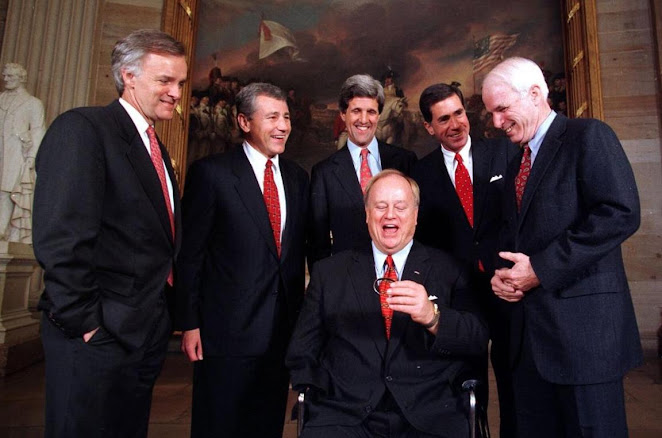
The Senate had six Vietnam combat veterans in January 1997. Sen. Max Cleland, D-Ga., is in the front. Behind him, from left: Bob Kerrey, D-Neb., Chuck Hagel, R-Neb., John Kerry, D-Mass., Chuck Robb, D-Va., and John McCain, R-Ariz. This photo was taken by The World-Herald during Senate orientation the previous month. (Kiley Cruse, The World-Herald)

Top photo: Secretary Max Cleland, American Battle Monuments Commission, delivers keynote remarks during the 72nd anniversary commemoration of the Dec. 7, 1941, attack on Oahu. This year’s commemoration theme, “Sound the Alarm,” examines how thousands of Americans answered the call to duty in the wake of the attack. More than 2,500 people attended the Pearl Harbor commemoration. (MC2 Nardel Gervacio)


Wednesday, April 8, 2020

An Interview with 'Crimes of Command' Author

by Bill Doughty–

Naval War College professor CAPT Michael Junge is a forward-thinking former CO (of USS Whidbey Island), who has strong feelings about how the Navy can improve its culture and continue to develop good leaders without losing well-trained, capable and courageous commanders – leaders who aren't afraid to lean forward. As a follow up to the Navy Reads review of his "Crimes of Command," we present this interview with Professor Junge. It's about leadership, a post-COVID Navy, artificial intelligence, transparency, and critical thinking. We also asked him for some of his favorite reading and online recommendations. The interview was conducted online earlier this week.

BD: Would a culture of institutional forgiveness promote less risk-averse leadership/leaders?

MJ: This is a really difficult question AND one I had to spend some time thinking about.

First of all, the idea of a culture of institutional forgiveness is something we have to think about – what that looks like – and then the second thing is what it means to be risk-averse. Around 20 years ago there was a movement within the Department of Defense to eliminate accidents, a movement away from the previous idea of reducing accidents. Now, we should all know that you can't get rid of all accidents, there is always going to be some small percentage of things that go wrong. We can make them rare. We can reduce them to almost nothing. We cannot eliminate them. So I think that might be the first thing we would have to look at – what are we willing to forgive and what is unforgivable?

Then-CDR Junge helms USS Whidbey Island’s personnel launch during a 2008 port visit to Camden, ME.
The second thing culturally would be taking a look at how Naval Aviation handles their human factors boards and possibly moving that across more of the fleet. In Human Factors boards, and I hope I get this right, any pilot can be challenged on an action or can admit to an action and then have it discussed amongst the group of fellow pilots in the ready room. This includes the commanding officer. The surface Warfare Community does not have anything like that and I don't think the submarine community does either, so that would that would be a place to start.

Finally, we have to remember that every institution is made up of individuals and too often we conflate the two. Senior officers are not the Navy, and when they protect themselves, thinking they are protecting the Navy, they do a disservice to everyone. Forgiveness needs to be both individual and institutional and neither is an easy thing to grant. 

BD: Do you think some senior leaders, now more than in the past, use the Rickover-expressed view of responsibility/culpability to scapegoat the commanders below them? If so, how can that be stopped?

MJ: I'm not so sure if it's using a subordinate as a scapegoat or the fear that if someone junior isn’t sacrificed, then the superior commander is the one who's going to get fired. Either one is a really poor way to look at command.

Adm. Arleigh Burke, Nov. 23, 1960, at pep rally on eve of Navy-Army football game.
The area that I think could really really have impact on removals is just basic communications between immediate superiors in command and their subordinates. Both of the Navy-wide reports that looked at commanding officer detachments for cause indicated lack of communication and lack of discussion between commanders and their subordinate commanders. This is definitely something that is a more modern Navy problem than we saw in the past. 

There's an anecdote of Arleigh Burke as Chief of Naval Operations going from Norfolk to Key West aboard ship – all told, I think the trip was two weeks. I have no idea who the last Chief of Naval Operations was that spent the night afloat at sea. Now most ship visits are a couple of hours – a brief visit with commanding officer, a brief visit with the Chiefs Mess, then an all-hands call on the flight deck or in the hangar bay and move on. That's no way to maintain contact with what's going on in the deck plates. If that's also what’s happening between 06 and 05 commanders, that minimal level of contact and not getting to know the officers of a ship’s wardroom or the Chiefs; that's going to cause a level of unfamiliarity that then removes the benefit of the doubt for a ship.

I had command a decade ago, and of the four bosses I had, I only really felt close to one of them – and he got underway with us…repeatedly. Nelson's subordinates are referred to as a “Band of Brothers” and I really wonder whether or not we have that any longer amongst our commanders. 

BD: Considering the smaller number of personnel needed to operate newer ships and other platforms, would there be a commensurate need for Sailors who have achieved Kohlberg's third level of moral development: the postconventional level?

A Sailor removes deck material aboard USS George H.W. Bush in July 2019 (MCSA Bodie Estep)
MJ: I kind of reject the opening premise of this question. I served on five different hull types and saw smaller crews and larger crews and I don't agree that a smaller number of personnel are needed to operate newer ships. I do agree that we are moving towards a smaller number of people operating newer ships, but when we do that we start losing track of who is doing the basic maintenance. Who is doing the cleaning, the painting, the corrosion control? Those are things that still have to happen, and as you reduce the crew size you increase workload on individual sailors.

I'll also be brutally honest and say that the vast majority of sailors will never need to achieve the third level of moral development. The vast majority of sailors are OK operating in the rules following environment, doing what is right based on norms and rules. And that's part of why we have to have rules that can be followed ...

BD: Do you think artificial intelligence can assume the role of rote-operating Sailors as described in Herman Wouk's "The Caine Mutiny": "If you’re not an idiot, but find yourself in the Navy, you can only operate well by pretending to be one"? Will deployment of AI accelerate after this pandemic?

MJ: This quote is one that has come up a lot in the last 10 years among conversations I've been in but a lot of it has to do with the other part of that quote – “The Navy is a master plan designed by geniuses for execution by idiots." That made perfect sense, especially to a very junior officer serving in World War II. From that level, the entire organization of the Navy looked like it was smart and well put together. The more I study the Second World War, the more I think it was really a Navy of resilient individuals who made things work rather than unintentional creation.

I'm also skeptical of AI in general. One of the first problems is we can’t agree on a definition of what AI is – and if we can’t define it then we really can’t talk about it. You can't talk about whether you're going to use it or not if you don’t know what “it” is. But if artificial intelligence can do things to take some of the cognitive load off of sailors then it's possible we'll see more but I think we're a long way away from having ships that are unmanned or even optionally manned or even the level of, say, a modern cargo ship.

HTFN Allyson Shay welds aboard USS Whidbey Island, July 7, 2016. (MC2 Nathan McDonald)
Regardless of how good artificial intelligence becomes, unless the AI is capable of cleaning, corrosion control, or painting, someone's going to have to do those. I think we'd be far better served to spend time figuring out a better design for a watertight door or better and longer lasting paint or better design to prevent corrosion like ensuring that the deck drains are actually the lowest point of a deck and not the highest point than worry about finding artificial intelligence to help reduce the cognitive load for a combat scenario where we don't even have sufficient ordnance to launch against a notional enemy.

BD: Why should senior leaders welcome transparency, especially in peacetime, as long as it doesn't violate operational security?

MJ: The important part about transparency is that transparency is how seniors educate subordinates on how and why a decision is made. That way, when speed of execution is needed, the subordinate understands the rationale behind how the boss thinks and can execute both the stated and intended mission.

When a commander just says “go do it” and doesn't explain why or doesn't allow for questions to be asked then that's what the subordinate learns – tell people to execute a decision. Then you lose that resilience we need. So that's where transparency is important.

One of the things found in the Greeneville/Ehime Maru collision was junior watchstanders knowing something was wrong, but either trusting the captain, or afraid to question a captain known for his operational acumen. But, he was wrong, those people didn't speak up and that led to disastrous results.

Capt. Brett Crozier, commanding officer of the aircraft carrier USS Theodore Roosevelt (CVN 71), addresses the crew during an all hands call on the ship’s flight deck Dec. 15, 2019. Theodore Roosevelt was underway conducting routine training in the Eastern Pacific Ocean. (Photo by MCSN Kaylianna Genier)
BD: The current COVID-19 pandemic presents threats, disruptions and changes. What do you foresee changing in the Navy when we all get back on our feet after this?

MJ: I'm not sure I really see anything changing in the Navy when we all get back on our feet after this. Mostly because, as I say this, as I write this, the operational Navy has really tried to go about business as usual. But that's the operational side; the shore side should and could be taking some serious lessons here about telework and the opening up of more jobs to more telework.

There’s a chance for some tremendous solutions for efficiency, better work-life integration, and overall productivity if we just look for them. Lots of people in DC commute two to four hours each day; that’s just plain-old lost time and productivity that can be regained for all sorts of things.

Rear Adm. Shoshana S. Chatfield, president of U.S. Naval War College, attends Quartermaster 1st Class Jessie Jowers’s reenlistment ceremony via FaceTime at NWC, March 20, 2020. Jowers reenlisted for an additional four years. Friends and colleagues attended in support of his dedication to the U.S. Navy and practiced social distancing by remaining at least six feet apart due to the COVID-19 virus. (Photo by Mass Communication Specialist 2nd Class Tyler D. John)
BD: Re critical thinking: What books do you recommend to people to help them think about thinking?

MJ: I recommend first and foremost any of the Freakonomics books. Secondly, I recommend two books by Ashley Merryman and Po Bronson. The first is “Nurtureshock” and the second is “Top Dog.”

“Nurtureshock” is about child raising, which may seem an unconventional recommendation, but the basic fact is that half of our Sailors are below 26 years of age and many of them are just out of high school so understanding how they grew up and what impacted them is important.

“Top Dog” is a scientific look at success.

Both Bronson-Merryman books take a kind of a Freakonomics, unconventional wisdom approach to the subjects. After that, anything on behavioral economics. 

BD: Who are some of your favorite all-time, any genre authors and books?

Neil Gaiman (Wikipedia Commons, Kyle Cassidy.
MJ: I grew up largely reading fantasy and science fiction and have read and reread “The Hobbit,” “The Lord of the Rings,” “Starship Troopers,” and “Ender's Game.” Robert Heinlein is probably my single favorite author. Neil Gaiman is my favorite living author. 

BD: Any specific recent books on online resources you'd recommend for these stay-at-home days?

MJ: I start with a YouTube channel called the “School of Life” and another called “Crash Course.” I find videos are easier to help me make connections and all these episodes are fairly concise – so much more comprehensible than longer writings.  They don’t substitute for those longer writings, but they do complement them.

BD: Are you considering another book? What does the future hold for you?

Michael Junge, courtesy photo
MJ: That’s a really good question. I am working on a revised, expanded, and largely new version of “Crimes of Command” – likely even with a new title. So much happened in 2017, 2018, 2019, and now in 2020 that I think I can add some more insight into what's going on. I’m also want to write a book on the USS Belknap and USS John F. Kennedy collision. I have a concept for that in my head, so that's also in the works.

But, before all that happens I need to find a post-Navy retirement job and that is taking up a lot of my thinking time, so we'll see where things go.

###

A big thanks and Aloha to CAPT Junge for this interview, a follow-up to our post earlier this week on his insightful book "Crimes of Command," which includes Junge's biography.

(My previous Navy Reads blogpost also included a commentary about the firing of CAPT Brett Crozier, CO of USS Theodore Roosevelt. Since that post, Acting Secretary of the Navy Modly flew to Guam to address the crew on the 1MC, during which he called Crozier "stupid" and "naive" and complained repeatedly that Crozier had complained and used poor judgment for how he tried to get help for his crew during a COVID-19 outbreak. On April 7, however, Modly apologized and resigned, reportedly at the direction of his chain of command. In COVID-19 press conferences this week, Commander in Chief President Trump mocked CAPT Crozier, first on April 6 – "this isn't a literature class" – and again on April 7 (after claiming he "would not have asked for" Modly's resignation), saying Crozier "didn't have to be Ernest Hemingway." That comment reminded me that Hemingway was Senator John S. McCain's inspiration, especially when McCain, a naval aviator and hero, was a POW in Vietnam. In fact, we published a post Aug. 12, 2018 about McCain's Hemingway inspiration. A related recommended read is Yahoo News reporter Michael Walsh's Aug. 26, 2018 remembrance of McCain: "The bell tolls for John McCain: How Hemingway's antifascist hero shaped the man." – Bill Doughty)

McCain and Hemingway photo illustration from Yahoo News