Showing posts sorted by relevance for query smedley. Sort by date Show all posts

Saturday, July 30, 2022

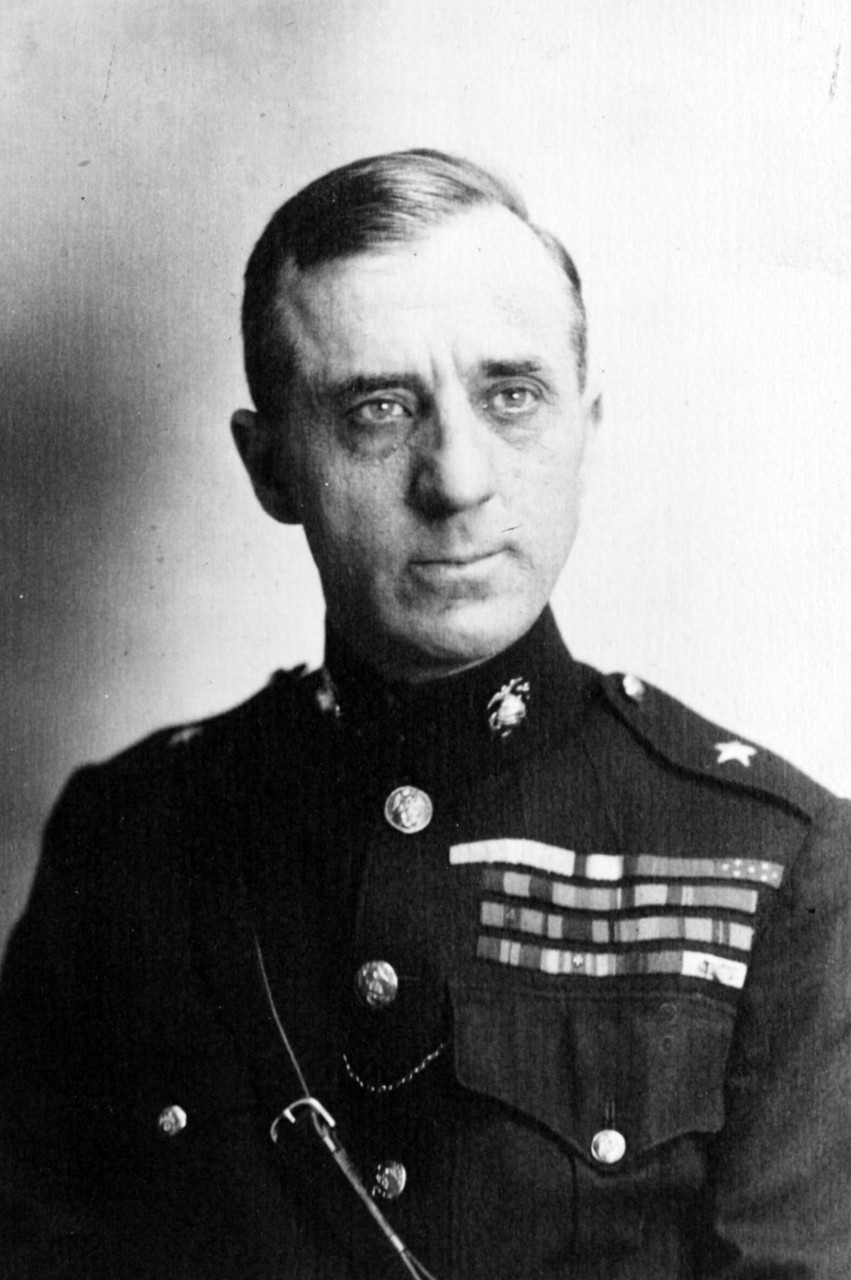
Smedley Butler: Remember 'Making and Breaking'

Review by Bill Doughty––

“Gangsters of Capitalism: Smedley Butler, the Marines, and the Making and Breaking of America’s Empire” by Jonathan M. Katz (St. Martin’s, 2021) shows why we need to study history as it was, not as we want it to be.

This book toggles between the past and present as award-winning journalist Jonathan M. Katz follows the path of Smedley Butler, United States Marine, a twice-awarded recipient of the Medal of Honor. He fought in China, Cuba, Haiti, Nicaragua, and Philippines; spied for the Navy in Mexico; and he served in World War I in France. 


Along the way, he helped oversee building and protecting the Panama Canal, which was envisioned by Alfred Thayer Mahan and Theodore Roosevelt. As a young Marine officer, Butler had been ordered to dig a much smaller canal across a tiny isthmus on the island of Culebra in the Caribbean.

“On a sweltering day in December 1902, Smedley Butler was standing waist-deep in a watery ditch. He dunked his shovel into the mud. Mosquitoes darted across the rust-colored ripples. Their bites itched like poison. He couldn’t decide what he hated more: this marshy hell, the solid rock his unit had to ship through he day before, or the admiral whose idea it had been to build this stupid canal in the first place.”

Katz’s superb writing is illuminated by the author’s access to Butler family letters and by his extensive travels in the footsteps of Smedley Butler.


Katz provides relevance and context in his visits to battlefields in Cuba with Public Affairs Officer MCC Barbara Meeks, to war-torn regions in China and the Philippines, and to the Marine Corps museum at Quantico, Virginia, as just a few examples.

We get some of the richest reporting and historical connections when Katz returns to Haiti. He lived there for several years and was there for the devastating earthquake of 2010. (Katz is also author of “The Big Truck That Went By” about the earthquake and humanitarian response.)


“Gangsters of Capitalism” opens with a Haitian proverb as the book’s epigraph, which also happens to be a found haiku:


...one who deals the blow

forgets. The one who carries

the scar remembers


Butler developed trust and confidence with local people in Haiti, those who would “remember.”


While he and his Marines could be ruthless in combat, their power could be tempered with diplomacy and paternalistic compassion. 

“Butler’s insights became the key to securing America’s imperial foothold in Haiti. Though Butler did not realize it at the time, he was helping invent a new approach to warfare. It would eventually be dubbed counterinsurgency: the combination of military, political, and psychological method employed by an occupying power with the goal of holistically defeating an armed resistance.”

The method would be fine-tuned as counterinsurgency doctrine: COIN.

Smedley Butler
Butler also served as commandant at Quantico and San Diego, and he took a leave of absence from the Marines to become Chief of Police in Philadelphia during the nation’s failed experiment with Prohibition. Katz shows how the militarization of policing got its start in the name of “law and order.”

The book reads like a Netflix series, each chapter an episode leaving readers hungry for the next. China might take more than one episode. Same for the Philippines. Central America could be a whole season itself.


If read chronologically, “Gangsters” shows Butler’s evolution from warrior for corporations to warrior for peace. He came to see imperialism and fascism overseas return to American shores as authoritarianism and nationalism at home. He foresaw the coming of another World War in a final eruption of colonialism and revanchist expansionism.

“Butler could not see the irony: that the imperialism he had helped foster was a direct catalyst of the World War. The conflict erupted in 1914 as a fight between empires: Germany and Austria-Hungary on one side; Britain, France, and Russia on the other. All had spent decades in a complex global struggle for colonies, resources, and prestige –– a struggle that the Americans (and Butler personally) had been parties to. The older empires, especially the British, were filled with anxiety over new competitors to their global supremacy. The Germans, as the United States’ fellow latecomers to global expansion, were reading Alfred Thayer Mahan’s tracts on sea power and empire when they declared: ‘We demand a place for ourselves in the sun.’…

Butler foresaw another war coming out of the Great War and out of the era of great empire (an era Putin's Russia seems to aspire to in 2022).

“…It was not a fight over a particular colony or sea lane that sparked the cataclysm into which millions of American families were now sending their sons, but imperial arrogance, mistrust, and the accelerating war machines that made those empires run.”

In the last ten years of his life, Butler fought against imperialism and tyranny, according to Katz, where the primary beneficiaries of authoritarianism and tyranny were banks, businesses, big oil, and bought-and-paid for politicians. His support for Bonus Marchers in Washington is recounted in a previous Navy Reads review.


Because he was loved and trusted by Veterans, an attempt was made to recruit Butler in 1934 to help set up a Fascist dictatorship in the United States, subverting the will of voters. The proposal was allegedly funded by a shadowy group backed by big business and the American Liberty League. Butler reported the coup proposal to Congress. But –– unlike the current Select Committee’s hearings into the January 6, 2021 insurrection –– a full investigation was not conducted.


A YouTube interview with Katz by “Democracy Now!” (below) features a clip of retired Major General Smedley Butler, who talks about why he reported the coup attempt: “My main interest in all this is to preserve our democratic institution. I want to retain the right to vote, the right to speak freely, and the right to write,” Butler proclaims.


YouTubers can find a longer conversation with the author on the Marines Memorial Club.

Katz writes to help readers understand history “as it was” and accept the reality of past mistakes in order to prevent history from repeating.
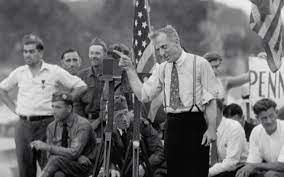

Butler speaks to Veterans July 19, 1939 –– ninety years ago this month.
Noting that Smedley Butler has no huge statue in his name, Katz asks a question that can apply to monuments honoring leaders of the Confederacy.  “… Why does America celebrate the generals who oversaw death and destruction on a massive scale, while forgetting the exceptional few who spent their later years trying to stop them?”

Interestingly, after retiring from the Marine Corps, Butler campaigned unsuccessfully for the Senate as a Republican from Pennsylvania.


This week, Pennsylvania Republican Senator Patrick Toomey led 40 other Republicans in voting down PACT burn pit legislation that would help wounded Veterans. The Promise to Address Comprehensive Toxics Act includes the "Camp Lejeune Justice Act" to help Marines and families.
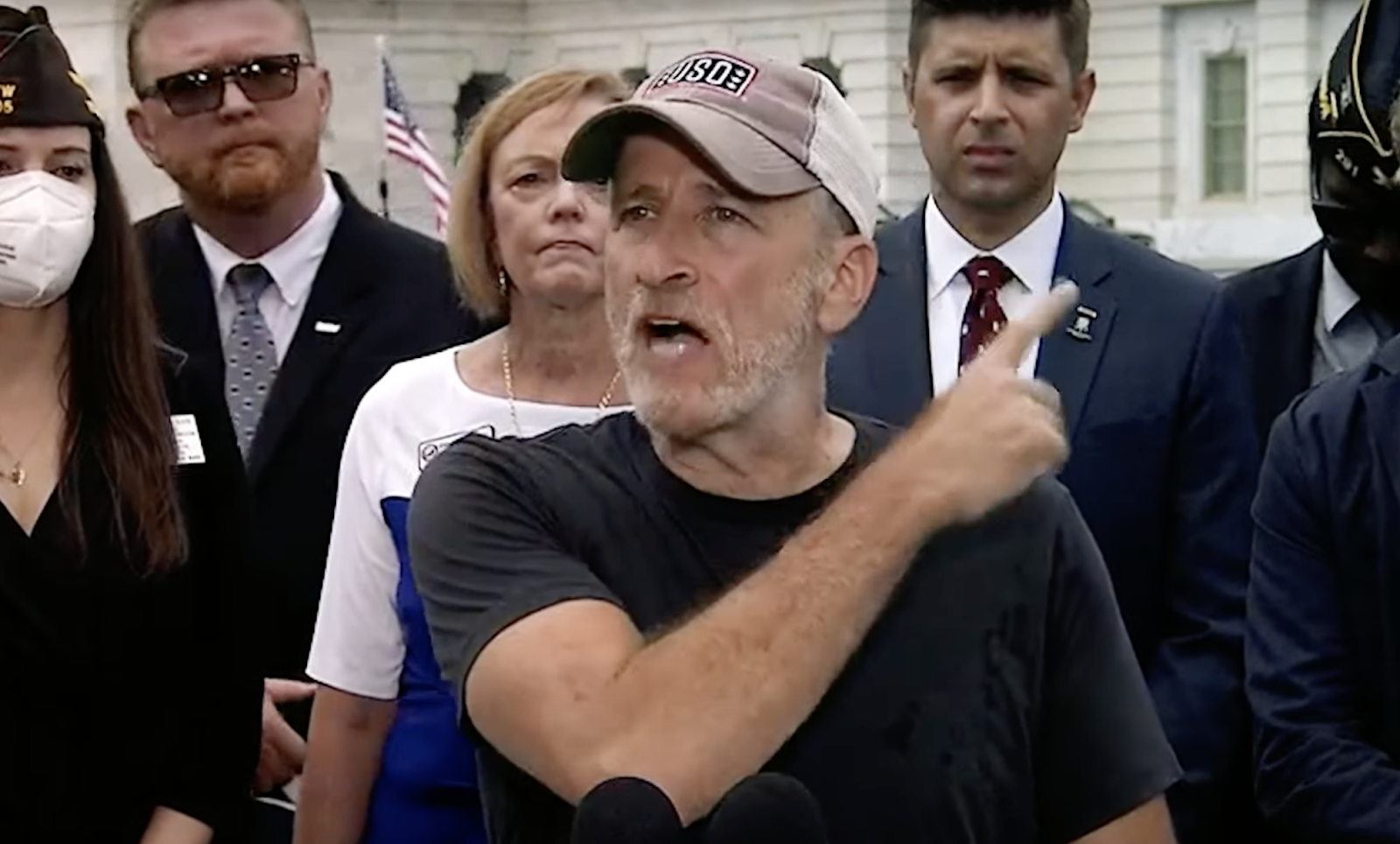

John Stewart speaks for Veterans July 28, 2022.
Jon Stewart, sounding every bit like Maj. Gen. Smedley Butler, stepped up to a microphone alongside Veterans and their loved ones to condemn the vote.

In reading this sweeping book of history, it’s amazing how many times the Navy is mentioned.


Navy readers will also be fascinated by Katz’s take on Mahan; Secretary of the Navy Josephus Daniels; Gen. Joseph H. Pendleton; Roger Leslie Farnum; Jose “Pepe” Azueta; Chiang Kai-shek; Gen. John Lejeune; and Commanders in Chief William McKinley, Theodore Roosevelt, William Howard Taft, Woodrow Wilson, Herbert Hoover,Franklin Delano Roosevelt, George H. W. Bush, and Donald J. Trump.

Sunday, May 22, 2022

Gen. Smedley D. Butler, Coup Fighter

Review by Bill Doughty––

Ninety years ago this month –– May 1932 –– thousands of military veterans marched on Washington D.C. and set up a tent city near the Capitol and within sight of the USS Constitution (pictured above).


Victims of the Great Depression, they were hungry, unemployed, and desperate. The “Bonus Marchers” demanded the right to cash in their bonuses, in the form of bonds due to be payable in 1945.

In Congress, the House of Representatives passed a bill authorizing pay to the veterans, but Republicans in the Senate declined to pass it. President Herbert Hoover had vowed to veto the bill anyway.


Hoover would soon order Army Generals Douglas MacArthur and George C. Patton to move against the marchers and get them out of Washington.


Running out of food by July, the Bonus Marchers threatened to storm the Capitol.


Butler
Enter Marine Corps General Smedley Darlington Butler, twice awarded the Medal of Honor, a respected and renowned veteran of several wars and conflicts. Butler met with the veterans in their tent city. He offered his support and advice: “If you don’t hang together, you aren’t worth a damn!”

He also suggested a different tactic instead of marching on the Capitol: “When you get home, go to the polls in November… Now go to it!” 


Butler warned the marchers against violence against the government, according to author Jules Archer, author of “The Plot to Seize the White House” (Hawthorn Books, 1973).


“You’re all right so long as you keep your sense of humor,” Butler said in is raspy hoarse voice, according to Archer.“ If you slip over into lawlessness of any kind, you will lose the sympathy of a hundred twenty million people in the nation,”


But it was Hoover’s administration that initiated the violence. MacArthur and Patton directed tanks, cavalry, infantry with bayonets, and a chemical weapon (adamsite, an arsenic vomiting-inducing tear gas) against the protesters, dispersing them and then burning down their tents and shacks.

FDR with Marines aboard USS Houston.
People did go to the polls in November. They elected Franklin D. Roosevelt, who righted the floundering economy, addressed greed and wealth inequality, and transformed the country with the New Deal, giving more power and protections to the people.

Butler explains how this New Deal did not sit well with bankers, industrialists, and rightwing groups (DuPonts, Remington, Standard Oil, J.P. Morgan, American Liberty League). And big media, under the control of big business, took on FDR and his progressive initiatives.


During his times in the Marines, as Smedley Butler rose in the ranks, he increasingly saw the influence of industrialists in the military and even in veterans’ ranks.


Some wealthy people, including bankers, funded the American Legion and used veterans to bust workers’ unions.

“The average veteran who joined the Legion in the 1920s had been unaware that big-business men were backing it to use it as a strikebreaking agency. When workers struck against wage cuts, Legion posts were informed that the strikers were communists trying to create national chaos so that the Reds could take over. Legionnaires were given baseball bats to break up strikes and civil rights demonstrations.”

Members of American Liberty League, implicated in a coup plot.
But those opposed to Roosevelt did not rely solely on violent means to change the government. Some of them reportedly conspired to set up a Fascist government modeled on Italy’s Mussolini. In 1935, the American Legion pinned a button on Mussolini to make him an “honorary member.” (On the other hand, Butler had been courtmartialed earlier in his career under orders by President Hoover for Butler’s criticism of Mussolini and the “Italian corporatist state.”)

Ironically, the conspiracy against FDR fell on Smedley Butler’s doorstep, when a representative of the American Legion, linked to the American Liberty League and funded by powerful businessmen, asked him to be part of a coup plot.


They planned to form a powerful paramilitary group modeled after France’s rightwing Croix de Feu (Cross of Fire); then, they would establish an “assistant president” as Secretary of General Affairs. The president would become a figurehead. According to the plan, veterans would rally around Butler as the de facto president of an authoritarian autocracy.


(J.P. Morgan reportedly preferred General MacArthur for the role, but MacArthur’s actions against the Bonus Marchers made him too unpopular with a wide swath of veterans.)


Fortunately, Butler, whose loyalty was to the Constitution, was the absolutely wrong man for the job.


Spivak
He took his evidence of the coup plot to Congress and worked with investigative reporters to tell the story, including in the Philadelphia Record. According to reporter John Spivak, the millionaires behind the plot were woefully wrong in thinking money could buy any thing. Those involved in the plot, Spivak said, “lacked an elementary understanding of people and the moral forces that activate them.”

Archer’s “The Plot to Seize the White House” is dedicated to reporters George Seldes and John L. Spivak “for their courageous dedication to the truth, wherever it led.”


The book is about the plot, but it’s also a fascinating biography of the great, complicated Marine general, an icon in United States Marine Corps history.


Smedley Butler served in the Spanish-American War, Philippines Campaign, Boxer Rebellion, Caribbean Intervention, Chinese Intervention of 1927-8, and World War I.


Archer describes him as “one of the most colorful generals who had ever led troops into battle.” He writes, “Smedley Butler was a wiry bantam of a man, shoulders hunched forward as though braced against the pull of a heavy knapsack, his hawk nose prominent in the leathery face of an adventurer.”


When he commanded Quantico he built a football stadium with and for Marines. He promoted health, fitness, and wellness for wounded warriors.

“He was even more famous and popular among rank-and-file leathernecks, doughboys, and bluejackets for the fierce battles he had fought against the American military hierarchy on behalf of the enlisted man. He was also admired, respected, and trusted because of his one-man fight to compel Americans to remember their tragic war casualties hidden away in isolated  veterans’ hospitals.”

Popular for his skill as an “enormously persuasive speaker” –– Butler toured VFW posts. He saw growing divisions and right-wingers willing to believe in conspiracies.

“Continuing his tour for the VFW, Butler observed more and more storm signals flying in the United States as he traveled around the country. The nation was rapidly becoming polarized between the forces of Left and Right. Demagogues with apparently inexhaustible funds for propaganda and agitation led ‘patriotic’ crusades against Communists, Jews, and ‘Jewish bankers,’ who were alleged to be behind the New Deal.”

Butler was called before the House of Representatives to testify about the attempt by industrialists via the American Legion to subvert democracy and “seize the White House,” according to Archer.

The first “House Un-American Activities Committee” was “equally oriented against Fascist and Communist activities, according to Archer. “Under Representative John W. McCormack, later Speaker of the House, it spent considerable time and energy unmasking Fascist agents in America.”


Though written nearly fifty years ago, Archer’s book is invaluable for its perspective. He interviewed Butler’s immediate family members as well as contemporary reporters, witnesses, and researchers. And, Archer interviewed HUAC’s McCormack. 


Archer writes: “I asked him, ‘Then in your opinion America could definitely have become a Fascist power had it not been for General Butler’s patriotism in exploding the plot?’”

McCormack acknowledged, “It certainly could have.” Coming out of the upheaval of the Great Depression and World War I, “The people were in a confused state of mind, making the nation weak and ripe for some drastic kind of extremist reaction,” McCormack told Archer. “Mass frustration could bring about anything.”


Archer’s book led me to find “War is a Racket,” by Brig. Gen. Smedley Butler. It’s a short book published in 1935 based on Butler’s speech against war for profit and against big business’s influence in the military. 


Butler was for a strong national defense but against using the military to fight wars to help commercial companies make profits.


Guarding Spanish POWs at Portsmouth Navy Base, New Hampshire, 1894; 1st Lt. Smedley Butler is standing, third from right.
Butler said:

“I helped make Mexico, especially Tampico, safe for American oil interests in 1914. I helped make Haiti and Cuba a decent place for the National City Bank boys to collect revenues in. I helped in the raping of half a dozen Central American republics for the benefits of Wall Street. The record of racketeering is long. I helped purify Nicaragua for the international banking house of Brown Brothers in 1909-1912 … I brought light to the Dominican Republic for American sugar interests in 1916. In China I helped see to it that Standard Oil went its way unmolested.”

Butler expounds on what, a generation later, President Eisenhower would call the Military-Industrial Complex in a warning to the nation as he left office. Butler said the only way to stop the “racket” of war was by “taking the profit out of war.”


Archer’s insightful biography includes Butler’s antiwar beliefs and how those beliefs may have gone too far. According to Archer, “Butler’s raging hatred of war led him into the same errors of judgment that ensnared the isolationists of America.” Butler agreed with Neville Chamberlain’s strategy of appeasing Hitler, confident (but wrong) that the Nazis couldn’t successfully invade France.


On June 21, 1940, just hours before France was to surrender to Adolf Hitler, Maj. Gen. Butler died in U.S. Naval Hospital Philadelphia.


Gleaves-class destroyer USS Butler (DD-636)
Butler’s death came eighteen months before the attack on Oahu. Eighteen months after Pearl Harbor, the U.S. Navy commissioned the destroyer USS Smedley Butler to serve in WWII. “Converted to a high-speed minesweeper, it saw distinguished service during the war.”

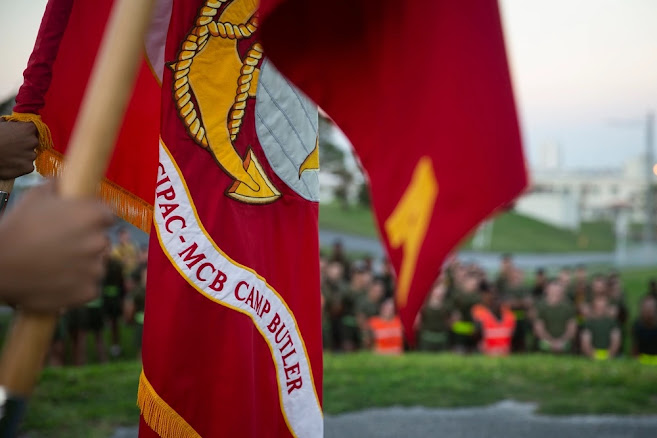
Marine Corps Base Camp Butler on Okinawa is another namesake of the great Marine warrior who came to hate war fought for what he considered the wrong reasons.


Butler believed war should only be conducted to defend the United States or the Constitution and Bill of Rights. He would have absolutely been against misadventures in Vietnam and Iraq. He would have also taken a stand against the insurrection at the Capitol and coup attempt of January 6, 2021.


Marine Corps Base Camp Butler, Okinawa.

[One hundred years ago, 1922, Smedley Butler introduced the first English bulldog into the Marine Barracks, Quantico. Bulldogs have become the mascot of the Marines ever since, with Chesty, namesake of famous Marine Lieutenant General Chesty B. Puller, in residence at Marine Barracks, Washington, D.C.]

Monday, May 28, 2018

Angels, 'Soul of America' Battle Fear

By Bill Doughty

"Peacemakers" Sherman, Grant, Lincoln and Porter, painted by George Healy, 1848.
The United States Navy is an unintended undercurrent running through "The Soul of America" by Jon Meacham (Random House, 2018). It starts with the book's front endpaper as soon as you turn the cover.

There is Admiral David Dixon Porter sitting next to President Abraham Lincoln and Generals Ulysses S. Grant and William T. Sherman in George Healy's painting "The Peacemakers," memorializing a meeting aboard the War Department's commissioned steamer River Queen.

The War Between the States was a crucible, an identity-defining event for the United States. Sailors of the Federal Navy played a key role in saving the Union and securing liberty for all, as they had done in fighting the British in the Revolutionary War and War of 1812.

Subtitled "The Battle for Our Better Angels," from Lincoln's First Inaugural Address, where the sixteenth president sought to unite a divided nation, Meacham's book shows how the United States has made progress when its leaders and especially its citizens focused energies on hope, optimism and inclusion instead of fear, hate and rejection of others.

"Progress in America does not usually begin at the top and among the few, but from the bottom and among the many," Meacham writes. He shows how good presidents like Lincoln, Grant, Theodore Roosevelt, Franklin D. Roosevelt, Harry Truman and Lyndon B. Johnson were instrumental in America's progress, while other presidents like Woodrow Wilson, Dwight D. Eisenhower and Richard M. Nixon were moved only after being pressured by the American people into expanding human rights and protecting civil liberties.

After every action, there is a reaction and sometimes unintended consequences.

In the aftermath of the Civil War came Reconstruction and "extreme, racism, nativism and isolationism, driven by fear" – a stormy period in America's past that included lynchings, white supremacy and the rise of the Ku Klux Klan.

President Andrew Johnson
President Andrew Johnson undermined the legacy of Lincoln in years after of the War Between the States.

Meacham reports how Johnson "delivered an angry, self-pitying speech" Feb. 22, 1866 at a campaign-style rally on George Washington's Birthday.
"Resentful and impassioned, Johnson also riled up the Washington's Birthday crowd with claims that his opponents were considering having him assassinated. Rather than offering reassurance to an anxious public, then, Johnson chose to foment chaos and promulgate fears of conspiracy."
According to historian Eric Foner, who Meacham cites, Johnson made "probably the most blatantly racist pronouncement ever to appear in an official state paper of an American president." In Meacham's words, Johnson "asserted that blacks were incapable of self-government."

Andrew Johnson, who "never seemed entirely stable," was later impeached, but one vote in the Senate trumped his conviction.

President Grant, on the other hand, "in contrast to Andrew Johnson, appreciated the bigness of his office and of the times." Grant supported the 15th Amendment, granting the extension of voting rights to African Americans. And he cracked down on the KKK's reign of violence and terror in the South.

Confederate naval officers James and Irvine Bulloch, TR's uncles.
A president who continued championing human rights, Teddy Roosevelt, was a former Assistant Secretary of the Navy and a man who, ironically had two uncles who served in the Confederate Navy. One was an admiral who helped build the warship CSS Alabama, and the other was a midshipman who served aboard the Alabama.

A flawed but passionate defender of freedoms, including the First Amendment, TR said, "To announce that there must be no criticism of the president, or that we are to stand by the president, right or wrong, is not only unpatriotic and servile, but is morally treasonable to the American public."

Yet, during times of national stress, particularly during wartime, the "better angels of our nature" have been silent, and leaders have resorted to fear, hate and exclusion.

One hundred years ago President Woodrow Wilson and the Congress enacted the Espionage Act of 1917 and the Sedition Act of 1918 during World War I, "restricting freedom of expression in the name of national security." Wilson's Justice Department indicted and put on trial the Industrial Workers of America.
"Speech itself was under siege. It was illegal, according to the 1918 legislation, to 'utter, print, write, or publish any disloyal, profane, scurrilous, or abusive language about the form of government of the United States, or the Constitution of the United States, or the military or naval forces of the United States.'"
Thanks to strong women such as Elizabeth Cady Stanton, Susan B. Anthony, Sojourner Truth, Carrie Chapman Catt, Lucretia Mott and Alice Paul, women received the right to vote over the intransigence and foot-dragging of President Wilson.

National Endowment for the Humanities composite of Roosevelts.
Teddy Roosevelt's fifth cousin Franklin, also a former Assistant Secretary of the Navy, witnessed the aftermath of a terrorist bombing attack by an anarchist on the home of his neighbor, Attorney General Michael Palmer.

As president, FDR faced twin existential threats to the nation – the Great Depression and the Second World War, brought about by Nazi fascism in Europe and Imperial Japan's attack on Pearl Harbor, Dec. 7, 1941.

FDR feared a military coup by General Douglas MacArthur on the right and Senator Huey Long on the left.

The threat of a coup was real, especially from "America First" isolationists who opposed FDR's behind-the-scenes help to Britain's Winston Churchill, including trading U.S. Navy destroyers for bases and conducting an "undeclared naval war in the Atlantic" during Britain's fight against Hitler's Germany.

American hero Maj. Gen. Smedley Butler, USMC.
In fact, a "small group of rich Wall Streeters" actually attempted to put together a coup. They tried to recruit retired Marine Corps Major General Smedley Butler to remove FDR by force. Butler, ever the hero, reported the plot and plotters to the FBI.

After WWII started, acting out of fear, FDR committed his greatest error when he imprisoned more than 100,000 Americans of Japanese Ancestry.

But FDR, followed by Truman, took a huge step toward integrating the military, instituting the GI Bill of Rights, setting up the New Deal that led to the Fair Deal, and setting the stage for the formation of the middle class and greater prosperity for millions of Americans.

"The product of both government action and of market forces, the creation of the post-WWII middle class was one of the great achievements in history," Meacham writes.

FDR, who designed the porch of his cottage in Warm Springs, Georgia to resemble the prow of a ship, was about the Navy's USS Tuscaloosa (CA-37) for a fishing trip, when he came up with the Four Freedoms speech: Freedom of speech, freedom of religion,  freedom from want and freedom from fear.

Navy Chief Graham Wilson expresses grief at FDR's death in 1945.
When FDR died in 1945, Navy Chief Petty Officer Graham Jackson became America's face of grief, weeping openly.

Fortunately, Presidents Truman and Eisenhower and especially Navy veterans John F. Kennedy and Lyndon B. Johnson righting the residual racism and discrimination of the Lost Cause of the Civil War, pushing for greater equality and voting rights for all. Once again, the people, led by Dr. Martin Luther King Jr., pushed for progress and LBJ listened.

LBJ was "Determined to preach the gospel of inclusion," Meacham writes. "Now was the time, the president said, to rise above racism. 'Whatever your views are, we have a Constitution and we have a Bill of Rights, and we have the law of the land. (LBJ said,) I am not going to let them build up the hate and try to buy my people by appealing to their prejudice.'"

MLK and LBJ meet in the White House Dec. 3, 1963 (Photo by Yoichi R.Okamoto). LBJ Library.
Johnson created the Great Society and signed the Immigration and Nationality Act of 1965 and the landmark Civil Rights Act of 1964.

"Leadership is the act of the possible, and possibility is determined by whether generosity can triumph over selfishness in the American soul," Meacham writes.

Meacham quotes Senator Daniel Webster: "When the mariner has been tossed for many days in thick weather, and on an unknown sea, he naturally avails himself of the first pause in the storm, the earliest glance of the sun, to take his latitude, and ascertain how far the elements have driven him from his true course," Webster said in 1830. "Let us imitate this prudence, and before we float farther on the waves of this debate, refer to the point from which we departed, that we may at least be able to conjecture where we now are."

"The Soul of America" revealed some "found haiku," one by Meacham himself:

The things we hope for
can come to pass. The things we
fear can hold us back

Here's another Abraham Lincoln found haiku (see also Navy Reads Lincoln's found haiku blog):

Cherish a just and
lasting peace among ourselves
and with all nations

And this reflective unintended haiku comes from LBJ:

A president can
appeal to the best in our
people or the worst

In Meacham's conclusion he offers five prescriptions for achieving progress and enlisting "on the side of the angels" in a time of crisis: enter the arena (use your First Amendment rights), resist tribalism (hear and listen to all sides), respect facts and deploy reason (recognize and reject lies), find a critical balance (being humble and open), and keep history in mind (read books and practice critical thinking).

Meacham was inspired to write this book after seeing the white supremacy demonstration in Charlottesville, Virginia in August 2017 that caused the death of counter-protester Heather Heyer and resulted in the the deaths of two Virginia state troopers.

In a rare move, the U.S. military's Joint Chiefs of Staff responded to the Charlottesville tragedy with statements condemning the racism and violence.

Navy Chief of Naval Operations Adm. John Richardson, was the first of the military chiefs to respond. On Twitter he said the events were "unacceptable and mustn't be tolerated." Richardson then called the events "shameful" and said, "Our thoughts and prayers go to those who were killed and injured, and to all those trying to bring peace back to the community. The Navy will forever stand against intolerance and hatred. For those on our team, we want our Navy to be the safest possible place — a team as strong and tough as we can be, saving violence only for our enemies."

Tuesday, September 6, 2022

Part II: Hornfischer’s One Ocean…

Review by Bill Doughty––

James D. Hornfischer’s final book, “Who Can Hold the Sea,” opens with a poignant message from Jim’s widow, Sharon Hornfischer.


Sharon includes this advice:

“Jim believed, as I also do, that others of this generation and future generations will carry on telling the stories of our great nation’s history. Share your stories with your children and grandchildren, nieces and nephews, so that they are engaged in our nation’s history and our country’s continued fight for freedom and democracy. Encourage our next generation, take them to air shows, museums, and libraries; ignite the spark of curiosity in our future historians and writers so that they can continue to tell stories for us all to read.”

Hornfischer
It’s both sad and inspiring to read Jim Hornfischer’s final work. As both a gifted writer and historian, he created vivid true stories of Sailors and Marines and their leaders. This book’s preface, introduction, and acknowledgements bookend the story of the Cold War with tender personal messages.

Hornfischer’s “Who Can Hold the Sea” (Bantam Books, 2022) opens in the gray aftermath of World War II.


After confronting and defeating fascism, the United States and most of the Allies moved toward greater democracy, peacekeeping, rule of law, and liberty for all. The Soviet Union, on the other hand, held on to autocracy, aggression, violations of laws, and control of its citizens’ freedoms.


“For Truman,” Hornfischer observes, “the Soviet Union was a treacherous and malignant betrayer.”


Americans adjusted to postwar realities –– not only fear of spreading communism and Soviet expansion, but also budgetary turmoil that reached into the military. Some politicians proposed doing away with the Marine Corps and Navy and merging the service branches.


None other than Adm. William “Bull” Halsey spoke out against the merger in a speech thankfully excerpted by Hornfischer.


Halsey said, in part:

“Merger is not necessary. It is not desirable. It is plainly dangerous. It would destroy the initiative of individual services. It would hamstring their right to advance. It would deprive them of representation before Congress and the people. It would substitute military for civilian control. It might lead to military dictatorship.”

Admirals Chester Nimitz, Ernest J. King, Marc Mitscher, and Edward L. Cochrane –– along with Secretary of the Navy (and first Secretary of Defense) James V. Forrestal –– persuaded President Truman and others that the Navy had a strategic role in the Atomic Age; merger of the services, along with loss of the Marine Corps, would be a bad idea.


President Truman is welcomed aboard USS Franklin D. Roosevelt (CV-42) by SECNAV Forrestal and Adm. Nimitz. Adm. Leahy pictured in background. (NHHC)
Truman visited Norfolk, Virginia, in April 1946 at the invitation of Commander in Chief, U.S. Atlantic Fleet Adm. Mitscher. Truman witnessed the power of naval aviation and capabilities of aircraft carriers USS Franklin D. Roosevelt (CV-42) and the seemingly ubiquitous USS Midway (CV-41). Mitscher’s chief of staff was Capt. Arleigh Burke.

Then-SECNAV Forrestal was one of the principal architects of the post-war modern Navy. His global vision was based on peace through freedom and democracy, not communism or autocracy. Hornfischer writes, “If that world was to become a community, it would be possible, Forrestal thought, only with U.S. leadership, the victorious democracy investing its credibility and standing in the world to promote self-determination and freedom wherever it showed aspiration.” Hornfischer explores the role Forrestal played and delves into Forrestal’s controversial death at Bethesda Naval Hospital.


“Who Can Hold the Sea” vividly covers how Burke, Nimitz and Forrestal shaped the Navy during the Cold War. And strategic thinker and diplomat George Frost Kennan influenced the influencers, as Mahan had done for the first half of the century. Kennan recognized early the “perverse brutality and terror” of Joseph Stalin and Communism’s threat to Capitalism and democracy.


Watercolor of scorched USS Nevada (BB-36) as Nagato and Sakawa sink.. (Arthur Beaumont, 1946)
As a result of those fears, including the real fear that the Soviets were developing nuclear weapons, the United States rushed to conduct atomic bomb tests in the Pacific just a year after the war. In Operation Crossroads, the Navy positioned hundreds of pigs and goats, as well as 4,000 rats, aboard a target ship to test the results of radiation from a nuclear “cauliflower head.” The results were staggering and crippling.

The flagship of Adm. William H. “Spike” Blandy, who headed up Operation Crossroads, was contaminated with radiation, so “hot” it needed to “cool down” before it could be boarded.


After "Able" and "Baker," Blandy had to cancel a third "Charley" stage of the test, Hornfischer notes. “The radioactive mess had become impossible to manage.”


Later, he would celebrate the operation with a bizarre cake-cutting ceremony.


Vice Adm. Blandy and his wife cut into an Operation Crossroads cake shaped to look like a radioactive geyser, as Rear Adm. Frank J. Lowry looks on, Nov. 7, 1946.

The Navy forged forward in developing deployable nuclear weapons, supported by John L. Sullivan, Secretary of the Navy.

“The atomic bomb would shape the entire forty-four-year span of the Cold War. Made even smaller and more easily deployable, with larger and larger payloads, it would place every crook and crevice of the world under threat of ruin. War planners schemed to win atomic exchanges, even as they and every policy maker had no sense of consequences, and prudence demanded keeping the weapon in Pandora’s box. Humility, terror, curiosity, eager innovation, and abject paranoia would be the diverse by-products of the bomb.”

Louis A. Johnson
Sullivan would fight for the Navy but would resign in the face of cutbacks, cancellation of construction of the CVA-58 class aircraft carrier USS United States, and favoritism for the Air Force by SECDEF Louis A. Johnson. “The new defense secretary was an equal opportunity irritant, abrasive and arrogant and making no effort to filter it,” Hornfischer writes. “Johnson’s animus toward the Navy was an open secret.”

Despite obstacles, the Navy forged ahead in developing deployable nuclear weapons and nuclear-powered ships, including submarines. 


Hornfischer reveals how close the world came to nuclear war in the decade-and-a-half after bombs were dropped on Hiroshima and Nagasaki.


Leaders contemplated using nuclear weapons after Communist China threatened Formosa (Taiwan), after Communist North Korea invaded the South, and after Communists took power in French Indochina (Vietnam). Eisenhower was a voice of reason in nixing the idea of using the Bomb. Though not covered in this book, the Bay of Pigs incident comes to mind, when President John F. Kennedy, Navy veteran and WWII hero, proved to be the voice of reason in preventing nuclear war after the Soviet Union threatened to position nuclear weapons in Cuba.


Admittedly incomplete and somewhat unfinished, Hornfischer’s history of the Cold War is a compelling book thanks to the author’s distinctive style and grace. His writing shines in descriptions of not only events but also people, such as the great Arleigh Burke, “the son of a humble Colorado farmer,” a leader who embraced an ethos of good leadership.

“[Burke] had taken integrity, self-discipline, and strong principles from his father and mother, a teacher. In 1923, the year he graduated from the U.S. Naval Academy, the faculty had just compiled the first textbook on naval leadership. It listed the ‘essential qualities’ of a naval officer as personal dignity, honor, courage, truthfulness, faith, justice, earnestness, assiduity, judgment, perseverance, tact, self-control, simplicity, and loyalty –– to country and to service, to both one’s seniors and juniors. ‘Loyalty up and down was important because of the natural independence and self-reliance of the American sailor,’ and naval officers had to earn the respect of their men [and women] through their personal merit and example. Burke had been trained as a specialist in ordnance, earning a master’s degree in chemical engineering and becoming a design and production specialist in explosives. This background exposed Burke to the most advanced naval technologies of his time and would prepare him as CNO to promote the development of nuclear weapons, nuclear power, and guided and ballistic missiles.”

Burke helped guide the Navy through rough seas during the Cold War.


CNO Arleigh Burke on the bridge of USS Forrestal (CVA-59) March 12, 1956 as ship's CO Capt. Roy L. Johnson points out distant aircraft. (NHHC)

It’s bittersweet to read this excellent book about the Cold War knowing that Hornfischer is gone. He died last summer after a valiant fight with cancer. As mentioned, his wife Sharon offers a beautiful tribute to him and his legacy in the book’s preface.

Both Jim and Sharon offer acknowledgements at the end of this book. They thank retired Navy Admiral “Fox” Fallon, former commander of both U.S. Pacific Command and Fleet Forces Command and current board chairman of the Naval Historical Foundation. They also acknowledge and thank other graybeards, including retired Rear Admiral Samuel Cox, director of Naval History and Heritage Command and Curator of the Navy. The Hornfischers pay special tribute to the Nimitz Museum in Fredericksburg, Texas, hometown of the great admiral who led the winning strategy in the Pacific War.


This terrific book brought other books to mind that would make good companion reading: “Atlantic” and “Pacific” by Simon Winchester; "The Second Most Powerful Man in the World: The Life of Admiral William D. Leahy, Roosevelt's Chief of Staff" by Phillips Payson O'Brien; “Revolt of the Admirals: The Fight for Naval Aviation, 1945-1950” by Jeffrey G. Barlow; "The Silent War: The Cold War Battle Beneath the Sea” by John Piña Craven; “This Kind of War: The Classic Korean War History” by T. R. Fehrenbach; “Gangsters of Capitalism: Smedley Butler, the Marines, and the Making and Breaking of America’s Empire” by Jonathan M. Katz; “Opening the Great Depths: The Bathyscaph Trieste and Pioneers of Undersea Exploration” by Norman Polmar and Lee J. Mathers; and “The Blue Age: How the US Navy created Global Prosperity –– and Why We’re in Danger of Losing It” by Gregg Easterbrook. It goes without saying that every book by Hornfischer should be on the reading list for anyone interested in American maritime history.


The Hornfischers valued libraries, museums, research institutes, and, of course, books. As Jim writes, “Those interested in national and maritime affairs ought to be mindful of the major events of the past.”


Top Photo: Operation Crossroads "Baker Day" A-bomb underwater explosion, seen from shore of Bikini Atoll, 25 July 1946. NHHC


(In Part I of this review, we presented Hornfischer's view of "one global ocean." We also compared Gorbachev and Putin, discussed the rise of NATO, and presented some coincidental milestones that happened in August and September decades ago.)