Showing posts sorted by relevance for query Confederacy. Sort by date Show all posts

Wednesday, August 4, 2021

Monuments: Human Values or States’ Rights


Review by Bill Doughty

Last summer some of the statues of heroes of the Confederacy were removed from Monument Avenue in Richmond, Virginia. Gone are JEB Stuart and Stonewall Jackson. The removal of Robert E. Lee and his horse, Traveler, seems just a matter of time.


Lee and the horse, like other monuments to the insurrection of the 1860s, will likely travel to a cemetery, museum, or warehouse. How those monuments came to be on display in the first place is revealed in “No Common Ground: Confederate Monuments and the Ongoing Fight for Racial Justice” by Karen L. Cox (University of North Carolina Press, 2021). Cox dedicated her book: “For everyone who speaks truth to power.”

A photo of General Lee and horse –– and a Black Lives Matter projection –– are featured prominently on the cover of “No Common Ground.”


Cox explains why monuments were erected and why some military bases were named (or renamed) for leaders of the Confederacy. She shows how believers and supporters of the “Lost Cause” wanted desperately to hold onto their positions of privilege and power in the face of a changing culture of inclusion, integration, and equal rights.


Above all, United Daughters of the Confederacy (UDC) and white supremacists said they believed in vindication and “states’ rights,” even if those rights included the right to own other people as property.

“Through a broad-based agenda to perpetuate Confederate memory, the Daughters gave inspiration to southern white men intent on dominating black Southerners at every step, and by violence if necessary. Two generations removed from the Civil War, these women saw their efforts as part of an overall program of vindicating the Confederacy and those who sought to preserve it. Their battle to maintain Confederate culture –– by perpetuating pro-southern history, educating white children, and yes, building monuments –– required that the men of their generation be victorious in creating a southern power structure that their forefathers had failed to achieve. And they were. Those men established a political foundation based on white supremacy, disenfranchised black men, compelled entire black communities into submission through racial violence, and wielded states’ rights like a saber to thwart racial progress, while the federal government turned a blind eye and the Supreme Court upheld segregation. While states’ rights for the Confederate generation meant maintaining the racial status quo through laws and customs that gutted African Americans’ rights as citizens, underfunded their schools, re-enslaved them through mass incarceration, and made it nearly impossible for black southerners to break free from systems of inequality that limited where they could live and work.”

Robert E. Lee statue is unveiled in Richmond, Virginia, in summer of 1890.

Monuments to the Confederacy, especially at court houses and state capitols, were polarizing symbols inspiring either continued white supremacy or greater civil rights. 

“To understand their history is to understand how white southerners memorialized men who fought in a war to preserve slavery and created a ‘new’ South that sought to limit the freedom of black southerners whose ancestors were enslaved. Yet at the same time, to fully understand their history is also to understand how generations of black southerners have demonstrated their scorn for monuments they have always believed were symbols of slavery and oppression.”

Forrest
Despite initial institutional racism, the United States military has been on the leading edge of gradual integration and equality throughout American history. In fact, the UDC, KKK, and other white supremacists built more monuments as they witnessed that greater post-war integration in the United States after World War I, World War II, and the Korean War. The building of Lost Cause monuments saw an uptick in the mid-60s during the civil rights movement and the centennial of the Civil War in 1965.

Cox presents some history pertinent to military readers:

  • How the Army renamed Camp Peay in Tennessee, as Camp Nathan Bedford Forrest, the founder of the Ku Klux Klan, Dec. 7, 1940.
  • How Air Force Sgt. James Meredith, an African American, tried to get an education at the University of Mississippi in 1961 but was blocked by a crowd led by retired Air Force Gen. Edwin Walker, a white supremacist, at the pedestal of a Confederate monument.
  • How 21-year-old Sammy Younge Jr., a black U.S. Navy veteran and student at Tuskegee University, was murdered in 1966 and how his white murderer was acquitted by an all-white jury. Protesters gathered at the town’s Confederate monument.
  • How middle-aged WWII veteran James Holley –– Portsmouth, Virginia’s first African American elected to the city council –– fought the UDC to decorate the town’s Confederate monument on Memorial Day with American flags instead of the traditional Confederate flags, “primarily battle flags.”

Marines of Range Company, Weapons and Field Training Battalion, walk through a museum on Fort Sumter during an educational trip Feb. 21, 2014, to Charleston, S.C. The Marines visited Battery Park, the Fort Sumter National Monument and rode a ferry to Fort Sumter itself, which is the site of the first shots of the Civil War. The trip was part of the company’s professional military education program, which helps Marines expand their knowledge outside their primary occupational specialties. The Marines of Range Company train recruits and Marines in marksmanship on Parris Island, S.C. (Photo by Cpl. Octavia Davis)


Cox considers monuments to be weapons of the culture wars, erected ostensibly to teach history but in reality teaching or perpetuating something else.

“Confederate monuments are not innocuous symbols,” she writes. “They are weapons in the larger arsenal of white supremacy, artifacts of Jim Crow not unlike the ‘whites only’ signs that declared black southerners to be second-class citizens. Removing a monument from the public square is no more an act of erasing history than removing those signs from public accommodations.”

The war over secessionist monuments to the Civil War includes marches and battles for voter registration and against gerrymandering as well as fights over flying the Confederate flag or keeping it as part of several southern states. The Lost Cause is losing this war too, with symbols falling and statues being removed. Selma, Alabama became the first city in the nation to remove a Confederate monument and relocate it to a cemetery. New Orleans removed several monuments exactly six months after nine people were murdered at the Emanuel African Methodist Episcopal Church by a white nationalist June 17, 2015.


Karen L. Cox
Yet, state laws about monuments remain an obstacle to change, Cox notes, where “states rights” overrule local communities’ votes. Legislatures that came into power thanks to redistricting and gerrymandering through voter suppression are passing laws to keep the Lost Cause monuments in their states. “Voter suppression, in fact, is key to understanding not only the current state of Confederate monuments but also the battle over their construction in the nineteenth century,” Cox writes.

While some southern leaders, notably in Texas, Alabama, and Tennessee, have resisted removal of Confederate monuments, the trend to reject and remove the memorials, especially from public land, continues to grow. Monuments came down this summer in Charlottesville, Virginia –– site of a deadly riot at a white nationalist rally centered around a monument to Robert E. Lee. A statue of Confederate General Alfred Mouton was removed July 17 in Lafayette, Louisiana. Even officials in Tennessee voted to remove a bust of KKK leader Nathan Bedford Forrest this summer from the Tennessee Capitol.


But removal of statues, like the monuments themselves, is just symbolic unless people consider human values and American ideals of equality and justice.

“Removing a monument does not remove the systemic racism with which it has long been associated. It is a symbolic act only, although it may also serve as an important first step. The hard work of dismantling racism and honestly confronting racial inequality within that community must come next. After all, it was a movement against white supremacy that initially brought public concerns about Confederate monuments into the open. Today’s protests against Confederate monuments, therefore, are but one stage in a much longer fight for racial justice.”

Truth to power.


DOD will likely rename hundreds of names of bases, buildings, and streets, etc. in coming years. The “Commission on the Naming of Items of the Department of Defense that Commemorate the Confederate States of America or Any Person Who Served Voluntarily with the Confederate States of America” –– commonly called the “Naming Commission –– is chaired by retired Navy Adm. Michelle Howard, former VCNO. The commission, which includes retired Gen. Robert Neller, former Marine Corps commandant, is visiting Army bases this summer. The Naming Commission is mandated to update Congress by Oct. 11 and continue its work through FY22.

Aviation Ordnanceman 2nd Class Teven Reed (left), from Cottonport, La., and Aviation Maintenance Administrationman 3rd Class Makayla Cabel, from Smithville, Mo., shift colors on the flight deck of the aircraft carrier USS Abraham Lincoln (CVN 72) April 5, 2021, in San Diego. Abraham Lincoln is underway conducting routine operations in the U.S. 3rd Fleet area of operations. (MC3 Michael Singley)

TOP PHOTO:

Ward Zischke, a native of Cedar Falls, Iowa, and historian for the Army Reserve 88th Regional Support Command, explains the Confederacy mind-set to an audience, April 19, 2012, during a Civil War lecture series at the Deke Slayton Memorial Space Museum in Sparta, Wis. Zischke is also an Army Reserve lieutenant colonel with 3rd Brigade of the 75th Battle Command Training Division. (Sgt. 1st Class Osvaldo Sanchez)


Wednesday, June 15, 2022

Empathy and Seditious Conspiracy

Review by Bill Doughty––

Mayor of New Orleans Mitch Landrieu was one of first politicians to take a stand and remove monuments honoring the “Cult of the Lost Cause.” He stood up to violent opposition and removed statues of Robert E. Lee, Jefferson Davis, and Pierre Gustave Toutant Beauregard, and more. Landrieu sees the removal of monuments to white supremacy as a moral more than a political issue. He sees “a difference between remembrance of history and reverence for it.”


Landrieu
Landrieu demonstrates empathy and a willingness to listen and understand the issue in his memoir, “In the Shadow of Statues” (Viking, 2018).

How and why did European Americans build and revere Civil War monuments? How did those memorials and monuments make African American residents feel?


People in the Confederacy were willing to commit treasonous sedition and kill other Americans for their beliefs: that they had the right to continue to buy, sell, imprison, and abuse other humans. And that they had a God-given right to separate families and expand slavery to western states and territories.


Monuments that honor seditious leaders of the Confederacy became a red-hot issue in recent years in the wake of the killing of Trayvon Martin in 2012. The issue gained momentum as the Black Lives Matter movement gathered strength in 2019 and 2020, especially after the murder of George Floyd and a string of police shootings of African Americans.


DoD Shows Empathy


The need for accountability touched the Department of Defense in recent years, too.


Former Secretary of Defense Mark T. Esper recounts in “A Sacred Oath:Memoirs of a Secretary of Defense During Extraordinary Times” (HarperCollins, 2022) how his commander in chief wanted to invoke the Insurrection Act and deploy the military to quell protests and riots. Esper tells how President Trump wanted troops to shoot U.S. citizens; Trump asked, "Can't you just shoot them? Just shoot them in the legs or something?”

Esper writes, “Ensuring law and order was important, indeed imperative. But it was important to distinguish between peaceful protesters and violent opportunists. Rather than also working to address the underlying problems and heal the division, however, Trump was fanning the flames of discord, and putting the U.S. military right into the middle of it.”


Esper adds, “Enforcement of the law needed balancing with empathy and understanding.”


Esper and Milley give testimony to Congress, March 2020. (Lisa Ferdinando)
He and Chairman of the Joint Chiefs of Staff Gen. Mark Milley, along with other senior military leaders, also used empathy and understanding to address the issue of Confederate monuments and the Confederate flag.

Military leaders invested time and employed patience as they listened to service members and their experiences facing prejudice and discrimination. Esper writes about his initiatives in the aftermath of the George Floyd murder:

“In the months that would follow, I conducted nearly two dozen listening sessions with our service members as I traveled around U.S. military installations. I would hear the same story over and over. From all parts of the joint force, both in America and abroad, I would learn about the racism and discrimination that so many of our uniformed personnel of color, and their families, had experience growing up. And in many cases, too many cases, that they were still experiencing while in uniform, on base, and certainly off base. This was troubling for me to hear…”

Trump and Esper (Army Sgt. Amber I. Smith)
Despite Trump’s support of Confederate symbols, Esper and Milley moved to eliminate flags and namesakes of the Confederacy at military facilities.

It’s hard to argue with the logic of renaming places that honored seditious leaders of the Confederacy, even if many service members have had no idea of that heritage.


“Regardless,” Esper writes, “the common thread running through all of these Confederate leaders was that they violated their sworn oaths and took up arms against the United States. It was that simple.” (More about Esper’s empathy and “A Sacred Oath” in the follow-on review.)


Out of the Shadows


Back to “In the Shadow of Statues.”


Landrieu writes this about the importance of empathy:

“Until every life matters, including black lives, we won’t be able to plant seeds of hope in beleaguered neighborhoods and fulfill America’s lofty promises. I believe that we are bound together as one people, indivisible, with one shared destiny. We cannot allow young black men to feel forsaken. We must go forward together or not at all. We must press on, share the agenda that the culture of homicides is evil and unacceptable, and resolve ourselves to changing it, however long it may take or incremental it may be. But to do so requires us to value every life. The monuments hover and tell a different story. The shadow these symbols cast is oppressive. It is in this broad context that people must now understand that the monuments and the reasons they were erected were intended not to affirm life but to deny life. And in this sense, the monuments in a way are murder.”

Landrieu builds a bridge from art and emotion toward facts and education.


“Art and music engage the human heart and transcend time; sadly, so does hatred,” Landrieu writes. So, what can hate and, conversely, love through art teach us?


In the epilogue, Landrieu said he is often reminded of lyrics to a song he heard as a young man from the musical South Pacific.


A scene from the 1949 Rodgers-Hammerstein musical South Pacific.

He writes, “I am still struck by the way Rodgers and Hammerstein handled the experiences of GIs on an island in the Second World War, a place where different cultures intersected and where we could see dramatized the yearning soldiers (sic) felt to finally go home.”

The song that impacted him is “You’ve Got to Be Carefully Taught.” Here's a cover version by James Taylor:


The Rodgers-Hammerstein song was controversial when it was released in 1949, considered "Communistic" and "un-American" for its call for understanding the roots of prejudice and racism.

“The gist is that hate is a learned behavior, passed down from parents to children, generation after generation," he writes. "Hate is not the natural order of things. The question then remains –– what do we need to do to unlearn it?” Again, empathy and openness lead the way out of the shadows.


Confederate Mound Monument dedication, 1895, at Oak Woods Cemetery. (LOC)
Landrieu says Confederate monuments he removed “cast a dark and repressive shadow over my city and, in a way, held us back.” Studying the motivations for setting up the monuments, he concluded: “The statues were not honoring history or heroes. They were created as political weapons, part of an effort to hide the truth, that the Confederacy was on the wrong side of history.”

His soul-searching and healing introspection is welcome in this time of division, especially after January 6, 2021 and the Capitol insurrection and attempted coup. His view is needed when the nation is split along so many issues, including guns, abortion, race, religion, and the right to read certain books.

“A house divided against itself cannot stand, but to heal our divisions we must be able to hear one another, see one another, understand one another and feel one another. Once we start to listen rather than speak, see rather than look away, we will realize a simple truth: we are all the same. We all want the same thing –– peace, prosperity, and economic opportunity. And for our kids to have a better life than we do. There are many who are cynical and believe we cannot change, that our divisions are somehow part of the natural order of things. This is the moment to prove them wrong.”

In his endorsement of Landrieu’s book, Walter Isaacson writes, “It’s an important book for everyone in America to read, because it shows how intellectual honesty can lead to moral clarity.”


Note: Current Secretary of Defense, Lloyd Austin, commissioned a group to consider new names for military installations and facilities that are now named for Confederates. The commission is led by retired Navy Adm. Michelle Howard.


”It’s important that the names we recommend for these installations appropriately reflect the courage, values and sacrifices of our diverse military men and women," Howard said in a statement. "We also are considering the local and regional significance of names and their potential to inspire and motivate our service members.”


A gate at Fort Hood after a mass shooting there in November 2009  that killed 13 and injured 33. (Army Sgt. Ken Scar)
SECDEF Lloyd Austin is planning to announce new names for some of the country's most iconic military facilities in 2023, including, for example, Fort Bragg, which could become Fort Liberty, and Fort Hood, which may be renamed Fort Cavazos.

Monday, July 18, 2022

Smashing Ideas About Monuments

Review by Bill Doughty––

More than 250 years ago the federal government hired sculptor Clark Mills to cast a statue called Freedom, pictured above, that would be placed atop the U.S. Capitol Building in Washington D.C.


The first plaster model of Freedom, created in 1854, was rejected by then-U.S. Secretary of War (SECDEF) Jefferson Davis (future president of the Confederacy) because it wore a “liberty cap,”as Erin L. Thompson explains in “Smashing Statues: The Rise and Fall of America’s Public Monuments” (W.W. Norton, 2022).


Davis insisted the cap, which represented emancipation, be replaced with a helmet. But the new design looked “more suited to a Vegas showgirl than a warrior, with a starry headband topped with feathers sprouting from a popeyed eagle.” Eventually the symbol of liberty created by Clark Mills and his team of workers moved forward and upward, headgear and all:

“When Freedom was finally hoisted into place in December 1863, it was hailed as a symbol of the universal liberty the Emancipation Proclamation had declared in January of that year. More than 150 years later, many avowed white supremacists undertook a deadly invasion of the Capitol building to dispute the results of the presidential election. You might think that a symbol of the liberty America is supposed to offer to all would have dissuaded or at least shamed them. Looking more deeply into Freedom’s history reveals why the monument instead inspired them. It is a white supremacists vision of freedom.”

To help create the cast and melt bronze for Freedom, Mills depended on his workmen, including Philip Reed, a man born into slavery in South Carolina, who was paid $1.25 per day by Mills, but was considered his property. As Mills gained fame and made more money he purchased more enslaved people.


The symbol of Freedom was, in actuality, a symbol of slavery. “Slavery shaped everything about her,” Thompson writes.


Despite an attempt to promote emancipation and liberty, seditionists in the South staged the ultimate insurrection, led by Jefferson Davis. Construction of the Capitol Building stopped for a while, but was restarted under orders from President Abraham Lincoln, who said, “If people see the Capitol going on, it is a sign we intend the Union shall go on.”


The supreme irony of the statue atop the Capitol –– symbolizing liberty but built by enslaved people –– is matched in the story of Horatio Greenough, eugenic “father of our monuments,” whose “blatant racism” is found in his work.


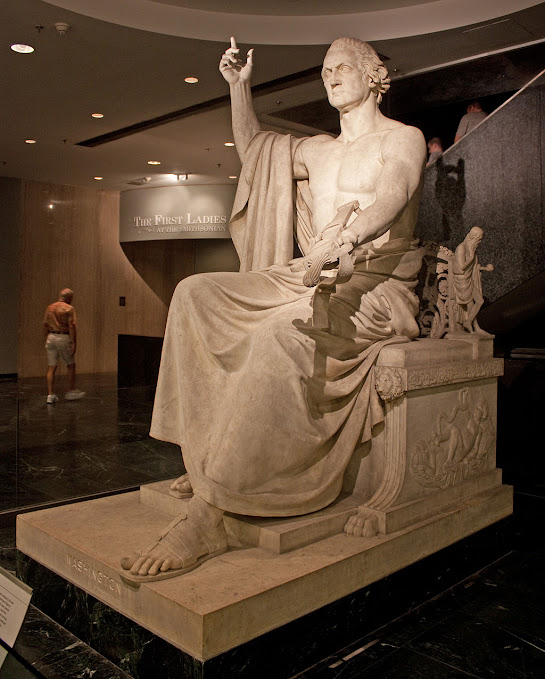
Greenough's George Washington (Wikimedia)
Greenough created a bizarre god-like statue of George Washington that includes a subjugated indigenous “Indian chief” in the design, under Washington’s hips, as the first president holds a sword and points to the sky. Greenough had planned to include “a negro” along with the indigenous figure, but abolitionist Charles Sumner convinced him not create a tie to slavery. The sculptor included a depiction of Christopher Columbus instead.

The public and press mocked the semi-nude statue of the first president. “American audiences paid less attention to deciphering the meaning of Washington’s symbolic sword and more to his nipples.” The statue, Thompson notes, "is on display at the Smithsonian’s National Museum of American History, awkwardly wedged next to an escalator. Today, the sculptures upraised hand looks as though it points the way up to the next floor."


Greenough's "Rescue." (LOC)
Greenough’s next work was received more favorably, at least by white Americans. In many ways it was even more bizarre and offensive. Like other monuments to follow, Rescue celebrated the genocide of Native Americans, particularly after President Andrew Jackson’s “Indian Removal Act” of 1830.

Rescue is in effect a monument to Manifest Destiny –– the idea of a god-given right of white people to subjugate indigenous people –– and for men to have an ordained role as dominant protectors of women. Thompson explains the scene of a white settler holding a dying indigenous warrior he'd just shot; his wife and child hover beneath him, and a dog watches balefully. The symbolism is clear and cringe-inducing.


At Abraham Lincoln’s inauguration in 1861, Rescue was prominently on display. It was removed from the eastern front of the Capitol Building in 1958 after decades of complaints. Thompson writes, “The removal of Rescue is another example of what happens when enough people decide that the messages encoded in a monument are unacceptable to them.”

“Greenough’s sculptures, the first thoroughly American national monuments, were also the first in a long line of public artworks to address questions of how much Black and Indigenous lives matter in America. He and his monuments claimed these lives didn’t matter at all. Greenough’s monuments assert that only people of a certain gender, class, and race deserve honor.

“Greenough’s beliefs informed not only his own sculpture but all the subsequent American public monuments based on his influential examples.”

A natural progression to other monuments highlighting white supremacy extended in the wake of the Civil War, even in Thomas Ball’s controversial Freedmen’s Memorial, dedicated in 1876.


Also known as Emancipation Memorial, it depicts a fully clothed Lincoln standing over a nearly naked kneeling black man. One interpretation is of a gracious leader bestowing freedom, but another view is of ongoing patriarchal and racial inequality.

Freedmen’s Memorial was unveiled on the eleventh anniversary of Lincoln’s assassination. President Ulysses S. Grant, members of Congress, and Supreme Court justices all attended and listened to Frederick Douglass’s speech. Several days later, Douglass wrote a letter to the editor of the National Republican in which he said, “What I want to see before I die is a monument representing the negro, not couchant on his knees like a four-footed animal, but erect on his feet like a man.”


Douglass’s descendants would live to see many hundreds of monuments erected to honor the seditionists of the Confederacy.


The rise of many of those monuments coincided with the rise of the rights and equality of African Americans as guaranteed under the Constitution.


An example is the statue of Robert E. Lee erected in Charlottesville, Virginia, in 1924, shortly after Virginia’s Racial Integrity Act made segregation lawful and outlawed in interracial marriage (not overturned by the Supreme Court until 1967 in Loving v. Virginia).


“The conflict at the heart of America,” Thompson writes, is “the conflict between the freedom for all and freedom for some.”


Thompson enlightens readers with the psychology, politics, and intent of Civil War monument creators. She delves into the meaning of statues’ poses, shows the influence of donations in creating profit motives for monuments, and explains the role of the Ku Klux Klan and other white supremacists.


Then there's Christopher Columbus.


Columbus Fountain in Washington D.C. (NPS)
Thompson reminds readers about Columbus’s contemporary, the priest Bartolemé de las Casas, who wrote about the real Christopher Columbus during his cruel reign as governor of Hispaniola (now Dominican Republic and Haiti). Columbus is condemned for overseeing torture, rape, slavery and genocide. Columbus shipped young girls back to Spain to be sold into slavery.

In recent years more people have assembled, protested, and demanded statues honoring Columbus, like monuments to the Confederacy, be taken down.


Thompson explores how, despite widespread opposition to their presence, some monuments remained in place for years. “We think our monuments celebrate our democracy, but really, they are held in place by some of America’s least democratic uses of power.”

Complacency and willful ignorance kept monuments up until catalysts of violence created a backlash: “Unite the Right” white supremacists' march (and killing of Heather Heyer) in Charlottesville; the horrific mass murder at a church in Charleston, South Carolina; and the senseless murder of George Floyd in Minneapolis, Minnesota, as examples.


Acts of civil disobedience are often the result of willful acts of bureaucratic lethargy, intransigence, and not listening to peaceful protesters. Thompson writes, "Talking about monuments is not easy. But we need to do it. We need to come together as communities to make sure our monuments leave room for everyone's life, liberty, and pursuit of happiness."


Towering over all the monuments to the Confederacy is the incomparable Stone Mountain in Georgia. Cut into the face of the mountain, it is the world’s largest bas-relief sculpture: images of Confederate President Jefferson Davis, along with Civil War generals Stonewall Jackson and Robert E. Lee on horseback. The sculpture inspires white racists and believers in the Lost Cause Big Lie, including the KKK.

Thompson writes about eccentric anti-semitic sculptor and con artist Gutzon Borglum, who was involved in creating the Stone Mountain monument. Borglum would go on to create the monument at Mount Rushmore, South Dakota, on land that was sacred to indigenous people.

There’s a lot more in this book about Borglum and Stone Mountain –– stories “to startle us out of our assumptions,” as Thompson writes.


[While reading this book I came across a new Americana CD by Bill Edwards, “61356,” with a great song from the perspective of a statue of a Union soldier on a Civil War monument in Illinois: “We Don’t See It Yet.” Edwards sings: “Since nineteen hundred and thirteen/I’ve stood in my place on this stone/In the middle of my Bureau County/But I haven’t stood here alone/Above me, a guardian angel/To my right, left and back, over Vets/We watch the horizon for justice/Alas, we don’t see it yet.” It’s a terrific song and album, highly recommended. Read more about "61356" on The Stratton Setlist.]


In “Smashing Statues” Thompson laments the lack of monuments to African Americans who fought for the Union in the Civil War.


There are also a relatively small number of monuments to women in the United States, but last week Speaker of the House of Representatives Nancy Pelosi unveiled a statue of Mary McLeod Bethune in the Capitol Building. Behune was “an unyielding force for racial justice, a pioneering voice for gender equity” from Florida, who was also “a devoted advocate for education,” Pelosi said in her remarks.


Bethune statue unveiled at Capitol Building July 13, 2022. (CNN)
The statue of Bethune joins statues of Rosa Parks, Sojourner Truth, Frederick Douglass and Martin Luther King, Jr. in the Capitol’s Statuary Hall. Bethune’s statue replaces that of a Confederate general.

On January 6, 2021, Trump-supporting insurrectionists, many wearing helmets or other headgear, walked through Statuary Hall during the coup attempt. Some rioters carried Confederate flags into the Capitol. High above them, on top of the building stood the statue in plumed helmet with an American eagle, mouth agape, eyes bulging –– Freedom.


This is an indispensable book for military readers interested in the reasons for the initiative to rename installations, facilities, and ships named for Confederate white supremacists or Confederate battle victories.

Saturday, December 29, 2012

War on the Waters – How the Navy Saved the Nation

by Bill Doughty

When the USS Monitor was lost in a storm Dec. 31, 1862, exactly 150 years ago, the future of the nation hung in the balance.

In his insightful new book, “War on the Waters,” James M. McPherson shows how Union naval leaders, technology and strategies combined to overcome setbacks and losses to the Confederacy – and eventually win the war.

Civil War SECNAV Gideon Welles
“To say that the Union navy won the Civil War would state the case much too strongly.  But it is accurate to say that the war could not have been won without the contributions of the navy,” concludes McPherson.

The Pulitzer Prize winning author writes about the wisdom of Secretary of the Navy Gideon Welles, the courage of Rear Adm. David Glasgow Farragut and the power of working jointly.  General Ulysses S. Grant worked hand-in-hand with Rear Adm. David D. Porter, the son and namesake of the War of 1812 hero.

Rear Adm. David D. Porter
We also meet Cmdr. John Rodgers (another son and namesake of a War of 1812 Captain) and Cmdr. George H. Preble (grandson of one of the Navy’s greatest leaders, Capt. Edward Preble).  The ties to the War of 1812 – in people, foreign alliances and brown-water naval tactics – are enlightening.

President Lincoln ordered the Army to provide its fleet of vessels to the Navy but promoted the idea of one-two punches by the Navy and Army from river ports to river forts. McPherson describes the fearless leadership of 19-year-old ship driver Colonel Charles Rivers Ellet.

Quoting letters, diary entries, first-person reports and dispatches, the author presents a broad history of naval warfare on both sides of the Civil War.  He describes “asymmetrical war on the waters” in blockades and blockade running, riverbank guerrilla warfare, subterfuge at sea, and night attacks, and he follows the development of ironclad ships, submersible vessels and mines (torpedoes).

Civil War gunship USS Commodore Perry.
The Civil War saw the watershed shift from wooden ships of previous centuries that would lead to the development of battleships by the end of the century.  Innovation would continue.  Less than 50 years after end of the Civil War the era of naval aviation would begin.

Well-worn strategies of blockading commerce and targeting blockade runners would be expanded into the next century.  A naval embargo against Imperial Japan in 1941 led to the beginning of the War in the Pacific.

Against the Confederacy in the 1860s, blockades were important in preventing the exporting of cotton and importing of salt.  The role of salt in the southern economy and the targeting of salt production in the south by the Union Navy are fascinating side notes showing the importance of a healthy economy to a strong military.

McPherson describes the overall sociological effect of naval strategies on people in the north and south, too.

“Modern historical scholarship has shown how the Union army became a powerful force in the liberation of slaves, and how the 180,000 liberated black Union soldiers (most of them liberated slaves) in turn helped the Union army win the war.  Less well known is the role of the Navy in freeing slaves and the vital contribution of black sailors to the navy’s campaigns.  In 1861-1862 the Navy penetrated earlier and more deeply than the army into tidewater regions of the South Atlantic coast and into the valleys of the lower Mississippi River and its tributaries...”

“War on the Waters: The Union & Confederate Navies, 1861-1865” starts as a dry treatise but picks up steam.  With nearly two dozen photos and illustrations and 19 easy-to-read maps, this book is filled with information, details and insights.  It deserves a place on every military historian’s book shelf.

McPherson proves his conclusion: The Navy played a key role in winning the Civil War and saving the United States – a mere 150 years ago.

Photos courtesy of National Archives and Naval History and Heritage Command.

Saturday, February 23, 2013

A Long Arc Toward Justice


by Bill Doughty
Secretary of the Navy Gideon Welles was one of the first people to learn about President Lincoln's commitment to free enslaved human beings in the South.  Lincoln confided in Welles and Secretary of State William Seward on July 13, 1862, according to Seward’s diary, that emancipation was part of a military strategy.

Secretary of the Navy Gideon Welles, center, at Lincoln's right hand.
Was Lincoln motivated by morality or practicality -- or both?

A new book by John Burt, “Lincoln’s Tragic Pragmatism,” joins over 16,000 titles published to date about the 16th president and explores the question. 

Regarding Lincoln's practical motivation, Burt writes:

“He explained to Welles that emancipation ‘was a military necessity absolutely essential to the salvation of the Union, that we must free the slaves or be ourselves subdued.’ Such an act would, at the least, weaken the power of the Confederacy, since it used its slaves to do such things as dig intrenchments or move supplies, jobs which otherwise would have to be performed by white soldiers. He further noted that the border states would do nothing, left to themselves, and could only be persuaded to free their slaves if the slaves were freed in the Confederacy first.”

Burt’s book was showcased this week on one of America’s best radio shows,  Tom Ashbrook’s On Point, and is available as a podcast. The acclaimed new book examines Lincoln’s philosophy and approach to democracy.  Listen to the discussion here.

Ashbrook opens his podcast with a quote from Dr. Martin Luther King, Jr.: “The arc of the moral universe is long but it bends toward justice.”

He quotes a passage from Burt:

“Lincoln provides a model for moral agency in a complex world in which one must make one’s way among various half-understood alternatives, none of which leaves ones hands clean.”

Burt discusses conflicting beliefs and values, the tension between democracy and morality, and the fundamental principles of persuasion.

He tells Ashbrook, “My conscience commands me, but it has to persuade you.  And, indeed, if I don’t persuade you and compel you, then I’m not behaving in a democratic way either.  It may be a high-minded tyranny, but it’s still a tyranny.  I have an obligation to get you to accept defeat on things that matter to you highly.”

The On Point conversation brings out contemporary parallels -- from Martin Luther King’s strategy in the 1960s to current challenges of the ongoing Continuing Resolution and impending Sequestration in 2013.  In considering Lincoln, the lessons in leadership, compromise and warfare -- concessions without “fatal sacrifices” -- are striking.

Another one of the 16,000+ Lincoln titles (used as a backdrop by CNO Adm. Greenert to announce his revamped Professional Reading Program) is Ronald C. White, Jr.’s “The Eloquent President.”  White examines some of the president’s greatest speeches, addresses and public letters between 1861 and 1865, pulling them apart and looking at the poetry, cadences and conviction inside.

Like Burt, White also describes the role of Welles and Seward as Lincoln’s close confidants on the issue of emancipation.

Welles wrote detailed entries in his diary and recounted Lincoln’s growing belief in “Divine Will.” According to Welles, Lincoln saw victory in the Battle of Antietam as an indication that “God had decided this question in favor of the slaves.”

In "The Eloquent President," White writes:

“What was most remarkable, in an atmosphere charged with religious fervor and hyperpatriotism, was Lincoln’s new belief that God’s purposes may not be able to be identified by either side.  What sets him apart, in this musing, from his contemporaries in both North and South was his absence of pretension.”

White puts Lincoln’s passionate and compelling speeches under a magnifying glass, peeling off words and phrases and examining the inspiration, techniques and underlying morality of the president’s rhetoric.

He considers the Annual Message to Congress, delivered Dec. 1, 1862, as  “Lincoln’s finest message to Congress.” In that address, Lincoln calls for a “plain, peaceful, generous, just” way to save the Union.

Lincoln’s conclusion includes the phrase “fiery trial”:

“Fellow-citizens, we can not escape history. We of this Congress and this Administration will be remembered in spite of ourselves. No personal significance or insignificance can spare one or another of us. The fiery trial through which we pass will light us down in honor or dishonor to the latest generation. We say we are for the Union. The world will not forget that we say this. We know how to save the Union. The world knows we do know how to save it. We, even we here, hold the power and bear the responsibility. In giving freedom to the slave we assure freedom to the free--honorable alike in what we give and what we preserve. We shall nobly save or meanly lose the last best hope of earth. Other means may succeed; this could not fail. The way is plain, peaceful, generous, just -- a way which if followed the world will forever applaud and God must forever bless.”

White concludes, “His words transcended the limitations of the event.  He used this occasion not simply to report to Congress but to mobilize public opinion. He offered a powerful appeal to history but also invited Americans to think in the future tense.  Lincoln’s message represented a breadth of conception and height of imagination in his expanding rhetorical arsenal.”

Lincoln balanced the highest ideals of morality with a tough, clear-eyed practical approach to achieve compromise and cooperation.  Using the art of the long view, he kept his commitment to the arc of the moral universe that would lead to justice for future generations.