Showing posts with label cyber. Show all posts

Wednesday, February 16, 2022

Unbelievable! ‘Putin’s Playbook’

Review by Bill Doughty

It seems Unbelievable. There are 150,000 Russian troops and dozens of ships and submarines surrounding the independent free democratic nation of Ukraine.


Putin, who invaded Georgia and Crimea in recent decades, says he has no intention of attacking his neighbor, but is he telling the truth? Does he respect Ukraine’s border? Hasn't Putin already demonstrated a pattern of aggression, including revanchism?


In “Putin’s Playbook: Russia’s Secret Plan to Defeat America” (Regnery Gateway, 2021), Rebekah Koffler makes the case that Putin not only wants to invade Ukraine, but also plans for an all-out war with the United States.


Koffler is a former U.S. intelligence analyst. Her reason for having to leave the intelligence community, in her own words, is not only surprising but shocking. More on that twist to her narrative later.


USS Lake Erie (CG-70) arrives in Pearl Harbor during RIMPAC 2008. (MC3 Paul Honnick)

Navy readers will be interested in several references in “Putin’s Playbook” to naval leaders (including Vice Adm. Arthur K. Cebrowski and General James Mattis) and events (such as Operation Burnt Frost [involving the shooting down of a disabled satellite by USS Lake Erie (CG-70) in 2008], Navy personnel helping rebuild floors of the American embassy in Moscow, and Koffler’s walk through the gate at the Naval Research Lab).
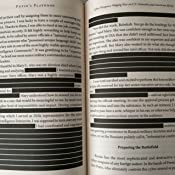
Koffler’s “Putin’s Playbook” itself is a messy amalgam of history, biography, advice, conjecture, and personal grievance. She offers a disclaimer that her views do not represent those of the government, followed by an author’s note strongly disagreeing with DIA/CIA redactions, which she prints as part of the text. Yet, out of the mess we can find potential gems of insight.

For example, she explains Putin’s own grievance over the collapse of the USSR and losing the Cold War. She writes about two philosophers who shaped his thinking: “In addition to Eurasianist influence, Putin drew his ideology from the ideas espoused by two Russian thinkers”: Ivan Il’in (1882-1954) and Lev Gumilev (1912-1992). Il’in was a Russian Orthodox Christian who believed Western democracies were dangerous; he considered that “an independent Ukraine would be an unthinkable ‘madness.’ Meanwhile, Gumilev, an anthropologist and historian, believed in a “super-ethnos” of Mother Russia. Eurasian vs. European. Slavs/Steppes vs. Anglo-Saxons. Us vs. them.


Putin uses ethnicity to justify threats of aggression against his neighbors. It may be hard for people in free democracies to understand his hardline, strongman attitude and why the people of Russia seem to support him as well as how he stays in office for decades.


Koffler says it is a mistake to see Putin and Russia through American eyes. Vladimir Putin and his supporters are steeped in grievance, superstition, resentment, and righteousness. Putin and his followers seem to have a boundless capacity for inflicting and enduring suffering. The list of political opponents, reformers, and journalists who have been poisoned, shot, or mysteriously killed by Putin’s Russia is long and alarming.

According to Koffler, “trust” is not a concept in Russia. (And, by the way, she says there is no word in Russian for “fun”).


Yet, Koffler seems to idolize Putin: “When Putin assumed the reigns (sic) of Russia, his first order of business was to restore internal stability, reverse the economic crisis, and reassert state control of most, if not all, aspects of life in Russia." Koffler says Putin was committed to restoring “law and order” and “respect towards Russia internationally.” “Putin delivered on his promise to the Russians.” “He has restored domestic stability, improved the Russian economy, and modernized the military to the point where even the Pentagon must play catch up in certain areas. Putin’s Russia is back on the map,” she boasts. 

Biden speaks with Putin
Koffler writes, “At sixty-eight, Putin is highly athletic and personifies strength. Acting as a benevolent patriarch…” Weirdly, she says: “Putin may be a villain, but he is not a supervillain.” “His rule has been far less brutal than that of Vladimir Ilyich Lenin or even the czars.”

Putin further justifies his aggression against his neighbors because of his fear and resentment of more free democracies on his borders and potential NATO expansion. It seems he would rather fight others, including Europe and the United States, than try to get along:

“Putin is stirring up chaos and disorder in America to save himself from a regime overthrow that he believes Washington seeks. Putin believes that destabilizing America by amplifying internal strife through social media and covert interference will help prevent an all-out war, which he would be ready to fight with the U.S. under certain scenarios. As the United States continues to try to peel off Ukraine from Russia’s orbit, it may be prudent to make a thorough intelligence assessment as to whether Putin would invade Ukraine if Washington pushes too hard. Before we consider such a move for Moscow ‘highly unlikely,’ it is worth remembering that Putin understands how Americans think but doesn’t think like them. He thinks like a Russian and a former KGB operative. While it may have seemed irrational to American national security experts that Putin took over Ukraine’s Crimea, for the Russian president, the long-term risk of not having Crimea as part of Russia outweighed the short-term risk of invading it.”

In the face of a growing Russian military threat on Ukraine’s border in recent days, weeks, and months, the Biden administration and European allies have strengthened diplomatic resolve, committed to finding a path to resolve tension and prevent war. Analysts say Putin's actions have boomeranged and only strengthened NATO's resolve and solidarity.


Putin has been warned that if his military invades Ukraine again on whatever pretext or justification, there will be dire consequences, including severe international sanctions. But Koffler writes:

“Sanctions or not, Putin has shown during the past decade that he will invade or destabilize Russia’s former republics –– as he did in Ukraine and Georgia –– rather than let them switch sides to NATO and the European Union. He will continue to unbalance America through cyber warfare and other tools in his playbook rather than let Washington democratize the former Soviet Eurasian countries. He understand well that he is playing a risky game that can lead to an escalation of tensions. But risk is something that Putin is accustomed to; it is a way of life for a former KGB officer. Bred as an intel operative, he plans for contingencies. Therefore he has a plan in his playbook for an all-out war with America.”

Koffler says that Russia’s war with America would be five-pronged: (1) space, attacking satellites; (2) cyber weapons; (3) spies and disrupters, infiltrating America; (4) active measures including subversion, election sabotage, and assassinations; and (5) all-out kinetic warfare, up to and possibly including nuclear weapons.


U.S. Navy's fourth Mobile User Objective System (MUOS) communications satellite lifts off from Space Launch Complex-41. (United Launch Alliance)
As expressed several times in her book, Koffler is a rock-solid supporter of her former boss, retired General Michael Flynn, who pleaded guilty to lying under oath about his contacts with Russian officials in the lead up to the 2016 U.S. presidential election. Former President Trump pardoned Flynn as well as other close associates with ties to Russia and a plot to overturn the 2020 election. Koffler calls former Defense Intelligence Agency Director Flynn an “American patriot.”

Michael Flynn and then-President Trump (D. Myles Cullen, DoD)
She defends Trump’s “patriotic desire” regarding his call with Ukraine President Zelensky in 2019. In that call, which led to his first impeachment, Trump tried to get Zelensky to announce an investigation into the Biden family during the U.S. presidential campaign, and the former president tied the request to a withholding of arms and other support to Ukraine.

Koffler says, believably, that Putin’s Russia is behind the schism in the United States between the Right and Left, fomenting mistrust in free elections and in democracy itself. She acknowledges Russia’s aggressive attempts to target U.S. elections and influence people through fake social media accounts.


Though she calls the Trump-Russia investigation a “witch hunt,” Koffler makes no reference to Rudy Giuliani, Paul Manafort, Roger Stone, and others in Trump’s orbit who actively worked with Russians. No mention of Trump Tower plans in Moscow or Russian investment in the Trump corporation. No mention of Trump’s public request for Russia and China to help him discredit his political opponent. No mention of Trump taking Putin’s side over his own intelligence community in 2016. 


And no mention of the January 6, 2021 Capitol insurrection by Trump supporters, even though her book was published in late July.


Koffler
Koffler, who is a contributor to Fox News, does not offer an opinion about Tucker Carlson’s pro-Russia and pro-authoritarian stances.

She presents a mere half-paragraph about Putin challenger Alexey Navalny and a bare mention of Russian agent Maria Butina, who infiltrated the NRA and influenced members of the Republican Party. She warns, instead, about the “Left’s true agenda”: single-payer healthcare, gun control, and –– deceivingly –– “defunding the police,” a phrase denounced by all Democratic leaders.


With no intended irony, Koffler writes, “It is high time for Americans and the U.S. government to understand how Russian disinformation works so we don’t become our own deceivers.”


As to why she is no longer a member of the intelligence community, Koffler explains how she was challenged after a background clearance investigation. Then, she gives a lengthy explanation of how a flight to Washington, D.C., had to make an emergency landing because of her behavior. She says, “what transpired next was straight out of Stephen King.” She was handcuffed by police and questioned by the FBI because of her disruption on the airplane. After the incident, the Intelligence Community issued psychological tests in which testers found “something not quite normal.”


She blames “deep-state operatives,” “bean-counters, “bureaucrats,” and “American apparatchiks” for destroying her career and her plan to be Deputy NIO for Cyber on the National Intelligence Council at the Office of the Director of National Intelligence.


Ultimately, readers must choose what to believe based on what Koffler chooses to present. In her opinion, the United States is no longer a free refuge for immigrants like her, she says: “And unlike me, my children and other God-loving Americans will have nowhere to flee.” But while warning of the dangers of leftwing socialism, she largely ignores the threats of rightwing authoritarianism and totalitarianism.


It may seem to be unbelievable, but history shows how fascism can arise from both the Left and/or the Right.


While there are gems of analysis about Russia to discover in this book there are other authors that are far more insightful and rewarding to help understand Putin and modern Russia. I've found Garry Kasparov to be a particularly strong voice, particularly in his warnings against appeasing Putin; I reviewed his book "Winter Is Coming" in 2017.


I just started reading Fiona Hill’s “There Is Nothing for You Here: Finding Opportunity in the 21st Century.” I’m only a few chapters in, but so far, it’s a much deeper and more rewarding book, both as a biography and as a geopolitical analysis. Hill is the former deputy assistant to the president and senior director for European and Russian affairs on the National Security Council. Hill served Presidents George W. Bush, Barack Obama, and Donald J. Trump with honor, courage, and commitment.


From the publisher: “Rebekah Koffler, is a Russian-born U.S. intelligence expert who served as a Russian Doctrine & Strategy specialist in the Defense Intelligence Agency… Rebekah is a writer and national security commentator whose work has been published on the Fox News website, The Hill, the Daily Caller, the New York Post, and the Washington Times. She has appeared on Fox News, One America News, News Nation Now, Newsmax TV, and the Sean Hannity nationally syndicated radio show.”

TOP PHOTO: From left, U.S. Army Europe and Africa Deputy Commanding General for Army National Guard, Maj. Gen. Joe Jarrard, U.S. Ambassador to Poland, Mark Brzezinski and Polish Land Forces 16th Mechanized Division Commander, Maj. Gen. Krzysztof Radomski walk and talk before the Battle Group Poland hand over, take over ceremony at Bemowo Piskie Training Area, Poland, Feb. 11, 2022. The ceremony demonstrated NATO's continued commitment to the collective defense and security of our allies on NATO's eastern flank. (Spc. Jameson Harris)

Sunday, December 20, 2020

‘General Naval Tactics: Theory and Practice’

Review by Bill Doughty

Warfighting occurs in a multidimensional, multi-domain universe –– a matrix of possibilities, challenges, and surprises, more art than science. Success in the maritime battle space depends on balancing three components of “the art of war at sea.”


“Naval tactics is one of three components of that art; the other two are naval/maritime strategy and operational art.” The components are interdependent and reliant –– most importantly –– on the human factor. That’s the revelation in Milan Vego’s “General Naval Tactics: Theory and Practice” (Naval Institute Press, 2020), an indispensable book for any commander or naval officer whose goal is to be a senior leader of leaders.

This book presents a nuts and bolts discussion of objectives, methods, and elements of tactics as well as design, leadership, targets, and other vital considerations.


But throughout the discussion, Vego emphasizes the importance of incorporating theory and an understanding of people together with hardware and tactics. “Experience shows that a naval officer is far better prepared to apply tactical doctrine and to use it creatively.” That means having an appreciation of psychology, philosophy, history, and epistemology. “The most common error is an over emphasis on the importance of matériel in naval warfare,” Vego writes, adding that over-reliance on untested technology and mere pockets of information can be dangerous, too.


Chief of Naval Operations, Adm. Mike Gilday, right, speaks to Sailors after the Cyber Foundry ribbon cutting Feb. 18, 2020. The Cyber Foundry is a development site for some of the U.S. Navy’s cyber-warfare capabilities by combining a modern physical environment, trained and experienced personnel, industry-leading processes and updated technology resources to enable the rapid development of offensive cyber capabilities. (Mass Communication Specialist 2nd Class William Sykes)

Information itself can a weapon. This month, in fact, we learned of cyber attacks reportedly by Russia against the United States. Vego outlines how tactical information warfare is conducted in the cyber warfighting domain and how electronic warfare, psychological operations and operational security are part of tactical protection in information warfare.

“One of the key requirements for effective tactical IW is timely, accurate, and relevant intelligence. Among other things, intelligence support of IW analyzes the enemy C2 [command and control] process and determines enemy IW capabilities. Intelligence supports IW through the collection, evaluation, analysis, and integration of all available information concerning the enemy’s capabilities. Capabilities to collect, evaluate, analyze, and transmit intelligence information have increased exponentially with the development of surveillance sensors, computers, and communications. The overall effectiveness of intelligence support is heavily dependent on all-source, accurate, timely, and relevant intelligence.”

Leaders must also understand the limitations of machines of war and test new technologies under realistic battlefield conditions. Tactical wargaming is indispensable training, according to Vego. An important part of the decision-making matrix is logistics and other forms of command support, including maintenance, defense, and security, among other concerns for any planner or commander. Vego defines and describes various kinds of replenishment.


He presents pros and cons of centralized and decentralized command structures and explains the importance of good communication in C2 and the chain of command. “C2 is not a system or command structure, as often erroneously believed, but the process of planning, preparing, directing, and controlling ones forces in both peacetime and in combat.”


Here again, in senior commanders’ choice of command structures, is the importance of the human factor and finding balance in risk awareness not avoidance.

“Risk avoidance results in over-centralization of C2 and undue interference of the higher commanders in the authority and responsibility of their subordinate commanders. The higher commanders issue overly detailed orders to subordinates to ensure that no mistakes are made. Subordinate commanders quickly realize the dangers of acting on their own initiative. The result is lack of initiative and waiting on orders instead of making quick and independent decisions in the case of a sudden change in the situation.”

Vego presents dozens of examples from history, including surprising ones such as the Battle of the Saintes (1782), Battle of Lissa (1886), and Turko-Greek War (1897).


Crew members aboard USS White Plains (CVE-66) observe Imperial Japanese Navy attack other ships of carrier division 25 in the Battle off Samar, Oct. 25, 1944.


Most of his examples naturally come from the War in the Pacific (1941-1945) and include presentations of strategy, tactics, and operations during the battles of Leyte Gulf, Midway, Savo Island, and Samar, among others, where bold decisions were made by strong leaders.


Good leaders with high intelligence, humility and ethics Vego cites include Adm. Chester Nimitz, Adm. Raymond Spruance, and Royal Navy Admiral of the Fleet Andrew Cunningham (1883-1963), pictured at right. They were “trustworthy and trusting” with strong work ethics and wisdom, able to make good and righteous decisions in wartime.

“Decision-making is more art than science. Sound decision-making requires that a naval tactical commander possesses accurate, relevant, and timely information on all aspects of the tactical, and sometimes even some elements of the operational, situation. As time-space relationships continue to compress and the volume of information expands exponentially, making a sound decision will become progressively more difficult. The naval tactical commander’s ability to ‘see’ the battlefield will be greatly improved, but so will the enemy’s ability to frustrate friendly forces’ plans and actions. New information technologies will reduce, perhaps dramatically, uncertainties regarding the location, composition, movements, and these technologies will penetrate the thick veil surrounding the enemies intentions and the unquantifiable elements of the enemy’s situation any better than in the past.”

“Making sound decision requires quick thinking, focus on the essentials, logical reasoning, common sense, and good judgment.” Naval commanders need selfless courage, agility, creativity and foresight as well as the ability to communicate effectively. “Effective communications has an importance far beyond the mere exchange of information. It builds trust, cooperation, and mutual understanding.”


A five-country multinational fleet, during Operation Enduring Freedom in the Oman Sea. In five descending columns, from the top left to the bottom right: MM Maestrale (F 570); FS De Grasse (D 612), USS John C. Stennis (CVN 74); FS Charles De Gaulle (R 91), FS Surcouf (F 711); USS Port Royal (CG-73), HMS Ocean (L 12), USS John F. Kennedy (CV 67), HNLMS Van Amstel (F 831); and MM Durand de la Penne (D 560).


Vego writes, “Any military objective should be balanced (harmonized) with he corresponding factors of space, time, and force.”


Every naval officer can benefit from this book and its advice about balancing multidimensional, multi-domain, nonbinary leadership –– more wisdom than information, more art than science.

Wednesday, December 11, 2019

With Respect to the Truth ...

Review by Bill Doughty

Here's a mind-expanding book that offers cosmic advice for the future – and the advice is most welcome today. 

Can we distinguish between facts and beliefs? Do we understand why some people reject science and secular values of truth, compassion, equality, freedom, courage and responsibility? Are we ready for a world in which humans could be irrelevant but under the control of more authoritarian leaders? Oh, and by the way, "what is the meaning of life" (and why is that the wrong question)?

According to philosopher-scholar Yuval Noah Harari in "21 Lessons for the 21st Century" (Spiegel & Grau, Penguin Random House, 2018), twin revolutions of infotech and biotech are bringing about big data algorithms and bioengineering as the world races to embrace artificial intelligence.

"What we are facing is not the replacement of millions of human workers by millions of individual robots and computers; rather, individual humans are likely to be replaced by integrated networks," Harari writes.

USAF maintainers prepare an MQ-9 Reaper drone at Ali Al Salem Air Base, Kuwait, July 23, 2019. (SSgt. Mozer O. Da Cunha)
This is a challenge already for the U.S. Air Force as it accelerates artificial intelligence technology:
"AI might help create new human jobs in another way. Instead of humans competing with AI, they could focus on servicing and leveraging AI. For example, the replacement of human pilots by drones has eliminated some jobs but created many new opportunities in maintenance, remote control, data analysis, and cybersecurity. The U.S. armed forces need thirty people to operate every unmanned Predator or Reaper drone flying over Syria, while analyzing the resulting harvest of information occupies at least eighty people more. In 2015 the U.S. Air Force lacked sufficient trained humans to fill all these positions, and therefore faced an ironic crisis in manning its unmanned aircraft."
Harari said the future may see "the rise of a new useless class" as we experience higher unemployment and a shortage of skilled workers. "Today, despite the shortage of drone operators and data analysts, the U.S. Air Force is unwilling to fill the gaps with Walmart dropouts."

In a rapid explanation of human history – from the African savannah through the Crusades and effects of the Industrial Revolution to today's Nuclear Age and into tomorrow – Harari provides an ominous warning:
"The challenge posed to humankind in the twenty-first century by infotech and biotech is arguably much bigger than the challenge posed in the previous era by steam engines, railroads, and electricity. And given the immense destructive power of our civilization, we just cannot afford more failed models, world wars, and bloody revolutions. This time around, the failed models might result in nuclear wars, genetically engineered monstrosities, and a complete breakdown of the biosphere. We have to do better than we did in confronting the Industrial Revolution."
Why worry about the growing influence of algorithms? Harari says the shift in authority from human control to networks of algorithms "might open the way to the rise of digital dictatorships."

One important question for our time, he says, is "who owns the data?"


Harari reminds us how George Orwell in "1984" warned of televisions watching us and controlling free will and freedom of choice. Biotechnology, memory storage capability and data assimilation are advancing exponentially and can be controlled centrally. Imagine the new technologies in the hands of authoritarian leaders.
"In fact, we might end up with something that even Orwell could barely imagine: a total surveillance regime that follows not just all our external activities and utterances but can even go under our skin to observe our inner experiences. Consider, for example, what the Kim regime in North Korea might do with the new technology. In the future, each North Korean citizen might be required to wear a biometric bracelet that monitors everything that person does and says, as well as their blood pressure and brain activity. By using our growing understanding of the human brain and drawing on the immense powers of machine learning, the North Korean regime might be able for the first time in history to gauge what each and every citizen is thinking at each and every moment. If a North Korean looks at a picture of Kim Jong-un and the biometric sensors pick up the telltale signs of anger (high blood pressure, increased activity in the amygdala), that person will be in the gulag tomorrow morning."
Harari warns, "Democracy in its present form cannot survive the merger of biotech and infotech," where authoritarian governments could control citizens "even more than in Nazi Germany."

In "Mein Kampf," Hitler wrote about the importance of constant repetition; his propagandist Joseph Goebbels said, "A lie told once remains a lie, but a lie told a thousand times becomes the truth."

Using lies and intimidation, dictators like Hitler and Joseph Stalin in the previous century controlled people's minds through a cult of personality, belief and anger. "The dictator might not be able to provide citizens with healthcare or equality, but he could make them love him and hate his opponents," writes Harari.

Stalin shamelessly embraced false stories and propaganda as he controlled minds, persecuted dissenters and killed millions of people, including in Ukraine, where his imposed famine became a weapon.

More recently, after Vladimir Putin invaded Ukraine and occupied Crimea in 2014 he lied about Russian troops being involved. Later, he and Russian nationalists claimed Ukraine is not a sovereign nation and should be part of Mother Russia.
"Ukrainian citizens, outside observers, and professional historians may well be outraged by this explanation and regard it as a kind of 'atom bomb lie' in the Russian arsenal of deception. To claim that Ukraine does not exist as a nation and as an independent country disregards a long list of historical facts – for example, that during the thousand years of supposed Russian unity, Kiev and Moscow were part of the same country for only about three hundred years. It also violates numerous international laws and treaties that Russia has accepted and that guarantee the sovereignty and borders of independent Ukraine. Most important, it ignores what millions of Ukrainians think about themselves. Don't they have a say about who they are?"
Fortunately, the U.S. Navy stands with its friend, the democratic nation of Ukraine.

Cmdr. Tyson Young, right, CO of USS Carney (DDG 64), meets with a Ukrainian Navy music conductor after a Ukrainian Navy performance during exercise Sea Breeze 2019 in Odesa, Ukraine, July 4, 2019. Sea Breeze is a U.S. and Ukraine co-hosted multinational maritime exercise held in the Black Sea and is designed to enhance interoperability of participating nations and strengthen maritime security and peace within the region. (MC1 Kyle Steckler)
Unfortunately, people throughout the world are unaware of verifiable facts. We are ill-equipped to deal with future "deep fake" attacks, attempts to interfere with free elections, and mind control by digital dictators.

Harari shows that human nature makes us susceptible to false information, and the so-called post-truth era may have started millennia ago with belief systems that reject science and objective reality. Fiction, for many people, is more palpable and believable than fact.

What to do? Harari says we should meditate in order to achieve greater consciousness, which he calls the greatest mystery in the universe. He says, "The big question facing humans isn't 'what is the meaning of life?' but rather 'how do we stop suffering."

This book is a good companion to Harari's other works, "Sapiens" and "Homo Deus." As with his previous works, "21 Questions" goes beyond nations, ethnicities, religions and human consciousness to present a cosmic perspective in examining big questions in search for ultimate truth and wisdom.

Thursday, June 6, 2019

Justice: Battle of Midway and the Constitution

Review by Bill Doughty

The Navy recruited one-day Supreme Court Justice John Paul Stevens when he was a senior at the University of Chicago. The well-read and academic Stevens agreed to learn codes and ciphers and become qualified to do cryptographic work for the Navy. That was in the summer of 1941.

Stevens on Oahu, his second duty location.
In early December the Navy notified him of his eligibility for a commission as an ensign. He reported to Great Lakes Naval Station for a physical on the eve of Imperial Japan's attack on Pearl Harbor, Oahu, Dec. 7.

Stevens recounts his time in the Navy briefly in his wonderful memoir, "The Making of a Justice: Reflections on My First 94 Years" (Little, Brown and Company, 2019). His first assignment was at the Navy Department in the Munitions building on Constitution Avenue in Washington, D.C.
"My first two chores as an officer in the Navy assigned to 'Op-20-G' – the communications intelligence section of the service – required skills unrelated to my training. Encrypted messages that were exchanged between one communications intelligence unit and another – between station 'Hypo' at Pearl Harbor and station 'Negat' in Washington, for example – were classified 'ultra' rather than merely 'secret,' 'confidential,' or 'restricted.' The originator of such a message typed the plain text into a cypher machine that created five-letter blocks of scrambled letters. The addressee, using a comparable machine, typed out the scrambled text to convert it back into plain language. When I arrived in Washington, the navy allowed only commissioned officers to decrypt 'ultra' messages. Though I had become a pretty good typist while working at the (student newspaper, Chicago Daily) Maroon, neither I nor any of the other commissioned officers doing that work could type as well as most of the enlisted men. The navy eventually permitted qualified typists to decrypt 'ultra' messages."
As a junior ensign, Stevens was assigned duties as typist and burn bag guard, armed with a .45-caliber handgun, before being assigned to the communications section to begin work in the traffic analysis section.

As a traffic analyst trainee, Stevens became familiar with kana in the Japanese language and was able to understand the transmission of messages from kana to Morse code.

His description, though brief, of how Japanese naval messages, sent in "JN-25" code, were studied and deciphered will be interesting to today's Navy cyber warriors. Stevens describes how cryptoanalysts hunted the identity ("call signs") of the senders and recipients of Japanese radio transmissions.


'Decisive" BOM & Duty in Hawaii
"In late May 1942, the cryptographers, language officers, and traffic analysts in the Fleet Radio Unit at Pearl Harbor (FRUPAC) had learned enough about Japanese naval communications to predict that a major assault on one of our Pacific outposts designated as 'AZ' was about to occur. They suspected, but were not certain, that AZ was Midway Island. Knowing that the Japanese were monitoring our naval communications, they arranged for an exchange of plain-language messages commenting on a supposed accident that had produced a serious water shortage on Midway Island; those messages produced a comment in the enemy's communications that confirmed our suspicions. As a result of that ruse, combined with the earlier intelligence obtained from decrypted JN-25 messages, Admiral Chester Nimitz's forces were prepared for the Japanese attack on June 6 and ultimately prevailed in what many experts have concluded was the decisive battle in our war with Japan."
Stevens is quick to say he had no direct role in "that historic triumph," however his next assignment – to Oahu – would take him to the heart of where the Battle of Midway was planned and launched.
"When I arrived in Pearl Harbor, FRUPAC was located in an unmarked area in the basement of a building near the headquarters of the Fourteenth Naval District. I was first assigned space in a house a short distance from the end of one of the runways at Hickam Field, and shortly thereafter I moved into the BOQ (bachelor officers' quarters) located near the main gate of the naval yard ... A few weeks after my arrival at Pearl, the name of the combat intelligence unit was changed from 'FRUPAC' to 'JICPOA' (Joint Intelligence Communications Pacific Ocean Area) and its location was moved from the navy yard to Makalapa, near Admiral Nimitz's headquarters."
Stevens served for 30 months in Hawaii and became one of a handful of watch officers who had the responsibility for reviewing all intercepted enemy radio traffic and writing a summary for Adm. Edward Layton, Chief Intelligence Officer of the Pacific Fleet once every 24 hours.

He remembers receiving "startling advice" to be on the lookout for one of the Imperial Japanese Navy's battleships – "I think it was the Musashi" – possibly headed to Truk, then a key naval base. The warning turned out to be a false alarm due to a garbled version of a call sign – a mistake due to operator error.

"In my later career as a judge," Stevens writes, "I have recalled that incident over and over again when confronted with the question whether a legislature actually intended a statute to have the meaning that its plain language seemed to convey. Legislatures, like radio operators, occasionally make mistakes."

Throughout this book we read the carefully considered words and meanings chosen by Justice Stevens throughout his career. We see the importance of definitions, meanings, intent and the need for precision when interpreting and applying the wisdom of the founders as outlined in the Constitution – balancing original intent with "evolving standards of decency." He reminds us of groundbreaking changes in society since the birth of the nation, back when the federal government sanctioned institutionalized slavery, disenfranchisement of Native Americans and anti-suffrage for women.

Stevens was on one of his 24-hour duty watches in Hawaii when he received the message confirming the success of an operation to target, intercept and kill Admiral Yamamoto, who was flying from Rabaul to an airfield on Bougainville. Yamamoto was the architect of the attack on Oahu that started the war in the Pacific and brought the United States into World War II.

Nimitz and Yamamoto
"I remember being somewhat troubled by the punitive motivation for the operation, but I also recognized that it had achieved a significant strategic benefit by terminating the most competent officer in the Japanese navy," Stevens writes.

After Yamamoto's death, the Japanese began to encode call signs. But, Stevens and "an exceptionally talented enlisted man" named Stanley Moe worked to decipher familiar call signs and figure out the "quite simple" pattern of kana that were changed each day. "The new system required more paperwork for us ... but otherwise did not impair our traffic analysis."

Read "The Making of a Justice" to see:
  • how he inadvertently interrupted Admiral Nimitz's target practice, almost becoming the target himself; 
  • how he met another future Supreme Court Justice (and NFL star) Byron White, a fellow Sailor who "saved the lives of sailors buried under debris" after a kamikaze attack on USS Bunker Hill in May 1945; and
  • how he experienced and appreciated his time in Hawaii, including bodysurfing at Makapu'u and visits to Kauai, Maui and the Big Island of Hawaii.
Rare and endangered Silverswords in bloom on Haleakula.
"On Maui we drove to the parking area near the Kilauea (Haleakula?) volcano. We walked to a spot where we had an excellent view of the crater. The view was memorable, but less so than our decision not to investigate the area identified by a sign pointing to an uphill path containing the words 'silver' and 'swords.' Not until after we had returned to Oahu and Walt (Hopkins) satisfied his curiosity by a visit to the Honolulu public library did we learn that silverswords are beautiful flowers that grow only on that volcano and, more importantly, although they rarely bloom, they probably were in full bloom when we decided to terminate our sightseeing that afternoon. Over the years that incident has been a frequent reminder of the importance of deliberation before refusing to take advantage of once-in-a-lifetime opportunities."
After learning that an Army plane dropped an atomic bomb on Hiroshima and another on Nagasaki a few days later, resulting in Imperial Japan's surrender soon after, Stevens was pragmatic in his assessment.
"Tragic as those events were for the residents of those two cities, I was then convinced (and have remained convinced ever since) that that method of bringing the war to its inevitable end saved many, many more lives – of American soldiers as well as Japanese soldiers and civilians – than the number of victims of those two bombings. An invasion of Japan would have caused hundreds of thousands, if not millions, of casualties."
Monumental Meaning of Patriotism

"The Making of a Justice" includes the text of a speech Stevens gave in 2010 on the tenth anniversary of the establishment of the National Japanese American Memorial Foundation. The speech starts on page 522 of the hardbound edition, and it deserves to be read for what it says about tolerance, patriotism and core values.

Stevens, front and center, with Veterans and hosts to commemorate the NJAM Foundation.
In his speech he recounts his visit to Pearl Harbor in 1994, his first visit there since the war.
"Admiral Retz took me on a tour of the harbor on his barge, pointing out changes that had occurred in the past 50 years. The most memorable and moving event during that tour was our approach to the Arizona Memorial – which spans the USS Arizona and the over a thousand American Sailors [and Marines] still entombed in the sunken battleship. As we approached the Arizona I could plainly see that the dozens of visitors on board that day were Japanese tourists. My first reaction to that sight was more emotional than you might expect from a senior citizen. Several thoughts flashed through my mind: 'Those people don't really belong here. We won the war, they lost it. We shouldn't allow them to celebrate their attack on Pearl Harbor even it if was one of their greatest victories.' But then I realized that those visitors must also have been experiencing a number of mixed and conflicting emotions. Perhaps a few did remember Pearl Harbor with pride. Some of them may even have been descendants of pilots who participated in the attack. Others may have remembered relatives that died or were wounded during the war. Still others may merely have reflected about how horrible all wars are to all who participate in them and the costs that they impose on civilians as well as soldiers. Most significantly, I realized that I was drawing inferences about every member of that tourist group that did not necessarily apply to any single one of them..."
Stevens said a central message conveyed by both the National Japanese American Memorial and the USS Arizona Memorial is to "beware of stereotypical conclusions about groups of people we don't know very well."

The view of the USS Arizona Memorial from below. (NPS)
"The Japanese tourists were not responsible for what some of their countrymen did decades ago..." Stevens ties his initial reaction to seeing Japanese visitors aboard the USS Arizona Memorial to some Americans' reaction to the building of an Islamic Center in New York City near the location of the 9/11 terrorist attacks. He notes, "terrorists like those who killed over 3,000 Americans – including Catholics, Jews, Protestants, atheists and some of the 600,000 Muslims who live in New York – have also killed many more Muslims who disagree with their radical views in other parts of the world."

He notes that many Muslims who escape groups like the Taliban come to America to try to avoid religious persecution and intolerance.

In his speech Stevens salutes the Americans of Japanese Ancestry who fought in World War II, including the "military bravery and unselfish service. "The predominantly Japanese-American 442nd Infantry Combat Team, for instance, became the most decorated regiment, for its size and length of service, in the history of the United States Armed Forces. Its members earned over 9,000 Purple Hearts."

Finally, Stevens noted another message of the Japanese American Memorial, one he called "a monument to stupidity": the "unnecessary internment of literally thousands of loyal American citizens for the duration of the war." He notes that 40 years after FDR's regretted decision, President Ronald Reagan and the U.S. Congress offered a formal apology to those Americans who were "deprived of their liberty without due process."
"Our Constitution protects every one of us from being found guilty of wrongdoing based on the conduct of our associates. Guilt by association is unfair. The monument teaches us that it is also profoundly unwise to draw inferences based on a person's membership in any association or group without first learning something about the group. Its message is a powerful reminder of the fact that ignorance – that is to say, fear of the unknown – is the source of most invidious prejudice."
Stevens meets Pat Summitt and Bob Dylan, also recipients of the Presidential Medal of Freedom.
President Barack Obama awarded Stevens the Presidential Medal of Freedom in 2012. Among the recipients were singer-songwriter Bob Dylan and basketball coach Pat Summitt as well as several other renowned Americans.

At the same ceremony, Obama awarded the medal to Gordon Hirabayashi, one of several Americans of Japanese Ancestry to defy the executive order for involuntary incarceration. He, as well as Fred Korematsu and Minoru Yasui, took his case all the way to the Supreme Court where he was defeated.

Hirabayashi
(Supreme Court Justice Robert H. Jackson wrote in his dissent in Korematsu v. United States: "If the people ever let command of the war power fall into irresponsible and unscrupulous hands, the courts wield no power equal to its restraint. The chief restraint upon those who command the physical forces of the country, in the future as in the past, must be their responsibility to the political judgments of their contemporaries and to the moral judgments of history.")

Obama repeated Hirabayashi's quote in his commendation: "It takes a crisis to tell us that unless citizens are willing to stand up for the [Constitution], it's not worth the paper it's written on." (Stevens says in error that there were no internment camps in Hawaii, but the Honouliuli Internment Camp near Pearl Harbor imprisoned as many as 4,000 people.)

Another dis
tinguished recipient of the medal at the same ceremony was Senator John Glenn, a former Marine and Naval Aviator/Astronaut and the first American to orbit the Earth (in 1962).

Stevens said he appreciated Obama's kind remarks about him at the medal presentation ceremony, but even more than those words, he treasures the words of President Gerald Ford, a fellow World War II Navy Veteran, who nominated Stevens to the Supreme Court in 1975.
President Ford and Chief Justice Warren Burger pose with John Paul Stevens, who was sworn in as Associate Justice of the Supreme Court, Dec. 19, 1975. Ford nominated Stevens, of the Court of Appeals for the Seventh Circuit, Chicago, to fill the vacancy created by the retirement of Justice William O. Douglas. 
Ford wrote in 2005 about Stevens: "I am prepared to allow history's judgment of my term in office to rest (if necessary, exclusively) on my nomination thirty years ago of Justice John Paul Stevens to the U.S. Supreme Court. I endorse his constitutional views on the secular character of the Establishment Clause and the Free Exercise Clause, on securing procedural safeguards in criminal cases and on the Constitution's broad grant of regulatory authority to Congress."

This review barely scratches the surface of "The Making of a Justice," which could easily be called, "The Making of Justice." Although I've focused on the Navy-oriented biography covered in this review, most of this book is devoted to Stevens's perspective on cases, laws, decisions and dissents in the pursuit of an ethical democracy with roots deep in the Constitution. This is a study of critical thinking and core values at their best.