Showing posts sorted by relevance for query kasparov. Sort by date Show all posts

Monday, January 16, 2017

Believe the Scorpion: 'Winter is Coming'

Review by Bill Doughty

What's the best thing we can do to defeat threats to our nation and world?

Brainy world chess champion Garry Kasparov offers advice, history, analysis and a prescription in his thoughtful "Winter is Coming: Why Vladimir Putin and the Enemies of the Free World Must Be Stopped" (PublicAffairs, Perseus Books Group, 2015).

Kasparov challenges us to keep human rights in the forefront – to not look away in the name of political expediency – when dealing with President Putin and his cronies. And deal we must, he says, or risk the appearance (or reality) of appeasement.
"Instead of standing on principles of good and evil, of right and wrong, and on the universal values of human rights and human life, we have engagement, resets, and moral equivalence. That is, appeasement by many other names. The world needs a new alliance based on a global Magna Carta, a declaration of fundamental rights that all members must recognize. Nations that value individual liberty now control the greater part of the world's resources as well as its military power. If they band together and refuse to coddle the rogue regimes and sponsors of terror, their integrity and their influence will be irresistible. The goal should not be to build new walls to isolate the millions of people living under authoritarian rule, but to provide them with hope and the prospect of a brighter future."
Havel (L) and Kasparov (R) meet at Democracy & Security conference, 2007.
Former Czech President Václav Havel is quoted, describing "politicians who kiss and embrace politicians, almost dizzy with the smell of oil and gas." According to Kasparov, Putin's wealth and power are provided by Western companies, especially "energy giants," investing in Russia "as Russian oligarchs spread their wealth."

This book comes with an endorsement from former Navy pilot and Vietnam War POW Senator John McCain (pictured below): "As one of the most influential critics of Vladimir Putin's reign of terror, Garry Kasparov has become a champion for the causes of freedom, democracy, and human rights in Russia."

Written after the invasion of Ukraine but before Russia's foray into Syria, this still-timely book shows how Putin – Time's Person of the Year in 2007 – came to power after Gorbachev and Yeltsin in the pivotal first year of the Millennium. 

Among the events in a tumultuous 2000, a faulty torpedo exploded aboard the Russian nuclear submarine Kursk in the frigid Barents Sea, resulting in the death of 118 Russian sailors. That same year Osama bin Laden's Al Qaeda targeted USS Cole (DDG 67), killing 17 American sailors.

Terrorism and military tension were once again on the rise in the 21st century, a combustible mix ready to explode in the fall of 2001.

President Putin.
Grandmaster Kasparov explains how history's chess pieces have moved – from Cuba's Bay of Pigs to Vietnam's Cam Ranh Bay, from Chechnya to Ukraine – and dozens of other hotspots on the planet, as ideals of freedom and democracy clashed with fascism and totalitarianism, as elections took place or power was seized and consolidated.

North Korea is mentioned several times. In 2001, "the Russian president had already established personal relations with Kim Jong-il and was ready to play a broker role on the Korean Peninsula."

Former North Korea dictator Kim Jong-il and Putin in 2002.
Kasparov describes the nature of a fascist kleptocracy such as Stalin's and Hitler's. "Dictatorships must be feared to survive and so they cannot bear to be mocked." Fear and disinformation are fomented, and freedom of speech is intolerable. 

Are dictators born or raised that way? "As with most nature-nurture questions, it's both in varying degrees of balance."

This book is filled with word gems, like:

  • "If the road to hell is paved with good intentions, compromises on principles are the streetlights."
  • "When Putin loaned the presidency to his shadow, Dmitry Medvedev it should have been clear to all that democracy was dead."
  • "Even after Western firms were repeatedly betrayed, cheated, and threatened by their Russian partners and kicked out of partnerships or the country, they came back looking for more like beaten dogs to an abusive master."
  • "The mullahs, monarchs, and dictators are pushing back against the threat to their medieval ecosystems."
  • "True nature can override logic and self-preservation."

The last bullet above refers to fabulist Orson Welles's story of the scorpion and the frog: 

"The frog carries the scorpion across the river on its back, convinced by the scorpion's logic that it will not sting him because if it does , they will both die. In the middle of the river the scorpion stings the frog, who says, dying, 'Logic? There is no logic in this!' The scorpion replies, 'I know, I can't help it. It is my character.'"

Fortunately, "Few humans are truly scorpions – complete psychopaths."

Kasparov warns, "Don't trust a scorpion because logic and being in the right doesn't help you very much when you're dead."

Dissidents are true patriots, dedicated to higher ideals as espoused in the Constitution and Declaration of Independence, according to Kasparov.

"If we rouse ourselves from our complacency and relearn how to stand up to the dictators and terrorists who threaten the modern world we have built, we can alter our course," he writes.

In other words: Read books.

Using Malala Yousafzai as an example of how education threatens fascists but empowers citizens, Kasparov, the chess champion prescribes a solution: "What these thugs cannot abide is the flowering of education, with the noteworthy exception of militant religious-teaching that often closes minds instead of opening them. They despise the possibility of an educated population, knowing it would mean the end of their kind for a generation."
"If there is anything I have learned from my extensive travels all over the world to promote chess in education it is that talent exists everywhere. The question is how to give it the opportunity to express itself and to thrive. This opportunity that education creates is what is lacking in so much of the undeveloped world and in parts of the developed world as well if we are honest – a shortfall that has wide-ranging and damaging effects. Education is the most effective way to address poverty and violence, even to tackle complex issues of terrorist groups and vicious warlords."
"Winter Is Coming" is, of course, a title taken from George R. R. Martin's "Game of Thrones," but Kasparov recommends another author "to understand the Putin regime in depth": Mario Puzo, author of "The Godfather" (a book novel published in 1969 that I read in high school English class, hiding a paperback version behind the assigned Carson McCullers book; sorry, Ms. Baker).

Kasparov advises: "The rise of Vladimir Putin and his St. Petersburg clan has been described as Machiavellian, but it is better described by the achievements of Don Vito Corleone: the web of betrayals, the secrecy, and the blurred lines between what is business, what is government, and what is criminal – it's all there in Puzo's books."

Other authors and works recommended or inspired after reading "Winter Is Coming" include David Halberstam's "War in a Time of Peace," George Orwell's "1984," Hanna Arendt's "Origins of Totalitarianism," and Masha Gessen's "The Man Without a Face."

Wednesday, February 16, 2022

Unbelievable! ‘Putin’s Playbook’

Review by Bill Doughty

It seems Unbelievable. There are 150,000 Russian troops and dozens of ships and submarines surrounding the independent free democratic nation of Ukraine.


Putin, who invaded Georgia and Crimea in recent decades, says he has no intention of attacking his neighbor, but is he telling the truth? Does he respect Ukraine’s border? Hasn't Putin already demonstrated a pattern of aggression, including revanchism?


In “Putin’s Playbook: Russia’s Secret Plan to Defeat America” (Regnery Gateway, 2021), Rebekah Koffler makes the case that Putin not only wants to invade Ukraine, but also plans for an all-out war with the United States.


Koffler is a former U.S. intelligence analyst. Her reason for having to leave the intelligence community, in her own words, is not only surprising but shocking. More on that twist to her narrative later.


USS Lake Erie (CG-70) arrives in Pearl Harbor during RIMPAC 2008. (MC3 Paul Honnick)

Navy readers will be interested in several references in “Putin’s Playbook” to naval leaders (including Vice Adm. Arthur K. Cebrowski and General James Mattis) and events (such as Operation Burnt Frost [involving the shooting down of a disabled satellite by USS Lake Erie (CG-70) in 2008], Navy personnel helping rebuild floors of the American embassy in Moscow, and Koffler’s walk through the gate at the Naval Research Lab).

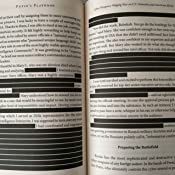
Koffler’s “Putin’s Playbook” itself is a messy amalgam of history, biography, advice, conjecture, and personal grievance. She offers a disclaimer that her views do not represent those of the government, followed by an author’s note strongly disagreeing with DIA/CIA redactions, which she prints as part of the text. Yet, out of the mess we can find potential gems of insight.

For example, she explains Putin’s own grievance over the collapse of the USSR and losing the Cold War. She writes about two philosophers who shaped his thinking: “In addition to Eurasianist influence, Putin drew his ideology from the ideas espoused by two Russian thinkers”: Ivan Il’in (1882-1954) and Lev Gumilev (1912-1992). Il’in was a Russian Orthodox Christian who believed Western democracies were dangerous; he considered that “an independent Ukraine would be an unthinkable ‘madness.’ Meanwhile, Gumilev, an anthropologist and historian, believed in a “super-ethnos” of Mother Russia. Eurasian vs. European. Slavs/Steppes vs. Anglo-Saxons. Us vs. them.


Putin uses ethnicity to justify threats of aggression against his neighbors. It may be hard for people in free democracies to understand his hardline, strongman attitude and why the people of Russia seem to support him as well as how he stays in office for decades.


Koffler says it is a mistake to see Putin and Russia through American eyes. Vladimir Putin and his supporters are steeped in grievance, superstition, resentment, and righteousness. Putin and his followers seem to have a boundless capacity for inflicting and enduring suffering. The list of political opponents, reformers, and journalists who have been poisoned, shot, or mysteriously killed by Putin’s Russia is long and alarming.

According to Koffler, “trust” is not a concept in Russia. (And, by the way, she says there is no word in Russian for “fun”).


Yet, Koffler seems to idolize Putin: “When Putin assumed the reigns (sic) of Russia, his first order of business was to restore internal stability, reverse the economic crisis, and reassert state control of most, if not all, aspects of life in Russia." Koffler says Putin was committed to restoring “law and order” and “respect towards Russia internationally.” “Putin delivered on his promise to the Russians.” “He has restored domestic stability, improved the Russian economy, and modernized the military to the point where even the Pentagon must play catch up in certain areas. Putin’s Russia is back on the map,” she boasts. 

Biden speaks with Putin
Koffler writes, “At sixty-eight, Putin is highly athletic and personifies strength. Acting as a benevolent patriarch…” Weirdly, she says: “Putin may be a villain, but he is not a supervillain.” “His rule has been far less brutal than that of Vladimir Ilyich Lenin or even the czars.”

Putin further justifies his aggression against his neighbors because of his fear and resentment of more free democracies on his borders and potential NATO expansion. It seems he would rather fight others, including Europe and the United States, than try to get along:

“Putin is stirring up chaos and disorder in America to save himself from a regime overthrow that he believes Washington seeks. Putin believes that destabilizing America by amplifying internal strife through social media and covert interference will help prevent an all-out war, which he would be ready to fight with the U.S. under certain scenarios. As the United States continues to try to peel off Ukraine from Russia’s orbit, it may be prudent to make a thorough intelligence assessment as to whether Putin would invade Ukraine if Washington pushes too hard. Before we consider such a move for Moscow ‘highly unlikely,’ it is worth remembering that Putin understands how Americans think but doesn’t think like them. He thinks like a Russian and a former KGB operative. While it may have seemed irrational to American national security experts that Putin took over Ukraine’s Crimea, for the Russian president, the long-term risk of not having Crimea as part of Russia outweighed the short-term risk of invading it.”

In the face of a growing Russian military threat on Ukraine’s border in recent days, weeks, and months, the Biden administration and European allies have strengthened diplomatic resolve, committed to finding a path to resolve tension and prevent war. Analysts say Putin's actions have boomeranged and only strengthened NATO's resolve and solidarity.


Putin has been warned that if his military invades Ukraine again on whatever pretext or justification, there will be dire consequences, including severe international sanctions. But Koffler writes:

“Sanctions or not, Putin has shown during the past decade that he will invade or destabilize Russia’s former republics –– as he did in Ukraine and Georgia –– rather than let them switch sides to NATO and the European Union. He will continue to unbalance America through cyber warfare and other tools in his playbook rather than let Washington democratize the former Soviet Eurasian countries. He understand well that he is playing a risky game that can lead to an escalation of tensions. But risk is something that Putin is accustomed to; it is a way of life for a former KGB officer. Bred as an intel operative, he plans for contingencies. Therefore he has a plan in his playbook for an all-out war with America.”

Koffler says that Russia’s war with America would be five-pronged: (1) space, attacking satellites; (2) cyber weapons; (3) spies and disrupters, infiltrating America; (4) active measures including subversion, election sabotage, and assassinations; and (5) all-out kinetic warfare, up to and possibly including nuclear weapons.


U.S. Navy's fourth Mobile User Objective System (MUOS) communications satellite lifts off from Space Launch Complex-41. (United Launch Alliance)
As expressed several times in her book, Koffler is a rock-solid supporter of her former boss, retired General Michael Flynn, who pleaded guilty to lying under oath about his contacts with Russian officials in the lead up to the 2016 U.S. presidential election. Former President Trump pardoned Flynn as well as other close associates with ties to Russia and a plot to overturn the 2020 election. Koffler calls former Defense Intelligence Agency Director Flynn an “American patriot.”

Michael Flynn and then-President Trump (D. Myles Cullen, DoD)
She defends Trump’s “patriotic desire” regarding his call with Ukraine President Zelensky in 2019. In that call, which led to his first impeachment, Trump tried to get Zelensky to announce an investigation into the Biden family during the U.S. presidential campaign, and the former president tied the request to a withholding of arms and other support to Ukraine.

Koffler says, believably, that Putin’s Russia is behind the schism in the United States between the Right and Left, fomenting mistrust in free elections and in democracy itself. She acknowledges Russia’s aggressive attempts to target U.S. elections and influence people through fake social media accounts.


Though she calls the Trump-Russia investigation a “witch hunt,” Koffler makes no reference to Rudy Giuliani, Paul Manafort, Roger Stone, and others in Trump’s orbit who actively worked with Russians. No mention of Trump Tower plans in Moscow or Russian investment in the Trump corporation. No mention of Trump’s public request for Russia and China to help him discredit his political opponent. No mention of Trump taking Putin’s side over his own intelligence community in 2016. 


And no mention of the January 6, 2021 Capitol insurrection by Trump supporters, even though her book was published in late July.


Koffler
Koffler, who is a contributor to Fox News, does not offer an opinion about Tucker Carlson’s pro-Russia and pro-authoritarian stances.

She presents a mere half-paragraph about Putin challenger Alexey Navalny and a bare mention of Russian agent Maria Butina, who infiltrated the NRA and influenced members of the Republican Party. She warns, instead, about the “Left’s true agenda”: single-payer healthcare, gun control, and –– deceivingly –– “defunding the police,” a phrase denounced by all Democratic leaders.


With no intended irony, Koffler writes, “It is high time for Americans and the U.S. government to understand how Russian disinformation works so we don’t become our own deceivers.”


As to why she is no longer a member of the intelligence community, Koffler explains how she was challenged after a background clearance investigation. Then, she gives a lengthy explanation of how a flight to Washington, D.C., had to make an emergency landing because of her behavior. She says, “what transpired next was straight out of Stephen King.” She was handcuffed by police and questioned by the FBI because of her disruption on the airplane. After the incident, the Intelligence Community issued psychological tests in which testers found “something not quite normal.”


She blames “deep-state operatives,” “bean-counters, “bureaucrats,” and “American apparatchiks” for destroying her career and her plan to be Deputy NIO for Cyber on the National Intelligence Council at the Office of the Director of National Intelligence.


Ultimately, readers must choose what to believe based on what Koffler chooses to present. In her opinion, the United States is no longer a free refuge for immigrants like her, she says: “And unlike me, my children and other God-loving Americans will have nowhere to flee.” But while warning of the dangers of leftwing socialism, she largely ignores the threats of rightwing authoritarianism and totalitarianism.


It may seem to be unbelievable, but history shows how fascism can arise from both the Left and/or the Right.


While there are gems of analysis about Russia to discover in this book there are other authors that are far more insightful and rewarding to help understand Putin and modern Russia. I've found Garry Kasparov to be a particularly strong voice, particularly in his warnings against appeasing Putin; I reviewed his book "Winter Is Coming" in 2017.


I just started reading Fiona Hill’s “There Is Nothing for You Here: Finding Opportunity in the 21st Century.” I’m only a few chapters in, but so far, it’s a much deeper and more rewarding book, both as a biography and as a geopolitical analysis. Hill is the former deputy assistant to the president and senior director for European and Russian affairs on the National Security Council. Hill served Presidents George W. Bush, Barack Obama, and Donald J. Trump with honor, courage, and commitment.


From the publisher: “Rebekah Koffler, is a Russian-born U.S. intelligence expert who served as a Russian Doctrine & Strategy specialist in the Defense Intelligence Agency… Rebekah is a writer and national security commentator whose work has been published on the Fox News website, The Hill, the Daily Caller, the New York Post, and the Washington Times. She has appeared on Fox News, One America News, News Nation Now, Newsmax TV, and the Sean Hannity nationally syndicated radio show.”

TOP PHOTO: From left, U.S. Army Europe and Africa Deputy Commanding General for Army National Guard, Maj. Gen. Joe Jarrard, U.S. Ambassador to Poland, Mark Brzezinski and Polish Land Forces 16th Mechanized Division Commander, Maj. Gen. Krzysztof Radomski walk and talk before the Battle Group Poland hand over, take over ceremony at Bemowo Piskie Training Area, Poland, Feb. 11, 2022. The ceremony demonstrated NATO's continued commitment to the collective defense and security of our allies on NATO's eastern flank. (Spc. Jameson Harris)