Showing posts with label Confucius. Show all posts

Saturday, October 10, 2020

‘Stand Back and Stand By’ for Autocracy

Review by Bill Doughty

Praising lawlessness of supporters, demonizing the media, lying to the public, threatening free elections, changing the meaning of words, and destroying institutions are clear signs of autocracy.


That’s according to two authors who discuss the threat to democracy in the fall of 2020: Masha Gessen in “Surviving Autocracy” (Riverhead Books, Penguin; 2020) and Anne Applebaum in “Twilight of Democracy: The Seductive Lure of Authoritarianism” (Doubleday; 2020). These books are literary grandchildren of Hannah Arendt’s “The Origin of Totalitarianism” and close cousins of Timothy D. Snyder’s “On Tyranny.” Snyder, in fact, endorsed the books and authors as “extraordinary,” “penetrating, and “indispensable.”


Gessen takes a scholarly approach in laying out the case for an imminent threat to American democracy. He quotes from the works and words of Arendt, George Orwell, Michiko Kakutani, Ronald Reagan, and Confucius.

He pinpoints President Trump’s “contempt for excellence” and corruption. “Trump’s incompetence is militant. It is not a factor that might mitigate the threat he poses: it is the threat itself.” He adds, “Trump not only doesn’t know what he’s doing –– he did not even know what he was not doing.”


If impeachment had succeeded in removing Trump from office, Gessen writes, “it would have constituted a triumph of institutions over the autocratic attempt. It did not.”


Trump’s embrace of white nationalism and his failure to acknowledge the threat of white power terrorists –– including his call to arms to “stand by,” to “LIBERATE MICHIGAN,” and to come to polling places on election day –– are all part of a pattern.


Trump’s contemptuous disregard for military justice is also part of the picture. Gessen writes:

“The hero Trump chose during the fall of his impeachment was Navy SEAL Chief Petty Officer Edward Gallagher. In the summer of 2019, Gallagher faced trial for allegedly killing an unconscious, unarmed captive in Iraq. The Navy fumbled the investigation, and in the last minute a witness who had been granted immunity testified that he, not Gallagher, had killed the young man; Gallagher was acquitted on most charges … After Gallagher was acquitted, Trump congratulated him by tweet. He then intervened to reverse the Navy’s decision to discharge Gallagher without honors –– once again demonstrating that the commander in chief can issue orders by tweet. Trump reinstated Gallagher’s rank and pay, and stripped the prosecutors in the case of their Navy medals. Ultimately, the struggle over Gallagher’s fate cost the secretary of the Navy, Richard Spencer, his job.”

Gallagher and Trump; SECNAV Spencer boxed in.
Gessen notes that Gallagher was turned in by members of his platoon, who were interviewed saying he was “freaking evil” and “perfectly okay with killing anybody that was moving,” intentionally targeting women and children, saying he “just wants to kill anybody he can.” Trump invited Gallagher to his residence at Mar-a-Lago and praised him as an American hero.


According to Gessen, Gallagher embodied the essence of the presidency: raw, unchecked power, contempt for rules, laws and norms, and an unbridled desire to act out of hatred.


Gessen writes, “Raw power can overtake moral authority, and perhaps today it is easier than ever before, but a determined effort to preserve ideals when they are under attack can serve as a bridge to the future.”


In “Twilight of Democracy,” Applebaum –– who describes herself as “educated conservative elite” –– takes a denser and more global view, building her own bridge from the past to the present and future to explain how autocracy continues to thrive.


She takes the reader on a tour of Poland, Hungary, England, EU, Spain, and France before landing in the United States. Like Gessen, she relies on Arendt and Orwell as bedrock literature, but she also cites Graham Greene’s “The Quiet American,” Marcel Proust’s “Remembrance of Things Past,” and Svetlana Boym’s “The Future of Nostalgia.”


Applebaum laments that the “party of Reagan became the party of Trump,” noting, “Reaganite optimism disappeared and slowly hardened into apocalyptic pessimism shared by so many others.” Echoing Gessen, Applebaum quotes Reagan’s UN ambassador, Jeanne Kirkpatrick, who said, “To destroy a society, it is first necessary to delegitimize its basic institutions.”


In a timely insight, Applebaum warns of the threat of autocracy and tyranny in the time of a pandemic. “Throughout history, pandemics have led to an expansion of the power of the state: at times when people fear death, they go along with measure that they believe, rightly or wrongly, will save them –– even if that means a loss of freedom,” she writes.


She explains, “People are often attracted to authoritarian ideas because they are bothered by complexity.” “Restorative nostalgics” see the world in black and white, without nuance; they want a return to what they perceive as a simpler past:

“Restorative nostalgics don’t just look at old photographs and piece together family stories. They are mythmakers and architects, builders of monuments and founders of nationalist political projects. They do not merely want to contemplate or learn from the past. They want, as Boym puts it, to ‘rebuild the lost home and pitch up the memory gaps.’ Many of them don’t recognize their own fictions about the past for what they are: ‘They believe their project is about truth.; They are not interested in a nuanced past, in a world in which great leaders were flawed men, in which famous military victories had lethal side effects. They don’t acknowledge that the past might have had its drawbacks. They want the cartoon version of history, and more importantly, they want to live in it, right now.”

Applebaum shows that tyranny can rise from the radical left as well as the radical right. But extreme right-wing domestic terrorism is the greatest threat in the United States now, according to the FBI. There is a connection between racism and defending the Confederacy, Confederate monuments, and gun-carrying vigilantes.


Later in her book she shows how that world view, exemplified in “America First,” is a siren call to white nationalism and radical right-wing terrorists. 

“Like those who live on the extreme edges of the American far left, some of those who live on the extreme edges of the far right have long been attracted to violence. There is no need to rehearse here the history of the Ku Klux Klan, to tell the stories of Oklahoma bomber Timothy McVeigh and Charleston shooter Dylan Roof, or to describe the myriad individuals and militia movements who have plotted mass murder, and continue to plot mass murder, in the name of rescuing a fallen nation. In 2017, an Illinois militia set off a bomb at a Minnesota mosque. In 2018, a man who believed Jews were plotting to destroy white America murdered eleven people at a Pittsburgh synagogue. In January 2019, a group of men calling themselves ‘the Crusaders’ plotted to put a bomb in an apartment complex in Garden City, Kansas, because they hoped to murder a large number of Somali refugees. These groups and movements were also inspired by a confection that democracy is worthless, that elections cannot bring real change, and that only the most extreme and desperate actions can stop the decline of a certain vision of America.”

Governor Whitmer at her Oct. 8 press conference.
Just this past week, the FBI and Michigan State Police busted a plot by right-wing terrorists to kidnap and possibly kill the governor of Michigan, Gretchen Whitmer. Whitmer thanked law enforcement and called out President Trump for his dog whistle calls to those among his supporters who are white nationalists.

In a press conference Oct. 8, Whitmer said, “Just last week, the president of the United States stood before the American people and refused to condemn white supremacists and hate groups like these two Michigan militia groups. ‘Stand back and stand by,’ he told them. ‘Stand back and stand by.’ Hate groups heard the president’s words, not as a rebuke, but as a rallying cry, as a call to action. When our leaders speak, their words matter. They carry weight. When our leaders meet with, encourage, or fraternize with domestic terrorists, they legitimize their actions and they are complicit. When they stoke and contribute to hate speech, they are complicit.”


Both Gessen and Applebaum cite Reagan’s openness to immigration and focus on optimism for the future.
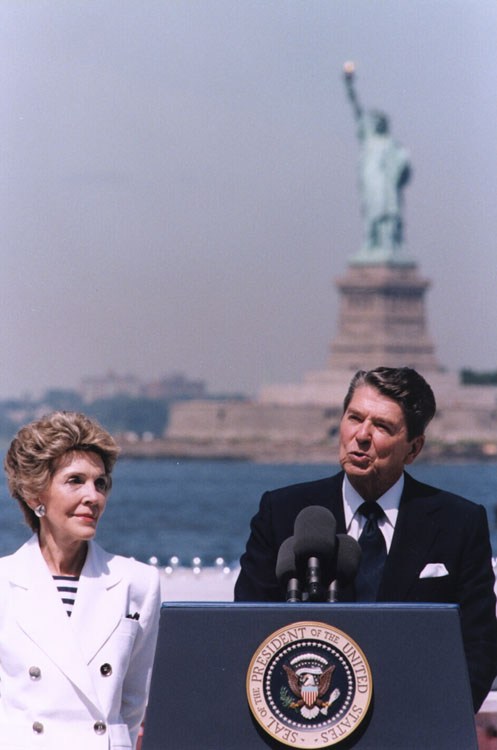

President Reagan and First Lady Nancy Reagan.

Whitmer herself brought up the 40th president of the United States: “In 1981, President Ronald Reagan spoke to the NAACP’s annual convention, and his comments stand in sharp contrast to what we have seen on the national and state level from his own beloved party in 2020. He said, ‘A few isolated groups in the backwater of American life still hold perverted notions of what America is all about.’ Recently, in some places in the nation, there’s been a disturbing recurrence of bigotry and violence.  Then Reagan sent a direct message to those who still adhere to senseless racism and religious prejudice: ‘You are the ones who are out of step with our society,' he said. 'You are the ones who willfully violate the meaning of the dream that is America. And this country, because of what it stands for, will not stand for your conduct.’”


Applebaum offers this chilling conclusion that provides the title for her book: “It is possible we are already living through the twilight of democracy; that our civilization may already be heading for anarchy or tyranny, as the ancient philosophers and America’s founders once feared…”


But, like Gessen, she offers explicit and implicit antidotes to a muddy downward slide toward autocracy. Explicitly: Build cooperation and coalitions; embrace allies; promote “rational thought, rule of law and integration;” and be “rooted to a place and yet open to the world.” Implicitly: become educated, practice critical thinking, and take the high road –– in the face of hate and anger, show love and kindness.

Friday, January 31, 2020

A Search for the Truth

by Bill Doughty

Who or what is the North Star, the Pole Star, of leadership?

Those who are educated in the West often rely on philosophers from ancient Greece, Judeo-Christian faith, Renaissance, and modern science to provide ethical, moral and practical principles on leadership.

A depiction of Master Kung - Confucius
What can the East, particularly Confucius ("Master Kung") – who influenced much of Asian thought and culture – say about leadership? Getting past the chauvinism and arguable misogyny of ancient times, there may be great value in learning advice from Asia's Pole Star on what it means to be a good leader.

In "Confucius: The Analects" translated by Arthur Waley (Alfred Knopf, 2000, first published 1938), "Master" refers to Confucius, and "gentleman" can be interpreted for our purposes as "leader" or "commander" or "CO."

From Book II:

1 The Master said, He who rules by moral force is like the pole-star, which remains in its place while all the lesser stars do homage to it.

2 The Master said, If out of the three hundred 'Songs' I had to take one phrase to cover all my teaching, I would say, 'Let there be no evil in your thoughts.'

3 The Master said, Govern the people by regulations, keep order among them by chastisements, and they will flee from you, and lose all self-respect. Govern them by moral force, keep order among them by ritual and they will keep their self-respect and come to you of their own accord.

Book IV:

2 The Master said, Without Goodness a man
Cannot for long endure adversity,
Cannot for long enjoy prosperity.

16 The Master said, A gentleman takes as much trouble to discover what is right as lesser men take to discover what will pay.

17 The Master said, In the presence of a good man, think all the time how you may learn to equal him. In the presence of a bad man, turn your gaze within!

Book XII:

16 The Master said, The gentleman calls attention to the good points in others; he does not call attention to their defects. The small man does just the reverse of this.

Book XIII:

1 ... Lead them; encourage them! ... Untiringly.

2 ... Get as much as possible done by your subordinates. Pardon small offenses. Promote men of superior capacity ...

Statue of Confucius at Yushima Seido, Tokyo
6 The Master said, If the ruler himself is upright, all will go well even though he does not give orders. But if he himself is not upright, even though he gives orders, they will not be obeyed.

Book XV:

17 The Master said, The gentleman who takes the right as his material to work upon and ritual as the guide in putting what is right into practice, who is modest in setting out his projects and faithful in carrying them to their conclusion, he indeed is a true gentleman.

18 The Master said, A gentleman is distressed by his own lack of capacity; he is never distressed at the failure of others to recognize his merits.

19 The Master said, A gentleman has reason to be distressed if he ends his days without make a reputation for himself.

20 The Master said, 'The demands that a gentleman makes are upon himself; those that a small man makes are upon others.'

22 The Master said, A gentleman does not
Accept men because of what they say,
Nor reject sayings, because the speaker is what he is.

23 Tzu-kung asked, saying, Is there any single saying that one can act upon all day and every day? The Master said, Perhaps the saying about consideration: 'Never do to others what you would not like them to do to you.'

Book XVI:

10 Master K'ung said, The gentleman has nine cares.

  • In seeing he is careful to see clearly,
  • in hearing he is careful to hear distinctly,
  • in his looks he is careful to be kindly;
  • in his manner to be respectful,
  • in his words to be loyal,
  • in his work to be diligent.
  • When in doubt he is careful to ask for information;
  • when angry he has a care for the consequences,
  • and when he sees a chance of gain, he thinks carefully whether the pursuit of it would be consonant with the Right.


Right Matters

How do we know what "the Master" taught? Like Jesus and Mohammed and Buddha, Confucius had disciples who carried on, interpreted and reinterpreted his teachings about what is right.

Evidence of those teachings are found on ancient manuscripts on bamboo strips once buried in history, according to Yale lecturer and author Annping Chin.

In 1993 archeologists and scholars came into possession of two batches of "manuscripts" written on bamboo strips, some "pilfered by grave robbers and then sold on the Hong Kong antiques market before the manuscripts were bought, a few bundles at a time, by the Shanghai Museum," Chin writes.

"The texts were written around Mencius and Xunzi's time, 300 BC or earlier, before China was unified in the period known as 'the Warring States.'" What can the words on these bamboo strips tell us about life, moral cultivation and political thought in China before the Imperial Age?

From "The Authentic Confucius: A Life of Thought and Politics" by Annping Chin (Scribner, 2007):
"One Chinese paleographer I got to know told me about the risks of removing the ancient mud from the bamboo. As the strips lie in their cleaning solution, he said, and the words begin to emerge, some of the words literally rise from their bamboo surfaces, seeking flight or freedom in their demise. This is the closest I have come to thinking of words as alive. Sometime after, I made a wish. Even as I accept the impermanence of life, I said, I want words to be the exception – not all words, but surely words in the classics and histories, words of the early poems, philosopher's words, and the words of Confucius. I want them to stick around so that we can taste them again and again and play with their flavors in our head."
Anchored in Tradition

Author Michael Schuman – "Confucius: And the World He Created" (Perseus, 2015) – finds relevance for Confucianism for the world in general and China in particular – not to mention for leaders in the United States.
"The Confucius I have come to know over the course of researching this book ... was not a pawn of autocrats or a tool of suppression. That Confucius, though far from perfect, was a voice of boundless humanity and unswerving determination. He was a man who refused to compromise his principles for fame, wealth, or status. He would not submit to the will of immoral men or abusive regimes. He told the most powerful people of his day that they were wrong, directly to their faces. He judged men not by their riches or birth, but on their sincerity and benevolence. He could laugh at himself. He envisioned a society in which everyone fulfilled their responsibilities and placed the welfare of their families and communities over their own. He strove to transform a world convulsed by selfishness and war into one of selflessness and peace. He thought our society could be perfected if we first improved ourselves. Most of all, he thought that any one of us who took the time and made the effort to become a better person held the power to change the world."
Like the traditions of the U.S. Navy, the traditions of Confucianism promote rituals, manners, duty and "love of learning."

Schuman interprets "the Master's" position on authority and power: "No one, not even a person in a position of great power, is permitted to abuse that power," he writes. "The Confucian idea that people ought to blindly submit to anyone in a position of authority is beyond the Western mentality."

According to Confucius's Analects anchored in Schuman's book, "Let the superior man never fail reverentially to order his own conduct, and let him be respectful to others and observant of propriety – then all within the four seas will be his brothers." Just as the Pole Star guides good leadership, an anchor can secure it.

Monday, January 20, 2020

Courage of a King and a Miller

by Bill Doughty

For this first post of 2020, here's a brief look at one of the Navy core values: Courage. This insight comes from an essay by Philip J. Ivanhoe published in Barbara Darling-Smith's "Courage" (University of Notre Dame Press, 2002).

East and West meet in Ivanhoe's discussion of "The Virtue of Courage in the Mencius," comparing Aristotle and Confucian disciple Mengzi and their concepts of fear and courage.

Doris "Dorie" Miller, awarded the Navy Cross by Adm. Nimitz for his courage at Pearl Harbor.
"Aristotle describes courage as a blend of controlling fear and being properly inspired to act," Ivanhoe writes. "He insists that a courageous person must to some degree feel fear and that controlling this feeling is part of what constitutes courage."

Similarly, Mengzi believed that true courage, or "great courage" comes from overcoming fear through a strong base of personal ethics – core values. 

Ivanhoe says "The truly courageous person must rationally assess the danger to be faced and deliberate about how to struggle against it to best realize the good for himself and others."

The virtues of an enlisted Sailor who assessed danger in the attack on Pearl Harbor and took matters into his own hands aboard USS West Virginia (BB 48). His heroism is remembered today as the Navy names a future aircraft carrier USS Doris Miller (CVN 84). Doris "Dorie" Miller was killed at sea during World War II.

Dr. Martin Luther King, Jr. monument, Washington D.C. (NPS)
After the war, Dorie Miller was a key influence to Americans who showed courage during the fight for Civil Rights Movement, a movement led by Dr. Martin Luther King, Jr. Examples of courage are not restricted to the battlefield.
"...If we conceive of courage as that excellent trait of character that enables people to pursue the good through the difficult and dangerous, then there is nothing inherent in such a conception that would restrict it to cases of combat. A firefighter who puts himself in danger to rescue a child from a burning building and a worker [whistleblower] who risks her livelihood or life fighting corporate greed in order to better the lives of her fellow workers are equally displaying courage in this sense. This broader conception of courage would also enable us to appreciate more fully cases where courage is manifested as an ability to persevere in the face of adversity rather than erupting in episodic bursts of action. The person who carries on in good cheer while suffering from a debilitating medical condition, and the prisoner of war or conscience who endures prolonged physical and psychological abuse and yet remains steadfast in his cause, require a broader and more nuanced conception of courage. One of the most profound and remarkable manifestations of courage is found in the life and work of Martin Luther King, Jr. For he risked and sacrificed everything in his remarkably patient, lifelong pursuit of the good. His example shows how far removed the concept of courage as a virtue is from violent and episodic displays of bravado. For he was explicitly dedicated to nonviolence and love in his struggle to realize the good."
Ivanhoe's essay, along with other essays in Darling-Smith's "Courage," provide scholarly looks at the nature of this core value, nearly inseparable from the other Navy values of Honor and Commitment.

PEARL HARBOR (Jan. 20, 2020) The Honorable Eddie Bernice-Johnson, United States representative from the 30th district of Texas, left, speaks at the unveiling of the new Ford-class aircraft carrier USS Doris Miller (CVN 81) at a Dr. Martin Luther King Jr. Day celebration event on Joint Base Pearl Harbor-Hickam as Acting Secretary of the Navy Thomas B. Modly look on. This will be the second ship named in honor of Miller, and the first aircraft carrier ever named for an African American and an enlisted Sailor. (U.S. Navy photo by Mass Communication 2nd Class Justin R. Pacheco)