Showing posts sorted by relevance for query robert kaplan. Sort by date Show all posts

Sunday, March 10, 2013

Kaplan Paints in a Monsoon


by Bill Doughty

Robert Kaplan paints words from a palatte of nearly forgotten colors and memories.

In “Monsoon” -- a top pick on the CNO’s Professional Reading Program, Kaplan literally (and littorally) travels the breadth of the Indian Ocean and, like an artist, reveals the people, places and history of the dynamic and vital IO Rim.

His words evoke sights, smells, tastes, dimensions and sensations for the reader.

Case in point:

“A few minutes from the Shah Jahan Mosque is the necropolis on Makli Hill: tombs from the Samma, Arghun, Tarkhan, and Mughal periods, made of sandstone and glazed bricks.  These, too, were dynasties with both Turkic and Mongol blood.  And yet the tombs remind one of so many similar buildings in India, demonstrating that what we think of as Indian is itself a mélange of Near Eastern cultures.  Everywhere there are brick plinths, rectangular pillars, imposing ramparts, and cracked bulbous domes.  The buckling, glazed brick is peeled away in layers, like old mascara, with faint touches of milky blue.  These lonely monuments appear to soar into the clouds, each occupying its own little hill.  Some, with their intricate fretwork, have an almost Byzantine stateliness.  Others bear the proportions and complexity of the pharaonic buildings at Karnak.  All stand in majestic separation from one another amid a destitute wasteland, with garbage everywhere, like at so many historical and cultural sites in Pakistan. It is as though in the last sixty years -- unlike during the dynastic centuries recounted by these tombs -- there has been no state here; nothing but marauders.”

This is beautifully constructed prose, and there is a lot of it.  Kaplan’s words frame the abstract into the tangible and help us understand people and situations in Oman, Baluchistan, Bangladesh, several regions of India, Burma, Sri Lanka and Zanzibar and along the Indus River. 

Camões
Several diverse and sometimes unexpected themes link his narrative.  These include the voyages of Zheng He and Vasco de Gama; the poem “The Lusiads”  (“Os Lusíadas”) by Luís Vaz de Camões; environmental and seismic issues, including climate change, tsunami; the influence of world religions; and, of course, the drift of monsoon seasons and winds.

“The southwest monsoon that arrives in the Bay of Bengal in early summer provides a new dimension to rain.  This is the time of tropical cyclones, and it is as though the ocean was continually emptying itself upon you.  For days at a time, the sky is a low, claustrophobic vault of angry clouds.  Absent sunlight, the landscape -- however intrinsically rich in color, with mountains of hibiscus and bright orange mangoes, and the flowing saris of women -- becomes scrubbed over in a grainy mist.  Mud is the primary color, but it is not depressing.  It is the coolness that you notice first, not the leaden darkness.  You are filled with energy.  No longer are your clothes dissolving in sweat or your knees hollow from the heat.  No longer is the air something thick and oppressive that your body needs to push against.”

Kaplan notes that a million ships pass through the Indian Ocean straits each year.  Countries like India and China are building more ships, competing for resources and influence as they develop various cooperative relationships.

Kaplan’s canvas is wide.  He combines long and deep descriptions with sudden flashes of pinpoint insights expressed in just one or two sentences.  Some examples:


  • “The Indian Ocean is small in a cultural sense but too vast even in the jet age for one power to gain real sway over it.”
  • “History is as much a series of accidents and ruined schemes as of great plans.”
  • “The Indus signals the western edge of the Subcontinent, from where its political unity was frequently breached by invaders coming out of the plateau and deserts of Afghanistan, Iran, and Baluchistan.  It is thus a lesson in the feebleness of borders.”
  • Regarding India’s democratic spirit: “A spirit that is truly breathtaking in terms of what it can overcome. That is india’s ultimate strength.”
  • “Strategic, romantic, and a moral catastrophe, Burma is a place that tends to consume people.”
  • “The future of American power is related directly to how it communicates its concern about issues like climate change to Bangladeshis and others.”
Jakarta, Indonesia
As a book of thoughtful influence and reflection, “Monsoon” is an important read on the two-year anniversary of the Tohoku earthquake/tsunami March 11 and U.S. Navy’s humanitarian response.  Next year will be the ten-year anniversary of the Indian Ocean Tsunami which slammed Indonesia at the end of 2004.  The U.S. Navy’s humanitarian response was a milestone cultural and historical event that, according to Kaplan, made a difference for the littoral nations throughout the region.

“Monsoon: the Indian Ocean and the Future of American Power” is presented in three parts, with the third predominantly focused on China and filled with naval power insights -- from Alfred Thayer Mahan in the late 1800s to current scholars from the U.S. Naval War College today, including James R. Holmes and Toshi Yoshihara.

Robert D. Kaplan
Kaplan’s analysis in Chapter 15 -- “China’s Two-Ocean Strategy?” -- is especially important to the U.S. Navy especially since Kaplan presciently touches on budgetary challenges, which he wrote two years before the threat of the Sequester, starting to bite this month. 

Respected thinkers Lee Kuan Yew of Singapore and Pankaj Mishra of India and Great Britain (author of the insightful “From the Ruins of Empire: The Intellectuals who Remade Asia”), both referenced in Monsoon, warn Americans about seeing Asia (and China, in particular) through an American prism that assumes people in the region want to be just like us.  Many people in and around the Indian Ocean hunger for freedom and democracy, but we would be best served if we see their region through their eyes.  Kaplan helps make that happen.  He helps us see the big picture.

Saturday, March 12, 2016

'In Europe's Shadow' – Between the Seas with Kaplan

Review by Bill Doughty

Happiness is a new Robert D. Kaplan book, even if it's filled with grim reflections. But wait – there's more...

Kaplan presents a large sweep of history Central and Eastern Europe as he captures a "perishable moment in time" in "In Europe's Shadow" (Random House, 2016). He looks back so we can look forward. Will Russia continue threatening its neighbors? Will the European Union survive?

Authoritarian Elena and Nicolae Ceausescu
Kaplan's personal but shared journal reflects on his travels through the Balkans and through time. He examines "Two Cold Wars and a Thirty-Year Journey Through Romania and Beyond."

Naturally, the author of "Balkan Ghosts" and "The Revenge of Geography," begins with 14 pages of maps showing how Romania's borders changed over the centuries.

The Byzantine, Ottoman and Habsburg empires used the region as a punching bag, as did Communists and fascists more recently, especially Stalin-like Nicolae Ceausescu, who took "eminent domain" to another level as part of a "drumroll of violent catastrophes."

Cold War shortages and depressed lives loom in Kaplan's earlier visits to the region.
"Soon the bread and fuel lines began ... The silence of the streets was devastating as I alighted from the bus with my backpack on Strada Academiei. The city had been reduced to a vast echo. There were few cars, and everyone was dressed in the same shapeless coats and furry hats that evoked internal exile somewhere on the eastern steppe. People clutched cheap jute bags in expectation of stale bread. I looked at their faces: nervous, shy, clumsy, calculating, heartrending, as if they were struggling to master the next catastrophe. Those clammy complexions seemed as if they had never seen the sunlight."
Kaplan introduces us to another authoritarian nationalist and mass-murderer who preceded Ceausescu by a generation, Marshal Ion Antonescu.

Antonescu's Romania "was Adolph Hitler's second most important Axis ally after Benito Mussolini's Italy." Antonescu contributed more than half a million Romanian troops to the Nazi invasion of the Soviet Union in 1941. "Antonescu's crimes against humanity are beyond adequate description," Kaplan writes.

Romania's Antonescu goes over war plans with Hitler.
He describes the violence and turmoil the people of Central Europe have faced during wars, crusades and empire-building. The Ottomans enforced edicts of fratricide to ensure sovereignty, castration to maintain a palace corps of eunuchs, and slavery and forced conversion to Islam.

Today, Romania is a victim of geography after the "eruption of a new Cold War in 2014," according to Kaplan, who reports that Poland and Turkey ("ironically the former Ottoman enemy") are Romania's most capable regional allies, according to Romania's Prime Minister Victor Ponta. 

Kaplan writes, "Men in high positions of power in Bucharest labored under the knowledge that the average Romanian would never again accept a border with Russia – but if Ukraine were ever overrun, that would be Romania's fate."
"Precisely because Romania was historically a victim of geography, nobody here dismissed geopolitics. And geopolitics, in a variation of Polish statesman Jozef Piludski's 1920s concept of an Intermarium ("between the seas"), demanded the re-creation of a belt of independent states between the Baltic and Black seas, to guard against Russian expansion westward. On this visit to Bucharest, I constantly had maps and pipeline routes thrust at me."
Vlad "the Impaler" Dracula
Kaplan reflects on people who have influenced the region – or influenced his thinking about Cold War Europe: Isaiah Berlin, Gorbachev, Yeltsin, Reagan, George Shultz, Kissinger, and (more than 500 years ago) "Vlad the Impaler," Vlad Tepes Dracula, who was the inspiration for Irish writer Bram Stoker's vampire novel.

Great thinkers and writers are mentioned throughout "Shadow": Voltaire, Lord Byron, Camus, Kierkegaard, Heidegger, Herman Melville, Hannah Arendt and Elie Wiesel.

But the famous are sometimes overshadowed by the obscure.

Marinuta (left) is among international leaders the Army honored at Fort Leavenworth in 2011.
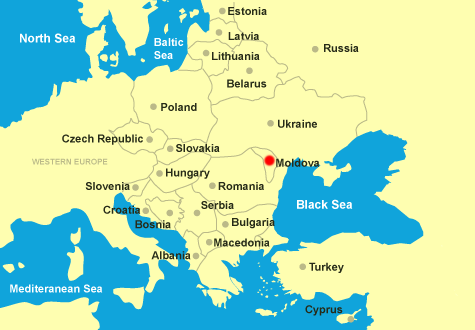
In Moldova, the "poorest country in Europe, behind Albania even," Kaplan interviews Vitalie Marinuta, defense minister from 2009 to 2014, who "personified the robust investment of the West and the United States in this part of the world. Marinuta studied at Lackland Air Force Base, Fort Leavenworth and the Naval Postgraduate School in Monterey, Calif. before being assigned to Central Command in Tampa, Fla.

Kaplan expresses his apprehension for Moldova, whose army numbers only 5,000 soldiers. Moldova's air force is only a few helicopters. The country faces an autocratic Russia after the annexation of Crimeria. "I feared for Moldova ... I worried that Moldova had a future in the headlines," Kaplan writes.
"Were Moldova to fall into hostile hands, Ukraine would be threatened, for Moldova combined with Transdniestria occupies what I like to term the Pontic Breach, the hinterland of the Black Sea that offers and invasion route to (or from) the Balkans and the Mediterranean. Just as the North European Plain – Poland, Belarus, and the Baltic States – comprises the northern invasion route between Europe and Russia, the Pontic Breach comprises the southern invasion route."
The author is an unabashed supporter of the European Union.
"If the European Union crumbled, there was only unbridled German power, exclusivist ethnic nationalism, and the dementia of ideologies. To wit, Russia was now a threat not because it was Russia essentially, but because Putin's neo-czarist oil and gas empire had reduced geopolitics to the zero-sum factor of ethnicity."
Is Russia a threat to Central and Eastern Europe?
"For years I had passionately countered that the Russians, taking advantage of Europe's fiscal woes, were attempting to buy banks and electricity grids, oil refineries, and natural gas transportation networks, in addition to other infrastructure, even as they extended their energy pipeline network throughout the former Soviet satellite states. Meanwhile, a financially weakened Europe had less political capital to draw countries like Romania, Moldova, Serbia, Bulgaria, and Ukraine closer into its fold, in exchange for social and economic reforms."
But "In Europe's Shadow" is not all geopolitics and depressing post-imperialist, post-Communist history. This journal is filled with bits of analysis, introspection, beauty, philosophy and sage advice about life:

"You don't grow up gradually. You grow up in short bursts at pivotal moments, by suddenly realizing how ignorant and immature you are."

"New surroundings prompt forgetfulness of old ones, and thus speed up the passage of time."

Predicting the future "is impossible, for so much depends not only on impersonal forces like geography and technology, but on the actions of individuals – themselves motivated often by the disfiguring whirlwinds of passion."

"Travel and serious reading, because they demand sustained focus, stand athwart the nonexistent attention spans that deface our current time on Earth."

"Travel is linear – It is about one place or singular perception or book at a time, each one etched deep into memory, so as to change your life forever..."

Reading this book is like finding Kaplan's diary left behind in some train station in the Balkans. You sit and read his personal reflections, insights, anger and love, half-hoping Kaplan will walk in to reclaim his journal so you can ask him more about what he's seen between the seas of time.

Kaplan's travel writing sometimes brings Mark Twain to mind. Both know how to convert monochrome to high-resolution color.
"From Cluj I drove north into Maramures, which had the calm purity and femininity of a New Testament landscape ... Each tree as he would say was a hieroglyph, speaking so much with just a few lines, and with wine and gold on its breath as the autumn advanced. How distinct the colors were! We think of the past in black-and-white because of the state of photography at the time. But the past before the age of smokestack economies was even richer in primary colors than the world of today. And in Maramures, mountainous isolation had meant a degree of safety from the environmental ravages of Communism. In the glistening swards, the hayricks took on a remote, prehistoric quality. Fruit orchards and flower beds abounded. Nothing in this landscape was unnecessary. I thought not of painting but of music: Saint-Saens, Debussy, with their spare and haunting notes, touching you for moments after. There was such abundance yet concision everywhere."
Another pleasure in "Shadow" is reading about Kaplan's love of books. It's how this book opens, and references to great authors and their works are listed throughout. As this insightful book comes to a close, Kaplan finds himself "looking out over the glittering Danube between the neo-Gothic towers" and reaching for a book: Cambridge University professor Brendan Simms's "Europe: The Struggle for Supremacy from 1453 to the Present."

"The printed book was still for me the greatest expression of art," he concludes.

Robert D. Kaplan is a visiting professor at the United States Naval Academy, and a member of the Pentagon’s Defense Policy Board. 

Tom Brokaw, author of "The Greatest Generation," calls this book "a masterly work of important history, analysis, and prophecy about the ancient and modern rise of Romania as a roundabout between Russia and Europe ... I learned something new on every page."

Thursday, October 17, 2019

In Post-Imperial World 'Navy Is Like Oxygen'


Review by Bill Doughty

War, anarchy and authoritarianism are children of crumbling empires. That's the gist of Robert D. Kaplan's retrospective collection, "The Return of Marco Polo's World: War, Strategy, and American Interests in the Twenty-First Century" (Random House, 2018). Kaplan sees the importance of a strong navy in a changing world.

Mahan
Noting that the U.S. Navy nearly half the size it was in mid-1980s, Kaplan warns, "A great navy is like oxygen: You notice it only when it is gone."

Decreases and delays in American warship production, coupled with increases in near-peer competitor shipbuilding, threaten U.S. Navy maritime influence.

As the Navy loses supremacy on the seas, according to Kaplan, similarly to what happened to the British Empire a century ago, other nations – including China and India –  are gaining influence and building more ships and ship-fighting technologies.

Kaplan reminds us of the influence of Navy Captain Alfred Thayer Mahan in 1890. Mahan, of course, called for the nation to become a great sea power, recognizing the oceans as the global "commons." Protecting sea lanes meant ensuring peace and prosperity. The Chinese are the Mahanians now," Kaplan contends. As Communist China expands its influence, Kaplan warns of the possibilities of conflict over freedom of maritime trade in Asia.

Such risk of conflict is a daily threat already in the Middle East, where the messy remnants of the Ottoman Empire and Arab Caliphate continue to flare in Turkey, Syria, Iraq and Iran, with the Kurds in the middle. Kaplan explains Turkey President Recep Tayyip Erdogan's "compulsive authoritarianism" and attempts to create "a mono-ethnic state" and a return to Ottoman-like imperialist tendencies. Again, the shadow of empire.

U.S. and Turkish military forces conduct a joint patrol in northeast Syria, Oct. 4, 2019.
(U.S. Army photo by Staff Sgt. Andrew Goedl)
"The map of former Syria and Iraq will continue to resemble a child's messy finger-panting with Sunni and Shi'ite war bands expanding and contracting  their areas of control – the result being flimsy and radical micro-states," Kaplan observes.

Neither continued conflict nor abandonment of partners in the region will win a war on terror: "Remember that right now there are millions of Arab refugees from these wars stuck in the region whose children are not being educated, making the next generation even more prone to radical Islamist propaganda."

Kaplan's map of history is vast and three-dimensional. As always, he shows the importance of geography and culture. And he gives examples from empires as far back as the Mesopotamia, Chinese dynasties, Persian Empire, Arab Caliphate, Greece and Rome.

Kaplan
As for recent events and the post-imperial world, Kaplan contends the vacuum is being filled vitally by a "raft of supranational and multinational groupings such as the North Atlantic Treaty Organization, European Union, International Monetary Fund, International Court of Justice, World Economic Forum," and United Nations.

Kaplan writes about the need for balanced leadership that carefully manages realism with idealism in the new world order. He says the Navy is part of a national leadership in protecting allies and projecting power.
"History moves on. World War II and the Cold War recede. But the United States is the most well-endowed and advantageously located major state on Earth. That good fortune comes with responsibilities that extend beyond our borders. Just look at the size of our three-hundred-warship Navy and the location of our aircraft carriers on any given week. Realism is about utilizing such power to protect allies without precipitating conflict. It is not about abandoning them and precipitating conflict as a consequence."
After World War II, the United States led by example and has silently undergirded a peaceful world, Kaplan contends: "protecting the sea-lanes, the maritime choke points, and access to hydrocarbons, and in general providing some measure of security to the world."
"This is not traditional imperialism, which is no longer an option," he writes about such international cooperation undergirding peace and prosperity, "but it is the best available replacement for it." Indeed, if a great Navy is like oxygen, then the world's economy depends on the U.S. Navy to breathe.

The Independence-variant littoral combat ship USS Gabrielle Giffords (LCS 10) transits the Philippine Sea during Exercise Pacific Griffin 2019, Oct. 1. Pacific Griffin is a biennial exercise conducted in the waters near Guam aimed at enhancing combined proficiency at sea while strengthening relationships between the U.S. and Republic of Singapore navies. (U.S. Navy photo by Mass Communication Specialist 3rd Class Josiah J. Kunkle)
This week, Chief of Naval Operations Adm. Mike Gilday presented the keynote address at the 12th Regional Seapower Symposium in Venice, Italy, noting in echoes of Mahan, "... our global economy floats on seawater.”

“I’m committed to advancing our relationship and our shared values of democracy, free and fair trade, the rule of law,” CNO Gilday said. “Combined with a robust constellation of allies and partners who desire to build and strengthen the international economic order, we are operating towards the same end – continued security and stability that results in a free and open maritime commons.”
CNO Adm. Mike Gilday speaks at the Regional Seapower Symposium in Venice, Italy, Oct. 17, 2019. The symposium goals are to foster open and constructive exchange of views and ideas, enhance a comprehensive approach to many sea-related matters, and boost mutual knowledge and trust among naval partners. (U.S. Navy photo by Cmdr. Nathan Christensen)
The essays in Kaplan's collection, some written more than a decade ago, are still relevant and provocative, particularly 2006's "When North Korea Falls."

This is an engrossing and often prescient book, well worth a Navy read. Among the dozens of people Kaplan acknowledges and thanks are Navy Adm. (Ret.) James Stravidis, Marine Corps Lt. Col. David Mueller, Army Lt. Gen. H. R. McMaster, and Air Force Col. (Ret.) James H. Baker.

Army Gen. David Petraeus calls "Return" a work that "will be regarded as a classic. "These essays constitute a truly path-breaking, brilliant synthesis and analysis of geographic, political, technological, and economic trends with far-reaching consequences."

Sunday, May 11, 2014

Geography: Bigger Splash than Godzilla

by Bill Doughty

Robert D. Kaplan's amazing "The Revenge of Geography" explores history, geopolitics and "the battle against fate" through his own ideas and by incorporating the ideas of other strategic thinkers like Mackinder, Mahan, Spykman and Braudel.

His work explains how and why the Navy balances power in oceans far from the continental United States, and his conclusion leads to a provocative proposal much closer to home.

Kaplan introduces us to Frenchman Fernand Braudel's broad history over time, "in which every detail of human existence is painted against the canvas of natural forces."

Braudel perceived history in three varying wavelengths of time: at the base, (1) landscape that is "slow, imperceptibly changing geological time." Next, (2) a faster wavelength with "systemic changes in demographics, economics, agriculture, society and politics." Finally, (3) the shortest-term  cycle, "the daily vicissitude of politics and diplomacy that are the stuff of media coverage." Kaplan writes:
"Braudel's analogy is the sea: in the deepest depths is the sluggish movement of water masses that bear everything; above that the tides and swells; and finally at the surface, in (Oxford archeologist Barry) Cunliffe's words, "the transient flecks of surf, whipped up and gone in a minute."
That puts into perspective Monica Lewinsky, Youtube cat videos, the Kardashians, Donald Sterling and most other popular culture -- even Godzilla. They're just sea spray in the wind.

Kaplan is instead concerned with the depths of geography and history over millennia -- the influence of mountains, deserts, rivers, oceans and natural resources, especially oil -- and the impact of population growth, urbanization, global climate change, democracy and overall human nature.

Published in 2012, two years before Putin took Crimea and threatened an invasion of Ukraine (which held faux elections this weekend), Kaplan explains why the Russian president had his sights on Ukraine, "suddenly challenging Europe." Russians were deprived of the benefits of the Renaissance because of invasions by Mongols. Russia was attacked on both sides in the previous century, by Japan and Germany. Because of their place in geography and history, Kaplan says, they continue to gravitate to autocratic leaders and blind nationalism.

"Truly, the Russian climate and landscape are miserably rugged and as such hold the keys to the Russians' character and to their history," Kaplan writes.

Writing more than a century ago, many years before the World Wars, creation of the Soviet Union and Cold War, Rear Adm. Alfred Thayer Mahan in "The Problem of Asia" discussed Russia's vulnerability, being so far from the Indian Ocean. Mahan predicted that Russia's dissatisfaction would readily take the form of aggression.

Writes Kaplan, "Mahan emphasized the importance of China, Afghanistan, Iran and Turkey. It is no coincidence that in 1900 he is able to identify the pivotal states of geopolitical significance in our own time: for geography is unchangeable."

However, Kaplan acknowledges that a warming Arctic is creating new sea power lanes, the widening of the Panama Canal will create significant changes in our hemisphere, and communication technology is changing geography virtually.


Cobra Gold opening ceremony in 2014, Photo by Spc. Tyler Meiester.
Naval War College professors James Holmes and Toshi Yoshihara, whose work is discussed in detail in Kaplan's "Monsoon," contribute their study of China's maritime perspective in "Revenge." Other NWC professors, Andrew Erickson and Lyle Goldstein, show how the politics in he South China Sea make it an Asian Mediterranean in the twenty-first century and where the future for the U.S. Navy and U.S. Air Force may be as part of a "concert of power" with other nations.

Millions of mainland Chinese visit Taiwan in 270 flights per week, where they can visit book stores and see free-spirited political talk shows on TV.  According to Kaplan, "a more open China is certainly more of a possibility than a repressive one."
"Navies have multiple purposes beyond fighting, such as the protection of commerce. Sea power suits those nations intolerant of heavy casualties in fighting on land. China, which in the twenty-first century will project hard power primarily through its navy, should, therefore, be benevolent in the way of other maritime nations and empires in history, such as Venice, Great Britain, and the United States: that is, it should be concerned mainly with the free movement of trade and the preservation of a peaceful maritime system."
In "Revenge" Kaplan explores not just Russia and China in great detail but also India, Pakistan, Iran and Turkey. His is a sweeping description of migration, invasion, revolution, religion, peace and war.
France's Fernand Braudel, 1902-1985.
Among other thinkers and authors cited in "revenge" are Thucydides, Herodotus, Toynbee, Solzhenitsyn, Darwin, Jared Diamond, Zbigniew Brzezinski, Samuel Huntington, Nikolas Gogol, W. Bruce Lincoln and George Orwell.

In 2014's world of big ideas and big thinking, Thomas Piketty is the rage, with his bestselling "Capital In the Twenty-First Century" warning about the dangers of income inequality and wealth disparity.

But another Frenchman, Fernand Braudel (who wrote about the Mediterranean and North Africa's Sahara while a captive of the Nazis in World War II), is presented by Kaplan in the context of today's challenges.
"In an era of climate change, of warming Arctic seas opening up to commercial traffic, of potential sea-level rises that spell disaster for crowded, littoral countries in the tropical Third World, and of world politics being fundamentally shaped by the availability of oil and other commodities, Braudel's epic of geographical determinism is ripe for reading. In fact, Braudel with his writings about the Mediterranean establishes the literary mood-context for an era of scarcity and environmentally driven events in an increasingly water-starved, congested planet."
Kaplan brings his insights home in the final chapter, "Braudel, Mexico and Grand Strategy," where he says our country's destiny is north-south, not the "sea-to-shining-sea" east-west.
USS Independence (LCS 2) in Manzanillo, Mexico. Photo by PO2 Trevor Welsh
"While we have spent hundreds of billions of dollars to affect historical outcomes in Eurasia, we are curiously passive about what is happening to a country with which we share a long land border, that verges on disorder, and whose population is close to double that of Iraq and Afghanistan combined." We should pay attention to Mexico in part because, "American GDP (is) nine times that of Mexico" -- the largest income gap of any tow countries next to each other in the world.

Kaplan's startling conclusion in "The Revenge of Geography: What the Map Tells Us About Coming Conflict and the Battle Against Fate" is that Mexico may be more important than China.

Sunday, August 3, 2014

Is Singapore the Israel in 'Asia's Cauldron'?

Review by Bill Doughty
In "Asia's Cauldron" Robert D. Kaplan combines insights from his "Monsoon" and "The Revenge of Geography" and shows where the future is unfolding, per his subtitle: "The South China Sea and the End of a Stable Pacific."

Kaplan gives us a priceless short history of the region. He describes the landscape and maritime environment in the context of global power politics as he draws parallels – for example, between Singapore, a key ally in the region, and Israel; both nations were created in the past century. In the case of the more ethnically diverse Singapore:
"It was thrown out of a Malay-dominated federation in the 1960s because Singapore's leaders insisted on a multiethnic meritocracy. Thus, Singapore found itself alone amid a newly constituted and hostile Malaysia, which controlled Singapore's access to freshwater, while a pro-communist Indonesian demographic behemoth was breathing down Singapore's neck. Singapore was as small and alone in its region as Israel was in its; it was no irony that Israel played a large role in training Singapore's armed forces."
"While Singapore has only 3.3 million citizens, it boasts an air force the same size as Australia's, whose population is 23 million. 'Like the Israelis, the Singaporeans believe in air superiority. They pay their pilots well. they have AWACS,' a defense official from a neighboring country told me. In addition to its one hundred or so fighter jets, Singapore has twenty missile-carrying ships, six frigates, and, notably, six submarines – an extraordinary number given that far more populous countries in the region like Indonesia, Malaysia, and Vietnam have fewer."
PEARL HARBOR (June 24, 2014) Republic of Singapore frigate RSS Intrepid (F 69) moors to the pier at Joint Base Pearl Harbor-Hickam for the Rim of the Pacific (RIMPAC) 2014 exercise, which concluded Aug. 1. (U.S. Navy photo by Mass Communication Specialist 2nd Class Tiarra Fulgham/Unreleased)

Other countries get the Israel comparison treatment, too, including Taiwan, which Kaplan says has survived because of "feverish, innovative diplomacy":  "More isolated than the Israelis, the Taiwanese were less bitter about it. No one in Taipei had chips on their shoulder. It was a place you instantly liked."

Kaplan finds other parallels with people and geography. The Caribbean of previous centuries is compared with the South China Sea, and "the South China Sea is the Mitteleuropa (German for Central Europe) of the twenty-first century." Kaplan describes the years leading up to World War I when Kaiser Wilhelm II built up his navy as President Theodore Roosevelt was anxious to prevent "a strong Germany from replacing a weak Spain" near United States shores. Strategic thinking and naval advances led to the creation of the Panama Canal, which opened one hundred years ago this month, Aug. 15, 2014.

Mark Twain said, "History doesn't repeat itself, but it does rhyme." Parallels and predictions are fraught with imperfections as history rhymes rather than repeats. Sometimes rhymes are beautiful sonnets, other times limericks.

"Future predictions are obviously dangerous because of the flaw of linear thinking: current trends rarely continue as they have in the past," Kaplan acknowledges.
Statue of Adm. Koxinga in Tainan, Taiwan
Reading Kaplan is like reading the best excerpts from the best books in the stacks of the best libraries. His bibliography weaves in such diverse sources as Aristotle, Sun Tzu, Thucydides, Machiavelli, John Stuart Mill, Lee Kuan Yew, Barbara Tuchman, University of Hawaii historian Leonard Andaya, Joseph Conrad, Steven Pinker, Mingjiang Li and Jonathan Fenby.

Some interesting insights from "Asia's Cauldron," in random order:
  • Seventy percent of modern Taiwanese are part aboriginal, "Malay in origin."
  • The last three chiefs of the Malaysian Navy are graduates of the U.S. Naval War College.
  • Early Chinese explorer Cheng Kung, or Adm. Koxinga (feted in both mainland China and Taiwan) had a Japanese mother.
  • According to Kaplan: "After Singapore, postnational Malaysia, with all of its Islamic pretensions, is America's most reliable – albeit quietest – ally around the South China Sea (though Vietnam may soon surpass Malaysia in this regard)."
  • On Eastern and Western views: "The Western – and particularly the American – tendency is to be suspicious of power and central authority; whereas the Asian tendency is to worry about disorder."
  • Indo-Asia-Pacific: By 2050, seven of nine billion people in the world will live in Asia, the Middle East and East Africa.
  • The Philippines has an "aesthetic of material devastation" brought on, in part, according the Kaplan, by America's colonial blunder and Spain's colonization via Mexico in the Philippines.
Martial law declared Sept. 21, 1972.
The Philippines stands in in sharp contrast to the Asian tigers like Singapore, Malaysia and Vietnam, Kaplan says. The culture of corruption, bureaucracy and inequality in the distribution of wealth is a legacy perpetuated by former President Ferdinand Marcos and his First Lady Imelda Marcos.

American occupation of the Philippines that ended just over 100 years ago was seen as a "model of enlightenment," as Kaplan quotes Stanley Karnow, author of "In our Image."  Kaplan writes:
"The Philippines, in turn, affected the destiny of twentieth-century America to a degree that few faraway countries have. Ohio judge William Howard Taft's leadership of the Philippine Commission propelled him to the presidency of the United States. Army Captain John 'Black Jack' Pershing, who would head the expedition against Pancho Villa in Mexico and command American forces in World War I, was promoted to brigadier general over nine hundred other officers after his stellar performance in leading troops against Islamic insurgents in the southern Philippines. Douglas MacArthur, son of Army General Arthur MacArthur, came to the Philippines to command an American brigade and returned for a second tour of duty as the indigenous government's military advisor. One of Douglas MacArthur's aides in Manila was a middle-aged major, Dwight D. Eisenhower, who honed his analytical skills for World War II by attempting to organize a Philippine national army. The Japanese victory over General Douglas MacArthur's forces on the Philippines, MacArthur's last stand on Corregidor in Manila Bay before retreating to Australia, the subsequent Japanese atrocities committed against both American and Filipino prisoners of war during the Death March on the nearby Bataan Peninsula, and MacArthur's triumphal return to the Philippines in the battle of Leyte Gulf, all became part of the Homeric legend of World War II that bound Americans to their military, and gave the American and Filipino people's a common historical inheritance."
Gen. MacArthur inspects the beachhead at Leyte Gulf, Oct. 24, 1944.
The Philippines remains crucial, he says, in large part because of its location and potential. "And yet, despite a century's worth of vast annual outlays of American aid, the Philippines has remained among the most corrupt, dysfunctional, intractable, and poverty-stricken societies in maritime Asia, with Africa-like slums and Latin America-style fatalism and class divides." Kaplan makes no Israel comparisons with the Republic of the Philippines, instead raising the risk of the Philippines becoming "Finlandized" by China.

Read "Asia's Cauldron" to see Kaplan's recommendation for a nuanced approach to the region, to interaction with China and to debates about contested islands, rocks and shoals in the Pratas, Paracels and Spratleys. This book shows how the U.S. Navy is viewed by key nations throughout the region who are embracing capitalism and seeing the benefits of freedom, critical thinking, and cooperation.
A case for optimism in a world where history rhymes rather than repeats: "The sea, unlike land, creates clearly defined borders, and thus has the potential to reduce conflict ... It is because of the seas around East Asia that the twenty-first century has a better chance than the twentieth of avoiding great military conflagrations."

LUMUT, Malaysia (June 18, 2014) A sailor from the Royal Malaysian Navy shakes hands with a Sailor from the guided-missile destroyer USS Pinckney (DDG 91) after playing the Malasian game takraw. Pinckney participated in exercise Cooperation Afloat Readiness and Training (CARAT) 2014. 
(U.S. Navy photo by Mass Communication Specialist First Class Tim Miller/Released)

Wednesday, September 11, 2019

Mattis on Preventing Leadership Failure

Review by Bill Doughty

General Jim Mattis, former Secretary of Defense, says a commander who hasn't read hundreds of books is functionally illiterate and will be a failure in a position of leadership.

In his new memoir, "Call Sign Chaos: Learning to Lead" (Penguin Random House, 2019), he writes, “If you haven’t read hundreds of books, you are functionally illiterate, and you will be incompetent, because your personal experiences alone aren’t broad enough to sustain you,” Jim Mattis writes in his memoir. 

“Any commander who claims he is ‘too busy to read’ is going to fill body bags with his troops as he learns the hard way,” Mattis says.

On Sunday's Global Public Square with Fareed Zakaria, Mattis explains: "Life is too short and leadership roles are too short ... to learn everything you need to know based on your own experience."

As a leader of Marines and Sailors, Mattis says many of his best "new" ideas came from old books. Reading not only quenched his thirst for knowledge but also sharpened his critical thinking skills and strategic competency.

"Everyone has got to lead in their own way," Mattis told Zakaria. "But I would say you have to have a curiosity about life, you have to have a thirst for learning. You have to be committed to your own development if you're going to be a leader."

Written with Bing West, "Call Sign Chaos" is a fast-paced, no-nonsense jog through Mattis's career, with a long focus on his role as a warrior and leader of warriors in what he calls the War of Terrorism (not Terror).

“Reading sheds light on the dark path ahead,” Mattis says. “By traveling into the past, I enhance my grasp of the present.” The book is meant for leaders in the military as well as in business, sports, politics or other endeavors.

Among the best parts of the Mattis memoir are the appendices, including his resignation letter to President Trump, a memo justifying awards for his troops, and an insightful article in Business Insider about Mattis's book and author suggestions.

Here are Mattis's recommended books when he served as Secretary of Defense:

"With the Old Breed: At Peleliu and Okinawa" by E. B. Sledge (1981)
"One Bullet Away: The Making of a Marine Officer" by Nathaniel Fick (2005)
"Dereliction of Duty: Johnson, Robert McNamara, The Joint Chiefs of Staff, and the Lies that Led to Vietnam" by H.R. McMaster (1997)
"Fighting Talk: Forty Maxims on War, Peace, and Strategy" by Colin Gray (2007)
"The Future of Strategy" by Colin Gray (2015)
"Military Innovation in the Interwar Period" by Williamson Murray (1996)
"Before the First Shot Is Fired: How America Can Win Or Lose Off The Battlefield" by Tony Zinni (2014) 
"Scipio Africanus: Greater Than Napoleon" by Basil H. Liddell Hart (1926)
"My American Journey" by Colin Powell (1995)
"The Forgotten Soldier" by Guy Sajer (1971)
"Long Walk to Freedom" by Nelson Mandela (1994) Gates of Fire by Steven Pressfield (1998)
"Duty: Memoirs of a Secretary at War" by Robert Gates (2014)
"The Lessons of History" by Will and Ariel Durant (1968)
"The Greatest Raid of All" by Lucas Phillips (1958)
"The Personal Memoirs of Ulysses S. Grant" by Ulysses S. Grant (1885) March of Folly: "From Troy to Vietnam" by Barbara Tuchman (1984) The Guns of August by Barbara Tuchman (1962)
"Alexander Hamilton" by Ron Chernow (2004)
"Rise and Fall of the Great Powers" by Paul Kennedy (1987)
"Meditations" by Marcus Aurelius (161-180 AD)
"Diplomacy" by Henry Kissinger (1994)
"World Order" by Henry Kissinger (2014)
"Defeat into Victory" by Viscount Slim (1956)
"Just and Unjust Wars" by Michael Walzer (1977)
"War, Morality, and the Military Profession" by Malham Wakin (1979)
"For Country and Corps: The Life of General Oliver P. Smith" by Gail Shisler (2009) "Sherman: Soldier, Realist, American" by Basil H. Liddell Hart (1929)
"The Rules of the Game" by Andrew Gordon (1996)
"The Far Pavilions" by M. M. Kaye (1978)

Earlier in his career, as a leader of Marines, Mattis recommended or required a variety of books for his warriors. Among the recommendations are these titles:

"Gates of Fire: Epic Novel of the Battle of Thermopylae" – Stephen Pressfield
"A Bell for Adano" – John Hersey
"One Bullet Away: The Making of a Marine Officer" – Nathaniel Fick
"Achilles in Vietnam" – Jonathan Shay
"The Crusades Through Arab Eyes" – Amin Maalouf 
"The Village" – Bing West
"The Utility of Force" – General Rupert Smith
"The Crisis of Islam: Holy War and Unholy Terror" – Bernard Lewis
"Jihad: The Rise of Militant Islam in Central Asia" – Ahmed Rashid
"Taliban" – Ahmed Rashid
"Imperial Grunts" – Robert Kaplan
"What Went Wrong?: The Clash Between Islam and Modernity in the Middle East" – Bernard Lewis
"From Beirut to Jerusalem" – Thomas Friedman
"Bear Went Over the Mountain: Soviet Combat Tactics in Afghanistan" – Lester Grau
"The Other Side of the Mountain: Mujahideen Tactics in the Soviet-Afghan War" – Ali Ahmad Jalali and Lester Grau
"The Savage Wars of Peace: Small Wars and the Rise of American Power" – Max Boot
"Soldiers of God: With Islamic Warriors in Afghanistan and Pakistan" – Robert Kaplan
"Taliban: Militant Islam, Oil and Fundamentalism in Central Asia" – Ahmed Rashid
"The Punishment of Virtue" – Sarah Chayes
"Afghan Guerrilla Warfare" – Ali Ahmad Jalali
"What Everyone Needs to Know About Islam" – John Esposito
"The Battle for God" – Karen Armstrong
"Islamism and its Enemies in the Horn of Africa" – Alex De Waal
"No God but God: The Origins, Evolution and Future of Islam" – Reza Aslan
"The Idea of Pakistan" – Stephen Cohen

This Marines' Marine also reads poetry. “Other Men’s Flowers,” an anthology by Lord Wavell, is one of his personal favorites.


Mattis on 9/11

At last year's 9/11 commemoration ceremony at the Pentagon, then-SecDef Mattis said, "We commit ourselves to remembering and honoring the lives that might have been. They endowed us forever with an enduring sense of purpose," he said, and "in their passing they empowered us."

On Sunday's Face the Nation, Margaret Brennan asked Mattis whether the Taliban can be trusted "to make a clean break with terrorists and honor a diplomatic deal."

Mattis responded, "Well, you're going to the heart of the issue right there: can they be trusted? You remember when we reduced nuclear weapons with Russia we talked about 'trust, but verify.' In this case with this group, I think you want to verify then trust. We've asked them – demanded – that they break with Al-Qaeda since the Bush administration; they've refused to do so," Mattis said. 

"They murdered three thousand innocent people. Citizens of 91 countries on 9/11. We should never forget that."