Showing posts sorted by relevance for query coach. Sort by date Show all posts

Sunday, March 23, 2014

March Madness -- Coach Reads

by Bill Doughty

"Did I ever tell you about..."

That's how Red Auerbach's "Let Me Tell You a Story" opens, with one chapter devoted to his years in the Navy during World War II. Auerbach, son of a Russian emigrant, joined in 1943.  

Lt. j.g. Arnold "Red" Auerbach in WWII.
He did physical training at Great Lakes and served in Norfolk alongside fellow Sailors Phil Rizzuto and Yogi Berra before being assigned as a rehabilitation officer at Bethesda Naval Hospital where, in addition to his other duties, he played and coached basketball.

Auerbach was never assigned overseas. For a while he coached basketball for NFL football players.  "In those days, professional athletes needed to supplement their income during the off-season. The (Washington) Redskins, the Philadelphia Eagles and the New York Giants had formed basketball teams, and they traveled around the East Coast playing one another."

John Feinstein, co-author with Auerbach, writes in "Let Me Tell You a Story," "The greatest coach in basketball history began his professional career coaching football players at basketball."

Bill Russell and Coach Auerbach in 1964.
After the war his coaching career jumped from coaching high school and off-season NFL players to calling plays for the Washington Capitols and then leading the dynasty of the Boston Celtics.

How did he achieve greatness as a coach? Auerbach writes:
"Coaching is simple: you need good players who are good people. You have that, you win. You don't have that, you can be the greatest coach who ever lived and you aren't going to win."
Other great coaches discussed in "Story" include: Rick Pitino, Mike Krzyzewski, John Thompson, Phil Jackson, Bobby Knight and Dean Smith.

Dean Smith played for the University of Kansas on the 1952 national championship team. He became an assistant coach for the Air Force Academy under Coach Bob Spear, a former Naval Academy Coach. Smith's big break came when he joined the coaching staff at the University of North Carolina, where he would coach Michael Jordan among other basketball greats.

In "A Coach's Life" Coach Smith outlines his core values for success:
"Our philosphy at North Carolina was clear from day one. Each year we had the same goals: (1) Play together; (2) play hard; (3) Play smart. Together meant unselfishly, hard meant with effort, and smart meant with proper execution."
He was inspired by Ernest Hemingway, who when someone asked him how to learn how to write, said, "by writing every day."

Michael Jordan and Coach Smith, 1980.
Smith said he built the success of his program on training and practice and compassion, and he shares leadership advice:
"A demanding teacher is quick to praise action that deserves praise, but will criticize the act, not the person. The coach's job is to be part servant in helping the player reach his goals ... To me the players get the wins, and I got the losses. Caring for one another and building relationships should be the most important goal, no matter what vocation you are in."
"A Coach's Life" by Dean Smith with John Kilgo and Sally Jenkins is rich with wisdom and insight about life and basketball. Smith discusses the impact of World War II and the turmoil of the 1960s.

Books that tie coaching and leadership are almost their own genre. These are just a couple of examples for another March Madness weekend -- one in which Stanford just upset #2 Kansas.

Another coaching leadership book worth picking up is Jerry Lynch's "Creative Coaching: New Ways to Maximize Athlete and Team Potential in All Sports."

A master of the Final Four -- Coach Dean Smith.
Unlike the biographies of Auerbach and Smith in this blogpost, "Creative Coaching" is promoted as "a strategic handbook" to maximize performance.

This book offers core values and principles from coaches like Chris Weller, head coach of women's basketball at the University of Maryland ("courageous, fearless"), Phil Jackson ("maintain humility") and John Thompson of Georgetown ("compassionate"). The book explores how to develop trust, discipline, team intelligence, loyalty and commitment.

"Creative Coaching" is dedicated by the author: "To Dean Smith, the quintessential Creative coach with a teacher's heart."

Saturday, April 4, 2015

Duke's Coach K and Navy Core Values

by Bill Doughty

Coach K after 1,000 wins with his 2014/2015 team.
Victory starts with strong defense and execution through power projection. That's the theme of today's victory by the Duke Blue Devils over the Michigan State Spartans.

The best teams have strong, good and caring coaches, and each of the coaches for this year's NCAA Final Four tournament in Indianapolis has a good, experienced coach on the bench.

"But the strongest bench job of the season has been done by arguably the best coach of any sport on the planet: Mike Krzyzewski," writes Steve DeShazo of Fredericksburg.com on the eve of today's game.


Coach K and Coach Izzo have fun yesterday.
Coach K is the picture of sustained honor, courage and commitment.

"After 35 years at Duke, his program is almost self-sustaining," DeShazo writes. "He’s won a record 1,016 games, four national titles and will tie the legendary John Wooden today with his 12th Final Four appearance ... Krzyzewski’s role with USA Basketball enriches his status even more."

Krzyewski knows when to be serious yet he shows he can have fun.

Coach K is author of several books, including "The Gold Standard: Building a World-Class Team," "Beyond Basketball: Coach K’s Keywords For Success" and "Leading with the Heart: Coach K’s Successful Strategies for Basketball, Business, and Life." We featured "Leading with the Heart" in a recent Navy Reads review; the book is on the CNO's Professional Reading Program.

Coach K on Honor, Courage and Commitment:

Honored to coach Team USA in the Olympics.
Honor as head coach of USA team in the Olympics – “For me, this is the ultimate honor in coaching,” said Krzyzewski. “It is a chance to represent the United States at this elite level of basketball. I am honored to be chosen and look forward to the opportunity to develop this team that will represent our great country in its own sport, both on and off the court.”

Courageous leadership – “It takes courage not only to make decisions, but to live with those decisions afterward.”

Committed teamwork – “Mutual commitment helps overcome the fear of failure—especially when people are part of a team sharing and achieving goals. It also sets the stage for open dialogue and honest conversation.”

Sunday, February 8, 2015

Coach K on Dean Smith: 'Integrity, Honor, Purpose'

Duke University issued a statement from Coach Mike Krzysewski today on the death of Coach Dean Smith, former coach of the University of North Carolina and one of the greatest coaches of all time:
“I am incredibly saddened to hear of the passing of Coach Dean Smith. We have lost a man who cannot be replaced. He was one of a kind and the sport of basketball lost one of its true pillars. Dean possessed one of the greatest basketball minds, and was a magnificent teacher and tactician. While building an elite program at North Carolina, he was clearly ahead of his time in dealing with social issues. However, his greatest gift was his unique ability to teach what it takes to become a good man. That was easy for him to do because he was a great man himself. All of his players benefited greatly from his basketball teachings, but even more from his ability to help mold men of integrity, honor and purpose. Those teachings, specifically, will live forever in those he touched. We offer our deepest sympathies – and gratitude for sharing his incredible life with us for so long – to Linnea, his children and the entire North Carolina family.”
In his "Leading with the Heart," Coach K mentions what it was like coming up as a young coach in the shadow of Smith. Krzyzewski writes about his friendship with the late Coach Jim Valvano of North Carolina State and shares an anecdote about how he and Valvano played a gentle prank on Coach Dean Smith at a stodgy Atlantic Coast Conference. 

("Leading with the Heart" is on the CNO's Professional Reading list.)

All three coaches shared a common trait for success: being "very passionate about what we did," in Coach K's words.

Smith (1931-2015) is remembered for his national championships, his leadership strategies and his stand for civil rights as early as the 1940s. 

Navy Reads featured a commentary about Coach Smith and Coach Red Auerbach last year in "March Madness – Coach Reads."

Sunday, March 8, 2015

March Madness: Coach K's Philosophy & Found Haiku

Review by Bill Doughty

One foundation for Duke University men's basketball head coach Mike Krzyzewski  (along with his family) is his education at West Point U.S. Military Academy, where he learned three disciplines: "respect for authority, personal responsibility and the discipline to be honest."

"Imagine if every person had such a great foundation and then the passion and heart to love what they do. They'd always love their lives," he writes in "Leading with the Heart," written in 2000 and published by Warner Books. "That's what I'd call success."

Fundamental qualities for success in leadership and performance include communication, trust, collective responsibilities, caring and pride, according to Coach K. "In leadership there are no words more important than trust. In any organization trust must be developed among every member of the team if success is going to be achieved."

Pride comes from ownership of the mission; understanding of the mission comes from communication, caring and demonstrating collective responsibility as a team.

Coach K writes about being overly rigid in his early days as a coach, but he learned how to keep his core principles while being flexible, adaptable and innovative, depending on the personalities and situations he faced as his teams evolved. Now, "I want no artificial walls erected that might limit potential, stifle creativity or shackle innovation." Good leaders must be able to think on their feet and react immediately when necessary. And good leaders give their teams freedom to excel.

"At Duke, nobody is a number. Rather, we try to plant seeds that help people grow. We try to give every individual the freedom to develop their full capabilities.

"If you put a plant in a jar, it will take the shape of the jar. but if you allow the plant to grow freely, twenty jars might not be able to hold it. The freedom to grow personally, the freedom to make mistakes and learn from them, the freedom to work hard, and the freedom to be yourself – these four freedoms should be guaranteed by every leader in every organization."

Touring the Pentagon after the 1992 season.
A pivotal moment in the book is his retelling of one of the most memorable plays in college sports history, the East Regional championship game against the University of Kentucky in March 1992. The Duke Blue Devils were down 103 to 102 with 2.1 seconds left in the game. Coach K called up a play for Grant Hill to pass the ball 75 feet down the length of the court to Christian Laettner at the top of the key on the other end.

It's what happened immediately before the play was called and immediately after it was executed that sets Coach Krzyzewski apart as a great coach, leader and human being. It must be read in its entirety to be fully appreciated, and it's too long to excerpt here.

Speaking with Soldiers at Fort Bragg.
In "Leading with the Heart," Krzyzewski offers practical advice for leading teams with exuberance and excitement, always living with integrity, demonstrating confidence, using plural pronouns such as "we" and "our" instead of "me" and "my," and building pride, unity and motivation through traditions. 

Returning several times to examples from his experience at West Point, Coach K writes:

"I find that people, generally, want to be on a team. They want to be part of something bigger than themselves. They want to be in a situation where they feel that they are doing something for the greater good."

Found Haiku in Coach K's Philosophy

This book is filled with Sun Tzu or Confucius-like sayings like, "Never let a person's weakness get in the way of his strength," "Sometimes a loss can be a win," and "The only way you lose is if you don't try your best."

Within some of his words of wisdom are "found haiku," poems or verses generally fitting the rule of three lines of 5-7-5 syllables.

Here are some found haiku in "Leading with Heart":

The deal is [in] the
handshake; the deal is that there
won't be any deals

You hear, you forget;
You see, you remember; You
do, you understand

Confidence can be
an extremely effective
weapon against fear

Confidence shared
is better than confidence
only in yourself

A key principle:
don't worry about losing;
think about winning

People have to be
given the freedom to show
the heart they possess

And at the heart of
character is honesty
and integrity

Help me do my best,
help me be myself, and help
me lead with my heart

"Leading with the Heart: Coach K's Successful Strategies for Basketball, Business and Life" by Mike Krzyzewski with Donald T. Phillips was written 15 years ago, so references to Duke basketball players and others are somewhat dated (no mention of Jahlil Okafor, for example, who was only four years old at the time), but references harken back to some great memories of NCAA seasons and games. Among the names Coach K recounts in hardwood stories: Bobby Hurley, Grant Hill, Danny Ferry, Chris Collins, Trajan Langdan, Steve "Wojo" Wojciechowski, Shane Battier, Christian Laettner, Tommy Amaker and Johnny Dawkins.


Coach K's book is on CNO Adm. Greenert's professional reading list. 

Duke Blue Devils (28-3) are ranked 3 by the AP as of March 8. Coach K's team was victorious yesterday over the University of North Carolina at Dean E. Smith Center, Chapel Hill, North Carolina. Down by two points at the half, they ended with a win at 84-77. They are expected to be a number-one seed in the upcoming NCAA tournament bracket.

Sunday, March 30, 2014

March Madness 2: Giants

by Bill Doughty

It was 1968. I was on a Brookhurst Junior High School eighth grade field trip to the campus of the University of California at Los Angeles when Lew Alcindor walked by.
From http://kareemabduljabbar.com
My buddies and I had been looking down, amazed by the huge roots of trees that broke apart the sidewalk, when a human tree walked past. Lew Alcindor, 7 feet and 2 inches tall, one of the greatest basketball players of all time.

Lew Alcindor. My buddies and I stopped and stared, open-mouthed, wide-eyed. The future Kareem Abdul-Jabbar had a serious look on his face and a huge stack of books under his arm.

Books.

It was an indelible image that had a huge impact on my life.

Abdul-Jabbar was an avid reader and writer even before he began playing college basketball. Now he's a successful author.

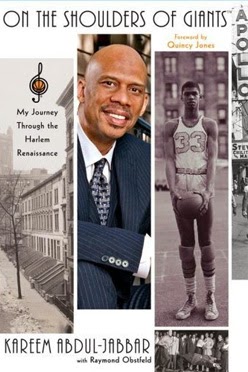
Among his books: "Brothers in Arms: The Epic Story of the 761st Tank Battalion, WWII's Forgotten Heroes" with Anthony Walton (2004); "On the Shoulders of Giants: My Journey Through the Harlem Renaissance" with Raymond Obstfeld (2007); and "What Color Is My World? The Lost History of African American Inventors" with Raymond Obstfeld (2012). I look forward to featuring some of Abdul-Jabbar's work in future posts.

In "Giant Steps," Abdul-Jabbar writes about his first impression of his coach at UCLA, the great John Wooden, who out of respect called him "Lewis."

"I found myself liking Mr. Wooden right away. People would always tell me they cared about me, but I felt Mr. Wooden really meant it. I came of his office knowing I was going to UCLA."

Perhaps it was their mutual interest in books. Each man's fathers, "Hugh" Wooden and "Big Al" Alcindor, had instilled in their sons a lifelong passion for reading. 

In "My Personal Best: Life Lessons from an All-American Journey" by John Wooden with Steve Jamison, the coach reflects in a chapter, "The Age of Alcindor," about self-control and poise being fundamental to achieving success.  "Lewis had the bearing of an eagle. He also reminded  me so much of my own father, Joshua Hugh Wooden."

"Wooden: A Coach's Life" by Seth Davis, opens with:
"The first thing you noticed were the books. Big books, little books, picture books, children's books, art books, religious books, coaching books, sports books, fiction books, science books. Before I walked through the door, they were there to greet me in tall, neat piles in the front hallway. The books were stacked on floors, lined up on tables, piled on desks, jammed into bookcases. The apartment was barely two thousand square feet, yet it seemed that most of it was covered by something that could be read."
Wooden was an English teacher before he was a coach. But he was also a lieutenant in the United States Navy providing physical readiness training for naval aviators during World War II. Davis writes:
"After World War II broke out, Wooden could have avoided being drafted because he was a married father and high school teacher, but eventually duty compelled him to enlist in the navy, a little more than a year after the bombing of Pearl Harbor."
One of Wooden's assignments was on the campus of the University of North Carolina in Chapel Hill. He also served at other college campuses, at an Iowa preflight school and as an underway watch officer aboard USS Sable (IX-81), an aircraft carrier training ship anchored in Lake Michigan.


Like fellow Sailor Red Auerbach, he never served overseas.  In Wooden's case, a bout of appendicitis prevented him from deploying to the carrier USS Franklin (CV-13) in the South Pacific, including off the coast of Samar, Philippines.
"As it turned out, Wooden knew well the man who replaced him aboard the Franklin. He was Freddy Stalcup, a former Purdue football player who was Wooden's fraternity brother in Beta Theta Pi. Several months later, Wooden received a piece of news that left him dumbstruck: Stalcup was working a gun position aboard the Franklin when the ship was struck by a Japanese kamikaze pilot. He was killed along with dozens of other men on board. Had Wooden's appendix not become inflamed, he could very well have lost his life that day."
Davis presents a lifetime of detail in nearly 600 pages of Wooden's biography, including details about the Coach's commitment to conditioning and the fast break, Wooden's complicated relationship with Bill Walton, his love of poetry (even on his deathbed), discussions of religion and racism, and the Coach's insights on leadership, including the development of his core values and Pyramid of Success, which reaches a pinnacle in "Competitive Greatness" -- requiring toughness, your best performance, and "real love of a hard battle."

When Wooden passed away in 2010, UCLA issued a statement that included a quote from Kareem Abdul-Jabbar, the former Lew Alcindor, who I saw carrying that armful of books back in 1968:

"It's kind of hard to talk about Coach Wooden simply, because he was a complex man. But he taught in a very simple way. He just used sports as a means to teach us how to apply ourselves to any situation.  He set quite an example. He was more like a parent than a coach. He really was a very selfless and giving human being, but he was a disciplinarian. We learned all about those aspects of life that most kids want to skip over. He wouldn't let us do that."

Wooden, known for his pithy words of wisdom, famously said, "What you are as a person is far more important that what you are as a basketball player."  He also advised, "Drink deeply from good books."

The dust jacket of "Wooden: A Coach's Life," calls the book, "A provocative and revelatory new biography of the legendary UCLA coach John Wooden, by one of America's top college basketball writers."

Sunday, August 21, 2016

Honor, Courage, Commitment: Grit Wins the Gold

Review by Bill Doughty

Like having Michael Phelps and Katie Ledecky as anchors, the last few chapters of Dr. Angela Duckworth's milestone, "Grit" (2016, Scribner, Simon & Schuster), completes an extended relay of a book–filled with life advice and examples of achievement and success.

In fact, Duckworth talks about Phelps, Ledecky, Kevin Durant and other Olympics heroes–along with dozens of other public and private individuals in this powerful book subtitled "The Power of Passion and Perseverance."

Readers will want to race through this book to pick up valuable tips about potential, resilience, character, training and achievement. From diverse fields or endeavors such as sports, zookeeping, NASA, cartooning, spelling bees and more, Duckworth delivers examples from her own life as well the lives of people including Jeff Bezos, Steve Young, Tom Seaver, Julia Child, John Irving, Aristotle, Ta Nehishi Coates, Benjamin Franklin, Will Shortz, Warren Buffet, and the nation of Finland.


A Navy SEAL monitors youth training camp. (Photo by MC3 Geneva G. Brier.)
Duckworth explores West Point's "The Beast" (barracks boot camp) as she and other scientists attempt to predict who will succeed and who will drop out. The same evaluation is done, no doubt, in all military branches especially in hyper-competitive areas such as Navy BUDS (Basic Underwater Demolition/SEAL) training.

Natural talent, initial physical strength, and inherent skills are not most important. Mental toughness–grit–is.

Winners like Michael Phelps, Katie Ledecky and Usain Bolt want to go head-to-head with other people, are willing to train continuously and with passion, and can accept failure as motivation for the next challenge. They understand "there are no shortcuts to excellence."

It helps, Duckworth notes, to have "purpose-driven grit"–a vision and calling, whether it's the Olympics, service in the military or as part of an NBA or NFL team. Each has its culture of teamwork,service and, some more than others, a concept of a greater good.

After seeing Duckworth's TED talk on grit, Seattle Seahawks head coach Pete Carroll, author of "Win Forever," contacted her and invited her to the Seahawks camp. Carroll's philosophy is, "Do things better than they have ever been done before."


The day after Carroll's team beat the Denver Broncos to win Superbowl XLVIII in 2014, he said this in an interview:

"We're looking for great competitors. That's really where it starts. And that's the guys that really have grit. The mindset that they're always going to succeed, that they've got something to prove. They're resilient, they're not going to let setbacks hold them back. They're not going to be deterred, you know, by challenges and hurdles and things ... It's that attitude–we really refer to it as grit."

Carroll had this to say about Duckworth after he shared a town hall with her in Seattle last year: “She has such a big personality and attitude, she’s really fun to work with. She goes really fast with her thoughts and ideas, which is just fine with me, so we’ll cover a lot of stuff in a short amount of time. She’s got a real sense of urgency about discovery as well, so we see things in a similar fashion in that regard as well.”

Duckworth examines Carroll's reaction to the next year's Superbowl XLIX and the Coach's decision to pass rather than run the ball with Marshawn Lynch, resulting in a historic loss. Failure became another opportunity for resilience.

Carroll's idol-mentor was Coach John Wooden, a World War II Navy veteran and epic winning coach of UCLA Bruins basketball team. Wooden's advice comes across in this found (unintentional) haiku from the great coach:


success is never
final; failure is never
fatal; ... courage ... counts

Duckworth is impressed by this Japanese saying: "Fall seven, rise eight." People with grit don't give up. They rise to the challenge. They learn that it takes at least 10 years and 10,000 repetitions to become an expert or master. They have purpose and passion.

Duckworth offers great words of wisdom, including her own found haiku:


our potential is
one thing; what we do with it
is quite another

As a neurobiologist and psychologist, Dr. Duckworth can explain the neuroplasticity of a "remarkably adaptive" brain that allows people to achieve their vision.
"Like a muscle that gets stronger with use, the brain changes itself when you struggle to master a new challenge. In fact, there's never a time in life when the brain is completely 'fixed.' Instead, all our lives, our neurons retain the potential to grow new connections with one another and to strengthen the ones we already have. What's more, throughout adulthood, we maintain the ability to grow myelin, a sort of insulating sheath that protects neurons and speeds signals traveling between them."
This book is packed with advice for individuals, leaders and parents. It includes a self-test and practical how-to advice, along with personal and public examples of people and situations where grit wins "the gold."

It's a perfect Navy read in the context of preserving a resilient workforce and fostering core values: Honor, Courage, Commitment."

Sunday, February 2, 2014

Football Dreams: Navy's First Black Admiral


Review by Bill Doughty

Long before becoming Navy's first black admiral, Samuel L. Gravely Jr., had his sights set on becoming a football coach.  He loved the game, but his father -- "deathly afraid" about injury -- didn't want him to play.  Gravely Sr., a World War I veteran and Pullman Porter, thought his son's future lay with the Post Office.
Gravely's biography, "Trailblazer: The U.S. Navy's First Black Admiral," is the heartfelt tale of how education, hard work, perseverance and luck came together for a remarkable and inspirational leader, whose training to become an officer actually preceded the Golden Thirteen (first naval officers).

Gravely played football despite his father's fears.  He had to hide his uniform behind the refrigerator during high school -- till his father found it.  

After high school he attended the all-black Virginia Union University in his hometown of Richmond Virginia where football changed his life.
"One difference from high school was that I was able to play football without my father knowing it.  The college had a gym with lockers, so it was no longer a case of trying to hide my uniform at home.  One of the football trips in 1940 had beneficial consequences down the road.  At the time, my sister Christie was going to school at Virginia State College in Petersburg.  I went over there once with a bunch of football players, and my sister introduced me to one of her roommates, Alma Clark.  Several years later, Alma and I were married..."
One year later, World War II started in the Pacific with Imperial Japan's attack on Pearl Harbor of December 7, 1941.  Gravely enlisted in the Navy after the Navy announced a new policy (April 7, 1942) that it would accept black Sailors into general service ratings).
As a young man in 1942.


It was a giant leap for the young man whose only life experiences were in the segregated south where every school he attended was all black and where he had to sit in the back of the streetcar or bus but in the front of the train, "which was the first place the coal hit."

At Great Lakes Naval Training Station and Hampton Institute Gravely excelled in study, but learned "I wasn't as technically minded as I thought I was."  He came out as a nonrated fireman. The East Coast would have seemed like a natural selection as a duty station.

"But I was influenced by one of my roommates to look in another direction," Gravely writes.  "[Roger] Gibbons had been a schoolteacher.  He'd been one of the great football players of Prairie View A&M, a black college in Texas ..." Gibbons suggested they take Horace Greeley's advice and "Go West, young man." They asked for and got orders to San Diego, which at the time was even more segregated than Richmond, he writes.

Gravely studied at UCLA. He considered his future and began taking premed classes, temporarily questioning his childhood dream of becoming a football coach.

He followed opportunity back to New York and Asbury Park, New Jersey and excelled as a midshipman, studying at Columbia University.  He expresses regret that instead of an assignment at sea in 1944 he was assigned to teach back at Great Lakes.

Alma and Sam Gravely married on Feb. 12, 1946, Roanoke, VA.
Soon, though, Gravely was serving aboard PC-1264, a submarine chaser homeported at Staten Island, New York City and operating along the East Coast, especially near Florida.  PC-1264 and USS Mason were the only two combatant ships with black officers aboard during WWII.

When PC-1264 went to Norfolk for a shipyard period to prepare for deployment to the Pacific, Gravely struck up a friendship with a worker there and joined his semi-pro football team, the Brown Bombers.  Sadly, while on liberty in Miami, he was arrested for "impersonating an officer" because the white military policeman had never seen a "Negro Navy officer."

After WWII, like a lot of his contemporaries, Gravely decided to leave the military and use the GI Bill to continue his education.  He attended Virginia Union and got serious about his studies, majoring in history.  And he played football.  His coach was Sam Taylor, who had been the coach for his former roommate Roger Gibbons at Prairie View.

Another turning point came in 1949 when Gravely was invited to come back on active duty.  The year before President Harry S. Truman issued an executive order (9981) which said, "It is hereby declared that there shall be equality of treatment and opportunity for all persons in the armed services without regard to race, color, religion, or national origin."

It was also a turning point for civil rights in the nation. Like a quarterback (Russell Wilson) and his father would ask in the next generation: "Why not me?  Why not us?"

Gravely became a coach and leader not of football players but of Sailors.  He would go on from recruiter duty to serve aboard the battleship USS Iowa, heavy cruiser USS Toledo, USS Seminole and USS Theodore E. Chandler.  He would serve throughout the Korean, Vietnam and Cold Wars.

USS Falgout in Pearl Harbor
He made history January 31, 1962 when he became CO of USS Falgout in Pearl Harbor.  "I guess it's been said that this was the first time a black had command of a U.S. Navy ship since Robert Smalls captured a small frigate out of the Charleston Harbor and turned it over to the Union forces during the Civil War," Gravely writes.

In 1963 he was invited to the White House where he and Alma met President Kennedy and Vice President Johnson.  He was in Washington DC as part of the Emancipation Proclamation centennial celebration.

Gravely next served at the Naval War College and Defense Communications Agency.  He commanded USS Taussig and then USS Jouett, a guided-missile frigate, later redesignated a guided-missile cruiser.

In 1971, Gravely was frocked to rear admiral, blazing another trail for naval officers.  He served as Director of Naval Communications and Commander of Cruiser-Destroyer Group Two and then Eleventh Naval District.  

In September 1976, back in Pearl Harbor, Gravely assumed command of U.S. Third Fleet, based in Hawaii. (Since then C3F has relocated to San Diego.)

Details of Gravely's assignments, new technologies, housing challenges, duty in the Pacific, "racial disturbances in the fleet," and the profound influence of CNO Adm. Zumwalt and his Z-grams are all included in "Trailblazer."

In addition to his accomplishments, Gravely shares his challenges and personal tragedies.  In 1978 his son Robbie was killed while driving on Ford Island in Pearl Harbor.

"Trailblazer" is written with Paul Stillwell, who in the preface notes that Gravely was born just 60 years after the Civil War.  The afterward is a very personal account by Alma B. Gravely, written in 2010, of her life together with her "Sammie."  Admiral Gravely passed away in 2004.

In 2009, the Samuel L. Gravely Jr. Elementary School was dedicated in Prince William County, Virginia.  Inside the front door of the school is the motto that Alma says expresses the admiral's philosophy:  "Success = Education + Motivation + Perseverance."

The dust jacket of "Trailblazer," published by the Naval Institute Press, notes:  "The U.S. Navy commissioned the guided-missile destroyer USS Gravely (DDG 107) in 2010 in tribute to a man who relished destroyer service and set an example for generations of Navy men and women."  Read a 2014 Naval History Blog post here, written by historian Dr. Regina T. Akers.

And on a separate note, about football...
(Samuel L. Gravely Sr.'s concerns about the dangers of football, expressed to his son more than 70 years ago, are echoed all over the news this Superbowl weekend as Russell Wilson and the Seattle Seahawks defeated Peyton Manning and the Denver Broncos. President Obama said if he had a son he wouldn't let him play tackle football, and even Brett Favre said something similar as more information comes out about the long-term damage to the brain, including memory loss, from concussions. Fans know the story of Junior Seau and they are hearing from Joe Namath and other former players.  Troy Aikman and John Lynch, high-profile Fox broadcasters, are asking for more information from the NFL. Don't expect the NFL to be complacent or take safety for granted. Already, the game has evolved thanks to new rules and steep fines against violent hits, helmet-to-helmet contact and late hits and other unsportsmanlike conduct. Too much money is at stake for the game to not evolve further. Imagine how much football has already progressed and changed for the better since it began, thanks to instant replay, for example.  As for the violence, just watch rugby to see how physical a game can be without as many serious injuries. BD)

Tuesday, January 28, 2020

Kobe Bryant: Self-Reflection, Work Ethic, Reading

By Bill Doughty


Kobe Bryant at Arlington, 2012.
Star of Lower Merion High School in Pennsylvania, NBA rookie Kobe Bryant was interviewed by anchor Tim Russert on Meet the Press in 1998. In the interview, the future #24 Lakers superstar spoke about what it takes to be a better individual in today's society: self-reflection, a strong work ethic and reading.

"I was fortunate to have a family ... a strong family background, wonderful mom and dad, two older sisters," Bryant acknowledged.

Russert asked him what advice he had for other young black men, many who did not have fathers living at home.

"In some cases they don't have somebody to love, to latch onto," Kobe said. "So I think they have to be strong individuals, dig deep inside themselves, look inside themselves, and not look for other venues, other negative paths to walk down, because there are so many of these in today's society."

He added, "So I tell them to dig deep inside, be patient, be strong, hit the books and work hard and continue to dream."

Kobe encouraged young people to follow their dreams and stand up to people who block those dreams. "If you have a goal, if you have something you want to accomplish, they put limits on you; they tell us what we can and cannot do. So I tell them to have faith in themselves."


Kobe Bryant of Team USA meets service members at a Hoops for Troops event in 2012.
Kobe Bryant became an NBA icon with the Los Angeles Lakers. He played on the U.S. national team at the Olympics. And he participated in Hoops for Troops, honoring the military and military families.

In 2012 Kobe, along with the United States Olympic men's basketball team, visited Arlington National Cemetery.

As part of the dream team led by Coach Mike Krzyzewski, Kobe acknowledged the importance of good coaching, respect, commitment, and devotion to his country. In his autobiography, "The Mamba Mentality: How I Play" (Farrar, Strauss and Giroux, 2018), Kobe writes:
"Our nation means so much to Coach Krzyzewski. He really hammered home the significance of getting to represent our country. Everything he did – from having generals come to speak with us, having soldiers be a part of our preparation process, having us take tours of national monuments – was aimed at increasing our admiration and love for America. You could sense that in the way he had us playing, in the intensity we showed."
"The Mamba Mentality" offers advice and strategies, tactics and priceless insights and memories for young basketball players. Kobe writes, "What separates great players from all-time great players is their ability to self-assess, diagnose weaknesses, and turn those flaws into strengths."

Years ago, when asked what his son was like as a child, Joe "Jelly Bean" Bryant said Kobe was studious and hardworking. “He was a good kid — he even cleaned his room,” Joe Bryant said, reminiscent of Navy Adm. William H. McRaven's advice in "Make Your Bed: Little Things That Can Change Your Life ... and Maybe Change the World." 

Joe Bryant has a strong connection with Japan. He even gave his son a Japanese name.

Kobe's dad coached the Tokyo Apache and other teams. He visited military bases, including Yokosuka naval base several times in the 2000s and practiced with Sailors of USS Kitty Hawk as well as speaking to young athletes and military families. 


Joe "Jellybean" Bryant, father of Kobe Bryant and coach of the Tokyo Apache basketball team, signs autographs and talks to fans after the game Feb. 7, 2007 at Yokota Air Base's Samurai Fitness Center. Bryant also played during the last half of the game. Tokyo Apache, a Japanese professional basketball team, took on the Yokota Warriors varsity team here and walked away with the win, 96 - 74. (U.S. Air Force photo by Mark Allen)
According to Pacific Stars and Stripes, Joe Bryant "has a message for everyone: 'To have a dream, to have a fantasy and to have a goal.'" 

His words are echoed by his son in Kobe's interview with Tim Russert. So are his words about hitting the books:

“Once you have that, all it takes is a work ethic,” Joe Bryant said. “If you don’t have homework, then you read ahead in your textbook. You do the next page in your workbook. In school, as in life, you have to do the extra work to get better in anything.”

Our thoughts, memories and condolences are with the Bryant family and the families of all those lost in the tragic helicopter crash Sunday that killed Kobe Bryant, Gianna Bryant, John Altobelli, Keri Altobelli, Alyssa Altobelli, Christina Mauser, and Ara Zobayan.

Kobe Bryant and Jerry Colangelo place a wreath on behalf of the U.S. Olympic Men's Basketball team at the Tomb of the Unknown Soldier in Arlington National Cemetery, Fort Myer, Va., Jul. 15, 2012. (Department of Defense photo by D. Myles Cullen)
Chairman of the Joint Chiefs of Staff U.S. Army Gen. Martin E. Dempsey, left, and Kobe Bryant talk at Arlington National Cemetery in Virginia, July 15, 2012. (Department of Defense photo by D. Myles Cullen)

Saturday, May 6, 2017

'General Confusion' & Lies of Vietnam War

Crawling out of a hole in Vietnam in 1967. (Photos from National Archives and LBJ Library)
Review by Bill Doughty––

H.R. McMaster shows how outright lies, obfuscation and "deceit and manipulation of Congress and the American people" brought about the Vietnam War.

His carefully researched "Dereliction of Duty: Lyndon Johnson, Robert McNamara, the Joint Chiefs of Staff, and the Lies that Led to Vietnam" (HarperCollins) was published in 1997. McMaster is the current National Security Adviser.

Now, twenty years after his book appeared – and fifty years after most of the events depicted in this book –McMaster's words ring with new relevance.
"The president's fixation on short-term political goals, combined with his character and the personalities of his principal civilian and military advisers, rendered the administration incapable of dealing adequately with the complexities of the situation in Vietnam. LBJ's advisory system was structured to achieve consensus and to prevent potentially damaging leaks. Profoundly insecure and distrustful of anyone but his closest civilian advisers, the president viewed the JCS with suspicion. When the situation in Vietnam seemed to demand military action, Johnson did not turn to his military advisors to determine how to solve the problem. He turned instead to his civilian advisers to determine how to postpone a decision. The relationship between the president, the secretary of defense, and the Joint Chiefs led to the curious situation in which the nation went to war without the benefit of effective military advice from the organization having the statutory responsibility to be the nation's 'principal military advisers.'"
Taylor and McNamara (2nd and 3rd from left) aboard Air Force One headed to Honolulu, 1964; President Johnson in executive seat and robe. (Yoichi Okamoto)


LBJ surrounded himself with yes-men. Chief among them was a holdover from the Kennedy in-crowd, military advisor Maxwell Taylor, author of "The Uncertain Trumpet" and trumpeter of the strategies of "flexible response" and "limited war."

In Neil Sheehan's comprehensive history of the Vietnam War, "A Bright and Shining Lie," Taylor's "limited war" strategy is called "Maxwell Taylor's rationalization to find employment for an unemployed U.S. Army." 

LBJ traveled to Honolulu with his inner circle for a conference in early June 1964. "The conference attendees affirmed the basic concept of graduated pressure and agreed to refine plans to support it." McMaster contends that a lack of consensus or clear understanding was part of the administration's plan. "The ambiguity was deliberate, and Taylor played a critical role in preserving it."

Marine walks through punji gully in January 1966.
Johnson skipped over Admiral George Anderson in order to keep Taylor as chairman of the joint chiefs. (In July 1964 LBJ chose Taylor to succeed Henry Cabot Lodge as ambassador to South Vietnam, where he served in '64 and '65.)

Meanwhile, LBJ tried to go after those in his administration who leaked to the press, and he "obscured the cost of the war" both to Congress and the public.

When the early Rolling Thunder air campaign did not succeed, LBJ and other senior military leaders blamed the inexperienced "boys" carrying out the mission. He called himself the coach and told his inner circle a story that was eerily reflected in the 2017 Super Bowl 51, more than 50 years later. Think of LBJ as the future Coach Bill Belichick. (Belichick, by the way, was then 13 years old and would soon to go to Annapolis High School, but that's another story.)
"LBJ told the JCS: 'Now, I'm like a coach I used to know, and you're my team; you're all Johnson men.' Referring to the situation in Vietnam, the president continued with his metaphor: 'We played the first half of the game and the score is now 21-0 against us; now I want you to tell me how to win' ... 'You're graduates of the Military Academy and you should be able to give me an answer. I want you to come back here next Tuesday and tell me how we are going to kill more Viet Cong.'"
LBJ and McNamara in a Vietnam security meeting July 21, 1966.
Johnson was fixated in the power of winning – even when claims of victories were increasingly less believable.

This book features nearly three dozen pages of notes and a very extensive bibliography including books, documents and oral histories conducted with witnesses and principals. "Dereliction" is recommended by authors and historians like Paul Fussell, Stanley Karnow and Tom Clancy as well as former uniformed leaders like Col. (U.S. Army ret.) David Hackworth and Lt. Gen. (U.S. Marine Corps ret.) Victor Krulak (father of the 51st commandant of the Marines), among others.

Each chapter begins with an epigraph, none more powerful than this one by Thomas Jefferson at the beginning of Chapter 5, "From Distrust to Deceit." The Jefferson quote is from August 19, 1785:
"He who permits himself to tell a lie often finds it much easier to do it a second and third time, til at length it becomes habitual; he tells lies without attending to it, and truths without the world's believing him. This falsehood of the tongue leads to that of the heart, and in time depraves all its good dispositions." – Jefferson
Whether LBJ believed in the logic of his argument or not, he argued midway into the war, that patriotism and support of the troops must be a "lynchpin for greater involvement." In May of 1965 LBJ said a vote against a ramp up and request for an additional $700 million was a "vote against 400 Americans" who had been killed up to that point.

McMaster doesn't blame the New York Times or college campuses for the failure of the United States in Vietnam. He places the blame squarely in "Washington D.C. ... indeed, even before the first American units were deployed."
"The disaster in Vietnam was not the result of impersonal forces but a uniquely human failure, the responsibility of which was shared by President Johnson and his principal military and civilian advisers. The failings were man and reinforcing: arrogance, weakness, lying in the pursuit of self-interest, and, above all, the abdication of responsibility to the American people."
A Navy Nurse helps a Marine aboard USS Repose, Oct. 1966.
Parallels are tied to another error in judgment, as defined by historians: President George Bush's foray into Iraq in 2002.

While patriotic Americans honor the sacrifice of the brave service members who went to Vietnam, many believing they were fighting for freedom, McMaster reminds us;
"The war continues to capture the public interest in part because, looking back, its cost seems exorbitant – and would seem so even if the United States had 'won.' The war took the lives of fifty-eight thousand Americans and well over one million Vietnamese. It left Vietnam in ruins and consumed billions of American dollars, nearly wrecking the American economy. Vietnam divided American society and inflicted on the United States one of the greatest Political traumas since the Civil War. indeed, the war's legacies proved to be as profound as the war was traumatic. It led Americans to question the integrity of their government as never before. Thirty (now fifty) years later, after the end of the Cold War, the shadow of the American experience in Vietnam still hangs heavy over American foreign and military policy, and over American society."
Counting down the days and months in 1968.
Missing in this dissertation, because of McMaster's narrow timeframe, is an accounting of President Richard Nixon, who used his own subterfuge directly and indirectly with the Republic of Vietnam to attain office in 1968 (and then lied to the American people about domestic affairs, including related to his election) and who extended the war before the American public demanded an end to the conflict in 1973. Interestingly, McMaster mentions Nixon only once and then in the context of John F. Kennedy, who "narrowly defeated Dwight Eisenhower's vice president" in 1960.

"Dereliction of Duty" concludes with this powerful observation:
"As American involvement in Vietnam deepened, the gap between the true nature of that commitment and the president's depiction of it to the American people, the Congress, and members of his own administration widened. Lyndon Johnson, with the assistance of Robert S. McNamara and the Joint Chiefs of Staff, had set the stage for America's disaster in Vietnam."
The antidote to similar disasters may be, in the words of other senior leaders,  "clarity and consistency" and "honesty and accountability" – credible leadership.