Showing posts sorted by relevance for query on tyranny. Sort by date Show all posts

Tuesday, February 22, 2022

‘On Tyranny’ Twosday


Review by Bill Doughty––

When Timothy Snyder’s “On Tyranny: Twenty Lessons from the Twentieth Century” was first published several years ago it was the size of a large slice of bread. Now, with stunning art by Nora Krug, it’s been republished by Ten Speed Press (an imprint of Random House, 2021) in a stunning graphic edition and is accessible to visually oriented readers.


Sandwiched between the covers –– in both hardbound and softbound versions –– are colorful nuggets of history, information, wisdom, and outright warnings. Speaking of history…


Today, Tuesday, 2/22/2022 “Twosday,” may be remembered in history as the day the Western world confronted Vladimir Putin’s further invasion of Ukraine. Europe, UK, and US immediately announced sanctions against last night’s actions by Russia in Ukraine’s Donbas region.

Using pretexts and distorted history as justification for his aggression is nothing new to Putin, who previously invaded Crimea and occupied Georgia, with his sights set on other former Soviet areas.


Timothy Snyder gave us warnings about Putin, showing how the Russian president came to power as a “terror manager,” targeting Muslims in Chechnya, seizing control of private media, removing elected regional governors, and invading Ukraine in 2014 with his own paramilitary force of soldiers with insignia removed from their uniforms.

“In the campaign for the Donbas region of southeastern Ukraine, Russia deployed Chechen irregulars and sent units of its regular army based in Muslim regions to join the invasion. Russia also tried (but failed) to hack the 2014 Ukrainian presidential election. In April 2015, Russian hackers took over the transmission of a French television station, pretended to be ISIS and then broadcast material designed to terrorize France … In early 2016, Russia manufactured a moment of fake terror in Germany while bombing Syrian civilians and thus driving Muslim refugees to Europe.”

Of course, Putin also interfered in U.S. elections, especially in 2016. Snyder warns that accepting radical untruths [and a Big Lie] “requires a blatant abandonment of reason.” As featured in other Navy Reads reviews, Snyder promotes books and reading as an antidote to post-truth tyranny.


Snyder defines various “isms,” including patriotism. He says authoritarianism takes root when people choose to be bystanders; one person can make a big difference. Beware of symbols worn or shown as gestures of pride that separate instead of unite. Understand the tie between greed and corruption. And know the importance of clear and concise language.


German American artist Nora Krug employs, in her words, “a variety of visual styles and techniques to emphasize the fragmentary nature of memory and to acknowledge the emotive effects of historical events.” Her illustrations give Snyder’s words a poetic feel.


Here are some related “found haiku” from “On Tyranny”:


Most of the power

of authoritarianism

is freely given


What might seem like a

gesture of pride can be a

source of exclusion


Billionaire is some-

one who can pay neither his

taxes nor his debts


Make an effort to

separate yourself from the

Internet. Read books


Authoritarians want to ban books and control media. “More than half a century ago, the classic novels of totalitarianism waned of the domination of screens, the suppression of books, the narrowing of vocabularies, and the associated difficulties of thought.


The bread and butter of resisting authoritarians is this: read more.


Retired U.S. Navy Admiral James Stavridis is a great author and curator of books and author. His latest book is "Sailor's Bookshelf," published at the end of last year by Naval Institute Press. Here’s what Stavridis had to say today on MSNBC’s “Morning Joe,” about Putin’s further invasion of Ukraine last night: “This would be like the United States deciding that the Canadian provinces of British Columbia and Alberta had historical resonance for the United States because American fur trappers operated up there, because we speak the same language; therefore we ought to be able to impose our will on those provinces. It’s absurd.”


Putin observes an exercise in the Black Sea off Crimea last year. (VOA file)

Stavridis says it’s time to “lower the hammer” with significant sanctions as part of deterrence efforts, and that we should “continue to rally the international community. Every nation, every democratic nation oughta stand up and oppose this.”


“On Tyranny” comes with some big-name endorsements, including Ken Burns and J.J. Abrams:


“Timothy Snyder is brilliant. On Tyranny is a must read, a clear-eyed guidebook for anyone seeking to learn from history to help us understand the present. It is a manual for how to protect and preserve Democracy. The past teaches us that we, as individuals, must act to reaffirm and protect the freedoms and institutions that we collectively cherish. Listen, learn, be kind and courageous. This stunning new edition beautifully illustrated by Nora Krug makes the lessons jump off the page, into our hearts, filling us with the urgent imperative: act now, before it is too late.”—Ken Burns

“A more concise, profound, or essential book on the subject does not exist. Snyder’s masterwork is a stunning reminder of the myriad, insidious forms oppression takes. Now beautifully illustrated by Nora Krug, On Tyranny is a bellwether for what we must be awake to, and fight against.”—J.J. Abrams, filmmaker, Star Trek and Star Wars: The Force Awakens

(Top Photo: U.S. President Joe Biden holds virtual talks with Russia's President Vladimir Putin amid Western fears that Moscow plans to attack Ukraine, Situation Room at the White House in Washington, Dec. 7, 2021 –– Pearl Harbor Remembrance Day)

Sunday, August 6, 2017

Fighting Fundamentalism, Fanaticism and Tyranny

Reviews by Bill Doughty


Adm. John Sylvester "Slew" McCain.
One hundred years ago, in August 1917, Lt. John S. "Slew" McCain (grandfather of Sen. John S. McCain) served aboard USS San Diego (Armored Cruiser No. 6). 

The USS San Diego joined the Atlantic Fleet to perform vital escort duties, protecting American ships from German attack in the First World War.

Out of the ashes of World War I, nationalism and Nazism arose in Germany. Tyranny grew and spread in Imperial Japan, leading to World War II. 

Sen. McCain's grandfather, Adm. John S. "Slew" McCain took a stand as Pacific Carrier Commander, alongside other heroes like Nimitz, Spruance, King, Mitscher and Halsey, to fight fundamentalism, tyranny and fanaticism nearly 75 years ago.

Three books explore those three concepts – fundamentalism, tyranny and fanaticism. One book also asks the question, "Can it happen here?"

From "A Little History of Religion" by Richard Holloway (Yale University Press, 2016):
"Fundamentalism is a tantrum. It's a screaming fit, a refusal to accept new realities" such as equality for women, gays and people of other races. "But if scientific change and the new knowledge it brings is hard for the fundamentalist mind to accept, even harder is change in the way we run society. In our era, religious fundamentalism became more agitated by social change than by the pressures of science. And in some of its forms not only did it get angry. It got violent."
Radical extremist fundamentalists such as ISIS claim their interpretation of reality is factual, even if it is not verified by a critical objective review of the facts.
"Fundamentalists don't debate. They don't try the evidence. They deliver a sentence. And it's always 'guilty' because their holy book has already decided the issue. This means that the crisis of fundamentalism in our time, including its violent versions, poses a question that goes to the heart of religions that claim to be based on a revelation that came directly from God. Surely, if it is used to justify not only the love of ignorance but the love of violence then there is something fundamentally wrong with it, to borrow their own language."
A contemporary of Adm. John S. McCain in both world wars, Sir Winston Churchill, believed that leaders must first and foremost have strong principles and then rely on objective facts upon which to base decisions.

The first targets of fascists and tyrants are reason, truth and free speech.

In Brian E. Fogarty's "Fascism: Why Not Here?" (Potomac Books, 2009) we see how authoritarianism arose in Germany in the 1930s, during the same years that Sen. McCain's grandfather was studying air warfare, on his way to earning his wings (at the age of 52) and becoming commander of USS Ranger (CV-4).

Fogarty defines fascism as "totalitarianism that enlists citizens against themselves."

Benjamin Franklin warned centuries earlier, "Those who would give up essential liberty, to purchase a little temporary safety, deserve neither liberty nor safety."


Sir Winston Churchill speaks at Harvard, Sept. 6, 1943.
On Sept. 6, 1943, speaking at Harvard University, Winston Churchill said, "Tyranny is our foe, whatever trappings or disguise it wears, whatever language it speaks, be it external or internal, we must forever be on our guard, ever mobilized, ever vigilant, always ready to spring at its throat. In all this, we march together."

At the same time, in the late summer of 1943, Vice Adm. "Slew" McCain was the new Deputy Chief of Naval Operations (Air), about to head back to Pearl Harbor to take command of "huge task forces, spearheaded by carrier-based aircraft" against Imperial Japan.

Fogarty, like Holloway, spotlights the importance of objective facts and reason. He notes how in the 1930s the Nazis sponsored public book burnings, abolished the free press and dissent, and began to ostracize Jews and other non-Aryans as members of the public went along.


Brian Fogarty
"More than anything else, the rise of Nazism was fueled by the negation of reason as a basis for government and for social and political discourse," Fogarty writes.

"Without universal or at least agreed-upon standards of knowledge, the truth of a statement comes to depend on the speaker's identity, persuasiveness or charisma." That can lead to blindly following, as happened in Nazi Germany and Imperial Japan in the early part of the last century.

"People commit evil, or acquiesce as others do it in their name, when it is sanctioned and legitimated by the community in which they belong." He warns us to beware of a "vortex of fear that drown(s) out debate and reason."

So, "why not here?" or put another way in the book's final chapter, "Can It Happen Here?" Fogarty answers with "fundamental ambiguity":
"On the one hand, Americans have a history since the nation's beginning of fierce individualism and of resistance to authority. The national mythology is replete with challenges to every social institution – state, family, church, school – and Americans tell and retell the stories of dissidents and rebels. One of the abiding national myths is the revolution against the English mother country – the most powerful empire of its day – which gave birth to the nation itself. And viewed from this perspective, we have been a nation of rebels ever since, from the Shays and Whiskey rebellions, to slave revolts and the Underground Railroad, to the abolition movement and John Brown's insurrection, and to the Civil War itself. More recent social and cultural movements have also challenged popular convention if not the authority of the state ... It is true that Americans have not hesitated to defy authority when they found it necessary, but they also have been astonishingly conformist and willing to acquiesce in their own oppression when faced with uncertainty and threats. Even the most revered acts of resistance to authority – women's suffrage, civil rights, (the counterculture movement of the Vietnam era, gay pride), and many other movements – usually brought negative reactions from fellow citizens who viewed the causes as un-American, immoral, sinful, or just weird."
Germany and Japan suffered greatly after the worldwide depression. Both had a chip-on-their-shoulder nationalist attitude as victims who wanted to participate in global imperialism. That's why most of their citizenry supported race-based fascism leading to the Second World War.

As an immigrant nation, however, the United States may not be as susceptible. Here, "racism has been more divisive than unifying," for most Americans. Diversity may be our biggest strength in being able to resist fundamentalism, tyranny and fascism.

Fogarty writes, "American society includes too many ethnic and racial groups to form a credible 'them' from which 'we' can protect ourselves." But he says, we may not have faced a major enough threat to our security, and we may, when really tested, have the propensity collectively to choose safety over liberty.

"Our history demonstrates that Americans have the capacity to react to adversity in a general director toward fascism," he concludes.

"On Tyranny: Twenty Lessons from the Twentieth Century" by Timothy Snyder (Tim Duggan Books, Penguin Random House, 2017) explores how leaders embrace fundamentalism, reject facts and rely on arguments of victimization:
"Both fascism and communism were responses to globalization: to the real and perceived inequalities it created, and the apparent helplessness of the democracies in addressing them. Fascists rejected reason in the name of will, denying objective truth in favor of a glorious myth articulated by leaders who declined to give voice to the people. They put a face on globalization, arguing that is complex challenges were the result of a conspiracy against the nation. Fascists ruled for a decade or two [Hitler and his ilk], leaving behind an intact intellectual legacy that grows more relevant by the day. Communists ruled for longer, for nearly seven decades in the Soviet Union, and more than four decades in much of eastern Europe [and to this day in North Korea]. They proposed rule by a disciplined party elite with a monopoly on reason that would guide society toward a certain future according to supposedly fixed laws of history."
As a champion for freedom and democracy – and an intense study of history – Churchill stood strong against Hitler. He was a lynchpin in opposing tyranny and fascism. "Had Churchill not kept Britain in the war in 1940, there would have been no such war to fight."

The late Christopher Hitchens warned of tyrants who are unpredictable and who don't believe in facts. 

Reading is inoculation to protect us from fascism and tyranny. Otherwise we're at risk of a society as painted by Ray Bradbury in "Fahrenheit 451" and George Orwell in "1984."

Bradbury's "firefighters" were authoritarian book burners. In "1984" Orwell describes not only the pollution of ideals and objective facts but also the dissolution of meaning and disappearance of words.

In his "The Principles of Newspeak" appendix to "1984," Orwell writes: "Quite apart from the suppression of definitely heretical words, reduction of vocabulary was regarded as an end in itself, and no word that could be dispensed with was allowed to survive. Newspeak was designed not to extend but to diminish the range of thought, and this purpose was indirectly assisted by cutting the choice of words to a minimum."

Among Snyder's recommended list of books and authors packed into this slim collection of how-to advice:
  • "The Brothers Karamazov" by Fyodor Dostoevsky
  • "The Unbearable Lightness of Being" by Milan Kundera
  • "It Can't Happen Here" by Sinclair Lewis
  • "The Plot Against America" by Philip Roth
  • "Harry Potter and the Deathly Hallows" by J. K. Rowling
  • "Politics and the English Language" by George Orwell
  • "The Language of the Third Reich" by Victor Klemperer
  • "The Origins of Totalitarianism" by Hannah Arendt
  • "The Rebel" by Albert Camus
  • "The Captive Mind" by Czeslaw Milsosz
  • "The Power of the Powerless" by Vaclav Haval
  • "Nothing is True and Everything is Possible" by Peter Pomerantsev
Timothy Snyder
Snyder asks us to examine the difference between nationalism and patriotism.
"A nationalist encourages us to be our worst, and then tells us that we are the best. A nationalist, 'although endlessly brooding on power, victory, defeat, revenge,' wrote Orwell, tends to be 'uninterested in what happens in the real world.' Nationalism is relativist, since the only truth is the resentment we feel when we contemplate others."
Chapter 10 is called "Believe in truth": "To abandon facts is to abandon freedom. If nothing is true, then no one can criticize power, because there is no basis upon which to do so. If nothing is true, then all is spectacle. The biggest wallet pays for the most blinding lights."


Three generations of John S. McCains.
Chapter 10 is titled "Be a patriot": "Set a good example of what America means for the generations to come. They will need it."

Adm. John S. "Slew" McCain demonstrated his patriotism fighting for his country in both World Wars, eventually standing aboard USS Missouri (BB-63) for the surrender of Imperial Japan. Militarists in Japan were purveyors of a spreading nationalism and fascist tyranny in Asia in the 1930s and 40s.

Adm. McCain's son was another four-star flag officer, Adm. John S. "Jack" McCain Jr., a submariner who also fought in WWII. Jack McCain also fought during the Cold War and, of course, during the Vietnam War, where his son, Lt. Cmdr. John S. McCain III, the future senior senator of Arizona, was imprisoned as a POW for five-and-half years.

The McCains' story is one of service and sacrifice. Adm. "Slew" McCain, who saw so many naval aviators go to their deaths, died four days after Japan's surrender. Adm. Jack McCain had to carry out President Nixon's orders to bomb Hanoi, where he knew his son was a POW. Sen. John McCain has been serving his country throughout his life.

The legacy of another WWII naval hero, President John F. Kennedy, recognized Sen. McCain's patriotism. Sen. John McCain received the JFK Profile in Courage award from the Kennedy family for his commitment toward campaign finance reform. In his acceptance speech of May 24, 1999, McCain said: 


JFK's brother, Sen. Ted Kennedy, and daughter, Caroline, present Sen. McCain the courage award. 
"Most Americans believe that we all conspire to hold on to every political advantage we have, lest we jeopardize our incumbency by a single lost vote. Most Americans believe we would let this nation pay any price, bear any burden to ensure the success of our personal ambitions – no matter how injurious the effect might be to the national interest. And who can blame them. As long as the wealthiest Americans and the richest organized interests can make six figure donations to political parties and gain the special access to power such generosity confers on the donor, most Americans will dismiss the most virtuous politician’s claim of patriotism ... In John Kennedy’s memorable phrase, 'without belittling the courage with which men have died, we should not forget the courage with which men have lived.' I’ve seen more than my fair share of both kinds. And I could not forget them if I wanted to." – Sen. John S. McCain.

According to Fogarty in "Fascism: Why Not Here," again from 2009, citing the work of Nancy Bermeo, "The mutual demonization of opposing parties locks up the machinery of government":
"The single best predictor of success for fascist movements is political polarization ... Such movements tend to be antidemocratic because they blame the democratic process itself as the cause of the gridlock. When parties have become so polarized that all anyone – voters included – can think of is vanquishing opponents, then a sort of political disillusionment sets in, and political principles give way to an empty contentiousness. A second useful generalization about the rise of such movements is that they tend to occur when existing democratic regimes are incompetent. Government is not just a theater for ideological or political drama; it is also an essential institution to human life. People get hurt when it doesn't work ... These two generalizations offer a warning to Americans: beware those who seek always to discredit government, to blame it for the nation's ills, and to alienate citizens from its workings ... Their game is to alienate citizens from their government, to trivialize the vote, and to make the democratic process look ineffective and foolish. The best way to prevent fascism is to avoid alienation, to resist extreme polarization, and to remain connected to the political process."
Looking toward the future back in 2009, in the face of crises, when the Great Recession and Iraq and Afghanistan wars were deepening, Fogarty asked, "How will Americans react ... Will we still value our individualism and love of liberty? Or will we find a leader with a bold plan that requires new conquests, new enemies, or a new world order. Will Americans reject the cool rationalism of the Obama presidency and rush to a bold outsider with a simple explanation and audacious plans?"


CAM RANH, Vietnam (June 2, 2017) Sen. John S. McCain III is piped aboard during a visit to the Arleigh Burke-class guided-missile destroyer USS John S. McCain (DDG 56) in Cam Ranh, Vietnam. The U.S. Navy has patrolled the Indo-Asia-Pacific routinely for more than 70 years promoting regional peace and security. (U.S. Navy photo by Mass Communication Specialist 3rd Class Joshua Mortensen/Released)

Sunday, March 25, 2018

Enough Marches

Washington and Lafayette with the militia at Valley Forge. (Lib. of Congress)
Review by Bill Doughty

Fear of a standing army and navy prompted the Framers to draft the stilted wording and punctuation of the Second Amendment to the Constitution that called for citizens to arm themselves as part of civilian "well regulated militia." But after the Revolutionary War, when members of the militia were not compensated for their service, officers threatened to mutiny and march on Washington D.C. The mutiny was put down by George Washington himself. That was in March 1783 – 285 years ago this month.

Michael Waldman recounts the story in "The Second Amendment: A Biography" (Simon & Schuster, 2014), a good primer for anyone interested in how fear and paranoia of tyranny brought on a passion for firearms in the United States.

Waldman explores the meanings of "the right of the people," "the security of a free state," and "militia" in what it means to keep and bear arms and not infringing on that right.

Fear and paranoia have been potent weapons for decades in preventing legislation for sensible gun laws, according to Gabrielle Giffords and Mark Kelly, authors of "Enough: Our Fight to Keep America Safe from Gun Violence" (Scribner, 2014), a personal but clear-eyed look at the issue.

Senator John McCain and General Stanley McChrystal both endorsed their book, with McChrystal calling the authors, "inspiring voices for responsibility. We need to listen."

Giffords and Kelly show how  "wannabe military" militia  try to look the part, speak in acronyms to sound cool, and align themselves with fundamentalist, white supremacist survivalists who, like the National Rifle Association, pose a real threat to society. The NRA is dangerous to citizens when they attack background checks, prohibit research into gun violence, and prevent voting on restrictions on armor-piercing bullets, ultra-capacity magazines, and assault-style military grade weapons, according to the authors.

Astronaut Capt. Kelly recounts his time in the Navy and having to lock his handgun in the Yokosuka base armory while he was stationed aboard USS Midway in 1990. "We tried to handle the deadly weapons of war with the utmost respect," he writes. Kelly lived off base, where firearms (and gun incidents) are unheard of. He fought – and dodged incoming fire as an F-14 fighter pilot in the Gulf War, Operation Desert Storm.

Both authors are gun owners who, even after Giffords was nearly assassinated by a gunman in 2011, shoot at ranges. Kelly is an avid hunter. Neither wants to do away with the Second Amendment. But they don't understand why the United States, which has only around one percent of the world's population of children, has 85 percent of the world's children deaths by guns.

"Enough" was one of the first words Giffords said after the senseless massacre of twenty young children and six adults at Sandy Hook Elementary School in Newtown, Connecticut just before Christmas, 2012. This powerful book walks us through the preventable tragedies of Tucson, Virginia Tech, Columbine, Aurora and Newtown. The book was written before mass shootings and killings in Orlando, Las Vegas and, of course, at Marjory Stoneman Douglas High School in Lakeland, Florida last month.

Gun control was part of society in the 1800s, including in Tombstone and Dodge City. Laws have come and gone, depending on the fear-inducing power and intimidation of the NRA: The National Fire Arms Act of 1934 after an assassination attempt on FDR; The Gun Control Act of 1968 in the wake of assassinations of JFK, RFK and MLK; the Brady Bill of 1993 after an attempted assassination of President Reagan; and the Assault Weapons Ban of 1994 after a spike of violence.

In the mid-90s white identity fundamentalists at Waco, Ruby Ridge and Oklahoma City (Timothy McVeigh) fomented hate, fear and violence. McVeigh had been a member of the NRA and shared NRA leader Wayne LaPierre's "demonization of the ATF" (Bureau of Alcohol, Tobacco, Firearms and Explosives). In the wake of McVeigh's bombing of the Murrah federal building that killed 168 people, including children in the day-care center, and wounded more than 680 others, George H. W. Bush resigned his life membership in the NRA.

Domestic terrorism can still explode in our society. Witness the bombings this month in Austin, Texas. But the number of bombing incidents pales in comparison to mass shootings. Those who fear tyranny are causing a tyranny of violence. Navy Veteran Kelly rejects their paranoia, promoted by the NRA:
"The NRA has, in essence, turned the tables on the Declaration of Independence. Forget about a government designed to protect 'life, liberty and the pursuit of happiness.' Most of us trust our government: even if, sure, the average ninth grader can build a better website, we believe the men and women we elect to represent us have our best interest at heart. But to hear the NRA tell it, once federal or state governments start to pass laws to reduce gun violence in any way, shape, or form, it's a 'slippery slope' or 'jackbooted' federal agents banging on a gun owner's door to demand he turn over his firearm. As a Navy pilot who risked his life during bombing missions over Iraq and Kuwait, I find that preposterous and offensive. I was fighting to protect the ideals of a country and a government that I believed in. I blasted into space for my country, in a government-financed spaceship. The NRA'S slippery slope is a fantasy, and a dangerous one. If the NRA gets its way, we'll be left with a country where everyone is armed but no one is safe."
When Gabby Giffords was shot, the shooter was tackled while trying to reload. When a bystander grabbed the shooter's gun, the bystander was nearly shot by someone responding with a concealed weapon. In the chaos of a shooting, more guns may not be the answer. And in a peaceful society, more guns indiscriminately in hands of more people is not the answer, according to the authors.

As long as there are lax laws for background checks, mentally ill people, including paranoid conspiracy theorists, Islamist terrorists and other end-times believers, have relatively easy access to firearms in the United States.

The irony is that crazed assassins who want to become famous for killing a public figure can instead become famous for spurring responsible gun control regulations and legislation.


"March for Our Lives": Yesterday, an estimated 800,000 students, survivors and supporters marched in Washington D.C. and thousands more marched in more hundreds of cities across the United States in a call for positive change for safer schools and streets and sensible gun laws, including restrictions on offensive military style weapons designed to kill people rather than for hunting or defense.

Yolanda Renee King stands with Jackie Corin.
Marjory Stoneman Douglas student Jackie Corin said last week, "The people of America care," adding, "The love outweighs the hate, no matter what." Corin said she and other students are following the inspiration of "students during the Vietnam War era" as well as the nonviolent philosophy of Dr. Martin Luther King, Jr.

Corin stood with MLK's nine-year-old granddaughter Yolanda Renee King yesterday. King said, "My grandfather had a dream that his four little children will not be judged by the color of their skin, but by the content of their character," adding, "I have a dream that enough is enough."

David Hogg at March for Our Lives March 24, 2018.
Fellow student David Hogg, hoping for common ground in the debate, said, "People get afraid and then misunderstand people. We're not trying to take your guns; we're trying to save the future of America."

In Michael Waldman's Second Amendment "biography," which calls for focusing on the phrase "the right of the people," the author concludes this about gun violence:
"This is a remarkably dense and thorny issue. The controversy is thick with symbolic politics. It pits rural culture against urban norms. It asks us to avoid emotionalism, to rely more on research, to find policies that actually work. Efforts to enact sensible regulations of guns face many obstacles: powerful organizations, inflamed opponents, cowardly politicians, a media culture that (when not suffused with violence itself) quickly loses interest. To surmount these will require grit and wisdom. It should not have to require overcoming a hostile judiciary, misreading history, over-interpreting text, and imposing political views in the guise of judicial philosophy."
The burning of Washington D.C. in 1814 proved the weakness of relying on the states' militia.
After Waldman recounts venerated George Washington's role in preventing a march by a mutinous militia on Philadelphia, the nation's capital at the time, he tells how the militia service itself "withered."

In the War of 1812, the British overran state militias and they marched on Philadelphia, burning the White House. It was clear that a well-regulated and equipped military was needed more than a "well-regulated militia." Fear of a standing army and navy gradually gave way to a sense of confidence in the strength of a free democracy, relying on the people and their right to vote, being able to withstand a rise of tyranny, even from within.

Waldman reminds us of this quote from Abraham Lincoln while debating slavery and an earlier Supreme Court decision: "Public sentiment is everything. With public sentiment, nothing can fail; without it, nothing can succeed. Consequently he who molds public sentiment goes deeper than he who enacts statutes or pronounces decisions."

Wednesday, March 2, 2022

A Woman’s Voice for Opportunity, Optimism

Review by Bill Doughty––

Here are three reasons to read this amazing book:


Firstly, it helps explain the rise of Russia’s President Putin and the popular support for America’s former President Trump. Secondly, it’s an inspiring account of a woman’s challenge in overcoming obstacles –– perfect for Women’s History Month. And, thirdly, it’s an extremely well-written contemporary history, with practical advice for how to prevent the further rise of authoritarianism and tyranny.

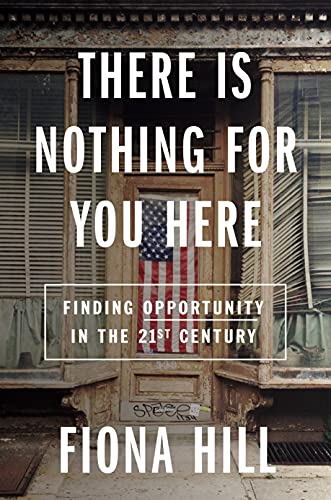
The book is “There Is Nothing for you Here: Finding Opportunity in the 21st Century” by Fiona Hill (Mariner Books, HarperCollins, 2021).


Hill grew up as a coal miner’s daughter in northern England, and she describes her journey “from the coal house to the White House.” Recruited by Fox News’s K.T. McFarland, Hill worked as deputy assistant to the president and senior director for European and Russia affairs on the National Security Council in the Trump administration.


Hill warns of the dangers of populism leading to tyranny. “Russia’s fate and its slide into authoritarianism since 2000 could well be our own.”

“Throughout history, populist have offered compelling narratives for people who feel they have lost their identities and cultural moorings as well as their jobs in an economic downturn and at times of rapid social change and political uncertainty. Populism was a major feature of European and also U.S. politics at pivotal points in the twentieth century: in the 1920s and 1930s during the Great Depression, in the 1960s and again in the 1980s during generational and technological changes. Putin, for example, first came to power in Russia on December 31, 1999, right at the very end of a decade of wrenching economic crisis, political upheaval, and strife, including a war in Chechnya, in Russia’s North Caucasus region. Putin promised to fix this.

“Populists like Putin provide straightforward, plain-speaking explanations for people’s misfortunes. They offer scapegoat, like corrupt bureaucrats and conniving immigrants, or the West trying to keep Russia down, in Putin’s case. They produce memorable catchphrases that encapsulate the ambitious claims that they, and only they, can solve ‘the people’s’ problems and ease their cultural despair. ‘The people’ is also who they say it is –– not everyone, just a specific group that they define. This group of ‘their people” (natshi, or ‘ours’ in Russian) is then divided against the rest of society.”

Hill describes the extreme sexism and discrimination she witnessed in Russia. She also describes how she dealt with numerous incidents of sexual harassment, misogyny, and discrimination –– including wage gaps –– in her career.


Reince Priebus, Trump’s first of several chiefs of staff, nicknamed Hill the “Russia Bitch.”


Hill writes, “I had struggled against sexism throughout my professional life in a seemingly unending effort to realize my potential and do my job effectively” despite the difficulties that somehow seemed intrinsic to being female.” Easily accessible national health care and childcare are seen as essential to promoting education, mobility, and career opportunities, especially for women.


Putin, with Hill to his left
There are several humorous recounts of her direct interactions with Trump, including in the Oval Office. There are also creepy accounts of her sitting next to Putin on several occasions during public meetings. And there is a laugh-out-loud, sad-but-funny reaction as she sat in the audience in Helsinki during a summit between Trump and Putin.

Many people will want to read her account of what it was like testifying to Congress in a hearing for the first impeachment of former President Trump. Hill was a witness to events surrounding Trump's call with the President of Ukraine when Trump withheld defensive arms as leverage for dirt on his political opponent. Hill offers fascinating takes on Ambassador Gordon Sondland, who also testified, and Representative Matt Gaetz, who tried unsuccessfully to stare her down during her appearance at the Capitol.


She praises many women by name who mentored, advised, or otherwise assisted her, including preparing her for her testimony. But she also notes how some women and men treated her unfairly throughout her education and career because of her accent, wardrobe, or humble beginnings in Bishop Aukland, England.


Hill compares the classism she experienced growing up in the UK with the racism she witnessed firsthand after emigrating to the U.S. She shares insights found in author Isabel Wilkerson's landmark book “Caste” (reviewed Jan. 14 on Navy Reads). White supremacy, Wilkerson notes, became memorialized for some after the Civil War and poisoned race relations "for generations.” Hill picks up on the theme:

“This sad history of racial identity being weaponized by the powerful against working people is not limited to the United States. It was also evident in the United Kingdom after both world wars, when race was used as a deliberate tool for divisive policies to benefit the narrow interests of shipyard owners and other big businesses who wanted to hire cheaper and non-unionized immigrant labor to stave off organized British labor demands for Black workers in shipyards and port cities, leading to riots, intercommunal violence, and the deaths of Black seamen and dockworkers who were accused of stealing jobs.”

She make several references to the effects of World War II, especially in post-war England and in the United States, where the G.I. Bill helped not only U.S. warfighters and their family, but also had an indirect influence on people in UK and Europe. The Marshall Plan and other “bold moves” had a direct and positive impact on people yearning for freedom, democracy, and self-determination.


“I mirrored the experience of millions of young Americans after World War II, who found college to be the door to a job and a better life than their parents’.” Her own choice to learn Russian and go into Russian studies hinged on a veteran uncle’s suggestion. The uncle was pained and perplexed to see how former WWII ally Russia had turned to oppressive communism under the Soviet Union and become an enemy to Western ideals.


Books and reading and the help of her community propelled Hill toward a higher education, with the path leading to Harvard’s Kennedy School, named for JFK, a navy hero of WWII. Hill received the Frank Knox scholarship. Knox was Secretary of the Navy during WWII.


Hill notes, “Breaking down racial barriers, as well as other universal or generalized spatial and structural impediments to opportunity, requires large-scale intervention.” The solution continually comes back to education, including the need for post-high school education, either for two-or four years or apprenticeship to learn a technical skill.

“Focusing collective action on education is an important aspect in countering the national security crisis of polarization and fragmentation. Lack of education –– in the sense of acquiring the critical thinking skills that a good K-12 and some form of college education can provide –– breeds suspicion of government, skepticism toward science and expert knowledge, and resistance to the very idea that there are things like basic facts and objective information. Poor educational attainment leaves people vulnerable to populists and political operatives –– a fact underscored by President Trump’s persistently higher ratings among Americans without a college degree.”

Analysts note that Putin’s most fervent supporters come from the rural, more isolated, parts of Russia. In contrast, the brave people who have come out on streets to protest Putin’s unprovoked aggressive invasion of Ukraine are the more educated people of the cities.

We can see the effects of populism leading to autocracy both in the J6 insurrection by Trump supporters at the U.S. Capitol on January 6, 2001 and in Putin’s invasion of Ukraine, a sovereign democracy.

“Russia’s fate over a twenty-year period shows how a country’s political path can turn away from democracy toward autocracy. No state, no matter how advanced, is immune from flawed leadership, the erosion of political checks and balances, and the degradation of its institutions. Democracy is not self-repairing. It requires constant attention and renewal, especially during periods of rapid technological and social change and economic uncertainty.”
I created a short playlist based on song and artists mentions by Hill, primarily from the 80s and early 90s and especially songs big in Britain at the time. High on the list: The Specials’ “Ghost Town,” Nena’s “99 Red Balloons,” and Billy Bragg’s “Waiting for the Great Leap Forward.” Also included, based on mentions by Hill: some acoustic Beatles songs and a group I’d never heard of, Russia’s Nautilus Pompilius. I also included the Scorpions’ “Wind of Change," about the thawing of the Cold War. It was released in 1990, exactly ten years before Putin ascended into power in Russia. Nena's "99 Red Balloons" from 1983 is mentioned several times; it is also considered an anthem protesting the Cold War, and was covered touchingly last week by Kelly Clarkson. It's a tribute to the brave people of Ukraine.


As this review is posted, Putin appears to be trying to lower another Iron Curtain and start another Cold War in his invasion of Ukraine. However, his actions have galvanized the NATO, Europe, and the free world. President Biden’s Department of Defense, led by SECDEF Lloyd Austin, is committing even more defensive support to NATO allies.


Secretary of Defense Lloyd Austin meets with Ukraine's Minister of Foreign Affairs Dmytro Kuleba at the Pentagon, Feb. 22, 2022. (Lisa Ferdinando)

Sanctions are having a devastating effect on Russia, in what amounts to “economic warfare,” according to analysts.

But Fiona Hill, now the director of the Center on the United States and Europe at the Brookings Institution, warns against sending direct military support to Ukraine. It could be falling into a trap laid by Putin, who believes in “escalation dominance” and looks for any excuse (couched as Western threats to Russia) to justify his actions. [On Pod Save the World, Ben Rhodes, former adviser to President Obama, said “Putin is at the vanguard of so much that’s wrong in the world.” But Rhodes also warns against direct military conflict with the Russians, who are threatening to literally “go nuclear.”]

My only complaint with “There Is Nothing for You Here” is minor; I wish it had a photo section. On the other hand, Hill presents a robust notes section, excellent conclusion, and helpful how-to afterword to provide more opportunity and possibilities for people, especially those who are less advantaged. 


Hill's style is easy, her approach is humble (one of her favorite words is “impecunious”), and her insights are refreshingly optimistic. This is a highly recommended book, both as biography and history, for Women’s History Month!