Showing posts sorted by relevance for query snyder. Sort by date Show all posts

Monday, January 20, 2025

‘On Freedom’ Found Haiku, Finding Wisdom

Review by Bill Doughty

Timothy Snyder dedicates “On Freedom” (Crown New York, 2024) “to those who wish to be free.” He attempts to define “freedom” –– positive freedom –– as not destruction and absence of things, but creation and presence of values, including the right kind of moral and political values.


“Virtue,” he writes, “is an inseparable part of freedom.”


So, too, is accountability, honesty, humility, and rule of law.


His book begins on a train in Ukraine, one of three trips to the democratic country he writes about after Putin’s Russia invaded its neighbor.

Snyder takes us along as he travels to and through Ukraine and contemplates the birth of the idea of freedom and democracy in ancient Greece. His writing is beautiful, poignant, and painful –– especially in light of the current state of affairs in the United States and the world where storm clouds seem to be gathering.


He condemns the rise of autocracy, oligarchy, inequality, and what he calls “sadopopulism.” And he offers prescriptions for standing up to greed, grift, and the abuse of power.

“As the future crashes in, we can panic and blame others. Those predictable reactions make us part of the mob and the catastrophe. Or we can, as free people, take responsibility, look deep into Earth’s past, and save the world.”

Freedom must be fought for. It is not a birthright, and it is not preordained. “The moment you believe that freedom is given, it is gone,” he warns.


A recurring theme in “On Freedom” is the need to confront racism in a free country. The military, up till now, has made a concerted effort to increase diversity and reject racism.


World War II was a watershed event: defeating fascism and creating democracies in Japan and Germany while also confronting bigotry, prejudice and discrimination on the home front. Snyder cites examples of veterans of the Second World War who returned to face hate and segregation. He discusses the Freedom Fighters of 1961 and the role of Martin Luther King Jr. and John Lewis in the peaceful fight for freedom, equality, and voting rights. 


We must engage, he asserts, writing on a train ride within Ukraine.


Snyder
And we must reject complacency, supplication to authority, leaders' hypocrisy, and our own lazy thinking, including confirmation bias (treating information as evidence only when it confirms what we already believe).

It is also important to recognize “the false tragedy of choice” presented by social media algorithms — between entrepreneurship and social justice, for example.


“On Freedom” includes an appendix that compares positive and negative freedom. The positive view: Government must be made for freedom; the negative view: Government must be dismantled for freedom. Science is either (positive) how we engage with the world or (negative) “one opinion among others.” Racism is either a historical fact requiring reflection or strictly “personal, irrelevant to freedom.”


Extrapolating from the appendix, security and prosperity are achieved through rule of law and accountability (positive freedom) or strictly imposed through strong-arm policing (negative).


We cannot sacrifice liberty for safety, Snyder advises.


“We believe that we can trade freedom for security. This is a fatal mistake.” A government of, by, and for the people should not be shunned or belittled.


Snyder writes, “We enable freedom not by rejecting government, but by affirming freedom as the guide to good government. Reasoning forward from the right definition of freedom, I believe, will get us to the right sort of government.”


He describes “five forms of freedom” as the “logical, moral, and political links between common action and the formation of free individuals.”

“The five forms are sovereignty, or the learned capacity to make choices; unpredictability, the power to adapt physical regularities to personal purposes; mobility, the capacity to move through space and time following values; factuality, the grip on the world that allows us to change it; and solidarity, the recognition that freedom is for everyone.”

Sometimes the best way to see oneself is through the eyes of others. That applies to people specifically and nations generally. Snyder says his book is for the United States, but, as a historian, he draws comparisons with western Europe, eastern Europe, the Soviet Union, and Nazi Germany.


Synder relies on other Western historians, philosophers, and critical thinkers: Frantz Fanon, Václav Havel, Leszek Kolakowski, Edith Stein, and Simone Weil. And he calls on more familiar names such as Socrates, Thomas Jefferson, George Orwell, and Ray Bradbury to help illustrate his point.

This vital book answers some of the questions brought up in Snyder’s “On Tyranny.” 


In this follow-up, he shows how to fight oligarchy (reject disinformation) and confront climate change (embrace to search for fusion power).


He champions actual infrastructure initiatives, real freedom of speech, and a commitment to civil rights.


We discover hidden unintentional “found haiku” in Snyder’s writing. Seventeen syllables, 5-7-5, displayed in three lines, that capture and focus an insight or truth like a laser. Here are a few:


Freedom is not just

an absence of evil but

A presence of good


Empathy is a

precondition for certain

knowledge of the world


Overconfidence

makes us vulnerable to

the propaganda (of tyrants)


A free person sees

the world in color, as through

a kaleidoscope


Synder’s prose travels effortlessly through countries, eras, and moods, both light and stormy. One moment he writes of oppression in the former Soviet Union and hope in Cold War-era Czechoslovakia; the next moment he expounds on the roots of rock and roll, the Velvet Underground, Louie Louie, and Frank Zappa’s Mothers of Invention. “On Freedom” is a fun, enlightened, but ultimately serious ride on Snyder’s train of thought. 


(Top photo of Ukraine's Carpathian Mountains courtesy of Pixabay)

Tuesday, February 22, 2022

‘On Tyranny’ Twosday


Review by Bill Doughty––

When Timothy Snyder’s “On Tyranny: Twenty Lessons from the Twentieth Century” was first published several years ago it was the size of a large slice of bread. Now, with stunning art by Nora Krug, it’s been republished by Ten Speed Press (an imprint of Random House, 2021) in a stunning graphic edition and is accessible to visually oriented readers.


Sandwiched between the covers –– in both hardbound and softbound versions –– are colorful nuggets of history, information, wisdom, and outright warnings. Speaking of history…


Today, Tuesday, 2/22/2022 “Twosday,” may be remembered in history as the day the Western world confronted Vladimir Putin’s further invasion of Ukraine. Europe, UK, and US immediately announced sanctions against last night’s actions by Russia in Ukraine’s Donbas region.

Using pretexts and distorted history as justification for his aggression is nothing new to Putin, who previously invaded Crimea and occupied Georgia, with his sights set on other former Soviet areas.


Timothy Snyder gave us warnings about Putin, showing how the Russian president came to power as a “terror manager,” targeting Muslims in Chechnya, seizing control of private media, removing elected regional governors, and invading Ukraine in 2014 with his own paramilitary force of soldiers with insignia removed from their uniforms.

“In the campaign for the Donbas region of southeastern Ukraine, Russia deployed Chechen irregulars and sent units of its regular army based in Muslim regions to join the invasion. Russia also tried (but failed) to hack the 2014 Ukrainian presidential election. In April 2015, Russian hackers took over the transmission of a French television station, pretended to be ISIS and then broadcast material designed to terrorize France … In early 2016, Russia manufactured a moment of fake terror in Germany while bombing Syrian civilians and thus driving Muslim refugees to Europe.”

Of course, Putin also interfered in U.S. elections, especially in 2016. Snyder warns that accepting radical untruths [and a Big Lie] “requires a blatant abandonment of reason.” As featured in other Navy Reads reviews, Snyder promotes books and reading as an antidote to post-truth tyranny.


Snyder defines various “isms,” including patriotism. He says authoritarianism takes root when people choose to be bystanders; one person can make a big difference. Beware of symbols worn or shown as gestures of pride that separate instead of unite. Understand the tie between greed and corruption. And know the importance of clear and concise language.


German American artist Nora Krug employs, in her words, “a variety of visual styles and techniques to emphasize the fragmentary nature of memory and to acknowledge the emotive effects of historical events.” Her illustrations give Snyder’s words a poetic feel.


Here are some related “found haiku” from “On Tyranny”:


Most of the power

of authoritarianism

is freely given


What might seem like a

gesture of pride can be a

source of exclusion


Billionaire is some-

one who can pay neither his

taxes nor his debts


Make an effort to

separate yourself from the

Internet. Read books


Authoritarians want to ban books and control media. “More than half a century ago, the classic novels of totalitarianism waned of the domination of screens, the suppression of books, the narrowing of vocabularies, and the associated difficulties of thought.


The bread and butter of resisting authoritarians is this: read more.


Retired U.S. Navy Admiral James Stavridis is a great author and curator of books and author. His latest book is "Sailor's Bookshelf," published at the end of last year by Naval Institute Press. Here’s what Stavridis had to say today on MSNBC’s “Morning Joe,” about Putin’s further invasion of Ukraine last night: “This would be like the United States deciding that the Canadian provinces of British Columbia and Alberta had historical resonance for the United States because American fur trappers operated up there, because we speak the same language; therefore we ought to be able to impose our will on those provinces. It’s absurd.”


Putin observes an exercise in the Black Sea off Crimea last year. (VOA file)

Stavridis says it’s time to “lower the hammer” with significant sanctions as part of deterrence efforts, and that we should “continue to rally the international community. Every nation, every democratic nation oughta stand up and oppose this.”


“On Tyranny” comes with some big-name endorsements, including Ken Burns and J.J. Abrams:


“Timothy Snyder is brilliant. On Tyranny is a must read, a clear-eyed guidebook for anyone seeking to learn from history to help us understand the present. It is a manual for how to protect and preserve Democracy. The past teaches us that we, as individuals, must act to reaffirm and protect the freedoms and institutions that we collectively cherish. Listen, learn, be kind and courageous. This stunning new edition beautifully illustrated by Nora Krug makes the lessons jump off the page, into our hearts, filling us with the urgent imperative: act now, before it is too late.”—Ken Burns

“A more concise, profound, or essential book on the subject does not exist. Snyder’s masterwork is a stunning reminder of the myriad, insidious forms oppression takes. Now beautifully illustrated by Nora Krug, On Tyranny is a bellwether for what we must be awake to, and fight against.”—J.J. Abrams, filmmaker, Star Trek and Star Wars: The Force Awakens

(Top Photo: U.S. President Joe Biden holds virtual talks with Russia's President Vladimir Putin amid Western fears that Moscow plans to attack Ukraine, Situation Room at the White House in Washington, Dec. 7, 2021 –– Pearl Harbor Remembrance Day)

Friday, January 27, 2023

Navy Reads Holocaust Remembrance

By Bill Doughty

Over the years, we’ve offered a number of reviews and commentaries about anti-semitism, Nazism, fascism, and the holocaust. Today, we remember the victims, warning signs, and parallels today on Holocaust Remembrance Day, January 27, 2023.


Among the champions of critical thinking we have featured on Navy Reads who have addressed the horrors of the Holocaust: Hannah Arendt, author of "The Origins of Totalitarianism;” Diane Ackerman, author of “The Zookeeper’s Wife: A War Story;” and Timothy Snyder, author of “On Tyranny;” among others.


Snyder observes similarities between Russia’s aggression and “genocide” in Ukraine with Nazi Germany’s targeting of Jews in the Holocaust. He warns that it could happen here; the rise of Nazism began with a Big Lie, too, that Jews were responsible for Germany losing the First World War. Feelings of victimization can lead to disorder, violence, authoritarianism, and terrorism.


Snyder says U.S. military contributions to the defense of Ukraine, confronting Putin's terrorism and genocide are an investment in peace – both in Europe and as prevention of war in Asia. China, he notes, is watching the resolve of free nations in the West to help support the people of Ukraine.

Sunday, August 6, 2017

Fighting Fundamentalism, Fanaticism and Tyranny

Reviews by Bill Doughty


Adm. John Sylvester "Slew" McCain.
One hundred years ago, in August 1917, Lt. John S. "Slew" McCain (grandfather of Sen. John S. McCain) served aboard USS San Diego (Armored Cruiser No. 6). 

The USS San Diego joined the Atlantic Fleet to perform vital escort duties, protecting American ships from German attack in the First World War.

Out of the ashes of World War I, nationalism and Nazism arose in Germany. Tyranny grew and spread in Imperial Japan, leading to World War II. 

Sen. McCain's grandfather, Adm. John S. "Slew" McCain took a stand as Pacific Carrier Commander, alongside other heroes like Nimitz, Spruance, King, Mitscher and Halsey, to fight fundamentalism, tyranny and fanaticism nearly 75 years ago.

Three books explore those three concepts – fundamentalism, tyranny and fanaticism. One book also asks the question, "Can it happen here?"

From "A Little History of Religion" by Richard Holloway (Yale University Press, 2016):
"Fundamentalism is a tantrum. It's a screaming fit, a refusal to accept new realities" such as equality for women, gays and people of other races. "But if scientific change and the new knowledge it brings is hard for the fundamentalist mind to accept, even harder is change in the way we run society. In our era, religious fundamentalism became more agitated by social change than by the pressures of science. And in some of its forms not only did it get angry. It got violent."
Radical extremist fundamentalists such as ISIS claim their interpretation of reality is factual, even if it is not verified by a critical objective review of the facts.
"Fundamentalists don't debate. They don't try the evidence. They deliver a sentence. And it's always 'guilty' because their holy book has already decided the issue. This means that the crisis of fundamentalism in our time, including its violent versions, poses a question that goes to the heart of religions that claim to be based on a revelation that came directly from God. Surely, if it is used to justify not only the love of ignorance but the love of violence then there is something fundamentally wrong with it, to borrow their own language."
A contemporary of Adm. John S. McCain in both world wars, Sir Winston Churchill, believed that leaders must first and foremost have strong principles and then rely on objective facts upon which to base decisions.

The first targets of fascists and tyrants are reason, truth and free speech.

In Brian E. Fogarty's "Fascism: Why Not Here?" (Potomac Books, 2009) we see how authoritarianism arose in Germany in the 1930s, during the same years that Sen. McCain's grandfather was studying air warfare, on his way to earning his wings (at the age of 52) and becoming commander of USS Ranger (CV-4).

Fogarty defines fascism as "totalitarianism that enlists citizens against themselves."

Benjamin Franklin warned centuries earlier, "Those who would give up essential liberty, to purchase a little temporary safety, deserve neither liberty nor safety."


Sir Winston Churchill speaks at Harvard, Sept. 6, 1943.
On Sept. 6, 1943, speaking at Harvard University, Winston Churchill said, "Tyranny is our foe, whatever trappings or disguise it wears, whatever language it speaks, be it external or internal, we must forever be on our guard, ever mobilized, ever vigilant, always ready to spring at its throat. In all this, we march together."

At the same time, in the late summer of 1943, Vice Adm. "Slew" McCain was the new Deputy Chief of Naval Operations (Air), about to head back to Pearl Harbor to take command of "huge task forces, spearheaded by carrier-based aircraft" against Imperial Japan.

Fogarty, like Holloway, spotlights the importance of objective facts and reason. He notes how in the 1930s the Nazis sponsored public book burnings, abolished the free press and dissent, and began to ostracize Jews and other non-Aryans as members of the public went along.


Brian Fogarty
"More than anything else, the rise of Nazism was fueled by the negation of reason as a basis for government and for social and political discourse," Fogarty writes.

"Without universal or at least agreed-upon standards of knowledge, the truth of a statement comes to depend on the speaker's identity, persuasiveness or charisma." That can lead to blindly following, as happened in Nazi Germany and Imperial Japan in the early part of the last century.

"People commit evil, or acquiesce as others do it in their name, when it is sanctioned and legitimated by the community in which they belong." He warns us to beware of a "vortex of fear that drown(s) out debate and reason."

So, "why not here?" or put another way in the book's final chapter, "Can It Happen Here?" Fogarty answers with "fundamental ambiguity":
"On the one hand, Americans have a history since the nation's beginning of fierce individualism and of resistance to authority. The national mythology is replete with challenges to every social institution – state, family, church, school – and Americans tell and retell the stories of dissidents and rebels. One of the abiding national myths is the revolution against the English mother country – the most powerful empire of its day – which gave birth to the nation itself. And viewed from this perspective, we have been a nation of rebels ever since, from the Shays and Whiskey rebellions, to slave revolts and the Underground Railroad, to the abolition movement and John Brown's insurrection, and to the Civil War itself. More recent social and cultural movements have also challenged popular convention if not the authority of the state ... It is true that Americans have not hesitated to defy authority when they found it necessary, but they also have been astonishingly conformist and willing to acquiesce in their own oppression when faced with uncertainty and threats. Even the most revered acts of resistance to authority – women's suffrage, civil rights, (the counterculture movement of the Vietnam era, gay pride), and many other movements – usually brought negative reactions from fellow citizens who viewed the causes as un-American, immoral, sinful, or just weird."
Germany and Japan suffered greatly after the worldwide depression. Both had a chip-on-their-shoulder nationalist attitude as victims who wanted to participate in global imperialism. That's why most of their citizenry supported race-based fascism leading to the Second World War.

As an immigrant nation, however, the United States may not be as susceptible. Here, "racism has been more divisive than unifying," for most Americans. Diversity may be our biggest strength in being able to resist fundamentalism, tyranny and fascism.

Fogarty writes, "American society includes too many ethnic and racial groups to form a credible 'them' from which 'we' can protect ourselves." But he says, we may not have faced a major enough threat to our security, and we may, when really tested, have the propensity collectively to choose safety over liberty.

"Our history demonstrates that Americans have the capacity to react to adversity in a general director toward fascism," he concludes.

"On Tyranny: Twenty Lessons from the Twentieth Century" by Timothy Snyder (Tim Duggan Books, Penguin Random House, 2017) explores how leaders embrace fundamentalism, reject facts and rely on arguments of victimization:
"Both fascism and communism were responses to globalization: to the real and perceived inequalities it created, and the apparent helplessness of the democracies in addressing them. Fascists rejected reason in the name of will, denying objective truth in favor of a glorious myth articulated by leaders who declined to give voice to the people. They put a face on globalization, arguing that is complex challenges were the result of a conspiracy against the nation. Fascists ruled for a decade or two [Hitler and his ilk], leaving behind an intact intellectual legacy that grows more relevant by the day. Communists ruled for longer, for nearly seven decades in the Soviet Union, and more than four decades in much of eastern Europe [and to this day in North Korea]. They proposed rule by a disciplined party elite with a monopoly on reason that would guide society toward a certain future according to supposedly fixed laws of history."
As a champion for freedom and democracy – and an intense study of history – Churchill stood strong against Hitler. He was a lynchpin in opposing tyranny and fascism. "Had Churchill not kept Britain in the war in 1940, there would have been no such war to fight."

The late Christopher Hitchens warned of tyrants who are unpredictable and who don't believe in facts. 

Reading is inoculation to protect us from fascism and tyranny. Otherwise we're at risk of a society as painted by Ray Bradbury in "Fahrenheit 451" and George Orwell in "1984."

Bradbury's "firefighters" were authoritarian book burners. In "1984" Orwell describes not only the pollution of ideals and objective facts but also the dissolution of meaning and disappearance of words.

In his "The Principles of Newspeak" appendix to "1984," Orwell writes: "Quite apart from the suppression of definitely heretical words, reduction of vocabulary was regarded as an end in itself, and no word that could be dispensed with was allowed to survive. Newspeak was designed not to extend but to diminish the range of thought, and this purpose was indirectly assisted by cutting the choice of words to a minimum."

Among Snyder's recommended list of books and authors packed into this slim collection of how-to advice:
  • "The Brothers Karamazov" by Fyodor Dostoevsky
  • "The Unbearable Lightness of Being" by Milan Kundera
  • "It Can't Happen Here" by Sinclair Lewis
  • "The Plot Against America" by Philip Roth
  • "Harry Potter and the Deathly Hallows" by J. K. Rowling
  • "Politics and the English Language" by George Orwell
  • "The Language of the Third Reich" by Victor Klemperer
  • "The Origins of Totalitarianism" by Hannah Arendt
  • "The Rebel" by Albert Camus
  • "The Captive Mind" by Czeslaw Milsosz
  • "The Power of the Powerless" by Vaclav Haval
  • "Nothing is True and Everything is Possible" by Peter Pomerantsev
Timothy Snyder
Snyder asks us to examine the difference between nationalism and patriotism.
"A nationalist encourages us to be our worst, and then tells us that we are the best. A nationalist, 'although endlessly brooding on power, victory, defeat, revenge,' wrote Orwell, tends to be 'uninterested in what happens in the real world.' Nationalism is relativist, since the only truth is the resentment we feel when we contemplate others."
Chapter 10 is called "Believe in truth": "To abandon facts is to abandon freedom. If nothing is true, then no one can criticize power, because there is no basis upon which to do so. If nothing is true, then all is spectacle. The biggest wallet pays for the most blinding lights."


Three generations of John S. McCains.
Chapter 10 is titled "Be a patriot": "Set a good example of what America means for the generations to come. They will need it."

Adm. John S. "Slew" McCain demonstrated his patriotism fighting for his country in both World Wars, eventually standing aboard USS Missouri (BB-63) for the surrender of Imperial Japan. Militarists in Japan were purveyors of a spreading nationalism and fascist tyranny in Asia in the 1930s and 40s.

Adm. McCain's son was another four-star flag officer, Adm. John S. "Jack" McCain Jr., a submariner who also fought in WWII. Jack McCain also fought during the Cold War and, of course, during the Vietnam War, where his son, Lt. Cmdr. John S. McCain III, the future senior senator of Arizona, was imprisoned as a POW for five-and-half years.

The McCains' story is one of service and sacrifice. Adm. "Slew" McCain, who saw so many naval aviators go to their deaths, died four days after Japan's surrender. Adm. Jack McCain had to carry out President Nixon's orders to bomb Hanoi, where he knew his son was a POW. Sen. John McCain has been serving his country throughout his life.

The legacy of another WWII naval hero, President John F. Kennedy, recognized Sen. McCain's patriotism. Sen. John McCain received the JFK Profile in Courage award from the Kennedy family for his commitment toward campaign finance reform. In his acceptance speech of May 24, 1999, McCain said: 


JFK's brother, Sen. Ted Kennedy, and daughter, Caroline, present Sen. McCain the courage award. 
"Most Americans believe that we all conspire to hold on to every political advantage we have, lest we jeopardize our incumbency by a single lost vote. Most Americans believe we would let this nation pay any price, bear any burden to ensure the success of our personal ambitions – no matter how injurious the effect might be to the national interest. And who can blame them. As long as the wealthiest Americans and the richest organized interests can make six figure donations to political parties and gain the special access to power such generosity confers on the donor, most Americans will dismiss the most virtuous politician’s claim of patriotism ... In John Kennedy’s memorable phrase, 'without belittling the courage with which men have died, we should not forget the courage with which men have lived.' I’ve seen more than my fair share of both kinds. And I could not forget them if I wanted to." – Sen. John S. McCain.

According to Fogarty in "Fascism: Why Not Here," again from 2009, citing the work of Nancy Bermeo, "The mutual demonization of opposing parties locks up the machinery of government":
"The single best predictor of success for fascist movements is political polarization ... Such movements tend to be antidemocratic because they blame the democratic process itself as the cause of the gridlock. When parties have become so polarized that all anyone – voters included – can think of is vanquishing opponents, then a sort of political disillusionment sets in, and political principles give way to an empty contentiousness. A second useful generalization about the rise of such movements is that they tend to occur when existing democratic regimes are incompetent. Government is not just a theater for ideological or political drama; it is also an essential institution to human life. People get hurt when it doesn't work ... These two generalizations offer a warning to Americans: beware those who seek always to discredit government, to blame it for the nation's ills, and to alienate citizens from its workings ... Their game is to alienate citizens from their government, to trivialize the vote, and to make the democratic process look ineffective and foolish. The best way to prevent fascism is to avoid alienation, to resist extreme polarization, and to remain connected to the political process."
Looking toward the future back in 2009, in the face of crises, when the Great Recession and Iraq and Afghanistan wars were deepening, Fogarty asked, "How will Americans react ... Will we still value our individualism and love of liberty? Or will we find a leader with a bold plan that requires new conquests, new enemies, or a new world order. Will Americans reject the cool rationalism of the Obama presidency and rush to a bold outsider with a simple explanation and audacious plans?"


CAM RANH, Vietnam (June 2, 2017) Sen. John S. McCain III is piped aboard during a visit to the Arleigh Burke-class guided-missile destroyer USS John S. McCain (DDG 56) in Cam Ranh, Vietnam. The U.S. Navy has patrolled the Indo-Asia-Pacific routinely for more than 70 years promoting regional peace and security. (U.S. Navy photo by Mass Communication Specialist 3rd Class Joshua Mortensen/Released)

Saturday, October 10, 2020

‘Stand Back and Stand By’ for Autocracy

Review by Bill Doughty

Praising lawlessness of supporters, demonizing the media, lying to the public, threatening free elections, changing the meaning of words, and destroying institutions are clear signs of autocracy.


That’s according to two authors who discuss the threat to democracy in the fall of 2020: Masha Gessen in “Surviving Autocracy” (Riverhead Books, Penguin; 2020) and Anne Applebaum in “Twilight of Democracy: The Seductive Lure of Authoritarianism” (Doubleday; 2020). These books are literary grandchildren of Hannah Arendt’s “The Origin of Totalitarianism” and close cousins of Timothy D. Snyder’s “On Tyranny.” Snyder, in fact, endorsed the books and authors as “extraordinary,” “penetrating, and “indispensable.”


Gessen takes a scholarly approach in laying out the case for an imminent threat to American democracy. He quotes from the works and words of Arendt, George Orwell, Michiko Kakutani, Ronald Reagan, and Confucius.

He pinpoints President Trump’s “contempt for excellence” and corruption. “Trump’s incompetence is militant. It is not a factor that might mitigate the threat he poses: it is the threat itself.” He adds, “Trump not only doesn’t know what he’s doing –– he did not even know what he was not doing.”


If impeachment had succeeded in removing Trump from office, Gessen writes, “it would have constituted a triumph of institutions over the autocratic attempt. It did not.”


Trump’s embrace of white nationalism and his failure to acknowledge the threat of white power terrorists –– including his call to arms to “stand by,” to “LIBERATE MICHIGAN,” and to come to polling places on election day –– are all part of a pattern.


Trump’s contemptuous disregard for military justice is also part of the picture. Gessen writes:

“The hero Trump chose during the fall of his impeachment was Navy SEAL Chief Petty Officer Edward Gallagher. In the summer of 2019, Gallagher faced trial for allegedly killing an unconscious, unarmed captive in Iraq. The Navy fumbled the investigation, and in the last minute a witness who had been granted immunity testified that he, not Gallagher, had killed the young man; Gallagher was acquitted on most charges … After Gallagher was acquitted, Trump congratulated him by tweet. He then intervened to reverse the Navy’s decision to discharge Gallagher without honors –– once again demonstrating that the commander in chief can issue orders by tweet. Trump reinstated Gallagher’s rank and pay, and stripped the prosecutors in the case of their Navy medals. Ultimately, the struggle over Gallagher’s fate cost the secretary of the Navy, Richard Spencer, his job.”

Gallagher and Trump; SECNAV Spencer boxed in.
Gessen notes that Gallagher was turned in by members of his platoon, who were interviewed saying he was “freaking evil” and “perfectly okay with killing anybody that was moving,” intentionally targeting women and children, saying he “just wants to kill anybody he can.” Trump invited Gallagher to his residence at Mar-a-Lago and praised him as an American hero.


According to Gessen, Gallagher embodied the essence of the presidency: raw, unchecked power, contempt for rules, laws and norms, and an unbridled desire to act out of hatred.


Gessen writes, “Raw power can overtake moral authority, and perhaps today it is easier than ever before, but a determined effort to preserve ideals when they are under attack can serve as a bridge to the future.”


In “Twilight of Democracy,” Applebaum –– who describes herself as “educated conservative elite” –– takes a denser and more global view, building her own bridge from the past to the present and future to explain how autocracy continues to thrive.


She takes the reader on a tour of Poland, Hungary, England, EU, Spain, and France before landing in the United States. Like Gessen, she relies on Arendt and Orwell as bedrock literature, but she also cites Graham Greene’s “The Quiet American,” Marcel Proust’s “Remembrance of Things Past,” and Svetlana Boym’s “The Future of Nostalgia.”


Applebaum laments that the “party of Reagan became the party of Trump,” noting, “Reaganite optimism disappeared and slowly hardened into apocalyptic pessimism shared by so many others.” Echoing Gessen, Applebaum quotes Reagan’s UN ambassador, Jeanne Kirkpatrick, who said, “To destroy a society, it is first necessary to delegitimize its basic institutions.”


In a timely insight, Applebaum warns of the threat of autocracy and tyranny in the time of a pandemic. “Throughout history, pandemics have led to an expansion of the power of the state: at times when people fear death, they go along with measure that they believe, rightly or wrongly, will save them –– even if that means a loss of freedom,” she writes.


She explains, “People are often attracted to authoritarian ideas because they are bothered by complexity.” “Restorative nostalgics” see the world in black and white, without nuance; they want a return to what they perceive as a simpler past:

“Restorative nostalgics don’t just look at old photographs and piece together family stories. They are mythmakers and architects, builders of monuments and founders of nationalist political projects. They do not merely want to contemplate or learn from the past. They want, as Boym puts it, to ‘rebuild the lost home and pitch up the memory gaps.’ Many of them don’t recognize their own fictions about the past for what they are: ‘They believe their project is about truth.; They are not interested in a nuanced past, in a world in which great leaders were flawed men, in which famous military victories had lethal side effects. They don’t acknowledge that the past might have had its drawbacks. They want the cartoon version of history, and more importantly, they want to live in it, right now.”

Applebaum shows that tyranny can rise from the radical left as well as the radical right. But extreme right-wing domestic terrorism is the greatest threat in the United States now, according to the FBI. There is a connection between racism and defending the Confederacy, Confederate monuments, and gun-carrying vigilantes.


Later in her book she shows how that world view, exemplified in “America First,” is a siren call to white nationalism and radical right-wing terrorists. 

“Like those who live on the extreme edges of the American far left, some of those who live on the extreme edges of the far right have long been attracted to violence. There is no need to rehearse here the history of the Ku Klux Klan, to tell the stories of Oklahoma bomber Timothy McVeigh and Charleston shooter Dylan Roof, or to describe the myriad individuals and militia movements who have plotted mass murder, and continue to plot mass murder, in the name of rescuing a fallen nation. In 2017, an Illinois militia set off a bomb at a Minnesota mosque. In 2018, a man who believed Jews were plotting to destroy white America murdered eleven people at a Pittsburgh synagogue. In January 2019, a group of men calling themselves ‘the Crusaders’ plotted to put a bomb in an apartment complex in Garden City, Kansas, because they hoped to murder a large number of Somali refugees. These groups and movements were also inspired by a confection that democracy is worthless, that elections cannot bring real change, and that only the most extreme and desperate actions can stop the decline of a certain vision of America.”

Governor Whitmer at her Oct. 8 press conference.
Just this past week, the FBI and Michigan State Police busted a plot by right-wing terrorists to kidnap and possibly kill the governor of Michigan, Gretchen Whitmer. Whitmer thanked law enforcement and called out President Trump for his dog whistle calls to those among his supporters who are white nationalists.

In a press conference Oct. 8, Whitmer said, “Just last week, the president of the United States stood before the American people and refused to condemn white supremacists and hate groups like these two Michigan militia groups. ‘Stand back and stand by,’ he told them. ‘Stand back and stand by.’ Hate groups heard the president’s words, not as a rebuke, but as a rallying cry, as a call to action. When our leaders speak, their words matter. They carry weight. When our leaders meet with, encourage, or fraternize with domestic terrorists, they legitimize their actions and they are complicit. When they stoke and contribute to hate speech, they are complicit.”


Both Gessen and Applebaum cite Reagan’s openness to immigration and focus on optimism for the future.


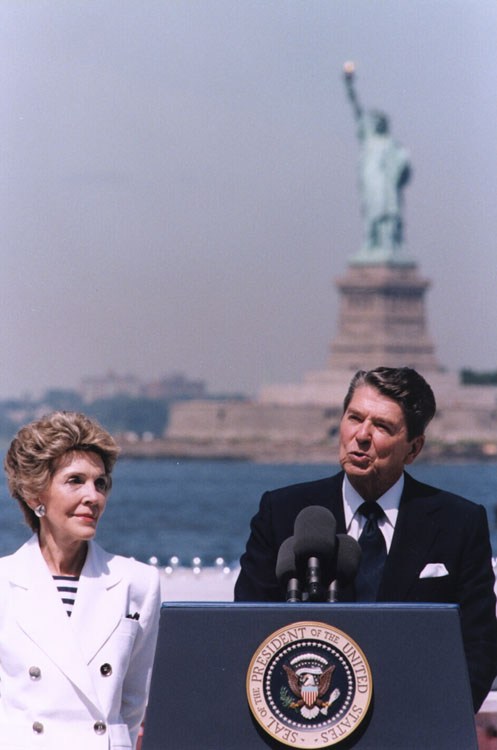
President Reagan and First Lady Nancy Reagan.

Whitmer herself brought up the 40th president of the United States: “In 1981, President Ronald Reagan spoke to the NAACP’s annual convention, and his comments stand in sharp contrast to what we have seen on the national and state level from his own beloved party in 2020. He said, ‘A few isolated groups in the backwater of American life still hold perverted notions of what America is all about.’ Recently, in some places in the nation, there’s been a disturbing recurrence of bigotry and violence.  Then Reagan sent a direct message to those who still adhere to senseless racism and religious prejudice: ‘You are the ones who are out of step with our society,' he said. 'You are the ones who willfully violate the meaning of the dream that is America. And this country, because of what it stands for, will not stand for your conduct.’”


Applebaum offers this chilling conclusion that provides the title for her book: “It is possible we are already living through the twilight of democracy; that our civilization may already be heading for anarchy or tyranny, as the ancient philosophers and America’s founders once feared…”


But, like Gessen, she offers explicit and implicit antidotes to a muddy downward slide toward autocracy. Explicitly: Build cooperation and coalitions; embrace allies; promote “rational thought, rule of law and integration;” and be “rooted to a place and yet open to the world.” Implicitly: become educated, practice critical thinking, and take the high road –– in the face of hate and anger, show love and kindness.