Showing posts sorted by relevance for query fabulist. Sort by date Show all posts

Friday, May 20, 2016

Happy Birthday Arnold Lobel, Fabulist

by Bill Doughty

Aesop. La Fontaine. "Uncle Remus." Hans Christian Anderson. Thurber. Orwell. Among the great fabulists – fable writers – we can add Arnold Lobel's name.

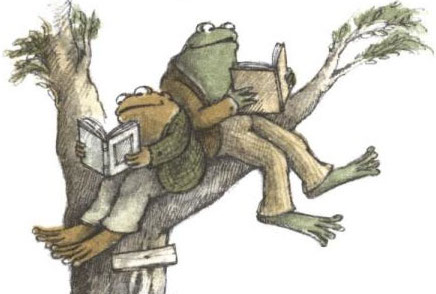
Author of the "Frog and Toad" series, "Ming Lo Moves the Mountain," "Owl at Home," and Caldecott Medal-winning "Fables," Lobel (May 22, 1933 – Dec. 4, 1987) was an artist and writer, who said writing was difficult because he was such a visual thinker.

His simple stories for various "I Can Read Books" held profound timeless ideas about ethics and morality.

In fact, he is interpreted as channeling the Buddhist dharma in a fascinating essay by Kathyryn Jeser-Morton. Christians and Jews can see his stories consistently reinforcing the Golden Rule; protagonists in Lobel's story frequently turn the other cheek, do unto others or practice "an eye for an eye" while young readers can appreciate the paradoxes. Lobel also inspired at least one "green Muslim" in the garden. 

Lobel's fables are universal for believers or nonbelievers. A writer who believes in the power of fabulist philosopher Lobel as "my hero" is Julia Donaldson, who writes in "The Guardian" that "the stories have a quality of joyful optimism celebrating things such as the spring and friendship in a fresh, unsentimental way."

Such is true in "Mouse Soup" (HarperCollins, 1977) a "Level 2" I Can Read Book for first through third graders. The story is filled with potential danger and creative innovative solutions. Spoiler alert: The quick-thinking mouse uses his wits – and some natural "weapons" – to outsmart and escape from a predatory weasel intent on making mouse soup.

Lobel's books are a great way to teach reading to children. In some cases military service members on deployment can get two copies of children's books and read to their sons and daughters as they read along, connected electronically. United Through Reading helps military families through a feedback loop of reading and recording reactions, bringing sponsors and children closer over time and distance.

From the UTR website: "One of the most difficult things a child can experience is having a parent separated from them for an indeterminate period of time. United Through Reading helps ease the stress of separation for military families by having service members who are separated from the children they love read children’s books aloud on video for the child to watch at home."

UTR provides information on how and where to participate. Also offered: lists of books as suggested reading at various reading levels. Titles include "Amelia Bedelia," "No, David," "Five Little Monkeys Jumping on the Bed," "Charlotte's Web," "Diary of a Wimpy Kid," and "Beyond Basketball: Coach K’s Keywords for Success," among dozens of others. 

Of course, families can choose their own favorite story book, nonfiction book, or book of fables.

Arnold Lobel's "Mouse Soup" is a fun choice and a good starting point for more discussion for military families about how to be cautious in a sometimes dangerous world.

Friday, December 30, 2022

December Remember: PAOs & Doggone Luntz

The day’s keynote guest speaker did something awful.

It happened at the May 2010 Navy Public Affairs Symposium in Baltimore, Md. The speaker was GOP pollster Frank Luntz. He bounced around the room in red-white-and-blue sneakers, arms waving, voice rising, making incendiary insinuations and politically incorrect remarks as he showed PowerPoint slides.


Attendees at the May 2010 Baltimore PAO Symposium hear a panel discussion. (SN Marty Carey)
Of course, his prickly comments and attempts at jokes were his First Amendment right ––– and typical Luntz schtick.

But then he went too far. On the screen he showed a picture of the first woman speaker of the house, Representative Nancy Pelosi. It was a photo –– he said –– of Pelosi "after plastic surgery" to her face. Then he showed a “before” photo. It was a picture of a dog.


A nervous murmur rippled through the crowd of military and civilian public affairs officers and mass communication specialists.


We were in Baltimore. Nancy Pelosi’s hometown, where her father, Thomas D’Alesandro Jr., had served as mayor after serving in Congress for five terms. Speaker of the House Pelosi was in her fourth year in her leadership role, second in line to Commander in Chief Barack Obama after Vice President Joe Biden.


Just a few years earlier, Pelosi had spent the early part of her time as Speaker in direct opposition to President George H. W. Bush and his war in Iraq, which she contended began on a lie about weapons of mass destruction. She said Bush’s war killed thousands of Americans and tens of thousands of Iraqis and negatively impacted the necessary war in Afghanistan and the hunt for Osama bin Laden. She had also vociferously opposed Bush’s move to privatize social security, and she fought for expanded affordable health care. Republican politicians and advisors unleashed their vitriol on her and, forgive the bad pun, really “dogged her out.”


Luntz
In making the jab ridiculing Pelosi’s appearance, Luntz, who has worked on behalf of Newt Gingrich, Pat Buchanon, Ross Perot, Ted Cruz, and other Right Wing politicians, as well as the former Washington Redskins, must have thought he’d receive a friendly reception in a conservative-leaning military audience. Personally, I thought he just embarrassed himself.

And –– his low-blow joke made him sound like a hypocrite.


After all, in his entertaining book “What Americans Really Want … Really: The Truth About Our Hopes, Dreams, and Fears” (Hyperion, 2009), published the year before the symposium, Luntz wrote, “‘Do Unto Others as You Would Have Them Do Unto You’ applies to communication, not just behavior.” Luntz says it’s important to come across as patient, understanding, and humble, not just in the words we use but in the words others hear us say.”


In recent years Luntz has publicly criticized the lack of “decorum” in politics and sore-loser campaigning by ex-President Trump and his ultra-MAGA supporters. Yet, on Nov. 7, 2022, he predicted Republicans would gain control of the Senate and win 233 to 240 House seats; instead, they lost a seat in the Senate and only won only ten seats in the House for a total of 222 (including Representatives Marjorie Taylor Greene, Lauren Boebert, and newcomer fabulist George Santos).


Luntz mis-read his flawed polls, and it wasn’t the first time. He also mis-read the room that day in Baltimore.

Part of his schtick includes polling his audience and asking provocative questions, which he did to the PAOs and MCs. He told us to indicate whether we believed the Constitution was more of an authority for the United States than the Bible. He expressed surprise when many of us chose the Constitution. It seemed to me, then and now, that Luntz was giving a veiled nod to Christian Nationalism.


In “What Americans Really Want…” Luntz praises former vice presidential candidate Sarah Palin’s commitment to her public expressions of devotion to her Christian identity:

“Sarah Palin is the perfect case study for those seeking to uncover the secret to religious messaging and communication. She clearly recognized the connection between religious values and small-town values –– and sought to make that connection the centerpiece of her campaign message. It was a genuine appeal from a devout Christian … Throughout the campaign, it was impossible to tell where her political beliefs ended and her religious beliefs began –– they were so intertwined.”

He notes how Palin said in an interview with James Dobson that she had sought God’s “intercession” in the election: “I can feel the power of prayer, and that strength that is provided through our prayer warriors across this nation,” Palin said, continuing, “…it’s our reminder to do the same, to put this in God’s hands, to seek his perfect will for this nation, and to of course seek his wisdom and guidance in putting this nation back on the right track.” Luntz admits, her words, “while balm to the religious community were like fingernails on the chalkboard to everyone else.”


In that chapter, “God Help Us,” Luntz offers his “rules for religious discussion” with an attempt to find common ground through listening instead of lecturing. He says we need to, for now, acknowledge a separation of state and church –– as “an accepted doctrine among all but the most devout in America, even as we disagree about its application.” To his credit, he says we wouldn’t want laws based on Sharia law or Supreme Court citations of Deuteronomy rather than the Constitution. Yet he concludes, “But just because we don’t want our government to establish a religion doesn’t mean we should pretend religion doesn’t influence our government at all. The fact is, we pick our politicians after we pick our God. Just don’t say it this way.”


Trump supporters, some holding Bibles and nationalist flags and symbols breach security at the Capitol, January 6, 2022, attacking police. (Luke Mogelson)
Luntz’s focus on seeming to be genuine, in "coming across" a certain way, and in disguising true beliefs in superficial and misleading phrases is antithetical to Navy core values of honor, courage, and commitment, where integrity is based on a deeper ethos. Politicians may take the oath to uphold the Constitution on a family bible or koran (or other book representing a person’s beliefs), but it’s the Constitution that matters.

The pinnacle of misplaced faith and beliefs came when Trump supporters, white supremacists, and Christian nationalists marched through the halls of the Capitol last year shouting “Hang Mike Pence,” “Nancy, where are you Nancy?” and, ironically, “Treason, treason, treason.” The insurrectionists defiled the People’s House and Pelosi’s office. They gathered for prayer in the U.S. Senate Chamber, captured on video by New Yorker reporter Luke Mogelson: “Jesus Christ, we invoke your name, amen … Thank you heavenly father for gracing us with this opportunity … Thank you divine, omniscient, omnipotent, and omnipresent creator God for filling this chamber with your white light and love, with your white light of harmony. Thank you for filling this chamber with patriots … We love you and we thank you, in Christ's holy name we pray.”


(Mogelson, New Yorker)
It’s been said that not every Republican or so-called ultra-MAGA Trumpist is a white supremacist or Christian nationalist, but every such extremist tends to be a Trump supporter.

Even Luntz says many conservatives are turning away from Trump and his martyrdom ideology.


Despite Luntz’s attempts at sincerity and concern for others, looking back, I wonder how much of a role Luntz played in fertilizing extremism, exploiting division, and empowering the insurrection he seems to earnestly condemn. The day after January 6, Luntz on CNBC called the attack on the Capitol “horrible,” but he did not distance himself from the Big Lie that the election was stolen. Instead, he said we need to understand the anger and pain of of the Trump supporters: “They do believe that there’s voter fraud,” he said. “I think the business community is expecting Washington to get its act together. It’s expecting Republicans and Democrats to figure out what went wrong in their various states and address it so we never have an election process like we had.”


Dr. Frank Luntz is a complicated individual. His books, including “Words that Work: It’s Not What You Say, It’s What People Hear” (Hyperion Books, 2007), are filled with truly good advice on how to communicate. Which must be why he was invited to speak the PAO symposium in Baltimore in 2010 (unexpectedly dropping a figurative dog turd in the punch bowl). Questions remain about Luntz and his self-described “wisdom” as a pollster and strategist. Does he really believe he is an impartial broker of opinions when Republican backers fund his focus groups? Does he really want to bring both sides together? Does he think ends justify the means if wrongdoing is done in service to a higher power?

Luntz had the right to say what he wanted about Speaker of the House Nancy Pelosi back then in Baltimore, but we have the right to turn away from his veiled hate, fears, and contempt.
Monday, January 16, 2017

Believe the Scorpion: 'Winter is Coming'

Review by Bill Doughty

What's the best thing we can do to defeat threats to our nation and world?

Brainy world chess champion Garry Kasparov offers advice, history, analysis and a prescription in his thoughtful "Winter is Coming: Why Vladimir Putin and the Enemies of the Free World Must Be Stopped" (PublicAffairs, Perseus Books Group, 2015).

Kasparov challenges us to keep human rights in the forefront – to not look away in the name of political expediency – when dealing with President Putin and his cronies. And deal we must, he says, or risk the appearance (or reality) of appeasement.
"Instead of standing on principles of good and evil, of right and wrong, and on the universal values of human rights and human life, we have engagement, resets, and moral equivalence. That is, appeasement by many other names. The world needs a new alliance based on a global Magna Carta, a declaration of fundamental rights that all members must recognize. Nations that value individual liberty now control the greater part of the world's resources as well as its military power. If they band together and refuse to coddle the rogue regimes and sponsors of terror, their integrity and their influence will be irresistible. The goal should not be to build new walls to isolate the millions of people living under authoritarian rule, but to provide them with hope and the prospect of a brighter future."
Havel (L) and Kasparov (R) meet at Democracy & Security conference, 2007.
Former Czech President Václav Havel is quoted, describing "politicians who kiss and embrace politicians, almost dizzy with the smell of oil and gas." According to Kasparov, Putin's wealth and power are provided by Western companies, especially "energy giants," investing in Russia "as Russian oligarchs spread their wealth."

This book comes with an endorsement from former Navy pilot and Vietnam War POW Senator John McCain (pictured below): "As one of the most influential critics of Vladimir Putin's reign of terror, Garry Kasparov has become a champion for the causes of freedom, democracy, and human rights in Russia."

Written after the invasion of Ukraine but before Russia's foray into Syria, this still-timely book shows how Putin – Time's Person of the Year in 2007 – came to power after Gorbachev and Yeltsin in the pivotal first year of the Millennium. 

Among the events in a tumultuous 2000, a faulty torpedo exploded aboard the Russian nuclear submarine Kursk in the frigid Barents Sea, resulting in the death of 118 Russian sailors. That same year Osama bin Laden's Al Qaeda targeted USS Cole (DDG 67), killing 17 American sailors.

Terrorism and military tension were once again on the rise in the 21st century, a combustible mix ready to explode in the fall of 2001.

President Putin.
Grandmaster Kasparov explains how history's chess pieces have moved – from Cuba's Bay of Pigs to Vietnam's Cam Ranh Bay, from Chechnya to Ukraine – and dozens of other hotspots on the planet, as ideals of freedom and democracy clashed with fascism and totalitarianism, as elections took place or power was seized and consolidated.

North Korea is mentioned several times. In 2001, "the Russian president had already established personal relations with Kim Jong-il and was ready to play a broker role on the Korean Peninsula."

Former North Korea dictator Kim Jong-il and Putin in 2002.
Kasparov describes the nature of a fascist kleptocracy such as Stalin's and Hitler's. "Dictatorships must be feared to survive and so they cannot bear to be mocked." Fear and disinformation are fomented, and freedom of speech is intolerable. 

Are dictators born or raised that way? "As with most nature-nurture questions, it's both in varying degrees of balance."

This book is filled with word gems, like:

  • "If the road to hell is paved with good intentions, compromises on principles are the streetlights."
  • "When Putin loaned the presidency to his shadow, Dmitry Medvedev it should have been clear to all that democracy was dead."
  • "Even after Western firms were repeatedly betrayed, cheated, and threatened by their Russian partners and kicked out of partnerships or the country, they came back looking for more like beaten dogs to an abusive master."
  • "The mullahs, monarchs, and dictators are pushing back against the threat to their medieval ecosystems."
  • "True nature can override logic and self-preservation."

The last bullet above refers to fabulist Orson Welles's story of the scorpion and the frog: 

"The frog carries the scorpion across the river on its back, convinced by the scorpion's logic that it will not sting him because if it does , they will both die. In the middle of the river the scorpion stings the frog, who says, dying, 'Logic? There is no logic in this!' The scorpion replies, 'I know, I can't help it. It is my character.'"

Fortunately, "Few humans are truly scorpions – complete psychopaths."

Kasparov warns, "Don't trust a scorpion because logic and being in the right doesn't help you very much when you're dead."

Dissidents are true patriots, dedicated to higher ideals as espoused in the Constitution and Declaration of Independence, according to Kasparov.

"If we rouse ourselves from our complacency and relearn how to stand up to the dictators and terrorists who threaten the modern world we have built, we can alter our course," he writes.

In other words: Read books.

Using Malala Yousafzai as an example of how education threatens fascists but empowers citizens, Kasparov, the chess champion prescribes a solution: "What these thugs cannot abide is the flowering of education, with the noteworthy exception of militant religious-teaching that often closes minds instead of opening them. They despise the possibility of an educated population, knowing it would mean the end of their kind for a generation."
"If there is anything I have learned from my extensive travels all over the world to promote chess in education it is that talent exists everywhere. The question is how to give it the opportunity to express itself and to thrive. This opportunity that education creates is what is lacking in so much of the undeveloped world and in parts of the developed world as well if we are honest – a shortfall that has wide-ranging and damaging effects. Education is the most effective way to address poverty and violence, even to tackle complex issues of terrorist groups and vicious warlords."
"Winter Is Coming" is, of course, a title taken from George R. R. Martin's "Game of Thrones," but Kasparov recommends another author "to understand the Putin regime in depth": Mario Puzo, author of "The Godfather" (a book novel published in 1969 that I read in high school English class, hiding a paperback version behind the assigned Carson McCullers book; sorry, Ms. Baker).

Kasparov advises: "The rise of Vladimir Putin and his St. Petersburg clan has been described as Machiavellian, but it is better described by the achievements of Don Vito Corleone: the web of betrayals, the secrecy, and the blurred lines between what is business, what is government, and what is criminal – it's all there in Puzo's books."

Other authors and works recommended or inspired after reading "Winter Is Coming" include David Halberstam's "War in a Time of Peace," George Orwell's "1984," Hanna Arendt's "Origins of Totalitarianism," and Masha Gessen's "The Man Without a Face."