Showing posts sorted by relevance for query Mattis. Sort by date Show all posts

Saturday, December 2, 2023

Best Friend, Worst Enemy: WWJD?

Review by Bill Doughty––

A Marine with a warrior heart must also have a trained mind, according to General James Mattis –– one of the key U.S. military leaders of this century. Among his many assignments, Mattis commanded the U.S. Joint Forces Command and U.S. Central Command. He led Marines in combat in Operations Iraqi Freedom and Enduring Freedom in the Middle East. And he served as the first Secretary of Defense in the Trump administration.


In his combat operations, Mattis faced jihadist enemies who ignored the rules and laws of war and put innocent civilians at risk, hiding behind women and children.

So, WWJD? What would Jim Mattis do –– if able –– about the situation now in Israel and Gaza? In “No Better Friend, No Worse Enemy: The Life of General James Mattis” (HarperCollins, 2018) author Jim Proser gives us a clue.


Mattis learned valuable lifelong lessons in Vietnam and its aftermath, as Marines and Sailors rescued refugees fleeing on small boats from Laos, Cambodia, and South Vietnam.

“The human aftermath of US political defeat in Vietnam and the ensuing political instability crowds every available inch of deck space around Mattis. They fill the seats hold of the ship, clutching their children and meager possessions, often shaking with fear and trauma. This is Mattis’s first real-world experience of war as a Marine. As soldiers of the navy, the first in and often the last out of smaller, third-world conflicts, Marines frequently end up with the responsibility for evacuation of war victims.”

Proser traces the arc of Mattis’s life, one dedicated to service, philosophy, and his fellow Marines and other service members. “No Better Friend” was published just months before Mattis resigned as SECDEF over differences with Trump (who later falsely claimed he fired Mattis).


The book concentrates on Mattis’s role in military operations, where we see his ethical leadership and humanism. The “Warrior Monk” –– callsign Chaos –– is against wholesale and indiscriminate warfare that ignores the effect on noncombatants. For example, after the Islamist attack of Sept. 11, 2001, Mattis recognized the danger of the Bush Administration’s race to invade Iraq under the pretense that Saddam Hussein was producing weapons of mass destruction.

“This rushed strategy by the Pentagon planners lacked deep thinking about the needs of the Iraqi people beyond their basic survival and provided few details on what Iraq’s tribes, communities, and cities would need after their country was invaded and their government overtaken. Mattis’s lifelong devotion to the study of philosophy and experience in occupied territories gave him a much keener sense of human needs, particularly in times of war. He could no more overlook the humanity of the Iraqis he would become responsible for under the rules of war than he could that of his own troops. In Mattis’s educated view, Iraqis and his occupying troops would have to form a community with specific physical, emotional, and spiritual needs.”

For Mattis, innocent families caught in the middle of war must have access to water, food, medicine, trash removal, and –– importantly –– education.


To some, "Peace through strength" means more violence and lethality; to Mattis and other thinking leaders, true strength rests in restraint, diplomacy, and ethical behavior and a clear warning to enemies against escalation.


Outside a medical clinic at Joint Security Station Douro, Iraq, Aug. 28, 2008. (PO2 Joan Kretschmer)

In the face of distrust and mistrust by local citizens in Iraq, Mattis instructed his Marines to show compassion and a helping hand, “first do no harm.” Proser says the general gave his Marines an extensive reading assignment leading up to engagement with the enemy. Mattis insisted “his Marines engage their minds before they engage their weapons.”


In a PBS interview in 2003, then-Major General Mattis said, “In other words, if the enemy tried to provoke us into a fight and that fight would cause innocent people to die, then we would forgo the fight. We would try to find a way to get them another day.”


In his “commander’s intent” instruction to troops on the eve of battle in Afghanistan, Mattis echoed lessons learned in Beirut and Baghdad: “We will be compassionate to all the innocent and deadly only to those who insist on violence, taking no ‘sides’ other than to destroy the enemy.”


“Show the people respect,” Mattis told his Marines.


At a school in Kandahar, Afghanistan, April 16, 2014 (Spc. Sara Wakai)
The least desirable outcome of war against an enemy is causing more animosity, hatred, and radicalization of the populace –– what Proser calls “a full-blown blood vendetta.”

The common enemy in the war on terrorism is Islamist extremism, which goes by many names: ISIS, ISIL, al-Qaeda, Hamas, and Hezbollah (literally, “the party of God”). A common denominator in the support of violent extremism is Iran. In an interview with MIHS Islander in 2017, Mattis said:

“Until the Iranian people can get rid of this theocracy, these guys who think they can tell the people even which candidates they get a choice of, it’s going to be very, very difficult. This is a regime that employs surrogates, like Lebanese Hezbollah to threaten Israel…

“The Iranian people are not the problem. The Iranian people are definitely not the problem; it’s the regime that sends agents around to murder ambassadors in Pakistan or in Washington DC. It’s the regime that provides missiles to Lebanese Hezbollah or the Houthi in Yemen…

“So, somehow, you don’t want to unite the Iranian people with that unpopular regime because if you pressure them both then they will grow together. We’ve got to make certain that the Iranian people know that we don’t have any conflict with them.”

Mattis says that if the people have economic and political alternatives and “a stake in the future” they will be less likely to pick up a gun and lash out.
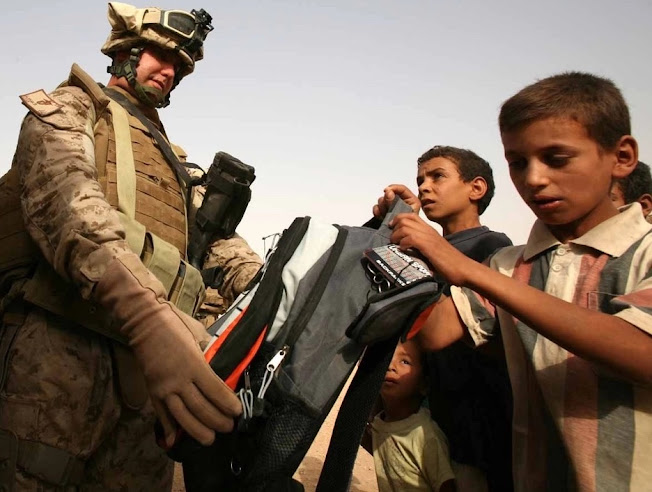

Staff Sgt. James Altman hands out book bags filled with school supplies to Iraqi children in Sahl, Al Assad, Iraq (Cpl. George Papastrat)
I finished this book in the midst of a pause in Israel’s war in Gaza against Hamas and heightened calls by President Biden for more restraint by Israel in its bombing campaign, which has been killing hundreds of civilians in Gaza. Unfortunately, as I write this, Israel has apparently ended the truce and ceasefire, and is bombing military and civilian targets again. Hostage negotiators in Qatar are suspending talks for now. Hamas seems to be succeeding in its efforts to create more violence and division in the region and beyond.

This week, the New York Times published a devastating report that Prime Minister Netanyahu’s government knew details about Hamas’s plan for an attack more than a year ago. Israel named the 40-page plan “Jericho Wall.” [It's a fraught name. Leading up to the attempted coup of at the U.S. Capitol of January 6, 2001, white Christian nationalists participated in Jericho Marches.]


Pre-MAGA conspiracist Proser is a gifted writer. His descriptions of the heat, stink, and noise of combat in Iraq and Afghanistan are gripping and powerful. Intentionally or not, readers get a nuanced view of what General Jim Mattis would do to achieve actual "peace through strength."


Proser, by the way, avidly promotes the Big Lie about elections, vaccination misinformation, and gender indoctrination conspiracies. His writings and repostings downplay the January 6, 2001, insurrection of the Capitol by white Christian nationalists and Trump supporters.


Trump, Mattis, and then-CJCS Joseph Dunford host a ceremony at Arlington National Cemetery, Virginia, for Memorial Day, May 28, 2018. (Sgt. Amber I. Smith)

In contrast, Mattis and retired General Joseph Dunford, former CJCS, each spoke out against the Big Lie and the J6 coup attempt on the same day of the insurrection.


Here's how CNN reported Mattis's and Dunford's position on J6:


"Trump's first secretary of defense, James Mattis, charged that Wednesday's 'violent assault on our Capitol, an effort to subjugate American democracy by mob rule, was fomented by Mr. Trump,' while Retired Gen. Joseph Dunford, the former chairman of the Joint Chiefs of Staff, told CNN that he believes 'our leaders who have continued to undermine a peaceful transition in accordance with our Constitution have set the conditions for today's violence.'"


Overall, Proser’s biography of Mattis is a rewarding read, although it unsurprisingly lacks the political analysis of the Mattis versus Trump relationship and Mattis’s unambiguous warning that Trump and Trumpism are a real and growing threat to the U.S. Constitution and the nation.


Top photo: Afghan civilians and Cpl. William C. Kaylor, 3rd Battalion, 3rd Marine Regiment, watch an MV-22 Osprey land at Forward Operating Base Geronimo, Helmand province, Afghanistan, July 14, 2010. (Sgt. Mark Fayloga)

Wednesday, September 11, 2019

Mattis on Preventing Leadership Failure

Review by Bill Doughty

General Jim Mattis, former Secretary of Defense, says a commander who hasn't read hundreds of books is functionally illiterate and will be a failure in a position of leadership.

In his new memoir, "Call Sign Chaos: Learning to Lead" (Penguin Random House, 2019), he writes, “If you haven’t read hundreds of books, you are functionally illiterate, and you will be incompetent, because your personal experiences alone aren’t broad enough to sustain you,” Jim Mattis writes in his memoir. 

“Any commander who claims he is ‘too busy to read’ is going to fill body bags with his troops as he learns the hard way,” Mattis says.

On Sunday's Global Public Square with Fareed Zakaria, Mattis explains: "Life is too short and leadership roles are too short ... to learn everything you need to know based on your own experience."

As a leader of Marines and Sailors, Mattis says many of his best "new" ideas came from old books. Reading not only quenched his thirst for knowledge but also sharpened his critical thinking skills and strategic competency.

"Everyone has got to lead in their own way," Mattis told Zakaria. "But I would say you have to have a curiosity about life, you have to have a thirst for learning. You have to be committed to your own development if you're going to be a leader."

Written with Bing West, "Call Sign Chaos" is a fast-paced, no-nonsense jog through Mattis's career, with a long focus on his role as a warrior and leader of warriors in what he calls the War of Terrorism (not Terror).

“Reading sheds light on the dark path ahead,” Mattis says. “By traveling into the past, I enhance my grasp of the present.” The book is meant for leaders in the military as well as in business, sports, politics or other endeavors.

Among the best parts of the Mattis memoir are the appendices, including his resignation letter to President Trump, a memo justifying awards for his troops, and an insightful article in Business Insider about Mattis's book and author suggestions.

Here are Mattis's recommended books when he served as Secretary of Defense:

"With the Old Breed: At Peleliu and Okinawa" by E. B. Sledge (1981)
"One Bullet Away: The Making of a Marine Officer" by Nathaniel Fick (2005)
"Dereliction of Duty: Johnson, Robert McNamara, The Joint Chiefs of Staff, and the Lies that Led to Vietnam" by H.R. McMaster (1997)
"Fighting Talk: Forty Maxims on War, Peace, and Strategy" by Colin Gray (2007)
"The Future of Strategy" by Colin Gray (2015)
"Military Innovation in the Interwar Period" by Williamson Murray (1996)
"Before the First Shot Is Fired: How America Can Win Or Lose Off The Battlefield" by Tony Zinni (2014) 
"Scipio Africanus: Greater Than Napoleon" by Basil H. Liddell Hart (1926)
"My American Journey" by Colin Powell (1995)
"The Forgotten Soldier" by Guy Sajer (1971)
"Long Walk to Freedom" by Nelson Mandela (1994) Gates of Fire by Steven Pressfield (1998)
"Duty: Memoirs of a Secretary at War" by Robert Gates (2014)
"The Lessons of History" by Will and Ariel Durant (1968)
"The Greatest Raid of All" by Lucas Phillips (1958)
"The Personal Memoirs of Ulysses S. Grant" by Ulysses S. Grant (1885) March of Folly: "From Troy to Vietnam" by Barbara Tuchman (1984) The Guns of August by Barbara Tuchman (1962)
"Alexander Hamilton" by Ron Chernow (2004)
"Rise and Fall of the Great Powers" by Paul Kennedy (1987)
"Meditations" by Marcus Aurelius (161-180 AD)
"Diplomacy" by Henry Kissinger (1994)
"World Order" by Henry Kissinger (2014)
"Defeat into Victory" by Viscount Slim (1956)
"Just and Unjust Wars" by Michael Walzer (1977)
"War, Morality, and the Military Profession" by Malham Wakin (1979)
"For Country and Corps: The Life of General Oliver P. Smith" by Gail Shisler (2009) "Sherman: Soldier, Realist, American" by Basil H. Liddell Hart (1929)
"The Rules of the Game" by Andrew Gordon (1996)
"The Far Pavilions" by M. M. Kaye (1978)

Earlier in his career, as a leader of Marines, Mattis recommended or required a variety of books for his warriors. Among the recommendations are these titles:

"Gates of Fire: Epic Novel of the Battle of Thermopylae" – Stephen Pressfield
"A Bell for Adano" – John Hersey
"One Bullet Away: The Making of a Marine Officer" – Nathaniel Fick
"Achilles in Vietnam" – Jonathan Shay
"The Crusades Through Arab Eyes" – Amin Maalouf 
"The Village" – Bing West
"The Utility of Force" – General Rupert Smith
"The Crisis of Islam: Holy War and Unholy Terror" – Bernard Lewis
"Jihad: The Rise of Militant Islam in Central Asia" – Ahmed Rashid
"Taliban" – Ahmed Rashid
"Imperial Grunts" – Robert Kaplan
"What Went Wrong?: The Clash Between Islam and Modernity in the Middle East" – Bernard Lewis
"From Beirut to Jerusalem" – Thomas Friedman
"Bear Went Over the Mountain: Soviet Combat Tactics in Afghanistan" – Lester Grau
"The Other Side of the Mountain: Mujahideen Tactics in the Soviet-Afghan War" – Ali Ahmad Jalali and Lester Grau
"The Savage Wars of Peace: Small Wars and the Rise of American Power" – Max Boot
"Soldiers of God: With Islamic Warriors in Afghanistan and Pakistan" – Robert Kaplan
"Taliban: Militant Islam, Oil and Fundamentalism in Central Asia" – Ahmed Rashid
"The Punishment of Virtue" – Sarah Chayes
"Afghan Guerrilla Warfare" – Ali Ahmad Jalali
"What Everyone Needs to Know About Islam" – John Esposito
"The Battle for God" – Karen Armstrong
"Islamism and its Enemies in the Horn of Africa" – Alex De Waal
"No God but God: The Origins, Evolution and Future of Islam" – Reza Aslan
"The Idea of Pakistan" – Stephen Cohen

This Marines' Marine also reads poetry. “Other Men’s Flowers,” an anthology by Lord Wavell, is one of his personal favorites.


Mattis on 9/11

At last year's 9/11 commemoration ceremony at the Pentagon, then-SecDef Mattis said, "We commit ourselves to remembering and honoring the lives that might have been. They endowed us forever with an enduring sense of purpose," he said, and "in their passing they empowered us."

On Sunday's Face the Nation, Margaret Brennan asked Mattis whether the Taliban can be trusted "to make a clean break with terrorists and honor a diplomatic deal."

Mattis responded, "Well, you're going to the heart of the issue right there: can they be trusted? You remember when we reduced nuclear weapons with Russia we talked about 'trust, but verify.' In this case with this group, I think you want to verify then trust. We've asked them – demanded – that they break with Al-Qaeda since the Bush administration; they've refused to do so," Mattis said. 

"They murdered three thousand innocent people. Citizens of 91 countries on 9/11. We should never forget that."

Friday, June 5, 2020

'To Unite Around a Common Purpose'

Trump and Mattis
By Bill Doughty––

This week, former Secretary of Defense retired Marine Corps General James Mattis spoke out against President Trump's threat to deploy militarized force against Americans peacefully protesting as part of their rights as guaranteed in the first amendment to the Constitution. 

In in op-ed for Foreign Policy and statement for other media outlets, Mattis wrote, "We do not need to militarize our response to protests. We need to unite around a common purpose. And it starts by guaranteeing that all of us are equal before the law." Protests throughout the United States and overseas are in the wake of the death of George Floyd, an African American, highlighting the need for greater equality and systemic police reforms.

Mattis joins a chorus of voices of respected leaders who are speaking out against misuse of the military and abuse of power by the commander in chief and his key staff. 

Trump –– along with his attorney general, secretary of defense and chairman of joint chiefs –– directed force be used to attack and remove peaceful protestors in and near Lafayette Park June 1 so the president could pose for pictures while holding a bible. Last week, Trump tweeted, "...Any difficulty and we will assume control but, when the looting starts, the shooting starts."

Prior to the photo-op, Trump spoke at the White House and threatened to "deploy the United States military" if mayors and governors didn't take brutal action to "dominate the streets." 

"As we speak," he said, "I am dispatching thousands and thousands of heavily armed soldiers, military personnel, and law enforcement officers to stop the rioting, looting, vandalism, assaults, and the wanton destruction of property."

Earlier in the day Trump held a phone call with governors in which he said, "General Milley is here, who's head of joint chiefs of staff, a fighter, a warrior, had a lot of victories and no losses ... And I just put him in charge." SECDEF Esper then told the governors, "We need to dominate the battle space."

In his op-ed, "In Union There Is Strength," Mattis wrote: "We must reject any thinking of our cities as a 'battlespace' that our uniformed military is called upon to 'dominate.' At home, we should use our military only when requested to do so, on very rare occasions, by state governors. Militarizing our response, as we witnessed in Washington, D.C., sets up a conflict —a false conflict — between the military and civilian society. It erodes the moral ground that ensures a trusted bond between men and women in uniform and the society they are sworn to protect, and of which they themselves are a part."

Mullen
His statement comes on the heels of a similar statement by former Chairman of the Joint Chiefs of Staff retired Navy Admiral Mike Mullen, published by The Atlantic the day after the incident in Lafayette Park. In an essay titled "I Cannot Remain Silent," Mullen wrote: "Our fellow citizens are not the enemy, and must never become so."

Mullen, a respected military leader, served as CNO and then as CJCS under both President George W. Bush and President Obama.

Mullen wrote, in part: "While no one should ever condone the violence, vandalism, and looting that has exploded across our city streets, neither should anyone lose sight of the larger and deeper concerns about institutional racism that have ignited this rage ... We must, as citizens, address head-on the issue of police brutality and sustained injustices against the African American community. We must, as citizens, support and defend the right—indeed, the solemn obligation—to peacefully assemble and to be heard. These are not mutually exclusive pursuits. And neither of these pursuits will be made easier or safer by an overly aggressive use of our military, active duty or National Guard."

Mullen’s successor as Joint Chiefs chairman, Army Gen. (ret.) Martin Dempsey, tweeted this week, “America is not a battleground. Our fellow citizens are not the enemy. #BeBetter.” Also speaking out on Twitter were retired Gen. Michael Hayden, former director of the CIA and NSA, and retired Gen. Tony Thomas, former head of Special Operations Command.

McRaven and Ash Carter
This morning, Adm. William H. McRaven, who served as the ninth commander of the United States Special Operations Command (2011-2014), spoke out on the "Morning Joe" show: “I was very pleased to see Jim Mattis, and obviously Adm. Mike Mullen, and today John Kelly come out and reinforce what we know to be the principles of the U.S. military,” McRaven said. “We all raise our right hand and swear an oath to the Constitution of the United States, it is not to the president of the United States, it is to the Constitution.”

“When you are in the military, there are three criteria for every decision we make: it has to be moral, legal and ethical,” McRaven said. “Ethical –– you have to follow the rules, legal –– you have to follow the law, and then moral –– you have to follow what you know to be right. And either way, that’s just not right.”

Allen
“You’re not going to use, whether it’s the military, or the National Guard, or law enforcement, to clear peaceful American citizens for the president of the United States to do a photo op,” McRaven said. “There is nothing morally right about that.”

Marine Corps General (ret.) John Allen, former commander of U.S. forces in Afghanistan, wrote in Foreign Policy this week, "To even the casual observer, Monday was awful for the United States and its democracy. The president's speech (calling for military deployment on American streets) was calculated to project his abject and arbitrary power, but he failed to project any of the higher emotions or leadership desperately needed in every quarter of this nation during this dire moment."

Among other leaders of character who are standing up and expressing their outrage about the events of June 1 is Steven J. Lepper, a retired Air Force major general, who served as Deputy Legal Counsel to the Chairman of the Joint Chiefs of Staff. Lepper wrote a thoughtful piece for The Hill about issuing and following unlawful orders and preventing misuse of the military.

Lepper
"Even before Monday," Lepper writes, "(Trump) has spent much of his time lavishing praise on the military, hailing himself as its savior, or pandering to it in ways that many have found embarrassing and, in some cases, abhorrent. Rather than treating the military as the professional organization it is and the element of national power it was intended to be, he seems to want it to be his friend. How else can anyone explain why he pardoned three accused American war criminals? By his own admission, he sought to shield these men — and, by extension, the rest of the military — from accountability on the battlefield. His 'I got your back' message was actually a slap in the face of every military professional who knows that right and wrong exist in combat."

Former defense secretaries Leon Panetta, Ash Carter and Chuck Hagel joined 86 other former Pentagon leaders in an open letter published in the Washington Post today. Yesterday, former SECDEF William Perry tweeted, "I am outraged at the deplorable behavior of our President and Defense Secretary Esper, threatening to use American military forces to suppress peaceful demonstrators exercising their constitutional rights. This is a deeply shameful moment for our nation."

Panetta and Stavridis
Navy Admiral (ret.) James Stavridis, former NATO Supreme Allied Commander Europe, wrote an essay for Time, saying, "The sweeping use of a combined civil-military force – D.C. police, Park Police, National Guard, and active duty military police – against the protesters to clear the way for a Presidential photo-op was beyond the pale of American norms. It was particularly ill-advised to include active duty military personnel in that event."

As usual, Stavridis puts recent events in the context of history: "Our founding fathers feared the use of a standing army that could be used to further the aims of a dictator."

"Our active duty military must remain above the fray of domestic politics, and the best way to do that is to keep that force focused on its rightful mission outside the United States," Stavridis writes. "Our senior active duty military leaders must make that case forcefully and directly to national leadership, speaking truth to power in uncomfortable ways. They must do this at the risk of their career. I hope they will do so, and not allow the military to be dragged into the maelstrom that is ahead of us, and which will likely only accelerate between now and November. If they do not stand and deliver on this vital core value, I fear for the soul of our military and all of the attendant consequences. We cannot afford to have a future Lafayette Square end up looking like Tiananmen Square."

In the book, "Civilian Control of the Military: Theory and Cases from Developing Countries," ed. by Claude E. Welch Jr. (State University of New York Press, Albany 1976), Welch warns against using the military in domestic civilian affairs. "Domestic violence tries the loyalty of the military to the government." Steps must be taken, he says, to "foster restraint on the part of civilian leaders." 

The book opens with advice from nearly two hundred years ago. General Maria von Clausewitz wrote that war is an instrument of state policy by an armed force created by the state, in our nation's case by "we, the people." Clausewitz writes what Welch calls "perhaps the strongest justification for civilian control over the military:
"The subordination of the political point of view to the military would be contrary to common sense, for policy has declared the war; it is the intelligent faculty, war only the instrument, and not the reverse. The subordination of the military point of view to the political is, therefore, the only thing which is possible."
Welch says that, in order to sustain civilian control over the armed forces, "Civilian politicians should follow policies of restraint in periods of domestic crisis." Policing should be left to police, including to quell the relatively few unfortunate violent and destructive acts in some cities. Also, Americans are smart enough to realize both: (1) the vast majority of law enforcement people are good and often heroic, and (2) due to systemic problems, there needs to be a fundamental reshaping of how "protect and serve" is carried out.

Mattis
Mattis's op-ed, like Mullen's and Stavridis's, leans heavily on history: "Instructions given by the military departments to our troops before the Normandy invasion reminded soldiers that "The Nazi slogan for destroying us...was 'Divide and Conquer.' Our American answer is 'In Union there is Strength.' We must summon that unity to surmount this crisis—confident that we are better than our politics."

Mattis concludes, "We can come through this trying time stronger, and with a renewed sense of purpose and respect for one another. The pandemic has shown us that it is not only our troops who are willing to offer the ultimate sacrifice for the safety of the community. Americans in hospitals, grocery stores, post offices, and elsewhere have put their lives on the line in order to serve their fellow citizens and their country. We know that we are better than the abuse of executive authority that we witnessed in Lafayette Square. We must reject and hold accountable those in office who would make a mockery of our Constitution. At the same time, we must remember Lincoln's 'better angels,' and listen to them, as we work to unite."

Saturday, December 22, 2018

Mattis/Washington & the Common Good

SECDEF James Mattis visits Sailors in Bahrain in March. (MC1 Bryan Blair) 
by Bill Doughty

When Secretary of Defense Gen. James Mattis announced his resignation this week it brought to mind the farewell speech by President George Washington, who similarly expressed his support to the Constitution, desire for other nations to become free allies, and rejection of totalitarianism.

Unlike Mattis's letter, George Washington's speech is typically dense, layered and flowery, which was the traditional style of writing at the time. Washington expresses his deep gratitude and offers this wish: 
"... that your union and brotherly affection may be perpetual; that the free Constitution, which is the work of your hands, may be sacredly maintained; that its administration in every department may be stamped with wisdom and virtue; that, in fine, the happiness of the people of these States, under the auspices of liberty, may be made complete by so careful a preservation and so prudent a use of this blessing as will acquire to them the glory of recommending it to the applause, the affection, and adoption of every nation which is yet a stranger to it."
Interestingly, just 65 years before the Civil War, Washington seems to see the coming divisions of North and South as well as differences between East Coast and the American West. He seems to present an early maritime strategy and an understanding of how trade and commerce can create national unity. 
"The North, in an unrestrained intercourse with the South, protected by the equal laws of a common government, finds in the productions of the latter great additional resources of maritime and commercial enterprise and precious materials of manufacturing industry. The South, in the same intercourse, benefiting by the agency of the North, sees its agriculture grow and its commerce expand. Turning partly into its own channels the seamen of the North, it finds its particular navigation invigorated; and, while it contributes, in different ways, to nourish and increase the general mass of the national navigation, it looks forward to the protection of a maritime strength, to which itself is unequally adapted. The East, in a like intercourse with the West, already finds, and in the progressive improvement of interior communications by land and water, will more and more find a valuable vent for the commodities which it brings from abroad, or manufactures at home. The West derives from the East supplies requisite to its growth and comfort, and, what is perhaps of still greater consequence, it must of necessity owe the secure enjoyment of indispensable outlets for its own productions to the weight, influence, and the future maritime strength of the Atlantic side of the Union, directed by an indissoluble community of interest as one nation. Any other tenure by which the West can hold this essential advantage, whether derived from its own separate strength, or from an apostate and unnatural connection with any foreign power, must be intrinsically precarious."
Washington's warning of "unnatural connection with any foreign power" is reinforced by his outright warning to remain vigilant against those who would drape themselves in the mantle of patriotism and threaten the democratic federal republic he, Jefferson and other founders created.

In her small but profound new book, "The Death of Truth" (Penguin Random House, 2018), Pulitzer Prize-winning author Michiko Kakutani, provides brilliant insights. Her epilogue examines Washington's warnings:
"George Washington's Farewell Address of 1796 was eerily clairvoyant about the dangers America now faces. In order to protect its future, he said, the young country must guard its Constitution and remain vigilant about efforts to sabotage the separation and balance of powers within the government that he and the other founders had so carefully crafted.Washington warned about the rise of 'cunning, ambitious, and unprincipled men' who might try to subvert the power of the people' and 'usurp for themselves the reins of government, destroying afterwards the very engines which have lifted them to unjust dominion.'He warned about the 'insidious wiles of foreign influence' and the dangers of 'ambitious, corrupted, or deluded citizens' who might devote themselves to a favorite foreign nation in order 'to betray or sacrifice the interests' of America."
Kakutani notes that America's founders embraced concepts of "common good," "common concerns" and "common cause." 
"Thomas Jefferson spoke in his inaugural address of the young country uniting 'in common efforts for the common good.' A common purpose and a shared sense of reality mattered because they bound the disparate states and regions together, and they remain essential for conducting a national conversation ... Jefferson wrote that because the young republic was predicated on the proposition 'that man may be governed by reason and truth,' our 'first object should therefore be, to leave open to him all the avenues to truth. The most effectual hitherto found, is the freedom of the press. It is therefore, the first shut up by those who fear the investigation of their actions' ... Without truth, democracy is hobbled. The founders recognized this, and those seeking democracy's survival must recognize it today."
Kakutani
Speaking of "common," Thomas Paine, the great agitator and critical thinker, brought reason and truth together in the unflowery and striking prose of "Common Sense," helping to bring freethinkers together against totalitarian Imperial Britain. 

What Americans can share together now is what Mattis's letter, Washington's address and Jefferson's words have in common: respect, devotion and loyalty to the Constitution and commitment to truth, justice, freedom and democracy.
Defense Secretary James N. Mattis and Chairman of the Joint Chiefs of Staff, Marine Gen. Joseph F. Dunford, Jr., brief reporters on the current U.S. air strikes on Syria during a joint press conference at the Pentagon in Washington, D.C., Apr. 13, 2018. (DoD photo by U.S. Army Sgt. Amber I. Smith.

Monday, February 20, 2017

C2 It: Mattis's Recommendation – Grant

Review by Bill Doughty

Mattis addresses the Naval War College
Secretary of Defense James Mattis, a former U.S. Marine Corps General, is known as a reader, leader and critical thinker – the so-called warrior monk.

Among the dozens of books he recommends as an avid reader, as reported in the Washington Post, is "Grant Takes Command: 1863-1865" (Little Brown and Company, 1968, 1969, and Castle Books, 2000).

Mattis says the book shows the importance of commanders' relationships, even more important than command relationships.

General Ulysses S. Grant, who would go on to become the 18th president, achieved command and control in a fractious environment in what, to date, has been the most fractious time in our nation's history: the Civil War fought to maintain the Union and end slavery in the United States.

General Ulysses S. Grant
On one hand, Grant was challenged with difficult generals such as Banks, Butler, Rosecrans and Thomas. Some of his subordinates were outrageously insubordinate or incompetent. Some went behind his back to members of Congress to complain or spread rumors about their adjutant general.

At the War Department, precursor of the Department of Defense, Grant found "... a crippling knot of jealousy, suspicion and self-seeking ... and furious back biting."

On the other hand, Grand had strong bonds with capable Generals like Sherman, Sheridan and Schofield (among many others) and with Navy Admiral David Dixon Porter, "whom Grant held in high regard." Most of all he had a good relationship with President Lincoln.

Lincoln depicted listening to Generals Sherman and Grant and Adm. Porter.
Catton, a Pulitzer Prize winning author and historian, shows that "Grant placed a high value on harmony ... and Lincoln placed a high value on Grant."

U.S. Grant, no grandstander or faker, was focused on substance over celebrity or appearance. He personified toughness. In the field, "The man seemed wholly unmilitary, not to say slouchy, and he went stumping about headquarters in an unbuttoned coat an a battered hat, head down, hands in pockets ... worn down by hard service," Catton writes. "Grant was not interested in parades."

Yet, his mind was sharp and focused, as evidenced by his writing and decisions in support of President Lincoln, including his commitment to bring harmony not only in the field but also to the nation. And "Grant was inclined to be optimistic" as he fought for a lasting peace.

Federal volunteers from Ohio form an honor guard.
Grant wrote, "The North and South could never live at peace with each other except as one nation, and that without slavery." He came to support African American Soldiers and integration of his Army, and he demanded equal treatment for prisoners of war, black or white.

Interestingly, "Grant had never been an antislavery man," Catton writes, "but he had said long ago the war for reunion must destroy slavery." The two simple but sublime points demanded by Grant and Lincoln to the South: "that the Union should be preserved" and "that slavery should be abolished."

Grant at City Point, Virginia in 1864.
To his boyhood friend and naval officer Dan Ammen, Grant wrote that any peace with the South must be unconditional: "A 'peace at any price' would be fearful to contemplate. It would be the beginning of the war. The demands of the South would know no limits. They would demand indemnity for expenses incurred in carrying on the war. They would demand the turn of all their slaves set free in consequence of war. They would demand a treaty looking to the rendition of all fugitive slaves escaping into the Northern states, and they would keep on demanding until it would be better dead than to submit longer."

Catton shows how Grant and his generals fought at places like Chattanooga, Spottsylvania/Cold Harbor and Fort Fisher, where the Navy and Army coordinated in amphibious warfare. His writing occasionally becomes almost McCullough-esque when describing Civil War battlefields. For example, at Cold Harbor, which, in the summer of 1864, was neither cold nor a harbor for warfighters:
"The Cold Harbor plain looked empty, and the fact that everybody knew that it ws not empty made it sinister, like the blank face of a dreadful haunted house. The ground was broken here and there by swamps and little ravines, in front of the Federal lines it rose after a few hundred yards to a low chain of flat hills, and all along this higher ground there was a scar on the earth – a trench of freshly turned dirt, zig-zagging in and out, disappearing in thin mist to right and left. It was marked by regimental flags, limp in the windless wet morning, and there did not seem to be anybody in it. Nobody was in the least deceived; and yet, except for the Rebel skirmishers, who were posted far out in front, the advancing Federals could see hardly any of their enemies. They could not see many friends, either, because there were gaps between the army corps, so that each division would have to fight its own battle. No Federal soldier could see more than a fragment of the field."
Battle of Spottsylvania
We see and feel the tension of media coverage during war in how General Meade punished a reporter (with the unfortunate name Crapsey) who misreported with what today are called "fake facts" about leadership in the Cold Harbor battle. Meade had him tied up, set backward on a mule and paraded around the camp wearing a big placard proclaiming him a libeler. In another case, Grant himself had to intercede when General Burnside wanted to shoot another reporter, named Swinton. Grant saved him, and Swinton got a one-way ticket back to Washington. "But (thereafter) neither Meade nor Burnside ever got any favors from the press."

Catton reveals how Grant and Lincoln kept an unswerving focus not on petty concerns but on the bigger picture: unconditional peace and a united nation with no slavery.

When the Confederacy's Gen. Robert E. Lee reached out to discuss ending the fighting, but with conditions, Grant and Lincoln remained resolute and tough. And when peace did come, Grant ensured there was no "poison" of reprisal against Lee and the South.

General Douglas MacArthur and President Harry Truman would take a similar approach with Imperial Japan 80 years, retaining the emperor as figurehead while helping Japan establish a constitutional democracy that embraced human rights and shifting power to the people.

General Mattis visited both Korea and Japan earlier this month to reaffirm U.S. support to both countries.

This book ends with the end of the Civil War and tragic assassination of President Lincoln, setting the stage for General Grant as a "stranger in a strange land," poised to find the next stage in duty to country.

Earlier this month the Associated Press reported that historian Ron Chernow is writing a "painstakingly researched" biography on Grant, due for publication in October 2017. Chernow is the author of "Hamilton," the book that inspired Lin-Manuel Miranda's historical and now historic broadway smash of the same name. Chernow's "Grant" is expected to reevaluate the life of the general and president who has been largely misunderstood and under-appreciated.

T.E. Lawrence of Arabia
Other recommended books by Mattis include T. E. Lawrence's "Seven Pillars of Wisdom," Stephen Pressfield's "Gates of Fire: Epic Novel of the Battle of Thermopylae," John Hersey's "A Bell for Adano," Bing West's "The Village," Karen Armstrong's "The Battle for God," Reza Aslan's "No God but God: The Origins, Evolution and Future of Islam," Bernard Lewis's "The Crisis of Islam: Holy War and Unholy Terror," and Tom Clancy's "Battle Ready."

Mattis's reading lists include several titles by authors familiar to readers of the Navy Reads blog: Robert Kaplan, Thomas Friedman, Bernard Lewis and Peter Bergen.