Showing posts sorted by relevance for query Jericho marches. Sort by date Show all posts

Friday, September 8, 2023

Joshuas ‘Preparing for (Civil) War’

Review by Bill Doughty––

They carried Trump banners, Gadsden and Confederate battle flags, and a sea of red-white-and-blue symbols on January 6, 2021. Some angry protesters-turned-rioters carried Bibles, crucifixion crosses, and signs that read “Jesus Is My Savior, Trump Is My President,” “Jesus Saves,” and “Gods, Guts, Guns.” Others carried Mary and Jesus statues and a picture of Nordic Jesus wearing a MAGA hat.

Also making an appearance among the icons, idols, and images: the red and white Deus Vult flag –– a symbol of the Christian Crusades. “Onward Christian soldiers…”


“Some of the most violent perpetrators wore vest patches with a portion of Psalm 144 that read ‘Blessed by God, My Rock Who Trains My Hands for Battle, My Fingers for War,” according to Dr. Bradley Onishi, author of “Preparing for War: The Extremist History of White Christian Nationalism –– What Comes Next” (Broadleaf Books, 2023).

“The Christian flags, symbols, rituals, and Bible verses gave the rioters’ actions a sense of divine permission, reassuring them that the desacralization of the Capitol was actually a sanctification of the American way. Through rituals of their White Christian nationalist faith, many insurrectionists rendered the profane act of desecrating the Capitol into a sacred act of reclamation on behalf of real Americans.”

Onishi, a scholar of religion, sees a strong likelihood for a violent future in the United States in the wake of the January 6, 2021 attack on the Capitol in which insurrectionists fought with law enforcement and threatened to assassinate the vice president and speaker of the house. But could he be wrong?


Host of the Straight White American Jesus podcast, Onishi can be considered “born-again-again.”


Like Dan Barker, Seth Andrews, Ryan Bell, Jerry DeWitt, Fred Phelps, Carter Warden, Jim Palmer, Daniel Miller, and Charles Templeton, Onishi is a former pastor or fundamentalist believer who turned away from religion and placed his faith in science, reason, and critical thinking.

Onishi’s book is essential reading for anyone concerned about the intrusion of religious fundamentalism in the form of white Christian nationalism into American institutions, including the military and government itself.


“January 6, 2021, is a day of infamy, a day that marks a Before and an After in American history, similar to the bombing of Pearl Harbor or 9/11,” Onishi says. “The difference with J6 is that the attack was a mob of Americans incited by the sitting president rather than a foreign enemy.”


“Recent data show that over 80 percent of white evangelicals are Christian nationalists, to some degree,” Onishi writes. “Not being willing … to separate cross and flag is Christian nationalism in a nutshell.” As has been said, not all Republicans, evangelicals, and Trump supporters are white Christian nationalists, but nearly all such believers are Republican Trump supporters.


”Americans have long conflated the kingdom of God and the nation state,” he says, citing the roles of Barry Goldwater, the John Birch Society, Reagan-era “Religious Right,” Pat Buchanon, Michael Flynn, Alex Jones, Russia’s Putin and Hungary’s Orbán, and Donald Trump, who embraces support of white Christian nationalists, calls a Ashli Babbitt a martyr, and promises to pardon J6 insurrectionists.


Tuberville with Marines at Quantico, 2021
In 2023 the United States military has been gut-punched by one senator who, in the name of his Christian beliefs, has held up hundreds of general and flag officers’ promotions and assignments because of abortion, adversely impacting military women’s access to reproductive health care. Sen. Tommy Tuberville (R-AL) previously refused to renounce white Christian nationalism, and he is against the DoD policy of allowing women service members to take leave and be reimbursed for abortions in a post-Roe-v-Wade world. Earlier this week, the three military service secretaries –– leaders of the Navy, Air Force, and Army –– addressed the issue in a Washington Post opinion piece, calling Tuberville’s obstruction a threat to national security. Regrettably, to date, Tuberville is refusing to back down on his impact to military readiness.

Tuberville is a vocal critic of what he calls a "woke" culture in the military. He and other far-right senators and representatives have called for a halt in rooting out extremists in the services' ranks. Last Wednesday, in an interview on FOX, Tuberville called out Secretary of the Navy Carlos Del Toro, to "get wokeness out of our Navy,” adding “We got people doing poems on aircraft carriers over a loudspeaker.” Tuberville's condescending view of poetry notwithstanding, at least one observer noted "The Star-Spangled Banner" was written on a warship.


“Preserving the holy trinity of family, god, and nation might be with the sacrifice of democracy itself,” Onishi warns. For “white Christian nationalists …the goal is domination, not dialogue or debate –– much less democracy.” In addition to an examination of the history of the movement, Onishi explores the roles of myths and conspiracies in white Christian nationalism.


“Unfortunately, conspiracy is now a mainstay in American politics,” he observes. Belief in the existence of a fundamentalist biblical god/angels, satan/demons, and heaven/hell, according to Onishi, is the ultimate conspiracy.

There is a similarity between the Big Lie (of a stolen election), Lost Cause (of North’s persecution of the South), and post-WWI Germany (of grievance and victimization) leading to Nazism. Violence against scapegoats, whether democrats, blacks, or jews, is part of a myth/conspiracy validation for violence.


As other examples, Shia identity is based on victimhood; Shia followers blame Sunni believers for the killing of Mohammed’s grandson Husayn in the seventh century, just one example of infighting in the Abrahamic religions based on grievance, superstition, and mythology. Even Buddhists and Muslims violently attack each other in Myanmar and Sri Lanka. And in 1923, Japanese people scapegoated and massacred thousands of people of Korean ethnicity in the wake of the Great Kantō earthquake.


Seeing other people as "Others," less than human, is at the root of biblical justification for slavery, Hutu/Tutsi violence, and countless other forms of genocide and inhumanity.


Shofar
In recent U.S. history, white Christian nationalists participated in Jericho Marches preceding the J6 attack. Some evangelicals who believe in myths and conspiracies, including the Big Lie, gathered –– blowing shofars (ram horns), and “marching as to war.” They praised the Bible story of Joshua. In that story, God supposedly ordered Israelites to kill Canaanites (men, women, and children) who didn’t believe in the same god, also commanding them to steal valuables for Him.

Joshua 6:19: “But all the silver, and gold, and vessels of brass and iron, are consecrated unto the Lord: they shall come into the treasury of the Lord.” Joshua 6:21: “And they utterly destroyed all that was in the city, both man and woman, young and old, and ox, and sheep, and ass, with the edge of the sword.” Joshua 6:27: “So the Lord was with Joshua; and his fame was noised throughout all the country.” (KJV)


“Any honest accounting of the January 6 insurrection –– one that takes seriously the religious symbols and language of the rioters –– must reckon with the very real sense in which many of the rioters … were reenacting key parts of the Jericho narrative,” Onishi writes. He reminds us how the Proud Boys gathered in prayer outside the Capitol and how QAnon Shaman Jacob Anthony Angeli Chansley led rioters in a Christian prayer in the Senate chamber.

“In essence, the January 6 insurrection was a religious ritual carried out by the Americans who believe they have a God-given right to rule the country. For them, a siege of the most important space in United States government was a crusade against the enemies of the United States. The framework that guided them was Christian nationalism. And the story of Jericho provides a window into the spiritual mechanics of the most traitorous attack on the country in modern history.”

Onishi takes a pessimistic view of what is yet to come.


“We now face a stark question: What if January 6 was not the end of an era but the beginning of one.” J6, he says, “was not the last stand of a dying faction. It was the first violent battle in what they foresee as the coming civil war.”


Parallels can be found in Hannah Arendt’s “The Origins of Totalitarianism” and her warnings of “the banality of evil.” Similar warnings about the rise of white Christian nationalism are found in works quoted throughout “Preparing for War” and in its extensive notes: “The Power Worshippers” by Katherine Stewart, “Jesus and John Wayne” by Kristin Kobes du Men, and “How Civil Wars Start” by Barbara Walter.


Onishi also sees a sociological parallel in the Great Migration of the last century, in which black Americans left the South, migrating North and westward, away from persecution and discrimination. He recommends Isabel Wilkerson’s “The Warmth of Other Suns: The Epic Story of America’s Great Migration.” Today, many white Christians are moving to the “American Redoubt:” Idaho, Montana, Wyoming, eastern Washington, and eastern Oregon, with Christian nationalist enclaves in Boise, Moscow, and Coeur d’Alene, Idaho. Could it be that such self-segregation will actually result in marginalization?


Tarrio
There are also some good reasons for optimism about the future and a return to reason: The changing of names of military bases and getting rid of Confederate monuments, the election of Georgia Senators Jon Ossoff and Raphael Warnock on January 5, 2021, and the arrests of more than one thousand J6 insurrections. Indictments have been handed down on alleged coup plot leaders, including the former president. Just this week, the leader of the so-called Proud Boys, Enrique Tarrio received a 22-year sentence for his role in the January 6 coup attempt. Grand juries, made up of U.S. citizens, have passed judgment against those who threaten democracy. There are active calls for more ethics enforcement, even within the Supreme Court and the president's family.

Yesterday, thirteen presidential libraries and foundations –– from Hoover through Reagan, Carter, both Bushes, and Obama –– made an unprecedented joint appeal on behalf of democracy, calling for more civility, respect for diversity, and protection of voting rights and representative government. The statement reads, in part:

"As a diverse nation of people with different backgrounds and beliefs, democracy holds us together. We are a country rooted in the rule of law, where the protection of the rights of all people is paramount. At the same time, we live among our fellow citizens, underscoring the importance of compassion, tolerance, pluralism, and respect for others...

"Each of us has a role to play and responsibilities to uphold. Our elected officials must lead by example and govern effectively in ways that deliver for the American people. This, in turn, will help to restore trust in public service. The rest of us must engage in civil dialogue; respect democratic institutions and rights; uphold safe, secure, and accessible elections; and contribute to local, state, or national improvement."

Perhaps there is reason for hope that more Americans will reject patriarchal authoritarianism and embrace free-thinking democracy, rule of law, accountability, and the ideals put forth in the United States Constitution.


“Onishi takes us on a sweeping yet personal journey through modern American religious and political history to understand the violent, extremist strains of white Christian America that led to the January 6th insurrection. With insight from hundreds of interviews, deep scholarship, and his own escape from white Christian Nationalism, Onishi’s Preparing for War is a clear account of what happened and clarion warning about what is coming. Compelling and timely.” – Andrew Seidel, Constitutional Lawyer at Americans United and author of "American Crusade: How the Supreme Court Is Weaponizing Religious Freedom."

Saturday, December 2, 2023

Best Friend, Worst Enemy: WWJD?

Review by Bill Doughty––

A Marine with a warrior heart must also have a trained mind, according to General James Mattis –– one of the key U.S. military leaders of this century. Among his many assignments, Mattis commanded the U.S. Joint Forces Command and U.S. Central Command. He led Marines in combat in Operations Iraqi Freedom and Enduring Freedom in the Middle East. And he served as the first Secretary of Defense in the Trump administration.


In his combat operations, Mattis faced jihadist enemies who ignored the rules and laws of war and put innocent civilians at risk, hiding behind women and children.

So, WWJD? What would Jim Mattis do –– if able –– about the situation now in Israel and Gaza? In “No Better Friend, No Worse Enemy: The Life of General James Mattis” (HarperCollins, 2018) author Jim Proser gives us a clue.


Mattis learned valuable lifelong lessons in Vietnam and its aftermath, as Marines and Sailors rescued refugees fleeing on small boats from Laos, Cambodia, and South Vietnam.

“The human aftermath of US political defeat in Vietnam and the ensuing political instability crowds every available inch of deck space around Mattis. They fill the seats hold of the ship, clutching their children and meager possessions, often shaking with fear and trauma. This is Mattis’s first real-world experience of war as a Marine. As soldiers of the navy, the first in and often the last out of smaller, third-world conflicts, Marines frequently end up with the responsibility for evacuation of war victims.”

Proser traces the arc of Mattis’s life, one dedicated to service, philosophy, and his fellow Marines and other service members. “No Better Friend” was published just months before Mattis resigned as SECDEF over differences with Trump (who later falsely claimed he fired Mattis).


The book concentrates on Mattis’s role in military operations, where we see his ethical leadership and humanism. The “Warrior Monk” –– callsign Chaos –– is against wholesale and indiscriminate warfare that ignores the effect on noncombatants. For example, after the Islamist attack of Sept. 11, 2001, Mattis recognized the danger of the Bush Administration’s race to invade Iraq under the pretense that Saddam Hussein was producing weapons of mass destruction.

“This rushed strategy by the Pentagon planners lacked deep thinking about the needs of the Iraqi people beyond their basic survival and provided few details on what Iraq’s tribes, communities, and cities would need after their country was invaded and their government overtaken. Mattis’s lifelong devotion to the study of philosophy and experience in occupied territories gave him a much keener sense of human needs, particularly in times of war. He could no more overlook the humanity of the Iraqis he would become responsible for under the rules of war than he could that of his own troops. In Mattis’s educated view, Iraqis and his occupying troops would have to form a community with specific physical, emotional, and spiritual needs.”

For Mattis, innocent families caught in the middle of war must have access to water, food, medicine, trash removal, and –– importantly –– education.


To some, "Peace through strength" means more violence and lethality; to Mattis and other thinking leaders, true strength rests in restraint, diplomacy, and ethical behavior and a clear warning to enemies against escalation.


Outside a medical clinic at Joint Security Station Douro, Iraq, Aug. 28, 2008. (PO2 Joan Kretschmer)

In the face of distrust and mistrust by local citizens in Iraq, Mattis instructed his Marines to show compassion and a helping hand, “first do no harm.” Proser says the general gave his Marines an extensive reading assignment leading up to engagement with the enemy. Mattis insisted “his Marines engage their minds before they engage their weapons.”


In a PBS interview in 2003, then-Major General Mattis said, “In other words, if the enemy tried to provoke us into a fight and that fight would cause innocent people to die, then we would forgo the fight. We would try to find a way to get them another day.”


In his “commander’s intent” instruction to troops on the eve of battle in Afghanistan, Mattis echoed lessons learned in Beirut and Baghdad: “We will be compassionate to all the innocent and deadly only to those who insist on violence, taking no ‘sides’ other than to destroy the enemy.”


“Show the people respect,” Mattis told his Marines.


At a school in Kandahar, Afghanistan, April 16, 2014 (Spc. Sara Wakai)
The least desirable outcome of war against an enemy is causing more animosity, hatred, and radicalization of the populace –– what Proser calls “a full-blown blood vendetta.”

The common enemy in the war on terrorism is Islamist extremism, which goes by many names: ISIS, ISIL, al-Qaeda, Hamas, and Hezbollah (literally, “the party of God”). A common denominator in the support of violent extremism is Iran. In an interview with MIHS Islander in 2017, Mattis said:

“Until the Iranian people can get rid of this theocracy, these guys who think they can tell the people even which candidates they get a choice of, it’s going to be very, very difficult. This is a regime that employs surrogates, like Lebanese Hezbollah to threaten Israel…

“The Iranian people are not the problem. The Iranian people are definitely not the problem; it’s the regime that sends agents around to murder ambassadors in Pakistan or in Washington DC. It’s the regime that provides missiles to Lebanese Hezbollah or the Houthi in Yemen…

“So, somehow, you don’t want to unite the Iranian people with that unpopular regime because if you pressure them both then they will grow together. We’ve got to make certain that the Iranian people know that we don’t have any conflict with them.”

Mattis says that if the people have economic and political alternatives and “a stake in the future” they will be less likely to pick up a gun and lash out.


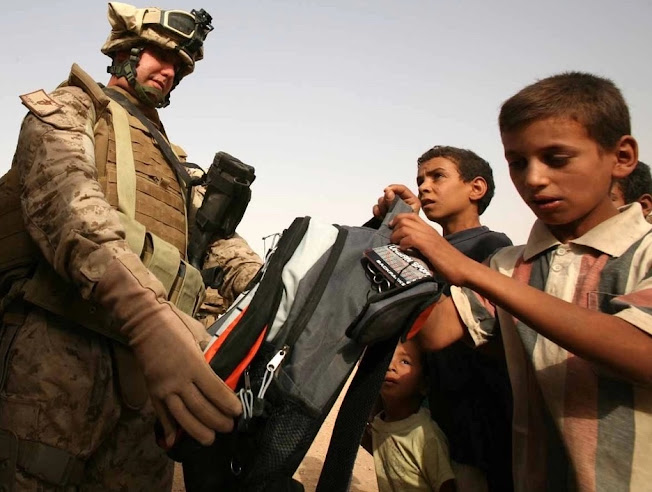
Staff Sgt. James Altman hands out book bags filled with school supplies to Iraqi children in Sahl, Al Assad, Iraq (Cpl. George Papastrat)
I finished this book in the midst of a pause in Israel’s war in Gaza against Hamas and heightened calls by President Biden for more restraint by Israel in its bombing campaign, which has been killing hundreds of civilians in Gaza. Unfortunately, as I write this, Israel has apparently ended the truce and ceasefire, and is bombing military and civilian targets again. Hostage negotiators in Qatar are suspending talks for now. Hamas seems to be succeeding in its efforts to create more violence and division in the region and beyond.

This week, the New York Times published a devastating report that Prime Minister Netanyahu’s government knew details about Hamas’s plan for an attack more than a year ago. Israel named the 40-page plan “Jericho Wall.” [It's a fraught name. Leading up to the attempted coup of at the U.S. Capitol of January 6, 2001, white Christian nationalists participated in Jericho Marches.]


Pre-MAGA conspiracist Proser is a gifted writer. His descriptions of the heat, stink, and noise of combat in Iraq and Afghanistan are gripping and powerful. Intentionally or not, readers get a nuanced view of what General Jim Mattis would do to achieve actual "peace through strength."


Proser, by the way, avidly promotes the Big Lie about elections, vaccination misinformation, and gender indoctrination conspiracies. His writings and repostings downplay the January 6, 2001, insurrection of the Capitol by white Christian nationalists and Trump supporters.


Trump, Mattis, and then-CJCS Joseph Dunford host a ceremony at Arlington National Cemetery, Virginia, for Memorial Day, May 28, 2018. (Sgt. Amber I. Smith)

In contrast, Mattis and retired General Joseph Dunford, former CJCS, each spoke out against the Big Lie and the J6 coup attempt on the same day of the insurrection.


Here's how CNN reported Mattis's and Dunford's position on J6:


"Trump's first secretary of defense, James Mattis, charged that Wednesday's 'violent assault on our Capitol, an effort to subjugate American democracy by mob rule, was fomented by Mr. Trump,' while Retired Gen. Joseph Dunford, the former chairman of the Joint Chiefs of Staff, told CNN that he believes 'our leaders who have continued to undermine a peaceful transition in accordance with our Constitution have set the conditions for today's violence.'"


Overall, Proser’s biography of Mattis is a rewarding read, although it unsurprisingly lacks the political analysis of the Mattis versus Trump relationship and Mattis’s unambiguous warning that Trump and Trumpism are a real and growing threat to the U.S. Constitution and the nation.


Top photo: Afghan civilians and Cpl. William C. Kaylor, 3rd Battalion, 3rd Marine Regiment, watch an MV-22 Osprey land at Forward Operating Base Geronimo, Helmand province, Afghanistan, July 14, 2010. (Sgt. Mark Fayloga)

Monday, February 16, 2015

'Pillar of Fire,' FBI Smoke – American Apartheid

Review by Bill Doughty
Shouts of "Allah-u Akbar!" and gunfire on a street in Los Angeles... Peaceful marches in the heart of the south... Violent extremism against white and black civil rights leaders... Police brutality, FBI surveillance and voting suppression...

Taylor Branch's "Pillar of Fire" opens with a fiery confrontation in South-Central LA in 1962 as Nation of Islam followers, police and civilians clash. Threaded throughout this book are themes of race, religion, war, abuse of power and assassination.
This second book in the trilogy about the history of the Civil Rights Movement continues Martin Luther King Jr.'s struggle and is interwoven with the life and death of Malcolm X. America was at a crossroads in the 1960s; the choice was between violence or nonviolence to bring about social change in the midst of fear of communism, growing conflict leading to war in Vietnam and misguided surveillance by the FBI. The surveillance was condemned by FBI Director James Comey in a very public and nuanced way last week.
Most of Branch's book centers on events in Mississippi, Florida, Georgia and Alabama, including Birmingham and Selma and in other key locations in the Deep South.
In the face of hate, beatings and murder, King, unlike Malcolm X, preached nonviolence:
"King urged his Savannah audience not to panic. 'We are on the move, and the burning of our churches will not deter us,' he cried. 'The bombing of our homes will not dissuade us. The beating and killing of our young people will not divert us ...' He preached a full rhythmic litany on marching that paused near ancient Jericho for a word of caution. There were 'no broad highways' or 'quick solutions' ahead, and 'it would be irresponsible' to say there were. 'Instead, the course we must follow lies through a maze of interrelated demands and counter demands, hopes and aspirations, fears and hatreds,' King said. 'But difficult and painful as it is, such a course must be charted.'"
Nation of Islam leader Elijah Muhammad and then disciple Malcolm X.
Malcolm X ridiculed King and the peaceful course he charted, calling him a "traitor to the Negro people" and mocking King's peaceful demonstrations. Malcolm X celebrated the crash of an Air France jetliner in June 1962 that killed more than 100 prominent white citizens, referring to them as "white devils," a term used by Nation of Islam founder Elijah Muhammad, in what Branch calls his "concocted version of Islam."
Seeking to understand and overcome hate, King said the growing calls for violence fomented by Black Muslims "gives me greater responsibility to help get rid of conditions that created such misguided and bitter individuals." Bitterness, hate and violence would lead to the assassination of Malcolm X by Nation of Islam followers, ironically after Malcolm had turned away from some of his earlier vitriol against King.
Branch works chronologically through the history and personalities of the era concurrent with the Civil Rights Movement: Cuba and the Soviet missile crisis, JFK's assassination, LBJ's "hypersensitive and erratic" behavior, changing politics in the South, and the growing disparity of haves and have-nots as voting rights are curtailed. Speaking in Berlin, Germany, a city then still divided by communism, King said, "We see the giants. We see massive urban societies, dominated by well-entrenched political machines that see new voters as a threat to their power."
King at the FBI after meeting with J. Edgar Hoover in 1964.
Communism was viewed by some as the greatest threat to the United States. Fear of communism (and racism) fueled J. Edgar Hoover and the FBI in their persecution of King. Simultaneously, fear of communists drove international policy in the Cold War that included covert raids in Southeast Asia, coups in South Vietnam and surveillance off the coast of North Vietnam in the mid-60s.

Confrontation in the Gulf of Tonkin involving USS Maddox (DD-731), joined by USS C. Turner Joy (DD-951), led to "police action" overseas. National Security Advisor McGeorge Bundy went to Vietnam and cabled LBJ that the country appeared to be "a civil war within a civil war."
Fifty years ago, at the same time that local actions by police in some southern states actively suppressed voting rights and freedom of assembly, "police action" in Vietnam, ostensibly in the name of freedom, continued to escalate.
A fake letter created by the FBI suggesting King commit suicide.
King, who opposed the Vietnam War, was awarded the Nobel Peace Prize in 1964. Heavyweight boxer Muhammad Ali, a follower of the Nation of Islam, was stripped of his title for his refusal to fight in Vietnam. Ali, originally closely tied with Malcolm X, eventually grew close to MLK. FBI wiretaps against Ali and King were revealed by newspaper columnist Carl Rowan.
On the first anniversary of JFK's assassination, the FBI attempted to kill King's character with a "recording of sex groans and party jokes, together with a contrived anonymous letter calling King 'a great liability for all of us Negroes.'" The fake letter by the FBI urged King to kill himself. Ben Bradlee, editor of Newsweek at the time, became locked in the middle of Hoover's FBI war against King and a burgeoning scandal when he refused to name his sources.
Branch writes, "Not until 1975, three years after Hoover himself was dead, did congressional investigations begin to uncover in retrospect the outlines of the FBI's covert crusade."
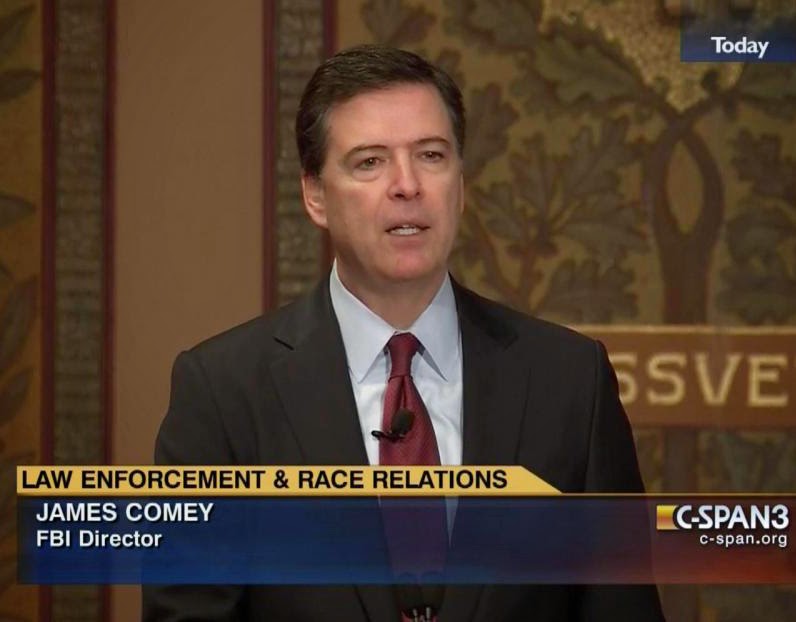
Last week, FBI Director James B. Comey spoke "hard truths" involving race and law enforcement. His remarks were delivered at Healy Hall, named after the university's 29th President, Patrick Francis Healy, who was born into slavery, in Georgia, in 1834.
Comey said:

"There is a reason that I require all new agents and analysts to study the FBI’s interaction with Dr. Martin Luther King, Jr., and to visit his memorial in Washington as part of their training. And there is a reason I keep on my desk a copy of Attorney General Robert Kennedy’s approval of J. Edgar Hoover’s request to wiretap Dr. King. It is a single page. The entire application is five sentences long, it is without fact or substance, and is predicated on the naked assertion that there is 'communist influence in the racial situation.' The reason I do those things is to ensure that we remember our mistakes and that we learn from them.

"One reason we cannot forget our law enforcement legacy is that the people we serve and protect cannot forget it, either. So we must talk about our history. It is a hard truth that lives on," Comey said.
Watts riots in Los Angeles, 1965. (Photo from Library of Congress)
"America isn’t easy. America takes work. Today, February 12, is Abraham Lincoln’s birthday. He spoke at Gettysburg about a 'new birth of freedom' because we spent the first four score and seven years of our history with fellow Americans held as slaves—President Healy, his siblings, and his mother among them. We have spent the 150 years since Lincoln spoke making great progress, but along the way treating a whole lot of people of color poorly. And law enforcement was often part of that poor treatment. That’s our inheritance as law enforcement and it is not all in the distant past.
"We must account for that inheritance. And we—especially those of us who enjoy the privilege that comes with being the majority—must confront the biases that are inescapable parts of the human condition. We must speak the truth about our shortcomings as law enforcement, and fight to be better. But as a country, we must also speak the truth to ourselves. Law enforcement is not the root cause of problems in our hardest hit neighborhoods. Police officers—people of enormous courage and integrity, in the main—are in those neighborhoods, risking their lives, to protect folks from offenders who are the product of problems that will not be solved by body cameras.
J. Edgar Hoover (photo art from Jewishcurrents.org)
"We simply must speak to each other honestly about all these hard truths.
"In the words of Dr. King, 'We must learn to live together as brothers or we will all perish together as fools.'
"We all have work to do—hard work, challenging work—and it will take time. We all need to talk and we all need to listen, not just about easy things, but about hard things, too. Relationships are hard. Relationships require work. So let’s begin that work. It is time to start seeing one another for who and what we really are. Peace, security, and understanding are worth the effort."
The full transcript of Comey's historic speech is available at FBI.gov.
As for Taylor Branch's masterful presentation in "Pillar of Fire," this review can only scratch the surface.

The Navy is mentioned several times in Branch's book. President Johnson ordered Secretary of Defense Robert McNamara to deploy military helicopters and Navy Divers – "Navy Frogmen" – to assist in a search for three missing civil rights workers.
Some other revelations and insights within its pages:
  • One of the last books Medgar Evers read before he was assassinated was Harper Lee's "To Kill a Mockingbird."
  • Birmingham, Alabama became known as "Bombingham." Violence there was condemned by Russia and the Vatican, especially after four girls were killed in a church bombing by white supremacists.
  • Author and activist James Baldwin called Selma, Alabama "one of the worst places I ever saw."
  • Alex Haley, U.S. Coast Guard veteran and Malcolm X biographer, developed a bond with Malcom X over a "mutual love of Shakespeare."
  • Malcolm X disparaged baseball great Jackie Robinson for not being more strident; Robinson returned the favor, saying Malcolm X was only interested in revenge and retaliation.
  • Around the same time MLK was named for the Nobel Peace Prize in 1964, Malcolm X was studying Islam at the University of Saudi Arabia, tutored in Sunni Islam.
  • LBJ zealously read "The Rich Nations and the Poor Nations" by Barbara Ward, which inspired his slogan, "Great Society" focusing on poverty, education and environment.
  • Civil rights demonstrators were tortured: hung by handcuffed arms at Parchman Penitentiary; put in concrete sweatboxes, chicken coops and miniature cells in St. Augustine, Florida; and beaten with blackjacks, kicked and shocked with cattle prods by police and sheriffs.

In 2011 Navy Reads featured a review of the first book in Branch's trilogy, "Parting the Waters," entitled "Deeply Rooted in the American Dream."