Tuesday, October 19, 2021

The Will of an ‘Unruly Torrent’

Review by Bill Doughty––

Venerable thinker George Will unleashes a storm of opinions in “American Happiness and Discontents: The Unruly Torrent, 2008-2020" (Hachette Books, 2021), proving he is still sharp in his observations while cemented in his positions of right and wrong.


This is a book of nearly two hundred essays about everything from military history and life-and-death issues to Will’s thoughts about the Beach Boys, Baptists, baseball, and blue jeans. (Regarding the latter, he claims to have only one pair, worn only once. He believes men should dress like Fred Astaire, women like Grace Kelly.)

While Will shares some acerbic humor, mostly he offers a ribbon of melancholy that ties these essays together. So many in this collection are devoted to past wars and their aftermath. Others lament culture wars still happening. And a final section, “Farewells, Mostly Fond,” features obituaries, including to fellow conservatives William F. Buckley, Charles Krauthammer, Gerald Ford, and George H.W. Bush, as well as, surprisingly, liberal-of-liberals George McGovern.


The most poignant remembrance is the final essay in the book, written July 6, 2008. Will honors the memory of Army Lieutenant Colonel Jim Walton, killed in Afghanistan. The essay is also a tribute to casualty assistance calls officers, CACOs, including LtCol Walton’s spouse, Sarah, herself a CACO who had to receive the terrible news of her husband’s death.


An epigraph by CACO Maj. Steve Beck, United States Marine Corps, at the beginning of the Walton essay contains a “found haiku”:


...curtains pull away.

They come to the door. And they

know. They always know


George Will concludes his Walton essay –– and his book –– with this:

“When the Army CACOs came to the Arlington door or Sara Walton, my assistant, she was not there. She rarely forgot the rule that a spouse of a soldier in a combat zone is supposed to inform the Army when he or she will be away from home. This time Sarah forgot, so it took the Army awhile to locate her at her parents’ home in Richmond.

“Her husband, Lieutenant Colonel Jim Walton, West Point Class of 1989, was killed in Afghanistan on June 21. This week he will be back in Arlington, among the remains of the more than 300,000 men and women who rest in the more than 600 acres where it is always Memorial Day. This is written in homage to him, and to Sarah, full sharer of his sacrifices.”*

George Will
Sacrifice on behalf of the nation is tied to the ribbon of sadness in the nearly 500 pages of this collection.

Will writes in “A Nation Not Made by Flimsy People” of the grit required to win the Revolutionary War. Readers will be reminded of the great historian David McCullough’s “1776,” one of the first books we featured on Navy Reads.


In “The Somme: The Hinge of World War I, and Hence of Modern History” he contextualizes the “reverberations” of that war. The First World War influences Will’s thinking and inspiration for topics, including in the penultimate essay, “The Last Doughboy.”


In “Haunted by Hue” and “Vietnam: Squandered Valor” he properly acknowledges the sacrifices of brave young Americans, while castigating the mendacity of the power structure that sent them to a war that was ultimately a “tragedy,” including for the people of Vietnam.


Color guard of 442nd in 1944

In “The 442nd,” written in 2010, he pays tribute to the most decorated unit for its size in American history, the Japanese-American soldiers who fought against Fascism and Nazism in Europe in WWII while many of their families were imprisoned in internment camps back in the States. George Will met some of these patriotic veterans.

“Such cheerful men, who helped to lop 988 years off the Thousand Year Reich, are serene reproaches to a nation now simmering with grievance groups that nurse their cherished resentments. The culture of complaint gets no nourishment from men like these who served their country so well while it was treating their families so ignobly. Yet it is a high tribute to this country that it is so loved by men such as these.”

Will has no time for political correctness and what’s now called “cancel culture.” He takes on some of the debates about political and social topics dominating college campuses. On the other hand, he also has no tolerance for racism, terrorism in the name of religion, and attacks on democracy.


He shows how the values of Frederick Douglass won out over Woodrow Wilson's bigotry. But he has little compassion or understanding for renaming professional sports teams such as the former Washington Redskins or for “coercing” bakers who refuse, for religious reasons, to provide a cake for a same-sex wedding. 


He celebrates books and “binge reading” while condemning new technologies and platforms that rewire the brains of young people, shorten attention spans and erode the ability to think critically and independently.

To say George Will is sometimes like the grouchy old man yelling at youngsters to get off his lawn is to state the obvious. But he cares about what he believes in, and he communicates with passion and conviction. His ribbon leads through a pursuit of happiness that ends ultimately to a reward for readers.


*(Lost at first reading is George Will’s epigraph to the entire book: “For Sarah Walton –– To whom I am indebted for her many years of indispensable assistance. And to whom the nation is indebted.”)


Grieving and Honoring
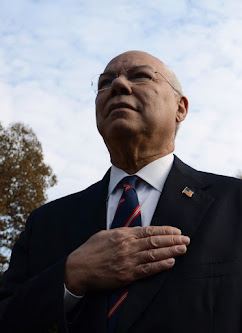

Colin Powell
I finished this book as I heard the news of an icon of conservative leadership passed away: former Secretary of State and Chairman of the Joint Chiefs of Staff Gen. Colin Powell. Flags fly at half staff for the great principled patriot and warrior-diplomat. But General Powell would want us to pay tribute to the person he most looked up to and respected in his life, his wife Alma. Powell told author Bob Woodward that Alma was his moral compass and inspiration.

Alma Powell is sponsor of USS Kearsarge (LHD-3). She is also the namesake of Kearsarge's airfield. 


According to the Navy, "Throughout her life of civic leadership [Alma] Powell has helped young people in need of educational resources for more than four decades. While serving as Chair of the Board of Directors for America’s Promise Alliance, a non-profit organization dedicated to improving the education opportunities of disadvantaged children, Ms. Powell helped to lead more than 450 partner network’s efforts to help tens of thousands of young people by connecting them with resources essential for academic success."


Capt. Neil Koprowski, commanding officer of the Wasp-class amphibious assault ship USS Kearsarge (LHD 3), delivers remarks during an airfield dedication ceremony in honor of Alma J. Powell, May 28, 2021. Alma Powell, Kearsarge’s ship sponsor, is a military spouse, a civic leader and civil rights activist who has advocated for women, children, and minorities for more than four decades, and has helped tens of thousands of disadvantaged people around the world. (MCSN Gwyneth Vandevender)

TOP PHOTO:
Gen. Colin L. Powell speaks at the 26th National Memorial Day Concert on the West Lawn of the U.S. Capitol in Washington, D.C., May 24, 2015.to help unite the country in remembrance and appreciation of the fallen and to serve those who are grieving. (MC1 Daniel Hinton)

Thursday, October 14, 2021

Filling in Gaps in ‘How the Word Is Passed’

Review by Bill Doughty––

At the beginning of “How the Word Is Passed: A Reckoning with the History of Slavery across America” (Hachette Book Group, 2021) author Clint Smith introduces us to Navy veteran David Thorson.


Thorson serves as a tour guide and teacher at Thomas Jefferson’s plantation home outside Charlottesville, Virginia. Smith learns that “prior to becoming a tour guide at Monticello, David served for more than thirty years in the U.S. Navy.”


Monticello
David Thorson’s “peach face, reddened from all the hours spent standing in the sun, was clean-shaven … He spoke with a calm evenhandedness that invited people into discussion, like a professor.”

According to Smith, Thorson became a docent and tour guide at Monticello after retiring from the Navy because of his love of history and interest in Thomas Jefferson.


While giving a tour focusing on Jefferson’s relationship to slavery, Thorson addresses the visitors:

“Slavery’s an institution. In Jefferson’s lifetime it becomes a system. So what is this slave system? It is a system of exploitation, a system of inequality and exclusion, a system where people are owned as property and held down by physical and psychological force, a system being justified even by people who know slavery is morally wrong. By doing what? Denying the very humanity of those who are enslaved solely on the basis of the color of their skin.”

Smith recounts, “In just a few sentences, David had captured the essence of chattel slavery in a way that few of my own teachers ever had.”


During the tour Smith notices how Thorson chooses to refer to the enslaved black people as “human beings” rather than “slaves.” Smith writes, “What reverberated throughout was the humanity of the enslaved people –– their unceasing desire to live a full life, one that would not be defined simply by their forced labor.”

Frederick Douglass
For his part in “How the Word Is Passed,” Smith brings in luminaries from history such as Frederick Douglass and W.E.B. DuBois, as well as respected historians Eric Foner, Annette Gordon-Reed, and Kenneth M. Stampp, to fill in some of the gaps of enslaved people’s lives. Smith presents information to settle debates about the impact of slavery on African Americans, from the founding of the nation through the Civil War and Emancipation and even through the era of Jim Crow, when many whites in southern states still longed for the Lost Cause of the Confederacy.

When it comes to debates about critical race theory or Big Lie / Lost Cause –– and even anti-vaccination stances –– it’s important to not only present facts and tell the truth but also be understanding and empathetic in how you talk to people. According to Smith:

“David sees it as essential that a guide be able to find the balance of telling the truth and not pushing people so much that they shut down. He told me that when you challenge people, specifically white people’s conception of Jefferson, you’re in fact challenging their conception of themselves. ‘I’ve come to realize that there’s a difference between history and nostalgia, and somewhere between those two is memory,’ he said. ‘I think that history is the story of the past, using all the available facts, and that nostalgia is a fantasy about the past using no facts, and somewhere in between is memory, which is kind of this blend of history and a little bit of emotion … I mean, history is kind of about what you need to know … but nostalgia is what you want to hear.'”

“What would it take –– what does it take –– to confront a false history even if it means shattering the stories you have been told throughout your life?” Smith asks. “Even if it means having to fundamentally reexamine who you are and who your family has been?”


Smith says the search for truth is worth the pain. “Just because something is difficult to accept doesn’t mean you should refuse to accept it. Just because someone tells you a story doesn’t make that story true.”

In the 1930s and 40s, black men dressed as slaves conducted tours of Monticello, so hearing about David Thorson is evidence of progress, but Smith is careful about too much celebrating about that progress.


“When I think about the history of slavery and racism in this country, I think about how quick we are to expose notions of progress without accounting for its uncertain and serpentine path,” Smith says, reflecting on a visit with his grandparents to the National African American History and Culture Museum. 

In this thought-provoking book Clint Smith travels from Monticello to the Smithsonian’s NAAHCM in Washington, D.C. And he also visits the Whitney Plantation in Wallace, Louisiana; Angola Prison in Louisiana; Blandford Cemetery in Petersburg, Virginia; Monument Avenue in Richmond, Virginia; Galveston Island, Texas; Wall Street and Ellis Island, New York City; and Gorée Island, Dakar, Senegal, Africa.

His journey backtracks the route black Africans took as chattel slaves brought to the colonies in the Americas to create and maintain an economy based largely on cotton, tobacco, and sugar.


Smith’s goal on his trip is to fill in the blanks of history and gaps that separate people. He fills in those blanks and gaps with information, truth, and understanding.


With a journalist’s ear and poet’s eye, he takes readers to uncomfortable places and truths.

  • We confront the fact that Thomas Jefferson kept hundreds of humans enslaved; he also separated families, removing children even under the age of ten from their mothers and fathers.
  • We go to the Whitney Plantation, site of a slave revolt in 1811 on the heels of the Haitian Revolution of 1803; at Whitney, whites decapitated 55 slaves and displayed their heads on posts.
  • We ride to Galveston, Texas, considered by some as the site of the end of slavery and beginning of celebrations now known as Juneteenth.
  • We take a behind-the-scenes tour of Angola, where Smith reveals how mass incarcerations have roots in slavery.
  • We get a comparison of the now-removed Robert E. Lee statue in Richmond with the Statue of Liberty, designed by a French abolitionist –– and we’re reminded that Lady Liberty stands on broken chains as she stands for truth, justice, and democracy.
  • Finally, Clint invites readers with him for an emotional return to Africa as he examines remnants of colonialism and the role of history in accurately reflecting what was once a “system of plunder,” slavery and colonial rule, where “white sugar [and white cotton] means black misery.”

The Statue of Liberty stands for freedom from slavery and the promises of July 4, 1776. (NPS)

Clint Smith
Along Smith’s remarkable journey, he introduces us to individuals who earned their right to provide perspective and context, people like Angola’s Norris Henderson, NYC’s Damara Obi, Dakar’s Hasan Kane, Smith’s grandparents, and Monticello’s David Thorson.

Near the end of his visit to Jefferson’s plantation, Smith seeks out Thorson to get more insight and fill in more gaps.


Smith is intrigued by Thorson’s wisdom about the reality of human imperfection and Thorson’s view on “an idea worth fighting for.”


Smith writes:

“Before I left, I wanted to understand how much David’s role as a former military officer –– responsible for protecting and promoting this country’s foreign policy agenda at home and abroad –– was something that felt, if at all, in tension with his role now. ’I was born in the United States of America. I served the country for thirty years, so I actually believe in the idea of America,’ he said, straightening up in his chair. ‘Are we exceptional? No. Have we had unique advantages based on geography, based on a whole host of factors? Yes. Did a group of people come together in 1776 and conceive of an idea that was pretty radical in its time and then create a system of government, through the Constitution and its amendments, that was pretty radical and pretty novel? Yeah. Have other countries found their own way? Sure. So I believe in the idea of America. I don’t believe that this country was perfect. I don’t believe it is perfect. I don’t believe it’s going to be perfect. I believe that the journey to make this a better place is worth the effort and that the United States, if you conceive it not so much as a place to be in but an idea to believe in, it is worth fighting for.'”

Democracy is safe when it’s protected. Truth, honest reflection, and the pursuit of justice must be at the heart of “how the word is passed.”


President Barack Obama and President François Hollande of France tour Monticello, the home of Thomas Jefferson in Charlottesville, Va., with Leslie Bowman, President of the Thomas Jefferson Foundation, Feb. 10, 2014 (Official White House Photo by Chuck Kennedy)


Wednesday, October 6, 2021

WHY Constitution Gets Your Vote

Review by Bill Doughty

There’s a key reason Sailors, Marines and other uniformed guardians of democracy pledge they “will support and defend the Constitution of the United States against all enemies, foreign and domestic … [and] will bear true faith and allegiance to the same…”

The Constitution provides a blueprint for balance of power, but it must be respected, supported, and defended. And, according to law professor Kim Wehle, author of “How to Read the Constitution and WHY” (HarperCollins, 2019), we must have accountability when the Constitution is violated in order for government to be effective and to prevent the rise of autocracy.


“Let’s be clear about one thing, for starters: The Constitution is not a bulwark,” Wehle writes. “By this I mean it does not erect an impenetrable wall around the citizens of the United States to defend them against tyranny and abuses. It is porous. It needs shoring up from time to time.” The ultimate accountability: people’s votes.


Wehle
Professor Wehle is a former associate independent counsel under Independent Counsel Kenneth Starr during the Whitewater investigation of Bill Clinton and Hillary Rodham Clinton in the early 1990s, leading to the Monica Lewinsky investigation and impeachment of President Bill Clinton.  


Wehle writes, “This is a book about the Constitution. If you’re looking for something to confirm your side of things politically, you might be wasting your time.” Instead of a political rant, Wehle teaches about the history, philosophy, and structure of the document and how it has been amended and interpreted over time.


Think about how the Constitution has evolved. When first written in 1789, the Constitution, for the most part, was for wealthy white men. Most African Americans were owned by other Americans, including some of the framers. And women would not be allowed to vote till 1920.


The United States Constitution was put on public display for the first time Sept. 17, 1970. (National Archives)
It took amendments to the Constitution and action as permitted by the Constitution to bring about progress for people: laws and acts passed by Congress and the states; orders and actions initiated by the Executive, including the president; and judgments and rulings passed by courts, including the Supreme Court.

Wehle not only outlines how the Constitution is constructed, but she also explains how it can be interpreted. Words can have more than one meaning, and she argues that’s part of the built in flexibility in the nation’s founding document.


“Strange as it sounds, reading the Constitution is a lot like reading poetry. Why? Because poetry requires careful focus on individual words as well as analyses of competing meanings.” Wehle says, “There is no such thing as a plain reading of the Constitution.

What is “necessary,” “essential,” “useful,” or “general welfare”? What about the meaning of these verbs: “prohibit,” “abridge,” or “respecting,” which Wehle says is “the broadest verb of all.” Even how commas are used can punctuate controversy over meaning; just read the Second Amendment and consider the commas and their relation to “a well regulated Militia.”


Sailors assigned to USS Constitution march(SN Michael Achterling)
Military readers will find interesting discussions about the right to wage war, lines of enforcement and chain of command, rights of women, and rights for battlefield chaplains. 

For example:

  • Tension between Article I granting Congress the power to declare war and Article II naming the president the commander in chief of the armed forces. Wehle compares the example of “the bombing of Pearl Harbor to authorize America’s entry into World War II” with Congress’s “ongoing funding for the armed forces, thereby leaving the president free to ‘execute’ that declaration…”
  • Discussion about the War Powers Resolution passed in 1973 after the Vietnam War. “The president may introduce armed forces only pursuant to (1) a declaration of war, (2) a specific statute, or (3) a national emergency created by attack upon the United States.”
  • How departments and federal agencies within the executive branch (including the Department of Defense) interact with each other and other branches –– legislative and judicial. Wehle discusses interrelated but distant lines of enforcement responsibility meant to create a balance-of-power safety net but which sometimes acts as a sticky web that bogs down action.
  • “The so-called war on terror under President George W. Bush,” when his administration drafted a set of “torture memos” and “authority to torture or to spy on U.S. citizens without a warrant.”
  • The unconstitutionality of excluding women from military academies. In 1996 the Supreme Court “reasoned that the male-only policy at the Virginia Military Institute was based on gender stereotypes.”
  • Underlying tensions within the First Amendment, providing that “Congress shall make no law respecting an establishment of religion, or prohibiting the free exercise thereof.” Wehle writes, “If the government makes a law to facilitate the free exercise of religion –– by providing religious ministers to soldiers during battle, for example –– it could be criticized for ‘establishing’ religion. If it refuses to do so on First Amendment Establishment Clause grounds, it could face ‘free exercise’ challenges from soldiers stuck on foreign soil without access to ministers due to government’s decision to deploy them.”
  • No monarchs, dictators, or military rule –– not only federally but within any of the states. Such a system is unconstitutional; “Elections are the only way of doing business” both at the federal and state level.
  • Wehle explores controversial topics, including abortion and privacy, race, gender, sexual orientation, immigration, voter suppression, “dark money” influencing Congress, originalist vs. activist views of courts, and a continuing amassing of power by the Executive, with ineffective checks by the Congress and the courts.

    Published more than a year before the insurrection by Trump supporters, who attacked police and guards at the nation’s Capitol on January 6, Wehle seems to warn about the threat of such an event as she raises concerns about a rising threat of authoritarianism and autocracy –– and need for accountability.

    “It is no exaggeration to say that in the twenty-first century, the structure of the Constitution is being tested like never before. There are several reasons for this … But mostly, the Constitution’s structure is being tested by the absence of accountability. The Constitution sets up three branches of government –– the legislative, the executive, and the judicial –– and makes no one person or group of persons in charge of everyone. If one branch breaks rules, the other two stand ready to hold the rule breaker accountable. That way, nobody amasses too much power, which would be a recipe for tyranny.”

    Wehle warns passionately of challenges in the era of smart phones and social media –– very relevant in light of current revelations by Facebook whistleblower Frances Haugen on CBS 60 Minutes and in testimony to Congress. Haugen, like Wehle, sees some use of algorithms of hate, anger, and fear as a threat to democracy. 


    Wehle also warns of a “next frontier” of artificial intelligence with sophisticated face recognition technologies.


    Without an effective legislature, fair judiciary, and responsible executive, Wehle warns, “There is a real chance of democracy failing in our lifetimes, with tyranny taking its place.”


    Yet, Wehle writes with hope: “If you take nothing else away from this book I hope you take away an appreciation of how we cannot take the Constitution for granted.”

    The oath to support and defend the Constitution includes, at least intrinsically, a promise also to be accountable and to cast a vote for greater accountability.


    “Rights and freedoms provided by the Constitution are like winning the lottery,” Wehle says, “But as with a lottery ticket, we need to cash in that windfall for the piece of paper to retain its value, and that means voting.”


    U.S. Marine 1st Lt. Jorge Luis B. Diaz with 7th Engineer Support Battalion, 1st Marine Logistics Group, participates in the Federal Voting Assistance Program at Marine Corps Base, Camp Pendleton, CA, Jan. 11, 2018. VFAP provides training for installation and unit voting officers to ensure service members, their eligible family members and overseas citizens are aware of their right to vote and have the tools and resources to successfully do so –– from anywhere in the world. (Cpl. Andre Heath)

    TOP PHOTO: 
    Capital Guardians provided crowd management and traffic control in support of local and federal agencies during the 57th anniversary of the March on Washington Aug. 28, 2020. The mission highlighted the D.C. National Guard’s commitment to ensure District citizens and visitors had the right to practice their First Amendment rights. Soldiers and Airmen worked alongside the Metropolitan Police Department, the Washington Metropolitan Area Transit Authority (WMATA) Metropolitan Police Department, D.C. Fire & Emergency Medical Services Department, D.C. Homeland Security and Emergency Management Agency. (TSgt Arthur Mondale Wright)

    Friday, September 24, 2021

    ‘Our Team’ of Guardians

    Review by Bill Doughty––

    Navy and Marine Corps veterans play a pivotal role in bending the arc of history toward justice in “Our Team: The Epic Story of Four Men and the World Series that Changed Baseball” by Luke Epplin (Flatiron Books, 2021).

    Sailors and Marines as guardians of democracy have key roles in this fascinating book about baseball’s history. It’s a timely book as the team from Cleveland plays its last home game as the “Indians” September 27. The team has been renamed the “Guardians,” as announced by the team owner Paul Dolan and as presented in a powerful video by Tom Hanks*.


    Seventy-five years ago the Cleveland team was led by owner Bill Veeck, who enlisted in the United States Marine Corps after Imperial Japan attacked Pearl Harbor/Oahu (and after Veeck said he saw the military drafting young fathers). Veeck would be wounded in an artillery accident at Bougainville in the South Pacific and would return to quickly rebuild the postwar Cleveland Indians.


    Feller takes the oath from boxer Gene Tunney and joins the Navy.
    Cleveland’s star pitcher and a national sports icon was Bob Feller. After the attack on Pearl Harbor, Feller signed up for the Navy at the encouragement of heavyweight boxing champion Gene Tunney, who told Feller he would help recruit young Americans if he, too, joined. Feller reported to gunnery school and became a chief petty officer in charge of an antiaircraft battery aboard USS Alabama (BB 60). He served in the North Atlantic and South Pacific.

    Larry Doby in WWII
    One of the team’s eventual top hitters and outfielders worked his way up from the Negro Leagues and became the first African American in the American League: Larry Doby. (Doby would forever be in the shadow of Jackie Robinson, the first African American to break the color barrier and play in Major League Baseball.)

    Veeck (rhymes with “heck”) would eventually lose part of his leg to his war injury. He was known as one hell of a showman. Epplin calls him “the most eccentric and forward-thinking executive of his era.” Veeck brought fireworks, gate prizes, bands, clowns, vaudeville acts, tightrope walkers, and quiz shows to baseball stadiums. He oversaw the planting of ivy along Wrigley Stadium. He was one of the first owners to embrace radio broadcasts and night games. Later in his career, Veeck famously recruited 3'7" little person Eddie Gaedel to bat, creating an impossible strike zone for the opposing pitcher.


    In the mid 1940s, Veeck, the Marine Corps Veteran, took a swing at integrating baseball and connected. He recruited Negro Leagues veteran pitcher Satchel Paige and Navy veteran Larry Doby as well as Major League Baseball’s first black executive, Louis Jones, the Cleveland team’s director of public relations.


    Satchel Paige and Bill Veeck
    Jackie Robinson, Army vet.
    The great Jackie Robinson is justifiably honored as the first African American to play in the major leagues, recruited by the Brooklyn Dodgers of the National League after being discharged from the Army. But what the Cleveland team created with Satchel Paige, Larry Cody, and Louis Jones –– combined with Veeck’s relentless welcoming of black fans –– also deserves the spotlight.

    Fortunately, “Our Team” enlightens readers with great storytelling about the ups and downs and behind-the-scenes lives of interesting and complicated characters, none more complicated than Veeck, Feller, Paige, and Doby. The stories are set in an era of Jim Crow segregation and discrimination, when black baseball players could not stay in most white hotels or eat in white restaurants, especially in the South. It was also a time when the military had not yet embraced equality of opportunity.


    When Larry Doby joined the Navy after attending an integrated high school in Paterson, New Jersey, he was “shocked” by what he experienced at Great Lakes Naval Training Station in a segregated section for black sailors. Doby said he dealt with the indignities of segregation by shutting down. “I didn’t crack up,” Doby recounts, “I just went into my shell.” Epplin writes:

    “It was a familiar feeling for many black recruits arriving at Great Lakes. For decades, no branch of the armed services practiced segregation as rigidly as the Navy. Almost immediately after the battleships docked in the wake of World War I, the Navy closed its ranks to black Americans. They were allowed to enlist again in 1933, but solely as stewards and mess attendants, tending to white troops during the day and retiring to separate quarters at night. The bombing of Pearl Harbor spurred change, but only to a degree. Though black recruits soon would be admitted as apprentice seamen, they were not treated equally. Clark Clifford, who acted as President Harry Truman’s naval adviser during World War II, looked back on the compulsory segregation of that period with disgust. ‘I thought the Navy at times resembled a Southern plantation the had somehow escaped the Civil War,’ he wrote in his memoirs.”

    Doby played baseball for the Great Lakes black Bluejackets. Later, Bob Feller, after returning stateside from fighting in the Great Marianas Turkey Shoot aboard USS Alabama, would oversee the white Bluejackets baseball team at Great Lakes.

    USS Alabama (BB 60)

    In building and promoting his team, Veeck took advantage of the great migration of blacks from the South to industrial centers, including Cleveland, to bring in massive crowds and record-breaking profits, embracing a slowly building wave of greater integration.


    Veeck told the press, “I don’t think any man who has the ability should be banned from Major League Baseball on account of his color.”


    Epplin writes, “It was (Veeck’s) belief that the war had ‘advanced us in regard to racial tolerance.’” But Veeck was a realist. He advised Cody –– just as Jackie Robinson had been advised –– to never show anger and to not respond to racial taunts by white supremacists.


    Veeck valued and rewarded military veterans. Navy veteran Eddie Robinson played first base for Cleveland. Veeck recruited two young Cleveland pitchers –– Gene Bearden and Bob Lemon, who together had starring roles in the World Series of 1948 –– both Navy veterans.


    USS Helena (CL-50), center, fires during the Battle of Kula Gulf, just before being torpedoed and sunk. The next ship astern is Saint Louis (CL-49). Photographed from Honolulu (CL-48). Official U.S. Navy photograph, National Archives, 80-G-54553.

    Writing about Bearden, Epplin reports:

    “While serving in the Navy during the war, he'd shipped out to the South Pacific aboard the USS Helena. During a skirmish with Japanese forces in the Solomon Islands in 1943, three torpedoes struck the ship, flooding its interior and throwing Bearden from a ladder. An officer, slinging the unconscious Bearden over his shoulder, lugged him onto a rubber life raft. There, they bobbed about before being saved by a rescue team. Bearden had a fractured skull and a crushed right knee. Aluminum plates were slotted into both.

    “Some doctors told him that his pitching days were done. But Bearden was persistent. Unable to lift his right leg high during his windup, the southpaw compensated by learning to throw his own peculiar version of a knuckleball.”

    Feller visits his teammates before shipping out.

    Cleveland’s star pitcher and combat veteran Bob Feller goes under the microscope and is revealed as a somewhat tarnished “hero.” In Cleveland’s run toward the World Series Feller sets up a military-grade telescope to spy on other teams’ pitching signs from the opponents’ catchers. Feller had obtained the three-foot-long telescope from USS Alabama! The sign-stealing "espionage" by Feller and some of his teammates wouldn't be revealed till decades later.


    A remarkable entrepreneur, Feller established a transactional relationship with Satchel Paige in barnstorming exhibition games. Feller nevertheless was a product of his time regarding race issues. “He seemingly continued to view racial matters through the prism of his own life story, which sometimes blinded him to the barriers that grit, hard work, and self reliance alone couldn’t topple.”


    Characters from the past drift in and out of this book, a treasure trove for baseball history aficionados: Leo Durocher, Dizzy Dean, Buck O'Neill, Branch Rickey, Effa Manley, Abe Saperstein, Joe DiMaggio, Lou Boudreau, Warren Spahn, and Fay Vincent, among others.


    You have to read this book to get the full effect and meaning of a special photo that personifies advances in baseball in the pivotal year of 1948. The iconic photo, included with other photos in the book, is of teammates Steve Gromek and Larry Doby at the end of game four of the World Series.


    Steve Gromek and Larry Doby embrace after game four of the 1948 World Series.
    The true standout hero in this book, though, is maverick Bill Veeck, a man who was a forward-thinking innovator who worked to bring greater equality to American society through baseball. What he lost along the way because of his singleminded passion is also an important part of this book, which in many ways is written for and about guardians of our democracy.


    *Tom Hanks video announcing the Cleveland Guardians above.
    Top Photo: Marine Corps Private Bill Veeck reads.

    Monday, September 13, 2021

    ‘It Got Me Thinking’ … More!


    Review by Bill Doughty––

    Hope Jahren quotes a bit of eye-opening graffiti at the very end of her latest book, “The Story of More: How We Got to Climate Change and Where to Go from Here” (Vintage Books, Penguin Random House; 2020).


    Jahren –– gifted scientist, teacher, painter of words, and author of “Lab Girl” –– looks all around for inspiration, and she finds it in trees, fish, cornfields, slaughterhouses, sanitation systems, memories, history, prehistory, and, yes, graffiti. More about the graffiti in a moment.


    Ford, Edison, and Firestone –– and trees.
    In this beautiful, funny, but melancholy personal reflection on climate change, Jahren examines the survivability of our species and the choices we make. Can we help each other and the planet we share? She’s not sure. But Hope drives her points home: use less, share more.

    “The Story of More” opens with a meeting between Thomas Edison, Henry Ford, and tire magnate Harvey Firestone. Edison said, as a brilliant insight, “The sun and solar energy. What a source of power! I hope we don’t have to wait until oil and coal run out before we tackle that.” Then, Jahren imagines Ford and Firestone, after listening to Edison’s insight, “nodded politely, finished their drinks, and went straight back to motorizing the planet.”


    By the way, Jahren admits her disdain for the automobile:

    “While pursuing the ever-elusive more, we inadvertently trapped ourselves into metal boxes. Now we spend our mornings and our evenings maneuvering among the other metal boxes, watching each other through the glass.”

    But she really, really hates “crap cars.” She’s convinced, rightfully so, that most Americans (especially those over the age of forty) have a story of a “crap car” from college with doors that would fall off, windows that wouldn’t crank open, starters that wouldn’t start, or, as in the case of Jahren's car described in "Lab Girl," where you could look down while driving and see the street whizz by.


    Hope and beloved dad celebrate her birthday.
    There are other ties to her wonderful first book “Lab Girl” –– her childhood in the heartland; Coco, the family Chesapeake Bay Retriever; co-worker Bill; and loving memories of her scientist dad who loved to always say, when served a Coke with lunch, “Coke with chow; wow!”

    Of course, her fond memories and other ties to the past are her way to tie in science. “Coke with chow; wow!” leads to discussion of sugar production and consumption. When Coco jumps into Kailua Bay and swims toward the waverider buoy, it’s a disarming way to discuss a scientific instrument that measures sea levels and shows a rise of seven inches since 1969, the year Jahren was born. That's around the time I read Paul Ehrlich’s “The Population Bomb” and Rachel Carson’s “Silent Spring.”


    The 1960s is when “ecology” first became a buzzword in high school and college campuses, and a year before Earth Day started, recognizing the damages of overpopulation, fossil fuel production and consumption, and a decline in forests and animal species.


    Jahren speaks frankly that we are on the way toward a sixth mass extinction, with 25 percent of species expected to be extinct by the year 2050:

    “All species will go extinct eventually, even our own: it is one of nature’s imperatives … [but] we still have control over our demise –– namely, how long will it take, and how much our children and grandchildren will suffer. If we want to take action, we should get started while it still matters what we do.”

    What can we do?


    Jahren provides the answers in one of the book’s several appendices, with steps to examine values, gather information, consider personal activities, evaluate personal investments, and see how to move institutions “toward consistency with your values.” Imagine how big a difference can be made if each person makes enlightened decisions to doing something to counter climate change, environmental destruction, and mass extinctions.


    “Knowledge is responsibility,” Jahren says, and people can have hope, but “having hope requires courage” not fear or “lazy nihilism” as an excuse not to roll up our sleeves and make personal choices –– even as simple as what foods we choose to eat, how much water we use, and where we get our energy and how we use it. 

    It’s also important to consider the source of information we receive. What’s believable? What’s backed by science –– even if scientists can be “both right and wrong,” as she illustrates early in the book. She examines claims by Aristotle, Thomas Malthus, M. King Hubbert, and Henry George, who “came the closest to being right about population growth” –– population kept up with food production (at least so far). Also, according to George:

    “Most of the want and suffering that we see in the world today originates not from Earth’s inability to provide but from our inability to share.”

    Jahren also examines claims from a Norwegian explorer and U.S. Navy experts.

    “Back in 1969, the Norwegian explorer Bernt Balchen noticed a thinning trend in the ice that covered the North Pole. He warned his colleagues that the Arctic Ocean was melting into an open sea and that this could change weather patterns such that farming would become impossible in North America ten to twenty years hence. The New York Times picked up the story, and Balchen was promptly shouted down by Walter Whittman of the U.S. Navy, who had seen no evidence of thinning during his monthly airplane flights over the pole.

    “As is the case with most scientists most of the time, Balchen was both right and wrong in his claims. By 1999, the submarines that had been cruising the Arctic Ocean since the 1950s could clearly see that polar sea ice had thinned drastically during the twentieth century –– thinned by almost half. Nevertheless, it’s been fifty years since Balchen graced the pages of the Times and American agriculture has yet to feel the full effect of any melting. Which, technically, means that Whittman was also both wrong and right.”

    Jahren says that it’s not good science or good strategy to incite panic about fossil fuels running out. “Scientists have been accused of crying wolf since 1939, when the director of the Naval Petroleum Reserves informed Congress that America’s oil reserves would not outlast another world war.”


    Scientists are better off when they maintain their skepticism, humility, and sense of awe in the face of chaos and the unknown. “Studying biology,” Jahren writes, “is like studying a Hieronymous Bosch painting: The chaos that you sense from a few steps back only increases as you lean forward to examine it more closely.” Case in point: Bosch's "Garden of Earthly Delights":


    And it’s important, Professor Jahren says, to teach and not preach. “My own goal is to inform and not to scare you, because teaching has taught me to know and respect the difference. I’ve found that fear makes us turn away from an issue, whereas information draws us in.”

    “An effort tempered by humility will go much further than one armored with righteousness,” she concludes.


    Which brings us back to the humble line of graffiti she credits in the acknowledgements at the end of “More.” Along with tons of scientific papers, journals, and other sources she cites is this random bit of wisdom at the corner of Blindernveien and Apalveien in her home of Oslo, Norway:

    “We worship an invisible god and slaughter visible nature –– without realizing that this nature we slaughter is the invisible god we worship.”

    Jahren thanks the anonymous author and concludes, “It got me to thinking.”


    In “The Story of More” Hope Jahren presents a wake up call to people who might otherwise prefer to sleep through reality without thinking –– or deny the nightmare of environmentally devastating climate change.


    (It was a career highlight to sponsor Hope Jahren for a visit to Pearl Harbor in 2017, where she spoke at NOAA's Daniel K. Inouye Regional Center about many of the same themes in this book and the need to address climate change. Jahren toured USS Halsey (DDG 97) and learned how the Navy helps protect the environment while protecting the nation.)


    Above: Dr. Hope Jahren, a geobiologist and New York Times bestselling author, speaks to audience members during a science and leadership seminar April 10, 2017 at the National Oceanic and Atmospheric Administration facility in Pearl Harbor. Jahren's visit was part of an open discussion on science, leadership and facing challenges in the workplace, as well as readings from her book "Lab Girl,"which documents her adventures studying plant life throughout the course of her career. (MC2 Jeff Troutman)

    Top photo: Airman Apprentice Nicole Duquet, aviation machinist mate, left, and Seaman Kimberly Usrey, boatswain's mate, both assigned to Transient Personnel Unit Norfolk, plant flowers during a base-wide Earth Day cleanup in 2009 at Naval Station Norfolk. (PO3 John Suits)