Sunday, May 11, 2014

Geography: Bigger Splash than Godzilla

by Bill Doughty

Robert D. Kaplan's amazing "The Revenge of Geography" explores history, geopolitics and "the battle against fate" through his own ideas and by incorporating the ideas of other strategic thinkers like Mackinder, Mahan, Spykman and Braudel.

His work explains how and why the Navy balances power in oceans far from the continental United States, and his conclusion leads to a provocative proposal much closer to home.

Kaplan introduces us to Frenchman Fernand Braudel's broad history over time, "in which every detail of human existence is painted against the canvas of natural forces."

Braudel perceived history in three varying wavelengths of time: at the base, (1) landscape that is "slow, imperceptibly changing geological time." Next, (2) a faster wavelength with "systemic changes in demographics, economics, agriculture, society and politics." Finally, (3) the shortest-term  cycle, "the daily vicissitude of politics and diplomacy that are the stuff of media coverage." Kaplan writes:
"Braudel's analogy is the sea: in the deepest depths is the sluggish movement of water masses that bear everything; above that the tides and swells; and finally at the surface, in (Oxford archeologist Barry) Cunliffe's words, "the transient flecks of surf, whipped up and gone in a minute."
That puts into perspective Monica Lewinsky, Youtube cat videos, the Kardashians, Donald Sterling and most other popular culture -- even Godzilla. They're just sea spray in the wind.

Kaplan is instead concerned with the depths of geography and history over millennia -- the influence of mountains, deserts, rivers, oceans and natural resources, especially oil -- and the impact of population growth, urbanization, global climate change, democracy and overall human nature.

Published in 2012, two years before Putin took Crimea and threatened an invasion of Ukraine (which held faux elections this weekend), Kaplan explains why the Russian president had his sights on Ukraine, "suddenly challenging Europe." Russians were deprived of the benefits of the Renaissance because of invasions by Mongols. Russia was attacked on both sides in the previous century, by Japan and Germany. Because of their place in geography and history, Kaplan says, they continue to gravitate to autocratic leaders and blind nationalism.

"Truly, the Russian climate and landscape are miserably rugged and as such hold the keys to the Russians' character and to their history," Kaplan writes.

Writing more than a century ago, many years before the World Wars, creation of the Soviet Union and Cold War, Rear Adm. Alfred Thayer Mahan in "The Problem of Asia" discussed Russia's vulnerability, being so far from the Indian Ocean. Mahan predicted that Russia's dissatisfaction would readily take the form of aggression.

Writes Kaplan, "Mahan emphasized the importance of China, Afghanistan, Iran and Turkey. It is no coincidence that in 1900 he is able to identify the pivotal states of geopolitical significance in our own time: for geography is unchangeable."

However, Kaplan acknowledges that a warming Arctic is creating new sea power lanes, the widening of the Panama Canal will create significant changes in our hemisphere, and communication technology is changing geography virtually.


Cobra Gold opening ceremony in 2014, Photo by Spc. Tyler Meiester.
Naval War College professors James Holmes and Toshi Yoshihara, whose work is discussed in detail in Kaplan's "Monsoon," contribute their study of China's maritime perspective in "Revenge." Other NWC professors, Andrew Erickson and Lyle Goldstein, show how the politics in he South China Sea make it an Asian Mediterranean in the twenty-first century and where the future for the U.S. Navy and U.S. Air Force may be as part of a "concert of power" with other nations.

Millions of mainland Chinese visit Taiwan in 270 flights per week, where they can visit book stores and see free-spirited political talk shows on TV.  According to Kaplan, "a more open China is certainly more of a possibility than a repressive one."
"Navies have multiple purposes beyond fighting, such as the protection of commerce. Sea power suits those nations intolerant of heavy casualties in fighting on land. China, which in the twenty-first century will project hard power primarily through its navy, should, therefore, be benevolent in the way of other maritime nations and empires in history, such as Venice, Great Britain, and the United States: that is, it should be concerned mainly with the free movement of trade and the preservation of a peaceful maritime system."
In "Revenge" Kaplan explores not just Russia and China in great detail but also India, Pakistan, Iran and Turkey. His is a sweeping description of migration, invasion, revolution, religion, peace and war.
France's Fernand Braudel, 1902-1985.
Among other thinkers and authors cited in "revenge" are Thucydides, Herodotus, Toynbee, Solzhenitsyn, Darwin, Jared Diamond, Zbigniew Brzezinski, Samuel Huntington, Nikolas Gogol, W. Bruce Lincoln and George Orwell.

In 2014's world of big ideas and big thinking, Thomas Piketty is the rage, with his bestselling "Capital In the Twenty-First Century" warning about the dangers of income inequality and wealth disparity.

But another Frenchman, Fernand Braudel (who wrote about the Mediterranean and North Africa's Sahara while a captive of the Nazis in World War II), is presented by Kaplan in the context of today's challenges.
"In an era of climate change, of warming Arctic seas opening up to commercial traffic, of potential sea-level rises that spell disaster for crowded, littoral countries in the tropical Third World, and of world politics being fundamentally shaped by the availability of oil and other commodities, Braudel's epic of geographical determinism is ripe for reading. In fact, Braudel with his writings about the Mediterranean establishes the literary mood-context for an era of scarcity and environmentally driven events in an increasingly water-starved, congested planet."
Kaplan brings his insights home in the final chapter, "Braudel, Mexico and Grand Strategy," where he says our country's destiny is north-south, not the "sea-to-shining-sea" east-west.
USS Independence (LCS 2) in Manzanillo, Mexico. Photo by PO2 Trevor Welsh
"While we have spent hundreds of billions of dollars to affect historical outcomes in Eurasia, we are curiously passive about what is happening to a country with which we share a long land border, that verges on disorder, and whose population is close to double that of Iraq and Afghanistan combined." We should pay attention to Mexico in part because, "American GDP (is) nine times that of Mexico" -- the largest income gap of any tow countries next to each other in the world.

Kaplan's startling conclusion in "The Revenge of Geography: What the Map Tells Us About Coming Conflict and the Battle Against Fate" is that Mexico may be more important than China.

Sunday, April 27, 2014

10 Reasons to Say 'Bravo Zumwalt'

by Bill Doughty

Adm. Elmo "Bud" Zumwalt Jr.:
  1. Became the first CO of a warship built from the keel up as a guided-missile destroyer, USS Dewey; was the youngest officer in the modern Navy to achieve flag rank and the youngest to become CNO.
  2. Fought for Strategic Arms Limitation Talks that would not give the Soviets an advantage; protected civilian control of the military under the Constitution before and during Watergate; and promoted peace through strength through a maritime balance.
  3. Broke down racial barriers. On his watch: The first African American admiral, opening of rates to minorities (including Filipinos, traditionally restricted to stewards), and increased minority enrollment in the Naval Academy; with respect to equal opportunity, he said, "equal means exactly that."
  4. Promoted women's rights. On his watch: The first woman admiral, first women to serve aboard ships (as part of a pilot program that led to women being able to serve aboard surface ships) and first women naval aviators.
  5. Accelerated "Vietnamization" turnover program to get the United States military out of the Vietnam War.
  6. Took a systematic rather than parochial approach to acquisition: pushed for development and use of the F-14 as a fighter jet for all services, advocated for Trident submarines, and championed littoral warfighting capabilities.
  7. Did away with "Mickey Mouse" rules, regulations and instructions he said were "irritating and unproductive barnacles"; directed that Sailors could take civilian clothes aboard ship, for example; communicated directly with Sailors in "rap sessions" and through Z-grams; and helped the Navy come to terms with the realities of an all-volunteer force.
  8. Improved Sailors' and families' quality of life, targeting sea-shore rotations, operational schedules and homeporting; established the ombudsman program; and fought for veterans, especially wounded warriors.
  9. Achieved a naval presence in Diego Garcia in the Indian Ocean and in Bahrain and Iceland; and deployed warfighting-ready ships forward, including USS Midway (CV 41) to Yokosuka Japan.
  10. Was honored with official christening of namesake DDG 1000 April 12, 2014.
Take Adm. Zumwalt's autobiography "On Watch," add the best of "My Father, My Son," written with his son Lt. Elmo Zumwalt (and most of the extended family and with help from John Pekkanen), and then add a healthy dose of context, insight and good writing -- and you have Larry Berman's "Zumwalt: The Life and Times of Admiral Elmo Russell 'Bud' Zumwalt, Jr."

Berman's book begins at the end. The first chapter focuses on the great admiral's death and funeral honors. Readers can start at Chapter 2 and jump right into his life and achievements.

Zumwalt graduated from the Naval Academy just six months after the attack on Pearl Harbor and headed straight for the Solomons Campaign, Guadalcanal and the Battle of Savo Island, where he witnessed death and destruction.

Later, aboard USS Robinson he fought in the battle of Surigao Straits. He received the Bronze Star for meritorious conduct in action during torpedo attacks against enemy battleships. 


At the end of World War II USS Robinson was assigned to Shanghai and captured a fleeing Imperial Japanese Navy gunboat Ataka. Zumwalt was assigned as the prize captain of the Ataka, and he brought it up the mine-filled Yangtze River to Shanghai.

Berman introduces us to Zumwalt's close-knit family, including wife, Mouza, who he met in Shanghai. His beloved Mouza was the daughter of a French father and Russian mother who had fled Siberia after the 1917 Revolution and lived in Manchuria before the Japanese invaded. (To learn more about the family's trials and tribulations over several generations, read "My Father, My Son," which delves deeper into how the family was impacted by Agent Orange and other legacies of Vietnam. "My Father, My Son" includes mini essays by family members, shipmates and friends.)

After WWII Zumwalt studied the USSR at the Naval war College "as a way of understanding the dynamics of the Soviet system." An early shore assignment to the Bureau of Personnel gave him insights into institutionalized discrimination by the Navy in the early 50s. A later tour at BuPers as detailer would give him an opportunity to analyze how the bureaucracy constrained innovation and resolution of the Navy's personnel problems.


SECNAV John Chafee, CNO Adm. Zumwalt, CJCS Adm. Moorer and SECDEF Melvin Laird.
Zumwalt served throughout the Cold War, both aboard ships, including off the coast of North Korea, and in the corridors of the White House, including during the Cuban Missile Crisis, where he drafted orders on behalf of Assistant Secretary of Defense for International Affairs Paul Nitze and President Kennedy to give the commander in chief, Atlantic Fleet.  He also drafted the letter under Secretary of Defense Robert McNamara's instructions that was given to Soviet prime minister Nikita Khrushchev.

The power of Berman's biography of Zumwalt is in its behind-the-scenes interactions between the Admiral and his advocates and adversaries -- on one side, George C. Marshall, John Chafee, Paul Nitze ("Socrates to Zumwalt's Plato"), Melvin Laird, Creighton Abrams and Gerald Ford; on the other side, Hyman Rickover, George Anderson, Donald Rumsfeld, Henry Kissinger and Richard Nixon.


In this biography as in the two autobiographies, Zumwalt is open, forthright and strongly opinionated. Some readers will not agree with all of his opinions, but everyone can respect his fearlessness in speaking his mind and fighting for what he believed to be right.

Zumwalt championed a leadership style that was inclusive and humane. He backed the chain of command but encouraged communication up and down the chain, not just down. He listened to his Sailors. He had faith in the American people and in citizens' rights to know what their government was doing in their name. Berman shows us how he ensured his legacy of innovation, equal opportunity and humane leadership would continue after his career in the Navy.


Promoting Rear Adm. Alene Duerk
Berman's book is an in-depth biography of the CNO who not just reformed but really revolutionized the Navy at a time of great transition for the nation and the military.  Vice Adm. Earl Frank "Rex" Rectanus wrote, "'Father of the Modern Navy' will remain a unique epitaph to this man."

Among Zumwalt's famous Z-grams was Z-57, eliminating what he called "Mickey Mouse" rules, but which went out as "Demeaning and Abrasive Regulations." Berman, who refers to Zumwalt as "Bud" to distinguish him from other family members, writes:
"Z-57 liberalized regulations and practices in twelve areas: style of hair, beards, sideburns, civilian clothes, uniforms for trips between home and base and when visiting commissaries and snack bars, attire for enlisted men at officers' clubs, salutes, motorcycles, conditions for leave, and overnight liberty. It's impact spanned the oceans. Inside the Hanoi Hilton, longtime POW James Stockdale tapped on the wall in Morse code to ask a recent arrival if there was any news from home. 'Got a new CNO, named Zumwalt. No more Mickey Mouse or chickenshit.' Stockdale could not know that Bud was wearing a POW bracelet imprinted with Stockdale's name. Once home, Zumwalt gave Stockdale the bracelet. 'No single memento of my return or imprisonment will have as profoundness [sic] of meaning comparable to this emblem of your faith in me," wrote Stockdale. On October 11, 1995, Stockdale gave Bud a copy of his book, 'Thoughts of a Philosophical Fighter Pilot.' The handwritten inscription read, 'For my Boss at a crucial time, Bud Zumwalt. It was he more than any other man who gave me a boost when I came out of prison, and the confidence to press ahead in the Post-Vietnam years.'"
USS Zumwalt (DDG 1000)
Along with reading about the christening of USS Zumwalt (DDG 1000) this month, reading Berman's 2012 account of the life and times of Admiral Elmo Zumwalt Jr. helps us understand the lasting influence he had in a time of great turmoil.

According to Rear Adm. Thomas Rowden, Director of Surface Warfare, N96, writing for NavyLive blog, "Like the admiral, this ship named in his honor challenges conventional wisdom. Unlike any other destroyer ever built, USS Zumwalt is the most advanced warship in the world and represents a great technological advancement in United States naval shipbuilding."

Saturday, April 19, 2014

How WWII Began in China

Review by Bill Doughty

The Second World War in the Pacific did not begin on December 7, 1941 and it did not begin at Pearl Harbor.

Of course, that's when and where the United States entered the war after that Day of Infamy, but infamous acts of aggression had already been launched against America's key Pacific ally -- China -- in the ten years leading up to the attack on U.S. military installations on Oahu.

"Forgotten Ally: China's World War II 1937-1945" by Rana Mitter presents the history of China in  those volatile years. The book outlines Chinese resistance against Imperial Japan's military colonization and dominance, internal struggles between Nationalists led by Chiang Kai-shek and Communists led by Mao Zedong, and how China perceived treatment by other key Allies -- Great Britain, United States and Soviet Union, especially at the end of the war.

Mitter contends the Second World War began at the Marco Polo Bridge, in the summer of 1937. On December 12 of that year Japanese military aircraft bombed and sank the American gunboat USS Panay on the Yangtze outside Nanjing, killing tree Sailors and wounding forty-eight people. War was averted with the United States, but "the Panay affair was a clear warning that the West could not rely on neutrality to shut itself off from the ever-spreading war."


Chiang, Song and Stilwell in happier days. Photo from history.army.mil
In an era of industrial competition and resource control -- rather than global cooperation and interdependent trade -- Japan saw its survival dependent on access, by force, to natural resources, especially petroleum.  As early as 1938, Japan was dedicating 70 percent of its budget to military spending. And the homeland was being primed for war through nationalism, xenophobia and paranoia. (A companion book to read with Mitter's that shows how these changes came about in Japan is Eri Hotta's "Japan 1941: Countdown to Infamy.")

Mitter explores the contentious relationship between China's Nationalist leader Chiang Kai-shek and the appointed U.S. military alliance leader in the region, Lt. Gen. Joseph Warren "Vinegar Joe" Stilwell. Despite the efforts by Chiang's popular and outgoing wife, Song Meiling, for everyone among the Allies to get along, Chiang and Stilwell didn't trust each other or agree on strategies for defending Burma and British India, not to mention key strategic areas in eastern China.

In Part IV of "Forgotten Ally," titled "The Poisoned Alliance," Mitter writes of the "duel" between the two military generals. "That encounter would last only four years, but the aftermath of his tenure would shape Chinese-American relations for more than half a century." FDR firmly demanded Stilwell have unrestricted command of all of Chiang's forces, and the Chinese were made to feel expendable, according to the author.

The author describes the bombing of Chonqing, the dissipation of power with the rise of the Communists, the horrors of the occupation of Nanjing (Nanking), and the unintended aftermath of the Doolittle Raid 72 years ago this weekend and less than five months after the attack on Pearl Harbor.
"As the Burma campaign ground on, another incident took place which showed the low status that China held in the minds of the Western Allies. On April 18, 1942, sixteen B-25 bombers took off from the aircraft carrier USS Hornet and raided military and industrial targets in cities including Tokyo, Osaka, and Nagoya. They did relatively little damage, but the raids showed that Japan was now vulnerable to attack from the air ... The news of the attack was a huge propaganda boost for the American war effort. But it appalled Chiang ... they all crash-landed at various points in eastern china, bar one that landed in Vladivostok on the Russian coast and was interned for a year. However, the Japanese reacted with fury. They attacked and committed atrocities agains the local population in the surrounding areas. What went down very well with the American public had a hugely negative effect on the Chinese war effort."
Historian E.B. Potter writes in "Bull Halsey," his biography of the great admiral who led the escort of Doolittle's Raiders and USS Hornet, that the Japanese launched "a campaign that thrust 200 miles into the interior of eastern China. The Japanese plowed up the landing fields and tortured and killed anyone even remotely suspected of having aided the Doolittle crews." Two hundred and fifty thousand men, women, children and babies were killed in the three month campaign.

Resistance in China against the Imperial Japanese over more than a decade gave the Allies time to fight both in Europe against Hitler and the Nazis and develop strategies to lead across the Pacific from 1942 through most of 1945. Mitter writes:
"Without Chinese resistance, China would have become a Japanese colony as early as 1938. This would have allowed Japan dominance over the mainland, and would have allowed Tokyo to turn its attention to expansion in Southeast Asia even more swiftly, and with less distraction. A pacified China would also have made the invasion of British India much more plausible. Without the 'China Quagmire' -- a quagmire caused by the refusal of the Chinese to stop fighting -- Japan's imperial ambitions would have been much easier to fulfill."
By 1943, Imperial Japan had to prioritize its strategy. After a summit in Tokyo, the military government moved to defend the home islands and their conquered Southeast Asia areas rich in petroleum. "Japan's war economy was under great pressure, with iron ore, steel, coal, and oil all in short supply."

Meanwhile, the Allies held their own summits around that time in Cairo and Teheran.

Commander in Chief Franklin D. Roosevelt's idea during World War II for a balance of power in the world after the war was "The Four Policemen" -- United States, Great Britain, Russia and China.  Allies who would cooperate and collaborate.


Churchill, FDR and Stalin seated. (Adm. King and Adm. Leahy behind FDR)
Yet, when a critical final conference was held on February 4, 1945 and the future of Asia was discussed, one of the Four Policemen was not represented: China. "When he heard even the public terms of the agreement, Chiang was plunged into gloom, thinking that the world would be thrown back into the same race for dominance that had marked the aftermath of the Great War,"  Mitter writes. Of course, the former fascist Axis powers of Germany and Japan turned away from imperialism and colonialism and toward freedom and democracy, but the same could not be said for the Soviet Union.

The final conference with FDR, Stalin and Churchill was held at Yalta -- in Crimea.

"Forgotten Ally's" author, Rana Mitter, is Professor of History and Politics of Modern China at the University of Oxford and a fellow of St. Cross College. The book was published in 2013 by Houghton Mifflin Harcourt.

Sunday, March 30, 2014

March Madness 2: Giants

by Bill Doughty

It was 1968. I was on a Brookhurst Junior High School eighth grade field trip to the campus of the University of California at Los Angeles when Lew Alcindor walked by.
From http://kareemabduljabbar.com
My buddies and I had been looking down, amazed by the huge roots of trees that broke apart the sidewalk, when a human tree walked past. Lew Alcindor, 7 feet and 2 inches tall, one of the greatest basketball players of all time.

Lew Alcindor. My buddies and I stopped and stared, open-mouthed, wide-eyed. The future Kareem Abdul-Jabbar had a serious look on his face and a huge stack of books under his arm.

Books.

It was an indelible image that had a huge impact on my life.

Abdul-Jabbar was an avid reader and writer even before he began playing college basketball. Now he's a successful author.

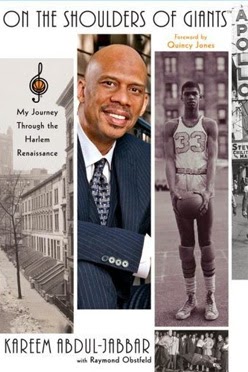
Among his books: "Brothers in Arms: The Epic Story of the 761st Tank Battalion, WWII's Forgotten Heroes" with Anthony Walton (2004); "On the Shoulders of Giants: My Journey Through the Harlem Renaissance" with Raymond Obstfeld (2007); and "What Color Is My World? The Lost History of African American Inventors" with Raymond Obstfeld (2012). I look forward to featuring some of Abdul-Jabbar's work in future posts.

In "Giant Steps," Abdul-Jabbar writes about his first impression of his coach at UCLA, the great John Wooden, who out of respect called him "Lewis."

"I found myself liking Mr. Wooden right away. People would always tell me they cared about me, but I felt Mr. Wooden really meant it. I came of his office knowing I was going to UCLA."

Perhaps it was their mutual interest in books. Each man's fathers, "Hugh" Wooden and "Big Al" Alcindor, had instilled in their sons a lifelong passion for reading. 

In "My Personal Best: Life Lessons from an All-American Journey" by John Wooden with Steve Jamison, the coach reflects in a chapter, "The Age of Alcindor," about self-control and poise being fundamental to achieving success.  "Lewis had the bearing of an eagle. He also reminded  me so much of my own father, Joshua Hugh Wooden."

"Wooden: A Coach's Life" by Seth Davis, opens with:
"The first thing you noticed were the books. Big books, little books, picture books, children's books, art books, religious books, coaching books, sports books, fiction books, science books. Before I walked through the door, they were there to greet me in tall, neat piles in the front hallway. The books were stacked on floors, lined up on tables, piled on desks, jammed into bookcases. The apartment was barely two thousand square feet, yet it seemed that most of it was covered by something that could be read."
Wooden was an English teacher before he was a coach. But he was also a lieutenant in the United States Navy providing physical readiness training for naval aviators during World War II. Davis writes:
"After World War II broke out, Wooden could have avoided being drafted because he was a married father and high school teacher, but eventually duty compelled him to enlist in the navy, a little more than a year after the bombing of Pearl Harbor."
One of Wooden's assignments was on the campus of the University of North Carolina in Chapel Hill. He also served at other college campuses, at an Iowa preflight school and as an underway watch officer aboard USS Sable (IX-81), an aircraft carrier training ship anchored in Lake Michigan.


Like fellow Sailor Red Auerbach, he never served overseas.  In Wooden's case, a bout of appendicitis prevented him from deploying to the carrier USS Franklin (CV-13) in the South Pacific, including off the coast of Samar, Philippines.
"As it turned out, Wooden knew well the man who replaced him aboard the Franklin. He was Freddy Stalcup, a former Purdue football player who was Wooden's fraternity brother in Beta Theta Pi. Several months later, Wooden received a piece of news that left him dumbstruck: Stalcup was working a gun position aboard the Franklin when the ship was struck by a Japanese kamikaze pilot. He was killed along with dozens of other men on board. Had Wooden's appendix not become inflamed, he could very well have lost his life that day."
Davis presents a lifetime of detail in nearly 600 pages of Wooden's biography, including details about the Coach's commitment to conditioning and the fast break, Wooden's complicated relationship with Bill Walton, his love of poetry (even on his deathbed), discussions of religion and racism, and the Coach's insights on leadership, including the development of his core values and Pyramid of Success, which reaches a pinnacle in "Competitive Greatness" -- requiring toughness, your best performance, and "real love of a hard battle."

When Wooden passed away in 2010, UCLA issued a statement that included a quote from Kareem Abdul-Jabbar, the former Lew Alcindor, who I saw carrying that armful of books back in 1968:

"It's kind of hard to talk about Coach Wooden simply, because he was a complex man. But he taught in a very simple way. He just used sports as a means to teach us how to apply ourselves to any situation.  He set quite an example. He was more like a parent than a coach. He really was a very selfless and giving human being, but he was a disciplinarian. We learned all about those aspects of life that most kids want to skip over. He wouldn't let us do that."

Wooden, known for his pithy words of wisdom, famously said, "What you are as a person is far more important that what you are as a basketball player."  He also advised, "Drink deeply from good books."

The dust jacket of "Wooden: A Coach's Life," calls the book, "A provocative and revelatory new biography of the legendary UCLA coach John Wooden, by one of America's top college basketball writers."

Sunday, March 23, 2014

March Madness -- Coach Reads

by Bill Doughty

"Did I ever tell you about..."

That's how Red Auerbach's "Let Me Tell You a Story" opens, with one chapter devoted to his years in the Navy during World War II. Auerbach, son of a Russian emigrant, joined in 1943.  

Lt. j.g. Arnold "Red" Auerbach in WWII.
He did physical training at Great Lakes and served in Norfolk alongside fellow Sailors Phil Rizzuto and Yogi Berra before being assigned as a rehabilitation officer at Bethesda Naval Hospital where, in addition to his other duties, he played and coached basketball.

Auerbach was never assigned overseas. For a while he coached basketball for NFL football players.  "In those days, professional athletes needed to supplement their income during the off-season. The (Washington) Redskins, the Philadelphia Eagles and the New York Giants had formed basketball teams, and they traveled around the East Coast playing one another."

John Feinstein, co-author with Auerbach, writes in "Let Me Tell You a Story," "The greatest coach in basketball history began his professional career coaching football players at basketball."

Bill Russell and Coach Auerbach in 1964.
After the war his coaching career jumped from coaching high school and off-season NFL players to calling plays for the Washington Capitols and then leading the dynasty of the Boston Celtics.

How did he achieve greatness as a coach? Auerbach writes:
"Coaching is simple: you need good players who are good people. You have that, you win. You don't have that, you can be the greatest coach who ever lived and you aren't going to win."
Other great coaches discussed in "Story" include: Rick Pitino, Mike Krzyzewski, John Thompson, Phil Jackson, Bobby Knight and Dean Smith.

Dean Smith played for the University of Kansas on the 1952 national championship team. He became an assistant coach for the Air Force Academy under Coach Bob Spear, a former Naval Academy Coach. Smith's big break came when he joined the coaching staff at the University of North Carolina, where he would coach Michael Jordan among other basketball greats.

In "A Coach's Life" Coach Smith outlines his core values for success:
"Our philosphy at North Carolina was clear from day one. Each year we had the same goals: (1) Play together; (2) play hard; (3) Play smart. Together meant unselfishly, hard meant with effort, and smart meant with proper execution."
He was inspired by Ernest Hemingway, who when someone asked him how to learn how to write, said, "by writing every day."

Michael Jordan and Coach Smith, 1980.
Smith said he built the success of his program on training and practice and compassion, and he shares leadership advice:
"A demanding teacher is quick to praise action that deserves praise, but will criticize the act, not the person. The coach's job is to be part servant in helping the player reach his goals ... To me the players get the wins, and I got the losses. Caring for one another and building relationships should be the most important goal, no matter what vocation you are in."
"A Coach's Life" by Dean Smith with John Kilgo and Sally Jenkins is rich with wisdom and insight about life and basketball. Smith discusses the impact of World War II and the turmoil of the 1960s.

Books that tie coaching and leadership are almost their own genre. These are just a couple of examples for another March Madness weekend -- one in which Stanford just upset #2 Kansas.

Another coaching leadership book worth picking up is Jerry Lynch's "Creative Coaching: New Ways to Maximize Athlete and Team Potential in All Sports."

A master of the Final Four -- Coach Dean Smith.
Unlike the biographies of Auerbach and Smith in this blogpost, "Creative Coaching" is promoted as "a strategic handbook" to maximize performance.

This book offers core values and principles from coaches like Chris Weller, head coach of women's basketball at the University of Maryland ("courageous, fearless"), Phil Jackson ("maintain humility") and John Thompson of Georgetown ("compassionate"). The book explores how to develop trust, discipline, team intelligence, loyalty and commitment.

"Creative Coaching" is dedicated by the author: "To Dean Smith, the quintessential Creative coach with a teacher's heart."

Saturday, March 8, 2014

In Shadow of ... America's Longest Wars

Review by Bill Doughty

Women and men of the Class of 2002 may think they are in the shadow of their grandparents -- "The Greatest Generation" who beat fascism, crushed nazism and crossed the Pacific to avenge Pearl Harbor and win the war in the Pacific in less than four years.

"In the Shadow of Greatness: Voices of Leadership, Sacrifice, and Service from America's Longest War" is a compilation by or about members of the U.S. Naval Academy Class of 2002. Put together with love and appreciation by Joshua Welle, John Ennis, Katherine Kranz and Graham Plaster -- and including a foreword by David Gergen -- the book is filled with essays and memories by and about members of the U.S. Naval Academy Class of 2002. The authors set the stage with a look back to the past:
"The magnitude of World War II provided the opportunity and experiences that shaped twentieth-century American leaders. As men served abroad, women provided support at home. All overcame great odds and faced adversity that gave them confidence and shaped their outlook in the decades to come. This 'greatest generation' returned from war, took advantage of the educational benefits offered through the GI Bill, and advanced the country's economy and transformed its society. World War II veterans, while fueling economic advancement, remained resolute in their  value system: service, sacrifice, and community."
Among "Shadow's" contributors are aviators, surface warfare officers, submariners, U.S. Marines and mothers of junior officers killed during training or in action.

The book is filled with first-person, heartfelt accounts of triumph and hardships: what it's like in humanitarian assistance missions, duty at sea, Search and Rescue operations, and combat; what it means to face family separation, "setting aside the comforts a normal life in service to our country and the Constitution. The dark sides of these sacrifices are broken marriages, post-traumatic stress disorder, depression, and estrangement."

But there is plenty of triumph here, too, focusing on why and how Navy and Marine Corps leaders choose to serve -- "not for self, but for country."

USS John Paul Jones (DDG 53)
A highlight is the account by Meghan Elger Courtney, who served aboard USS John Paul Jones (DDG 53) of her commitment to promote warfighting readiness for Sailors aboard the Arleigh Burke-class guided-missile destroyer. Courtney recognized a need to improve shipboard physical fitness opportunities to help Sailors who would deploy forward -- either aboard ship or as individual augmentees in Iraq and Afghanistan.

With the blessing of her commanding officer and strong support from the command master chief and Chief's Mess, j.o. Courtney planned for, procured and arranged for installation of a new fitness center that replaced outdated insufficient gear and space.  Courtney writes, "Almost immediately, I saw a positive renewal in people's attitude toward fitness, healthy eating, and incorporating workouts into their daily routine as a way to relieve stress and stay in shape."
"What some may have viewed as my silly pet project, the command master chief took seriously, and he became my closest ally in seeing it through. I never really knew how much the experience had impacted him until I saw him become visibly choked up recollecting it during his closing remarks when he transferred off the ship. I don't think he thought that a young officer like me could have cared about his crew so much, but I did, and I still do..."
Explorer Robert E. Perry
Courtney said she was inspired by a quote by explorer Robert E. Peary on a motivational placard in Halsey Field House at the academy: "I will find a way, or make one."

Other essayists share their sources of inspiration as President Teddy Roosevelt, President Dwight Eisenhower, President John F. Kennedy, Senator Daniel Inouye and Secretary of Defense Chuck Hagel, among others. 

One essayist quotes the last two lines of a poem by Mary Oliver, "The Summer Day" in pursuing a life of purpose, wanting to make a difference:

"Tell me, what is it you plan to do
with your one wild and precious life?"

The authors and essayists show how core values of honor, courage and commitment make up an ethos that "forms the fabric of people's personality and drives them to a life of service, in and out of uniform."
"'In the Shadow of Greatness' was envisioned to recognize and chronicle the service of brave men and women and through their stories establish connections with the broader, nonmilitary community. These first graduates of the Naval Academy after 9/11 entered a global war at sea, in the air, and on land. This war would last more than a decade and define the United States in the early part of the millennium. The actions of the select few profiled here represent those of a much broader spectrum of patriots."
Attacks on 9/11/2001 changed the lives of the Class of 2002.
In a short introductory piece, "Inside the Gates of Annapolis," Adm. Sam Locklear (now Commander, U.S. Pacific Command) writes about the investment the country makes in the women and men who attend service academies, including the Naval Academy, reflecting on the morning of September 11, 2001 when he sat at his desk as commandant of midshipmen.
"I recall vividly watching the al-Qaeda attacks on the World Trade Center and the Pentagon and the plane crash in Pennsylvania. When the images reached the Brigade, and the uncertainty of the events rapidly became reality, I asked myself, Are these men and women, these young patriots, ready for the challenges that most certainly lay ahead. A decade of war has proven that they were more than ready. Fortunately for us all, they remain ready today. We are extremely proud of all they have accomplished and thankful that we chose the right men and women to lead the next great generation."
The book, published by the Naval Institute Press, is a key title on the CNO's Professional Reading Program essential list.

Saturday, March 1, 2014

Women Who Don't Wait / dot Complicated

Review by Bill Doughty

It's complicated (but doesn't have to be) according to authors Randi Zuckerberg and Reshma Saujani in their books from 2013.  Be authentic to "untangle our wired lives" and "break the mold, lead the way."

Zuckerberg's "dot Complicated" is filled with ideas for achieving tech-life balance in the brave new world of super-smart phones, instant communication, hyper connectivity and changing definitions of privacy.

Like a lot of business books, "dot Complicated" has personal anecdotes and easy-to-find highlighted lists. You'll see tips for achieving tech-life balance with self, friends, love, family, career, community and future.

"Strive to find personal peace, friendship, love, fulfillment at work, and good in your community, and use the Internet to improve your life, not control it," she advises. And, "don't be a jerk."

Think of that when you're having a face-to-face conversation with someone and they turn to check their tweets; or you look in the rearview mirror while stopped in traffic and notice the driver behind you is obviously texting; or you read hate-filled troll droppings in anonymous online comments. Again, "don't be a jerk."

Among Zuckerberg's simple and common sense advice: know how to break digital addiction, learn how to achieve balance, and think about how/what/when/where/why to post or repost information. She applies the Golden Rule of life to social media: "Repost unto others as you would have them repost..."

This book is easy and fun to read. As the sister of Mark Zuckerberg, creator of Facebook, the author has the bonafides to describe social media and the do's and don'ts of navigating the new millennial landscape where "technology seems to make things both easier and harder at the same time."

Reshma Saujani mentions Randi Zuckerberg in her groundbreaking work, "Women Who Don't Wait" published last year, praising Zuckerberg's work-life balance and willingness to be herself.

"Randi is right. The more open women are about the richness and multidimensional aspects of their lives, the more acceptable it will become to simply act like ourselves -- and the more effective we will be as leaders."

Saujani's book is filled with provocative chapter/subchapter titles: Fail Fast, Fail First, Fail Hard; Unapologetically Ambitious; Don't Worry If They Don't Like You; Jump the Line (Wear What You Want); and Building a Sisterhood for the Twenty-First Century.

Her biggest advice, like Zuckerberg's, is: "be authentic." She discusses her transformation and encourages the reader to "free yourself from believing that you have to behave like anyone other than yourself."
YN1c Marjorie Daw Adams (right) with Mailman 2nd Class Harrison, 1945.

While her insights are relevant for everyone, her target audience is, of course, women.  She calls for a strong community of support, or sisterhood, but writes, "And guys? We aren't hating on them; we are looking to men to be our allies. We no longer see them as a barrier to our success."
"I have worked with and been inspired by others, every day, to help create the world I want the next generation to live in. As women we must have the humility to see the world as it is, but the audacity to envision it as it could be. To apply a new lens of female leadership and reinvent, reshape, and retool the traditional system. To realize that we can learn from the poorest of women and the richest of women. We can and should be talking to one another about what this new model should look like -- and about how we can build it together."
Saujani dedicates her book "For all the women in my life whose shoulders I stand on, and for all the women who will stand on mine."

Since the 1980s March has been National Women's History Month, a time to recognize the women who didn't wait and who shouldered the struggle for freedom and equality, including the right to vote.
Future President Jimmy Carter readies to graduate from Naval Academy, 1947.

The first National Women's History Week was proclaimed by President and Commander in Chief Jimmy Carter, a former naval officer.

Here is Carter's Message to the nation designating March 2-8, 1980 (sixty years after women won the ability to vote) as National Women’s History Week:
   "From the first settlers who came to our shores, from the first American Indian families who befriended them, men and women have worked together to build this nation. Too often the women were unsung and sometimes their contributions went unnoticed. But the achievements, leadership, courage, strength and love of the women who built America was as vital as that of the men whose names we know so well.
   As Dr. Gerda Lerner has noted, 'Women’s History is Women’s Right.' – It is an essential and indispensable heritage from which we can draw pride, comfort, courage, and long-range vision.
   I ask my fellow Americans to recognize this heritage with appropriate activities during National Women’s History Week, March 2-8, 1980.
   I urge libraries, schools, and community organizations to focus their observances on the leaders who struggled for equality -- Susan B. Anthony, Sojourner Truth, Lucy Stone, Lucretia Mott, Elizabeth Cady Stanton, Harriet Tubman, and Alice Paul.
   Understanding the true history of our country will help us to comprehend the need for full equality under the law for all our people.
   This goal can be achieved by ratifying the 27th Amendment to the United States Constitution, which states that 'Equality of Rights under the Law shall not be denied or abridged by the United States or by any state on account of sex.'"
Congress passed a joint resolution proclaiming a Women's History Week in 1981.

The National Women's History Project and Department of Defense theme for this year's commemoration is, "celebrating women of character, courage and commitment," clearly mirroring Navy core values.

The books by Zuckerberg and Saujani in this review build on the gains of women in the past with a focus on the future, whether achieving tech-life balance or workplace gender balance -- with equal pay for equal work. It's not complicated.

Saturday, February 22, 2014

Hell in Ukraine: 'Where the West Ends"

Review by Bill Doughty
In "Where the West Ends: Stories from the Middle East, the Balkans, the Black Sea, and the Caucasus," reporter Michael J. Totten takes road trips and detours to describe "scars from the communist era, both physical and emotional."
The road to Borjomi, Georgia from michaeltotten.com.
If the road to hell is paved with good intentions, the road to and from communism seems to be paved with potholes. Totten measures the potholes in Eastern Europe by the size of various kitchen appliances that could fit inside.

He has a special view of taxis.  He writes, "No one has given me more trouble in the Middle East than people who drive for a living."

While not quite stereotyping, he tries to explain how the various religious, ethnic and cultural differences evolved in the Balkans:
"Ethnicity in the Balkans, as in the Middle East, has nothing to do with biological characteristics.  Expanding and contracting empires of both the East and the West have mixed up the gene pools everywhere in both regions. American-style racial categories make no sense there. An Orthodox Christian in the former Yugoslavia who speaks Serbo-Croatian as a first language is a Serb no matter where his ancestors may have lived hundreds of years ago.  And that's true whether he attends church or not. Religious belief as such is no more relevant to ethnicity in the Balkans than it is inside Israel. Dark-eyed or dark-skinned Slavs are even more common in Serbia than white-skinned or blue-eyed Arabs are in North Africa and the Levant -- and the Arab world has more white-skinned and blue-eyed Arabs than you might think if you've never been there to see it. Blue-eyed Arabs are often the children of Crusaders. Dark-skinned Slavs tend to be the descendants of Ottoman Turks."
In trips to Kosovo, Georgia, Romania and Ukraine, the dark shadows and ghosts of the former Soviet Union continue to loom. Totten gives us history lessons and insights through his colorful interactions with locals.

He quotes Daniel Apostol, editor in chief of Romania's Money Channel,who recounts the rise and fall of Ceausescu's totalitarian state:
"Communism changed our mentality. We are fighting now to come back to what we were. We lost the culture of private property. We lost this sense of privacy and respecting each other's time and respecting people as individuals, as human beings. That was the worst thing that happened to us. This is why we are struggling so much now to get back to the capitalist society, to the free market, which can run only if there is respect for private property."
Kennan as a young man in 1924
Totten seems to strive to prove a quote from George F. Kennan, America's ambassador to the Soviet Union under President Truman, and a contemporary and colleague of Secretary of the Navy James Forrestal.

Kennan's quote is used twice in "Where the West Ends": "Russia can have on its borders only enemies or vassals."

Of Ukraine's capital, Totten writes, "Kiev is what Moscow and St. Petersburg wish they were." Totten visited years before the recent uprising that saw street demonstrations and snipers in Kiev in 2014.


Ukraine demonstrations in 2014; photo from World Affairs Journal.
In his blog post this week for World Affairs Journal, Totten writes about Ukraine. "Almost every country I’ve ever written about is either in hell, has only recently recovered from hell, or is on its way to hell. I hoped when I visited Ukraine that it was on its way out, but I did not have a good feeling about it, as you’ll recall if you read my book."

Totten's descriptive power and insights come together at the end of "Where the West Ends," as he attempts a road trip to Chernobyl but instead travels through Ukraine and to the Sea of Azor, which links Ukraine and Southwestern Russia.
"We were technically in Europe, but it looked like the nastiest parts of Iraq.  The sound of machine-gun fire would not have seemed out of place.  I have never been anywhere that looks and feels more like the rotted dead center of the Soviet Empire. This place was so utterly godforsaken and misery-stricken I had a momentary feeling that the Union of Soviet Socialist Republics had never fallen apart, that, Mordor-like, its malice truly is sleepless, that it's still crushing parts of the world in its totalitarian fist."
The author shares the names of other authors and book titles frequently. Among the books cited in "Where the West Ends":
  • "Black Lamb and Grey Falcon" by Rebecca West
  • "Bosnian Book of the Dead"
  • "We Wish to Inform You that Tomorrow We Will Be Killed with All Our Families" by Philip Gourevitch
  • "Sarajevo Haggadah"
  • "Mein Kampf" by Adolf Hitler
  • "Azerbaijan Diary," "Georgian Diary" and "Chechnya Diary" by Thomas Goltz
  • "Eastward to Tartary" by Robert Kaplan
  • "Harvest of Sorrow: Soviet Collectivism and the Terror Famine" by Robert Conquest
  • "The God that Failed" by Arthur Koestler
  • "Forever Flowing" by Vasily Grossman
  • "I Chose Freedom" by Victor Krauchenko
Michael J. Totten
Totten references thinkers and writers Thomas Friedman and the late Christopher Hitchens.

The 2014 Winter Olympics comes to a close in Sochi, Russia this weekend, and they will be tied forever to human rights debates and images like the horsewhipping of protestors by Cossacks. 

Meanwhile, in nearby Ukraine, people in potholed streets of Kiev have been dying to be free of corruption and totalitarian rule. Totten helps us understand the region and the historical context for what's happening there now.