Showing posts sorted by date for query charleston. Sort by relevance Show all posts

Thursday, June 29, 2023

McVeigh/Constitution/Jan. 6 –– Part 1

Review by Bill Doughty––

“Homegrown: Timothy McVeigh and the Rise of Right-Wing Extremism” by Jeffrey Toobin (Simon & Schuster, 2023) is a relevant and necessary account of the bombing of the Murrah federal building in Oklahoma City in 1995 during President Bill Clinton's administration. 


The bombing was sparked by anger and hatred in the wake of “woke,” even before that term became popular. Timothy McVeigh, the Army-veteran-turned-right-wing-extremist was an avid supporter of states’ rights, white separatism, and unobstructed Second Amendment access to military-style assault weapons.


He wanted to spawn a militia army to start a civil war against the federal government. He hoped his bomb –– which killed or maimed hundreds of men, women, and children –– would inspire others.

And McVeigh may have been right about his expectation about gaining support for the causes he espoused.


White supremacist Dylann Roof left a McVeigh-like manifesto trying to justify his murder of nine parishioners in Charleston, South Carolina. Brandon Russell, the leader of a neo-Nazi group was arrested in Tampa, Florida, in possession of explosives; “there was a framed photo of McVeigh on his nightstand.” Richard Tobin, of Brooklawn, New Jersey, wanted to see bombings of synagogues around the country quoting the method used by McVeigh. Timothy Wilson planned to blow up non-Christian worship centers and an elementary school in the Kansas City area; he quoted Timothy McVeigh in a text to an associate.


Toobin presents dozens of other examples of homegrown terrorism by white supremacists, vigilante militia members, Christian nationalists and anti-abortionists. He says the “Unite the Right” rally in Charleston, Virginia, in August 2017 showed that “the ‘army’ that McVeigh told his lawyers he was seeking had finally assembled.” Neo-Nazis, militia members, and other extremists gathered there and violently clashed with left-wing protesters who were demanding the removal of a statue of Confederate General Robert E. Lee.


Toobin also notes how “terrorism associated with radical Islam and left-wing extremists never disappeared from the United States.” He cites the 2009 shooting of 13 unarmed soldiers by a psychiatrist at Fort Hood, Texas; the 2015 mass shooting by an Islamist couple in San Bernardino, California; the 2017 shooting by a leftist political activist at a congressional baseball game; and the stalking and threatening by a mentally ill protester of Supreme Court Justice Brett Kavanaugh.


“Still, the record is clear that there were far fewer of these attacks than those by right-wing extremists,” Toobin writes. Indeed, according to one study, right-wing extremism was responsible for 76 percent of all extremist murders in the United States from 2009 to 2019.”


Toobin shows how white nationalism increased after the election of President Barack Obama. “Days after the 2008 election, a Marine corporal at Camp Lejeune in North Carolina was arrested and charged with planning to kill Obama as a ‘domestic enemy’ in ‘Operation Patriot.’”
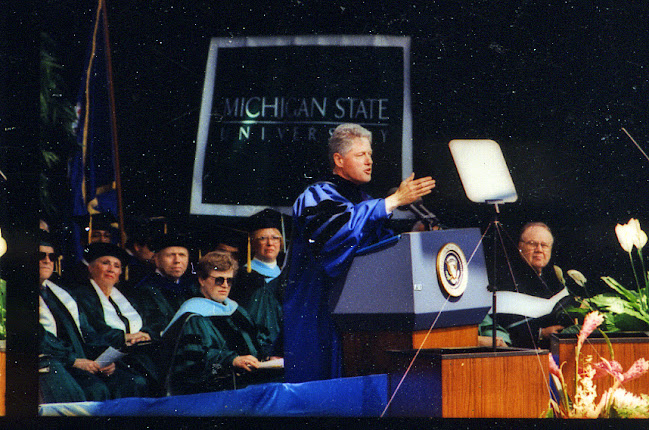

The question of patriotism and issues such as the First and Second Amendment were addressed head-on in the aftermath of the Oklahoma City bombing when then-President Bill Clinton gave a memorable commencement address at Michigan State University, May 5, 1995, in East Lansing. (McVeigh’s accomplice, Terry Nichols, was associated with the Michigan Militia.) Toobin excerpts a big chunk of Clinton's speech, and it’s worth reading in its entirety for its thoughtful and nuanced message.

Here is the part of that speech that Toobin included in “Homegrown.” Clinton offers comments not only to the graduates, but also to right-wing militia members:

“I want to say this to the militias … I am well aware that most of you have never violated the law of the land. I welcome the comments that some of you have made recently condemning the bombing in Oklahoma City. I believe you have every right, indeed you have the responsibility, to question our government when you disagree with its policies. And I will do everything in my power to protect your right to do so. But I also know there have been lawbreakers among those who espouse your philosophy. I know from painful personal experience as a governor of a state who lived through the coldblooded killing of a young sheriff and a young African American state trooper who were friends of mine by people who espoused the view that the government was the biggest problem in America and that people had a right to take violence into their own hands.

“So I say this to the militias and all others who believe that the greatest threat to freedom comes from the government instead of from those who would take away our freedom: If you say violence is an acceptable way to make change, you are wrong. If you say that government is in a conspiracy to take your freedom away, you are just plain wrong. If you treat law enforcement officers who put their lives on the line for your safety every day like some kind of enemy army to be suspected, derided, and if they should enforce the law against you, to be shot, you are wrong. If you appropriate our sacred symbols for paranoid purposes and compare yourselves to colonial militias who fought for the democracy you now rail against, you are wrong. How dare you suggest that we in the freest nation on Earth live in tyranny! How dare you call yourselves patriots and heroes! I say to you, all of you, the members of the Class of 1995, there is nothing patriotic about hating your country or pretending that you can love your country but despise your government.”

Victims' families attend a memorial service as President Clinton gives remarks, April 23, 1995. 
Clinton, who also spoke at the memorial service in Oklahoma City in April 1995, took the opportunity in at Michigan State University to condemn violence by both the Left and Right. He noted, “Freedom of political speech will never justify violence--never. Our Founding Fathers created a system of laws in which reason could prevail over fear. Without respect for this law, there is no freedom.”

Prosecutors in the McVeigh trial used the bomber’s own words against him: how he wanted to start a new revolution in order to protect the Second Amendment, states’ rights, and a white male hierarchy. He hoped to provoke another civil war.


“The McVeigh prosecutors put the ‘civil war’ issue in front of the jury to show how extreme and exotic the defendant’s views were," Toobin writes. "But a quarter century later, McVeigh’s view was close to the conservative movement norm. This view –– about the possibility of civil war –– became mainstream as the passions underlying the January 6 insurrection roiled conservatives during the Biden presidency.”


According to Toobin, “The events of January 6, 2021, saw the full flowering of McVeigh’s legacy in contemporary politics. McVeigh was obsessed with gun rights; he saw the bombing as akin to the revolutionary struggle of the Founding Fathers; and he believed that violence was justified to achieve his goals. So did the rioters on January 6.”


(In Part 2, we examine the Oklahoma City bombing and rise of right-wing extremism through the lens of the U.S. military.)

Monday, July 18, 2022

Smashing Ideas About Monuments

Review by Bill Doughty––

More than 250 years ago the federal government hired sculptor Clark Mills to cast a statue called Freedom, pictured above, that would be placed atop the U.S. Capitol Building in Washington D.C.


The first plaster model of Freedom, created in 1854, was rejected by then-U.S. Secretary of War (SECDEF) Jefferson Davis (future president of the Confederacy) because it wore a “liberty cap,”as Erin L. Thompson explains in “Smashing Statues: The Rise and Fall of America’s Public Monuments” (W.W. Norton, 2022).


Davis insisted the cap, which represented emancipation, be replaced with a helmet. But the new design looked “more suited to a Vegas showgirl than a warrior, with a starry headband topped with feathers sprouting from a popeyed eagle.” Eventually the symbol of liberty created by Clark Mills and his team of workers moved forward and upward, headgear and all:

“When Freedom was finally hoisted into place in December 1863, it was hailed as a symbol of the universal liberty the Emancipation Proclamation had declared in January of that year. More than 150 years later, many avowed white supremacists undertook a deadly invasion of the Capitol building to dispute the results of the presidential election. You might think that a symbol of the liberty America is supposed to offer to all would have dissuaded or at least shamed them. Looking more deeply into Freedom’s history reveals why the monument instead inspired them. It is a white supremacists vision of freedom.”

To help create the cast and melt bronze for Freedom, Mills depended on his workmen, including Philip Reed, a man born into slavery in South Carolina, who was paid $1.25 per day by Mills, but was considered his property. As Mills gained fame and made more money he purchased more enslaved people.


The symbol of Freedom was, in actuality, a symbol of slavery. “Slavery shaped everything about her,” Thompson writes.


Despite an attempt to promote emancipation and liberty, seditionists in the South staged the ultimate insurrection, led by Jefferson Davis. Construction of the Capitol Building stopped for a while, but was restarted under orders from President Abraham Lincoln, who said, “If people see the Capitol going on, it is a sign we intend the Union shall go on.”


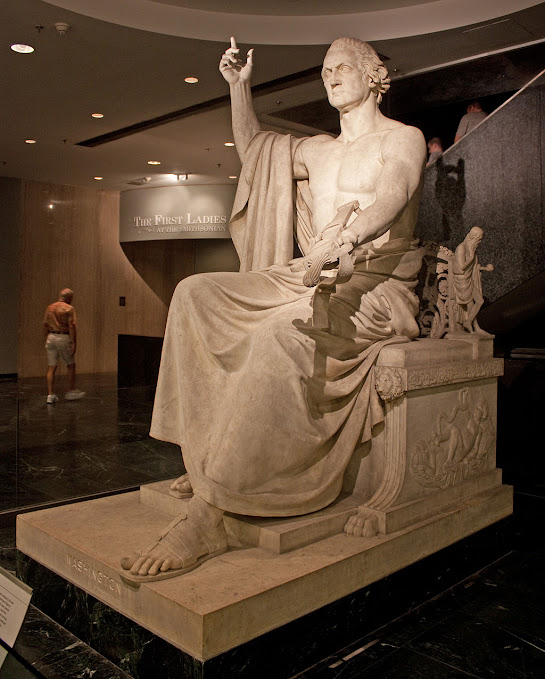
The supreme irony of the statue atop the Capitol –– symbolizing liberty but built by enslaved people –– is matched in the story of Horatio Greenough, eugenic “father of our monuments,” whose “blatant racism” is found in his work.


Greenough's George Washington (Wikimedia)
Greenough created a bizarre god-like statue of George Washington that includes a subjugated indigenous “Indian chief” in the design, under Washington’s hips, as the first president holds a sword and points to the sky. Greenough had planned to include “a negro” along with the indigenous figure, but abolitionist Charles Sumner convinced him not create a tie to slavery. The sculptor included a depiction of Christopher Columbus instead.

The public and press mocked the semi-nude statue of the first president. “American audiences paid less attention to deciphering the meaning of Washington’s symbolic sword and more to his nipples.” The statue, Thompson notes, "is on display at the Smithsonian’s National Museum of American History, awkwardly wedged next to an escalator. Today, the sculptures upraised hand looks as though it points the way up to the next floor."


Greenough's "Rescue." (LOC)
Greenough’s next work was received more favorably, at least by white Americans. In many ways it was even more bizarre and offensive. Like other monuments to follow, Rescue celebrated the genocide of Native Americans, particularly after President Andrew Jackson’s “Indian Removal Act” of 1830.

Rescue is in effect a monument to Manifest Destiny –– the idea of a god-given right of white people to subjugate indigenous people –– and for men to have an ordained role as dominant protectors of women. Thompson explains the scene of a white settler holding a dying indigenous warrior he'd just shot; his wife and child hover beneath him, and a dog watches balefully. The symbolism is clear and cringe-inducing.


At Abraham Lincoln’s inauguration in 1861, Rescue was prominently on display. It was removed from the eastern front of the Capitol Building in 1958 after decades of complaints. Thompson writes, “The removal of Rescue is another example of what happens when enough people decide that the messages encoded in a monument are unacceptable to them.”

“Greenough’s sculptures, the first thoroughly American national monuments, were also the first in a long line of public artworks to address questions of how much Black and Indigenous lives matter in America. He and his monuments claimed these lives didn’t matter at all. Greenough’s monuments assert that only people of a certain gender, class, and race deserve honor.

“Greenough’s beliefs informed not only his own sculpture but all the subsequent American public monuments based on his influential examples.”

A natural progression to other monuments highlighting white supremacy extended in the wake of the Civil War, even in Thomas Ball’s controversial Freedmen’s Memorial, dedicated in 1876.


Also known as Emancipation Memorial, it depicts a fully clothed Lincoln standing over a nearly naked kneeling black man. One interpretation is of a gracious leader bestowing freedom, but another view is of ongoing patriarchal and racial inequality.

Freedmen’s Memorial was unveiled on the eleventh anniversary of Lincoln’s assassination. President Ulysses S. Grant, members of Congress, and Supreme Court justices all attended and listened to Frederick Douglass’s speech. Several days later, Douglass wrote a letter to the editor of the National Republican in which he said, “What I want to see before I die is a monument representing the negro, not couchant on his knees like a four-footed animal, but erect on his feet like a man.”


Douglass’s descendants would live to see many hundreds of monuments erected to honor the seditionists of the Confederacy.


The rise of many of those monuments coincided with the rise of the rights and equality of African Americans as guaranteed under the Constitution.


An example is the statue of Robert E. Lee erected in Charlottesville, Virginia, in 1924, shortly after Virginia’s Racial Integrity Act made segregation lawful and outlawed in interracial marriage (not overturned by the Supreme Court until 1967 in Loving v. Virginia).


“The conflict at the heart of America,” Thompson writes, is “the conflict between the freedom for all and freedom for some.”


Thompson enlightens readers with the psychology, politics, and intent of Civil War monument creators. She delves into the meaning of statues’ poses, shows the influence of donations in creating profit motives for monuments, and explains the role of the Ku Klux Klan and other white supremacists.


Then there's Christopher Columbus.


Columbus Fountain in Washington D.C. (NPS)
Thompson reminds readers about Columbus’s contemporary, the priest Bartolemé de las Casas, who wrote about the real Christopher Columbus during his cruel reign as governor of Hispaniola (now Dominican Republic and Haiti). Columbus is condemned for overseeing torture, rape, slavery and genocide. Columbus shipped young girls back to Spain to be sold into slavery.

In recent years more people have assembled, protested, and demanded statues honoring Columbus, like monuments to the Confederacy, be taken down.


Thompson explores how, despite widespread opposition to their presence, some monuments remained in place for years. “We think our monuments celebrate our democracy, but really, they are held in place by some of America’s least democratic uses of power.”

Complacency and willful ignorance kept monuments up until catalysts of violence created a backlash: “Unite the Right” white supremacists' march (and killing of Heather Heyer) in Charlottesville; the horrific mass murder at a church in Charleston, South Carolina; and the senseless murder of George Floyd in Minneapolis, Minnesota, as examples.


Acts of civil disobedience are often the result of willful acts of bureaucratic lethargy, intransigence, and not listening to peaceful protesters. Thompson writes, "Talking about monuments is not easy. But we need to do it. We need to come together as communities to make sure our monuments leave room for everyone's life, liberty, and pursuit of happiness."


Towering over all the monuments to the Confederacy is the incomparable Stone Mountain in Georgia. Cut into the face of the mountain, it is the world’s largest bas-relief sculpture: images of Confederate President Jefferson Davis, along with Civil War generals Stonewall Jackson and Robert E. Lee on horseback. The sculpture inspires white racists and believers in the Lost Cause Big Lie, including the KKK.

Thompson writes about eccentric anti-semitic sculptor and con artist Gutzon Borglum, who was involved in creating the Stone Mountain monument. Borglum would go on to create the monument at Mount Rushmore, South Dakota, on land that was sacred to indigenous people.

There’s a lot more in this book about Borglum and Stone Mountain –– stories “to startle us out of our assumptions,” as Thompson writes.


[While reading this book I came across a new Americana CD by Bill Edwards, “61356,” with a great song from the perspective of a statue of a Union soldier on a Civil War monument in Illinois: “We Don’t See It Yet.” Edwards sings: “Since nineteen hundred and thirteen/I’ve stood in my place on this stone/In the middle of my Bureau County/But I haven’t stood here alone/Above me, a guardian angel/To my right, left and back, over Vets/We watch the horizon for justice/Alas, we don’t see it yet.” It’s a terrific song and album, highly recommended. Read more about "61356" on The Stratton Setlist.]


In “Smashing Statues” Thompson laments the lack of monuments to African Americans who fought for the Union in the Civil War.


There are also a relatively small number of monuments to women in the United States, but last week Speaker of the House of Representatives Nancy Pelosi unveiled a statue of Mary McLeod Bethune in the Capitol Building. Behune was “an unyielding force for racial justice, a pioneering voice for gender equity” from Florida, who was also “a devoted advocate for education,” Pelosi said in her remarks.


Bethune statue unveiled at Capitol Building July 13, 2022. (CNN)
The statue of Bethune joins statues of Rosa Parks, Sojourner Truth, Frederick Douglass and Martin Luther King, Jr. in the Capitol’s Statuary Hall. Bethune’s statue replaces that of a Confederate general.

On January 6, 2021, Trump-supporting insurrectionists, many wearing helmets or other headgear, walked through Statuary Hall during the coup attempt. Some rioters carried Confederate flags into the Capitol. High above them, on top of the building stood the statue in plumed helmet with an American eagle, mouth agape, eyes bulging –– Freedom.


This is an indispensable book for military readers interested in the reasons for the initiative to rename installations, facilities, and ships named for Confederate white supremacists or Confederate battle victories.

Wednesday, August 4, 2021

Monuments: Human Values or States’ Rights


Review by Bill Doughty

Last summer some of the statues of heroes of the Confederacy were removed from Monument Avenue in Richmond, Virginia. Gone are JEB Stuart and Stonewall Jackson. The removal of Robert E. Lee and his horse, Traveler, seems just a matter of time.


Lee and the horse, like other monuments to the insurrection of the 1860s, will likely travel to a cemetery, museum, or warehouse. How those monuments came to be on display in the first place is revealed in “No Common Ground: Confederate Monuments and the Ongoing Fight for Racial Justice” by Karen L. Cox (University of North Carolina Press, 2021). Cox dedicated her book: “For everyone who speaks truth to power.”

A photo of General Lee and horse –– and a Black Lives Matter projection –– are featured prominently on the cover of “No Common Ground.”


Cox explains why monuments were erected and why some military bases were named (or renamed) for leaders of the Confederacy. She shows how believers and supporters of the “Lost Cause” wanted desperately to hold onto their positions of privilege and power in the face of a changing culture of inclusion, integration, and equal rights.


Above all, United Daughters of the Confederacy (UDC) and white supremacists said they believed in vindication and “states’ rights,” even if those rights included the right to own other people as property.

“Through a broad-based agenda to perpetuate Confederate memory, the Daughters gave inspiration to southern white men intent on dominating black Southerners at every step, and by violence if necessary. Two generations removed from the Civil War, these women saw their efforts as part of an overall program of vindicating the Confederacy and those who sought to preserve it. Their battle to maintain Confederate culture –– by perpetuating pro-southern history, educating white children, and yes, building monuments –– required that the men of their generation be victorious in creating a southern power structure that their forefathers had failed to achieve. And they were. Those men established a political foundation based on white supremacy, disenfranchised black men, compelled entire black communities into submission through racial violence, and wielded states’ rights like a saber to thwart racial progress, while the federal government turned a blind eye and the Supreme Court upheld segregation. While states’ rights for the Confederate generation meant maintaining the racial status quo through laws and customs that gutted African Americans’ rights as citizens, underfunded their schools, re-enslaved them through mass incarceration, and made it nearly impossible for black southerners to break free from systems of inequality that limited where they could live and work.”

Robert E. Lee statue is unveiled in Richmond, Virginia, in summer of 1890.

Monuments to the Confederacy, especially at court houses and state capitols, were polarizing symbols inspiring either continued white supremacy or greater civil rights. 

“To understand their history is to understand how white southerners memorialized men who fought in a war to preserve slavery and created a ‘new’ South that sought to limit the freedom of black southerners whose ancestors were enslaved. Yet at the same time, to fully understand their history is also to understand how generations of black southerners have demonstrated their scorn for monuments they have always believed were symbols of slavery and oppression.”

Forrest
Despite initial institutional racism, the United States military has been on the leading edge of gradual integration and equality throughout American history. In fact, the UDC, KKK, and other white supremacists built more monuments as they witnessed that greater post-war integration in the United States after World War I, World War II, and the Korean War. The building of Lost Cause monuments saw an uptick in the mid-60s during the civil rights movement and the centennial of the Civil War in 1965.

Cox presents some history pertinent to military readers:

  • How the Army renamed Camp Peay in Tennessee, as Camp Nathan Bedford Forrest, the founder of the Ku Klux Klan, Dec. 7, 1940.
  • How Air Force Sgt. James Meredith, an African American, tried to get an education at the University of Mississippi in 1961 but was blocked by a crowd led by retired Air Force Gen. Edwin Walker, a white supremacist, at the pedestal of a Confederate monument.
  • How 21-year-old Sammy Younge Jr., a black U.S. Navy veteran and student at Tuskegee University, was murdered in 1966 and how his white murderer was acquitted by an all-white jury. Protesters gathered at the town’s Confederate monument.
  • How middle-aged WWII veteran James Holley –– Portsmouth, Virginia’s first African American elected to the city council –– fought the UDC to decorate the town’s Confederate monument on Memorial Day with American flags instead of the traditional Confederate flags, “primarily battle flags.”

Marines of Range Company, Weapons and Field Training Battalion, walk through a museum on Fort Sumter during an educational trip Feb. 21, 2014, to Charleston, S.C. The Marines visited Battery Park, the Fort Sumter National Monument and rode a ferry to Fort Sumter itself, which is the site of the first shots of the Civil War. The trip was part of the company’s professional military education program, which helps Marines expand their knowledge outside their primary occupational specialties. The Marines of Range Company train recruits and Marines in marksmanship on Parris Island, S.C. (Photo by Cpl. Octavia Davis)


Cox considers monuments to be weapons of the culture wars, erected ostensibly to teach history but in reality teaching or perpetuating something else.

“Confederate monuments are not innocuous symbols,” she writes. “They are weapons in the larger arsenal of white supremacy, artifacts of Jim Crow not unlike the ‘whites only’ signs that declared black southerners to be second-class citizens. Removing a monument from the public square is no more an act of erasing history than removing those signs from public accommodations.”

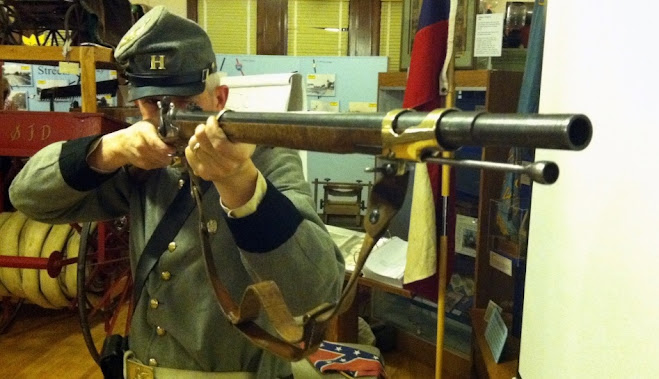
The war over secessionist monuments to the Civil War includes marches and battles for voter registration and against gerrymandering as well as fights over flying the Confederate flag or keeping it as part of several southern states. The Lost Cause is losing this war too, with symbols falling and statues being removed. Selma, Alabama became the first city in the nation to remove a Confederate monument and relocate it to a cemetery. New Orleans removed several monuments exactly six months after nine people were murdered at the Emanuel African Methodist Episcopal Church by a white nationalist June 17, 2015.


Karen L. Cox
Yet, state laws about monuments remain an obstacle to change, Cox notes, where “states rights” overrule local communities’ votes. Legislatures that came into power thanks to redistricting and gerrymandering through voter suppression are passing laws to keep the Lost Cause monuments in their states. “Voter suppression, in fact, is key to understanding not only the current state of Confederate monuments but also the battle over their construction in the nineteenth century,” Cox writes.

While some southern leaders, notably in Texas, Alabama, and Tennessee, have resisted removal of Confederate monuments, the trend to reject and remove the memorials, especially from public land, continues to grow. Monuments came down this summer in Charlottesville, Virginia –– site of a deadly riot at a white nationalist rally centered around a monument to Robert E. Lee. A statue of Confederate General Alfred Mouton was removed July 17 in Lafayette, Louisiana. Even officials in Tennessee voted to remove a bust of KKK leader Nathan Bedford Forrest this summer from the Tennessee Capitol.


But removal of statues, like the monuments themselves, is just symbolic unless people consider human values and American ideals of equality and justice.

“Removing a monument does not remove the systemic racism with which it has long been associated. It is a symbolic act only, although it may also serve as an important first step. The hard work of dismantling racism and honestly confronting racial inequality within that community must come next. After all, it was a movement against white supremacy that initially brought public concerns about Confederate monuments into the open. Today’s protests against Confederate monuments, therefore, are but one stage in a much longer fight for racial justice.”

Truth to power.


DOD will likely rename hundreds of names of bases, buildings, and streets, etc. in coming years. The “Commission on the Naming of Items of the Department of Defense that Commemorate the Confederate States of America or Any Person Who Served Voluntarily with the Confederate States of America” –– commonly called the “Naming Commission –– is chaired by retired Navy Adm. Michelle Howard, former VCNO. The commission, which includes retired Gen. Robert Neller, former Marine Corps commandant, is visiting Army bases this summer. The Naming Commission is mandated to update Congress by Oct. 11 and continue its work through FY22.

Aviation Ordnanceman 2nd Class Teven Reed (left), from Cottonport, La., and Aviation Maintenance Administrationman 3rd Class Makayla Cabel, from Smithville, Mo., shift colors on the flight deck of the aircraft carrier USS Abraham Lincoln (CVN 72) April 5, 2021, in San Diego. Abraham Lincoln is underway conducting routine operations in the U.S. 3rd Fleet area of operations. (MC3 Michael Singley)

TOP PHOTO:

Ward Zischke, a native of Cedar Falls, Iowa, and historian for the Army Reserve 88th Regional Support Command, explains the Confederacy mind-set to an audience, April 19, 2012, during a Civil War lecture series at the Deke Slayton Memorial Space Museum in Sparta, Wis. Zischke is also an Army Reserve lieutenant colonel with 3rd Brigade of the 75th Battle Command Training Division. (Sgt. 1st Class Osvaldo Sanchez)


Saturday, March 6, 2021

‘How to Lead’ -– Attributes


Review by Bill Doughty

What makes a good leader? What attributes can be found in successful ethical leadership? Listen to this.


David M. Rubenstein hears from renowned leaders in “How to Lead: Wisdom from the World’s Greatest CEO, Founders and Game Changers” (Simon & Schuster, 2020). He interviews people like Bill and Melinda Gates, Gen. David Petraeus, Speaker Nancy Pelosi, and President George W. Bush, and others. He arranges the interviews in six categories: visionaries, builders, transformers, commanders, decision-makers, and masters.

According to Rubenstein, here are attributes of a good, successful leader: luck, focus, persuasiveness, a desire to succeed, pursuit of something unique, willingness to work long hours, ability to keep learning (“nothing focuses the mind like a good book”), integrity, humble demeanor, credit-sharing, ability to keep learning, responding to crises, and rising from failure.


“Failure teaches humility and exponentially enhances the desire to succeed the next time,” he writes.


Dr. Anthony Fauci, interviewed in this book, gives this advice about good leadership: “You don’t dictate to people. But if you let them know what your vision is, hire the best people, and then don’t get in their way, those are the qualities of a good leader.”


As for other advice in responding to crises, Rubenstein writes:

“Leaders are most needed when crises occur, as we have been reminded this year during the COVID-19 pandemic and the nationwide protests over the death of George Floyd. Rising to the occasion when an existential crisis occurs can mark a leader forever –– Lincoln holding his country together during the Civil War or Churchill rallying his country to fight the Nazi attacks.”

Powell, Bush and Schwarzkopf attend a memorial service in Kuwait, Jan. 26, 2001. (Sgt. B. Beach)
In an interview with Gen. Colin Powell (former Chairman of the Joint Chiefs and former Secretary of State), Rubinstein listens to how the United States responded to a crisis –– Iraq’s invasion of Kuwait leading to the first Gulf War during George H. W. Bush’s administration.

Powell said every good leader must have a strong vision and understand “why we are here” and then instill that understanding of “why” through all levels of the organization or team. 


“That’s what leadership is all about –– inspiring others,” he says.


Powell discusses how United States Marines achieved the mission in the first Gulf War, not only following their initial orders but also seizing an opportunity to advance when they saw the chance. Agility and nimbleness are good attributes for any leader.


Powell also takes questions head-on about his role in the second Gulf War, in which the CIA provided information Powell then relayed to Congress about weapons of mass destruction in Iraq –– as justification for an invasion. He offers a thoughtful and critical analysis.


Cadet Dalton MacAfee receives the Mike Krzyzewski Teaching Character Through Sport Award May 6, 2019 at West Point Military Academy. (PO1 Bryan Ilyankoff)

Interviewing Coach Krzyzewski (“Coach K”) of Duke basketball, Rubenstein asks about what he rightly calls “one of the greatest games ever played”: the 1992 semi-final game between Duke and Kentucky. Kentucky scored an improbable basket in the last seconds of overtime, putting them up by one point. With 2.1 seconds left in the game, Duke had the ball and called a timeout.

Coach K  remembers, “The very first thing a leader has to show is strength, so I met them as they were coming to the bench, and I said, ‘We’re going to win. We are going to win.' Then he called up a creative play –– Grant Hill passing 75 feet to Christian Laettner at the top of the key for a turnaround jump shot. Duke won the game and went on to win the championship thanks to their leader’s confidence.


Among this book’s eclectic group of leaders –– including Condoleeza Rice, Justice Ruth Bader Ginsberg, Yo Yo Ma, Robert F. Smith, and James A. Baker III –– is an unexpected but rewarding choice of subjects: Lorne Michaels, creator and producer of Saturday Night Live. SNL has catapulted the careers of Bill Murray, Eddie Murphy, Steve Martin, Will Ferrell, Tina Fey, Billy Crystal, Chris Rock, Julia Louis-Dreyfus, Amy Poehler, Kristin Wiig, Jimmy Fallon, Seth Meyers, Kate McKinnon, and scores of other comedians, talk show hosts, and actors.

Second Lieutenant Leah Davis speaks with actor Bill Murray, at the Wrenwoods Golf Course, Joint Base Charleston, S.C., Aug. 17, 2012. Murray participated in the golf tournament sponsored by the Airlift/Tanker Association. (SSgt. Katie Gieratz)


Michaels discusses the challenges of leading generations of creative people. “You try to create a culture where everyone feels they’re heard,” he says. “You lead by example.” He admits to being “ruthless” in ensuring the show is good. He is equally ruthless in ensuring everyone’s voice is heard and in being flexible enough to adapt quickly to change. He listens. To everyone.

It’s interesting to hear also about the history of how SNL got started; its ties to Johnny Carson, Howard Cosell, and first host George Carlin; and how the show and comedy itself has evolved over nearly 50 years.


Most of the very best leaders, by the way, have another important attribute: a sense of humor.


Robert M. Gates praises this book in a prominent blurb: “A wonderfully entertaining book about leaders from very different professions and walks of life … Rubenstein discerns the attributes of leadership they all have in common. ‘How to Lead’ is an exceptionally instructive and inspirational book.”


Chief of Naval Operations (CNO) Adm. Mike Gilday uses the 1MC to address the crew aboard the Freedom-class littoral combat ship USS Billings (LCS 15). Gilday visited Naval Station Mayport Mar. 3, 2021 to engage with Sailors, speak to local Navy leaders, and tour a number of commands in the area. (MC3 Austin Collins/Released)

Saturday, October 10, 2020

‘Stand Back and Stand By’ for Autocracy

Review by Bill Doughty

Praising lawlessness of supporters, demonizing the media, lying to the public, threatening free elections, changing the meaning of words, and destroying institutions are clear signs of autocracy.


That’s according to two authors who discuss the threat to democracy in the fall of 2020: Masha Gessen in “Surviving Autocracy” (Riverhead Books, Penguin; 2020) and Anne Applebaum in “Twilight of Democracy: The Seductive Lure of Authoritarianism” (Doubleday; 2020). These books are literary grandchildren of Hannah Arendt’s “The Origin of Totalitarianism” and close cousins of Timothy D. Snyder’s “On Tyranny.” Snyder, in fact, endorsed the books and authors as “extraordinary,” “penetrating, and “indispensable.”


Gessen takes a scholarly approach in laying out the case for an imminent threat to American democracy. He quotes from the works and words of Arendt, George Orwell, Michiko Kakutani, Ronald Reagan, and Confucius.

He pinpoints President Trump’s “contempt for excellence” and corruption. “Trump’s incompetence is militant. It is not a factor that might mitigate the threat he poses: it is the threat itself.” He adds, “Trump not only doesn’t know what he’s doing –– he did not even know what he was not doing.”


If impeachment had succeeded in removing Trump from office, Gessen writes, “it would have constituted a triumph of institutions over the autocratic attempt. It did not.”


Trump’s embrace of white nationalism and his failure to acknowledge the threat of white power terrorists –– including his call to arms to “stand by,” to “LIBERATE MICHIGAN,” and to come to polling places on election day –– are all part of a pattern.


Trump’s contemptuous disregard for military justice is also part of the picture. Gessen writes:

“The hero Trump chose during the fall of his impeachment was Navy SEAL Chief Petty Officer Edward Gallagher. In the summer of 2019, Gallagher faced trial for allegedly killing an unconscious, unarmed captive in Iraq. The Navy fumbled the investigation, and in the last minute a witness who had been granted immunity testified that he, not Gallagher, had killed the young man; Gallagher was acquitted on most charges … After Gallagher was acquitted, Trump congratulated him by tweet. He then intervened to reverse the Navy’s decision to discharge Gallagher without honors –– once again demonstrating that the commander in chief can issue orders by tweet. Trump reinstated Gallagher’s rank and pay, and stripped the prosecutors in the case of their Navy medals. Ultimately, the struggle over Gallagher’s fate cost the secretary of the Navy, Richard Spencer, his job.”

Gallagher and Trump; SECNAV Spencer boxed in.
Gessen notes that Gallagher was turned in by members of his platoon, who were interviewed saying he was “freaking evil” and “perfectly okay with killing anybody that was moving,” intentionally targeting women and children, saying he “just wants to kill anybody he can.” Trump invited Gallagher to his residence at Mar-a-Lago and praised him as an American hero.


According to Gessen, Gallagher embodied the essence of the presidency: raw, unchecked power, contempt for rules, laws and norms, and an unbridled desire to act out of hatred.


Gessen writes, “Raw power can overtake moral authority, and perhaps today it is easier than ever before, but a determined effort to preserve ideals when they are under attack can serve as a bridge to the future.”


In “Twilight of Democracy,” Applebaum –– who describes herself as “educated conservative elite” –– takes a denser and more global view, building her own bridge from the past to the present and future to explain how autocracy continues to thrive.


She takes the reader on a tour of Poland, Hungary, England, EU, Spain, and France before landing in the United States. Like Gessen, she relies on Arendt and Orwell as bedrock literature, but she also cites Graham Greene’s “The Quiet American,” Marcel Proust’s “Remembrance of Things Past,” and Svetlana Boym’s “The Future of Nostalgia.”


Applebaum laments that the “party of Reagan became the party of Trump,” noting, “Reaganite optimism disappeared and slowly hardened into apocalyptic pessimism shared by so many others.” Echoing Gessen, Applebaum quotes Reagan’s UN ambassador, Jeanne Kirkpatrick, who said, “To destroy a society, it is first necessary to delegitimize its basic institutions.”


In a timely insight, Applebaum warns of the threat of autocracy and tyranny in the time of a pandemic. “Throughout history, pandemics have led to an expansion of the power of the state: at times when people fear death, they go along with measure that they believe, rightly or wrongly, will save them –– even if that means a loss of freedom,” she writes.


She explains, “People are often attracted to authoritarian ideas because they are bothered by complexity.” “Restorative nostalgics” see the world in black and white, without nuance; they want a return to what they perceive as a simpler past:

“Restorative nostalgics don’t just look at old photographs and piece together family stories. They are mythmakers and architects, builders of monuments and founders of nationalist political projects. They do not merely want to contemplate or learn from the past. They want, as Boym puts it, to ‘rebuild the lost home and pitch up the memory gaps.’ Many of them don’t recognize their own fictions about the past for what they are: ‘They believe their project is about truth.; They are not interested in a nuanced past, in a world in which great leaders were flawed men, in which famous military victories had lethal side effects. They don’t acknowledge that the past might have had its drawbacks. They want the cartoon version of history, and more importantly, they want to live in it, right now.”

Applebaum shows that tyranny can rise from the radical left as well as the radical right. But extreme right-wing domestic terrorism is the greatest threat in the United States now, according to the FBI. There is a connection between racism and defending the Confederacy, Confederate monuments, and gun-carrying vigilantes.


Later in her book she shows how that world view, exemplified in “America First,” is a siren call to white nationalism and radical right-wing terrorists. 

“Like those who live on the extreme edges of the American far left, some of those who live on the extreme edges of the far right have long been attracted to violence. There is no need to rehearse here the history of the Ku Klux Klan, to tell the stories of Oklahoma bomber Timothy McVeigh and Charleston shooter Dylan Roof, or to describe the myriad individuals and militia movements who have plotted mass murder, and continue to plot mass murder, in the name of rescuing a fallen nation. In 2017, an Illinois militia set off a bomb at a Minnesota mosque. In 2018, a man who believed Jews were plotting to destroy white America murdered eleven people at a Pittsburgh synagogue. In January 2019, a group of men calling themselves ‘the Crusaders’ plotted to put a bomb in an apartment complex in Garden City, Kansas, because they hoped to murder a large number of Somali refugees. These groups and movements were also inspired by a confection that democracy is worthless, that elections cannot bring real change, and that only the most extreme and desperate actions can stop the decline of a certain vision of America.”

Governor Whitmer at her Oct. 8 press conference.
Just this past week, the FBI and Michigan State Police busted a plot by right-wing terrorists to kidnap and possibly kill the governor of Michigan, Gretchen Whitmer. Whitmer thanked law enforcement and called out President Trump for his dog whistle calls to those among his supporters who are white nationalists.

In a press conference Oct. 8, Whitmer said, “Just last week, the president of the United States stood before the American people and refused to condemn white supremacists and hate groups like these two Michigan militia groups. ‘Stand back and stand by,’ he told them. ‘Stand back and stand by.’ Hate groups heard the president’s words, not as a rebuke, but as a rallying cry, as a call to action. When our leaders speak, their words matter. They carry weight. When our leaders meet with, encourage, or fraternize with domestic terrorists, they legitimize their actions and they are complicit. When they stoke and contribute to hate speech, they are complicit.”


Both Gessen and Applebaum cite Reagan’s openness to immigration and focus on optimism for the future.


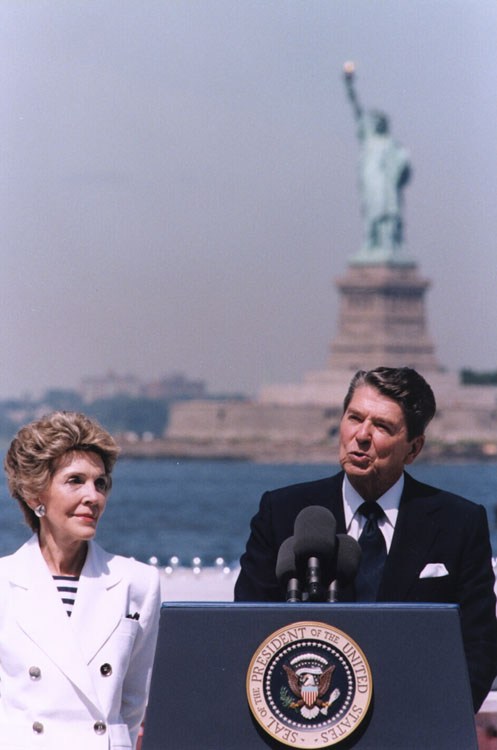
President Reagan and First Lady Nancy Reagan.

Whitmer herself brought up the 40th president of the United States: “In 1981, President Ronald Reagan spoke to the NAACP’s annual convention, and his comments stand in sharp contrast to what we have seen on the national and state level from his own beloved party in 2020. He said, ‘A few isolated groups in the backwater of American life still hold perverted notions of what America is all about.’ Recently, in some places in the nation, there’s been a disturbing recurrence of bigotry and violence.  Then Reagan sent a direct message to those who still adhere to senseless racism and religious prejudice: ‘You are the ones who are out of step with our society,' he said. 'You are the ones who willfully violate the meaning of the dream that is America. And this country, because of what it stands for, will not stand for your conduct.’”


Applebaum offers this chilling conclusion that provides the title for her book: “It is possible we are already living through the twilight of democracy; that our civilization may already be heading for anarchy or tyranny, as the ancient philosophers and America’s founders once feared…”


But, like Gessen, she offers explicit and implicit antidotes to a muddy downward slide toward autocracy. Explicitly: Build cooperation and coalitions; embrace allies; promote “rational thought, rule of law and integration;” and be “rooted to a place and yet open to the world.” Implicitly: become educated, practice critical thinking, and take the high road –– in the face of hate and anger, show love and kindness.