Showing posts sorted by relevance for query manifest destiny. Sort by date Show all posts

Tuesday, March 31, 2026

Hegseth’s Holy War

By Bill Doughty


On March 25 at the Pentagon “Secretary of War” Pete Hegseth prayed “in the name of Jesus” for God to help break the teeth of his enemies in Iran.


His prayer, written in part by a military chaplain, calls up ghosts of the Crusades, Manifest Destiny, and Old Testament brutality as well as an interpretation of the New Testament that is violent and unforgiving.


Hegseth called on the Christian God to give “overwhelming violence of action against those who deserve no mercy.”


“Almighty God, who trains our hands for war and our fingers for battle. You, who stirred the nations of the north against Babylon of old, making her land a desolation where none dwell. [“Nations of the North against Babylon of old” = Crusades]


“Behold now, the wicked who rise against Your justice and the peace of the righteous. Snap the rod of the oppressor, frustrate the wicked plans, and break the teeth of the ungodly.
By the blast of Your anger, let the evil perish. Let their bulls go down to slaughter, for their day has come… 

"Pour out your wrath upon those who plot vain things, and blow them away like chaff before the wind. Grant this task force clear and righteous targets for violence. Surround them as a shield. Protect the innocent and blameless in their midst. Make their arrows like those of a skilled warrior who returned empty-handed. Let every round find its mark against the enemies of righteousness and our great nation.”

[“Riighteousness…great nation = Manifest destiny]


“Give them wisdom in every decision, endurance for the trial ahead, unbreakable unity, and overwhelming violence of action against those who deserve no mercy. Preserve their lives, sharpen their resolve, and let justice be executed swiftly and without remorse, that evil may be driven back and wicked souls be delivered to the eternal damnation prepared for them. For the wicked flee when no one pursues, but the righteous are as bold as a lion.”

[Overwhelming violence…without remorse…eternal damnation = Old Testament.


“We ask these things with bold confidence in the mighty and powerful name of Jesus Christ, king over all kings.”


Hegseth’s apocalyptic vision frames the war with Iran as a struggle against "religious fanatics" seeking a "religious Armageddon.”


As George W. Bush did in his war with Iraq, Hegseth also characterizes Operation Epic Fury as a "crusade" and a "holy war.” Theocracy is embraced on a path toward "end times."


Framing Jesus Christ as “king over all kings” seems to place Christianity above the Constitution, with “under God” supplanting “e pluribus unum.” It is a turn away from secular democracy and toward dominion domination.

Considering the pattern of discrimination against secular humanism and diversity, equity and Inclusion –– such as raising the profile of Christian military chaplains and preventing the promotion of blacks and women in senior officer ranks –– Hegseth’s prayer and war strategy seem to align with white Christian supremacy.


During his Pentagon prayer service, he welcomed another member of the Trump cabinet, Veterans Administration head Doug Collins, an Air Force reserve chaplain. “It’s such a blessing to be a part of a cabinet filled with faith-filled members who pray together, who share scripture together on a regular basis, who meet together and pray together,” Hegseth said.

Hegseth’s pastor, Doug Wilson, spoke and prayed at a previous Pentagon service. Wilson opposes gay marriage, supports women not voting, and promotes past slavery as good for black people.


Regarding slavery, Wilson says that the Bible does not explicitly forbid slavery and permits owning other people if slaves are treated well. He co-authored “Southern Slavery as it Was,” which claimed that American slavery preserved families and introduced black families to Christianity.


Hundreds of Christian leaders, joined by other religious and nonreligious groups, have condemned white Christian nationalism and supremacy and Hegseth’s view of patriarchy and dominionism. Many express their opposition in ongoing “No Kings” rallies and protests.


After Hegseth’s prayer for violence, Pope Leo addressed Catholic worshippers during a Palm Sunday mass in St Peter’s Square. Leo said the conflict between Iran, Israel and the US was “atrocious” and that Jesus could not be used to justify war.


“This is our God: Jesus, king of peace, who rejects war, whom no one can use to justify war,” he said to tens of thousands of followers. “He does not listen to the prayers of those who wage war, but rejects them.”


Quoting a Bible passage, Leo added: “‘Even though you make many prayers, I will not listen: your hands are full of blood.’”

Sunday, October 16, 2022

Mahan the Realist / ‘Proud Tower’ 1

Review by Bill Doughty––

In “The Proud Tower: A Portrait of the World Before the War: 1890-1914,” (MacMillan, 1966) author Barbara W. Tuchman describes U.S. Navy Adm. Alfred Thayer Mahan as “a quiet, tight-lipped naval officer with one of the most forceful minds of this time.” Tuchman paints her description of Mahan this way:

“Well over six feet tall, wiry, thin and erect, he had a long, narrow face with narrowly placed pale-blue eyes, a long, straight, knifelike nose, a Sandy mustache blending into a closely trimmed beard over an insignificant chin. All the power of the face was in the upper part, in the eyes and domed skull and the intellectual bumps over the eyebrows … He had little sense of humor, a high moral tone … So precise were his scruples that when living on naval property at the War College he would not allow his children to use the government pencils.”

Mahan embraced his moment in time and was a driving force in turning the growing power of the United States toward expansion. He told others he could prove he was not anti-semitic: “That Jesus Christ was a Jew,” he said, “covers his race for me.”

Tuchman writes that among history’s many turning points at the end of the 19th and beginning of the 20th centuries, was “the last armed conflict between Indians and whites” at Wounded Knee Creek, South Dakota. (Although not detailed in Tuchman’s book, the “conflict” was, in fact, an atrocity –– the massacre of 300 Lakota men, women and children by the U.S. Army in 1890.)


The massacre was a turning point for the United States. “In that year [then] Captain A.T. Mahan, president of the Naval War College, announced in the Atlantic Monthly, ‘Whether they will or no, Americans must now begin to look outward.’”


Mahan saw the Pacific as America’s destiny. Expansion westward, he thought, must continue in the name of Manifest Destiny –– what Rudyard Kipling would call “the White Man’s Burden.”

“The immediate issue was Annexation of Hawaii. A naval coaling base at Pearl Harbor had been acquired in 1887, but the main impulse for annexation of the Islands came from American property interests which were dominated by Judge Dole and the sugar trust. With the support of the United States Marines they engineered a revolt against the native Hawaiian government in January 1893…”

In “The Proud Tower” Tuchman describes the political challenges and opportunities involved in Hawaii becoming a territory of the United States.


It was a time of tumult and war for the U.S. military in Cuba, the Philippines, and China. War continued to flair between other countries, as well.

Japan’s victory over China in 1895 –– not to mention Japan’s success in the Russo-Japanese War several years later –– reinforced Mahan’s published opinions about America’s continued need to look outward to defend its interests in a dangerous world through power. That power could only be achieved with a strong navy, which was “moribund” at the time, according to Tuchman. 

With strong support from Assistant Secretary of the Navy Theodore Roosevelt and allies in the U.S. Congress, it wouldn’t be long before shipbuilding in the United States was revitalized.


Meanwhile, Mahan’s classic “The Influence of Seapower on History” “had an effect that was epochal on world history,” according to Tuchman. The book was a favorite of Kaiser Wilhelm in Germany, and was high on the reading list for naval officers in Japan. She notes that another remarkable book published in that period also influenced the course of history: Charles Darwin’s “The Origin of the Species.”


Darwin’s conclusions about the animal kingdom were twisted to apply to human society so that Darwinism “acquired a moral imperative,” Tuchman writes. “Darwin’s indirect effects reached apotheosis in Captain Mahan. It’s no coincidence that science’s rise in the late 1800s came at the same time as the waning of the influence of religion. People needed to believe in something, Tuchman said, and that something was either nationalism, socialism, or anarchy –– or some combination of the above.

The world also experienced a revolution in art around the turn of the century. Picasso and Braque created expressionist Cubism. Richard Strauss experimented with formless new music with Also Spruce Zarathustra. The title of Tuchman’s book comes from a poem by Edgar Allan Poe, “The City in the Sea,”* written in the mid-1800s. By the first decade of the 1900s, playwrights, composers, painters, and writers, including Friedrich Nietzsche, tinkered with ideas that both reflected society and influencing it.


Mahan, a stubborn realist, continued to be a firm believer in the necessity of war and the right of a nation, at least his nation, to expand its interests through belligerence, even at the expense of others.


Mahan was chosen as a key U.S. representative at the Hague Convention of 1899 in the Netherlands. Tsar Nicholas II of Russia called leading nations to the convention to try to curb a global arms race. Mahan’s “rectitude and assuredness” led to his rejection to proposals to limit the calibre of guns and other restrictions. He even voted against limiting use of weapons of mass destruction, including chemical weapons such as “asphyxiating gas.”


Barbara Tuchman
It’s ironic (thinking of Vladimir Putin’s invasion of Ukraine) to consider that it was Russia that proposed the Hague talks in 1899 and later in 1907. The Hague Conventions wanted to prevent or at least lessen the impacts of war through limitations in armaments, adoption of laws of war, and acceptance of rules of arbitration. To Russian thinkers, the thought was that war had become “impossible except at the price of suicide,” as stated in the six-volume “The Future or War,” published by Ivan Bloch, who believed “Limited war was no longer possible.”

Despite any meager agreements between nations, the “Great War” came to the world as Anarchists, Socialists, Ultra-Nationalists, and anti-Socialists prevailed in their assassinations, bomb-throwing, and revanchism in the second decade of the 20th century, culminating with the assassination of Franz Ferdinand and Jean Jaurés.


Tuchman laments the loss of the Old World and “much that has since been lost.” Touching on the imagery in Poe’s maritime-themed “The City in the Sea,” Tuchman writes, “Illusions and enthusiasm slowly sank beneath a sea of massive disillusionment.”


“For the price it paid, humanity’s gain was a painful view of its own limitations.”


*The City in the Sea


By Edgar Allan Poe


Lo! Death has reared himself a throne
In a strange city lying alone
Far down within the dim West,
Where the good and the bad and the worst and the best
Have gone to their eternal rest.
There shrines and palaces and towers
(Time-eaten towers and tremble not!)
Resemble nothing that is ours.
Around, by lifting winds forgot,
Resignedly beneath the sky
The melancholy waters lie.

No rays from the holy Heaven come down
On the long night-time of that town;
But light from out the lurid sea
Streams up the turrets silently—
Gleams up the pinnacles far and free—
Up domes—up spires—up kingly halls—
Up fanes—up Babylon-like walls—
Up shadowy long-forgotten bowers
Of sculptured ivy and stone flowers—
Up many and many a marvellous shrine
Whose wreathed friezes intertwine
The viol, the violet, and the vine.
Resignedly beneath the sky
The melancholy waters lie.
So blend the turrets and shadows there
That all seem pendulous in air,
While from a proud tower in the town
Death looks gigantically down.

There open fanes and gaping graves
Yawn level with the luminous waves;
But not the riches there that lie
In each idol’s diamond eye—
Not the gaily-jewelled dead
Tempt the waters from their bed;
For no ripples curl, alas!
Along that wilderness of glass—
No swellings tell that winds may be
Upon some far-off happier sea—
No heavings hint that winds have been
On seas less hideously serene.

But lo, a stir is in the air!
The wave—there is a movement there!
As if the towers had thrust aside,
In slightly sinking, the dull tide—
As if their tops had feebly given
A void within the filmy Heaven.
The waves have now a redder glow—
The hours are breathing faint and low—
And when, amid no earthly moans,
Down, down that town shall settle hence,
Hell, rising from a thousand thrones,
Shall do it reverence.

Monday, July 18, 2022

Smashing Ideas About Monuments

Review by Bill Doughty––

More than 250 years ago the federal government hired sculptor Clark Mills to cast a statue called Freedom, pictured above, that would be placed atop the U.S. Capitol Building in Washington D.C.


The first plaster model of Freedom, created in 1854, was rejected by then-U.S. Secretary of War (SECDEF) Jefferson Davis (future president of the Confederacy) because it wore a “liberty cap,”as Erin L. Thompson explains in “Smashing Statues: The Rise and Fall of America’s Public Monuments” (W.W. Norton, 2022).


Davis insisted the cap, which represented emancipation, be replaced with a helmet. But the new design looked “more suited to a Vegas showgirl than a warrior, with a starry headband topped with feathers sprouting from a popeyed eagle.” Eventually the symbol of liberty created by Clark Mills and his team of workers moved forward and upward, headgear and all:

“When Freedom was finally hoisted into place in December 1863, it was hailed as a symbol of the universal liberty the Emancipation Proclamation had declared in January of that year. More than 150 years later, many avowed white supremacists undertook a deadly invasion of the Capitol building to dispute the results of the presidential election. You might think that a symbol of the liberty America is supposed to offer to all would have dissuaded or at least shamed them. Looking more deeply into Freedom’s history reveals why the monument instead inspired them. It is a white supremacists vision of freedom.”

To help create the cast and melt bronze for Freedom, Mills depended on his workmen, including Philip Reed, a man born into slavery in South Carolina, who was paid $1.25 per day by Mills, but was considered his property. As Mills gained fame and made more money he purchased more enslaved people.


The symbol of Freedom was, in actuality, a symbol of slavery. “Slavery shaped everything about her,” Thompson writes.


Despite an attempt to promote emancipation and liberty, seditionists in the South staged the ultimate insurrection, led by Jefferson Davis. Construction of the Capitol Building stopped for a while, but was restarted under orders from President Abraham Lincoln, who said, “If people see the Capitol going on, it is a sign we intend the Union shall go on.”


The supreme irony of the statue atop the Capitol –– symbolizing liberty but built by enslaved people –– is matched in the story of Horatio Greenough, eugenic “father of our monuments,” whose “blatant racism” is found in his work.
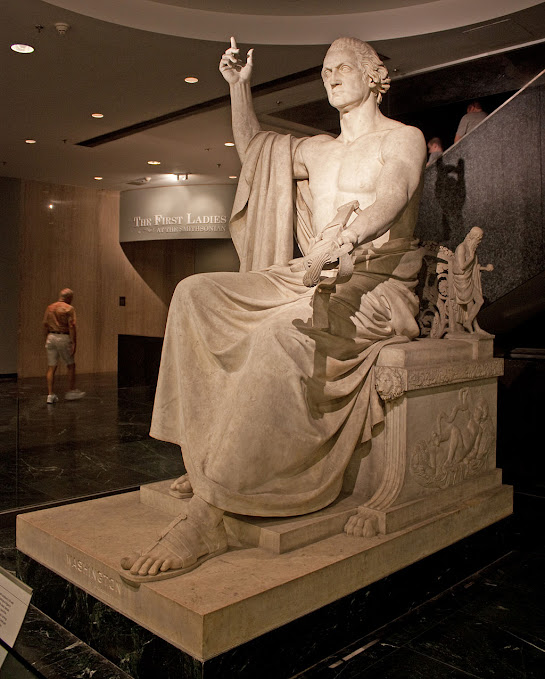

Greenough's George Washington (Wikimedia)
Greenough created a bizarre god-like statue of George Washington that includes a subjugated indigenous “Indian chief” in the design, under Washington’s hips, as the first president holds a sword and points to the sky. Greenough had planned to include “a negro” along with the indigenous figure, but abolitionist Charles Sumner convinced him not create a tie to slavery. The sculptor included a depiction of Christopher Columbus instead.

The public and press mocked the semi-nude statue of the first president. “American audiences paid less attention to deciphering the meaning of Washington’s symbolic sword and more to his nipples.” The statue, Thompson notes, "is on display at the Smithsonian’s National Museum of American History, awkwardly wedged next to an escalator. Today, the sculptures upraised hand looks as though it points the way up to the next floor."


Greenough's "Rescue." (LOC)
Greenough’s next work was received more favorably, at least by white Americans. In many ways it was even more bizarre and offensive. Like other monuments to follow, Rescue celebrated the genocide of Native Americans, particularly after President Andrew Jackson’s “Indian Removal Act” of 1830.

Rescue is in effect a monument to Manifest Destiny –– the idea of a god-given right of white people to subjugate indigenous people –– and for men to have an ordained role as dominant protectors of women. Thompson explains the scene of a white settler holding a dying indigenous warrior he'd just shot; his wife and child hover beneath him, and a dog watches balefully. The symbolism is clear and cringe-inducing.


At Abraham Lincoln’s inauguration in 1861, Rescue was prominently on display. It was removed from the eastern front of the Capitol Building in 1958 after decades of complaints. Thompson writes, “The removal of Rescue is another example of what happens when enough people decide that the messages encoded in a monument are unacceptable to them.”

“Greenough’s sculptures, the first thoroughly American national monuments, were also the first in a long line of public artworks to address questions of how much Black and Indigenous lives matter in America. He and his monuments claimed these lives didn’t matter at all. Greenough’s monuments assert that only people of a certain gender, class, and race deserve honor.

“Greenough’s beliefs informed not only his own sculpture but all the subsequent American public monuments based on his influential examples.”

A natural progression to other monuments highlighting white supremacy extended in the wake of the Civil War, even in Thomas Ball’s controversial Freedmen’s Memorial, dedicated in 1876.


Also known as Emancipation Memorial, it depicts a fully clothed Lincoln standing over a nearly naked kneeling black man. One interpretation is of a gracious leader bestowing freedom, but another view is of ongoing patriarchal and racial inequality.

Freedmen’s Memorial was unveiled on the eleventh anniversary of Lincoln’s assassination. President Ulysses S. Grant, members of Congress, and Supreme Court justices all attended and listened to Frederick Douglass’s speech. Several days later, Douglass wrote a letter to the editor of the National Republican in which he said, “What I want to see before I die is a monument representing the negro, not couchant on his knees like a four-footed animal, but erect on his feet like a man.”


Douglass’s descendants would live to see many hundreds of monuments erected to honor the seditionists of the Confederacy.


The rise of many of those monuments coincided with the rise of the rights and equality of African Americans as guaranteed under the Constitution.


An example is the statue of Robert E. Lee erected in Charlottesville, Virginia, in 1924, shortly after Virginia’s Racial Integrity Act made segregation lawful and outlawed in interracial marriage (not overturned by the Supreme Court until 1967 in Loving v. Virginia).


“The conflict at the heart of America,” Thompson writes, is “the conflict between the freedom for all and freedom for some.”


Thompson enlightens readers with the psychology, politics, and intent of Civil War monument creators. She delves into the meaning of statues’ poses, shows the influence of donations in creating profit motives for monuments, and explains the role of the Ku Klux Klan and other white supremacists.


Then there's Christopher Columbus.


Columbus Fountain in Washington D.C. (NPS)
Thompson reminds readers about Columbus’s contemporary, the priest Bartolemé de las Casas, who wrote about the real Christopher Columbus during his cruel reign as governor of Hispaniola (now Dominican Republic and Haiti). Columbus is condemned for overseeing torture, rape, slavery and genocide. Columbus shipped young girls back to Spain to be sold into slavery.

In recent years more people have assembled, protested, and demanded statues honoring Columbus, like monuments to the Confederacy, be taken down.


Thompson explores how, despite widespread opposition to their presence, some monuments remained in place for years. “We think our monuments celebrate our democracy, but really, they are held in place by some of America’s least democratic uses of power.”

Complacency and willful ignorance kept monuments up until catalysts of violence created a backlash: “Unite the Right” white supremacists' march (and killing of Heather Heyer) in Charlottesville; the horrific mass murder at a church in Charleston, South Carolina; and the senseless murder of George Floyd in Minneapolis, Minnesota, as examples.


Acts of civil disobedience are often the result of willful acts of bureaucratic lethargy, intransigence, and not listening to peaceful protesters. Thompson writes, "Talking about monuments is not easy. But we need to do it. We need to come together as communities to make sure our monuments leave room for everyone's life, liberty, and pursuit of happiness."


Towering over all the monuments to the Confederacy is the incomparable Stone Mountain in Georgia. Cut into the face of the mountain, it is the world’s largest bas-relief sculpture: images of Confederate President Jefferson Davis, along with Civil War generals Stonewall Jackson and Robert E. Lee on horseback. The sculpture inspires white racists and believers in the Lost Cause Big Lie, including the KKK.

Thompson writes about eccentric anti-semitic sculptor and con artist Gutzon Borglum, who was involved in creating the Stone Mountain monument. Borglum would go on to create the monument at Mount Rushmore, South Dakota, on land that was sacred to indigenous people.

There’s a lot more in this book about Borglum and Stone Mountain –– stories “to startle us out of our assumptions,” as Thompson writes.


[While reading this book I came across a new Americana CD by Bill Edwards, “61356,” with a great song from the perspective of a statue of a Union soldier on a Civil War monument in Illinois: “We Don’t See It Yet.” Edwards sings: “Since nineteen hundred and thirteen/I’ve stood in my place on this stone/In the middle of my Bureau County/But I haven’t stood here alone/Above me, a guardian angel/To my right, left and back, over Vets/We watch the horizon for justice/Alas, we don’t see it yet.” It’s a terrific song and album, highly recommended. Read more about "61356" on The Stratton Setlist.]


In “Smashing Statues” Thompson laments the lack of monuments to African Americans who fought for the Union in the Civil War.


There are also a relatively small number of monuments to women in the United States, but last week Speaker of the House of Representatives Nancy Pelosi unveiled a statue of Mary McLeod Bethune in the Capitol Building. Behune was “an unyielding force for racial justice, a pioneering voice for gender equity” from Florida, who was also “a devoted advocate for education,” Pelosi said in her remarks.


Bethune statue unveiled at Capitol Building July 13, 2022. (CNN)
The statue of Bethune joins statues of Rosa Parks, Sojourner Truth, Frederick Douglass and Martin Luther King, Jr. in the Capitol’s Statuary Hall. Bethune’s statue replaces that of a Confederate general.

On January 6, 2021, Trump-supporting insurrectionists, many wearing helmets or other headgear, walked through Statuary Hall during the coup attempt. Some rioters carried Confederate flags into the Capitol. High above them, on top of the building stood the statue in plumed helmet with an American eagle, mouth agape, eyes bulging –– Freedom.


This is an indispensable book for military readers interested in the reasons for the initiative to rename installations, facilities, and ships named for Confederate white supremacists or Confederate battle victories.

Friday, January 21, 2022

Blue Age I: ’Global Prosperity’ Ignoring Mahan

Review by Bill Doughty––

“The United States Navy –– A Global Force for Good.”


There was a time –– and it doesn’t seem that long ago –– when that message, a former recruiting slogan, came on TV in commercial breaks during NFL games.


For some, it was controversial. Anyone who misunderstood the meaning of the word “force” could misconstrue the message. Should the United States, through its surface ships, submarines, aircraft carriers, and Navy SEALs, be “forcing” its way? So, another way to look at the former Navy slogan is, “A Global Enforcer for Good.


Gregg Easterbrook makes the case for the Navy’s role as “a force for good” –– enforcing free trade on the world’s oceans and seas –– in “The Blue Age: How the US Navy created Global Prosperity –– and Why We’re in Danger of Losing It” (Public Affairs, Hachette Book Group, 2021). The result of such enforcement is peace, prosperity, and an amazing decline in extreme poverty, especially in China.

“Nearly all the decline of extreme poverty occurred in the trade-focused nations of Asia. Max Roser, an economist at the University of Oxford, has noted that China’s trade-based improvement of living standards in the last two decades works out to about 130,000 people escaping poverty each day. Roser calls this ‘the leading achievement in human history,” greater than the Apollo missions, greater than the European Enlightenment, greater than independence for the United States or India.”

“We are living in the blue age. Many generations of our ancestors, up to our grandparents, could only have dreamt of a time when a guardian navy eliminated nearly all risk involving sea lanes, anyone anywhere can sell to or buy from anyone else, anyone anywhere can sail anywhere.”


Mahan
Someone who did imagine it in our grandparents’ and great-grandparents’ time was Alfred Thayer Mahan. He foresaw a strong U.S. Navy on two oceans, and he greatly influenced President Theodore Roosevelt to build battleships and achieve naval hegemony under Manifest Destiny "moral" justification.

But, according to Easterbrook, Mahan, though still revered in many circles and right about the importance of the oceans, was devastatingly and fundamentally wrong then and now about some key theories.


Among Mahan’s failed theories were that bigger platforms are always better, a big navy could deter war just by being built and kept in port, and “that if sent into action, a navy should concentrate all force into a single, decisive battle.” Mahan’s theories enticed not just T.R. but also Kaiser Wilhelm, Führer Hitler, and Emperor Hirohito. Today, Mahan is read and cited by military leaders in the Communist Chinese Party, according to Easterbrook.


Mahan’s theories led Wilhelm and his navy leader Adm. Alfred von Tirpitz to build a big fleet but leave it in port until a decisive battle and defeat at Scapa Flow. “Unable to make Mahan’s theoretical notions work in the real world, Tirpitz pressured the kaiser to allow unrestricted submarine warfare against American merchantmen. This decision, taken in winter 1917, brought the United States into the Great War. “By drawing in the United States, strongest nation in the world, Mahan’s theories converted German military advantage into utter ruin.”


Imperial Japan made the same mistake less than a generation later when the attack on Pearl Harbor, instead of striking decisive blow, brought America into World War II. Japan built super-sized battleships Yamato and Musashi, and aircraft carrier Shinano, that were quickly sunk by the U.S. Navy.


After the British government appeased Hitler in the late 1930s, the Nazi’s were unleashed. “Hitler conceived a pure Mahan strategy, with he ominous label Plan Z, of building supergiant battleships, aircraft carriers, and long-range cruisers, all of which never would leave port: the ultimate fleet-in-being, to use Mahan’s terminology.”


The world has moved away from military conquest and toward greater international cooperation and trade by sea. But what about China’s plans?

“Today, Alfred Thayer Mahan is admired in China. Officers of the Chinese maritime force –– officially the People’s Liberation Army Navy, the existence of an organization called the Army Navy being delightful –– are required to read ‘The Influence of Sea Power Upon History.’ A documentary about how the upstart Tudor fleet brought great-power status to England in 1588 by defeating the Spanish Armada in decisive battle is shown on state-controlled Chinese television, followed by a talk-show format discussion of the genius of Mahan.”

Easterbrook observes, “Should China make a Mahan-style move, the harm to international trade will send the entire world spiraling backward.” He examines the current situation in Taiwan and the ways in which forces on all sides are monitored so as to create less uncertainty.


Easterbrook says that though Mahan was right about a nation’s coastline being its most valuable natural resource, he was wrong in arguing for the right of America to use its naval force “outward” to seize power over developing nations –– or otherwise Germany would do so.


One of the problems of building bigger and more and more ships, as Mahan advised, is that it gives powerful leaders more hammers, and you know what they say about hammers.

“Peace on the waters is both invisible to most of humanity and tenuous. For decades the US Navy has been so strong that no other nation tried to contest its ensign. Recently, China has engaged in a clipped naval buildup. The saying ‘When you have a hammer, every problem looks like a nail’ can apply to military affairs. Soon China will possess maritime hammers, and the world’s oceans may begin to seem like nails.

“The Russian Federation is improving its navy, while India, the United Kingdom, Japan, and other nations are adding warships. Destructive, almost continuous novelist military buildup was a distinguishing feature of the world from about 1500 to the 1950s. The English-German naval arms race that began in 1909 engaged the momentum of World War I. The reprise English-German naval arms race that began in 1936, coupled with Japan’s preparations to sink the American Pacific fleet at Pearl Harbor, were major factors in the impetus for World War II. Should a new naval arms race commence, the impacts will be global and entirely negative. Americans ignore the prospect at our peril.”

The world cannot ignore what Easterbrook considers the two greatest threats to continued prosperity: a renewed arms race (more hammers) and global climate change.


He explores how the Arctic is creating new challenges but also new opportunities for international cooperation, including new trade routes as long as sea lanes are unrestricted.


Special attention is given to contested areas and expanded sweeping claims by the PRC in the South China Sea.


Yesterday, the United States showed how it “will continue to defend the rights and freedoms of the sea guaranteed to all,” according to a statement on Navy.mil.


Logistics Specialist Joshua Green, from New Orleans, stands lookout watch on the bridgewing as Arleigh Burke-class guided-missile destroyer USS Benfold (DDG 65) conducts routine underway operations, Jan. 20, 2022. Benfold is forward-deployed to the U.S. 7th Fleet area of operations in support of a free and open Indo-Pacific. (MC2 Class Arthur Rosen)

From the Navy: “On Jan. 20, USS Benfold (DDG 65) asserted navigational rights and freedoms in the vicinity of the Paracel Islands, consistent with international law. At the conclusion of the operation, USS Benfold exited the excessive claim and continued operations in the South China Sea. This freedom of navigation operation (‘FONOP’) upheld the rights, freedoms, and lawful uses of the sea recognized in international law by challenging restrictions on innocent passage imposed by the People's Republic of China (PRC), Taiwan, and Vietnam and also by challenging the PRC’s claim to straight baselines enclosing the Paracel Islands.”


Easterbrook
The Navy is still “a global force for good” if you believe Easterbrook’s contention that free and open trade between nations helps prevent wars.

“For present generations, a world without war is too distant to represent a practical goal,” Easterbrook writes.


“Disincentives to war are more pragmatic. The strongest disincentive to war on the blue water –– and, thereby, the best protection for trade that benefits nearly everyone on earth –– is the strength, scope, and forward placement of American naval power.”


In Part II of our review of “The Blue Age,” we will dive deeper into Easterbrook’s observations about China as well as the need for enforcing international laws, including especially, as the Navy notes, “international law of the sea as reflected in the 1982 Law of the Sea Convention provides for certain rights and freedoms and other lawful uses of the sea to all nations.”


Top photo: Arleigh Burke-class guided-missile destroyer USS Benfold (DDG 65) conducts routine underway operations in the South China Sea, Jan. 20, 2022. (MC2 Arthur Rosen)

Thursday, July 11, 2019

How Navy & Marines Reached the Moon 50 Years Ago

Glenn and Armstrong, survival training in Panama, 1963. NASA
Review by Bill Doughty

July 20, 1969: A Sailor (Neil Armstrong) became the first human to step on the moon. 

Earlier in the decade, another Sailor (Alan Shepard) was the first American to travel in space, and a Marine (John Glenn) was the first American to orbit Earth.

A United States president and vice president (both Navy veterans) along with a NASA administrator (a former Marine) provided key leadership so Americans could plant the American flag in the Sea of Tranquility fifty years ago this month.

That flag – once red, white and blue – is now bleached white by UV radiation, according to Douglas Brinkley in "American Moonshot: John F. Kennedy and the Great Space Race" (HarperCollins, 2019).

From War/Destruction to Peace/Discovery

Writing with a journalist/historian's touch, Brinkley shows how the influence of World War II – and the resultant Cold War – brought about the Space Race between the United States and the Soviet Union. It was a race that the Soviets proved to dominate – hare to tortoise – in the early 1960s.

"Space was America's Cold War Manifest Destiny," Brinkley writes, "and the Mercury astronauts wore its rough-and-ready trailblazers, following in the footsteps of Kennedy's own World War II Generation and almost two centuries of American adventurers before."

America's moonshot would not have happened in 1969 without JFK's drive.

John F. Kennedy, who had some health issues even as a young man, was at first rejected from service, but he used his father's influence to help him get into the Navy. 
"When the Japanese bombed Pearl Harbor on December 7, 1941 – 'a date that will live in infamy,' as President Roosevelt termed it – Jack and Joe Kennedy were already in uniform and ready for combat duty. They would never have to scrub off the taint of using their father's influence to avoid military service. Four days after Pearl Harbor, Nazi Germany and the Axis partners declared war on the United States. 'Industrial Mobilization' became an urgent catchphrase across the nation. Military bases were built on empty land. Factories were adapted to switch from manufacturing consumer goods to producing war matériel. Between 1940 and 1943, enlistment in the U.S. 
Armed Forces expanded from fewer than five hundred thousand to more than nine million. Mobilization efforts swelled in every direction, from far-flung Honolulu to the shipyards of Norfolk."
A young JFK.
JFK showed his profile in courage in the War in the Pacific, and was profoundly affected when his big brother, Joseph Jr., was killed on a combat mission. Joe's plane exploded in mid-air in what proved to be an unsuccessful bombing mission against a Nazi missile base.

Brinkley posits that Hitler's missile program laid the foundation for NASA's success, particularly with the help of former Nazi scientist Wernher von Braun. Kennedy was motivated and propelled by a combination of influences, including his father's drive, his brother's death, and a vision of the future for America and the world.

JFK, followed by LBJ and assisted by NASA administrator James Webb, a Marine major in WWII, presented the vision, the mission and the will to reach the Moon, despite other challenges and sea changes in the 60s – including the Cuban Missile Crisis, civil rights movement and Vietnam.

JFK's visionary leadership, combined with the hard work and creative innovation of an elite civilian-military team, the United States discovered a world of innovation in space, including communication, mapping and global positioning satellites; commercial air transport; and the microchip.

Navy veterans/leaders kept space closed to militarization and turned away from nuclear atmospheric testing and proposals to put nuclear weapons in space.

In Kennedy's challenge to go to the Moon, he said – with speechwriter Ted Sorensen's help in balancing optimism with humility – "we meet in an hour of change and challenge, in a decade of hope and fear, in an age of both knowledge and unforgettable ignorance. The greater our knowledge increases, the greater our ignorance unfolds."

Naval Propulsion Into Space

While the sea services were joined by the Army and Air Force and led by civilians in developing the space program, Brinkley reveals various naval ties – Navy and Marine Corps connections – to putting Americans into space:

CNO Adm. Arleigh Burke joins JFK and LBJ to observe the successful mission by Alan Shepard.
  • Secretary of the Navy James Forrestal mentored Navy veteran-turned-politician JFK on "post-war national security imperatives," preparing him for his next roles in public service.
  • On May 5, 1961 Chief of Naval Operations Admiral Arleigh Burke was with JFK and LBJ to observe news coverage Alan Shepard's successful flight into space.
  • NASA Administrator James Webb was a major in the Marine Corps in WWII, tasked with running the U.S. radar system for the planned invasion of Japan, ultimately unnecessary after the bombing of Hiroshima and Nagasaki and Imperial Japan's surrender.
  • The Naval Research Laboratory announced Sputnik's successful orbit of the Earth on Oct. 4, 1957.
  • The Navy led development of the Vanguard satellite, which experienced fits and starts (though former Nazi Wernher von Braun, supported by Senator Barry Goldwater, favored the Army's satellite hardware and development – as well as militarization of space).
  • Among the hundreds of U.S. Navy ships involved in the recovery of astronauts and development of the space program were USS Lake Champlain (CV-39), USS Decatur (DD-936), USS Intrepid (CV-11), USS Kearsarge (LHA-3), USS Noa (DD-841) and USS Randolph (CV-15). Navy helos, divers, tracking and personnel were also critical to the success of the program. (Check out the extensive list of recovery ships on NASA's history site.)
  • Lt. Cmdr. Victor Prather, a Navy flight surgeon, lost his life testing the full-pressure Mark IV space suit. Other military veterans as well as civilians paid the ultimate price over the years as the space program developed.
  • Shepard was a  Navy test pilot and "military aviation superstar" who had served aboard USS Cogswell (DD-651) during WWII and as a squadron operations officer aboard USS Orinsky (CV-34) during the Korean War. He was a leader among astronauts and became the oldest man to walk on the moon, at the age of 47.
  • Naval aviator Neil Armstrong "had become one of the most respected jet pilots of the Korean War generation, part of an 'ace club' that also included John Glenn and Wally Schirra."
  • Marine John Glenn distinguished himself in World War II and the Korean War. He became a close friend of both President Kennedy and younger brother Robert F. Kennedy. Glenn represented all astronauts at JFK's funeral. After leaving NASA he entered further public service, running for the United States Senate. Jacqueline Kennedy called on Glenn and asked him to comfort her children Caroline and John Jr.  after JFK was killed. Glenn would do the same for RFK's children in 1968 after Bobby Kennedy was murdered.
  • Astronaut Scott Carpenter, a Navy test pilot who followed John Glenn into space, had served in the Korean War, flying "numerous reconnaissance and antisubmarine missions along both the Siberian and Chinese coasts."
  • Astronaut Wally Schirra served aboard Navy cruiser USS Alaska (CB-1) during WWII. After the war he married the stepdaughter of Adm. James L. Holloway, Jr. (father of a future CNO).
  • A big supporter of the Navy in Congress – U.S. Senator John C. Stennis (D-Mississippi) is quoted: "Whoever controls space controls the world." is the namesake for the aircraft carrier USS John C. Stennis (CVN-74).
  • SECNAV Fred North, along with LBJ and SECDEF Robert McNamara, accompanied President Kennedy for a visit to Houston, Sept. 11-12, 1962.
  • Although patriarchy and prejudice prevented qualified women (along with non-Christians and non-whites) from becoming astronauts in the early 60s, the Naval School of Aviation Medicine began testing women – seasoned pilots. Dr. William "Randy" Lovelace II, an aeromedical pioneer, "believed that women were better equipped psychologically for NASA space travel because they were, on average, shorter and smaller than men, needed less food and oxygen, and had better blood circulation and fewer cardiac problems." Unfortunately, when NASA and Congress learned about the initiative, the program was shut down, postponing and delaying fulfillment of the promise of equality.
President Kennedy visits Cape Canaveral Nov. 16, 1963.
Cape Kennedy, Vindications, Revelations

Shortly before JFK was killed in Dallas, Texas, he visited Cape Canaveral, Florida, Nov. 16, 1963. "The president's visit to Cape Canaveral had reinforced his faith in exactly what a gargantuan, well-funded, centralized government project could achieve in breakneck time."

Navy, led by USS Wasp (CV-18), recovers Gemini 9 capsule.
Within a week of Kennedy's assassination, LBJ proclaimed a new name for Cape Canaveral: Cape Kennedy.

Interestingly, Brinkley shows how Kennedy was wrong about his claim of a big missile gap with the Soviets, something he proclaimed in what would today be called "fake news." Kennedy made that claim in pointed attacks against President Eisenhower in the late 1950s.

In some ways Ike was vindicated by what Kennedy learned when he came into office (and what was then reported in the New York Times). Eisenhower had quietly kept pace in space in the 50s, deploying reconnaissance and missile-detection satellites.
"All JFK's taunts at Ike had been overdrawn. The fact were that when Eisenhower left the White House, the United States had one hundred sixty operational ICBMs to a paltry four R-7s in the Soviet arsenal. Kennedy now gladly accepted this reality. Later in 1961, Corona satellite intelligence indicated that Khrushchev, expectations aside, had only six ICBMs. Kennedy and Johnson's campaign swipes that Eisenhower and Nixon were the architects of a national security missile strategy of 'drift, delay, and dilution' had clearly been off base. Furthermore, America's three coastal launch sites (Cape Canaveral, Florida; Vandenberg Air Force Base, California; and Wallops Island, Virginia) were already operating around the clock to further spaceflight advancement. Each of these sites had technical facilities, a control center, and the most modern of launchpads. What Kennedy learned was that Eisenhower had actually done an able job of building up U.S. defenses. When Ike was inaugurated for his first term in 1953, the air force still used piston-driven bombers, and navy strategy focused on basing ships around the Pacific. By the time he handed the reins over to JFK, the United States had developed reconnaissance and communication satellite capabilities. And there were nuclear submarines – including the USS George Washington (SSBN-598) – deployed the very month Kennedy was elected and able to carry sixteen nuclear Polaris missiles. Five generations of rockets – starting with the early Vanguard, and then onward with ICBMs like Atlas and Titan – were born in the Eisenhower years. The army had teams designing heavy-launch Saturn rockets, while the air force, not to be outdone, had made headwind with its Space Launching System (SLS), experimenting with a myriad of launch configurations using solid-fuel boosters and hydrogen/oxygen upper states. The Strategic Air Command had more than fifteen hundred jet bombers capable of dropping hydrogen bombs on America's enemies."
Still, JFK was passionate about winning the Space Race for "global prestige" as he fought for peaceful exploration rather than exploitation – for discovery instead of dominance. Already in the 60s there were overtures of joint collaborative missions with the Soviets. But, "For Kennedy, much depended on the United States going to the moon, beating the Soviet Union, being first, winning the Cold War in the name of democracy and freedom, and planting the American Flag on the lunar surface."


Today, as we learned, that flag from 1969 is bleached white. But, rather than being a flag of surrender to the new frontier, perhaps it's a blank slate that could represent a renewable spirit of cooperation and collaboration, reflected in the words of a naval aviator: "one giant leap for mankind."

The American flag planted on the surface of the moon.


Bonus – The U.S. Navy recovers John Glenn: