Sunday, October 31, 2010

ARTificial Life Imitates ART


Review by Bill Doughty

Wired For War is P.W. Singer’s big wave-catching guidebook to the tsunami of change, subtitled as The Robotic Revolution and Conflict in the 21st Century. Part history, part current state of the art, and all philosophy, his book balances ancient storytelling, futuristic thinking and current ethics.

Are we on the verge of a Singularity, a revolution in military affairs (not to mention social/human reality) not seen since the discovery of gunpowder or invention of the steam engine?What will refinement of robots and nanotechnology mean for our military and society in decades ahead?

Nearly five centuries ago, an emperor of the Incan Empire, Atahuallpa, confronted Pizarro and Spanish Conquistadors in what is now Peru -- the first encounter with swords, armor and cavalry. It was, “a powerful example of just how shocking and powerful new weapons of war can be.”

Sir Winston Churchill, featured in our previous blog post, discussed the paradigm shift of new technology. He saw Edison’s and Tesla’s inventions applied to warfare and predicted the future widespread use of drones.

Singer leads Chapter 2 with this quote from Sir Winston: “The further backward you look, the further forward you can see.”

Churchill, who embraced the advent of aviation in warfare, would no doubt appreciate the evolution of asymmetrical warfare, UAVs and development of the Predator, Raven, PackBot, Ro-Bart, Wasp, REMUS, Zeus, Robo-Lobster, Cormorant, as well as other systems and machines explained by Singer in Wired For War.

Other people, however, find it hard to predict, let alone come to terms with, fundamental shifts in technology.
That’s not new.

Singer reminds us what the New York Times said 107 years ago this month, on Oct. 9, 1903, inaccurately predicting human flight:

“The flying machine which will really fly might be evolved by the combined and continuous efforts of mathematicians and mechanicians in from one million to ten million years.”

That same day the Wright Brothers, owners of a bicycle shop in Ohio, began assembling their first airplane -- just seven years before the beginning of the Centennial of Naval Aviation.

Singer shows how the “Dennymite” became the first unmanned plane in history immediately after the Dec. 7, 1941 attack on Pearl Harbor. Its inventor, Reginald Denny, provided work for Norma Jeane Dougherty -- the future Marilyn Monroe -- who was discovered at a factory where she worked spraying Denny’s drones with fire retardant.

In WWII, John F. Kennedy famously served in the Navy. His older brother, Joseph Jr., was a Navy pilot who served in Great Britain, part of a secret pilot-and-remote-control program called Operation Aphrodite. He was killed in 1944 while flying in support of a drone mission against Germany.

Singer tells us about the important role of Navy mathematician “Amazing” Grace Hopper, who was part of a team that developed COBOL so computers could communicate. USS Hopper is named in Rear Adm. Hopper’s honor.

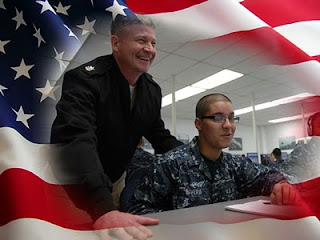
Chief of Naval Operations (CNO) Adm. Gary Roughead visits with Sailors aboard the Arleigh Burke-class Destroyer USS Hopper (DDG 70) at Joint Base Pearl Harbor-Hickam on June 9, 2010. Roughead is at the base to participate in the 2010 Japan-U.S. Junior Officers Symposium. U.S. Navy photo by Mass Communication Specialist 1st Class Tiffini Jones Vanderwyst.
From ancient mythology, Talos is a mechanical statue who served the Greek and Roman god of metalworks. It’s also the name used by an early Apple Computer operating system and the first computer-guided missiles on U.S. Navy Ships.

Modern “mythology” continues to inspire scientists.

Singer shows how much science fiction has predicted where we’ve come and where we’re going.

He gives a nod to former CNO, Chairman of the Joint Chiefs of Staff ADM Mike Mullen and the Navy’s Professional Reading Program, which includes SF titles by Robert Heinlein (Starship Troopers) and Orson Scott Card (Ender’s Game). [Wired For War has been included in the supplemental reading list and was recommended by Capt. John Jackson, “father” of NPRP, in his interview with Navy Reads.]

Singer credits Arthur C. Clarke with “one of the most militarily instructive stories on the dangers of being seduced by possibilities of new technology” -- Superiority.

He cites Isaac Asimov, Brian Aldiss, Joe Haldeman, William Gibson, H.G. Wells and Jules Verne and provides dozens of other sources as examples to explain how life imitates art and vice versa.

The unpredictability and uncertainty of war and unintended consequences of conflict are explored with insights from analyst Richard Clarke.

The same analyst who tried to warn against an invasion of Iraq warns about “a real digital divide” between haves and have-nots, educated and uneducated. Clarke recognizes, Singer says, that fear (including fear of change) is extremely powerful and can drive people toward violence, especially when religion is part of a volatile mix.

Nevertheless, change is not only here, it’s accelerating.

Singer gives an insightful quote from Gen. Eric Shinseki, about the constancy and inevitability of change: “If you dislike change, you’re going to dislike irrelevance even more.”

How will new forms of remote-control or robotic warfare affect the human psyche?

“The courage of a warrior ... is about victory over fear. It is not about the absence of fear,” Singer says, contending, “By removing warriors completely from risk and fear, unmanned systems create the first complete break in the ancient connection that defines warriors and their soldierly values.”

Can understanding and managing change -- like managing and controlling fear -- be part of human “wiring”?

Wired For War, with an obvious pipeline to the Pentagon, is packed with research -- but without jargon -- and backed with copious notes, explanations and examples from literature and popular culture.

Here’s just a partial list (in no particular order) of producers, authors, book titles, movies and games Singer shares:

Steven Spielberg, Clint Eastwood, James Cameron, Mel Gibson, Stephen King, Bertrand Russell, Tom Clancy, Mary Shelley, Nathaniel Hawthorne, Dan Brown, Michael Crichton, S.M. Stirling, Stephen E. Ambrose, Immanuel Kant, Charles Darwin, Ray Bradbury, Albert Einstein, George Orwell, Edgar Rice Burroughs, John Donne, Greg Bear, J. R. Rowling, Frank Herbert, Descartes, Jack London, Marvin Minsky, L. Sprague de Camp, Alien and Aliens, AI, Minority Report, Robocop, Metropolis, Terminator 2, Star Wars, Star Trek, Braveheart, Lost in Space, Matrix, Manchurian Candidate, Twilight Zone, Dr. Who, Battlestar Gallactica, Lord of the Rings, The Last Samurai, Metal Gear, Halo, Medal of Honor, Madden Football, Pixar and Japanese manga.

Sunday, October 17, 2010

Churchill Predicted Drone Warfare

Review of The Gathering Storm by Bill Doughty
Book One of Winston Churchill’s The Gathering Storm From War to War 1919-1939 shows how the seeds of WWII in Europe were planted in the ashes of WWI.

Churchill, known as one of the last century’s greatest orators, was also a writer with extraordinary analytical ability and insight. And, though he denied it, he was a historian who carefully documented events, speeches and testimony.


A “wow” moment in this book — which is on the Navy’s Professional Reading List — comes from Churchill’s writing in 1925 about the technical nature of War, past and present:

May there not be methods of using explosive energy incomparably more intense than anything yet discovered? Might not a bomb no bigger than an orange be found to possess a secret power to destroy a whole block of buildings — nay, to concentrate the force of a thousand tons of cordite and blast a township at a stroke? Could not explosives even of an existing type be guided automatically in flying machines by wireless or other rays, without a human pilot, in ceaseless procession upon a hostile city, arsenal, camp or dockyard? ... A study of Disease — of Pestilences methodically prepared and deliberately launched upon man and beast — is certainly being pursued in the laboratories of more than one great country. Blight to destroy crops, Anthrax to slay horses and cattle, Plague to poison not armies but whole districts —such are the lines along which military science is remorselessly advancing.
That was written in 1925 85 years ago.
Churchill provides historical forensics of events leading to WWII — examining the motives and actions of communists, socialists and followers of “Corporal Hitler.” He examines the consequences of actions by key players in the drama: British politicians, Italy, Spain, Russia, France and the United States.
He warns against paralysm in the name of pacifism, while still hoping for lasting peace in Europe.
He quotes passages from Mein Kampf and shows how Hitler’s unholy bible outlined a vision and agenda for Nazi true believers.
He shows the surprising opposition to building an air force in the Great Britain in the 1930s and the effects of a failure to understand, embrace and control new technologies.
Book Two, Twilight War shows the role of the British Navy at the dawn of the war.

This volume was written in 1948. WWII was still smoldering and the name “Second World War” was still fresh. Churchill saw it as a second Thirty Year War, part of the so-called Great War.
Churchill warns of wars to come in his preface:
One day President Roosevelt told me that he was asking publicly for suggestions about what the war should be called. I said at once “The Unnecessary War.” There never was a war more easy to stop than that which has just wrecked what was left of the world from the previous struggle. The human tragedy reaches its climax in the fact that after all the exertions and sacrifices of hundreds of millions of people and of the victories of the Righteous Cause, we have still not found Peace or Security, and that we lie in the grip of even worse perils than those we have surmounted. It is my earnest hope that pondering upon the past may give guidance in days to come, enable a new generation to repair some of the errors of former years and thus govern, in accordance with the needs and glory of man, the awful unfolding scene of the future.
Can new generations learn how to cherish and sustain the peace and security Churchill writes about? Can we give peace a chance without becoming vulnerable to extremists? Can we imagine a world capable of evolving?

Sunday, October 3, 2010

Thought Ballistics - The Art of the Long View

Review by Bill Doughty


Futurist Peter Schwartz uses “thought ballistics” to hit the target in his now-classic book on understanding global strategic change.


In The Art of the Long View, he shows that everyone has an innate ability to build scenarios -- stories to explain and understand the future. Research shows that the part of brain that controls speech is the same involved in ballistics -- the ability of our distant ancestors to hit small animals with a rock, spear or arrow. A good quarterback (think Joe Montana, Drew Brees or Peyton Manning) has an extraordinary ability to look ahead down field -- to read the future -- in order to hit his receiver with the ball.


New Orleans Saints QB Drew Brees, on target.


Scenarios are “what if?” thoughts about the future that can help governments, businesses and militaries -- society in general -- make strategic decisions that are good for all possible futures, says Schwartz, whose book is recommended in the original Navy Professional Reading List.


The author, in turn, recommends or discusses a variety of books throughout The Art of the Long View, including:


The Ascent of Mind by William Calvin

On Thermonuclear War: Thinking About the Unthinkable by Herman Kahn

On Death and Dying by Elisabeth Kübler-Ross

American Myth, American Reality by James Robertson

The End of Work by Jeremy Rivkin

The Population Explosion by Paul R. Ehrlich and Anne H. Ehrlich


The Art of the Long View is a business/history/philosophy/self-help/roadmap for thinking about the future as compelling in 2010 as it was twenty years ago when it was written.


Schwartz provides comprehensive endnotes, a “scenario planning select bibliography” and a detailed index.


His perspective is business and economics and, like Freakonomics, his perspective is futuristic, synergistic and out-of-the-box thinking, using neurobiology to explain why we sometimes act the way we do.


The idea of speed and language as ballistics is compelling.


Schwartz shows how thinkers and planners can miss a target when their scenarios are hobbled by denial or a lack of imagination in examining consequences.


He says leaders failed to imagine victory after the Cold War. What now? “What if we won?” More than 10 years before 9/11 and subsequent wars in Iraq and Afghanistan, he wrote:


“The new military to cope with the Saddam Husseins of today and tomorrow will be very different from the military needed to contain a hostile superpower.”


Reading The Art of the Long View in the 20/20 hindsight of post-9/11/2001 revealed shadows of things to come. Futurist Schwartz came close to predicting the terrorism that would happen in the beginning of the 21st century.


He acknowledges in his epilogue the seeds of “a deep mutual misreading between Islam and the Christian world” that pose enormous demands upon the world for mutual understanding. And, he says, “The conflicts do not have to be duels to the death.”

Unfortunately, Osama bin Laden and his ilk didn’t get that notice.


In terms of ballistics, those who believe in fomenting fear, hate and terror are off target in today’s world. Some whould argue that, especially in the case of radical Islamists, that’s the reason they are the target.

Sunday, September 26, 2010

Navy Volunteer!... But Why?

by Bill Doughty


Thousands of Sailors volunteer to read to students at schools throughout the United States. Service members, Navy civilians and families volunteer to work at community service projects to help the environment, prevent drug abuse and assist people in need.


Why?


Thomas Jefferson saw charitable giving of time and resources as part of responsible citizenship and good morality. In his 1786 letter to Maria Cosway, “Dialog Between My Head & My Heart,” Jefferson wrote:


And what more sublime delight than to mingle tears with one whom the hand of heaven hath smitten! To watch over the bed of sickness, & to beguile its tedious & its painful moments! To share our bread with one to whom misfortune has left none! This world abounds indeed with misery: to lighten its burthen we must divide it with one another.


Evolutionary biologists, anthropologists and sociologists may explain the benefits of volunteering in scientific terms -- altruism has its roots in survival of the species through natural selection. Those who cooperate and collaborate increase their chances for survival by being able to more effectively feed and defend their families.

In practical terms, Sailors today who volunteer in their communities are more likely to achieve success in their careers. The Sailor benefits and so does the Navy and society, in general.

(Aug. 17, 2010) Sailors assigned to the aircraft carrier USS George H.W. Bush (CVN 77) pick up trash at the Virginia Zoological Park during the ship's "1,000 Points of Light" community service event. Nearly 2,000 George H.W. Bush Sailors volunteered at approximately 100 different locations around the Hampton Roads area. (U.S. Navy photo by Mass Communication Specialist 2nd Class Eric S. Garst/Released)

Last week the Navy Community Service Program council met in Washington, D.C. to evaluate the effects of Navy Volunteer efforts in communities nationwide.


The council looked at ways to streamline the annual volunteer awards program and clarify instructions and processes.


As part of the annual meeting, the council attended a welcoming ceremony hosted by CNO Adm. Gary Roughead for the CNO’s Indian Navy counterpart, Adm. Nirmal Kumar Verma. The CNO spoke of the importance of the strategic partnership with the Indian Navy and the importance of working together toward increased interoperability.

The U.S. and Indian navies worked together in the exercise Malabar 2010, training together as friends and maritime allies.

The strategic importance of volunteering and working together -- whether globally or locally -- is a key theme in the Navy’s mission, outlined in the Maritime Strategy and Commanders’ goals, where preventing war is better than fighting war.

Another highlight for the council was visiting the headquarters of the Navy's Ceremonial Guard. Check out this performance of the guard being shared on line:


In my next blog post I’ll review The Art of the Long View -- Planning for the Future in an Uncertain World by Peter Schwartz, who discusses scenarios for predicting and adapting to change. Schwartz supports the idea of collaborating in an ever-more diverse and integrated society.


Schwartz writes:


The world needs a framework of new international institutions -- a new global commons -- to coordinate people worldwide and help resolve conflicts over resources like oil and territory, or the impact of pollution on a country’s neighbors. The rich and the free need to assure the poor and repressed that they, too, can have a realistic sense of hope for the future -- that the gulf between the top and bottom does not widen so much that we who are well off find ourselves living at the expense of a desperate and angry mass.


More on his perspective next week...


--------------------------------------------


(Aug. 21, 2010) Lt. j.g. Michael Anderson, command chaplain at U.S. Naval Hospital Yokosuka, plays with a child from Fujisawa City's Misono Orphanage during a community relations event sponsored by the hospital and the guided-missile cruiser USS Cowpens (CG 63). More than 70 children were transported onboard Commander Fleet Activities Yokosuka for a day of bowling, playing in the park and an American style barbecue with more than 100 command volunteers. (U.S. Navy photo by Ben Avey/Released)


Saturday, September 11, 2010

‘Beyond Survival’ - Thinking of POWs on 9/11

Review by Bill Doughty

Today we remember the lives lost and damage done in the attacks of nine years ago -- 9/11/2001. Next week, Sept. 17, is national POW/MIA Day. Several weeks ago we ended combat operations in Iraq. It’s timely for a good read by a Vietnam-era POW, for patriots who want to preserve the lessons of history -- Gerald Coffee’s Beyond Survival.


No subject -- sex, religion, torture, fear, feces -- is off limit in Coffee’s reflections on life as a Prisoner of War in Hanoi, North Vietnam from 1966 to 1973.


As a Navy pilot, he flew missions from the deck of USS Kitty Hawk (CV 63). Coffee was shot down and captured in a harrowing encounter. His losses and ultimate triumphs are inspiring.

Coffee introduces us to characters like “Pig Eye,” “Rabbit” and “Louie the Rat.”

Read Beyond Survival and you’ll smell the smells, feel the pain and gain some insights into human nature: the humanity even in a makeshift firing squad; the “kinship of all life” in nurturing a pet bird named Charlie; the collateral, unintended damaging consequences of semantics -- “war” vs. “conflict”; and the brutality of hate.

Coffee reveals the resilient spirit of American warriors and shows the strength of the Code of Conduct as a personal and professional ethos.

He also shows the ingenious codes used by POWs to communicate inside and outside their Hanoi prison, including tapping code, with taps corresponding to letters of the alphabet. POWs may have come up with an early version of texting: TD, TN, TM and YD = Today, Tonight, Tomorrow and Yesterday; GBA = God Bless America. Brushing fingernails against a wall indicated laughing at another prisoner’s coded jokes.

Indomitable spirit... Sense of humor... Inspirational.

Poetry helped him cope. He was inspired by the poem If by Rudyard Kipling:

If you can keep your head when all about you
Are losing theirs and blaming it on you;
If you can trust yourself when all men doubt you,
But make allowance for their doubting too;
If you can wait and not be tired by waiting,
Or, being lied about, don't deal in lies,
Or, being hated, don't give way to hating,
And yet don't look too good, nor talk too wise;
If you can dream - and not make dreams your master;
If you can think - and not make thoughts your aim;
If you can meet with triumph and disaster
And treat those two imposters just the same;
If you can bear to hear the truth you've spoken
Twisted by knaves to make a trap for fools,
Or watch the things you gave your life to broken,
And stoop and build 'em up with wornout tools;
If you can make one heap of all your winnings
And risk it on one turn of pitch-and-toss,
And lose, and start again at your beginnings
And never breath a word about your loss;
If you can force your heart and nerve and sinew
To serve your turn long after they are gone,
And so hold on when there is nothing in you
Except the Will which says to them: "Hold on";
If you can talk with crowds and keep your virtue,
Or walk with kings - nor lose the common touch;
If neither foes nor loving friends can hurt you;
If all men count with you, but none too much;
If you can fill the unforgiving minute
With sixty seconds' worth of distance run -
Yours is the Earth and everything that's in it,
And - which is more - you'll be a Man my son!

After 9/11, it is easy for Americans to hate. As a POW who missed years with his precious family, it would be easy for people like Capt. Jerry Coffee to hate. Instead, he shows that love and true strength of character are the ultimate triumphs over evil.

To learn more about his triumphs, visit Capt. Coffee's website: http://www.captaincoffee.com/

Sunday, August 29, 2010

Cognitive Surplus – a new name for what Sailors always have done

Reviewed by Nancy Harrity


As the social media debate continues inside of the military, government and corporate entities worldwide, Clay Shirky continues to enlighten today’s leaders about how “our social media tools aren’t an alternative to real life, they are a part of it,” in his latest book, Cognitive Surplus: Creativity and Generosity in a Connected Age.


While this book is not on the Navy’s Professional Reading Program list, any Navy leader looking to find new ways to engage their Sailors and to harness their efforts can benefit from Shirky’s analysis of what can happen when ordinary individuals pool their cognitive surplus, their cumulative free time in aggregate, toward a common purpose. With the diffusion of social media tools throughout the world, others are benefiting from cognitive surplus in ways the Navy has long enjoyed, even though we never called it that.

Sailors at sea are particularly adept at finding creative and useful ways to use their cognitive surplus – for purposes both good and not-so-good. Why? They’ve always had the three things that the rest of the world are just getting access to thanks to improved social applications of technology – means, motive and opportunity -- the very same traits that make any military unit successful in meeting its mission.


Each ship at sea has a certain number of people populating it in a limited amount of space. Sailors run into the same people everywhere on the ship, all the time unlike the general population. This frequent contact and knowing something about everyone simplifies coordinating activities and finding others with similar interests. Once their work is finished for the day, the obvious motive is to get their mind off their work or to do something that provides them with something they might not get from their work, such as autonomy or the opportunity to share knowledge and competence in a non-work-related skill. With outside distractions at a minimum on a ship, Sailors get very creative in what they do in their off time on the ship. While they don’t have a lot of free time, Sailors at sea make the most of every opportunity they have.


Before YouTube, Facebook, Flickr, blogs, etc., the general public usually did not see the results of a ship’s crew’s cognitive surplus as there wasn’t an easy way to share it. On my second deployment on USS Shenandoah (AD 44), crew members created amazing Christmas decorations for the ship from surplus and scrap materials, but only the crew members saw that. Generally the only people writing for audiences outside the ship, taking photos and shooting video were the ship’s photographer’s mates and journalists. We didn’t have an easy way to share photos or videos of the decorations. The only people who were able to visit the ship were family members participating in a Tiger Cruise at the end of a deployment and if we had tours during our port visits. Today it is very different. Anyone anywhere in the world can check out Sailor-produced videos on YouTube, photos on Flicker or both on Facebook and on blogs.


Before you get hung up on any particular tool as is common in these debates, Shirky reminds his readers, “the use of a social technology is much less determined by the tool itself; when we use the network, the most important asset we get is access to one another. We want to be connected to one another,” and our use of social media allows us yet another means to. Social media allows Sailors to connect to each other, not just within their commands, but across the entire Navy to learn from one another, to coordinate efforts and to share best practices and ideas, all of which can save time and effort as well as improve job performance. How are you going to harness social media at your command?


Thanks to guest reviewer Nancy Harrity for her post this week. We're looking forward to more Knowledge Management insights, as they apply to the lives of Sailors, in the months ahead. -- Bill Doughty

Sunday, August 22, 2010

First 18: Top Ten Highlights

By Bill Doughty


It’s been 18 months since I started Navy Reads, blogging about the Navy Professional Reading Program (NPRP) and commenting about books.

Since April 2009 Navy Reads has had 5,568 visits from 99 countries: Australia to Zimbabwe.

Here are my top ten highlights, so far, doing this blog:

  1. John Finn and Pearl Harbor Survivors - I met John Finn on Dec. 6, 2009 when he visited his namesake, the John W. Finn, a biodiesel-fueled boat that takes visitors to the USS Arizona Memorial. He told me that in 1941 his favorite author was artist and naturalist Ernest Thompson Seton. Seton’s books and life, especially his dedication to conservation and native American culture, are worth rediscovering, which I did, thanks to my local library. Lt. John Finn, 100-year-old Medal of Honor Navy hero, passed away this year. It was a thrill to share his and other Pearl Harbor survivors' favorite authors.
  2. New York Times Link to Navy Reads - When the Freakonomics guys mentioned Navy Reads on their New York Times blog, we had 300 hits in a few hours. Leavitt and Dubner thought it was cool that the library on USS Nimitz (CVN 68) features their book, as pointed out by innovative blogger Roxanne Darling.
  3. Interviewing the Creator of NPRP - The interview with Capt. John Jackson revealed how and why titles were chosen and how the program is evolving. In the words of CNO Adm. Roughead, the NPRP is a “starting point.” Jackson shared other great new suggestions in that interview.
  4. Comments from Iraq and Afghanistan - Navy readers shared what they’re reading in the sands of South Asia. Perhaps not surprising, they read books like The Kite Runner, Three Cups of Tea and A Thousand Splendid Suns -- books that help us all understand more about history and context.
  5. 1776 - The review of David McCullough’s great book about the trials faced by Gen. George Washington has had the most hits on Navy Reads. Few authors can breathe life into history like McCullough can.
  6. Interviewing Presidential Advisor Dr. Betances - Here’s a man who’s larger than life. Meeting and interviewing this presidential advisor, community activist and good human being was a highlight. He shows how reading and diversity are tied to freedom. To free your mind, read.
  7. April 2009 - I started this blog in March 2009, but the first full month was April; I posted a link to the Hokule‘a blog and their amazing voyage and gave a review of a seminal work of modern philosophy, Covey’s 7 Habits of Highly Effective People. This book should be in everyone’s top-10 bucket list of books to read and may be one of the most important books I’ll review. It’s one I’ve given to a number of friends and colleagues.
  8. A Woman’s Perspective - A common thread running through Navy Reads is diversity. One of the best Navy Reads posts was by colleague Theresa Donnelly, now a lieutenant at U.S. Pacific Command. She wrote about the Sea Services Leadership Symposium and shared her commentary on Dee Myers’s Why Women Should Rule the World.
  9. Navy History Hawaii Blog - Another of the proudest moments for me is how Navy Reads helped plant a seed with a colleague, Navy historian Jim Neuman, who subsequently started his own blog, with insights into the history of arguably the most important place in U.S. Navy history -- Pearl Harbor. (That reminds me, I’ve got to return that book Jim loaned me...)
  10. Father’s Day Perspective - My favorite and most personal post, and a way for everyone to gain perspective on history and world events. It's all about time.

More top ten: The top ten countries and territories checking out this blog are U.S., Canada, U.K., Australia, Philippines, Brazil, Japan, India, Germany and Djibouti. Others, though, include Tanzania, Peru, Estonia and El Salvador. This blog has connected or reconnected people, helped put books into individual's hands, shared ideas through reading and discovery. Thank you!

Sunday, August 15, 2010

Surprising Choices on Petraeus Reading List

Among the titles on Gen. David Petraeus's summer reading list are books about the Ulysses S. Grant presidency and Rudyard Kipling’s years in India, Petraeus revealed on today’s Meet the Press episode, surprising insights with connections to the Civil War on the one hand, and British legacy in Asia, on the other.
Both subjects for the yet-unnamed books and authors are rooted in the past. Grant and Kipling were complex individuals who were seen over many decades through the prism of history -- in a different light at different times. Gen. Grant, who once said, “I am not a politician, never was, I hope never to be,” has proven to be an evolving enigma for historians.

On today’s special edition of NBC’s Meet the Press, General Petraeus spoke to host David Gregory about the military and civilian team serving in Iraq and Afghanistan. He addressed questions about public frustration, the Taliban threat, the Karzai government, recent leaks of documents, and timeline for leaving Afghanistan after nine years.


He speaks about President Bush’s “courageous” decision to call for the surge of troops in Iraq, and some of the similarities and differences for the approach in Afghanistan.


“Over the last 18 months or so, what we’ve sought to do in Afghanistan is to get the inputs right for the first time,” Petraeus said. “We needed to refine the concepts — to build, in some cases, concepts that didn’t exist” seven years after the Afghanistan war began in October 2001.


Gen. Petraeus studies historiography, where he can learn from others’ experiences -- different conflicts, different times, similar complex situations with potential long-term consequences.
He’s already generating interest in reading more about the life and times of Grant and Kipling, as contemporary historians write about this century.

Sunday, July 25, 2010

Bush and Flyboys of WWII

(July 14, 2010) Below, right: Former President George H.W. Bush watches flight operations from the landing signal officer's platform aboard the aircraft carrier that bears his name, USS George H.W. Bush (CVN 77). Bush and his wife, Barbara, spent their time aboard watching flight operations, touring the ship and visiting the crew. George H.W. Bush is conducting training in the Atlantic Ocean. (U.S. Navy photo by Mass Communication Specialist 3rd Class Nicholas Hall/Released)


Review by Bill Doughty


When the former President and First Lady visited namesake USS George H. W. Bush, (CVN-77) this month, among other things, they watched flight operations, toured the tribute room where a model of his WWII ship USS San Jacinto (CVL-30) is on display, and visited the ship’s library, a place filled with books, including good reads about Navy history and heritage.

Bush, one of the “Flyboys” described in James Bradley’s 2003 primer on aviation in WWII, was barely 20 when he and his flight crew were shot down after a bombing run on Chichi Jima, the island near Iwo Jima from which the orders to bomb Pearl Harbor were transmitted.


The book, on the Navy’s supplemental reading list, describes Bush’s rescue by the submarine Finback (SS-230) and the tragic loss of his two shipmates, gunner Ted White and radioman John Delaney.


Bradley delves into the horrors of war, carefully documenting incidents of torture, cruelty, even cannibalism, and explaining how such inhumanity arises from hatred, racism and xenophobia.


Less than one hundred years after Matthew C. Perry was welcomed at Chichi Jima in 1853, the tiny island was a focal point for bombing, POW abuse and fierce fighting.


Bradley interviewed then-President Bush and transcribes emotional memories of personal loss and tragedy, focusing on his sense of duty and personal ethos, his coming to terms with the tragedy of war, and ultimate transcendence, with his return to Chichi Jima in 2002, to face the ghosts of war.


Bradley, son of the Navy Corpsman who helped raise the flag on Iwo Jima, author of Flags of Our Fathers, says he is dedicated to disproving philosopher Immanuel Kant’s contention that, for humans, “the normal state of nature is not peace but war.”


In Bradley’s words, “war is the tragedy of what might have been.”


The USS George H. W. Bush is training to prevent war, to protect and defend peace, but to respond if called upon. No doubt it will have opportunities to interoperate with American allies and U.S. Navy partners -- including Japan.


More...

The following interview with former President George H. W. Bush can be found at www.achievement.org. Both the former president and former first lady are big supporters of literacy, learning and reading. While president, Bush participated in Read Aloud events, sharing the gift of reading with young people.


http://www.achievement.org/autodoc/page/bus0int-1


Was there a book that inspired you?


George H.W. Bush: One of the historians here in Williamsburg talked about War and Peace. I had to read that in school. It was an inspiring, lengthy treatise. I read it twice. It taught me a lot about life. There was a marvelous book by Salinger called Catcher in the Rye. There was a book about discrimination called Gentleman's Agreement. These books I think helped shape my life.


Was there an experience that changed your life?


George H.W. Bush: I think the major event that shaped my life was being a Naval aviator. I got my commission and wings at 18 years old, and then I went into combat at 19. And I think, as I look back on it, that whole experience probably shaped my life more than any incident, or any event. Although I remember when I was shot down in that war. I remember how terrified I was.

ATLANTIC OCEAN (July 15, 2010) Command Chaplain Cmdr. Cameron Fish and former First Lady Barbara Bush tour the ship's library aboard the aircraft carrier George H.W. Bush (CVN 77). The library is dedicated to the former president's daughter, who is also the ship's sponsor. Bush, along with the ship's namesake, George H.W. Bush, spent their time aboard watching flight operations, touring the ship and visiting with the crew. The aircraft carrier is underway conducting training in the Atlantic Ocean. (U.S. Navy photo by Mass Communication Specialist 2nd Class Nathan A. Bailey/Released)

Sunday, July 4, 2010

Warfare - 1876 to 2010

Reviews by Bill Doughty

Two books I just finished -- The Last Stand by Nathaniel Philbrick and War by Sebastian Junger -- take us into combat, more than a century apart. Each is filled with rich characters, strong personalities and gruesome details about individual acts of courage in the face of death. Both books were published in 2010.

Philbrick’s book, subtitled Custer, Sitting Bull, and the Battle of the Little Big Horn, brings the West to life through the men and women who lived, fought and died in the Kansas, Dakota, Wyoming and Montana Territories.

Philbrick reveals the importance of good intelligence and command and control -- key to success in warfare over the centuries. George Armstrong Custer learned the challenges when he raced off to chase a buffalo:

“Only gradually did he realize that these rolling green hills possessed a secret. It seemed as if the peak up ahead was high enough for him to catch a glimpse of the regiment somewhere back there in the distance. But each time he and his horse reached the top of a rise, he discovered that his view of the horizon was blocked by the surrounding hills. Like a shipwrecked sailor bobbing in the giant swells left by a recent storm, he was enveloped by wind-rippled crests and troughs of grass and was soon completely lost... This same trick of western topography would lure him to his death on a flat-topped hill beside a river called the Little Bighorn.”


Sitting Bull, Hunkpapa Lakota leader


Philbrick’s carefully researched and documented book is packed with photos, maps and descriptions of the history of cruelty that unfolded in the wake of the Civil War and moved westward against Native Americans.

Custer was killed on June 25, 1876, just nine days before the United States Centennial.

In War, Sebastian Junger shows the hardships of combat from a remote outpost in eastern Afghanistan named for a beloved medic, Juan “Doc” Restrepo. Junger describes the sounds, smells and feel of combat and the long lulls before and after.

He smacks readers with sudden, shocking violence. With the forced detachment of a journalist, he reveals the life and psychology of the soldiers he came to know and care about while on assignment for Vanity Fair.

A reward comes at the end of the book when he puts his observations in the context of history and evolutionary biology.

What motivates warriors? Why is a certain size group most effective -- 30-50 for hunter-gatherer family tribes and 150 for communitiy groups, comparable to platoons or battle companies, respectively.

It is more about buddies and loyalties than big ideals and politics. A powerful motivator is simply not wanting to let your teammates down.

A fitting quote for this Independence Day introduces Book Two, entitled Killing. The quote is attributed to Winston Churchill and possibly George Orwell:

“We sleep soundly in our beds because rough men stand ready in the night to visit violence on those who would do us harm.”

Restrepo, a documentary in association with National Geographic, filmed by Junger and Tim Hetherington, earned the 2010 Grand Jury Prize at the Sundance Film Festival.


PFC Juan Restrepo