Showing posts sorted by relevance for query Fiona Hill. Sort by date Show all posts

Wednesday, March 2, 2022

A Woman’s Voice for Opportunity, Optimism

Review by Bill Doughty––

Here are three reasons to read this amazing book:


Firstly, it helps explain the rise of Russia’s President Putin and the popular support for America’s former President Trump. Secondly, it’s an inspiring account of a woman’s challenge in overcoming obstacles –– perfect for Women’s History Month. And, thirdly, it’s an extremely well-written contemporary history, with practical advice for how to prevent the further rise of authoritarianism and tyranny.

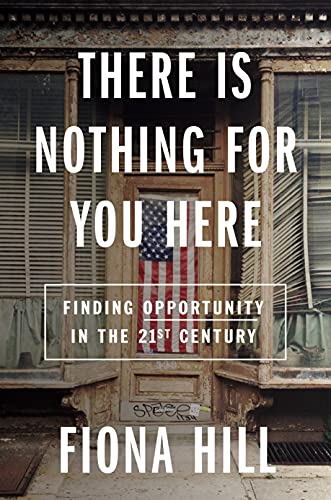
The book is “There Is Nothing for you Here: Finding Opportunity in the 21st Century” by Fiona Hill (Mariner Books, HarperCollins, 2021).


Hill grew up as a coal miner’s daughter in northern England, and she describes her journey “from the coal house to the White House.” Recruited by Fox News’s K.T. McFarland, Hill worked as deputy assistant to the president and senior director for European and Russia affairs on the National Security Council in the Trump administration.


Hill warns of the dangers of populism leading to tyranny. “Russia’s fate and its slide into authoritarianism since 2000 could well be our own.”

“Throughout history, populist have offered compelling narratives for people who feel they have lost their identities and cultural moorings as well as their jobs in an economic downturn and at times of rapid social change and political uncertainty. Populism was a major feature of European and also U.S. politics at pivotal points in the twentieth century: in the 1920s and 1930s during the Great Depression, in the 1960s and again in the 1980s during generational and technological changes. Putin, for example, first came to power in Russia on December 31, 1999, right at the very end of a decade of wrenching economic crisis, political upheaval, and strife, including a war in Chechnya, in Russia’s North Caucasus region. Putin promised to fix this.

“Populists like Putin provide straightforward, plain-speaking explanations for people’s misfortunes. They offer scapegoat, like corrupt bureaucrats and conniving immigrants, or the West trying to keep Russia down, in Putin’s case. They produce memorable catchphrases that encapsulate the ambitious claims that they, and only they, can solve ‘the people’s’ problems and ease their cultural despair. ‘The people’ is also who they say it is –– not everyone, just a specific group that they define. This group of ‘their people” (natshi, or ‘ours’ in Russian) is then divided against the rest of society.”

Hill describes the extreme sexism and discrimination she witnessed in Russia. She also describes how she dealt with numerous incidents of sexual harassment, misogyny, and discrimination –– including wage gaps –– in her career.


Reince Priebus, Trump’s first of several chiefs of staff, nicknamed Hill the “Russia Bitch.”


Hill writes, “I had struggled against sexism throughout my professional life in a seemingly unending effort to realize my potential and do my job effectively” despite the difficulties that somehow seemed intrinsic to being female.” Easily accessible national health care and childcare are seen as essential to promoting education, mobility, and career opportunities, especially for women.


Putin, with Hill to his left
There are several humorous recounts of her direct interactions with Trump, including in the Oval Office. There are also creepy accounts of her sitting next to Putin on several occasions during public meetings. And there is a laugh-out-loud, sad-but-funny reaction as she sat in the audience in Helsinki during a summit between Trump and Putin.

Many people will want to read her account of what it was like testifying to Congress in a hearing for the first impeachment of former President Trump. Hill was a witness to events surrounding Trump's call with the President of Ukraine when Trump withheld defensive arms as leverage for dirt on his political opponent. Hill offers fascinating takes on Ambassador Gordon Sondland, who also testified, and Representative Matt Gaetz, who tried unsuccessfully to stare her down during her appearance at the Capitol.


She praises many women by name who mentored, advised, or otherwise assisted her, including preparing her for her testimony. But she also notes how some women and men treated her unfairly throughout her education and career because of her accent, wardrobe, or humble beginnings in Bishop Aukland, England.


Hill compares the classism she experienced growing up in the UK with the racism she witnessed firsthand after emigrating to the U.S. She shares insights found in author Isabel Wilkerson's landmark book “Caste” (reviewed Jan. 14 on Navy Reads). White supremacy, Wilkerson notes, became memorialized for some after the Civil War and poisoned race relations "for generations.” Hill picks up on the theme:

“This sad history of racial identity being weaponized by the powerful against working people is not limited to the United States. It was also evident in the United Kingdom after both world wars, when race was used as a deliberate tool for divisive policies to benefit the narrow interests of shipyard owners and other big businesses who wanted to hire cheaper and non-unionized immigrant labor to stave off organized British labor demands for Black workers in shipyards and port cities, leading to riots, intercommunal violence, and the deaths of Black seamen and dockworkers who were accused of stealing jobs.”

She make several references to the effects of World War II, especially in post-war England and in the United States, where the G.I. Bill helped not only U.S. warfighters and their family, but also had an indirect influence on people in UK and Europe. The Marshall Plan and other “bold moves” had a direct and positive impact on people yearning for freedom, democracy, and self-determination.


“I mirrored the experience of millions of young Americans after World War II, who found college to be the door to a job and a better life than their parents’.” Her own choice to learn Russian and go into Russian studies hinged on a veteran uncle’s suggestion. The uncle was pained and perplexed to see how former WWII ally Russia had turned to oppressive communism under the Soviet Union and become an enemy to Western ideals.


Books and reading and the help of her community propelled Hill toward a higher education, with the path leading to Harvard’s Kennedy School, named for JFK, a navy hero of WWII. Hill received the Frank Knox scholarship. Knox was Secretary of the Navy during WWII.


Hill notes, “Breaking down racial barriers, as well as other universal or generalized spatial and structural impediments to opportunity, requires large-scale intervention.” The solution continually comes back to education, including the need for post-high school education, either for two-or four years or apprenticeship to learn a technical skill.

“Focusing collective action on education is an important aspect in countering the national security crisis of polarization and fragmentation. Lack of education –– in the sense of acquiring the critical thinking skills that a good K-12 and some form of college education can provide –– breeds suspicion of government, skepticism toward science and expert knowledge, and resistance to the very idea that there are things like basic facts and objective information. Poor educational attainment leaves people vulnerable to populists and political operatives –– a fact underscored by President Trump’s persistently higher ratings among Americans without a college degree.”

Analysts note that Putin’s most fervent supporters come from the rural, more isolated, parts of Russia. In contrast, the brave people who have come out on streets to protest Putin’s unprovoked aggressive invasion of Ukraine are the more educated people of the cities.

We can see the effects of populism leading to autocracy both in the J6 insurrection by Trump supporters at the U.S. Capitol on January 6, 2001 and in Putin’s invasion of Ukraine, a sovereign democracy.

“Russia’s fate over a twenty-year period shows how a country’s political path can turn away from democracy toward autocracy. No state, no matter how advanced, is immune from flawed leadership, the erosion of political checks and balances, and the degradation of its institutions. Democracy is not self-repairing. It requires constant attention and renewal, especially during periods of rapid technological and social change and economic uncertainty.”
I created a short playlist based on song and artists mentions by Hill, primarily from the 80s and early 90s and especially songs big in Britain at the time. High on the list: The Specials’ “Ghost Town,” Nena’s “99 Red Balloons,” and Billy Bragg’s “Waiting for the Great Leap Forward.” Also included, based on mentions by Hill: some acoustic Beatles songs and a group I’d never heard of, Russia’s Nautilus Pompilius. I also included the Scorpions’ “Wind of Change," about the thawing of the Cold War. It was released in 1990, exactly ten years before Putin ascended into power in Russia. Nena's "99 Red Balloons" from 1983 is mentioned several times; it is also considered an anthem protesting the Cold War, and was covered touchingly last week by Kelly Clarkson. It's a tribute to the brave people of Ukraine.


As this review is posted, Putin appears to be trying to lower another Iron Curtain and start another Cold War in his invasion of Ukraine. However, his actions have galvanized the NATO, Europe, and the free world. President Biden’s Department of Defense, led by SECDEF Lloyd Austin, is committing even more defensive support to NATO allies.


Secretary of Defense Lloyd Austin meets with Ukraine's Minister of Foreign Affairs Dmytro Kuleba at the Pentagon, Feb. 22, 2022. (Lisa Ferdinando)

Sanctions are having a devastating effect on Russia, in what amounts to “economic warfare,” according to analysts.
But Fiona Hill, now the director of the Center on the United States and Europe at the Brookings Institution, warns against sending direct military support to Ukraine. It could be falling into a trap laid by Putin, who believes in “escalation dominance” and looks for any excuse (couched as Western threats to Russia) to justify his actions. [On Pod Save the World, Ben Rhodes, former adviser to President Obama, said “Putin is at the vanguard of so much that’s wrong in the world.” But Rhodes also warns against direct military conflict with the Russians, who are threatening to literally “go nuclear.”]

My only complaint with “There Is Nothing for You Here” is minor; I wish it had a photo section. On the other hand, Hill presents a robust notes section, excellent conclusion, and helpful how-to afterword to provide more opportunity and possibilities for people, especially those who are less advantaged. 


Hill's style is easy, her approach is humble (one of her favorite words is “impecunious”), and her insights are refreshingly optimistic. This is a highly recommended book, both as biography and history, for Women’s History Month!

Wednesday, March 29, 2023

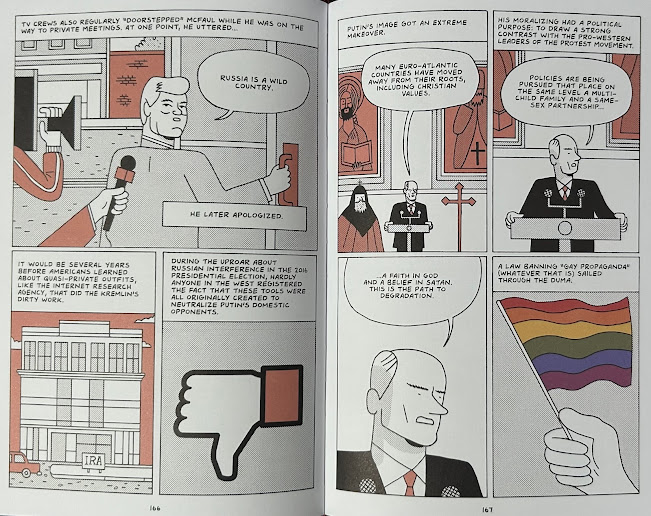
Putin is a Cartoon. Literally

Review by Bill Doughty––

Russia’s President Putin is a cartoon in the seriously insightful “Accidental Czar: The Life and Lies of Vladimir Putin” by Andrew S. Weiss and Brian “Box” Brown, First Second, 2022).


Like the best graphic novels and graphic nonfiction, much is communicated in few words. For example ––

  • “For Russia, geography is destiny”: With no natural defenses including oceans, unlike the United States, “Russia safeguarded its security through conquest and territorial expansion.”
  • Quoting Gene Sharp, author of “The Politics of Nonviolent Action”: “Dictators are never as strong as they tell you they are, and people are never as weak as they think they are.”
  • Fomenting fear, conspiracies, and disinformation: “Russian leaders simply can’t accept that brave people sometimes shape history all on their own.”
  • Again quoting Sharp: “The extreme repression comes when a dictatorship really is frightened and therefore they act ruthlessly.”
  • Irony: In May 2007 in a Victory Day speech in Moscow, Putin said, “We have a duty to remember that the causes of any war lie above all in the mistakes and miscalculations of peacetime.”
  • Putin compared the United States to Nazi Germany and said, “These new threats, just as under the Third Reich, show the same contempt for human life.” Irony meets hypocrisy (condemning “contempt for human life”) when considering what Putin is doing to the people of Ukraine.

Weiss’s insights are succinct but deep. Brown’s simple art is both evocative and informative.


This book follows the rise of Putin from childhood to KGB apparatchik in East Germany, to Communist Party hack, to opportunistic sycophant, to power-mad leader. Picturing Russian history, Weiss and Brown show how Putin put forth grandiose ideas for restoring the “glory” of the Russian Empire and Russian Orthodox Christianity. Nearly 40 years ago, in 1989, Russian territory covered “one-sixth of the earth’s landmass.”


Faith in Russia’s system of nepotism, cronyism, and corruption is baked into its history, where serfdom was a close equivalent to slavery. The czar and the State were held above the individual or rule of law.

Putin’s invasion of Georgia in 2008 and Crimea in 2014 were telling signs that he would commit further international crimes. “Territorial expansion is at the core of Russia’s national identity,” according to Weiss.


We learn about the roles of a whole host of characters who endorsed Putin: former Russian President Boris Yeltsin, former Ukrainian President Viktor Yanukovych, Alexandr Torshin and Maria Butina, retired Lt. Gen. Michael Flynn, evangelist Franklin Graham, actor Steven Seagal, Republican representative Steve King, and Trump advisor Steve Bannon.


Putin v. McCain
On the other side, we see Putin’s nemeses, including former President Barack Obama, entertainers Pussy Riot, philanthropist George Soros, and late Senator John McCain, who was a “perennial nemesis of Putin.” Navy hero McCain was pro-Ukraine and pro-democracy; he saw Putin as an autocratic war criminal.

The late former Secretary of State Madeleine K. Albright endorsed: “Accidental Czar is an absorbing and visually stunning account of Vladimir Putin’s rise and take-no-prisoners approach to wielding power on the world stage. Andrew S. Weiss and Brian Brown have made one of the most consequential stories of our time more accessible and engaging for readers of all backgrounds. I would urge anyone who wants to better understand the forces shaping modern Russia, and disrupting our world, to open up this extraordinary book.”


Fiona Hill offers this endorsement: “This biography of Vladimir Putin deftly combines entertainment and serious analysis. Renowned Russia scholar Andrew S. Weiss and artist Brian Brown have found the perfect means to introduce the complexities of Russian politics and Putin’s peculiarities to a new set of audiences. Everyone should have a copy of Accidental Czar on their bookshelf.” Hill is senior fellow at the Brookings Institution and co-author of "Mr. Putin: Operative in the Kremlin." (She also authored the brilliant “There Is Nothing for You Here: Finding Opportunity in the 21st Century.”)

“Accidental Czar” is also blurbed by other notable thinkers, including former ambassador to Russia Michael McFaul, former President Bush speechwriter David Frum, conservative historian Max Boot, and New Yorker staff writer Susan B. Glasser. Author Gary Shteyngart blurbs: “A witty and comprehensive takedown of the annoying Putin-is-a-genius myth.”


In fact, Weiss and Brown show how Putin the cartoon is actually a deranged, dangerous, and destructive war criminal.

Wednesday, February 16, 2022

Unbelievable! ‘Putin’s Playbook’

Review by Bill Doughty

It seems Unbelievable. There are 150,000 Russian troops and dozens of ships and submarines surrounding the independent free democratic nation of Ukraine.


Putin, who invaded Georgia and Crimea in recent decades, says he has no intention of attacking his neighbor, but is he telling the truth? Does he respect Ukraine’s border? Hasn't Putin already demonstrated a pattern of aggression, including revanchism?


In “Putin’s Playbook: Russia’s Secret Plan to Defeat America” (Regnery Gateway, 2021), Rebekah Koffler makes the case that Putin not only wants to invade Ukraine, but also plans for an all-out war with the United States.


Koffler is a former U.S. intelligence analyst. Her reason for having to leave the intelligence community, in her own words, is not only surprising but shocking. More on that twist to her narrative later.


USS Lake Erie (CG-70) arrives in Pearl Harbor during RIMPAC 2008. (MC3 Paul Honnick)

Navy readers will be interested in several references in “Putin’s Playbook” to naval leaders (including Vice Adm. Arthur K. Cebrowski and General James Mattis) and events (such as Operation Burnt Frost [involving the shooting down of a disabled satellite by USS Lake Erie (CG-70) in 2008], Navy personnel helping rebuild floors of the American embassy in Moscow, and Koffler’s walk through the gate at the Naval Research Lab).

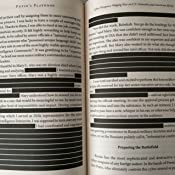
Koffler’s “Putin’s Playbook” itself is a messy amalgam of history, biography, advice, conjecture, and personal grievance. She offers a disclaimer that her views do not represent those of the government, followed by an author’s note strongly disagreeing with DIA/CIA redactions, which she prints as part of the text. Yet, out of the mess we can find potential gems of insight.

For example, she explains Putin’s own grievance over the collapse of the USSR and losing the Cold War. She writes about two philosophers who shaped his thinking: “In addition to Eurasianist influence, Putin drew his ideology from the ideas espoused by two Russian thinkers”: Ivan Il’in (1882-1954) and Lev Gumilev (1912-1992). Il’in was a Russian Orthodox Christian who believed Western democracies were dangerous; he considered that “an independent Ukraine would be an unthinkable ‘madness.’ Meanwhile, Gumilev, an anthropologist and historian, believed in a “super-ethnos” of Mother Russia. Eurasian vs. European. Slavs/Steppes vs. Anglo-Saxons. Us vs. them.


Putin uses ethnicity to justify threats of aggression against his neighbors. It may be hard for people in free democracies to understand his hardline, strongman attitude and why the people of Russia seem to support him as well as how he stays in office for decades.


Koffler says it is a mistake to see Putin and Russia through American eyes. Vladimir Putin and his supporters are steeped in grievance, superstition, resentment, and righteousness. Putin and his followers seem to have a boundless capacity for inflicting and enduring suffering. The list of political opponents, reformers, and journalists who have been poisoned, shot, or mysteriously killed by Putin’s Russia is long and alarming.

According to Koffler, “trust” is not a concept in Russia. (And, by the way, she says there is no word in Russian for “fun”).


Yet, Koffler seems to idolize Putin: “When Putin assumed the reigns (sic) of Russia, his first order of business was to restore internal stability, reverse the economic crisis, and reassert state control of most, if not all, aspects of life in Russia." Koffler says Putin was committed to restoring “law and order” and “respect towards Russia internationally.” “Putin delivered on his promise to the Russians.” “He has restored domestic stability, improved the Russian economy, and modernized the military to the point where even the Pentagon must play catch up in certain areas. Putin’s Russia is back on the map,” she boasts. 

Biden speaks with Putin
Koffler writes, “At sixty-eight, Putin is highly athletic and personifies strength. Acting as a benevolent patriarch…” Weirdly, she says: “Putin may be a villain, but he is not a supervillain.” “His rule has been far less brutal than that of Vladimir Ilyich Lenin or even the czars.”

Putin further justifies his aggression against his neighbors because of his fear and resentment of more free democracies on his borders and potential NATO expansion. It seems he would rather fight others, including Europe and the United States, than try to get along:

“Putin is stirring up chaos and disorder in America to save himself from a regime overthrow that he believes Washington seeks. Putin believes that destabilizing America by amplifying internal strife through social media and covert interference will help prevent an all-out war, which he would be ready to fight with the U.S. under certain scenarios. As the United States continues to try to peel off Ukraine from Russia’s orbit, it may be prudent to make a thorough intelligence assessment as to whether Putin would invade Ukraine if Washington pushes too hard. Before we consider such a move for Moscow ‘highly unlikely,’ it is worth remembering that Putin understands how Americans think but doesn’t think like them. He thinks like a Russian and a former KGB operative. While it may have seemed irrational to American national security experts that Putin took over Ukraine’s Crimea, for the Russian president, the long-term risk of not having Crimea as part of Russia outweighed the short-term risk of invading it.”

In the face of a growing Russian military threat on Ukraine’s border in recent days, weeks, and months, the Biden administration and European allies have strengthened diplomatic resolve, committed to finding a path to resolve tension and prevent war. Analysts say Putin's actions have boomeranged and only strengthened NATO's resolve and solidarity.


Putin has been warned that if his military invades Ukraine again on whatever pretext or justification, there will be dire consequences, including severe international sanctions. But Koffler writes:

“Sanctions or not, Putin has shown during the past decade that he will invade or destabilize Russia’s former republics –– as he did in Ukraine and Georgia –– rather than let them switch sides to NATO and the European Union. He will continue to unbalance America through cyber warfare and other tools in his playbook rather than let Washington democratize the former Soviet Eurasian countries. He understand well that he is playing a risky game that can lead to an escalation of tensions. But risk is something that Putin is accustomed to; it is a way of life for a former KGB officer. Bred as an intel operative, he plans for contingencies. Therefore he has a plan in his playbook for an all-out war with America.”

Koffler says that Russia’s war with America would be five-pronged: (1) space, attacking satellites; (2) cyber weapons; (3) spies and disrupters, infiltrating America; (4) active measures including subversion, election sabotage, and assassinations; and (5) all-out kinetic warfare, up to and possibly including nuclear weapons.


U.S. Navy's fourth Mobile User Objective System (MUOS) communications satellite lifts off from Space Launch Complex-41. (United Launch Alliance)
As expressed several times in her book, Koffler is a rock-solid supporter of her former boss, retired General Michael Flynn, who pleaded guilty to lying under oath about his contacts with Russian officials in the lead up to the 2016 U.S. presidential election. Former President Trump pardoned Flynn as well as other close associates with ties to Russia and a plot to overturn the 2020 election. Koffler calls former Defense Intelligence Agency Director Flynn an “American patriot.”

Michael Flynn and then-President Trump (D. Myles Cullen, DoD)
She defends Trump’s “patriotic desire” regarding his call with Ukraine President Zelensky in 2019. In that call, which led to his first impeachment, Trump tried to get Zelensky to announce an investigation into the Biden family during the U.S. presidential campaign, and the former president tied the request to a withholding of arms and other support to Ukraine.

Koffler says, believably, that Putin’s Russia is behind the schism in the United States between the Right and Left, fomenting mistrust in free elections and in democracy itself. She acknowledges Russia’s aggressive attempts to target U.S. elections and influence people through fake social media accounts.


Though she calls the Trump-Russia investigation a “witch hunt,” Koffler makes no reference to Rudy Giuliani, Paul Manafort, Roger Stone, and others in Trump’s orbit who actively worked with Russians. No mention of Trump Tower plans in Moscow or Russian investment in the Trump corporation. No mention of Trump’s public request for Russia and China to help him discredit his political opponent. No mention of Trump taking Putin’s side over his own intelligence community in 2016. 


And no mention of the January 6, 2021 Capitol insurrection by Trump supporters, even though her book was published in late July.


Koffler
Koffler, who is a contributor to Fox News, does not offer an opinion about Tucker Carlson’s pro-Russia and pro-authoritarian stances.

She presents a mere half-paragraph about Putin challenger Alexey Navalny and a bare mention of Russian agent Maria Butina, who infiltrated the NRA and influenced members of the Republican Party. She warns, instead, about the “Left’s true agenda”: single-payer healthcare, gun control, and –– deceivingly –– “defunding the police,” a phrase denounced by all Democratic leaders.


With no intended irony, Koffler writes, “It is high time for Americans and the U.S. government to understand how Russian disinformation works so we don’t become our own deceivers.”


As to why she is no longer a member of the intelligence community, Koffler explains how she was challenged after a background clearance investigation. Then, she gives a lengthy explanation of how a flight to Washington, D.C., had to make an emergency landing because of her behavior. She says, “what transpired next was straight out of Stephen King.” She was handcuffed by police and questioned by the FBI because of her disruption on the airplane. After the incident, the Intelligence Community issued psychological tests in which testers found “something not quite normal.”


She blames “deep-state operatives,” “bean-counters, “bureaucrats,” and “American apparatchiks” for destroying her career and her plan to be Deputy NIO for Cyber on the National Intelligence Council at the Office of the Director of National Intelligence.


Ultimately, readers must choose what to believe based on what Koffler chooses to present. In her opinion, the United States is no longer a free refuge for immigrants like her, she says: “And unlike me, my children and other God-loving Americans will have nowhere to flee.” But while warning of the dangers of leftwing socialism, she largely ignores the threats of rightwing authoritarianism and totalitarianism.


It may seem to be unbelievable, but history shows how fascism can arise from both the Left and/or the Right.


While there are gems of analysis about Russia to discover in this book there are other authors that are far more insightful and rewarding to help understand Putin and modern Russia. I've found Garry Kasparov to be a particularly strong voice, particularly in his warnings against appeasing Putin; I reviewed his book "Winter Is Coming" in 2017.


I just started reading Fiona Hill’s “There Is Nothing for You Here: Finding Opportunity in the 21st Century.” I’m only a few chapters in, but so far, it’s a much deeper and more rewarding book, both as a biography and as a geopolitical analysis. Hill is the former deputy assistant to the president and senior director for European and Russian affairs on the National Security Council. Hill served Presidents George W. Bush, Barack Obama, and Donald J. Trump with honor, courage, and commitment.


From the publisher: “Rebekah Koffler, is a Russian-born U.S. intelligence expert who served as a Russian Doctrine & Strategy specialist in the Defense Intelligence Agency… Rebekah is a writer and national security commentator whose work has been published on the Fox News website, The Hill, the Daily Caller, the New York Post, and the Washington Times. She has appeared on Fox News, One America News, News Nation Now, Newsmax TV, and the Sean Hannity nationally syndicated radio show.”

TOP PHOTO: From left, U.S. Army Europe and Africa Deputy Commanding General for Army National Guard, Maj. Gen. Joe Jarrard, U.S. Ambassador to Poland, Mark Brzezinski and Polish Land Forces 16th Mechanized Division Commander, Maj. Gen. Krzysztof Radomski walk and talk before the Battle Group Poland hand over, take over ceremony at Bemowo Piskie Training Area, Poland, Feb. 11, 2022. The ceremony demonstrated NATO's continued commitment to the collective defense and security of our allies on NATO's eastern flank. (Spc. Jameson Harris)

Wednesday, April 6, 2022

‘Where Law Ends’ / Seeds of Ukraine Invasion

Review by Bill Doughty––

There’s a scene in “Where Law Ends: Inside the Mueller Investigation” by Andrew Weissmann (Random House, 2020) in which Vietnam Veteran Robert Mueller leads his Special Counsel team in a celebration of the Marine Corps Birthday, something Mueller had done since his days as director of the FBI. Semper Fi.

“On November 10, [2018], Mueller held his last U.S. Marine Corps Birthday celebration –– an annual event he had commemorated at the Bureau and now in the Special Counsel’s Office. The whole office attended, cake was served, and –– as tradition would have it –– the first piece was handed from Mueller to Ben Cohen (our security officer), symbolizing the passing of the torch from the oldest to the youngest marine. The tradition was lovely, and we all knew it would be our last with the office and Mueller.”

The birthday commemoration occurred during the fraught days of Special Counsel team interviews with a key figure in events that would lead to the first impeachment of Donald Trump.

Paul Manafort, Trump’s campaign manager, was accused of coordinating a meeting at the Trump Tower in June 2016 between Russian operatives, including Natalia Veselnitskaya and other Russians, and members of the Trump campaign, including Donald Trump Jr. and Jared Kushner. 


Manafort coordinated also with Russian intelligence officer Constantin Kilimnik, providing internal polling information to a foreign entity; Manafort pleaded guilty in federal court to obstruction of justice and conspiracy. He comes across in “Where the Law Ends” as a simultaneously pathetic loser, smooth Svengali, and evil liar.


Weissmann outlines how Manafort worked with Ukrainian oligarchs and Russian officials in an attempt to divide Ukraine after the Ukrainian people voted Russia’s puppet Viktor Yanukovych out of office. We see the seeds of Putin’s invasion plans –– planted years ago and fertilized during the Trump administration.

“Russia had sought for years to control Ukraine, as Putin needed that territory to transmit oil and gas to Europe. But Ukraine needed Russia even more, as it obtained basically all of its energy from that nation. Russia had enjoyed de facto control of Ukraine when Yanukovych was president, funneling him millions of dollars in bribes to curry his favor. But after Yanukovych’s overthrow, Russia no longer had such a willing puppet under its control. Thus, Russia had turned to brute force: its infamous invasion of Crimea, a region of eastern Ukraine, in 2014 –– the one that had outraged most Western democracies, but which candidate Trump oddly had regarded as no big deal.

“The proposal for Russia to take over the eastern half of Ukraine was the Crimea invasion on steroids. Russia would annex the country, reinstall its favorite figurehead, and thus control the economic heart of the country. Notably, Manafort and Kilimnik’s proposal explained that, for such a move to succeed, it would need the consent of the United States. It called on Trump to give Russia an approving ‘wink’ –– the word the proposal used –– and, furthermore, to appoint Manafort to negotiate the logistics with Russia on America’s behalf. In a separate email, Kilimnik endorsed Manafort for this role; Manafort would be able to deal with Russia at the ‘very top level,’ Kilimnik explained…

“The facts we’d established, even amid Manafort’s attempts to muddy them were staggering. On August 2, if not earlier, Russia had clearly revealed to Manafort –– and, by extension, to the Trump campaign –– what it wanted out of the United States: ‘a wink,’ a nod of approval from a President Donald Trump, as it took over Ukraine’s richest region.

“It was a tremendous thing for Russia to ask for. It would seem to require significant audacity –– or else, leverage –– for another nation to even put such a request to a presidential candidate. This made what we didn’t know, and still don’t know to this day, feel monumentally disconcerting: namely, why would Trump ever agree to this? Why would Trump ever agree to this Russian proposal if the candidate were not getting something in return? Both Manafort and Trump were too transactional to give away something for nothing.”

Trump, Manafort and Ivanka Trump (Shealah Craighead)
Weissmann’s book was written prior to Trump’s pardons of people involved in coordination with Russia to help him get elected: Michael Flynn, George Papadopoulos, Alex van der Zwann, Roger Stone, and Paul Manafort (along with dozens of other pardons).

Regarding Manafort, Weissmann says Judge Jackson’s expression of disapproval of Manafort’s crimes were incisive and “managed to articulate a central and dismaying truth about our entire experience at the Special Counsel’s Office.”

“She spoke of Manafort’s numerous lies, and his multiple obstructions of our investigation –– both through his own willful deceit and by coaching witnesses to lie for his protection. He’d done the latter, Judge Jackson noted, while he was under indictment and out on bail. Finally, she explained that Manafort had even lied to the government about telling the truth: claiming that he would finally cooperate with our investigation only to obfuscate and impede it further. ‘It is hard to overstate the number of lies and the amount of fraud and the extraordinary amount of money involved,’ she said. Manafort had not lived an exemplary life. Here was a chastening recognition that his conduct was serious and flagrant, and repeated over years.”

Working with the Russians and on behalf of the Trump campaign, it seems Manafort had sowed the political terrain for an invasion of Ukraine.


The title of Weissmann’s book comes from a John Locke quote, “Where law ends, tyranny begins.”Weissman outlines how Mueller's team faithfully and methodically defended the Constitution (from enemies, both foreign and domestic).


He introduces us not only to key actors in the limelight such as Manafort, Jared Kushner, Donald Trump Jr., and Bill Barr, but also to various members of the Mueller team who worked behind the scenes, sometimes at odds over how to present to the courts the corruption they encountered.


Trump and Barr (Shealah Craighead)
Weissmann begins and ends his narrative with discussion of former Attorney General William Barr, starting with the author’s profound disappointment in how Barr presented a distorted summary of the Mueller Report to the public. Near the end of the book Weissmann lists specifics, point by point, of how Barr misled, obfuscated, and showed a “disregard to the facts and attempted erasure” of the Mueller Report’s findings, even though the report clearly shows coordination between the Trump campaign and Russia.”

Barr had emasculated the special counsel, which he alluded he would do in an AG audition memo he wrote as a private citizen.


“Barr’s gambit –– enabled by [Rod] Rosenstein and his staff –– gave the president a green light to resume conducting himself beyond legal confines,” Weissmann contends.

“And it worked. Three months later [after release of the Mueller Report], on the day after Mueller testified about our report in Congress, the president held up hundreds of millions of dollars in funding to aid Ukraine in its war against Russia –– funding that had been authorized by Congress and previously signed off on by the president himself. Why? Because he wanted the Ukrainian government to open an investigation into his political opponent Joe Biden and his son…

“Still, it is a different investigation that Trump sought from Ukraine that I find even more disturbing. The president leaned on the Ukrainian government to investigate Ukraine’s purported interference in the 2016 U.S. presidential election. These allegations are rooted in Russian disinformation. The unanimous conclusion of our Intelligence Community and Trump’s own experts, like Dr. Fiona Hill, is that Russia interfered with the election; our indictments laid out clear and extensive proof, replete with Russian emails detailing the efforts. We had the facts. Why would Trump raise the boogeyman of Ukraine election interference other than to distract from what Russia had done (and would continue to do)?

“Did Ukraine help Trump in the 2016 election? Of course not. And nothing about Trump’s Ukraine allegations diminished the proof against Russia.”

Historians will value this book a hundred years from now for its first-person findings, eventually leading to the first impeachment (of two) of former President Donald Trump, who solicited a foreign entity (Ukraine) for help in an election campaign. And he would solicit foreign help again and again.

Weissmann’s book is all-the-more relevant after Trump’s recent request, once again, for a foreign entity’s help against his political foe in an interview at the end of March with Real America’s Voice at Mar-a-Lago. Reminiscent of his “Russia, if you’re listening” request in 2016 for dirt on political opponent Hillary Clinton, Trump again asked President Putin of Russia for scandalous information on political opponent President Joe Biden and his son.

Trump, who previously and recently called Putin a savvy genius, lamented not being able to coerce Ukraine for information. And the former president offered this shocking comment about China: “And I won’t even talk about China because they haven’t gone into Taiwan yet.”


At the end of March, two hundred U.S. Marines were deployed to Lithuania on the eastern edge of the NATO alliance. The deployment includes a command-and-control unit for Marine Air Control Group 28 out of Cherry Point, North Carolina.


NATO Mine Countermeasures Group 1 ships sail in formation in Geiranger Fjord, Norway, March 9, 2022, during Exercise Cold Response. NATO
Following Exercise Cold Response training in Norway, ten Marine F-18 Hornet fighter jets from Beaufort, South Carolina, were repositioned to Eastern Europe, according to the Pentagon, which has 14,000 troops stationed in Europe. The U.S. Navy and U.S. Coast Guard have helped or trained with Ukraine, especially since 1997.

Meanwhile, for more than a month valiant Ukrainian military members and civilians are defending their country and are now beating back the Russians, who are committing war crimes against their neighbor.


NATO, reunited and stronger, is supporting the courageous Ukranians. Semper Fi.


In an interview at Mar-a-Lago in March, during Putin's invasion of Ukraine, Trump asks Putin for dirt on Bidens.