Tuesday, March 8, 2022

Russia Scars ‘The Border’

Review by Bill Doughty––

The sunflower is the national flower of Ukraine. It has become a symbol of resistance after a Ukrainian woman confronted a Russian soldier and offered him seeds. She told him to put the seeds in his pocket so sunflowers would grow when he died on Ukraine’s soil. She shouted at him, “You’re occupants, you’re fascists. Take these seeds and put them in your pockets so at least sunflowers will grow when you all lie down here … You are occupiers. You are enemies.”


The sunflower seeds incident is just one of the stories of heroic resistance and resilience in Ukraine inspiring the world for the past two weeks since Putin’s unprovoked invasion.


Erika Fatland
I was interested in learning more about the people and history of Ukraine and was rewarded with a great book by historian and travel writer Erika Fatland, author of “The Border” (translated from the Norwegian by Kari Dickson; Pegasus Books Ltd., 2017).

In Ukraine, Fatland visits Odessa, Gammalsvenskby, Crimea, Mariupol, Kramatorsk, Donetsk, Poltava, Kiev, Lviv, and other areas in her two-year exploration around Russia’s border. After completing her journey –– more than five years ago –– Fatland had a chilling premonition about Putin’s aggression:

“The borders have changed and multiplied time and again over the centuries, most recently in 2014, when Russia annexed Crimea. Borders are not set in stone; the new fibreglass boundary markers are easy to move. The world’s biggest country is low on self-esteem; the economy is failing and the population shrinking. Thus the need to assert itself is even greater.”

“Putin, a former K.G.B. officer, stops at nothing to gain power and influence,” she observes. “Rules are only followed if they are in Russia’s favor.”


Putin justifies his invasion of the sovereign democratic nation of Ukraine because it once was part of Russia. But that view is myopic, at best, considering the long sweep of history. Fatland presents history lessons throughout her narrative, and she provides a helpful annex at the end of her book listing key events in Russian History from 862 to 2015.


With regard to Ukraine, she explains the strong ties with Sweden, the role of religion in the region, and the roles of Rural the Run, Vladimir 1, Grand Prince of Kiev; Genghis Khan and the Mongols; Ivan the Terrible; Napoleon; and various Alexanders, Nicholases, and Vladimirs/Volodymirs. Readers learn about the role of the Tartars, the Turks, the Crimean War, Stalin’s war of famine, and the Putin’s aggression in recent years in Chechnya, Georgia, and Crimea.

Monument to Peter the Great, St. Petersburg, Russia

Two Russian leaders leap out of history for Navy readers: Peter the Great and Catherine the Great, each with maritime interest in Ukraine.

“In 1682, Peter I, better known as Peter the Great, was crowned tsar at the tender age of ten. He was no more than a child and liked to spend his time building and sailing boats. As he grew up, his ambitions also grew, without his losing interest in boats and sailing: Peter the Great’s dream was to make Russia a maritime superpower. He first attempted to conquer the port areas on the Black Sea, but was unsuccessful, so he turned his sights west instead. In 1700, his troops besieged the Swedish-controlled town of Narva, on the current Estonian-Russian border. The clearly inferior Swedish army, led by the then eighteen-year-old Charles XII, were blessed by a snowstorm that blew up behind them and blinded the Russians, who panicked and fled, suffering great losses.”

Catherine II, known as Catherine the Great, continued Peter’s revanchist ambitions:

In 1689, when Peter the Great came to the throne, Russia, despite its size still had only one port, in Archangel. This was frozen over for the greater part of the year and was in the far north. Peter the Great managed to secure Russia’s access to the Baltic Sea and built a new capital, St Petersburg, there. But all attempts to conquer the Black Sea coast failed. It was only at the end of the eighteenth century, under Catherine the Great, that ships flying the Russian flag finally sailed on the Black Sea. Like her predecessor, Catherine the Great was ambitious. Her big dream was to conquer Istanbul, cradle of orthodox Christianity. She was not successful in that, but in the course of two long wars with the Ottoman Empire, she did manage to acquire large parts of what is now South Ukraine, from Odessa in the south to Dnepropetrovsk (now known as Dnipro) in the north, including Crimea.

“After the war with the Turks, which ended in 1774, Crimea was given the status of independent khanate. The freedom was, however, short-lived. In 1783, Catherine the Great announced that the khan in Crimea and his people would henceforth be considered subjects of the Russian tsar.” 

Portrait of Catherine the Great by Alexey Antropov

[By the way, later in his life, with few career options after his military service, American naval hero John Paul Jones entered into the service of Catherine the Great on April 23, 1787.]


Fatland’s book and journey begins in, of all places, North Korea, which shares a tiny border but huge history with Russia. Fatland takes us on a fascinating propaganda tour filled with giant statues of the Kims, choreographed mass dances, school visits, and photo-deleting tour guides. Along the way, she contextualizes places and culture with history.


Navy readers will enjoy her brief discussion of the Russo-Japan War, where Tsar Nicholas II’s Russian fleet was destroyed by the Japanese fleet in the Tsushima Straits, May 27, 1905. President Theodore Roosevelt received the Nobel Peace Prize for helping negotiate peace.


Today, in response to Russia’s atrocities in Ukraine, the free world is imposing  more sanctions against Russia. We can imagine what the future could portend for Putin, as a result of those sanctions, when we consider the effects of Russia’s war on its home front –– in 1905:

“In addition to the many thousands of soldiers who had been killed far away in a war that very few understood, it had also resulted in food shortages in the major ciities. On January 22, several hundred peaceful demonstrators marched on the Winter Palace, demanding reform, better working conditions, and an end to the war with Japan. [Russian police were ordered to open fire on citizens]… More than 130 people were killed in what has gone down in history as ‘Bloody Sunday.’ This, in turn, led to strikes, protests, and revolt throughout the empire. In the autumn, following Russia’s humiliating defeat by the Japanese, all the major cities were brought to a standstill by a general strike … Nicholas II’s inability to accept the fact that times were changing, and that the days of the autocrat were numbered, would cost him dear.”

After Putin the autocrat aggressively annexed the Crimean Peninsula 2014 and fomented unrest in eastern Ukraine, he showed interest in fortifying his relationship with China and North Korea. Just a few months after taking over Crimea, Putin wiped out ninety percent of North Korea’s debt with Russia, according to Fatland. Russia has unrestricted access to North Korea’s mineral resources. In addition to other quid pro quo infrastructure initiatives, Putin arranged for a fifty year lease for the use of Rason, a port in the Sea of Japan.

“The Russian authorities plan to transport goods by rail from Vladivostok, which will then be transferred to ships in Rason, which, unlike Vladivostok, is ice-free all year round. Even though more than two thirds of Russia’s border is maritime, the country has very few deepwater ports. This desire for warm-water ports has been the cause of several wars in Russian history: Peter the Great, Catherine the Great, Nicholas I and Nicholas II all stopped at nothing in their attempts to make the enormous empire a maritime superpower. A leasing agreement with the world’s worst dictator is one of the less dramatic steps Russian leaders have taken to guarantee the country an ice-free port.”

The problem for the Russians in using the port, however lies in the sanctions imposed by the United States, European Union, and many other nations.


Today, President Joe Biden announced the United States was sanctioning oil and natural gas exports from Russia. The U.S. continues to send billions in military aid to Ukraine, and is fortifying NATO allies.


Pallets of ammunition, weapons and other equipment bound for Ukraine wait to be loaded during a foreign military sales mission at Dover Air Force Base, Delaware, Feb. 28, 2022. Since 2014, the United States has committed more than $5.4 billion in total assistance to Ukraine, and reaffirms its steadfast commitment to a secure and prosperous Ukraine and to its sovereignty and territorial integrity. (Tech. Sgt. J.D. Strong II)

There is so much more to discover in this book: meeting the Uyghurs in Xinjiang; taking a group tour to Chernobyl; discovering the connection between explorers Vitus Bering and Captain James Cook and the Arctic; contemplating borders as both real and abstract; and learning more about Putin’s forays into Chechnya, Syria, and Georgia.


The full name of her book is “The Border: A Journey Around Russia Through North Korea, China, Mongolia, Kazakhstan, Azerbaijan, Georgia, Ukraine, Belarus, Lithuania, Poland, Latvia, Estonia, Finland, Norway, and the Northeast Passage.”


Fatland is also author of “Sovietistan,” that, according to Kirkus Review is “A lively, if rarely cheerful, travelogue that fills a yawning knowledge gap for readers concerned with international affairs,” which aptly describes “Border” too. In "The Border," she introduces us to colorful characters, fraught or funny situations, and fascinating landscapes.


Fatland writes with precision and compassion. In Georgia’s Caucasus mountains she visited the Gergeti Monastery, pictured above. She has a poet’s soul, especially when she writes about Georgia:

“Georgia is one of my favorite countries. It is a country that has absolutely everything: some of the highest mountains in Europe in the north, you can swim in the Black Sea in the west and in the east you will find world-class vineyards. Add old, almost untouched architecture (everything from medieval villages where stone towers stand side by side, to some of the oldest churches in the world), a cuisine that can compete with Italian, and people who not only are open and hospitable, but always ready to party and have another drink, and you have Georgia. Were it not for their neighbours, the Georgians would probably be the world’s happiest people”

With her perspective as a citizen of Norway, Fatland has an objective eye, yet she sees the danger of Russian aggression throughout her journeys both on land and through time. “Being Russia’s neighbour has never been easy,” she writes. “Norway is the only one of its fourteen neighbours that has not been invaded or at war with Russia in the past five hundred years.”


“I had travelled through fourteen countries and three breakaway republics,” Fatland writes:

“And none of the countries I had travelled through were without wounds or scars left by their neighbor, Russia. For centuries, the smaller countries and peoples, in particular, had been ground between the millstones of power, torn by wars between the major players, and pulled here and there.

“Nations have not collective memory; nations have no healed wounds. It is the individuals, millions of then, who carry the scars.”

Scars –– deep scars –– are being created right now in Ukraine, where Putin’s Russia is attacking not only military targets, but also schools, hospitals, residential neighborhoods, evacuation centers, and even nuclear power plants, committing war crimes as he spreads disinformation to his own nation.

Analysts say Putin won’t stop in Ukraine unless he is stopped; some say we may already be in World War III –– or WWZ, considering the Russians use of the letter Z as a crooked half-swastika symbol. “The Border” gives us an appreciation of liberty and freedom in the face of authoritarian autocratic governments, and it helps us understand the people impacted by Russian aggression and find the right questions for what's ahead.

“After two years of traveling along Russia’s border –– in real terms, along dusty country roads and across the sea, and in figurative terms, charting its long and complex history –– I now have more questions than answers. Which is not unexpected. My main impression is of a lack of direction and opportunism. The Russian Empire grew to the size it did because tsar after tsar seized any opportunity to expand the empire’s borders, using violence, trickery and war if necessary. And one group of people after another, from the nomadic tribes of Siberia to the Muslim Khanates of Central Asia and Russia’s Slav neighbors, was encompassed by the great empire, willingly and unwillingly. In the borderlands and on the periphery, freedom came and went. History teaches us that those who were once part of the Russian empire are most at risk of falling under its yoke in the future.”

“The Border” is an amazing achievement. Fatland manages to plant dry seeds of history in a compelling, often poetic, travel adventure. At nearly 600 pages, her book is both informative and fun but also melancholy considering the humanitarian catastrophe occurring now in some of the same places she visited –– places where perhaps sunflowers will grow in the future.


Wednesday, March 2, 2022

A Woman’s Voice for Opportunity, Optimism

Review by Bill Doughty––

Here are three reasons to read this amazing book:


Firstly, it helps explain the rise of Russia’s President Putin and the popular support for America’s former President Trump. Secondly, it’s an inspiring account of a woman’s challenge in overcoming obstacles –– perfect for Women’s History Month. And, thirdly, it’s an extremely well-written contemporary history, with practical advice for how to prevent the further rise of authoritarianism and tyranny.

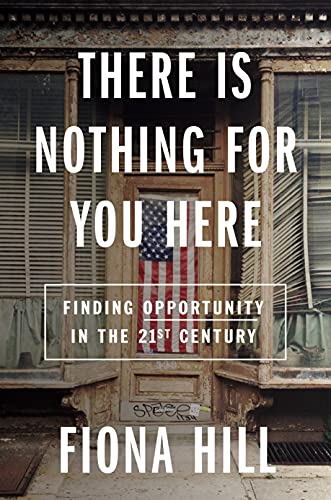
The book is “There Is Nothing for you Here: Finding Opportunity in the 21st Century” by Fiona Hill (Mariner Books, HarperCollins, 2021).


Hill grew up as a coal miner’s daughter in northern England, and she describes her journey “from the coal house to the White House.” Recruited by Fox News’s K.T. McFarland, Hill worked as deputy assistant to the president and senior director for European and Russia affairs on the National Security Council in the Trump administration.


Hill warns of the dangers of populism leading to tyranny. “Russia’s fate and its slide into authoritarianism since 2000 could well be our own.”

“Throughout history, populist have offered compelling narratives for people who feel they have lost their identities and cultural moorings as well as their jobs in an economic downturn and at times of rapid social change and political uncertainty. Populism was a major feature of European and also U.S. politics at pivotal points in the twentieth century: in the 1920s and 1930s during the Great Depression, in the 1960s and again in the 1980s during generational and technological changes. Putin, for example, first came to power in Russia on December 31, 1999, right at the very end of a decade of wrenching economic crisis, political upheaval, and strife, including a war in Chechnya, in Russia’s North Caucasus region. Putin promised to fix this.

“Populists like Putin provide straightforward, plain-speaking explanations for people’s misfortunes. They offer scapegoat, like corrupt bureaucrats and conniving immigrants, or the West trying to keep Russia down, in Putin’s case. They produce memorable catchphrases that encapsulate the ambitious claims that they, and only they, can solve ‘the people’s’ problems and ease their cultural despair. ‘The people’ is also who they say it is –– not everyone, just a specific group that they define. This group of ‘their people” (natshi, or ‘ours’ in Russian) is then divided against the rest of society.”

Hill describes the extreme sexism and discrimination she witnessed in Russia. She also describes how she dealt with numerous incidents of sexual harassment, misogyny, and discrimination –– including wage gaps –– in her career.


Reince Priebus, Trump’s first of several chiefs of staff, nicknamed Hill the “Russia Bitch.”


Hill writes, “I had struggled against sexism throughout my professional life in a seemingly unending effort to realize my potential and do my job effectively” despite the difficulties that somehow seemed intrinsic to being female.” Easily accessible national health care and childcare are seen as essential to promoting education, mobility, and career opportunities, especially for women.


Putin, with Hill to his left
There are several humorous recounts of her direct interactions with Trump, including in the Oval Office. There are also creepy accounts of her sitting next to Putin on several occasions during public meetings. And there is a laugh-out-loud, sad-but-funny reaction as she sat in the audience in Helsinki during a summit between Trump and Putin.

Many people will want to read her account of what it was like testifying to Congress in a hearing for the first impeachment of former President Trump. Hill was a witness to events surrounding Trump's call with the President of Ukraine when Trump withheld defensive arms as leverage for dirt on his political opponent. Hill offers fascinating takes on Ambassador Gordon Sondland, who also testified, and Representative Matt Gaetz, who tried unsuccessfully to stare her down during her appearance at the Capitol.


She praises many women by name who mentored, advised, or otherwise assisted her, including preparing her for her testimony. But she also notes how some women and men treated her unfairly throughout her education and career because of her accent, wardrobe, or humble beginnings in Bishop Aukland, England.


Hill compares the classism she experienced growing up in the UK with the racism she witnessed firsthand after emigrating to the U.S. She shares insights found in author Isabel Wilkerson's landmark book “Caste” (reviewed Jan. 14 on Navy Reads). White supremacy, Wilkerson notes, became memorialized for some after the Civil War and poisoned race relations "for generations.” Hill picks up on the theme:

“This sad history of racial identity being weaponized by the powerful against working people is not limited to the United States. It was also evident in the United Kingdom after both world wars, when race was used as a deliberate tool for divisive policies to benefit the narrow interests of shipyard owners and other big businesses who wanted to hire cheaper and non-unionized immigrant labor to stave off organized British labor demands for Black workers in shipyards and port cities, leading to riots, intercommunal violence, and the deaths of Black seamen and dockworkers who were accused of stealing jobs.”

She make several references to the effects of World War II, especially in post-war England and in the United States, where the G.I. Bill helped not only U.S. warfighters and their family, but also had an indirect influence on people in UK and Europe. The Marshall Plan and other “bold moves” had a direct and positive impact on people yearning for freedom, democracy, and self-determination.


“I mirrored the experience of millions of young Americans after World War II, who found college to be the door to a job and a better life than their parents’.” Her own choice to learn Russian and go into Russian studies hinged on a veteran uncle’s suggestion. The uncle was pained and perplexed to see how former WWII ally Russia had turned to oppressive communism under the Soviet Union and become an enemy to Western ideals.


Books and reading and the help of her community propelled Hill toward a higher education, with the path leading to Harvard’s Kennedy School, named for JFK, a navy hero of WWII. Hill received the Frank Knox scholarship. Knox was Secretary of the Navy during WWII.


Hill notes, “Breaking down racial barriers, as well as other universal or generalized spatial and structural impediments to opportunity, requires large-scale intervention.” The solution continually comes back to education, including the need for post-high school education, either for two-or four years or apprenticeship to learn a technical skill.

“Focusing collective action on education is an important aspect in countering the national security crisis of polarization and fragmentation. Lack of education –– in the sense of acquiring the critical thinking skills that a good K-12 and some form of college education can provide –– breeds suspicion of government, skepticism toward science and expert knowledge, and resistance to the very idea that there are things like basic facts and objective information. Poor educational attainment leaves people vulnerable to populists and political operatives –– a fact underscored by President Trump’s persistently higher ratings among Americans without a college degree.”

Analysts note that Putin’s most fervent supporters come from the rural, more isolated, parts of Russia. In contrast, the brave people who have come out on streets to protest Putin’s unprovoked aggressive invasion of Ukraine are the more educated people of the cities.

We can see the effects of populism leading to autocracy both in the J6 insurrection by Trump supporters at the U.S. Capitol on January 6, 2001 and in Putin’s invasion of Ukraine, a sovereign democracy.

“Russia’s fate over a twenty-year period shows how a country’s political path can turn away from democracy toward autocracy. No state, no matter how advanced, is immune from flawed leadership, the erosion of political checks and balances, and the degradation of its institutions. Democracy is not self-repairing. It requires constant attention and renewal, especially during periods of rapid technological and social change and economic uncertainty.”
I created a short playlist based on song and artists mentions by Hill, primarily from the 80s and early 90s and especially songs big in Britain at the time. High on the list: The Specials’ “Ghost Town,” Nena’s “99 Red Balloons,” and Billy Bragg’s “Waiting for the Great Leap Forward.” Also included, based on mentions by Hill: some acoustic Beatles songs and a group I’d never heard of, Russia’s Nautilus Pompilius. I also included the Scorpions’ “Wind of Change," about the thawing of the Cold War. It was released in 1990, exactly ten years before Putin ascended into power in Russia. Nena's "99 Red Balloons" from 1983 is mentioned several times; it is also considered an anthem protesting the Cold War, and was covered touchingly last week by Kelly Clarkson. It's a tribute to the brave people of Ukraine.


As this review is posted, Putin appears to be trying to lower another Iron Curtain and start another Cold War in his invasion of Ukraine. However, his actions have galvanized the NATO, Europe, and the free world. President Biden’s Department of Defense, led by SECDEF Lloyd Austin, is committing even more defensive support to NATO allies.


Secretary of Defense Lloyd Austin meets with Ukraine's Minister of Foreign Affairs Dmytro Kuleba at the Pentagon, Feb. 22, 2022. (Lisa Ferdinando)

Sanctions are having a devastating effect on Russia, in what amounts to “economic warfare,” according to analysts.

But Fiona Hill, now the director of the Center on the United States and Europe at the Brookings Institution, warns against sending direct military support to Ukraine. It could be falling into a trap laid by Putin, who believes in “escalation dominance” and looks for any excuse (couched as Western threats to Russia) to justify his actions. [On Pod Save the World, Ben Rhodes, former adviser to President Obama, said “Putin is at the vanguard of so much that’s wrong in the world.” But Rhodes also warns against direct military conflict with the Russians, who are threatening to literally “go nuclear.”]

My only complaint with “There Is Nothing for You Here” is minor; I wish it had a photo section. On the other hand, Hill presents a robust notes section, excellent conclusion, and helpful how-to afterword to provide more opportunity and possibilities for people, especially those who are less advantaged. 


Hill's style is easy, her approach is humble (one of her favorite words is “impecunious”), and her insights are refreshingly optimistic. This is a highly recommended book, both as biography and history, for Women’s History Month!

Tuesday, February 22, 2022

‘On Tyranny’ Twosday


Review by Bill Doughty––

When Timothy Snyder’s “On Tyranny: Twenty Lessons from the Twentieth Century” was first published several years ago it was the size of a large slice of bread. Now, with stunning art by Nora Krug, it’s been republished by Ten Speed Press (an imprint of Random House, 2021) in a stunning graphic edition and is accessible to visually oriented readers.


Sandwiched between the covers –– in both hardbound and softbound versions –– are colorful nuggets of history, information, wisdom, and outright warnings. Speaking of history…


Today, Tuesday, 2/22/2022 “Twosday,” may be remembered in history as the day the Western world confronted Vladimir Putin’s further invasion of Ukraine. Europe, UK, and US immediately announced sanctions against last night’s actions by Russia in Ukraine’s Donbas region.

Using pretexts and distorted history as justification for his aggression is nothing new to Putin, who previously invaded Crimea and occupied Georgia, with his sights set on other former Soviet areas.


Timothy Snyder gave us warnings about Putin, showing how the Russian president came to power as a “terror manager,” targeting Muslims in Chechnya, seizing control of private media, removing elected regional governors, and invading Ukraine in 2014 with his own paramilitary force of soldiers with insignia removed from their uniforms.

“In the campaign for the Donbas region of southeastern Ukraine, Russia deployed Chechen irregulars and sent units of its regular army based in Muslim regions to join the invasion. Russia also tried (but failed) to hack the 2014 Ukrainian presidential election. In April 2015, Russian hackers took over the transmission of a French television station, pretended to be ISIS and then broadcast material designed to terrorize France … In early 2016, Russia manufactured a moment of fake terror in Germany while bombing Syrian civilians and thus driving Muslim refugees to Europe.”

Of course, Putin also interfered in U.S. elections, especially in 2016. Snyder warns that accepting radical untruths [and a Big Lie] “requires a blatant abandonment of reason.” As featured in other Navy Reads reviews, Snyder promotes books and reading as an antidote to post-truth tyranny.


Snyder defines various “isms,” including patriotism. He says authoritarianism takes root when people choose to be bystanders; one person can make a big difference. Beware of symbols worn or shown as gestures of pride that separate instead of unite. Understand the tie between greed and corruption. And know the importance of clear and concise language.


German American artist Nora Krug employs, in her words, “a variety of visual styles and techniques to emphasize the fragmentary nature of memory and to acknowledge the emotive effects of historical events.” Her illustrations give Snyder’s words a poetic feel.


Here are some related “found haiku” from “On Tyranny”:


Most of the power

of authoritarianism

is freely given


What might seem like a

gesture of pride can be a

source of exclusion


Billionaire is some-

one who can pay neither his

taxes nor his debts


Make an effort to

separate yourself from the

Internet. Read books


Authoritarians want to ban books and control media. “More than half a century ago, the classic novels of totalitarianism waned of the domination of screens, the suppression of books, the narrowing of vocabularies, and the associated difficulties of thought.


The bread and butter of resisting authoritarians is this: read more.


Retired U.S. Navy Admiral James Stavridis is a great author and curator of books and author. His latest book is "Sailor's Bookshelf," published at the end of last year by Naval Institute Press. Here’s what Stavridis had to say today on MSNBC’s “Morning Joe,” about Putin’s further invasion of Ukraine last night: “This would be like the United States deciding that the Canadian provinces of British Columbia and Alberta had historical resonance for the United States because American fur trappers operated up there, because we speak the same language; therefore we ought to be able to impose our will on those provinces. It’s absurd.”


Putin observes an exercise in the Black Sea off Crimea last year. (VOA file)

Stavridis says it’s time to “lower the hammer” with significant sanctions as part of deterrence efforts, and that we should “continue to rally the international community. Every nation, every democratic nation oughta stand up and oppose this.”


“On Tyranny” comes with some big-name endorsements, including Ken Burns and J.J. Abrams:


“Timothy Snyder is brilliant. On Tyranny is a must read, a clear-eyed guidebook for anyone seeking to learn from history to help us understand the present. It is a manual for how to protect and preserve Democracy. The past teaches us that we, as individuals, must act to reaffirm and protect the freedoms and institutions that we collectively cherish. Listen, learn, be kind and courageous. This stunning new edition beautifully illustrated by Nora Krug makes the lessons jump off the page, into our hearts, filling us with the urgent imperative: act now, before it is too late.”—Ken Burns

“A more concise, profound, or essential book on the subject does not exist. Snyder’s masterwork is a stunning reminder of the myriad, insidious forms oppression takes. Now beautifully illustrated by Nora Krug, On Tyranny is a bellwether for what we must be awake to, and fight against.”—J.J. Abrams, filmmaker, Star Trek and Star Wars: The Force Awakens

(Top Photo: U.S. President Joe Biden holds virtual talks with Russia's President Vladimir Putin amid Western fears that Moscow plans to attack Ukraine, Situation Room at the White House in Washington, Dec. 7, 2021 –– Pearl Harbor Remembrance Day)

Wednesday, February 16, 2022

Unbelievable! ‘Putin’s Playbook’

Review by Bill Doughty

It seems Unbelievable. There are 150,000 Russian troops and dozens of ships and submarines surrounding the independent free democratic nation of Ukraine.


Putin, who invaded Georgia and Crimea in recent decades, says he has no intention of attacking his neighbor, but is he telling the truth? Does he respect Ukraine’s border? Hasn't Putin already demonstrated a pattern of aggression, including revanchism?


In “Putin’s Playbook: Russia’s Secret Plan to Defeat America” (Regnery Gateway, 2021), Rebekah Koffler makes the case that Putin not only wants to invade Ukraine, but also plans for an all-out war with the United States.


Koffler is a former U.S. intelligence analyst. Her reason for having to leave the intelligence community, in her own words, is not only surprising but shocking. More on that twist to her narrative later.


USS Lake Erie (CG-70) arrives in Pearl Harbor during RIMPAC 2008. (MC3 Paul Honnick)

Navy readers will be interested in several references in “Putin’s Playbook” to naval leaders (including Vice Adm. Arthur K. Cebrowski and General James Mattis) and events (such as Operation Burnt Frost [involving the shooting down of a disabled satellite by USS Lake Erie (CG-70) in 2008], Navy personnel helping rebuild floors of the American embassy in Moscow, and Koffler’s walk through the gate at the Naval Research Lab).

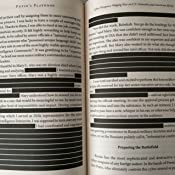
Koffler’s “Putin’s Playbook” itself is a messy amalgam of history, biography, advice, conjecture, and personal grievance. She offers a disclaimer that her views do not represent those of the government, followed by an author’s note strongly disagreeing with DIA/CIA redactions, which she prints as part of the text. Yet, out of the mess we can find potential gems of insight.

For example, she explains Putin’s own grievance over the collapse of the USSR and losing the Cold War. She writes about two philosophers who shaped his thinking: “In addition to Eurasianist influence, Putin drew his ideology from the ideas espoused by two Russian thinkers”: Ivan Il’in (1882-1954) and Lev Gumilev (1912-1992). Il’in was a Russian Orthodox Christian who believed Western democracies were dangerous; he considered that “an independent Ukraine would be an unthinkable ‘madness.’ Meanwhile, Gumilev, an anthropologist and historian, believed in a “super-ethnos” of Mother Russia. Eurasian vs. European. Slavs/Steppes vs. Anglo-Saxons. Us vs. them.


Putin uses ethnicity to justify threats of aggression against his neighbors. It may be hard for people in free democracies to understand his hardline, strongman attitude and why the people of Russia seem to support him as well as how he stays in office for decades.


Koffler says it is a mistake to see Putin and Russia through American eyes. Vladimir Putin and his supporters are steeped in grievance, superstition, resentment, and righteousness. Putin and his followers seem to have a boundless capacity for inflicting and enduring suffering. The list of political opponents, reformers, and journalists who have been poisoned, shot, or mysteriously killed by Putin’s Russia is long and alarming.

According to Koffler, “trust” is not a concept in Russia. (And, by the way, she says there is no word in Russian for “fun”).


Yet, Koffler seems to idolize Putin: “When Putin assumed the reigns (sic) of Russia, his first order of business was to restore internal stability, reverse the economic crisis, and reassert state control of most, if not all, aspects of life in Russia." Koffler says Putin was committed to restoring “law and order” and “respect towards Russia internationally.” “Putin delivered on his promise to the Russians.” “He has restored domestic stability, improved the Russian economy, and modernized the military to the point where even the Pentagon must play catch up in certain areas. Putin’s Russia is back on the map,” she boasts. 

Biden speaks with Putin
Koffler writes, “At sixty-eight, Putin is highly athletic and personifies strength. Acting as a benevolent patriarch…” Weirdly, she says: “Putin may be a villain, but he is not a supervillain.” “His rule has been far less brutal than that of Vladimir Ilyich Lenin or even the czars.”

Putin further justifies his aggression against his neighbors because of his fear and resentment of more free democracies on his borders and potential NATO expansion. It seems he would rather fight others, including Europe and the United States, than try to get along:

“Putin is stirring up chaos and disorder in America to save himself from a regime overthrow that he believes Washington seeks. Putin believes that destabilizing America by amplifying internal strife through social media and covert interference will help prevent an all-out war, which he would be ready to fight with the U.S. under certain scenarios. As the United States continues to try to peel off Ukraine from Russia’s orbit, it may be prudent to make a thorough intelligence assessment as to whether Putin would invade Ukraine if Washington pushes too hard. Before we consider such a move for Moscow ‘highly unlikely,’ it is worth remembering that Putin understands how Americans think but doesn’t think like them. He thinks like a Russian and a former KGB operative. While it may have seemed irrational to American national security experts that Putin took over Ukraine’s Crimea, for the Russian president, the long-term risk of not having Crimea as part of Russia outweighed the short-term risk of invading it.”

In the face of a growing Russian military threat on Ukraine’s border in recent days, weeks, and months, the Biden administration and European allies have strengthened diplomatic resolve, committed to finding a path to resolve tension and prevent war. Analysts say Putin's actions have boomeranged and only strengthened NATO's resolve and solidarity.


Putin has been warned that if his military invades Ukraine again on whatever pretext or justification, there will be dire consequences, including severe international sanctions. But Koffler writes:

“Sanctions or not, Putin has shown during the past decade that he will invade or destabilize Russia’s former republics –– as he did in Ukraine and Georgia –– rather than let them switch sides to NATO and the European Union. He will continue to unbalance America through cyber warfare and other tools in his playbook rather than let Washington democratize the former Soviet Eurasian countries. He understand well that he is playing a risky game that can lead to an escalation of tensions. But risk is something that Putin is accustomed to; it is a way of life for a former KGB officer. Bred as an intel operative, he plans for contingencies. Therefore he has a plan in his playbook for an all-out war with America.”

Koffler says that Russia’s war with America would be five-pronged: (1) space, attacking satellites; (2) cyber weapons; (3) spies and disrupters, infiltrating America; (4) active measures including subversion, election sabotage, and assassinations; and (5) all-out kinetic warfare, up to and possibly including nuclear weapons.


U.S. Navy's fourth Mobile User Objective System (MUOS) communications satellite lifts off from Space Launch Complex-41. (United Launch Alliance)
As expressed several times in her book, Koffler is a rock-solid supporter of her former boss, retired General Michael Flynn, who pleaded guilty to lying under oath about his contacts with Russian officials in the lead up to the 2016 U.S. presidential election. Former President Trump pardoned Flynn as well as other close associates with ties to Russia and a plot to overturn the 2020 election. Koffler calls former Defense Intelligence Agency Director Flynn an “American patriot.”

Michael Flynn and then-President Trump (D. Myles Cullen, DoD)
She defends Trump’s “patriotic desire” regarding his call with Ukraine President Zelensky in 2019. In that call, which led to his first impeachment, Trump tried to get Zelensky to announce an investigation into the Biden family during the U.S. presidential campaign, and the former president tied the request to a withholding of arms and other support to Ukraine.

Koffler says, believably, that Putin’s Russia is behind the schism in the United States between the Right and Left, fomenting mistrust in free elections and in democracy itself. She acknowledges Russia’s aggressive attempts to target U.S. elections and influence people through fake social media accounts.


Though she calls the Trump-Russia investigation a “witch hunt,” Koffler makes no reference to Rudy Giuliani, Paul Manafort, Roger Stone, and others in Trump’s orbit who actively worked with Russians. No mention of Trump Tower plans in Moscow or Russian investment in the Trump corporation. No mention of Trump’s public request for Russia and China to help him discredit his political opponent. No mention of Trump taking Putin’s side over his own intelligence community in 2016. 


And no mention of the January 6, 2021 Capitol insurrection by Trump supporters, even though her book was published in late July.


Koffler
Koffler, who is a contributor to Fox News, does not offer an opinion about Tucker Carlson’s pro-Russia and pro-authoritarian stances.

She presents a mere half-paragraph about Putin challenger Alexey Navalny and a bare mention of Russian agent Maria Butina, who infiltrated the NRA and influenced members of the Republican Party. She warns, instead, about the “Left’s true agenda”: single-payer healthcare, gun control, and –– deceivingly –– “defunding the police,” a phrase denounced by all Democratic leaders.


With no intended irony, Koffler writes, “It is high time for Americans and the U.S. government to understand how Russian disinformation works so we don’t become our own deceivers.”


As to why she is no longer a member of the intelligence community, Koffler explains how she was challenged after a background clearance investigation. Then, she gives a lengthy explanation of how a flight to Washington, D.C., had to make an emergency landing because of her behavior. She says, “what transpired next was straight out of Stephen King.” She was handcuffed by police and questioned by the FBI because of her disruption on the airplane. After the incident, the Intelligence Community issued psychological tests in which testers found “something not quite normal.”


She blames “deep-state operatives,” “bean-counters, “bureaucrats,” and “American apparatchiks” for destroying her career and her plan to be Deputy NIO for Cyber on the National Intelligence Council at the Office of the Director of National Intelligence.


Ultimately, readers must choose what to believe based on what Koffler chooses to present. In her opinion, the United States is no longer a free refuge for immigrants like her, she says: “And unlike me, my children and other God-loving Americans will have nowhere to flee.” But while warning of the dangers of leftwing socialism, she largely ignores the threats of rightwing authoritarianism and totalitarianism.


It may seem to be unbelievable, but history shows how fascism can arise from both the Left and/or the Right.


While there are gems of analysis about Russia to discover in this book there are other authors that are far more insightful and rewarding to help understand Putin and modern Russia. I've found Garry Kasparov to be a particularly strong voice, particularly in his warnings against appeasing Putin; I reviewed his book "Winter Is Coming" in 2017.


I just started reading Fiona Hill’s “There Is Nothing for You Here: Finding Opportunity in the 21st Century.” I’m only a few chapters in, but so far, it’s a much deeper and more rewarding book, both as a biography and as a geopolitical analysis. Hill is the former deputy assistant to the president and senior director for European and Russian affairs on the National Security Council. Hill served Presidents George W. Bush, Barack Obama, and Donald J. Trump with honor, courage, and commitment.


From the publisher: “Rebekah Koffler, is a Russian-born U.S. intelligence expert who served as a Russian Doctrine & Strategy specialist in the Defense Intelligence Agency… Rebekah is a writer and national security commentator whose work has been published on the Fox News website, The Hill, the Daily Caller, the New York Post, and the Washington Times. She has appeared on Fox News, One America News, News Nation Now, Newsmax TV, and the Sean Hannity nationally syndicated radio show.”

TOP PHOTO: From left, U.S. Army Europe and Africa Deputy Commanding General for Army National Guard, Maj. Gen. Joe Jarrard, U.S. Ambassador to Poland, Mark Brzezinski and Polish Land Forces 16th Mechanized Division Commander, Maj. Gen. Krzysztof Radomski walk and talk before the Battle Group Poland hand over, take over ceremony at Bemowo Piskie Training Area, Poland, Feb. 11, 2022. The ceremony demonstrated NATO's continued commitment to the collective defense and security of our allies on NATO's eastern flank. (Spc. Jameson Harris)

Tuesday, February 8, 2022

Book Ban or Legitimate Political Discourse?

Review by Bill Doughty––

When some parents and politicians moved to ban Toni Morrison’s “Beloved” from school curricula and libraries, it moved me to read her award-winning novel about an escaped slave family and the nearly unimaginable horrors they endured.


“Beloved” contains references to explicit sex, violent rape, child murder, and bestiality. It’s definitely not a book for very young and immature readers. Some call it a “dirty” book. Others consider it a masterpiece of American literature by a Nobel Laureate and Pulitzer Prize winning author. 


The book is based loosely on a true story. According to essayist Walter Johnson, it is set in “the moment when the Indians were removed, the woodlands stripped of trees, and the Lower South put under the dominion of a single plant –– king cotton.” 


Johnson adds, “Morrison presents her readers with the terrifying excesses of violence imposed upon enslaved people.”


Essayist Tiya Miles writes, “‘Beloved’ is a spiritual and psychological drama about the lasting wounds of cruelty and the wrenching difficulty of holding together damaged selves and human relationships in the aftermath of unspeakable tragedy.”

The book depicts the depravity of slavery: “White wardens treated these black men worse than chattel, locking them up nights in wooden pens dug into a trench, forcing them to perform unwanted sex acts, humiliating them with caustic words of defilement, and working them in an unrelenting grind,” according to Miles.


In “Beloved,” Morrison describes how one chained man, Paul D, felt locked in one of those pens in a trench, along with 45 other slaves:

“A flutter of a kind, in the chest, then the shoulder blades. It felt like rippling –– gentle at first and then wild. As though the further south they led him the more his blood, frozen like an ice-on for twenty years, began thawing, breaking into pieces that, once melted, had no choice but to swirl and eddy.”

“All forty-six men woke to rifle shot. All forty-six. Three whitemen walked along the trench unlocking the doors one by one. No one stepped through. When the last lock was opened, the three returned and lifted the bars, one by one. And one by one the blackmen emerged –– promptly and without the poke of a rifle butt if they had been there more than a day; promptly with the butt if, like Paul D, they had just arrived. When all forty-six were standing in a line in the trench, another rifle shot signaled the climb out and up to the ground above, where one thousand feet of the best hand-forged chain in Georgia stretched. Each man bent and waited.  The first man picked up the end and threaded it through the loop on his leg iron. He stood up then, and, shuffling a little, brought the chain tip to the next prisoner, who did likewise. As the chain was passed on and each man stood in the other’s place, the line of men turned around, facing the boxes the had come out of. Not one spoke to the other. At least not with words.”

Morrison further paints the scene, within nature but unnatural: “Chain-up completed, they knelt down. The dew, more likely than not, was mist by then. Heavy sometimes and if the dogs were quiet and just breathing you could hear doves.”

Those who seek to ban Morrison’s book(s) and other works of art base their opinions on alleged "sexually explicit language,” "LGBTQIA+ content," "anti-police messages,” "divisive language,” and themes of race, according to the American Library Association. 


Another of Morrison’s books, “The Bluest Eye” is on the ALA’s top ten list of challenged books. So are Harper Lee’s “To Kill a Mockingbird” and John Steinbeck’s “Of Mice and Men.” Mark Twain’s works have long been “canceled” before “cancel culture” was part of the vernacular.


Last month Art Spiegelman’s “Maus,” a graphic novel about the Holocaust, came under attack. And last week, a Christian pastor led a book burning in Tennessee. Books thrown into a bonfire included young adult fantasy fiction including from J.K. Rowling’s “Harry Potter” series.


Book burnings: Germany 1933 and Tennessee 2022.

‘Beloved’ Found Haiku


On my Navy Reads blog I've featured unintentional "found" haiku from Senator John McCain, President Abraham Lincoln, Coach Mike Krzyzewski, and others. I found this Toni Morrison haiku from “Beloved”:


Who would have thought that

a little old baby could

harbor so much rage


That quote is used as an epigraph to a chapter about Morrison’s novel in the funny and rewarding “25 Great Sentences: And How They Got That Way” by Geraldine Woods (Norton, 2020): Woods picks apart the words and focuses understandably on the phrase “little old baby.” The baby and its spirit is at the heart of Morrison’s magical and “impossible” realism.

After reading “Beloved,” I turned to a relatively recent book of essays edited by Davîd Carrasco, Stephanie Paulsell, and Mara Willard titled “Toni Morrison: Goodness and the Literary Imagination” (University of Virginia Press, 2019). The collection contains the Walter Johnson and Tiya Miles quotes at the beginning of this review.


Another “found haiku” by Toni Morrison comes from the "Goodness" collection. It is from Morrison herself, captured in her Ingersoll address of 2012, and it happens to be a pivotal point arguing against book banning and for teaching about slavery, racism, and other evils of America’s past:

Thinking about good-

ness implies, indeed requires, a view

of its opposite


The argument for studying the past while not wearing rose-colored glasses is this: confront what was wrong in order to do what is right. Reject racism, misogyny, and imperialism; embrace equality, respect, and freedom. Repel hate; stick with love.

A slave cabin in Barbour County, Alabama (LOC)

On Feeling Uncomfortable


Book-banning groups want to protect children’s self-esteem and not make them uncomfortable: White children should not be made to feel bad that their ancestors may have been oppressors, and children of color should not be made to feel like victims. Children (even, apparently college advanced-placement literature students) should be protected from what they consider obscene “dirty” books.


But, isn’t it necessary to know where the real dirt is in order to become clean?


Jonathan L. Walton explores the Morrison concept of "dirty" in his essay “Luminous Darkness.”

“…Morrison refers to the dirtying process of slavery in her novel 'Beloved.' Black Folk are dirtied, first by the racial imagination of white supremacy. Racial visions are then transformed into laws, statues, and cultural practices that dehumanize and dirty their targets. These are the conditions from which those on the underside of freedom and autonomy, and power seek to break free. These are the conditions from which Morrison seeks to reconsider goodness by reframing who and what we deem as inherently evil.”

The institution of slavery, itself, was a dirty shame. Some could argue that we didn’t start to live up to the ideals in the Constitution until the mid-1960s with the passing of the Civil Rights Act and Voting Rights Act, which were brought about by President John F. Kennedy and President Lyndon B. Johnson (both U.S. Navy veterans).


      From Civil War to Civil Rights (NPS)
Parents and politicians who want to ban books say teaching about slavery will divide people along racial lines. But studying the truth of the past can show how much progress we’ve made in the past hundred years –– which can be a uniting force.

Tenured Professor of Women and Gender Studies Brittney Cooper appeared on Ari Melber’s “The Beat” on MSNBC on January 28 and spoke about slavery, book banning, and what makes people uncomfortable. She notes that black people were kidnapped and brought to America to make white  people “more comfortable.”


Brittney Cooper
Cooper says, “Sure, racism –– learning about racism –– is perhaps uncomfortable. But you know what`s more uncomfortable? Racism. Learning about slavery might be a bit uncomfortable. But you know what was more uncomfortable? Slavery.”

Fighting the Civil War to end slavery was more than uncomfortable. Marching for civil rights and voting rights was uncomfortable.

Cooper adds, “Learning that one is ignorant might be a bit uncomfortable. But you know what`s more uncomfortable, ultimately? Remaining ignorant, even as these problems continue to encroach upon our lives.” Legislating against books and learning, she says, “is nothing but a return to the very history we fought to get out of.”


Shouldn’t the freedom to read and discuss literature be protected as truly “legitimate political discourse?” Choosing to learn more about Toni Morrison and her books is especially legitimate during Black History Month.