Friday, July 13, 2018

Conversation III: CNO, Drones & Beer w/ Mahan

Interview by Bill Doughty

Professor John Jackson, creator of the Navy Professional Reading Program
He's the originator of the Navy's Professional Reading Program (NPRP, or CNO PRP), and this is our third interview. In this "conversation with the creator III" Naval War College Professor John Jackson, an expert in robotics and unmanned systems, provides insights into how the CNO's reading program, now 12 years old, has evolved over the years. Our interview begins with how the NPRP was personally reinvigorated by Chief of Naval Operations Adm. John Richardson. Like Navy Reads, Jackson aims to support reading and critical thinking.

Q. What was CNO ADM Richardson's contribution to the latest incarnation of the NPRP?

Adm. Richardson has been very “hands-on” in shaping his Professional Reading Program. In fact, we met with him prior to his assumption of the CNO job so we could get a head-start in ensuring that his program met his expectations. He has personally selected the books on the various lists and sub-lists, and has updated them about every six-months. He is a “true-believer” in the value of reading as a primary tool to improve the professionalism of our force. 

Adm. John Richardson, Chief of Naval Operations
Q. The Canon seems to be a foundation – and a good starting point – for Navy readers.

The Canon represents books with which every Sailor should be familiar. It was very difficult to limit the number of books in this category since Navy professionals work in such a wide variety of jobs and specialties. Choices were made that cut across all communities and provided a baseline valuable to everyone in Navy blue and gold.  

Q. The NPRP has evolved since it started under CNO Adm. Mike Mullen. What are some of the biggest changes you've seen in how it's organized and presented?

Our original list in 2006 was categorized by “skills” such as leadership and critical thinking, and was further divided into collections based on experience/rank. The “junior enlisted” collection focused on issues young Sailors would contend with, and the “senior leaders” collection focused more command and large organization issues. We have now evolved into a reading program that is “rank agnostic” and allows everyone to read any book they desire.   

MASN Trevor Miller browses the LiveSafe app on a smartphone. (MC2 Ricks)
Q. Speaking of changes, how has the audience changed? What are some of the ongoing challenges of reaching the digital generations who seem to be tied to their smart phones?

Because of the issues you raise, the CNO-PRP is now based on e-books and digital content. We no longer distribute hard-copy books. As an old guy who likes paper, I tend to read more in hard-copy, but the younger crowd of “digital natives” prefers to read on Kindles, Nooks, or other readers… or to squint and read them on their phones. We don’t care, as long as they are READING!

Fleet Adm. Nimitz and Gen. Eisenhower loved reading about history.
Q. Does reading develop better leadership skills?

I can think of no better way to improve a person’s leadership skills than to read about successful leaders from today and yesterday. It is often said that no one can live long enough to make all the mistakes, but rather should learn from others' experiences whenever possible. It has been said that “not all readers are leaders, but all leaders are readers”!

Q. How can reading and writing help develop better trained and ready Sailors?

Reading and writing demand concentration, much more so than watching a movie or a television program. Your brain must be fully engaged in translating the letters into words and the words into ideas. You can’t be a passive reader.  There are thousands of books on nearly every subject, so Sailors who want to be better at the profession should seek out the biographies and autobiographies of people who have succeeded on the paths they are beginning to walk.

Q. What are the best books right now in your specialty, the study of Unmanned Vehicle Systems?

P.W. Singer’s “Wired For War” is a bit dated, but is still a great source for understanding how we arrived at the place we are in the development and use of Unmanned Systems. “Killing Without Heart” by M. Shane Riza raises many thoughtful questions about what it means to fight a “robot war.” 

And there is a new book being published by the U.S. Naval Institute called “One Nation, Under Drones.” I am the editor, and 10 highly qualified chapter authors write at length about the world of “drones” as it exists today and how it will probably develop in the future. OK, so I plugged my own book! It will be out in December, and I know what everyone on MY Christmas list is getting!

Professor Sally Paine, USNWC
Q. Who are some good women writers you'd recommend?

Naval War College professor Sally Paine has written a number of top-quality books about Asian affairs and other subjects. "The Wars for Asia 1911–1949" (by S. C. M. Paine) is an award winner book that is highly regarded for its use of original source material in the native languages of the originators. 

Q. In May 2017 Navy Reads published a list of 50 books (for 50 years) about the Vietnam War. What are a few of your favorite titles about Vietnam?

Jim Webb’s novel “Fields of Fire” which describes in painful and searing details how U.S. marines faced the challenges of ground combat in the jungles of South East Asia, and “Two Souls Indivisible” by James S. Hirsch that tells the story of the friendship that saved two POWs in Vietnam. My close personal friend CDR Porter Halyburton, USN (ret), lectures annually at the Naval War College and shares the lessons he learned from his seven-and-a-half year ordeal in the prisons of North Vietnam. His inspiring recollections are full of faith, friendship and forgiveness.   

Q. If you could have lunch or a beer with any four or five historians (living or dead) who would be at the table? Why?

I have been blessed to be able to interact with a number of incredible historians, and have shared a meal or a drink with: 

1. David McCullough for his ability to capture the essences of historical events by mining the intimate details of the simple men and women involved. 

2. Craig Symonds, the author of 12 books and the editor of another 9, taught history at the U.S. Naval Academy for three decades and has been on the faculty of the Naval War College. His books (mostly on maritime subjects) are all considered classics. His book “The U.S. Navy: A Concise History” is THE source for understanding how our Navy grew into the incredible fighting force it is today. 

3. George Baer, whose book “100 Years of Seapower” is a classic in every sense. He helped shape thousands of young military officers during his long tenure at the Naval War College. 

…. And in addition to the remarkable men above, I would make special room for Winston Churchill and Alfred Thayer Mahan.   

Q. Adm. Richardson encourages writing as well as reading. For my money, Zinsser's "On Writing Well," is indispensable (a recommendation from Adm. Richardson and Rear Adm. (ret) John Kirby). What's your advice for writers? What should be in their toolbox?

The best way to become a good writer is to write as frequently as possible. You must exercise your “writer’s brain” and seek out other authors/writers and ask them to critique your work. You must have tough skin, since the comments could be harsh. But accept the criticism with the good intention with which it is provided…. write another draft….. rinse and repeat. 

Q. What do you see on the horizon? What's ahead for the Navy's Professional Reading Program?

The CNO-PRP will continue to provide digital access to books that matter. We will do all that we can to promote a reading culture within our Navy and help every Sailor become more effective as they labor in support of our great Navy and our treasured nation. I salute “Navy Reads” for doing a superb job of fanning the flames of learning through reading!

Professor John Jackson (right), program manager for the CNO-PRP, discusses reading with U.S. Navy Cmdr. Daniel Dolan and Rear Adm. Walter E. Carter Jr. (center), president of the Naval War College, in Newport, R.I., in Dec. 10, 2013. (Photo by MCC James E. Foehl)

Sunday, July 8, 2018

Destroyers for Democracy / SCOTUS Legacy

Review by Bill Doughty


U.S. and British sailors examine destroyers prior to transfer in 1940.
It's hard to imagine the depths of fear and fascism washing over the world in the wake of the Great Depression and approach of war in the 1930s, a fear that intensified in 1941 when Imperial Japan attacked Pearl Harbor and Hitler declared war on the United States.

America had sided with Great Britain, with President Franklin D. Roosevelt providing 50 World War I navy destroyers to fight German submarines in exchange for the use of military bases on British territories in the Caribbean and western Atlantic.

The man who made that deal happen, despite entering a "sea of troubles" was new U.S. Attorney General and head of the Department of Justice, Robert Houghwout Jackson.

Jackson's story, intertwined with FDR's, is captured in "That Man: An Insider's portrait of Franklin D. Roosevelt" by Robert H. Jackson, edited and introduced by John Q. Barrett (Oxford University Press, 2003). Barrett cobbles together Jackson's manuscript with Jackson's oral history narrations and adds key documents and explanations.

The destroyers for bases deal, including the behind-the-scenes machinations between FDR and Churchill, will be interesting to Navy readers. So will Jackson's insider insights as WWII became a reality.

By the summer of 1941 Hitler had crushed Poland, Denmark, Norway, Belgium, the Netherlands, Luxembourg, France, Yugoslavia and Greece. Jackson writes:
"By June 15, conquest and demoralization had so far subdued France that the French fleet, under the ambiguous Admiral Jean Francois Darlan, seemed likely to be surrendered and thus added to the German and Italian navies. Churchill again cabled Roosevelt ... The specter of overwhelming German naval power, added to her seemingly irresistible air and land forces, deeply troubled the President. If the Germans should capture the French fleet, it – with Germany's own and that of Italy, and with probably cooperation from Japan – would leave the United States to face alone a most formidable naval and air power. But in the early days of July, Britain, defying what seemed to be forces as inexorable as fate and risking alienation fo the French people, boldly attacked and largely disabled the French fleet so that it could no longer be of any substantial service to Hitler. Britain won not only our admiration for her courage and audacity but our gratitude as well."
By the way, a great movie released last year, highly recommended, is "The Darkest Hour," directed by Joe Wright, written by Anthony McCarten and starring Gary Oldman as Winston Churchill. It's a slice of history as Churchill deals with challenges and the need for toughness in his first weeks as Prime Minister. Churchill was elected to the position after serving as First Lord of the Admiralty, the U.S. counterpart to Secretary of the Navy.

In "That Man" Jackson shows the back and forth between Churchill and FDR. 
"Churchill," Jackson writes, "seemed not to comprehend the very different constitutional and political position of President Roosevelt, who was bound by a written Constitution separating executive from legislative power and putting in Congress the control of disposal of government property."


Churchill reads
Eventually, Jackson worked out a legal transaction that helped both nations and navies. His artful deal assisted European Allies at a critical time and helped set the stage for American involvement in the war.

"That Man" gives us a front-row seat to the impact of the attack on Hawaii of Dec. 7, 1941 and its reverberations across the world to the White House.
"I think Pearl Harbor was a great shock to the President – that with all the war talk there had been, he did not believe Japan would make a surprise attack. Of course it was a great embarrassment to him ... How long the war would last and what the prospects were, I did not have much opinion. I was baffled. Our intelligence had proved to be wrong on nearly everything. American intelligence services let us down at every point. I had heard in Cabinet discussions the views that had come from our intelligence services. We had enormously underestimated the strength and striking power of Hitler. We had overestimated the staying power of France. We had overestimated the strength of England. We had overestimated the attitude and stamina of Belgium. We had terribly underestimated Japan, at least her immediate striking power. We had terribly underestimated the power of Russia ... The conquest of Russia was expected to be a very short matter. Based on such information as I had, it was a very dark prospect indeed. I was very pessimistic about it. It looked like a very long war and a war that would be terrifically costly in lives because Hitler would have to be dislodged from the position that he held. We had to wage a war of attack. The foolish optimism that had prevailed, such as the invincibility of the American navy and this and that, all went out of Washington very fast. In place of it, a very deep pessimism came in. There was talk about a war of a decade and all that. In the early part of December and the following months, spirits were pretty low here."
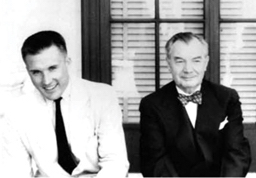
Daughter Mary and son Bill flank Irene and new Supreme Court Justice Robert Jackson, June 2041.
During the war, FDR appointed Jackson to the Supreme Court, but Jackson did not always side with the president. He recognized the importance of balance and separation of powers and the overriding authority of the Constitution.

For example, Jackson was in the minority in the Korematsu decision by the Court, arguing against the constitutionality of FDR's decision to imprison Americans of Japanese Ancestry in concentration "internment" camps, an order based on unfounded fear of a racial minority and one FDR would later admit was a mistake.

Robert H. Jackson had close personal ties to the Navy and the extended Roosevelt family. He knew "quite well ... the old gentleman" Josephus Daniels, Secretary of the Navy, who he first met in 1913. He conferred with Secretary of War Henry Stimson, Under Secretary of State Sumner Welles and newspaper editor and Secretary of the Navy Frank Knox.


Jackson at FDRs naval conference with Henry Stimson, Sumner Welles and Frank Knox.
Jackson's daughter, Mary, married a Navy physician. Jackson's son, Bill, earned a law degree and entered the Navy as an ensign. Bill later married Theodore Roosevelt's grandaughter. 

Both TR and FDR served in the position of assistant secretary of the Navy early in their government service. According to Jackson, FDR embraced innovation in the 30s and 40s:
"Roosevelt was not over-awed by military or naval rank and did not feel any sense of inferiority in the presence of a general or an admiral ... The Navy was his special interest, and at Cabinet meetings we sometimes referred to it as his branch of the service. He had the general conception of naval power that was set forth in the late nineteenth century by Admiral Alfred Thayer Mahan, but he was not blind to the significance of the growth of air power. He knew that that opened a new chapter and called for new techniques. He was interested in the most minute developments of new weapons and new strategies, even new tactics. My impression was that Roosevelt had no lack of respect for the training, judgment and advice of his generals and his admirals on the special subjects that were within their technical competence, but that as Commander-in-Chief he was more apt than most presidents to assert his personal authority over the military, naval and air authorities."
Jackson is a fascinating figure in history for his role in the New Deal, as solicitor general and attorney general, as Supreme Court justice and then for a time as chief prosecutor for the United States in the Nuremberg Trials of Nazi leaders.


Jackson, who began a successful career as a country lawyer, never finished law school.

A justice for the people, Jackson opposed indiscriminate wiretapping and invasions of citizens' privacy.

"It seemed to me that wire tapping was a source of real danger if it was not adequately supervised, and that the secret of the proper use of wire tapping was a highly responsible use in a limited number of cases, defined by law, and making wire tapping criminal outside of those purposes or limits," Jackson said.

A Wave-Top Read on Jackson

A wonderful book for young readers makes a good companion read to "That Man." It's Gail Jarrow's "Robert H. Jackson: New Deal Lawyer, Supreme Court Justice, Nuremberg Prosecutor" (Calkins Creek, 2008).

Jarrow explores Jackson's early life in western Pennsylvania and New York as a devoted reader and, in high school, a skilled debater, often benefiting from the wisdom of mentors. In just just a couple of hundred pages we get a wave-top view of his life, culminating in his role at Nuremberg and final years on the Court. She writes:
"Nuremberg had shown Robert Jackson how easily a dictator like Hitler could seize power. The lesson stayed with him when he returned to the Supreme Court. He was determined to protect each person's rights and freedoms from an overpowering government. Yet Jackson didn't want the government to be so weak that it couldn't keep the country secure. Twice in his lifetime, he watched Germany take over Europe. Now Communist Soviet Union was moving to control the free countries in Eastern Europe."
Earlier in his tenure in a First Amendment case he led the majority 6-3 opinion in West Virginia State Board of Education v. Barnette, siding with Jehovah's Witness schoolgirl plaintiffs against the West Virginia Board of Education. The students had been suspended for not putting their hands on their hearts and participating in the Pledge of Allegiance.

Jackson took a different stand in Terminiello v. City of Chicago. The case involved a priest issuing what today would be considered hate speech.


Gail Jarrow
"Catholic priest Arthur Terminiello gave a political speech in a Chicago auditorium in February 1946," Jarrow writes. "During his speech, Terminiello verbally attacked Jews and blacks and called former First Lady Eleanor Roosevelt a Communist." More than a thousand angry people protested outside. Some pounded on the doors and threw rocks. The priest "urged his supporters to use violence against the 'slimy scum' protestors."

In the ensuing riot Terminiello was arrested and fined $100. He took his case through the judicial system to SCOTUS. The Court sided 5-4 against Chicago and for the priest, saying the First Amendment protected his freedom of speech.

"Jackson strongly opposed the majority's decision," Jarrow reports.

She quotes Jackson: "No mob has ever protected any liberty, even its own, but if not put down it always winds up in an orgy of lawlessness which respects no liberties ... The choice is not between order and liberty [of the citizen]. It is between liberty with order and anarchy without either. There is a danger that, if the Court does not temper its doctrinaire logic with a little practical wisdom, it will convert the constitutional Bill of Rights into a suicide pact."

In the same year as the Terminiello decision was announced, by the way, the United States formed the North Atlantic Treaty Organization. NATO was created by the United States, Canada, and several Western European partner nations after WWII to provide collective security against the Soviet Union.

Jackson, who lived through two world wars and the Cold War, was on the Supreme Court during the Korean War. 

He heard a pivotal case called Youngstown Sheet & Tube Company v. Sawyer. President Truman had ordered the government to take over the steel mills during the war in response to threats of a steelworkers' strike. By 6-3, the Court decided the Constitution did not give the president the authority to take private property without the consent of Congress.
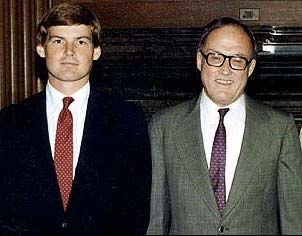
Above: Rehnquist and Jackson; below: Roberts and Rehnquist.

"This ruling," Jarrow said, "brought the three branches of government into balance again and became the basis for many later Court decisions."

In one of his final cases, recovering from a heart attack, Jackson was part of one of the most important cases in U.S. history, Brown v. Board of Education.

The year before he'd heard the reasoned arguments of then-attorney Thurgood Marshall against school segregation. "Jackson made up his mind that the Court should reverse the 1896 Supreme Court ruling Plessy v. Ferguson," Jarrow writes. The decision, issued by Chief Justice Earl Warren, was unanimous.
Jackson did not achieve his dream of becoming chief justice, but his legacy was profound.
"Although Robert Jackson never became chief justice, he is connected to a line of chief justices. His law clerk in 1952-1953 was William Rehnquist, who served as chief from 1986 to 2005. When Rehnquist died in 2005, his former law clerk John Roberts took the position. Robert Jackson dedicated his life to the law, first as a lawyer, then as a judge. He believed that the basis of a government was its laws, not the whims of its leaders. Shortly before his death, he wrote: 'There are only two real choices of government open to a people. It may be governed by law or it may be governed by the will of one or of a group of men. Law, as the expression of the ultimate will and wisdom of the people, has so far proven the safest guardian of liberty yet devised.'"
Jarrow's biography includes a timeline, notes, bibliography, index and resources for more information. Among the resources are oral histories, presidential libraries (Wilson, Hoover, Roosevelt, Truman and Eisenhower) and the Robert H. Jackson Center of Jamestown, New York – www.roberthjackson.org – a site with comprehensive coverage of the Nuremberg trials of Nazi war criminals.

Jackson saw the value of working closely with Allies. He recognized the dangers of totalitarianism and fascism. And he believed in the awe-inspiring power of Constitutional Democracy. He embraced freedom, rejected fear, spoke truth to power and put his faith in critical thinking.


Robert H. Jackson, Associate Justice of the Supreme Court, in 1953: second from the left, in the back row. Also pictured are, from left, in the bottom row: Felix Frankfurter; Hugo Black; Earl Warren (Chief Justice); Stanley Reed; William O. Douglas. Back row: Tom Clark; Jackson; Harold Burton; Sherman Minton.

Sunday, July 1, 2018

Toughness of Churchill & Orwell

Review by Bill Doughty––

Thomas Ricks's choice of subject is at first glance a head scratcher. What could right-wing imperialist Winston Churchill and left-wing flamethrower George Orwell have in common?

Churchill in WWI, middle row, center.
George Orwell
The answer: toughness of character, love of freedom and a commitment to truth and action. Both fought in combat for their belief in democracy and liberty – Churchill as an army officer in the First World War, Orwell twenty years later as a rebel against fascists in the Spanish Civil War. Churchill also served as First Lord of the Admiralty in the lead up to WWI.

In "Churchill and Orwell: The Fight for Freedom" (Penguin Press, 2017) Pulitzer Prize-winning author Ricks shows how military experience shaped the two men as thinkers and writers.

In Orwell's case his position was cemented as a lifelong skeptic. "From Spain on, his mission was to write the facts as he saw them, no matter where that took him, and to be skeptical of everything he read, especially when it came from or comforted those wielding power."

For Churchill, connections to the military informed his approach as Prime Minister. "From his time in World War I, and even more from his two turns at overseeing the British navy, Churchill had developed a delicate feel for the wiles of military bureaucracy."

The bombing of Pearl Harbor on Dec. 7 1941 was a moment of truth for the United States not only in the Pacific but also, Churchill immediately realized, across the Atlantic to Europe.

"Churchill's post-Pearl Harbor address to Congress was a work of political genius," Ricks writes. "Its structure was artistic, with four sections that could be titled: I, We, They, Us Against Them." Churchill was a good writer but a great orator.

"Orwell's reaction to Pearl Harbor was markedly more skeptical about the Americans. While Londoners were becoming more pro-Russian, he observed, 'There is no corresponding increase in pro-American sentiment – the contrary.'" Still, Orwell seemed to be enamored with the idea of America if not the reality. Writer Christoper Hitchens, Ricks says, described Orwell as having a "curious blind spot" about America.
"Among Orwell's favorite authors were three Americans – Twain, Walt Whitman, and Jack London. Orwell does not seem to have been much influenced by the scathing portrayal of the nineteenth-century United States by another of his favorite writers, Charles Dickens. 'Martin Chuzzlewit,' a novel based upon Dickens's tour of the United States in 1842, depicted America as a nation of 'dollars, demagogues, and bar-rooms,' violent and deeply hypocritical, prating about honor, freedom, and liberty while enslaving millions."
Mark Twain (Library of Congress)
Ricks's book, with great photos of the protagonists and insights into their work, is a fascinating examination of two vines intertwined in the arc of history in the early 1900s.

Both men were drawn progressively more toward the ideas and ideals of the United States – including as expressed by the venerated Mark Twain.
"Early in his career, in the mid-1930s, Orwell had contemplated writing a biography of Mark Twain, but could not find a publisher interested in the project. Churchill also contemplated a book on an American theme in his youth – a history of the American Civil War. As a young man on his first lecture tour in America, he was introduced on the stage by Mark Twain."
During WWII, as Churchill led the British nation, Orwell served in the Home Guard. Orwell, influenced by the war and especially the postwar period, wrote his great novels "Animal Farm," published in 1945, and "1984," published 69 years ago this month in 1949.

After the war Churchill, like Orwell, retreated to the countryside to write. He had been voted out as prime minister and took what Ricks calls his "revenge," his Homeric war memoirs, starting with "Volume 1: The Gathering Storm."

Ricks examines each of Churchill's volumes and concludes, "No one can ever consider the history of World War II without referring to Churchill's account."

Orwell, however, may have the longer lasting impact on the world, at least from a literary standpoint. "A new post-Cold War generation has found his words to have resonance," Ricks writes. "All told, in terms of contemporary influence, Orwell arguably has surpassed Churchill."

Orwell, whose hero of 1984 is named Winston, gave us words and phrases including "doublethink," "big brother" and "all animals are equal, but some are more equal than others."

Ricks shows how "kindred spirits" Churchill and Orwell had the toughness to fight to preserve the liberty of the individual – "the key question of the century" – first by seeking facts, then by acting on their beliefs and finally by writing down their thoughts for posterity.

Both were men of action who, "facing an existential threat then responded with caring and clear-sightedness."

In his conclusion Ricks asserts that their path leads to a jail cell in Birmingham, Alabama and to the pen of Martin Luther King Jr. "King was arguing that in a world based on facts, in which the individual has the right to perceive and decide those facts on his or her own, the state must earn the allegiance of its citizens. When it fails to live up to its rhetoric, it begins to forfeit that loyalty. This is a thought at once profoundly revolutionary and very American."

Ricks's explanation of how Orwell and Churchill are relevant to MLK and the Civil Rights movement is an eyeopener and a call to action for truth, justice and reality in the face of lies, corruption and obfuscation.

"That struggle to see things as they are is perhaps the fundamental driver of Western civilization," Ricks concludes. Facts matter.

Sunday, June 24, 2018

'Unprecedented Corruption & Obstruction'

Review by Bill Doughty

An era of hope and cultural transformation came to an abrupt end with a backlash of unprecedented corruption and obstruction leading to impeachment and cynicism. The president distracted a nation with a trip to Asia to break the ice with a decades-long adversary. He would collude with an enemy for political advantage. And he would use fear to win office.

That president came to power in 1968. 

Sen. Robert F. Kennedy
Nixon's glide to the presidency came after the assassination of his greatest rival for the office, Robert F. Kennedy, in June 1968, fifty years ago this month.

It took writer Richard N. Goodwin twenty years to recover from his grief of another Kennedy assassination sufficiently to publish a book about his experience in the 60s, first working with President John F. Kennedy as assistant special counsel, in the Johnson administration and then as an advisor and supporter of JFK's younger brother Robert Francis Kennedy.

"Remembering America: A Voice from the Sixties" (Little, Brown and Company, 1988) is not just an illuminating and insightful history of the period, but it is also an examination of what our nation stands for: one nation, free, indivisible, led by the people, guided by the Constitution, dedicated to justice, inalienable rights and the rule of law.

"Remembering" is also, by its name, a memoir, one that opens with Goodwin's connection to Dec. 7, 1941. It was his birthday. He was ten years old.
"An aunt interrupted my tenth birthday party. The Japanese had just attacked Pearl Harbor. I barely noticed the swift dissolution of my celebration, feeling a thrill of excitement, an exultation of awareness that great events had happened. And on my birthday. On Dick Goodwin's day. Ignoring my departing friends I rushed to the radio, listened to the confused tumble of announcements, took several pieces of paper, and penciled the news of the attack across the top of a dozen sheets. I ran down the street to the corner drugstore and offered my homemade broadsheet to passing motorists at the outrageous price of five cents a copy, selling out quickly for enough money to buy six comic books."
Goodwin the Army and was in France in December 1955 when African-American Rosa Parks refused to move to the back of the bus. He, along with Kennedy, witnessed integration of the military accelerate after the Second World War. In Goodwin's case, he saw integration already embraced in Europe. JFK, skipper of PT-109, fought for America in the Pacific against Imperial Japan's racist and expansionist military.

In 1957, the Soviet Union with Sputnik became the first nation in space, stunning the world.
"With a single, immense leap, the Soviets had undermined our confidence in the divinely bestowed preeminence of America. Voices were raised to challenge the quality of our education, our laboratories, our very way of life. Had we – we asked ourselves – become soft, complacent, begun to decline? The year I graduated law school – 1958 – newspapers were crowded with accounts of anti-American riots that, within the next two years, would spread to embassies and missions in dozens of countries. In France, a tomato was splashed into the windshield of an American tourist's car; in Morocco, a better dispute was raging over air base rentals; in Germany there were increasing outbursts of popular resentment against American GIs, who had come as occupiers and stayed on in the role of defenders against the new communist menace; in Okinawa the U.S. Air Force was under attack for appropriating highly productive land to expand air fields. 'The Ugly American,' a devastating fictional critique of American policy in Asia, written by two Americans, became a best-selling book. What had gone wrong? The liberator of World War II, the guardian of freedom, the beacon's of man's hope, was being spat on and reviled."
Richard N. Goodwin (JFK Library)
Rather than being seen as standing for justice and against oppression, Americans were then thought of "as the selfish rich aristocrats of the globe, modern imperialists who wished only to protect our own interests, indifferent to the misery and discontent of those in other lands," Goodwin writes. This was a dangerous development in the Cold War, he said: "Enmity toward America was, ultimately, in some indefinable sense, a victory for the Russians..."

Enter "malevolently deceitful" Richard M. Nixon, Eisenhower's vice president, and power-hungry prevaricator who would undermine policy toward Cuba and later subvert peace-talks with North Vietnam, leading to a lengthening of the war. Nixon, brilliantly flawed, would leverage fear to eventually win the presidency 50 years ago this year.

Goodwin provides an instructional vision of his own coming-of-age in the Cold War – serving in the Army and in the Civil Rights Movement, working for JFK and LBJ. As a speechwriter and advisor he was responsible for naming LBJ's program to help underprivileged people, "the Great Society." He actually worked to make America great, dedicating himself to civil rights, voting rights and greater equality for people regardless of race.

Goodwin believed in speaking truth to power. "One did not serve a powerful master by flattering accommodation to his views."

President Kennedy and Vice President Johnson.
In "Remembering" we are treated to behind-the-scenes stories of LBJ and JFK revealing their warts and weaknesses as well as their great strengths. Kennedy was tolerant and understanding of other world leaders. He knew they could not defy their own constituencies without losing authority and power.
"This informed tolerance was infiltrated, sometimes distorted, by his personal experience, as observer and participant, of the Second World War. The man who, as a student, had written 'While England Slept' did not intend to allow hope of peace to enfeeble our capacity to make war. The son of a notorious appeaser, personal witness to Chamberlain's folly, was not likely to withdraw before the demands of our Soviet adversary. The fighting sailor of World War II, like many of his generation, derived from his participation in American military exploits, a heightened, almost naive confidence in the country's ability to match any foe, bear any burden necessary to victory. His was a generation of winners. In toppling the formidable military empires of Germany and Japan, they had been imbued with the belief that America possessed reserves of will and strength adequate to any threat. Like many of his fellow veterans he did not fully appreciate – at first – how nuclear weapons had changed the nature and possibility of war; or that obscure, murky, and inconclusive battles within the third world could not be translated into the kind of contest between Western powers that had directed, scarred, and degraded the most bloody century in human history."
Goodwin's revelations swing from the global to the national and local.

President Kennedy inspects U.S. Coast Guard cadets.
In the book's "prelude" Goodwin describes one of JFK's first conversations in the hours after the inaugural parade of his young presidency. It was noon, January 20, 1961, and Kennedy asked, "Did you see the Coast Guard detachment?" Goodwin remembered, "Frantically I canvassed my memory of the parade. Impatiently Kennedy interrupted my efforts at recollection. 'There wasn't a black face in the entire group. That's not acceptable. Something ought to be done about it.' The observation was an order. It was a manner of command I had learned well over the brief period of my employment."

Civil rights and voting rights are causes that electrified the 60s and form the basis for the hope and change and greater equality that defined a generation. The goodness of service was tempered by the Vietnam War and by the reality that power attracted people who hoped to gain influence for personal profit. Goodwin received calls, including from at least one big-business attorney, who knew that access to the White House translated to higher fees. "But a few instances like this were enough to dispel naiveté about the ubiquity of greed, and our vulnerability to those who could contrive ways of making money from ... White House contacts."

"The hazards of openness were trivial compared to the enrichments, both of personal experience and, more substantially, of government," Goodwin writes, but he warns of the dangers of self-delusion in an insulated environment where power can corrupt and where delusions of grandeur can cloud vision. That's what happened to Richard Nixon as he corrupted, impeded and obstructed his way to a second term in office.
"It is a hallucination bred of sensory deprivation and fed by a continual stream of flattery, respectful attention, and well meant invocations of patriotic reverence. It is intensified by the natural tendency of all power – even the most democratic – to resent any impediments to its exercise. What better way to achieve this than to close oneself off from dissent or to pretend it does not even exits. The pressures toward such dangerous and misleading isolation are so powerful – so pervasive in that company town called Washington – that they can only be resisted by continual, conscious effort to reach out, personally an with a critical intelligence, to people and ideas apart from government, to the ceaseless movement of an elusively complex society. The president does not rule America. He does not even lead it, except within the limits defined by the society itself."
President Kennedy and astronaut John Glenn peer inside Friendship 7 capsule.
Goodwin contends that JFK "seemed to embody the idea of America ... the idea by which we have defined America, and, by extension, ourselves as Americans." Kennedy's "presence helped to revitalize our belief in ourselves."
"This idea contains no claim of moral superiority. Still less does it encompass the realities of American history and modern life. Our behavior has often contradicted faith, belief, and principle. But it is the American idea; forced upon us by history and certain moments of illuminating vision. It has provided us with a sense of shared worth and social purpose. Even our most unholy departures have sought justification in that idea. We may have had warlike majorities, destructive majorities, or greedy majorities, but we have never had a majority of cynics. At least until now."
Goodwin's words come from 1988, decades before Internet trolls and vulgar tweets. Goodwin lamented there was "no place for romantics in the triumphant ascendance of bureaucracy."

The "postscript" epilogue in this book begins with this "found haiku" as Goodwin describes "signs of a most troublesome decay" from the hopeful 60s to the cynical 80s:

Now the ghosts dissolve.
The tumult and the speeches
fade into silence.

This book was so good I dedicated two reviews to it; the first, posted on Father's Day, follows Goodwin's time with LBJ and his disillusionment brought about by the war in Vietnam and by the assassinations of three great men in the 1960s.


Goodwin died one month ago, May 25. His memorial service was held June 15. "Remembering America" is dedicated to his wife, Pulitzer Prize-winning historian and author Doris Kearns-Goodwin.

Sunday, June 17, 2018

Vietnam / Remembering an American Voice

Review by Bill Doughty

By 1968 it was becoming clear to many Americans that the war in Vietnam was a terrible miscalculation. One of those Americans was a young government worker, speechwriter Richard N. "Dick" Goodwin, author of "Remembering America: A Voice from the Sixties" (Little, Brown and Company, 1988)

In a chapter called "The Impossible War" Goodwin explains clearly how the war started and escalated. Ignited by JFK and turned into a bonfire by LBJ, the Vietnam War engulfed the United States and led to the election of Richard Nixon and what Goodwin called thirty years ago, "our more cynical age."

The war, which began as a legacy of World War II, escalated in earnest for the United States with "Operation Rolling Thunder" that "would be the largest sustained campaign of aerial attack in the history of warfare."

Speechwriter and adviser Dick Goodwin stands with President Kennedy.
Those Americans who were ordered to fight in Vietnam should be honored for their patriotism. What about those who ordered them? Why were warnings of involvement ignored? What about those who sought deferment from service? And how should we remember the patriotism of those who were on the right side of history and fought to end the war?

Goodwin helps provide context and understanding by describing how the war in Vietnam started. His succinct account deserves to be remembered:
At the end of World War II, after the Japanese had been driven from Indochina, the French returned to reoccupy their former colonial possessions. In 1946 – three years before Mao Tse-Tung had conquered China – Ho Chi Minh, himself a communist, organized and led the opposition to French rule. The war against the French lasted for eight years, until, in 1954 – with the collapse of the French Stronghold at Dien Bien Phu – it culminated in victory for Ho Chi Minh. Twenty-five thousand Frenchmen had perished in the futile effort to maintain a colonialism that was being ended or destroyed throughout the third world.   On the eve of defeat, the French asked President Eisenhower for direct American intervention. He refused. "Ike sent General Ridgway and me to evaluate the situation on the ground," I was later told by General James Gavin, hero of the airborne assaults that preceded the Allied invasion of Europe. "When we returned Ike asked us what we thought. Ridgway told him that intervention was a political decision, but he could give an opinion of the military situation. 'If we do go in, air strikes won't do the job. The war has to be won on the ground. To fight a ground war I would need to begin with a few divisions, building to a strength of several hundred thousand men fairly quickly. And even then I can't guarantee victory.'" If there had been any doubt in Eisenhower's mind, it was dissolved by this report from the general who had led our forces in Korea, and whose bravery, integrity and honesty of judgment were beyond question.   "No one could be more bitterly opposed to ever getting involved in hot war in the region than I am," Eisenhower said in February of 1954. "I could not conceive of a greater tragedy for America than to get heavily involved now in an all-out war in any of these regions, particularly with large units." Admittedly the United States had supplied the French with over 2.5 billion dollars of military and economic assistance, almost 80 percent of the French war effort. But the war was lost. Facts were facts. We would just have to write off our losses. Eisenhower was a realist.   In that decisive year of 1954, with the French approaching defeat and American intervention still a possibility, two men who were to direct the unfolding Asian drama of the sixties spoke in opposition to their country's involvement."No amount of American military assistance in Indochina," said Senator John Kennedy in April of 1954, "can conquer an enemy which is everywhere and at the same time nowhere, 'an enemy of the people' which has the sympathy and covert support of the people."   Around the same time, Senate Minority Leader Lyndon Johnson, summoned by John Foster Dulles in a frantic effort to assure bipartisan support for an American intervention, told the secretary of state that he could not support any military action that did not have  the full support and assistance of our allies. It was, of course, an impossible condition. Our allies had no intention of companioning us into the Asian jungles. But it was shrewd politics. Johnson had not actually refused support, but he had avoided becoming an accomplice. The memory of Korea ... was still fresh...   Once the possibility of U.S. intervention was foreclosed, the game was over for France. Ho Chi Minh could not be defeated. The best the French could hope for would be a long and probably losing war of attrition against Asian multitudes. Somewhat pompously we instructed the French that no military victory was possible in Vietnam unless  "proper political atmosphere" was established. "A proper political atmosphere!" Hidden in that abstraction, its inward meaning, was the key to French failure and to failures yet to come. Effective opposition to communist insurgency could come only from a people who had a stake in their own society, faith in their own future, a sense of allegiance, an identity of interests with their own government – enough so that they would fight and risk their lives for its preservation. The French commanded no such loyalty and belief, and neither, in the end, did we or the governments we selected and sustained.
Marines in South Vietnam. (National Archives)
Goodwin shows how Kennedy and Johnson may have used Eisenhower's promise of continued "commitment" to South Vietnam. That commitment deepened when one million Catholics fled the North and in the face of a communist insurgency that threatened the South, itself a "virtual fiefdom, run for the benefit of an oligarchy, its population and, ultimately, its government hostage to a military establishment fed and strengthened by U.S. aid." Kennedy increased the numbers of "advisers" sent to Southeast Asia by the hundreds, deepening the commitment substantially.

"Kennedy's policy was doomed," Goodwin writes. "And it was also dangerous. By increasing the number of American advisers from six hundred to around sixteen thousand, the Americanization of Vietnam was accelerated, the likelihood that Americans would come under attack was increased, and the credibility of the government in Saigon – the perception of its independence – was undermined, increasing the ability of the Vietcong to attract adherents for their 'war of liberation.'"

But the decision to transform the war, to escalate, to fully engage in ground combat, was President Johnson's. The decision would destroy his presidency.

Johnson committed more and more American troops into Vietnam. "By April of 1967 the number was well over half a million," Goodwin writes. "And the horror of it was that almost everyone knew that the war was unwinnable – except for a president of the United States and the few ambitious, limited men who shared and served to fortify his disastrous self-deception."


The Constitution was designed by the framers to prevent the disaster that was the Vietnam War. Goodwin quotes Founder James Madison:

"In framing a government which is to be administered by men over men," wrote Madison, "the greatest difficulty lies in this: you must first enable the government to control the governed; and in the next place oblige it to control itself. A dependence on the people is, no doubt, the primary control on the government; but experience has taught mankind the necessity of auxiliary precautions."

Goodwin contends that beginning in 1965 those "auxiliary precautions were taken down, with Congress ignorant and "rendered virtually impotent," no longer a strong check on the power of the executive branch, and even the advisers and special assistants "excluded from the councils of decision" except those who told the president what he wanted to hear.

Goodwin writes, "And finally the wisdom of Madison was wholly discarded for that far more ancient maxim of Saint Matthew's Gospel that 'He that is not with me is against me,' forgetting that an admonition to follow God through an act of faith had no relevance to mortal leaders whose acts are to be judged by reason and secular conviction."

Evacuating a casualty in a South Vietnam swamp. (National Archives)
We get a disturbing look at the corruption of power and how the war affected the President's conduct. "My conclusion that Lyndon Johnson experienced certain episodes of what I believe to have been paranoid behavior is based purely on my observation of his conduct during the three years I worked for him."

In 1968 there were  545,000 American troops in Vietnam. That same year both Martin Luther King Jr. and Robert F. Kennedy were assassinated. Richard Nixon was elected president.

Vietnam Veterans, like my dad, who had served their nation and followed orders were vilified and unappreciated. Cynicism deepened as the 60s ended. Gifted writer Goodwin, who died last month at 86, encouraged us to remember and reflect.