Saturday, January 28, 2012

A Case for Optimism: Navy Energizes

by Bill Doughty
In some distant future, will people read Thomas Friedman’s books and think, “So that’s why we’re in this mess”?
That Used to Be Us: How America Fell Behind in the World It Invented and How We Can Come Back, published in 2011, begins and ends with self-described “frustrated optimism” that we will see, read, understand and heed the warnings all around us -- ecological, political and economic.
The book combines the progression and global perspective of Friedman’s previous works -- Hot, Flat and Crowded and The World is Flat, an original title on the Navy Professional Reading Program.
Friedman and co-author Michael Mandelbaum show that the nation’s energy policy is a strategic issue.  Embracing clean renewable energy and reducing the use of fossil fuels would:
  • Make troops and supply lines in Afghanistan less vulnerable,
  • Free us from economic dependency from despots and radical Islamists,
  • Trigger innovation and make us more competitive in the global market,
  • Strengthen the dollar and improve our trade deficit, and
  • Provide cleaner air and reduce related health-care costs.
Secretary of the Navy (SECNAV) Ray Mabus talks with Sailors and Marines 
in Afghanistan about Ground Renewable Expeditionary Energy System (GREENS).
(Photo by MCC Sam Shavers)
The authors single out the Department of the Navy, recognizing the Navy’s success in promoting new energy.
Led by Ray Mabus, President Obama’s Secretary of the Navy and the former U.S. ambassador to Saudi Arabia, the Navy and Marines are not waiting.  Using their own resources, they have been building a strategy for “out-greening” al-Qaeda, the Taliban and the world’s petro-dictators.
The authors amp up their optimism in discussing the historic first flight of a Navy F/A-18 Super Hornet fighter in 2010 powered by a fifty-fifty blend of conventional jet fuel and biofuel.  But they express their frustration about how the nation is currently dealing with education and politics.
Last September the U.S. Navy flight demonstration team, the Blue Angels, flew using the fifty-fifty blend for the first time.
An "Energy Security" logo on an F/A-18 Hornet.
 (Photo by MC1 Rachel McMarr)
Friedman and Mandelbaum show how trust, creativity and innovation are top traits in what they call today’s hyper-connected world and dealing with such issues as global climate change, fossil fuel depletion and a root cause: overpopulation.  They report that the world’s population is projected to grow to 9.2 billion by 2050 from 6.8 billion at the time their book was published.
We learn that in the "flattened" world, in which workers from China and India are competing for jobs down the street, we need new ways of learning new skills.  Here are the traits employers now want in their work force:
They are looking for workers who can think critically, who can tackle non-routine complex tasks, and who can work collaboratively with teams located in their office or globally.
Creative, innovative thinking is valued not only in the marketplace but also in the classroom.
EOD Sailors demonstrate IED
detection.  (Photo by J. Johnston)
The authors cite Chairman of the Joint Chiefs of Staff Gen. Martin E. Dempsey’s vision and support of outcome-based training as a model for education.  Dempsey says that peer-to-peer hands-on training is the most effective way to learn.
Dempsey champions wiki doctrinal manuals, for example, on how to deal with IEDs and bridge-crossings in Afghanistan.  The manuals are continually updated with new information from the troops on the ground -- literally of the people, by the people, for the people.
The bottom line: “Collaboration is important on the battlefield, and trust is the cement of collaboration,” said Dempsey.  “And trust is the prerequisite for creativity.  You will never be creative if you think that what you have to say will be discounted.  So creativity cannot happen without trust and collaboration cannot happen without trust.  It is the essential driver.  And that is why you build authority now from the bottom up and not the top down.”
Writing in one voice, Friedman and Mandelbaum do their own teaching, using references to Orson Welles, Galileo, Pasteur, Darwin, Einstein, Lewis Carroll and Atlanta Mayor Kasim Reed.
They praise two key points in Amy Chua’s Battle Hymn of the Tiger Mother: “The need to hold children to the highest standards that push them out of their comfort zones, and the need to be involved in their schooling.” Like Chua, they encourage strategies that challenge young people to think critically and understand science.
Global warming is a call to action, according to the authors, who explain why the United States has failed so far to meet the challenges of climate change and moving to alternative energy use.
In a subchapter called Of Science and Political Science, they write, “For starters, climate change occurs gradually and may not produce an equivalent of Pearl Harbor -- until it is too late.”
The authors salute President Richard Nixon for creating the Department of Natural Resources and the Environmental Protection Agency and pushing Congress to pass the landmark Clean Air Act of 1970.
Presidents Gerald Ford and Jimmy Carter addressed the Arab oil embargo of 1973-4 and faced down OPEC.  [Memories of 1974, Tower of Power’s Only So Much Oil in the Ground.  Lyrics: “There is only so much oil in the ground / Sooner or later, there won’t be much around... / Alternate sources of power must be found / Cause there's only so much oil in the ground / There's no excuse for our abuse...”]
Under President Reagan, then-Secretary of State George Schultz oversaw negotiation of the landmark Montreal Protocol on Substances That Deplete the Ozone Layer.  Later, President George H. W. Bush introduced the idea of “cap-and-trade” to address environmental problems.
Navy’s commitment to renewable energy was a key point in President Obama’s State of the Union speech last week.  Discoveries of natural gas and safer means of extracting traditional energy sources may be reasons for optimism in 2012.  Last year the automobile industry agreed to raise fuel efficiency to 54.5 miles per gallon by 2025.
And there appears to be a growing commitment to wind, solar, and energy efficiency and conservation.  Can we take advantage of the positive trends and deal with the negative: deficits, educational challenges and marketplace competitiveness?
That Used to Be Us concludes that the American Dream can still be achieved and sustained by reading and re-discovering our history, which brings us back to how Friedman’s books will be read and reflected upon in the future: “So that’s why we're in this mess?” or “Thank goodness we listened to the warnings!”

Sunday, January 15, 2012

Warfighting First - Schneller’s ‘Top Ten’

(In 2012 I am pleased to present a series of guest posts offering “top ten” choices of books and authors for our Navy Reads audience.  In the months ahead we’ll have “top ten” recommendations from noted thinkers.  The recommendations in this post -- books on American naval history -- are from historian Robert J. Schneller Jr., Ph.D., historian with the U.S. Naval Historical Center and author of Farragut: America’s First Admiral, which Navy Reads reviewed last September.  Schneller’s suggestions align with the first tenet in the CNO’s Sailing Directions:  Warfighting First. -- Bill Doughty)
by Dr. Bob Schneller
This list reflects my own personal interests as well as the books I think everyone connected with the naval services should read. Most of the books focus on war, for that always has been and always will be the Navy and Marine Corps's primary reason for existence. As you will soon notice, I like stories about the past told by those who were there; hence my list is heavily laden with memoirs and biographies. It is also rife with recently published books, because the focus on the individual's experience in war is a relatively recent historiographic phenomenon. Narrowing the list to ten proved impossible for me, hence the fourteen titles, listed in chronological order of subject. Enjoy!
Despite the amount of historical literature that has come out since The Naval War of 1812 appeared in print a century ago, Roosevelt's book remains arguably the most accurate, impartial, and intrepid account yet written. A particularly timely book this is, too, with the bicentennial commemoration kicking off this year.
The historical literature on the Civil War is so vast that I would have great difficulty in choosing only ten from that conflict alone. Renowned Civil War scholar Holzer and his sidekick Mulligan have presented us with a collection of essays from fellow experts William C. Davis, who provides an overview of the battle; Craig Symonds, who recounts the construction of the ironclads; and Howard Fuller, who examines the battle from the British perspective, as well as the renowned historian of technology David Mindell, who tells us what life was like aboard the ironclads. There's also a nifty essay on the battle's historiography. The slugfest at Hampton Roads was neither the most significant nor costly naval battle of the War of Rebellion by a longshot, but it remains the most written about, most famous, and most symbolic.
For the big one, World War II, I have to list more than one title, as the war included history's most titanic clashes at sea. This book, although dated -- for example, information about codebreaking remained classified when Morison wrote up the battle of Midway -- remains the best introduction to the war at sea. Morison, a Harvard grad, two-time Pulitzer Prize winner, and buddy of President Franklin D. Roosevelt, gained unparalleled access to records, interviewees, and staff assistance to produce a 15-volume history of the war (of which this is a condensation), as well as a commission as a rear admiral in the Naval Reserve and permission to take part in operations. Morison was a gifted writer, too.
Frank's brilliantly researched and well written book seems to be exactly what it claims to be. Subsequent scholarship has overturned some of his findings, but I remain convinced that Guadalcanal was the Pacific War's most important campaign. It was also, by necessity, a joint campaign.
Pacific War expert Wukovits gives us a deeply personal window on the life of a Marine Corps aviation icon. The author lays bare Gregory Boyington's chequered life as a boozer, brawler, and iconoclast. All this the Marine Corps forgave Boyington, because he excelled at two things -- shooting down enemy aircraft and commanding men in battle. During the months he flew in the Solomons, his "Black Sheep" squadron ruled the skies. This book strips away the myths behind the man, yielding an unbiased, unflinching, but sympathetic portrait of a true war hero, with "warts and all," to borrow a phrase from Samuel Eliot Morison.
Here we have an autobiography straight from the deck plates, written by an enlisted destroyerman who served in the Pacific throughout World War II. Officers who read this book might want to avoid becoming martinets, for stewards might urinate in their coffee, as happened with one of Jernigan's unpopular officers. Enlisted men will learn what it was like to experience combat against the weather and the enemy inside a small ship, the vital importance of teamwork and bonding with shipmates and the value of "leading up" good officers.
The 1st Marine Division fights in Okinawa.
Photo by SSgt. Walter F. Kleine, Okinawa, 1945. 
William T. Sherman said "war is all hell" and Sledge leads us right into the inferno. Written from the grunt's perspective, Sledge's memoir exposes the horror, brutality and ugliness of war more fully than any other book I've read. A gently raised teenager, Sledge witnessed the way war strips away the thin veneer of civilization and results in unthinkable acts by beloved comrades. His patriotism never wavers, but neither does the grittiness of his story. Anyone who has the power to declare war or to command people in battle, as well as those who will experience battle, must read this book. If I had to narrow my list to one, this would be it.
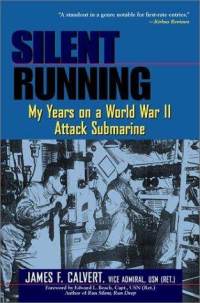
This is my favorite book on the Silent Service during the war because it provides a view from the deck plates, or in this case, from inside the pressure hull. Silent Running opens with the renowned submariner Ned Beach's renowned screed against early war U.S. torpedoes, and then Calvert recounts his nine war patrols in the Pacific against the Japanese. World War II certainly included more renowned and controversial submariners than Calvert, but his understated style and clarity of expression landed his book on my list.
Winner of many prestigious awards, Dower argues that the Pacific War was essentially a race war between the Americans and Japanese, with each race believing itself superior to the other. On both sides the results included poor estimates of the enemy's capabilities, other military miscalculations, and a much higher level of brutality than Americans faced in Northwest Europe. War Without Mercy yields vital insights into what can happen when two different cultures clash; when each side uses a different rulebook for warfare.

Daws, Gavan. Prisoners of the Japanese: POWs of World War II in the Pacific. William Morrow, 1994.


Daws dwells on one particular product of the Pacific War culture clash -- the brutal Japanese treatment of POWs. The book is, in many ways, a collection of horror stories, including the fact that Japanese "physicians" performed vivisection -- dissection of a living being without anesthetic -- vivisection, on members of downed B-29 aircrews. I still shudder to think of it. The warning implicit in Prisoners of the Japanese, like that in War Without Mercy, is that different cultures have different rules of warfare than we do and will not behave as we do in fighting wars.
Naval officers and enlisted men and women do lots more than fight, including, among other things, conducting humanitarian operations, performing rescues at sea, and exploring space. With exclusive access to private papers and interviews with his subject's family and closest friends, Thompson examines the life of one of the first men to fly off aircraft carriers, one of the world's most fearless test pilots, and one of the Navy's iciest, brashest, cockiest and most competitive officers, beating out John Glenn for the first Mercury spaceflight and then later, as a crew member of Apollo 14, whacking a golf ball on the moon. I recommend this one because the Navy still needs test pilots, and Thompson is a brilliant writer.
In this book Reardon, one of America's finest military historians, recounts the history of Medium Attack Squadron 75 from multiple perspectives (the cockpit, the bomb handler, the wives left behind), and sets it within multiple layers of context. The Journal of Military History described it as "a model unit history." So here we have a group biography.
Honestly, I'm not including this to stroke my ego, but I consider this book, along with its predecessor, Breaking the Color Barrier, to be my masterpieces. Using a deep dive into the documentary records along with scores of interviews with largely black midshipmen, I've examined how the Naval Academy was transformed from a racist institution into one that genuinely ranks diversity among its fundamental tenets. The documentary research lays out the Naval Academy's racial policies, how they changed over time, and why. The interviews provide the impact these policies had on the experiences of black midshipmen, told through their own words. The third part of the book includes information on integration of women into the Academy, because many of those women are black. Naval officers and enlisted men and women should read Blue & Gold and Black because it explains the price minority and female shipmates will have to pay as long as parents teach prejudice to their children.
During his 22-year career as a CIA Intelligence Officer, Scheuer served as chief of the Bin Laden Issue Section from 1996 to 1999 and as special advisor to the chief of the bin Laden unit from September 2001 to November 2004. He began this book in 1999 as an unclassified manual for counterterrorism officers. Initially, Potomac Books listed the author as "Anonymous," but with the publication of his follow-on book, Imperial Hubris, his name came to light. As for Through Our Enemies' Eyes, "The crux of my argument," declares Scheuer, "is simply that America is in a war with militant Islamists that it cannot avoid; one that it cannot talk or appease its way out of; one in which our irreconcilable Islamist foes will have to be killed, an act which unavoidably will lead to innocent deaths; and one that is motivated in large measure by the impact of U.S. foreign policies in the Islamic world, one of which is unqualified U.S. support for Israel." It is a harrowing argument, but one that must be understood by all who are serving in the global war on terrorism, the current war, the war we are now in, or whatever we're calling it now.
(A big thanks to Dr. Schneller for sharing his thoughts and recommendations... Look for more thinkers’ suggestions in the weeks and months ahead. -- BD)

Sunday, January 1, 2012

1812: The Navy’s War


by Bill Doughty
We don’t know what we don’t know, and ignorance of history condemns us to repeat past mistakes.
That could explain why the bicentennial of the War of 1812 -- which has lots of lessons from the past, of the present, and for the future -- is so important to the Navy.
It was:
  • Our second war for independence;
    • A war with Great Britain and Canada, now among our strongest allies; and
    • A rebirth for the U.S. Navy, inspiring the Star Spangled Banner.
    Author George C. Daughan gives a Navy-oriented history lesson in his 2011 overview, 1812: The Navy’s War.  A reading of the history of the War of 1812 teaches why this conflict was so important to the nation’s development, especially as a world economic power.
    We see familiar themes and how they apply today in chapters like “Free Trade and Sailors’ Rights,” “Jefferson’s Embargo and the Slide to War,” and “From Temporary Amistice to Lasting Peace: The Importance of the War.”
    The book reveals how the Navy committed to being a blue water, forward-deployed and ready force for a nation that was less than 40 years old, just 25 years since the Constitutional Convention of 1787, and a mere five years after two big milestones: Robert Fulton development of the first practical steamboat and the British Parliament’s declaration that it was illegal to buy, sell and transport slaves.
    Daughan shows that the strength of the Navy -- demonstrated at Lake Erie, Plattsburgh Bay, Baltimore and New Orleans -- proved to the British that their former colonies made a formidable partner.  The collaboration and cooperation earned on the seas and in the littorals in 1812 would prove invaluable in the next century in two world wars.
    Madison - Painting by Chet Jezierski 
    The book begins and ends with a discussion of economics and commerce.  President Madison was enthralled with the British Empire’s economic might but, like Thomas Jefferson, championed the more French ideals of human rights and equality.
    Daughan shows how Madison’s pragmatic approach with former enemies and strategic conduct of the War of 1812, “within the confines of the Constitution,” contributed to lasting military and diplomatic success.  “In conducting himself in this manner, he immeasurably strengthened the democratic forces that had been building in America since the start of the Revolution and that had accelerated under Jefferson.”
    1812: The Navy’s War inspires the reader to think about the rise of nationalism, the effects of the Industrial Revolution, and everything else that was happening in the world during that pivotal time, including and how it might affect history in generations to come:
    • 1812 - Napoleon led his Grand Army from France, Germany and Poland into Russia (read Tolsoy’s War and Peace), which had just finished fighting the Russo-Finnish War and was already fighting the Russo-Turkish and Russo-Persian Wars; 
    • From 1808 to 1813 - Napoleonic Peninsular War in Spain and Portugal;
    • From 1811 to 1818 - the Egyptian war with Wahhabis, with Egyptian forces retaking Mecca from the Wahhabis in 1813;
    • From 1811 to 1825 - Latin-American wars of independence;
    • 1812 - Russian establishment of Fort Ross outpost near Bodea Bay in Northern California, Fort Ross. (The Russians tried to lay claim to Alaska in the previous century and established three forts on Kauai, Hawaii beginning in 1817.)
    • From 1804 to 1813 - Serbian Insurrection (with WWI implications); and 
    • 1812 - Siamese invasion of Cambodia.
    Connecting all of those nations, directly or indirectly: the world's oceans and a still-developing world economy.  The slogan for the bicentennial is  "America's Navy... Keeping the sea free for more than 200 years."  The Navy has a 200-years-ago-today timeline on its 1812 bicentennial site as well as an interactive map, historic paintings, classroom curricula, and a list of events, starting with the Navy's kickoff event in April 2012 in Washington, D.C.

    Last year we reviewed books tied to the Centennial of Naval Aviation.  This year we look forward to exploring the significance of the bicentennial of the War of 1812 and how it shaped the Navy, the United States and the world.


    The USS Constitution had a special role to play in 1812, as did its skipper.
    According to history.navy.mil: "Captain Hull's time on Constitution was eventful. He took the ship on a European cruise in 1811-12, returning home before the War of 1812 broke out between the United States and Great Britain. An enemy squadron closely pursued his ship off the East Coast in July, but Hull skillfully evaded them. On 19 August 1812, Constitution encountered the British frigate Guerriere at sea and pounded her to a wreck in an action that electrified the Nation and demonstrated that the small U.S. Navy was a worthy and dangerous opponent for Britain's otherwise overwhelming maritime might."

    Monday, December 26, 2011

    Heinlein, Haldeman, ERB & Mars

    by Bill Doughty
    Robert A. Heinlein, whose Starship Troopers is a surprising fiction title on the mostly nonfiction Navy Professional Reading Program list, owes much to Mary Shelley, Jules Verne, H.G. Wells and Edgar Rice Burroughs (ERB).  But, unlike most of the fantasy and science fiction that preceded him, Heinlein’s literary fiction opened doors to a future history through human eyes, concentrating more on the heart and hands heading to Mars than on the tools those hands operated.
    If former Lt. Cmdr. Heinlein represented the WWII and Korean War period SF of his generation, then Joe Haldeman is a Vietnam-era and Post-Vietnam counterpoint starting in the early-mid 70s, especially with his masterpiece The Forever War.  Both writers established powerful characters of both genders and moved away from earlier genre fantasy and SF that tended to objectify women or stereotype people of other backgrounds or cultures.
    Sir Ridley Scott
    Haldeman, praised by Heinlein and vice versa, served as a combat engineer in Vietnam, where he was awarded the Purple Heart.  His combat experience shapes his writing and gives credibility to his military SF.  The Forever War concepts show up in the films Avatar  and Aliens. It will be fascinating to see how Ridley Scott brings Haldeman to the big screen if/when it happens. Scott, who created Blade Runner, Alien and now Prometheus, has the rights to make The Forever War.

    Haldeman’s skill in writing about war, space and time led Stephen King to endorse him: “If there was a Fort Knox for the science fiction writers who really matter, we’d have to lock Haldeman up there.”
    Haldeman’s latest work is a trilogy beginning with 2008’s Marsbound, which shows a Heinlein-like commitment to characters and heart but with a warped look into what can happen after first contact with a “Martian” race and “Others.”  Interestingly, Haldeman writes in the first person as a female protagonist.
    Marsbound gives a distinct nod to Edgar Rice Burroughs, author of the Barsoom series -- A Princess of Mars, The Gods of Mars, John Carter of Mars, etc.  The spaceship that carries characters to and from Mars is named the John Carter.  The aliens are red, green and yellow, like the characters created by ERB, but unlike ERB’s swashbuckling swordplay, Haldeman employs psychology, sex and Sun-Tzu.
    Mars, named after the Roman god of war, has long been a destination for science fiction writers.
    Giovanni Schiaparelli, Italian scientist, discovered what he thought were continents, seas and “channels” on Mars. American astronomer Percival Lowell hypothesized that the channels, interpreted as “canals,” showed signs of water and vegetation.  His views were part of a worldwide meme imagining life on Mars.
    In the final years of the 19th Century, H.G. Wells captivated human imagination with the The Crystal Egg and War of the Worlds, where Martians who had depleted the resources on their planet came as predators to stake their claim on Earth.
    Discoveries and conjecture about Mars inspired the young Edgar Rice Burroughs, who was educated at Michigan Military Academy and then served in the Army with the 7th U.S. Cavalry before devoting most of the rest of his life to writing.
    Like Heinlein, ERB and Haldeman, Arthur C. Clarke, Ray Bradbury, Lester del Rey, Philip José Farmer, Philip K. Dick and Frederik Pohl all had great works revolving around the red planet.
    Heinlein created a mindbending look at Mars and spirituality with his Stranger in a Strange Land.  In The Number of the Beast Heinlein pays tribute to ERB with characters named Zebedia John Carter and Jacob Burroughs traveling to Barsoom and Oz.
    As we’ve seen in earlier posts, ERB as a staple reading choice of Sailors who fought in World War II.  Pearl Harbor Survivors enjoyed SF, westerns and other adventure books.  Like the Greatest Generation service members who inspire Sailors today, Golden Age SF writers and imagineers like Haldeman inspire the writers and filmmakers of today.

    Sunday, December 11, 2011

    What Pearl Harbor Survivors Read

    by Bill Doughty
    What did Pearl Harbor Survivors read before and after Dec. 7, 1941?
    Clark J. Simmons
    Clark J. Simmons of USS Utah told me last week, immediately after the 70th Commemoration of Pearl Harbor Day, “My mother was a librarian.  We did quite a bit of reading.  She inundated us with books.  I had three sisters and all of us were readers.  I would read anything I could get my hands on.”
    Marshall LaFavor, son of Chief Warrant Officer Machinist Franklyn LeFavor, grew up in a Navy family.  “One of the first things we did when we went to a new base was check in at the library and get our library cards,” Marshall said.  “My dad was a big Zane Grey fan.  Being at sea for so long he said he wanted to read something with sand in his boots.”  LeFavor also enjoyed reading C. S. Forester’s Horatio Hornblower books, and after the war he read Day of Infamy.
    Ray Emory of USS Honolulu told me earlier in the year, on his way to a Sacred Tea Ceremony aboard USS Arizona Memorial, that he only had time for his ship’s manual during the war.  He distinctly remembered its oil-stained and sea-sprayed pages and mentioned losing it during action in the western Pacific.  Today, Emory helps write the books of what happened at Pearl Harbor; he is a champion of the unidentified casualties of WWII.
    Delton "Wally" Walling
    Delton “Wally” Walling, who happened to be with Watchstanders in the Shipyard water tower during the attack, even though he wasn’t on duty, also read only the manuals he needed be an effective signalman during the war.  “We were young kids coming in.  We had nothing, no supplies, no libraries,” he told me.  “After the war I wanted to try to forget.”
    George Bennett, National Secretary of the Pearl Harbor Survivors Association, which is to disband at the end of this month, said he enjoyed reading books of short stories and, after the war, about the history of what went on behind the scenes leading up to and during WWII -- especially about intelligence and cryptanalysts and code breakers who did so much to help Nimitz and Spruance win at the Battle of Midway and across the Pacific throughout the war.
    WIlliam F. Howell of USS Phoenix, was a fan of Adm. Halsey during and after the war.  “Read Sea of Thunder,” he told me.  “Read about Halsey.”
    Simmons, whose librarian mother instilled a love for reading, said, “I recommend history books -- all history.  And don’t forget to study math and science!

    Sunday, November 27, 2011

    If Carrots and Sticks Don’t Work, What Does?

    (Special thanks to shipmate Nancy Harrity for this guest review of two books that explore what science reveals about human nature and how those lessons can be applied by Navy leaders to motivate their teams.) 
    By Nancy Harrity
    With budgets decreasing and demands on our teams increasing, the best leaders are looking at what they can do differently to motivate their teams and improve morale. 
    Author Daniel H. Pink looks into if what we know about motivation is true in Drive: The Surprising Truth About What Motivates Us.  He finds there is a gap between what science knows about what works and how leaders actually motivate people. 
    Most Navy leaders have been taught some variation of reward what you want more of and punish what you want less of – an extrinsic, or outside of oneself, model.  According to Pink, this approach is all wrong because it doesn’t account for how we organize what we do, how we think about what we do nor how we actually do what we do.  Pink explains that carrots and sticks don’t work because they extinguish intrinsic motivation, diminish performance, crush creativity, crowd out good behavior, encourage cheating, shortcuts and unethical behavior, become addictive and foster short-term thinking – all things that helped to create many of the issues we face today.  So what has science learned that can help us effectively motivate our teams?
    Master Chief Petty Officer of the Navy  Rick D. West, left, congratulates Basic
    Underwater Demolition/SEAL Class 290 upon their completion of Hell Week, Aug. 5, 2001.
    Pink discusses how scientific studies have uncovered that motivation must come from within and has three essential elements – autonomy, mastery and purpose.  Autonomy means focusing on results and allowing your team members to work on their own terms as much as possible.  To foster mastery of the work at hand, leaders need to match what their teams must do with what their team members can do and like to do as much as possible, as well as allowing the activities to be their own reward.  To foster purpose, leaders must allow their team members to find a way to do what is meaningful to each of them.  Leaders also need to answer the question of why the work is being done and how it fits into the bigger picture.
    Lastly, Pink notes that constant rewards can transform interesting tasks into drudgery and play into work.  He advises his readers to shift from “if you do this, then you’ll get that” type of rewards in favor of the occasional “now that you’ve accomplished this,” type rewards.  He also advises considering the use of non-tangible rewards such as praise and feedback.
    In The 5 Languages of Appreciation in the Workplace by Gary Chapman and Paul White provide leaders with some concrete suggestions on how to use non-tangible rewards in the workplace. Many Sailors may recognize the five languages from Chapman’s The 5 Languages of Love from Fleet and Family Service Center homecoming briefs. 
    The concept is a simple evolution of the basic communication model.  As with the five love languages, everyone has a way or language that he likes to receive appreciation in.  Message of appreciation (and of love, and in general for that matter) are best received when they are sent in the language valued most by the recipient, not the language most valued by the sender.  Chapman and White point out that many supervisors miss the mark when they try to show appreciation to their team members because they express their appreciation in the language they, as the senders respond best to, not the language the intended recipient responds best to.
    The five languages are:
    • Words of Affirmation – using words to convey a positive message to the person you wish to show appreciation to, the classic “atta boy.”  When using words of affirmation, take care to keep in mind that the recipient may prefer private, one-on-one recognition over a public awards ceremony, or a written note over the spoken word.  Words of affirmation are most effective when they are specific and speak to the individual’s character or his personality.
    • Quality Time – giving the person you wish to appreciate your undivided attention for a period of time.  Quality time can take many forms from working closely together on a project, to small group dialogue, to quality conversation or even shared experiences.
    • Acts of Service – helping the person you wish to show appreciation to do what he does the way he does it.  When offering acts of service, volunteer, ask before you help, do whatever it is the way the recipient would, finish what you start and most importantly, check your attitude.
    • Tangible Gifts – giving a gift the person you wish to show appreciation to.  When giving tangible gifts, give the recipient a gift that he values – it could be time off, a small token or an experience.  
    • Physical Touch – giving the person you wish to show appreciation an appropriate, affirming, non-sexual touch.  Tread carefully when using physical touch as not everyone wants to be touched.
    Commander, Navy Region Hawaii Rear Adm. Frank Ponds, Joint Base Pearl Harbor-Hickam
    Commander Capt. Jeff James and Joint Base Command Master Chief CMDCM(SS/AW)
     Gregg Weber serve military families at JBPHH on Thanksgiving, Nov 24, 2011.
    As you prepare for the New Year, take some time, look into yourself and consider how you might use these approaches to make 2012 your team’s best year yet.
    -------------


    (Coming soon, a look at what Sailors were reading on Dec. 7, 1941.) 

    Friday, November 11, 2011

    Tribute to Veterans

    by Bill Doughty
    CNO Adm. Jonathan W. Greenert delivers Veterans Day remarks. 
    (U.S. Navy photo by MC2 Jacob Sippel)
    Veterans are being honored today from coast to coast and around the world.  Today, Chief of Naval Operations Adm. Jonathan W. Greenert delivered remarks at Madison Square Park during the New York City Veterans Day parade opening ceremony.  This year the Navy is the parade’s featured service.
    In San Diego, the Navy hosted a history-making sports event aboard a historic aircraft carrier.  More about that in a moment.
    Last year Navy Reads reflected on Veterans Day and Sailors who transited both the Atlantic and Pacific.  The context was Tom Ashbrook’s On Point radio interview with Commander, U.S. Pacific Command Adm. Willard and Simon Winchester, author of Atlantic. We also discussed a special radio interview with veterans, including a conversation with former Command Master Chief Jim Taylor, Pearl Harbor Survivor Liaison for Commander, Navy Region Hawaii.
    Since then we’ve featured other posts of interest to veterans.
    In “Faith, Fear and Tom Hanks” I reprinted some of Hanks’s remarks at a commencement address at Yale, including his challenge to the college graduates about veterans, especially wounded warriors, returning from Iraq, Afghanistan and other deployments.  His words are worth reposting today:
    "Whatever your opinion of the wars, you can imprint the very next pages of the history of our troubled world by reinforcing faith in those returning veterans," Hanks told the seniors. "Allowing them rest, aiding in their recovery ... empathizing with the new journey they are starting even though we will never fully understand the journey they just completed, even though we will never understand what they endured. We will all define the true nature of our American identity not by the parades and the welcome-home parties, but how we match their service with service of our own."
    Over the past year I reviewed Army veteran Wes Moore’s remarkable book, The Other Wes Moore.  Moore talked about the key that unlocked his passion for education, his mother’s encouragement to read Mitch Albom’s Fab Five, a book about the Michigan University college basketball team.  Moore writes: 
    I was riveted by that book.  The characters jumped off the page, and I felt myself as engulfed in their destiny as I was in my own.  I finished Fab Five in two days.  The book itself wasn’t what was important -- in retrospect, I see that it was a great read but hardly a work of great literature -- but my mother used it as a hook into a deeper lesson: that the written word isn’t necessarily a chore but can be a window into new worlds.
    Navy veteran Nancy Harrity guest-reviewed two windows into new worlds of strategic thinking, Seven Deadly Scenarios and Power Rules.  Always insightful and thought-provoking, Nancy has a new review on the way. Stay tuned.  
    In a review of Ganbare! I discussed the juxtaposition of achievements of the veterans and heroes like the 442nd Regimental Combat Team with what happened to some of their families -- the WWII interment of Americans of Japanese ancestry.
    Guest reviewer Theresa Donnelly reviewed Use Your Head to Get Your Foot in the Door, a book that can help new veterans who face challenges after leaving the service.  Theresa wrote, “This is why it is important to have a robust plan in place for your post-military transition.”
    Since last November we wrote other posts with with a focus on veterans: a review of USS Arizona’s Last Band, Culturnomics (Honor/Courage/Commitment) and Revolt of the Admirals in the Centennial of Naval Aviation, with some interesting history and perspective on Congressman Carl Vinson and his vision of a two-ocean Navy.  Revolt ties in nicely, by the way, with the latest post on Courageous Followership and an interview with author Ira Chaleff.
    The Navy Reads blogpost on the late Navy veteran “Amazing Grace” Hopper and her 2011 milestones was reposted on a number of other blogs, including GHC Bloggers in conjunction with the Grace Hopper Celebration of Women in Computing going on now (Nov. 9-12) in Portland, Oregon.
    Rear Adm. Grace Hopper’s namesake, USS Hopper (DDG 70), recently transited the waters of the Battle of Leyte Gulf and observed a moment of silence exactly 67 years to the day of that historic battle. You can read about the veterans of WWII who fought in “the U.S. Navy’s Finest Hour” in Leyte and off Samar, Philippines in James D. Hornfischer’s Tin Can Sailors.
    This Veterans Day, 2011, in addition to tributes and commemoration ceremonies around the world, the Navy is hosting a season-opening college basketball game aboard USS Carl Vinson (CVN 70) in San Diego.  The Commander in Chief and First Lady attended the Quicken Loans Carrier Classic featuring the University of North Carolina and Michigan State University.  That’s a pretty cool, all-American thing to do for and with our veterans.  The game is going on now as I post this.  
    The University of North Carolina team practices aboard USS Carl Vinson. (U.S. Navy photo by MC2 James R. Evans)
    Check out how USS Carl Vinson was transformed, and see ESPN’s “a look at life on USS Carl Vinson.”  ESPN also featured a Veterans Day profile of J. P. Bolwahnn, a 34-year-old former Navy SEAL, who plays football at the University of San Diego as a walk-on.