Showing posts sorted by date for query inouye. Sort by relevance Show all posts

Thursday, June 5, 2025

Ho’oponopono – Remembering Judge King

Review by Bill Doughty

He’s been gone for 15 years, but the remarkable legacy of Federal Judge Samuel P. King, a Navy veteran and Republican icon from Hawaii, lives on.

And, considering the chaos of today, his philosopher’s voice needs to be heard for its common sense, clarity, and relevance.


King was born in China in 2016 to a U.S. Naval officer father (who later became governor of Hawaii). His dad captained USS Samar (PG-41) as a river pilot navigating on the Yangtze.


Sam, himself, joined the Navy as an intelligence officer show spoke French and Japanese. He served during World War II, including aboard the minelayer USS Adams (DM-27).


King was one of the first Americans to visit and see the destruction of Hiroshima in 1945.


His autobiography, “Judge Sam King: A Memoir” (Watermark 2013), published posthumously, was written with the help of newspaper reporters Jerry Burris and Ken Kobayashi.


The book’s foreword is penned by another WWII veteran, Hawaii’s late Senator Daniel K. Inouye, who commends King for helping to navigate Hawaii from territory to statehood.
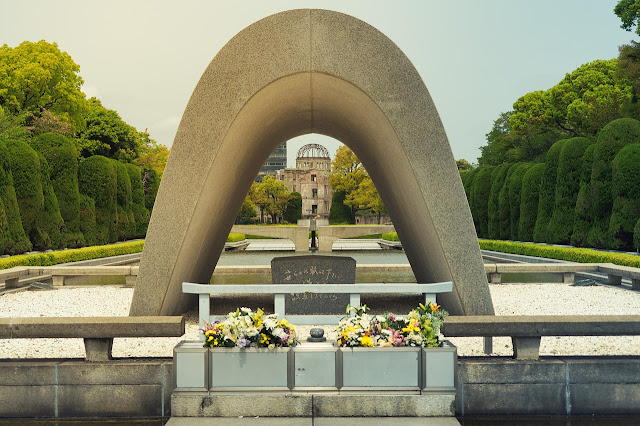

Hiroshima Memorial
One of the highlights in “Memoir” is in an appendix with King’s keynote address to the Japan-Hawaii Lawyers’ Association in Hiroshima, Japan, in April 1985, a speech given 40 years ago –– and delivered 40 years after WWII ended. Speaking to fellow lawyers, he said, in part:

“That August 1945 explosion over this city was a terrible event in the history of mankind, and one which mankind must prevent from ever happening again. The attainment of world peace is the most important duty of our leaders, yet we all have a responsibility to exert our best efforts to the same end. Lest we lose our sense of urgency in this struggle, Hiroshima exists as a reminder that our goal has not been achieved until the chance of nuclear war has been rendered impossible.

“We lawyers and judges and law professors may not be able to guarantee peace in our world, but we can and do make substantial contributions to peace. After all, our training centers around dispute resolution. It is our function in society to identify the points of conflict between individuals, develop the facts, apply accepted principles and reach just conclusions.

Within a single country, our activities may well be limited to disputes and conflicts that relate to internal harmony. What we do at home in handling divorce cases, breach of contract suits, civil rights actions, etcetera has little bearing on world peace. But when we cross over our national boundaries and concern ourselves with disputes and conflicts that arise between persons in different countries, we build bonds of understanding and friendship that ease the way to dispute resolution in international transactions.

I do not mean to claim too much for this modest beginning. We are not here to fashion solutions to disputes between nations. I do maintain that in relations between peoples of different countries, every increase in understanding, and every expansion of friendship, and every consensus on a procedure for resolving disputes, makes international harmony— and therefore world peace-more likely.”

Another appendix is King’s remarks in 1969 to the Pearl Harbor Commissioned Officers’ Mess for Law Day USA. Titled, “Justice and Equality Depend Upon Law –– and YOU,” King spoke about each individual’s responsibility to embrace the rule of law, including accepting personal accountability.

“Our system of criminal justice depends very largely upon the acquiescence and even support of those charged with crimes,” he said.


In the same remarks to those naval officers, delivered during the height of the Vietnam War, King spoke of the importance of mutual understanding and love in the pursuit of justice:


“If we love one another, justice becomes a byproduct of our humanity. Where there is unrestricted freedom, there is unleashed equality.” And he said, “A little mutual respect will go a long way toward bridging the apparent chasm in understanding.”


King’s father, Samuel Wilder King, entered politics as a Republican member of the Honolulu Board of Supervisors, and was later elected as a Hawaii Territory delegate to U.S. Congress. As a libertarian, the elder King strongly opposed the military’s imposition of martial law on civilians in the aftermath of the infamous Massie case (see previous related Navy Reads post from 2019).


“Partly in response to the Massie case, my father was a very strong champion for statehood and introduced a bill for statehood in 1935.” He would go on to write a draft constitution for Hawaii and serve as chairman of the Statehood Commission.

“Dad served three terms in Congress but withdrew right after Pearl Harbor to return to the Navy as a commander, and later became captain. My father's second round of Navy service took him to Saipan, American Samoa and eventually aboard a ship assigned to Japan to repatriate American prisoners of war. After the war, he returned to Hawaii, where he busied himself with politics and the pursuit of statehood.

Dad felt strongly about the need for statehood. He was one-eighth Hawaiian and very proud of it. He resented that we were only a territory and had no political representation, whereas all the states had two senators and more power to control their own destinies. Congress could do anything it pleased to a territory –– declare martial law, for instance –– and it wouldn't have any say in the matter. He had a very low opinion of most of the congressmen, especially the ones from the South. Back in those days, you got off the airplane in Atlanta and everywhere you looked, it said whites only, blacks only.

He didn't want people who came from that mentality making decisions for Hawaii.

After the war, he returned to Hawaii where he busied himself with politics and the pursuit of statehood.”

Samuel Wilder King went on to become governor of the territory before retiring from public service. He passed away in 1959 just two weeks after Hawaii became the 50th state.


After his own service in the Navy, younger King honored his father’s long career of service by becoming a judge. His proudest achievement, he said, was creating Hawaii’s family court. He conducted thousands of marriages and signed many divorce decrees, including the divorce papers for the parents of President Barack Obama.


He believed in accountability, integrity, and truth and was strongly in favor of “justice tempered with mercy.” His watchwords were “aloha,” “pono” (respect), and “ho’oponopono” ("doing something the right way, the just way").

As a Federal Judge, he oversaw cases involving organized crime, including tax evasion, murder (including the Palmyra Murders Case), treason, and other criminal issues.


He also championed environmental issues, abortion rights, nuclear disarmament, and anti Death Penalty initiatives. He believed strongly in defending the Constitution, especially the First Amendment. For example, he sided with the media after Mayor Frank Fast banned some reporters from news conferences, calling Fast’s act “unconstitutional.”


Understandably, folks wondered whether Sam King was really a Republican, and King admitted he was “not like the right-wing conservatives we have today.” He said, “I’m a strong believer in the ‘three party’ system: Republicans, Democrats, and Incumbents. And the Incumbents almost always win.”


King is author with Randall Roth of “Broken Trust: Greed, Mismanagement & Political Manipulation at America’s Largest Charitable Trust,” published in 2006, a landmark book in Hawaii credited with cleaning up corruption by the rich and powerful –– ensuring accountability and ho'oponopono.

Monday, December 6, 2021

Stavridis’s 50: ‘The Sailor’s Bookshelf’

Review by Bill Doughty––

The FedEx van pulled up in front of my home as I backed into my driveway. It’s a special feeling when a wished-for book arrives. I carefully sliced through the padded mailer and there it was: “The Sailor’s Bookshelf: Fifty Books to Know the Sea” by Admiral James Stavridis, arriving just days before Pearl Harbor Remembrance Day. This year’s commemoration comes on the 80th anniversary of the attack on Oahu of Dec. 7, 1941.


Stavridis gives a very personal reflection of some of the favorite books on his bookshelf, and some relate to Pearl Harbor, Hawaii, and the Pacific, which he calls “the mother of all oceans.” Others center on Europe and his favorite ocean, the Atlantic. Still others offer a diverse window into the art of reading, the lure of history –– and the terrible yet tempting beauty of the sea.


Some of the books in his collection go back to Stavridis's childhood. Many were influential in his choosing to apply to the U.S. Naval Academy or were part of his life throughout his distinguished careers both in and after the Navy.


Retired Adm. James Stavridis, former supreme allied commander, Europe, gives the keynote speech during the Armed Forces Communication and Electronics Association-U.S. Naval Institute (AFCEA/USNI) West 2016 conference. (MC2 Liam Kennedy)

His midshipman cruise in 1972 was to Pearl Harbor.

So was his first cruise as an ensign and anti-submarine warfare officer aboard USS Hewitt (DD-996), in which Stavridis sailed first to Hawaii and then westward across the Pacific in some of the same waters once explored by Capt. James Cook. 


Cook’s voyages come to life in one of Stavridis’s recommendations, “Blue Latitudes: Boldly Going Where Captain Cook Has Gone Before.” The book follows Cook’s “three epic cruises in the mid-1700s” when only about a third of the world globe was known and mapped for navigation.


The flag flies at half mast while Marines of 3rd Marine Regiment "man the rails" of the USS Arizona Memorial in 2011. (Maj. Alan Crouch)

In the Explorers section of his book, Stavridis also features James P. Delgado’s “Across the Top of the World: The Quest for the Northwest Passage.” Delgado is a maritime archeologist and veteran diver who has explored hundreds of shipwrecks, including USS Arizona (BB-39) and USS Nevada (BB-36), both hit in the attack on Pearl Harbor. Delgado goes far, far north to present a history and heritage of exploration of the Arctic region. Sir John Franklin’s perilous journey in 1845 is at the heart of the story.

Rear Adm. Fiske (NHHC)
Another intrepid explorer of a sort is a “consummate seaman” and commander who invented technology in the late 1800s and turn of the century to help sailors on steam vessels and promote sea control and sea power. Admiral Bradley A. Fiske is author of “The Navy as a Fighting Machine.” Like Alfred Thayer Mahan, who is also featured in this collection, Fiske lobbied for and helped establish the position of Chief of Naval Operations. 

He was a champion for readiness as “a persuasive and thoughtful operational maritime thinker and writer.”


Exactly one hundred years ago, Fiske was president of USNI.


Stavridis writes:

“He was also a prescient strategic analyst. He served as president of the U.S. Naval Institute, the intellectual heart of the naval profession, for eleven years, 1912-1923, thinking, writing, and publishing constantly. As late as 1924 he was commenting on international affairs, correctly predicting the inevitability of a U.S.-Japanese war. He lived to see that dire proclamation come to pass with the 1941 attack on Pearl Harbor in his eighty-seventh year but sadly not quite long enough to see the pivotal battle of Midway in the early summer of 1942 turn the tide in the Pacific.”

Speaking of heroes and Pearl Harbor, Stavridis features a book in the “Oceans” section co-authored by Adm. Chester W. Nimitz, along with Professor E.B. Potter, titled “Sea Power: A Naval History.” Nimitz, of course, commanded the Pacific Fleet from Pearl Harbor and led the effort to defeat Imperial Japan in less than four years. In this classic 932-page book, first published in 1960, Potter and Nimitz provide a history of the American and world navies and how naval warfare has evolved to become a fundamental part of national power.


Stavridis, who was a student of Potter’s at the Naval Academy, wrote his own book with the same name but “different in tone and style” and in homage to his former professor. Adm. Stavridis’s “Sea Power: The History and Geopolitics of the World’s Oceans” is one of many of his works I’ve featured on Navy Reads over the past decade. 


Stavridis acknowledges he could have chosen to showcase many other books about the War in the Pacific in addition to the Potter-Nimitz “Sea Power.” He considered Samuel Eliot Morison’s multi-volume “History of Naval Operations in World War II” and Craig L. Symonds’s single-volume “World War II at Sea: A Global History."


Lt. Cmdr. Ernest E. Evans, at commissioning ceremonies of USS Johnston (DD-557), Seattle, WA, 27 October 1943. He was Johnston's commanding officer from then until she was sunk in the Battle off Samar, 25 October 1944, and was lost with the ship. (U.S. Naval History and Heritage Command)


The “cornerstone book about the naval war in the Pacific during World War II” he chooses, however, is the captivating “Sea of Thunder: Four Commanders and the Last Great Naval Campaign, 1941-1945.” The book centers on the Battle of Leyte Gulf in October 1944 and, as the subtitle says, four commanders:

“Admiral William ‘Bull’ Halsey, a swaggering (and deeply racist) commander of the American fleet for much of the combat; the elegant Japanese admiral Takeo Kurita, a battleship force commander who launched a near-suicidal attack on the American forces poised to retake the Philippine Islands; another Japanese admiral, Matome Ugaki, who saw himself as the purest of samurai and led the kamikaze forces at the end of the war; and –– the most appealing of the four –– the relatively junior Navy commander Ernest Evans, captain of USS Johnston (DD-557), a small destroyer that undertook a deeply heroic attack on a far larger Japanese force … In the course of telling the story of the battle, Thomas takes the reader through the vast U.S. maritime strategy to reconquer to Pacific Ocean and its hundreds of atolls, islands, barrier reefs, and littoral nations after the Japanese offensive wave of conquest had swept over much of it in the early days of the war” [in the aftermath of Pearl Harbor]

Pearl Harbor is just one of the many themes touched on in this wonderful collection that also includes diverse works by Rachel L. Carson, Simon Winchester, Thomas J. Cutler, Caroline Alexander, Nathan Philbrick, Herman Wouk, Patrick O’Brian, Sebastian Junger, and Joan Druett.


Throughout the collection, Stavridis shares personal joys and discoveries through reading. He expresses his deep love for the sea, starting in childhood. “What fascinated me then, and still does so many decades later, was the unpredictability of the ocean. It could change color, smell, wave pattern, surface condition, and a dozen other variables in an hour. It was a chameleon…”


The admiral’s curiosity also drives unpredictability in his selection of books in this collection, which features a book of poetry (“Moods of the Sea: Masterworks of Sea Poetry” by George C. Solley and Eric Steinbaugh), a book about art (“Turner & the Sea” by Christine Riding and Richard Johns, about artist J. M. W. Turner, who painted "The Battle of Trafalgar" and "The Fighting termeraire tugged to her last Berth to be broken up," pictured above), and a book of magical fiction (“Life of Pi” by Yann Martel), requiring the reader to suspend the constraints of science.

“I have always loved magical realism in the world of literature. This is a strain of fiction writing in which things exist in a novel or short story (or even a poem) that cannot quite be squared with the real world. The most famous writer of magical realism, who is especially prominent in the literature of Latin America, is the Nobel Prize-winner Gabriel García Márquez. His extraordinary novel “One Hundred Years of Solitude” is widely regarded as the classic example of magical realism. Some other authors who deal in this style of writing include Toni Morrison (“Beloved”), Salman Rushdie (“Midnight’s Children”), Haruki Murakami (“IQ84”), Günter Grass (“The Tin Drum”), and Neil Gaiman (“The Ocean at the End of the Lane”). In such novels there are often ghostly visitations, dreamlike sequences, mythological gods, talking animals, imagined events, and unreliable narrators.”

Stavridis is a most-reliable narrator and navigator as he takes us on his voyage to “The Sailor’s Bookshelf” and a journey of self discovery. “I’ve always believed that reading allows an individual to essentially expand their life every time they open a book,” he writes in the book’s preface.


U.S. Navy Airman Benjamin Adams, from Panama City, Fla., reads a book on the fantail of the aircraft carrier USS Nimitz (CVN 68), July 5, 2017, in the South China Sea. Nimitz was on deployment in the U.S. 7th Fleet area of operations. The U.S. Navy has patrolled the Indo-Asia Pacific routinely for more than 70 years promoting regional peace and security. (MC3 Ian Kinkead)

While he provides ample inclusion of fiction titles, most of the selections in “The Sailor’s Bookshelf” are nonfiction and history. Based on his recommendation, I added this title to my to-read list: “Empires of the Sea: The Siege of Malta, the Battle of Lepanto, and the Contest for the Center of the World,” a book about the Battle of Lepanto, and a book that had special meaning to Stavridis when he was the Supreme Allied Commander of NATO.

“For a sailor to read ‘Empires of the Sea’ is to almost feel the ships under way and hear the sails snapping in the breeze. You can smell the gunpowder and hear the crack of cannons over the waves and wind. Crowley focuses on the geopolitics as backdrop, but the great strength of this book is a realistic focus on war at sea. It includes descriptions of the sea battles and sieges against the islands of Cyprus and Malta as well as the more or less constant activities of pirates. The centerpiece, of course, is Lepanto, and there is not a better description written. The entire book is truly an engrossing read, and one that keeps the reader’s sensibility under way with every page.”

The subtitle of “The Sailor’s Bookshelf” says “50 books,” but the author can’t help himself. Readers will find hundreds of titles of great books tucked inside “bonus” suggestions, lists, and notes as well as the fifty essays themselves.


                                                                                                                                         (PO2 Patrick Kelly)
Among the recommended reads are titles of books that were read by Pearl Harbor Survivors and other World War II veterans. I’ve had the honor to meet and interview many Pearl Harbor Survivors, most of whom are gone. Before and after and sometimes even during the war they read Jules Verne, Herman Melville, and Ernest Hemingway, all featured in this collection. Stavridis’s “The Sailor’s Bookshelf” is a labor of love.

It is dedicated “To my parents who taught me to love reading, To my teachers who taught me to love writing, To my shipmates who taught me to love the sea, and To my wife and daughters who taught me to love life.”


I will revisit this collection for a future Navy Reads “Bookshelf Part II.”


-----------------------------------------------------------------------


RIP Senator Robert J. Dole


American statesman Sen. Bob Dole of Kansas died yesterday, Dec. 5, 2021, after a long bout with lung cancer. Like another of his colleagues, late Sen. Daniel K. Inouye of Hawaii, Dole wanted to become a doctor prior to the attack on Oahu and the start of American involvement in World War II. And like Inouye, Dole joined the Army shortly after Pearl Harbor and was severely, nearly mortally, wounded but recovered and dedicated his life to continued public service.


Senator Bob Dole and President Gerald Ford, Oval Office, 1976. (Bob and Elizabeth Dole Archives, KU)

While in Congress, Dole helped bring about the Civil Rights Act, the Voting Rights Act, and the Americans with Disabilities Act. He helped save Social Security when it came under threat in 1983, and he was a lifelong strong supporter of national defense.


Dole, known for his dry-wit sense of humor, support for the Constitution, and general grace in defeat, was vice presidential running mate to Navy/WWII Veteran President Gerald Ford in the 1976 U.S. campaign; Dole became the Republican nominee for president in 1996. President Bill Clinton presented Dole with the Presidential Medal of Freedom in 1997 (pictured below).


Flags are flying at half-staff to honor both Dole and Pearl Harbor Remembrance Day on the 80th anniversary of the attack.

Saturday, November 13, 2021

A True Patriot and Statesman: Max Cleland

By Bill Doughty––

When Joseph Maxwell "Max" Cleland spoke at the 72nd Pearl Harbor Day commemoration ceremony, Dec. 7, 2013, with Pearl Harbor itself as a backdrop, he was nearly overcome with emotion. He saw the dozens of World War II veterans seated in the front rows of the audience, and he thought of his father. Cleland spoke without notes, from the heart, about the sacrifice of military service and the joy of homecomings.


Army CPT Max Cleland in Vietnam
Hugh Cleland, Max’s dad, joined the Navy after the attack on Oahu in 1941. In 1965, Max volunteered for the Army to serve in combat in Vietnam, where he earned the Silver Star and Bronze Star.

Cleland was severely wounded and nearly killed. Yet, he personified resilience to become head of the Veterans Administration and a U.S. Senator.

Cleland died earlier this week. He was a great statesman, military veteran, and advocate for veterans, especially those with lasting physical and mental wounds.


President Joe Biden issued a statement November 9 on Cleland’s passing:

Max Cleland was an American hero whose fearless service to our nation, and to the people of his beloved home state of Georgia, never wavered.

As a 25-year-old serving in the 1st Cavalry Division of the U.S. Army during the Vietnam War, Max lost both of his legs and his right arm in a grenade explosion at Khe Sanh. After grueling months in the hospital, enduring multiple surgeries and a long road back to recovery, Max turned his pain into purpose. He continued his distinguished public service, becoming a lifelong champion of the dignity and rights of working people and America’s wounded veterans. His leadership was the essential driving force behind the creation of the modern VA health system, where so many of his fellow heroes have found lifesaving support and renewed purpose of their own thanks in no small part to Max’s lasting impact... He was a man of unflinching patriotism, boundless courage, and rare character... He will be remembered as one of Georgia’s and America’s great leaders.”

I was fortunate to help plan the Navy’s Pearl Harbor Day commemoration ceremony in 2013 and to hear Max Cleland speak about honor, courage, and commitment –– as well as true family values and patriotism.


In 2013 I posted a Navy Reads review featuring Cleland’s autobiography, “Heart of a Patriot.”

Cleland, who chaired the armed services subcommittee on personnel in the Senate, was known for working closely with both Democratic and Republican colleagues.


Cleland reads about JFK.
From Navy Reads: “His colleagues, mentors and friends in the Senate included fellow combat veterans Chuck Hagel, Dan Inouye, John Kerry and ‘my Vietnam veteran brother’ John McCain. Cleland describes the pride of wearing his dad's WWII Navy peacoat as a U.S. Senator during a presidential inauguration.”


Prior to serving in the Navy for three years during WWII, Max Cleland’s father, Hugh, had served in the Civilian Conservation Corps, an environmental infrastructure program created by President Franklin D. Roosevelt during the Great Depression. FDR was an inspiration to a young Max Cleland. Cleland loved books and reading. He authored several books.


Like Biden, Secretary of Defense Lloyd Austin issued a statement about Senator Cleland’s passing; fittingly, Austin includes references to literature.


In part, SECDEF Austin says:

“The Department of Defense stands united in mourning the loss of Senator Max Cleland, an extraordinary public servant and a great patriot…He served his country and his community from a wheelchair, following in the gallant tradition of his hero President Franklin Roosevelt.”


SECDEF Austin notes that as head of the Veterans Administration, Cleland “fought fiercely for his fellow veterans, made PTSD an official VA diagnosis, and helped create the groundbreaking Vet Centers program. Later, after being elected a U.S. senator from Georgia, he continued his passionate focus on defense and veterans' issues, serving with distinction on the Senate Armed Services Committee and leading on such issues as health care, bioterrorism preparedness, and homeland security. He also served on the 9/11 Commission before being nominated for the board of the Export-Import Bank. His final act of public service was leading the American Battlefield Monuments Commission. When battle maps of Vietnam were added to the National Memorial Cemetery of the Pacific in Hawaii, he asked to add an inscription from the poet Archibald MacLeish: ‘We leave you our deaths: give them their meaning.’

With courage and grit, Senator Cleland struggled with PTSD and depression—seeking help through counseling, medication, and attendance at a recovery group. He said that he drew strength from being around his fellow veterans and wounded warriors, including those from Iraq and Afghanistan. As the head of the VA, he made psychological counseling available to his fellow veterans. And I hope that his example will encourage others carrying unseen wounds to seek out the help they need and deserve. 

Senator Cleland liked to quote Hemingway, who wrote, ‘The world breaks everyone and afterward many are strong at the broken places.’ He surely was. Max Cleland's civic-minded spirit, optimism, and resilience will stand as an inspiration to every American.”

Funeral services are planned for early next week.


Senator Max Cleland, RIP.


Vietnam War veteran Max Cleland, a triple amputee, holds a photograph of himself as a child with his father, Hugh, and mother, Juanita, at the National Memorial Cemetery of the Pacific at Punchbowl in 2013. (Jamm Aquino, Honolulu Star-Advertiser)


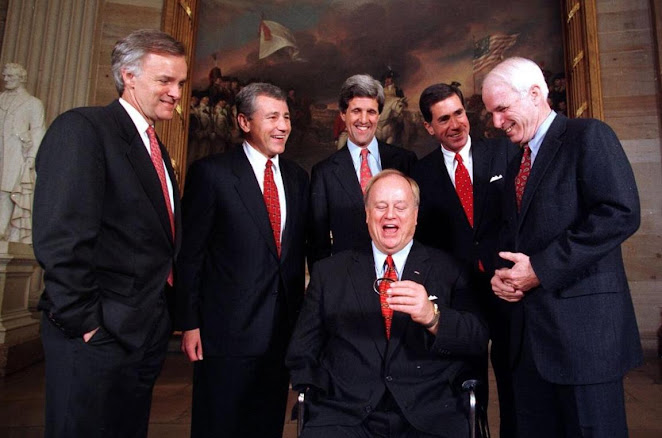
The Senate had six Vietnam combat veterans in January 1997. Sen. Max Cleland, D-Ga., is in the front. Behind him, from left: Bob Kerrey, D-Neb., Chuck Hagel, R-Neb., John Kerry, D-Mass., Chuck Robb, D-Va., and John McCain, R-Ariz. This photo was taken by The World-Herald during Senate orientation the previous month. (Kiley Cruse, The World-Herald)

Top photo: Secretary Max Cleland, American Battle Monuments Commission, delivers keynote remarks during the 72nd anniversary commemoration of the Dec. 7, 1941, attack on Oahu. This year’s commemoration theme, “Sound the Alarm,” examines how thousands of Americans answered the call to duty in the wake of the attack. More than 2,500 people attended the Pearl Harbor commemoration. (MC2 Nardel Gervacio)


Monday, September 13, 2021

‘It Got Me Thinking’ … More!


Review by Bill Doughty––

Hope Jahren quotes a bit of eye-opening graffiti at the very end of her latest book, “The Story of More: How We Got to Climate Change and Where to Go from Here” (Vintage Books, Penguin Random House; 2020).


Jahren –– gifted scientist, teacher, painter of words, and author of “Lab Girl” –– looks all around for inspiration, and she finds it in trees, fish, cornfields, slaughterhouses, sanitation systems, memories, history, prehistory, and, yes, graffiti. More about the graffiti in a moment.


Ford, Edison, and Firestone –– and trees.
In this beautiful, funny, but melancholy personal reflection on climate change, Jahren examines the survivability of our species and the choices we make. Can we help each other and the planet we share? She’s not sure. But Hope drives her points home: use less, share more.

“The Story of More” opens with a meeting between Thomas Edison, Henry Ford, and tire magnate Harvey Firestone. Edison said, as a brilliant insight, “The sun and solar energy. What a source of power! I hope we don’t have to wait until oil and coal run out before we tackle that.” Then, Jahren imagines Ford and Firestone, after listening to Edison’s insight, “nodded politely, finished their drinks, and went straight back to motorizing the planet.”


By the way, Jahren admits her disdain for the automobile:

“While pursuing the ever-elusive more, we inadvertently trapped ourselves into metal boxes. Now we spend our mornings and our evenings maneuvering among the other metal boxes, watching each other through the glass.”

But she really, really hates “crap cars.” She’s convinced, rightfully so, that most Americans (especially those over the age of forty) have a story of a “crap car” from college with doors that would fall off, windows that wouldn’t crank open, starters that wouldn’t start, or, as in the case of Jahren's car described in "Lab Girl," where you could look down while driving and see the street whizz by.


Hope and beloved dad celebrate her birthday.
There are other ties to her wonderful first book “Lab Girl” –– her childhood in the heartland; Coco, the family Chesapeake Bay Retriever; co-worker Bill; and loving memories of her scientist dad who loved to always say, when served a Coke with lunch, “Coke with chow; wow!”

Of course, her fond memories and other ties to the past are her way to tie in science. “Coke with chow; wow!” leads to discussion of sugar production and consumption. When Coco jumps into Kailua Bay and swims toward the waverider buoy, it’s a disarming way to discuss a scientific instrument that measures sea levels and shows a rise of seven inches since 1969, the year Jahren was born. That's around the time I read Paul Ehrlich’s “The Population Bomb” and Rachel Carson’s “Silent Spring.”


The 1960s is when “ecology” first became a buzzword in high school and college campuses, and a year before Earth Day started, recognizing the damages of overpopulation, fossil fuel production and consumption, and a decline in forests and animal species.


Jahren speaks frankly that we are on the way toward a sixth mass extinction, with 25 percent of species expected to be extinct by the year 2050:

“All species will go extinct eventually, even our own: it is one of nature’s imperatives … [but] we still have control over our demise –– namely, how long will it take, and how much our children and grandchildren will suffer. If we want to take action, we should get started while it still matters what we do.”

What can we do?


Jahren provides the answers in one of the book’s several appendices, with steps to examine values, gather information, consider personal activities, evaluate personal investments, and see how to move institutions “toward consistency with your values.” Imagine how big a difference can be made if each person makes enlightened decisions to doing something to counter climate change, environmental destruction, and mass extinctions.


“Knowledge is responsibility,” Jahren says, and people can have hope, but “having hope requires courage” not fear or “lazy nihilism” as an excuse not to roll up our sleeves and make personal choices –– even as simple as what foods we choose to eat, how much water we use, and where we get our energy and how we use it. 

It’s also important to consider the source of information we receive. What’s believable? What’s backed by science –– even if scientists can be “both right and wrong,” as she illustrates early in the book. She examines claims by Aristotle, Thomas Malthus, M. King Hubbert, and Henry George, who “came the closest to being right about population growth” –– population kept up with food production (at least so far). Also, according to George:

“Most of the want and suffering that we see in the world today originates not from Earth’s inability to provide but from our inability to share.”

Jahren also examines claims from a Norwegian explorer and U.S. Navy experts.

“Back in 1969, the Norwegian explorer Bernt Balchen noticed a thinning trend in the ice that covered the North Pole. He warned his colleagues that the Arctic Ocean was melting into an open sea and that this could change weather patterns such that farming would become impossible in North America ten to twenty years hence. The New York Times picked up the story, and Balchen was promptly shouted down by Walter Whittman of the U.S. Navy, who had seen no evidence of thinning during his monthly airplane flights over the pole.

“As is the case with most scientists most of the time, Balchen was both right and wrong in his claims. By 1999, the submarines that had been cruising the Arctic Ocean since the 1950s could clearly see that polar sea ice had thinned drastically during the twentieth century –– thinned by almost half. Nevertheless, it’s been fifty years since Balchen graced the pages of the Times and American agriculture has yet to feel the full effect of any melting. Which, technically, means that Whittman was also both wrong and right.”

Jahren says that it’s not good science or good strategy to incite panic about fossil fuels running out. “Scientists have been accused of crying wolf since 1939, when the director of the Naval Petroleum Reserves informed Congress that America’s oil reserves would not outlast another world war.”


Scientists are better off when they maintain their skepticism, humility, and sense of awe in the face of chaos and the unknown. “Studying biology,” Jahren writes, “is like studying a Hieronymous Bosch painting: The chaos that you sense from a few steps back only increases as you lean forward to examine it more closely.” Case in point: Bosch's "Garden of Earthly Delights":


And it’s important, Professor Jahren says, to teach and not preach. “My own goal is to inform and not to scare you, because teaching has taught me to know and respect the difference. I’ve found that fear makes us turn away from an issue, whereas information draws us in.”

“An effort tempered by humility will go much further than one armored with righteousness,” she concludes.


Which brings us back to the humble line of graffiti she credits in the acknowledgements at the end of “More.” Along with tons of scientific papers, journals, and other sources she cites is this random bit of wisdom at the corner of Blindernveien and Apalveien in her home of Oslo, Norway:

“We worship an invisible god and slaughter visible nature –– without realizing that this nature we slaughter is the invisible god we worship.”

Jahren thanks the anonymous author and concludes, “It got me to thinking.”


In “The Story of More” Hope Jahren presents a wake up call to people who might otherwise prefer to sleep through reality without thinking –– or deny the nightmare of environmentally devastating climate change.


(It was a career highlight to sponsor Hope Jahren for a visit to Pearl Harbor in 2017, where she spoke at NOAA's Daniel K. Inouye Regional Center about many of the same themes in this book and the need to address climate change. Jahren toured USS Halsey (DDG 97) and learned how the Navy helps protect the environment while protecting the nation.)


Above: Dr. Hope Jahren, a geobiologist and New York Times bestselling author, speaks to audience members during a science and leadership seminar April 10, 2017 at the National Oceanic and Atmospheric Administration facility in Pearl Harbor. Jahren's visit was part of an open discussion on science, leadership and facing challenges in the workplace, as well as readings from her book "Lab Girl,"which documents her adventures studying plant life throughout the course of her career. (MC2 Jeff Troutman)

Top photo: Airman Apprentice Nicole Duquet, aviation machinist mate, left, and Seaman Kimberly Usrey, boatswain's mate, both assigned to Transient Personnel Unit Norfolk, plant flowers during a base-wide Earth Day cleanup in 2009 at Naval Station Norfolk. (PO3 John Suits)