Showing posts sorted by date for query eleanor roosevelt. Sort by relevance Show all posts

Sunday, May 14, 2023

The Nimitz We Need Now

Review by Bill Doughty––

Historian Ian Toll calls Clyde Symonds’s new book “The greatest biography yet written about the greatest admiral in American history.” The book is “Nimitz at War: Command Leadership from Pearl Harbor to Tokyo Bay” (Oxford University Press, 2022).


This book compiles well-known Nimitz information during the war in the Pacific and spices the narrative with new flavors: what Nimitz was saying to colleagues, writing in letters to family, and doing in his limited spare time with friends in Hawaii during the war. Symonds seems to get into the mind of the great admiral “behind those cool blue eyes, impassive expression, and enigmatic demeanor.”

Nimitz was serious but did not take himself too seriously. He was known for storytelling, and he enjoyed 

a good ribald joke, which Symonds relays in “Nimitz at War.” Readers will smile at Nimitz’s hotel joke, what he said to his daughter about praying in church, how he joked about his missing half ring finger, and how he labeled his toilet paper at his Makalapa home.


This biography is bracketed almost entirely to the war years, starting with Nimitz’s arrival to a devastated Pearl Harbor. It’s divided into four parts: Taking Command, The South Pacific, The Central Pacific Drive, and Dénouement. Using excellent sources, including contemporaneous correspondence and messages, oral histories, and especially the Nimitz Graybook, Symonds takes readers to Nimitz’s side during battles and campaigns in the Marshall Islands, Coral Sea, Midway, Guadalcanal, Aleutians, Philippine Sea, Saipan, Leyte Gulf, Okinawa, and more.


Marines at Betio during Battle of Tarawa
We get a gripping recounting of the intelligence preparations, training challenges, command tensions, and communications frustrations in the early 1940s. We read about Nimitz’s quiet “anxiety” in the lead-up to the Battle of Midway, for example, where Nimitz decided to trust Rochefort’s intelligence and ambush the then-powerful Imperial Japanese Navy. “It is difficult in hindsight to appreciation the boldness of that decision,” Symonds writes.


Nimitz had high regard for the Sailors and Marines he sent in harm’s way, including the heroic Marines who assaulted Betio and the fearless Marines who stormed Iwo Jima. Nimitz famously reported, “Among the Americans who served on Iwo Island, uncommon valor was a common virtue.”


The lives of Sailors, Marines, and Soldiers lost in combat weighed heavily on him, yet he was able to “compartmentalize” thanks to words of wisdom from his grandfather: “never to worry about things that were beyond his control.”


We read about Nimitz’s love for hiking and long walks, swimming in the ocean, playing horseshoes, and shooting at a pistol range at Makalapa.

Toll may be right that this is the best Nimitz biography considering the depth of the analysis, the plethora of photos, and the 15 fantastic maps and charts by Jeffrey L. Ward. What makes this book extra special is the way Symonds weaves relationships between Nimitz and other contemporary leaders: How E.J. King underestimated Nimitz, how Spruance and Halsey could be as different as ice and fire yet still be friends, and how MacArthur could be so obstinate and belligerent but still fail to steamroll Nimitz and the Navy despite continual efforts to challenge command authority.


Nimitz was in firm control of strategy during the U.S. Navy’s advancement across the Pacific. We see how he trusted and was supported by Spruance, Lockwood, Layton, Mitscher and others –– and how he met the challenges of dealing with Towers, Holland “Mad” Smith, Halsey, and especially MacArthur.


When Nimitz received his fifth star as Fleet Admiral he wanted Spruance to also receive a fifth star, but Washington instead awarded it to Halsey, whose brash and bombastic style caught the media’s attention much more so than Spruance’s quiet, diplomatic, and cerebral way. Symonds makes the case that Spruance deserves his more respected place in history.

Of course, like all humans, Nimitz was not a perfect person. Symonds calls the Texas hill country admiral “a product of his time and his culture” in that he avoided African American service members (with the notable exception of Messman Doris “Dorie” Miller, to whom Nimitz presented the Navy Cross for December 7 heroism). In 1943 there were no black officers in the Navy. And Nimitz also wanted no part in having women service members on his staff, disallowing WAVES from serving in the Pacific.


Relocating Americans of Japanese Ancestry (AJAs) to concentration camps.
Still, Nimitz resisted persecution of Americans of Japanese ancestry (AJAs).

At the outset of the war, Secretary of War Henry Stimson and Army General John DeWitt pushed for relocation of AJAs.


DeWitt “instituted a program that eventually relocated some 120,000 Japanese Americans from California and other western states, miles inland.


In March of 1942 FDR approved a recommendation to remove 158,000 AJAs from Hawaii as well.


Although some relocation camps were set up in Hawaii, Nimitz thought the idea of removing AJAs from Hawaii was “neither necessary nor desirable.” Symonds writes: “It was not out of an enlightened concern for the civil rights of Japanese Americans; he simply recognized the practical limitations of such a policy.” Nimitz realized AJAs played a critical role in the local Hawaii economy.


Symonds shows how Nimitz dealt with many respected high-profile visitors, first in Hawaii and later in Guam. One of the guests who visited Pearl Harbor was first-lady Eleanor Roosevelt, who also toured Bora Bora, Aitutaki, Tutuila, and even Guadalcanal, helping raise the morale of fighting men there.


At the end of the war, Nimitz took a statesmanlike stance in ordering his officers enlisted Sailors and Marines to utter no more insults or epithets and to treat the defeated people of Japan with dignity: “Neither familiarity and open forgiveness nor abuse and vituperation should be permitted,” he ordered. 

Nimitz ended his career as Chief of Naval Operations, working for prickly Secretary of the Navy James Forrestal. As CNO, Nimitz successfully fought for Navy independence during efforts to downsize and consolidate the military services after the war. “As strong a champion as he was of joint service and joint command, he fought hard to prevent the Navy from being subsumed altogether … His calm, non-confrontational manner acted as a balm to the fierce and sometimes better inter-service rivalries concerning unification, budgets, and national policy.”


Nimitz’s priorities, plans, and abilities –– especially his skill in dealing with challenging colleagues, subordinates, and senior leaders –– were the mark of brilliance. Though Ian Toll calls “Nimitz at War” a biography, Symonds claims it’s not:

“This is not a biography of Chester Nimitz. It is, instead, a close examination of his leadership during his three and a half years directing World War II in the Pacific Theater when his actions and decisions guided the course of the war and helped determine its outcome, the legacy of which we still live with today. In many ways, it is remarkable that he assumed such a role. National trauma –– social, political, economic, and military –– produces a cultural tension that can challenge democratic norms. In such circumstances, the loudest, most aggressive voices often assume leadership roles. During World War II, military and naval leaders such as Admiral Ernest J. King, General Douglas MacArthur, Admiral “Bull” Halsey, and General George Patton all rose to prominence. All were talented and competent. All were also larger-than-life figures whose temperament, stubbornness, self-assurance, and impatience characterized their leadership. They were, and are, polarizing figures.

“Nimitz, like Generals George Marshall and Dwight Eisenhower, exemplified another leadership style, a quieter one that depended on intelligent listening, humility, and patience. Nimitz did not shrink from hard decisions –– he was, at critical moments, as bold as any commander in the war. Yet he believed that ultimate success depended on accommodation as well as determination, on humility as well as aggressiveness, on nurturing available human resources as well as asserting his authority. Rather than impose orders, he elicited solutions; he sought achievement, not attention. He unified. His was a quiet, calm, yet firm hand on the tiller during an existential crisis, and his leadership style reinforced rather than challenged democratic norms. It is a leadership template more relevant than ever.”

Symonds says his “focus and purpose” is to “re-create and evaluate” what Nimitz experienced and achieved in the 1,341 days of the war in the Pacific as he “commanded, directed, and supervised the largest naval force ever assembled in the largest naval war ever fought.”


As a result of his excellent presentation, Symonds also succeeds in profiling the type of leader we need not only in the Navy, but also for the United States itself: indeed, “a leadership template more relevant than ever.”

Friday, March 31, 2023

‘Lethal Tides,’ Lifesaving WAVES and Science


Review by Bill Doughty––

Two western Pacific storms –– one in 1274 CE and another seven years later –– saved Japan from conquest by Kublai Khan and the Mongol Fleet.  The invading wooden ships were crushed by typhoons as they neared the Japanese coast. Tens of thousands of Mongols were killed in the invasion attempts.


Raijin
Back then, most Japanese people believed that a god or gods, including Raijin, had intervened on their behalf and had ordained the storms.

Superstition reined in Asia, as it did throughout most of the world for centuries. God or gods were the reasons for the actions of nature and of humans.


More than six hundred years after the storms, Imperial Japan, became the invader.  Headed by a revered god-like emperor, Nippon’s military invaded its neighbors, including Korea, Mongolia, and Indochina. On December 7, 1941, Imperial Japan attacked U.S. territories, including Pearl Harbor and other bases on Oahu.


But…


The United States Navy, Marine Corps, and Army/Air Force, with help from Allies, used science instead of superstition to win the war in the Pacific in World War II. How they did it is at the heart of “Lethal Tides: Mary Sears and the Marine Scientists Who Helped Win World War II” by Catherine Musemeche (HarperCollins, 2022).


Early in the last century, women had to fight against prejudice, discrimination, and another type of superstition: the belief that if women served aboard ships –– even aboard scientific research vessels –– it could bring about storms, shipwreck, pirates, or other calamities.

“The prohibition of women sailing on oceanographic vessels grew out of ancient taboos that originated in myths and legends, like Homer’s Odyssey, where after the Trojan War, Odysseus sails home with his all-male crew. Although he encounters numerous female characters during his stops along the way, nary a one dares to set foot on his ships. Ships are where men exercise their manly skills like war mongering and fending off monsters while simultaneously battling storms and rogue waves. Allowing women on board would only distract the crew from their duties and incite the wrath of an angry sea, leading to certain misfortune. For hundreds of years sailors clung to these beliefs and preserved the all-male domain at sea even while perpetuating the striking paradox that a female body carved into the bow of a ship would bring good luck on a voyage.”

“But not every woman was willing to adhere to this nonsensical restriction,” Musemeche writes. She presents a brief but good history of women breaking barriers on behalf of science, for greater equality, and to have opportunities for careers, including in the nascent field of oceanography.


Mary Sears
Fortunately, the hero of this story, Mary Sears, achieved quiet greatness thanks to her initiative, expertise, and record of achievement. She was helped indirectly by pioneers and champions of equality, including Naval Officer Joy Bright Hancock, Representative Edith Nourse Rogers, and First Lady Eleanor Roosevelt. Male mentors gave her a chance to excel. But she had to pay her dues at Woods Hole Oceanographic Institute, with opportunity ultimately provided by Lt. Robert Revelle, an oceanographer from Scripps Institute in San Diego.

Other men, though, stuck with old-fashioned views of “a woman’s place.” Senator David I. Walsh, chairman of the Senate Naval Affairs Committee, for example, declared “that to permit women to become members of the armed forces would destroy their femininity and futures as ‘good mothers.’” As a result, the Navy was slow to fully accept help from women who wanted to serve but eventually turned toward actively recruiting women for non-combat roles.

Sears persisted in her work and earned a leadership position at the Hydrographic Office during World War II, where, with other WAVES (Women Accepted for Volunteer Emergency Service) and scientists, she provided mapping, analysis, and much-needed intelligence, especially helpful to submariners and amphibious assault operations. “Her colleagues realized Sears could be depended on to provide the answers the military needed to wage war in the oceans.”


Though her background was anchored in biology, she and her team provided key and essential information about tides, waves, surf zones, reefs, currents, underwater obstructions, and the composition of shorelines –– analyzing “a fusion of hazards” for the military.


Such information, formulated in Joint Army Navy Intelligence Studies (JANIS) reports, was found to be much needed after the Battle of Tarawa, which revealed flaws in planning. “The resulting lack of preparation manifested on the blood-stained beaches of Tarawa,” Musemeche writes.


Marines wade ashore at Tinian, July-August 1944. (NHHC)
The Oceanographic Unit team Sears led became indispensable to war planners in the Palaus (Peleliu), Philippines (Luzon), and Marianas (Tinian was “a model amphibious assault”). Sears and her mixed gender team –– especially stalwarts Fenner Chace, Dora Henry, Mary Grier, and Roger Revelle –– helped guide ship captains who navigated unknown offshore waters and warned "of every possible danger to the troops risking their lives to go ashore in hazardous waters.”

“As the Pacific Campaign unspooled, getting the troops to shore presented a range of problems, confirming what Sears had said about the Navy’s lack of preparation. They had gone to war knowing very little about the ocean, at least about the offshore challenges of launching amphibious landings. But there was no stopping the action so American forces could rehearse and get better. The march to Japan would not wait.

The Americans had not fought this way or at this pace before. In World War I troops had sailed across the Atlantic into welcoming harbors, docked at piers, and unloaded without enemy resistance. Those operations were easily achieved without oceanographic information. The Allies rarely had such advantages in World War II. Harbors, if they existed at all at island targets, were not welcoming. There were no piers at which to dock. There was nothing simple about dropping marines into boats and tractors bucking in the grasp of heaving waves and sending them over jagged coral reefs, under a barrage of machine-gun fire and artillery shells toward plunging waves. The problem was, there didn’t appear to be any other way to win the war in the Pacific.

The success of the Pacific Campaign mandated capturing one island after another in far-reaching locales, as the military worked its way toward Japan.”

Musemeche tells of a set-back in planning for the assault of Iwo Jima. She writes of the hardship of rationing on the homefront, which impact the ability to do research. And, she shows how the war impacted everyone as the loss of loved ones in the Pacific and in Europe touched the lives of colleagues and friends.


Her description of the action on Palau is heart-pounding and searing. Admiral William H. McRaven endorsed the book: “Magnificently researched, brilliantly written, Lethal Tides is immensely entertaining and reads like an action novel.” (The book is lovingly dedicated, by the way, to Musemeche’s father, QM3 Frank M. Musemeche, who served in WWII.)


USNS Mary Sears (T-AGS-65) at Yokosuka, Japan. (MC2 Travis Bailey)
While Iwo Jima was a setback thanks to the special challenge of the volcanic island’s geography, the Battle of Okinawa demonstrated the team’s success at innovative research and applied science.

Imperial Japan’s military refused to surrender, with many leaders and troops and even some civilians preferring to commit suicide.


The kamikaze pilots who crashed their planes into U.S. Navy ships, were named “divine winds” after the storms that superstition said were brought about by the gods to protect Japan from invasion. It took the science of the atom to finally bring forth a surrender after the President Truman authorized nuclear attacks on Hiroshima and Nagasaki.


Fleet Admiral Chester Nimitz credited Lt. Cmdr. Mary Sears and her team more than once for contributing to successes in the Pacific War.


In 1946, Nimitz issued a postwar commendation crediting her “technical knowledge and administrative skill.” Sears’s use of science, data, and analysis, provided exceptional assistance to warfighters.


USNS Mary Sears, the first oceanographic survey ship named for a woman, was christened in 2000 by Mary’s younger sister Leila, who herself served as a WAVE in the Navy’s code decryption department.


Packed with under-reported facts, compelling photos, and actual data reports, this is a wonderful book for anyone interested in appreciating the depth of women’s history, the power of science and technology, and the strength of diversity and inclusion. BZ!


Pathfinder-class oceanographic survey ship USNS Mary Sears (T-AGS 65) hosted U.S. Ambassador to Australia Caroline Kennedy during the ship’s scheduled visit to Sydney, Australia, Nov. 8, 2022. Ambassador Kennedy toured USNS Mary Sears and received a Naval Oceanography overview from Commander Jonathan Savage during her time aboard. The visit was Ambassador Kennedy’s first to an oceanographic survey vessel and her first visit to a U.S. Navy ship since taking office as U.S. Ambassador to Australia in July 2022. Kennedy is former U.S. Ambassador to Japan. She is the daughter of Navy hero President John F. Kennedy. (Photo by Lt. Cmdr. Bobby Dixon)

Monday, April 5, 2021

‘Forging the Trident’ –– TR and Navy Infrastructure

Review by Bill Doughty

Theodore Roosevelt was appointed as Assistant Secretary of the Navy in April 1897, 124 years ago this month. In that position and later as President of the United States, TR helped build the infrastructure of the modern Navy. But, in his attempt to fortify deterrence, did he build inadvertently toward war a generation later?


Editors John B. Hattendorf and William P. Leeman draw up their own blueprint of TR's history with the Navy. They deploy a team of scholars, historians, and essayists to construct an argument for TR’s remarkable role to transform the Navy in “Forging the Trident: Theodore Roosevelt and the United States Navy” (Naval Institute Press, 2020). In complementing essays, various authors show TR’s leadership and influence after the Civil War, through the Spanish-American War and World War I, and –– through his cousin FDR –– in World War II.

TR was born three years before the start of the Civil War. His father was an ardent supporter of the Union, but members of his mother’s family were part of the Confederacy. In fact, his maternal grandparents were slave owners, and his uncles served in the Confederate navy, which is where TR acquired his love of ships and the open ocean.


The authors of “Forging the Trident” show how TR, who came from the party of Abraham Lincoln, negotiated and cajoled to keep the South and North united. Author Sarah Goldberger writes about the politics of reconciliation in “An Indissoluble Union.”

“Upon Roosevelt assuming the presidency, southern Republicans immediately approached him on the importance of taking control of the Republican Party in the South. John Wise, a lawyer from Virginia who now lived in self-appointed exile in New York, brought Roosevelt up to date on the sad state of affairs in Virginia –– that the commonwealth, like the other southern states, would soon disfranchise black voters. Some Republicans –– ‘Lily Whites,’ as they were called –– believed that this was perhaps a good thing, as it would make white men more likely to join the Republican Party; other Republicans saw the elimination of the black voters as fatal to the party. Wise, who considered himself in the latter category, served as the attorney of a group of black plaintiffs who fought disfranchisement. As president, Roosevelt became immersed in the very complex intersection of southern racial politics and federal patronage. Although the majority of federal employment now required civil service examinations, there was still patronage enough to bestow, such as the coveted position of local postmaster.”

TR became determined to change the system of discriminatory and patriarchal patronage into a merit-based system that rewarded performance.


“Roosevelt was determined to appoint only the most qualified people,” Goldberger writes. He invited Booker T. Washington to dinner at the White House to help judge African American appointees, but the backlash from white Southerners was extensive (and would have a lasting effect until the Nixon presidency).

TR delivers a speech on U.S. naval preparedness, Haverhill, MA, 1902.

Following in the footsteps of Lincoln, TR put his faith in the Constitution, the Union, and progressive values. He was also a champion of the environment as a true conservative and conservationist. And he strongly supported the Navy throughout his life.


Under TR’s leadership, the Navy enacted the Personnel Act of 1899. He wanted every Navy officer to be an engineer. He saw the advent of submarines and supported the possibility of developing “flying machines,” including for the Navy. Roosevelt communicated –– like few before him –– the need for public support for the Navy and understanding of its global maritime mission.


In “Checking the Wake While Looking Beyond the Horizon,” David Kohnen observes this about infrastructural changes in the Navy and nation after the Civil War as the country looked beyond its own borders:

“The naval outlook of Roosevelt reflected the confidence associated with industrialization and economic prosperity. Americans viewed the U.S. Navy as a symbol of national unity, as the Reconstruction era culminated in the stunning success of the Spanish-American War. The oceanic borders having been connected with the transcontinental railroad, the armored warships driven by coal-fired steam propelled the U.S. Navy forward in the global maritime arena. The economic rise of the United States remained closely connected to the watery lines of maritime communications –– as the empires of Europe and Asia also competed for economic dominance through naval power.”

Forward-thinking Roosevelt believed in having an international profile. And he strenuously promoted naval innovation.


TR
Under TR, the Navy shifted from coal to oil, deployed wireless communication, and developed new gunnery for its large battleships. “Forging the Trident” explains in several essays how Lt. Cmdr. William S. Sims –– with the support and protection of Roosevelt –– became more influential than most admirals and captains in the era of change in the early 20th century, often in the face of opposition from older traditionalists.


The ghost of Adm. Alfred Thayer Mahan haunts this book. In fact, Mahan’s name appears in all but one chapter. TR owed much to Mahan. But, as president, Roosevelt saw that the great geostrategic theorist was also a bureaucratic authoritarian whose “apostasy” stood in TR’s way. So, in order to advance many of the new technologies and strategies of the time, TR gently nudged him into retirement.


Kohnen writes, “As for Mahan, in late 1914 he died, as did the era of coal and multi-caliber battleship guns … The death of Mahan enabled the generation of Sims to pick up the torch in defining the future of American sea power.” 


Volatility extended to the top level of Navy leadership. Historian Branden Little lays out a fascinating review of TR’s turnover of SECNAVs –– six men served as Navy Secretaries during TR’s time as president.


FDR
In another chapter, “Legacy,” Craig Symonds presents an thoughtful look at the similarities as well as the differences between TR and his cousin FDR. “Among their shared values was a belief that government had both the authority and responsibility to proactively improve the lives of American citizens.”


Both men held the same jobs, and both had to be reigned in during their tenures as Assistant Secretary of the Navy. FDR, who married TR’s niece Eleanor, shared “Uncle Ted’s” deep love of the maritime service. He continued TR’s commitment to preparedness of a powerful, modern fleet able to have an impact on the international stage. As presidents, however, FDR proved to be more cerebral and cautious –– and perhaps more effective than TR as a communicator and consensus-builder. FDR, working with allies and former enemies, built a lasting infrastructure of a post-war era of peace for Europe and Asia.


Navy Reads readers may find James R. Holmes’s essay to be the biggest gem in this collection. It appears in chapter 9 and is titled “Why Deterrence Failed: The Imperial Japanese Navy, Strategic Memes, and the Great White Fleet.” 


Using Richard Dawkins’s insights about memes –– published in “The Selfish Gene” –– as a way to explain the history, psychology, and sociology leading to WWII, Holmes examines TR’s strategy to deploy the Great White Fleet as a “Big Stick” intended to show the world the power, prestige, and peacekeeping abilities of the United States.


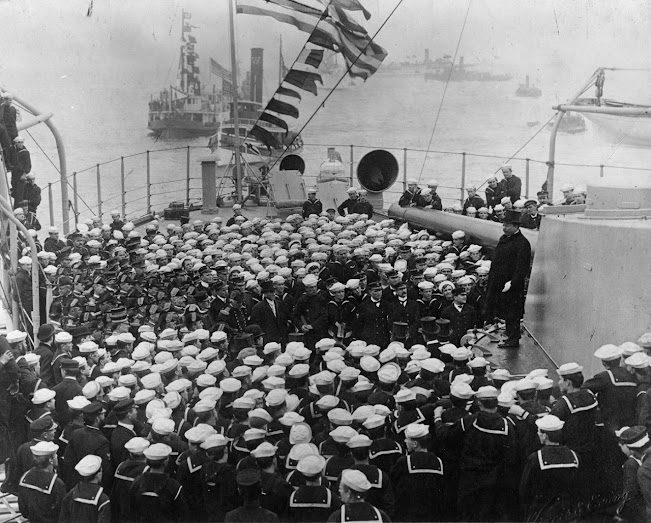
President Theodore Roosevelt addresses sailors on the after deck aboard USS Connecticut (Battleship #18), in Hampton Roads, Virginia, Feb. 22, 1909. (NHHC)

But was the GWF actually a deterrent? TR may not have fully appreciated the nationalism memes running through Japanese society after the IJN’s victories in the Sino-Japanese War, 1894-95, and Russo-Japanese War, 1904-05, which “forged the IJN’s access-denial strategy.” TR believed the circumnavigating voyage would foster peace. “The truth is murkier,” Holmes says. In the end, the GWF “message” may have piqued Japan’s pride and hubris –– an incentive for militaristic Japan to build the IJN even stronger, leading to an inevitable clash over Hawaii and the Pacific during FDR’s presidency.

Holmes’s conclusions –– and the legacy of both TR and FDR –– are relevant when thinking about innovative infrastructure initiatives in the United States in 2021.

“Few institutions are are exempt from bureaucratic dynamics –– or stasis. Dynamists typically fare better in armed competition than services set in their ways. Perhaps the way to remain supple and innovative is for top leaders to inscribe one indelible precept on the institutional culture, setting it above all others: No Precept Is Forever. That is one meme worth making permanent. The Imperial Japanese Navy offers an example to avoid –– or to exploit if some future foe appears likewise prone to fixed ideas.”

Reading “Forging the Trident” is like sitting alone with gifted historians and informed communicators telling you about how a great president served as a key architect of the modern Navy at the beginning of the last century. Editors Hattendorf and Leeman have succeeded in designing an indispensable edition –– and addition –– to the Roosevelt bookshelf. No precept is forever, but some concepts can last and improve over time.


OYSTER BAY, New York (Oct. 26, 2018) Cmdr. Julie Schmidt (right), the commanding officer of Navy Operational Support Center Long Island, and Cmdr. Christopher Kendrick, the executive officer of Navy Recruiting District New York, saluting a presidential wreath after placing it beside the grave of President Theodore Roosevelt in Youngs Memorial Cemetery. Students from nearby Theodore Roosevelt Elementary School were on hand to place flowers and play "Taps" to commemorate his birthday. (U.S. Navy photo by Bruce Howard/Released)

Monday, March 29, 2021

‘Gutsy’ Women Knocking on the Door

Review by Bill Doughty

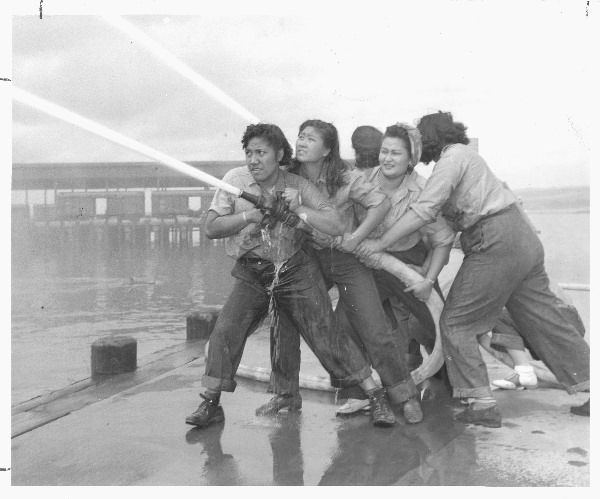
In an iconic photo, four Asian American Pacific Islander women at the Pearl Harbor Naval Shipyard train in firefighting. Long mislabeled as taken during the attack of Dec. 7, 1941, the photo in fact portrays some of  the strong women who applied to support the Navy’s war efforts in the wake of that attack. From left to right: Elizabeth Moku, Alice Cho, Katherine Lowe, and Hilda Van Gieson.


Over time, history usually has a way of sorting out fact from fiction.


Rear Adm.Grace Hopper, "Mother of Computing"
The facts and highlights of strong women of grit and grace are spotlighted in a book recommended for Women’s History Month. Profiles of more than 100 women come to life in “The Book of Gutsy Women” by Hillary Rodham Clinton and Chelsea Clinton (Simon & Schuster, 2019).

Among the women profiled are some we featured in Navy Reads posts: Rear Adm. Grace Hopper, Ada Lovelace, Rachel Carson, Marjory Stoneman Douglas, Margaret Chase Smith, Malala Yousafzai, and Maya Angelou. This book includes mini-biographies of both famous (Clara Barton, Helen Keller, Ida B. Wells, Maya Lin, Gabby Giffords, Greta Thunberg, and Venus and Serena Williams) as well as less-well-known women (Rigoberta Menchu Tum, Dr. Gao Yaojie, Nelba Marquez-Greene, Wangari Maathai, and Jineth Bedoya Lima).


Chelsea and Hillary Clinton, 2011
Hillary and Chelsea each provide essays about their subjects. They also offer personal perspectives about the women who have inspired and enlightened them – women who have made a difference in the world. The book is organized in sections: early inspirations, education pioneers, earth defenders, explorers and inventors, healers, athletes, advocates and activists, storytellers, elected leaders, groundbreakers, and women’s rights champions.

Chelsea writes, “I learned of Grace (Hopper) in 1996, when the navy named a new ship the USS Hopper (DDG 70) in her honor … I learned even more about her when I spoke many years later at the Grace Hopper celebration, the largest gathering of women technologists in the world.”


Former First Lady, senator, and Secretary of State Hillary Clinton reflects about the suffragists who knocked on the door, marched in the street, and fought for women to be able to vote in the United States one hundred years ago. That right was guaranteed with the passing of the Nineteenth Amendment to the U.S. Constitution, but it was a right that took decades to apply to women of color:

“Reading the words of the Nineteenth Amendment today, it’s hard not to wonder why it took so long” ‘The right of citizens of the United States to vote shall not be denied or abridged by the United States or by any State on account of sex. Congress shall have the power to enforce this article by appropriate legislation.’ But, of course, it was a long struggle because it was about so much more than the right of women to vote. It was about race, class, and deeply held cultural and religious views about women’s subordinate roles to men in society. It was about men’s –– and some women’s –– insecurities and fears of the unknown. These challenges are still present today.

The franchise –– the basic right of citizenship –– is still being fought over between those of us who believe every citizen should be able to vote and have that vote counted, and those who want to restrict the vote by erecting barriers against people, largely still based on race.”

Celia Ou, a graduate student at Scripps Institution of Oceanography, monitors computer screens displaying detailed sonar imaging of the ocean floor aboard the Auxiliary General Oceanographic Research (AGOR) vessel R/V Sally Ride, Dec. 15, 2016. (John F. Williams)


Nearly all the Gutsy women featured in this book faced and overcame some kind of obstacles of discrimination. Chelsea Clinton says this about space pioneer astronaut Sally Ride, the first American woman in space (in 1983) and a champion of STEM education for young people worldwide:

“Even after her death in 2012, Sally Ride kept breaking barriers. She came out as a lesbian quietly, without fanfare … Not long after her death, Tam [O’Shaughnessy, her partner of 27 years] received a call that surprised her, from Ray Mabus, then secretary of the navy. The navy hoped to honor Sally by naming a research vessel after her. Secretary Mabus was calling to ask whether Tam would be the ship’s sponsor – a role that had, up until that point, been filled by the wife of the man for whom the ship was named. ‘I think it is fitting the the celebration of Sally’s legacy as a pioneering space explorer and a role model includes an acknowledgment of who she really was and what she cared about,’ said Tam. The R/V Sally Ride, commissioned in 2016, is the first navy research ship named for a woman. Her legacy lives on in the scientific curiosity sparked in the girls and boys she continues to inspire, the ship that bears her name, and a spot on the moon named after her by NASA.”

Military readers may find fascinating nuggets of history in the essays about Sylvia Earle, Mary McLeod Bethune, Florence Nightingale, Eleanor Roosevelt, and Mary Edwards Walker. Chelsea writes this about Walker:

“…Dr. Mary Edwards Walker, the only woman in her medical school class at Syracuse Medical College in 1855. She was a practicing physician when the Civil War broke out. She desperately wanted to enlist in the Union Army as a surgeon but wasn’t allowed to because she was a woman. Initially she was called a nurse, since women generally weren’t considered doctors. Because women were not allowed to enlist, Mary had to volunteer, working for free at a temporary hospital, first in Washington and then in Virginia, where she traveled to Union field hospitals across the commonwealth … When her medical credentials were finally accepted she moved to Tennessee and became a War Department surgeon – a paid position that was the equivalent of a lieutenant in status.”


Dr. Sylvia Earle became chief scientist at the National Oceanic and Atmospheric Administration in 1990. She pioneered research in preserving 
and protecting the ocean, including the study of damage to coral reefs. Her inspiring TED talk, above, is a call to action. Hillary writes:

“When I think of Sylvia’s work, I am reminded how important it is for all of us to peruse and consider what we want to leave to the generations who come after us –– how they’ll honor the past, imagine the future, and give gifts to those who will live out their lives long after we’re gone. That’s exactly what Sylvia’s life as a scientist, an engineer, a teacher, and an explorer should inspire all of us to do: we must preserve our oceans for the future.”

Last year, this book generated controversy because of the women who were not included. For example, there is an unfortunate dearth of women who have served in or with the military. Surely, the authors could have included a “protectors” section filled with inspiring women who served in uniform.


Despite the intriguing photo on the cover, there is little focus on the women who served on the Homefront during the Second World War. In fact, there’s no explanation of the colorized photo of the women firefighters at the Pearl Harbor Naval Shipyard.

Yet, considering the general lack of attention toward the achievements of women in American and world history for many generations, it is refreshing to see a book of this scope. Women continue to knock on the door, push through the glass ceiling, and demand equality.


“The Book of Gutsy Women” illustrates the strengths of women throughout history, often in the face of sexism, misogyny, harassment, and patriarchy. It highlights the facts of women’s history and showcases women’s contributions to creating a better world now and in the future.